
The US 39 Trillion Debt Trap: AI Hype Masks the Real Danger – Why the US Debt Mountain Threatens the Global Financial System
Xpert Pre-Release

Available in 27 languages 📢
Prefer Xpert.Digital on GoogleⓘPublished on: July 5, 2026 / Updated on: July 5, 2026 – Author: Konrad Wolfenstein

The US 39 trillion debt trap: AI hype masks the real danger – Why the US debt mountain threatens the global financial system – Image: Xpert.Digital
China is withdrawing billions: Who else is buying US debt – and when will things come to a head?
Trump's debt accelerator: The dangerous game with the global bond market
The trillion-dollar wave is rolling in: How America's debt addiction is driving up global interest rates
While global stock markets race from one tech rally to the next and artificial intelligence dominates the headlines, a storm is brewing in the background that could shake the entire global financial system. US national debt is exploding at an unprecedented pace, inexorably approaching the $40 trillion mark. But the real problem isn't just the astronomical sum. It's a fatal combination of escalating interest payments and an unprecedented wave of refinancing that is putting massive pressure on the US Treasury market—the very foundation of the global economy. At the same time, historically large buyers like China and Japan are gradually withdrawing, and geopolitical rifts are accelerating the shift away from the US dollar. What happens when the world stops blindly funding America's debt? This analysis sheds light on the structural debt trap of the world's largest economy and shows why the next major crisis could originate not on the stock market, but in the bond market – with far-reaching consequences for investors, interest rates and global prosperity.
The speed at which American national debt has grown is unprecedented in history. Since the beginning of the Trump presidency in 2017, the gross US debt has effectively doubled—from $19.9 trillion in January 2017 to over $39 trillion now.
The trillion-dollar wave is rolling in: When silence becomes the most dangerous threat
America is buying its way to ruin — and the rest of the world is watching as long as it can
The greatest danger to financial markets often arises where few investors look. While Wall Street is carried by artificial intelligence euphoria and technology stocks are hitting new all-time highs, a structural risk is growing in the background, one whose magnitude overshadows everything that has shaken financial markets in recent decades. The US Treasury market—the nervous system of the global financial system—is coming under increasing pressure, and the cause is not a sudden crisis, not an exogenous shock, but the result of years of fiscal overconfidence by the world's largest economy.
The real problem lies not in a short-term disruption, but in a process that has been building up for years and is now gaining momentum. The United States finds itself in a situation where exploding budget deficits, astronomical refinancing needs, and a foreseeable demand problem for government bonds converge—and this triad could fundamentally shake the foundations of the global financial system. Anyone who thinks this is an exaggeration should look at the raw numbers. As of early June 2026, total US national debt stands at $39.20 trillion, of which $31.60 trillion is held by the public—that is debt that actually needs to be financed on the capital markets. In a single year, total debt has increased by another $2.99 trillion, which equates to a daily increase of more than $8 billion.
The growth of debt and its new dimension
The speed at which American national debt has grown is unprecedented in history. Since the beginning of the Trump presidency in 2017, the gross US debt has effectively doubled—from $19.9 trillion in January 2017 to over $39 trillion today. What is particularly alarming is not just the absolute amount, but the pace of accumulation. Every new trillion dollars of debt is being accumulated in an ever-shorter period: Between October 2020 and March 2026, more than $1 trillion in new debt was piled up in just five months, with the government having to borrow $308 billion in February 2026 alone.
The Congressional Budget Office (CBO) projects a federal deficit of $1.9 trillion for fiscal year 2026, equivalent to 5.8 percent of gross domestic product. Even more alarming is the outlook: By 2036, the deficit is projected to climb to $3.1 trillion, and public debt would then reach 120 percent of GDP—a level last seen immediately after World War II. In its extended 30-year projection, the CBO estimates that the debt-to-GDP ratio could rise to 175 percent. Some independent economists, who also consider implicit liabilities from social security programs, put the actual US budget shortfall at as much as $100 trillion.
A particularly critical question is how long the markets will tolerate the current pace of debt accumulation. Economists and fiscal policymakers are unusually unanimous in their view that the current fiscal path is unsustainable. The Penn Wharton Budget Model has calculated that, without significant policy changes, the US could find itself in a situation within about 20 years where US Treasury bonds could no longer be refinanced at market rates—forcing either an explicit default on interest payments or implicit devaluation through inflation.
Interest payments as a growing threat to the state budget
As the debt burden grows, the burden of interest payments is rising to a level that alarms even seasoned fiscal policymakers. Net interest payments on the national debt surpassed one trillion dollars for the first time in U.S. history in fiscal year 2026—a sum not only higher than the Department of Defense's expenditures but also nearly three times the interest payments in 2020, when pandemic financing began. In the first three months of fiscal year 2026 alone, $346 billion flowed into interest payments, representing 14 percent of total federal spending during that period.
The CBO expects net interest payments to rise to nearly $1.8 trillion annually by 2035. Based on current JEC projections, interest expenses will reach 13.95 percent of total federal spending in fiscal year 2026, rising to 14.25 percent in 2027 and further increasing to 14.94 percent in 2028. This means that almost one in seven dollars of federal spending is already being spent not on infrastructure, health, education, or defense, but simply on servicing past debt—a share that is growing year by year.
Comparing this trend with other major economies makes the structural problem even clearer. Germany, France, and Japan may also have substantial levels of public debt, but none of these countries faces such a rapidly escalating interest burden resulting from the combination of high debt levels and increased market interest rates. This compound interest effect at the government level—higher debt generating higher interest payments, which in turn necessitate new debt—is the very core of the dynamic many analysts refer to as the structural debt trap.
The refinancing wave — a sword of Damocles hanging over the markets
In addition to the ongoing deficit, the US faces another, previously underestimated challenge: a massive refinancing wave of maturing government bonds. Around 33 percent of all publicly held, marketable US debt will mature within the next twelve months and must be reissued at prevailing market interest rates. The Government Accountability Office has confirmed that in fiscal year 2026 alone, securities worth $9.7 trillion will require refinancing—added to the ongoing deficits, meaning that the total issuance volume this year could exceed $11 trillion. This is a volume that no modern bond market has ever absorbed on this scale.
At the same time, recent documents from the U.S. Treasury Department and the Treasury Borrowing Advisory Committee (TBAC) show that the government will need an additional $1.3 trillion in net borrowing on the capital markets for the period 2027-2028, beyond the currently planned issuance volumes—a gap that the TBAC explicitly highlighted as a financing challenge for the coming years at its last meeting in May 2026. The average interest rate on all marketable government debt is currently 3.386 percent, compared to just 1.485 percent five years ago. This means that bonds issued at one or two percent during the period of zero interest rates are now being refinanced at four to five percent—a dramatic increase in the interest burden per bond issued.
This wave of refinancing is largely the result of a deliberate short-term issuance strategy pursued in recent years. When interest rates were low, the Treasury Department issued a disproportionately large number of short-term bonds to take advantage of low short-term interest rates. Now this strategy is backfiring: The average remaining maturity of US government debt is now only 70 months—less than six years—and has thus fallen to a historically low level. The shorter the maturities, the more frequently bonds need to be refinanced, and the more directly interest rate fluctuations impact the budget.
Who is still buying — and why this question is becoming increasingly urgent
The explosive growth in the supply of US Treasury bonds brings to the fore a central question that long seemed self-evident: Who is actually buying these Treasury bonds? For decades, three major buyer groups formed the reliable foundation of the market: foreign central banks and sovereign wealth funds, the Federal Reserve, and domestic institutions such as pension funds, insurance companies, and commercial banks. All three pillars are now showing cracks.
China, once the largest foreign creditor of the United States, has reduced its holdings of US Treasury securities by almost half since their peak of $1.32 trillion in November 2013. In October 2025, Chinese holdings fell to $688.7 billion—the lowest level in 17 years. In 2022, Beijing reduced its holdings by $173.2 billion, in 2023 by $50.8 billion, and in 2024 by another $57.3 billion. In July 2025, China withdrew its holdings by $35.8 billion, the largest reduction in nearly two years. Strategic considerations underlie this development: diversifying its currency reserves, increasing its gold accumulation, and reducing its dependence on an asset caught in the crossfire of geopolitical conflict with Washington.
Japan, currently the largest foreign holder of US Treasury securities with holdings of roughly $1.1 to $1.4 trillion, is no longer a stable entity. The persistent weakness of the yen repeatedly forces Tokyo to intervene in the foreign exchange market, typically financed by selling US Treasury securities. Between April 28 and May 27, 2026, alone, Japan intervened with 11.73 trillion yen (approximately $73.4 billion), resulting in a historic decline of $75.6 billion in Japan's foreign exchange reserves. At the same time, Japanese authorities emphasize that further interventions will be structured in such a way as not to drive up US yields—a goal that is hardly compatible with the actual forced sale of Treasuries.
When foreign central banks cease to be reliable buyers, the pressure on domestic buyers and the Federal Reserve increases. The Fed officially ended its quantitative tightening (QT) program in December 2025—at a time when its balance sheet had stabilized at around $6.2 trillion. While the Fed is no longer an active seller in the market, it is also no longer an additional buyer. The market must absorb the growing supply on its own.
Auction signals: What the bid-to-cover ratio reveals
The most reliable and least manipulable real-time information about the state of the bond market comes from auction activity on the primary market. There, the bid-to-cover ratio is calculated for every issuance of US Treasury bonds—the ratio of all bids received to the actual number issued. A value of 2.0 or higher is considered a sign of sufficiently strong demand. Current auction data paints a nuanced, but generally worrying, picture.
At the most recent auction of 10-year US Treasuries in July 2026, the bid-to-cover ratio was just 2.35—the lowest level since August 2024. The so-called primary dealers, the large Wall Street banks that must act as the final buyers in Treasury auctions, acquired 16.2 percent of the total issue volume—the highest share in a year. A high primary dealer takeover is a warning sign: it indicates that too few other investors were willing to buy the securities at market prices, and that the banks had to add these bonds to their own portfolios first. The historical average bid-to-cover ratio for 10-year Treasuries was 2.54; currently, it ranges between 2.35 and 2.40, depending on the auction, and is thus consistently below the long-term average.
However, it would be wrong to paint an entirely pessimistic picture. In April 2025, an auction of 10-year government bonds still saw very strong demand, with a bid-to-cover ratio of 2.67 and a record 71.9 percent participation from indirect bidders. The market thus fluctuates between periods of solid and occasionally disappointing demand. Regarding the structural trend, the picture is clearer: the share of foreign buyers (so-called indirect bidders, which include foreign central banks) is declining slightly on average, while the share of domestic institutional buyers and primary dealers is tending to increase—a pattern that suggests a gradual erosion of the global demand base.
The interest rate dilemma and the vicious cycle of national debt
Behind the seemingly technical events in the bond market lies a fundamental economic dilemma that is increasingly restricting the political options available to the United States. If demand for new US Treasury bonds does not keep pace with the growing supply, yields must rise to attract new investors. However, rising yields mean falling prices for existing bonds—a loss that all holders of Treasury bonds, from pension funds to insurance companies, feel directly on their balance sheets.
The yield on the 10-year US Treasury bond—the most important benchmark in the global capital market—has remained noticeably volatile so far in 2026, hovering around 4.4 to 4.5 percent. The 30-year bond was last at 4.84 percent. Compared to the low of under 4 percent at the end of 2024, this is a significant increase that directly impacts the cost of all interest-bearing financing in the American economy. Higher interest rates mean more expensive mortgages, more expensive corporate loans, higher financing costs for small and medium-sized enterprises (SMEs), and lower valuations for stocks with high price-to-earnings ratios.
The structurally dangerous aspect of this is the self-reinforcing nature of this spiral. Higher interest rates make refinancing existing US debt more expensive. This further increases the deficit because interest payments rise. A larger deficit necessitates more new government bond issuances. More government bonds on the market increase supply and—without a corresponding increase in demand—dampen the price of these securities, which in turn drives yields up. The cycle completes and intensifies. This mechanism is described in economic literature as "fiscal dominance": the state in which the need to finance government spending effectively dominates monetary policy and increasingly restricts the central bank's room for maneuver.
Our US expertise in business development, sales and marketing

Our US expertise in business development, sales and marketing - Image: Xpert.Digital
Industry focus areas: B2B, digitalization (from AI to XR), mechanical engineering, logistics, renewable energies and industry
More information here:
A thematic hub offering insights and expertise:
- Knowledge platform covering global and regional economies, innovation and industry-specific trends
- A collection of analyses, insights, and background information from our key areas of focus
- A place for expertise and information on current developments in business and technology
- A hub for companies seeking information on markets, digitalization, and industry innovations
When US Treasury bonds collapse: How the global economy falters
The US Treasury bond as a global benchmark — and what its failure would mean
The real explosive potential of US debt dynamics lies not solely in US fiscal policy. It lies in the systemic role that US Treasury bonds play in the global financial system. The yield on the 10-year US Treasury bond serves as a benchmark interest rate for a virtually uncountable number of financial contracts worldwide. Mortgage rates, corporate bonds, derivatives, valuation models for stocks and real estate—almost every financing decision in the modern global economy is either directly or indirectly linked to the performance of this benchmark.
A sustained rise in this yield therefore not only increases the cost of US government debt but also sets in motion a global spiral of rising costs. Companies worldwide that issue US dollar-denominated bonds see their refinancing costs increase. Emerging markets, already suffering from a strong US dollar and high dollar debt, come under additional pressure. Pension funds and insurance companies that hold historically large holdings of US Treasury bonds as a safe haven suffer book losses. The International Monetary Fund and the World Bank have explicitly pointed to these spillover risks in their recent fiscal outlooks.
It is particularly significant that there is still no real alternative to US Treasury bonds as a global safe haven. The euro, the yen, and the British pound may play a role in certain portfolio contexts—but the sheer size and liquidity of the US Treasury market is unmatched. The US dollar still accounts for almost 60 percent of global currency reserves, while the euro represents only around 20 percent. An end to the dollar's dominance is not foreseeable in the short term, simply because credible alternatives are lacking—but this very fact should not be interpreted as a sign of complacency. It merely means that a loss of confidence in US Treasury bonds would hit global financial markets proportionally harder because there are no alternative options.
Geopolitics as a fiscal risk — China, BRICS and the creeping dedollarization
In addition to purely economic mechanisms, a geopolitical factor is gaining increasing importance: the strategic decision by a growing number of countries to reduce their dependence on the US dollar and US Treasury bonds. This process, known as dedollarization, is not a market reaction to fluctuations in yield, but a politically motivated reallocation of currency reserves—and it is proceeding slowly but steadily.
China is the most well-known, but by no means the only, player in this trend. Brazil, Russia, India, and a number of medium-sized economies have massively increased their gold reserves in recent years and reduced the proportion of US Treasuries in their foreign exchange reserves. Following the 2022 freeze of its foreign exchange reserves in the wake of the Ukraine war, Russia virtually eliminated its US Treasury holdings—a decision that has served as a blueprint for other countries with strained relations with Washington. The freezing of Russian reserves was a warning sign for many central banks worldwide: dollar-denominated reserves are potentially vulnerable to Western sanctions in geopolitical conflicts. This realization has significantly accelerated efforts to diversify beyond Western financial institutions.
At the same time, the US trade conflict—particularly the Trump administration's drastic tariffs of up to 145 percent on Chinese imports—is increasing the pressure on Beijing to use economic levers that could harm the US. An accelerated reduction of US Treasuries would be the most effective financial instrument China could employ in this context. The fact that Beijing has so far used this instrument only sparingly is not due to a lack of willingness, but rather to the fact that too abrupt a sell-off would weaken its own reserve assets. However, the direction is clear: Geopolitical pressure is accelerating a shift in demand that will continue in the same direction for years to come.
The fiscal policy of the Trump era — debt accelerator instead of budget consolidator
The Trump administration's political agenda bears particular responsibility for the current fiscal imbalance. The budget legislation known as "One Big Beautiful Bill," passed in 2025, extends and expands the tax cuts of the first Trump term and adds new spending programs, according to estimates by the NBER and CBO. As a result, the cumulative debt burden is expected to increase by an additional 29 percentage points of GDP by 2054 compared to previous projections. If the temporary provisions are made permanent, the debt-to-GDP ratio is projected to reach 199 percent in 2054.
At the same time, the Treasury Department is recording higher customs revenues—in the first half of fiscal year 2026, customs revenues rose by 272 percent, or $128 billion, compared to the previous year. However, these revenues can only marginally alleviate the structural deficit problem. Expenditures also increased massively during the same period: healthcare spending alone (Medicare and Medicaid) rose by 7 percent, or $59 billion. The debt trend continues, despite partial revenue increases. Meanwhile, the goal set by Treasury Secretary Scott Bessent to reduce the deficit to 3 percent of GDP remains a political pipe dream without sufficient fiscal foundation, given a CBO forecast of 5.8 percent for fiscal year 2026.
Structural change in the capital market — when demand needs to adjust
The dwindling demand from foreign central banks and the increasing flood of new Treasury issuance must be compensated for. The market is finding ways to do so—but at a price. Domestic buyers, namely pension funds, insurance companies, money market funds, and commercial banks, have significantly increased their holdings of US Treasury bonds in recent years. Added to this are structural changes to the regulatory framework for banks: The recently amended rules on the Enhanced Supplementary Leverage Ratio (eSLR) give banks more leeway to include US Treasury bonds on their balance sheets without jeopardizing core capital requirements—a deliberate policy decision intended to support the Treasury bond market.
At the same time, the transition to a central clearing system for US Treasury bonds is progressing, with deadlines by the end of 2026 or mid-2027. This system is intended to improve market liquidity and stability in the long term by reducing counterparty risk. Such structural adjustments are sensible, but they do not solve the fundamental problem of an overwhelming volume of issuance. They merely smooth out the absorption mechanisms—as long as overall investor confidence is maintained.
Market observers are therefore paying particularly close attention to the relationship between institutional domestic buyers and foreign investors. As long as capital from around the world continues to flow readily into US Treasuries, the system remains stable. Global crises—such as the Covid pandemic or the war in Ukraine—have shown in the past that US Treasuries act as a global safe haven in such moments and, paradoxically, even attract inflows, despite the fact that the US itself was fiscally responsible for some of these crises. This refuge privilege, however, is not inexhaustible.
When America coughs — how US interest rates are infecting the world
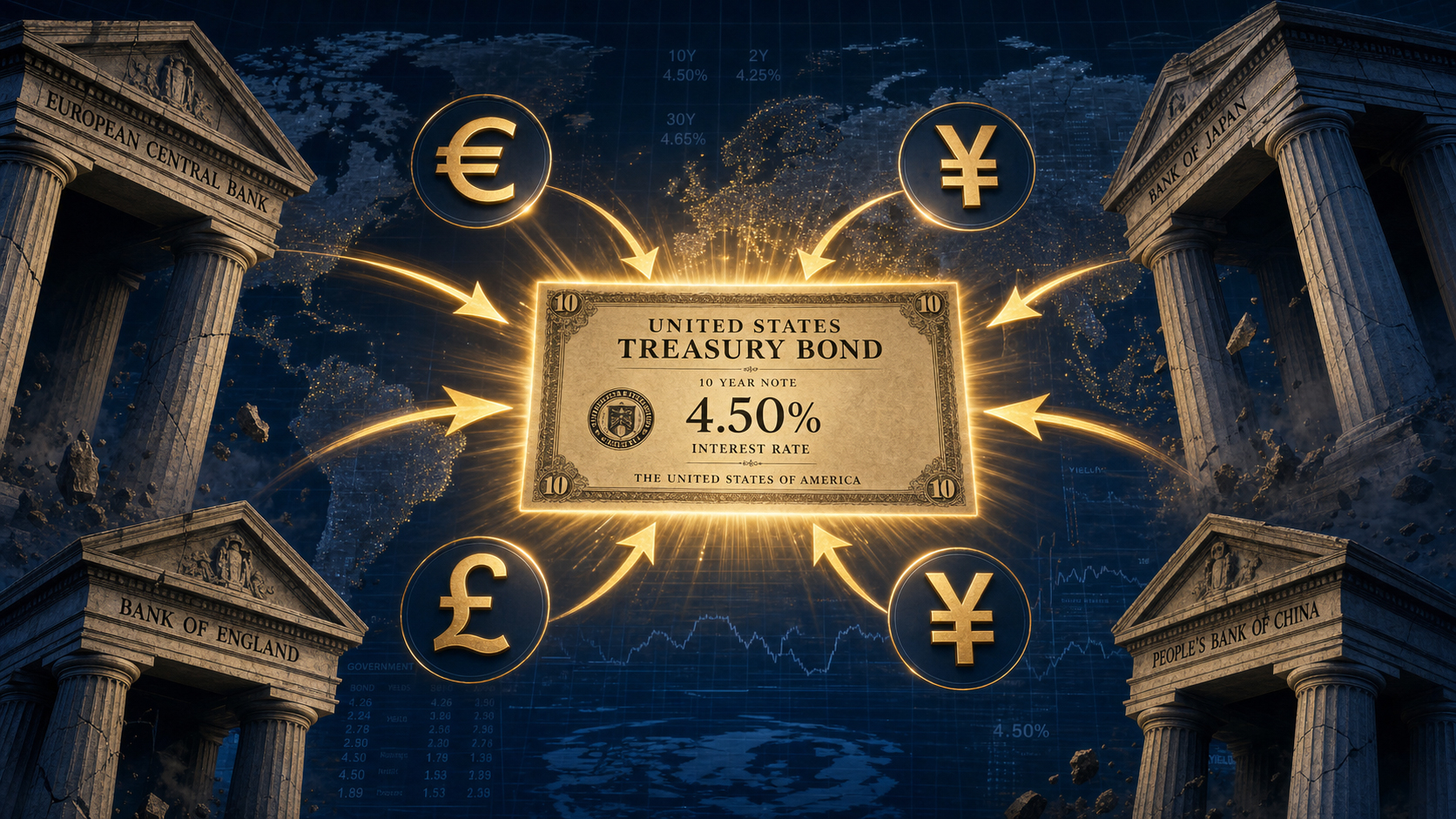
The speed at which American national debt has grown is unprecedented in history. Since the beginning of the Trump presidency in 2017, the gross US debt has effectively doubled—from $19.9 trillion in January 2017 to over $39 trillion now – Image: Xpert.Digital
The immense national debt of the USA is no longer solely an American budgetary problem, but a major driver of the global rise in interest rates. Since US Treasury bonds are considered a global benchmark for safe investments, interest rate developments there inevitably force other countries to adjust their own monetary policies—a transmission channel that, in times of globalized capital markets, operates faster and more relentlessly than ever before.
The underlying mechanism is as simple as it is consequential: The US must continuously issue new government bonds to refinance its growing mountain of debt, which now stands at almost $40 trillion. To attract sufficient investors for this gigantic issuance volume, yields of sometimes well over four percent must be offered. These comparatively attractive US interest rates act like a gravitational pull for global capital: Investors from Europe, Asia, and emerging markets withdraw funds and redirect them to the dollar zone. This puts other central banks under pressure, as remaining passive would result in capital outflows and currency devaluations.
This mechanism is historically proven and particularly pronounced in the current cycle. The European Central Bank has had to recalibrate its interest rate policy several times, partly because US interest rates put downward pressure on the euro. Japan already deployed 11.73 trillion yen in foreign exchange market interventions in 2026, largely triggered by the interest rate advantage of the US dollar over the yen. Emerging markets, whose government debt is denominated in US dollars, see their debt burden increase in real terms if the dollar remains strong and US interest rates remain high.
Historically, such rampant debt cycles rarely end in harsh sovereign defaults rather than in gradual devaluation through high inflation. Governments that can no longer offset fiscal pressure through austerity measures or growth have, in the past, resorted to printing money—with the result that creditors are effectively expropriated without a formal declaration of default. Current discussions surrounding the Trump administration regarding potential debt restructuring plans—also known as the "Mar-a-Lago Accord"—are causing additional uncertainty in the financial markets and prompting creditors to reassess the confidence premium for US Treasury bonds.
The growing global debt trap is putting international central banks like the Fed and the ECB under pressure to act, both from within and without. The following comparison shows the direct fiscal policy effects in the US and their global consequences:
| Fiscal policy aspect | Developments in the USA | Global impact |
|---|---|---|
| Government bonds | Yields are sometimes rising significantly above 4% to refinance the enormous debt burden | Existing government bonds worldwide are losing massive market value due to rising global interest rates |
| Monetary policy | The US dollar is under structural pressure due to protectionist economic policies and budget deficits | International central banks must keep their own interest rates high to stop capital outflows into the dollar zone |
| Default risk | Government circles are discussing debt restructuring scenarios at the expense of existing creditors | Growing risk of inflation worldwide, as large states have historically tended to reduce their debts through currency devaluation rather than formal default |
Scenarios for the future — between adjustment, inflation and domino loss
In light of the dynamics described, three main scenarios can be outlined for the medium-term future, illustrating the range of possible developments.
In the first and most optimistic scenario, gradual fiscal consolidation is achieved. Economic growth—fueled by productivity gains from AI and automation—increases tax revenues, while moderate spending discipline slowly reduces the deficit. Demand for US Treasuries remains sufficiently high, as private investors worldwide continue to invest in Treasuries given a lack of alternatives. Yields stabilize at a high but sustainable level. This scenario assumes that neither a political shock nor an external crisis disrupts the fragile balance.
In the second, more likely scenario, the debt machine continues to run at full speed, and the Fed will sooner or later be forced to once again act as a buyer of US Treasury bonds—a move known in financial jargon as "fiscal dominance," which effectively imports inflation. A return to quantitative easing to prop up the Treasury market would be a tightrope walk between debt stabilization and a loss of purchasing power in an already inflationary environment. Historically, countries that have taken this path—Japan being the most prominent example—have shown that escaping the debt spiral through central bank financing weakens the currency in the long run.
The third and most dangerous scenario involves a loss of confidence, triggered by an auction disaster, an unexpected political decision, or an external shockwave that abruptly alters global risk appetite. In this case, yields could rise sharply, financial markets worldwide could be destabilized, and credit lines for businesses and consumers could be drastically tightened. The probability of such a shock is difficult to quantify—it is not high, but it is not zero, and the fiscal buffers available in past crises are significantly smaller today.
The hidden risk as reflected in the bond markets
Bravos Research and a growing number of independent analysts are not warning of an imminent collapse. That would be an exaggeration and would underestimate the system's actual resilience. What they are describing is more subtle and therefore harder to communicate: a creeping erosion of structural stability, manifesting itself in small signals—weaker auction results, rising bid-to-cover variances, the gradual decline in the foreign demand base, the steadily increasing interest burden on the federal budget, and the mathematically almost unstoppable expansion of the debt volume.
The message here is not one of fatalism, but of structural awareness: Those who know the risks today and understand how the global bond market works, how to interpret auction data, and which geopolitical forces are pulling at the demand side are better positioned—as investors, as entrepreneurs, as political decision-makers. The bond market is not an abstract construct for financial professionals. It is the foundation upon which mortgage rates, corporate financing, government spending, and ultimately every citizen's savings rest. When this foundation comes under pressure, everyone feels it sooner or later.
The next major stress test for global financial markets might therefore not come from an overheated technology market, a banking crisis, or a recession. It could originate where the world's safest investment is issued—and is becoming increasingly less safe: the US Treasury market. Because the real problem isn't that America has debt. The real problem is that America can no longer stop incurring more—and that the world is slowly ceasing to believe in it without limits.
Your global marketing and business development partner
☑️ Our business language is English or German
☑️ NEW: Correspondence in your native language!

Konrad Wolfenstein
I and my team are happy to be available to you as your personal advisor.
You can contact me by filling out the contact form here [email protected]:or simply call me at +49 7348 4088 965. My email address is
I'm looking forward to our joint project.
☑️ SME support in strategy, consulting, planning and implementation
☑️ Creation or realignment of the digital strategy and digitization
☑️ Expansion and optimization of international sales processes
☑️ Global & Digital B2B trading platforms
☑️ Pioneer Business Development / Marketing / PR / Trade Fairs
🎯🎯🎯 Data-driven B2B industry hub as a quasi-in-house solution

The quasi-in-house solution: How Xpert.Digital closes operational gaps in B2B marketing and sales – Smart Content-Driven Business - Image: Xpert.Digital
Xpert.Digital is a data-driven B2B industry hub led by Konrad Wolfenstein . The company acts as an external, quasi-in-house solution for industrial partners, closing operational gaps in marketing, content, and sales – without requiring additional resources on the client side.
More information here:










