
A bottomless pit of billions: Why Europe's 2 trillion euro budget is flowing in completely the wrong direction
Xpert Pre-Release

Available in 27 languages 📢
Prefer Xpert.Digital on GoogleⓘPublished on: May 26, 2026 / Updated on: May 26, 2026 – Author: Konrad Wolfenstein
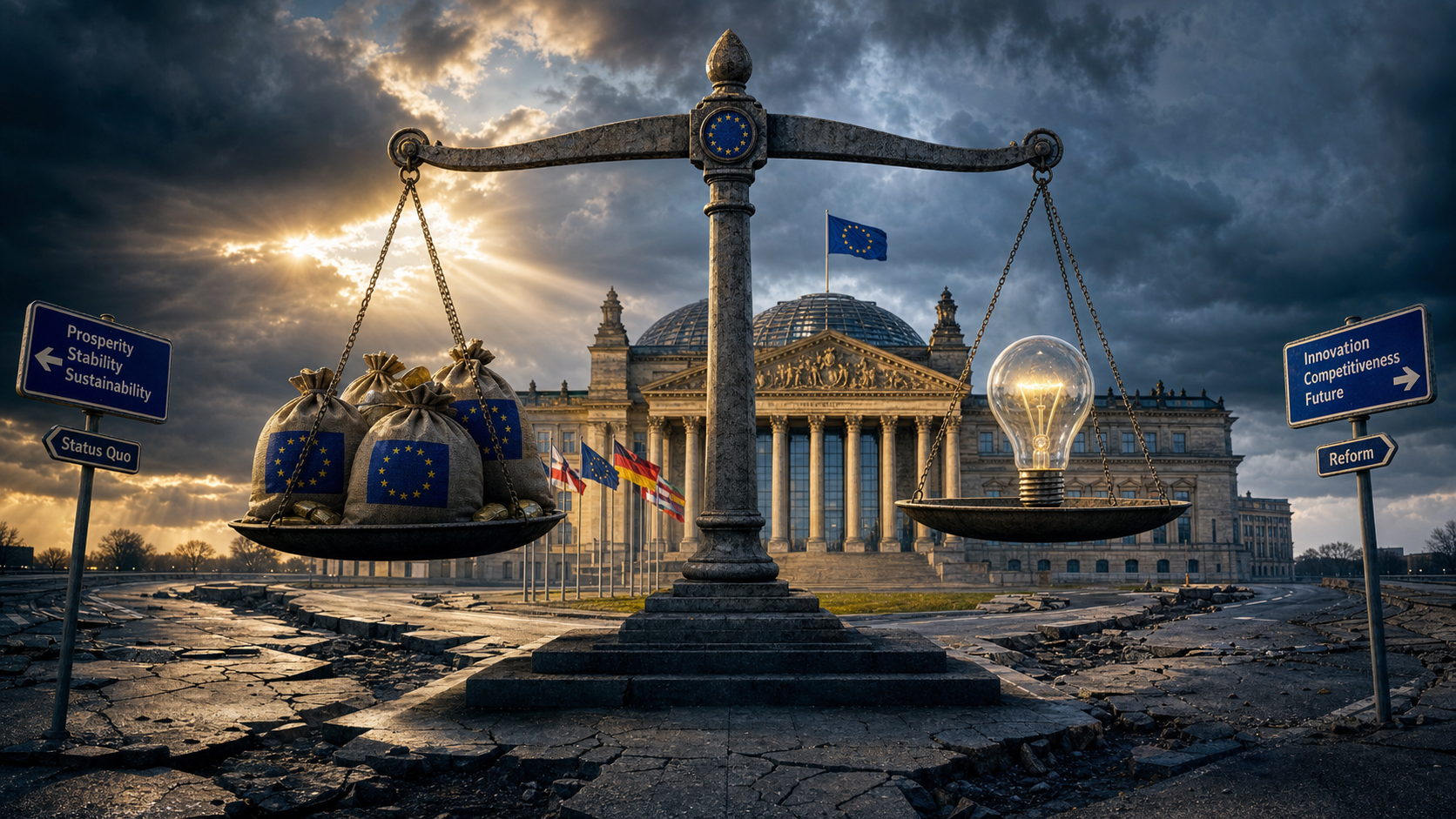
A bottomless pit of billions: Why Europe's 2 trillion euro budget is flowing in completely the wrong direction – Image: Xpert.Digital
Redistributing instead of generating wealth: How Europe is deindustrializing itself with its own record budget
Chancellor Merz settles accounts: The radical plan against Europe's centrally planned waste of money
Phantom buildings and pension gaps: The scandalous truth about the EU's billions in subsidies
The European Union is facing a historic turning point: an unprecedented record budget of around two trillion euros is to be put together for the years 2028 to 2034. But anyone who looks beyond these gigantic figures will recognize a fatal structural problem. Instead of investing the money in urgently needed future technologies, competitiveness, and defense, the lion's share threatens to once again disappear into outdated redistribution schemes and inefficient subsidy loopholes. While Europe is falling further and further behind in the global race with the USA and China due to exploding energy prices and creeping deindustrialization, national interest groups are fiercely defending their privileges. Leading politicians and economic experts such as Friedrich Merz and Mario Draghi are issuing urgent warnings against this flawed system. Recent scandals involving embezzled EU billions in Italy and Spain also demonstrate all too clearly that a system that distributes money according to central planning principles instead of promoting investment becomes an existential threat to the entire economic area. Is Europe facing the most expensive misunderstanding in its history?
A continent redistributes its wealth – and forgets how to generate it in the process
When Friedrich Merz delivered the keynote address on May 14, 2026, in the Coronation Hall of Aachen's City Hall, upon the awarding of the Charlemagne Prize to Mario Draghi, he chose a phrase that transcended the festive occasion and addressed the fundamental question of European economic policy: More than two-thirds of European funds still flow into redistribution and subsidies, and the budget is still determined almost entirely in a centrally planned manner seven years in advance. This is not the marginal comment of a Eurosceptic critic, but rather the sobering diagnosis of the German Chancellor on the occasion of one of the most symbolic honors of European integration. The significance of this statement lies not in its originality, but in the person who uttered it and in the moment it was made: immediately before the start of the crucial phase of negotiations on the EU's Multiannual Financial Framework (MFF) for the years 2028 to 2034.
The trillion-dollar budget and its structural limits
In July 2025, the European Commission proposed a budget framework of around two trillion euros for the period 2028 to 2034 – an increase of approximately 700 billion euros compared to the current budget. In absolute terms, this is a historic sum. However, a closer look at the figures quickly reveals that the crucial question is not how much money is being spent, but what it is being spent on. By far the largest single item in the Commission's proposal is a so-called National and Regional Partnerships Fund amounting to 865 billion euros – meaning almost half of the total budget flows into a pot primarily aimed at regional redistribution and cohesion policy compensation payments, not at productivity-enhancing investments.
The fundamental problem with EU budgetary policy is structural and extends far beyond the current round of negotiations. For decades, the two largest spending categories – agricultural policy and regional policy – have remained virtually unchanged in their basic structure. Both areas follow a distributional logic: those who farm land receive direct payments; those who live in poorer regions receive cohesion funds. The question of economic added value is systematically relegated to the background. Merz's diagnosis that the EU budget is organized almost like a centrally planned economy hits the nail on the head: funds are allocated seven years in advance according to political negotiation logic, instead of reacting flexibly to changing priorities and market conditions. From an economic perspective, this is a remarkable design flaw for an economic area that wants to compete globally.
As the strongest economic powerhouse in the EU, Germany typically contributes nearly a quarter of the EU budget. Based on the proposed two-trillion-euro budget, this would amount to approximately 500 billion euros over seven years, or more than 70 billion euros annually from German tax revenue. Against this backdrop, it is more than understandable that the question of the efficiency of this funding takes on a profoundly national and democratic dimension.
The innovation and productivity gap as the real threat
To understand why the debate surrounding the EU budget is so heated, one must consider the bigger picture. For years, the European economy has suffered from a structural productivity and innovation gap with the US and China, a gap that is increasingly becoming an existential challenge. In the field of artificial intelligence, for example, 70 percent of all AI models worldwide are currently developed in the US. Europe is struggling with fragmented markets, dependence on external cloud providers, and a persistent brain drain. Only a small fraction of European companies are currently using AI productively – a figure that falls far short of the EU's self-imposed targets for 2030.
Mario Draghi described this situation with unusual sharpness in his competitiveness report presented in September 2024. He estimated the EU's annual investment needs at 750 to 800 billion euros – for comparison, this is more than double the Marshall Plan aid after the Second World War, measured as a share of GDP at the time. Draghi identified three key areas for action: closing the innovation gap, decarbonization, and reducing security-related dependencies. The report contained 170 concrete reform proposals, a comprehensive industrial strategy, and an urgent appeal for Europe to stop investing and subsidizing in a fragmented way along national lines.
However, a year and more after the report's publication, the implementation record is sobering. According to the "Draghi Tracker" of the Joint European Disruptive Initiative (JEDI), the European Commission has not yet fully implemented a single idea from the report. A mere 15 percent of the proposals are in the process of being implemented, while 40 percent have made little progress and another 45 percent are not even being discussed. An analysis by the European Policy Innovation Council (EPIC) arrives at a somewhat more favorable figure – assessing around a third of the measures as at least partially implemented – but even this, given the urgency of the challenges described, hardly reflects decisiveness.
At the Charlemagne Prize ceremony in Aachen, Draghi himself emphasized that, according to a recent survey, three-quarters of Europeans wanted more resources for the EU to meet the challenges ahead. He urged EU leaders to be bold and criticized the fragmented national investment behavior that systematically weakens Europe vis-à-vis China and the US. His analysis of the situation was particularly pointed: For the first time in living memory, Europe is truly alone together – and must develop a global strategy from this position.
Energy prices, deindustrialization and the relocation of value creation
In addition to the structural productivity deficit, there is an acute competitive problem that has worsened dramatically in recent years: exploding energy prices and their consequences for Europe's industrial base. European companies still pay almost three times as much for industrial electricity as their US competitors. While US companies pay around 7 cents per kilowatt-hour, prices for many medium-sized and large European consumers are over 20 cents.
The consequences of this cost gap are already measurable. A survey by the German Association of Chambers of Industry and Commerce (DIHK) shows that two-thirds of industrial companies consider high energy and raw material prices to be the greatest threat, and 40 percent are considering reducing their production in Germany or relocating it abroad. In Austria, according to a Deloitte study, every second company is considering a partial relocation of production. Even Pierre Wunsch, Governor of the National Bank of Belgium, publicly warned that energy-intensive industries in Europe are dying under the current political conditions.
What is happening here is a creeping deindustrialization, not triggered by acute crises, but by structurally superior locational conditions in other parts of the world. The USA attracts businesses with abundant natural gas reserves, low energy costs, and massive subsidy programs through the Inflation Reduction Act. China combines state-run industrial policy with low production costs and already dominates entire value chains, from solar modules to electric vehicles. Europe, on the other hand, simultaneously bears the burden of ambitious climate targets, fragmented energy markets, and a lack of a common industrial strategy. That, precisely in this situation, more than two-thirds of the EU budget is being spent on redistribution instead of targeted location policy is difficult to justify economically.
The billion-dollar boondoggle: When subsidies do more harm than good
The debate about the efficiency of European spending is supported by several concrete case studies that have recently come to light and shake confidence in the purpose of large-scale subsidy policies.
The most striking example is the Italian Superbonus. At the beginning of the COVID-19 pandemic, the Conte government at the time introduced a 110 percent tax break for energy-efficient building renovations. The idea sounded enticing: Homeowners who upgraded their properties could deduct more than the actual costs, effectively making renovations free. The program triggered a renovation boom – but at a price now considered one of the most expensive subsidy fiascos in recent European history. Instead of the originally planned 35 billion euros, the actual costs amounted to 119 billion euros – equivalent to around five percent of Italy's total economic output. Italian investigators estimate the fraud triggered by the program alone at at least 16 billion euros. Criminal networks used fictitious invoices and phantom buildings to siphon off subsidies; in 2021, an average of 64 new construction companies were founded every day, most of them solely for the purpose of claiming the Superbonus. As a result, Italy's budget deficit rose to over seven percent of gross domestic product in 2023 – a direct result of uncontrolled subsidy policies.
Even more explosive is the recently uncovered misappropriation of EU coronavirus funds in Spain. According to reports in the Spanish daily newspaper El Mundo and the German newspaper Bild, the Sánchez government misused more than ten billion euros from the EU's NextGenerationEU recovery fund. Around 2.4 billion euros were reportedly diverted to the civil servants' pension fund and the budget for the Spanish minimum income, while a further 8.5 billion euros are said to have flowed into the social welfare system. Madrid has since confirmed parts of these transfers. Andreas Schwab (CDU/EPP), chairman of the European Parliament's Budget Committee, described the use of European funds to mask national budget problems as absolutely unacceptable.
The case of Spain is not an isolated failure, but rather symptomatic of structural control deficits. In early May 2026, the European Court of Auditors found that it lacked a complete overview of the whereabouts of the €577 billion already disbursed from the COVID-19 recovery fund. Thousands of recipients – companies, consortia, and individuals – were either unknown to the Court or not systematically recorded. One auditor clearly articulated the consequence: without this information, it was impossible to assess whether the funds were being distributed fairly, whether there were concentration risks, and whether EU funds were actually providing a benefit to citizens. The Commission largely relied on EU member states to uncover rule violations themselves – a control mechanism that, by its very nature, fails in the case of systemically motivated breaches.
Our EU and German expertise in business development, sales and marketing

Our EU and German expertise in business development, sales and marketing - Image: Xpert.Digital
Industry focus areas: B2B, digitalization (from AI to XR), mechanical engineering, logistics, renewable energies and industry
More information here:
A thematic hub offering insights and expertise:
- Knowledge platform covering global and regional economies, innovation and industry-specific trends
- A collection of analyses, insights, and background information from our key areas of focus
- A place for expertise and information on current developments in business and technology
- A hub for companies seeking information on markets, digitalization, and industry innovations
Draghi Report vs. Politicians' Interests: Dispute in Aachen – Debt Union versus Common Investment Model
Merz's reform vision: The "Draghi-proofed" budget as a counter-proposal
Against this backdrop, Merz's intervention in Aachen takes on economic policy substance beyond the festive setting. The Chancellor is calling for a fundamental modernization and radically streamlined structure of the EU budget. The core of his vision is a reallocation of redistribution funds towards investments in European competitiveness and defense – what he programmatically calls a "Draghi-proofed" budget: a budget, therefore, that structurally enshrines the reform agenda of the Draghi Report, rather than treating it as a supplementary add-on.
Specifically, this means less money for agriculture and regional funding programs, such as those for infrastructure construction using EU funds, and more capital for joint European projects in future technologies, defense, energy security, and digitalization. Merz describes this as a prioritization: the challenges of the 21st century cannot be met with a 20th-century budget. The strategic direction is clear: away from an EU that primarily functions as a distribution mechanism, towards an EU that acts as a common investment space.
At the same time, Merz is taking a tactical stance: He rejects new joint debt – also for constitutional reasons, as he emphasized in Aachen. This is a direct response to the increasingly vocal demands in Brussels that the EU should once again follow the path of the NextGenerationEU fund from 2020 and issue joint bonds to finance major challenges. Merz's political calculation is not solely based on constitutional law: Given the strength of the AfD in Germany, a new European debt debate would entail considerable national political risks.
The timing of Aachen's intervention is also no coincidence. The Cypriot EU Council Presidency intends to present its budget proposal in May 2026, thus entering a crucial phase of the negotiations. Merz aims for an agreement at the EU leadership level by the end of 2026, before parliamentary elections in France, Italy, Poland, and Spain in 2027 could reshape the political balance in Europe. The time pressure is real: if no agreement is reached by the end of 2026, the EU risks a budgetary standstill in 2027.
The contradiction from Athens: Common challenges require common instruments
The substantive reaction from European partners was swift. Greek Prime Minister Kyriakos Mitsotakis, an ally of Merz from the same European political family, the EPP, directly contradicted him in his own keynote address in Aachen: When facing new common challenges such as energy and defense, one should be open to joint European financing models, because common challenges require common instruments.
This statement reflects an economic logic that should not be easily dismissed in the debate. The EU single market is characterized by significant economic asymmetries: Highly indebted member states face the paradox that, precisely because of their debt, they are less able to invest in the future. A new ZEW study shows that highly indebted EU countries systematically spend less on future investments – the situation in these countries is even more serious than debt statistics alone suggest. In such an environment, a purely nationally financed investment program could exacerbate existing economic imbalances within the EU: Rich member states invest, poorer ones cannot.
In his Aachen speech, Draghi presents a related argument, without directly addressing the debt issue. He criticizes the fragmented national investment behavior that drives EU member states into mutual competition instead of enabling them to present a stronger, unified front on the global market. His report clearly demonstrates the investment needs: €800 billion annually, financed by public and private capital – an amount that far exceeds the entire seven-year budget of €2 trillion, even when factoring in generous leverage effects from private capital. A €2 trillion EU budget over seven years equates to approximately €285 billion annually – less than 36 percent of the required annual investment volume.
Between reform rhetoric and institutional inertia
The tension that unfolded in Aachen between the speeches of Merz, Mitsotakis and Draghi is structural in nature: it corresponds to the fundamental conflict of interest between net contributor and net recipient states in the EU, between a reform vision that implies setting priorities and thus foregoing redistribution, and the political reality that precisely those states that benefit from existing funding programs have a strong interest in maintaining them.
Furthermore, there is an institutional inertia effect. The structures of the EU budget – particularly the Common Agricultural Policy and regional policy – have been built up over decades and are deeply embedded in national political and economic systems. Farmers' associations, regional administrations, national ministries – all these actors have a vital interest in not losing the flow of funds. The reaction of farmers' associations to the new Commission proposal clearly demonstrates this: despite the general rhetoric of reform, agricultural policymakers are resisting any reduction in the agricultural budget and any merging of funding programs, which they argue would create planning uncertainty. Whether a genuine reallocation of funds towards investments in future technologies and competitiveness is possible in this political environment remains an open question.
The implementation record of the Draghi Report speaks volumes. A year and a half after its publication, only 43 of the 383 recommendations have been implemented. The areas where the most progress has been made are critical raw materials and transportation – areas with clear national security interests and short time horizons. Little progress has been made in systemically important fields such as AI, energy market reform, and capital market integration. This is no coincidence, but rather a reflection of the fact that far-reaching reforms affect national sovereignty and are therefore politically costly.
The real turning point: investment versus subsidy
Beyond the specific budget figures, the debate revolves around a more fundamental economic policy question: Which development model will Europe pursue in the 21st century? The EU's fiscal policy has thus far implicitly answered this question with the aim of securing prosperity through redistribution and equalization. The principle of cohesion—that poorer regions catch up through subsidies—is a legitimate political goal and has contributed to convergence in the past. However, cohesion can only function sustainably if the overall economy, from which redistribution takes place, grows.
This is precisely where the real dilemma lies. Europe's productivity growth has stagnated at a low level for years. The investment rate is structurally below that of the US and China. In its European Future Readiness Index, presented in Davos in January 2026, Roland Berger noted that while Europe's competitiveness had deteriorated over many years, the first tentative signs of a turnaround are now emerging – albeit from an absolutely too low level. Particularly problematic is the fact that highly indebted EU countries are spending less on future investments. This creates a downward spiral: debt limits investment scope, a lack of investment reduces growth potential, and lower growth increases the relative debt level.
A continent that sustains itself in the long term by transferring money to one another cannot create a foundation for sustainable prosperity. Prosperity arises from productivity, technological progress, entrepreneurial innovation, and an economic structure that directs capital to where it generates the greatest social return. Subsidies can be used strategically to correct market failures, develop strategic industries, or cushion the social impact of structural change. However, if they become the norm, they distort price signals, perpetuate unproductive structures, and tie up public funds that could be used more productively elsewhere—as the example of the Italian superbonus has dramatically demonstrated.
The debt union as a hidden systemic issue
The debate surrounding new joint EU debt is more than a budgetary detail. It's a systemic question: Should the EU permanently act as a joint borrower, thus becoming a de facto fiscal union, without a correspondingly robust democratic control mechanism? The NextGenerationEU fund, adopted in 2020, was a historic exception under extraordinary crisis pressure. But what was intended as a one-off emergency measure is already being discussed as a blueprint for a permanent debt strategy. Repaying the Corona bonds is already burdening the EU budget with around €30 billion annually – roughly one-sixth of total annual expenditure.
Bundesbank President Joachim Nagel recently expressed a general openness to Eurobonds, and the ECB also advocates for a permanent common debt market. Merz, however, maintains his opposition – basing his position not only on German constitutional law but also on an economic policy conviction: shared debt without common liability and control mechanisms creates problematic incentives. Spain's use of NextGenerationEU funds for pension expenditures provides a current and compelling argument for this position.
The deeper question, however, is whether the dilemma can even be solved by taking on new debt as long as the institutional control deficits persist. A budget in which thousands of recipients of billions in payments cannot be identified, in which member states repurpose EU funds for national pension schemes without expecting immediate consequences, and in which a subsidy program costs six times its planned volume – such a budget will not become more efficient simply by increasing it. Giving more money to a structurally flawed system may mask the problem in the short term, but it does not solve it.
Time windows and political arithmetic
The next 18 months will be crucial. Merz wants an agreement by the end of 2026 to preempt the 2027 election cycle. This requires the Cypriot Presidency of the Council to quickly present substantial numerical proposals and for the 27 member states – with a budget requiring unanimous approval – to be prepared to compromise beyond symbolic adjustments. Historically, MFF negotiations have often taken considerably longer than planned. The current MFF for 2021–2027 was adopted with unusual speed in 2020 under the acute pressure of the coronavirus crisis and with the inclusion of the NextGenerationEU fund – a special case that is unlikely to be repeated.
At the same time, the international situation has increased the pressure on Europe to negotiate. The ongoing Russian war of aggression against Ukraine—already in its fifth year in May 2026—Trump's American tariff policy, China's state-sponsored competitiveness strategy, and energy security issues create a shared sense of urgency that could, in principle, generate majorities capable of reform. But urgency and political will are two different things. Draghi has been awarded the Charlemagne Prize, Merz has delivered a programmatic speech, Mitsotakis has voiced his opposition—and the actual negotiations are still to come.
A budget that will not save Europe unless it is reformed
Two trillion euros over seven years sounds like an immense sum. But compared to the annual investment needs of 800 billion euros identified by Draghi, this amount is no more than a starting point – and even then, only if it is consistently geared towards future investments. As long as more than two-thirds of the funds flow into redistribution and subsidies, as long as control mechanisms are so weak that billions disappear without a trace or are misappropriated for pension funds, as long as reform proposals like those in the Draghi report remain more than 80 percent unimplemented a year and a half after their presentation – as long as this continues, the discussion about the size of the budget is of secondary importance.
The real reform challenge facing Europe is politically more difficult than any budget figure: it is about overcoming an institutional culture that systematically prioritizes short-term redistribution interests over long-term investment priorities. Merz's initiative in Aachen sends an important signal in this regard. Whether there is a politically viable majority for actually transforming the EU budget from a redistribution instrument to an investment instrument will become clear in the coming months. The alternative – distributing more money on the same structural foundations – would be the most costly of all conceivable misunderstandings.





