LinkedIn: You build the network, the platform sells access to it
Xpert Pre-Release

Available in 27 languages 📢
Prefer Xpert.Digital on GoogleⓘPublished on: November 25, 2026 / Updated on: November 25, 2026 – Author: Konrad Wolfenstein
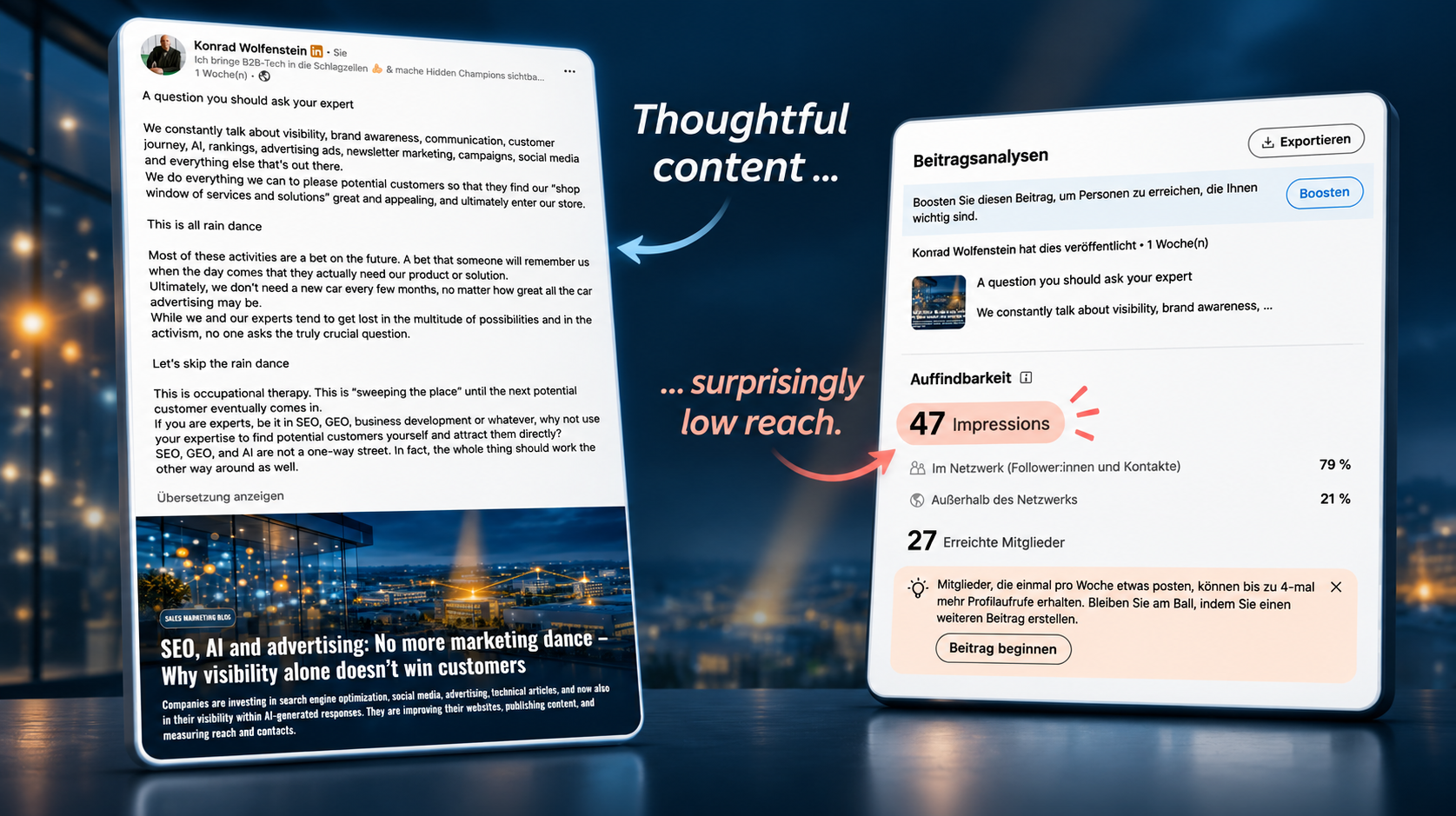
LinkedIn: You build the network, the platform sells access – Creative image on the topic, with AI: Xpert.Digital
17,000 contacts collected, 43 impressions received – and next to it, the boost button awaits
Networked for years, and now gradually becoming almost invisible
More than 17,000 contacts don't just happen. They're the result of years of professional work, personal encounters, expert exchange, and a willingness to share knowledge publicly. Building such a network isn't just about investing in a profile page; it's about investing in relationships, trust, and the opportunity to stay connected professionally.
If a post only achieves 43 impressions within a week, while previous posts reached around 40,000 per post, there's more to discuss than just a failed post. The question then arises as to what economic value this network still holds.
No one can expect every contact to read every publication. But there's a huge difference between such an expectation and virtually no visibility. A network with more than 17,000 contacts that barely has any public impact loses a significant part of its original promise.
That's precisely where the conflict lies: LinkedIn lets people build their networks, but decides for itself how much public connection actually results. The number of contacts remains visible. Accessibility can disappear.
For companies, this isn't just a cosmetic flaw. It affects the economic value of years of work. A network that looks impressive on a profile but barely attracts any attention is not a reliable basis for communication.
LinkedIn, let's talk about your business model. More specifically: about my work on your business model.
Over the years, I've built up a network here with more than 17,000 contacts. Previously, individual posts reached around 40,000 impressions. Lately: 43 impressions for one post within a week.
What remains reliably visible, however, is your boost button.
I build the contacts. I provide the content. I invest the time. And when I want to reach someone with it, you're the one holding out the cash.
A remarkable understanding of networking.
No, LinkedIn doesn't owe me any work. But if a painstakingly built network is barely accessible to the public anymore, we should stop pretending it's a self-determined communication channel.
My contacts are listed on my profile. Your visibility switch is set to "on".
And before the usual advice comes up: post more often, comment more, write better hooks. I run a B2B business. This isn't unpaid busywork for your feed.
The contacts are yours, but you don't have control over them
The language of social networks creates a strong sense of belonging and control. It's about one's own profile, one's own contacts, and one's own network. It all sounds like a digital portfolio of relationships that one develops oneself and can then use for professional exchange.
In reality, one primarily possesses access within a third-party infrastructure. What content becomes visible there, how strongly existing connections are taken into account, and which publications receive additional attention are beyond one's control.
The user builds relationships. The platform organizes their public impact.
This is a fundamental difference. Those who overlook it can invest years in a supposedly private public sphere without establishing self-determined access to it. The network grows numerically, while its practical usability depends on decisions outside of one's control.
This creates a peculiar situation for companies: they are expected to understand network building as a long-term investment, but cannot rely on the later usability of this investment.
The term "own network" thus promises more self-determination than the actual conditions allow. It is a network under external management – and this management pursues its own economic interests.
43 impressions are not a trivial statistical problem
The difference between roughly 40,000 impressions previously and 43 later is so massive that it can't be dismissed with a friendly reference to fluctuating reach. For someone who invests time and expertise, the entire equation changes.
A piece of content must be prepared, regardless of whether it subsequently appears tens of thousands of times or remains almost invisible. The work is done beforehand. The reward is allocated afterward.
It is precisely this uncertainty that makes the situation economically problematic. Companies can plan their expenses. They can develop topics, create content, and organize publications. What they cannot reliably plan on an external platform is the actual distribution.
Of course, not every publication is equally successful. But that doesn't explain the fundamental contradiction between a large, visible network and a vanishingly small public reach.
Those who merely use this contradiction as an opportunity to recommend even better entry points, different formats, or additional comments to the user are missing the point. They are then reinterpreting a structural dependency problem as a personal optimization task.
The crucial question is not which sentence was missing from the beginning of the article. It is what reliable benefit a platform still offers its long-standing active members for building their networks.
The publication is free, not the work done
Organic reach is often referred to as free reach. For companies, this is a misleading oversimplification. At best, the technical process of publishing is free. The work required for it remains a real expense.
A professionally sound contribution requires research, experience, and concentration. Statements must be well-reasoned, connections explained clearly, and content presented in a way that meets one's own quality standards. This is followed by questions, comments, and further interactions.
This time is then lacking elsewhere. It is not available for client projects, consulting, business development, or improving one's own services.
Freelancers, in particular, cannot indefinitely increase this workload. Every additional hour spent on a platform competes with other tasks. Those who need to evaluate their working time economically cannot be satisfied with the fact that publishing content doesn't incur an immediate fee.
At the same time, LinkedIn benefits from the content provided. Expertise, experience, and discussions make the platform interesting for other members. Users are therefore not only participants but also producers of content that increases the platform's value.
The relevant question is therefore: What appropriate compensation remains for the person who performs this work?
Networking becomes an obligation to be constantly present
A particularly problematic aspect of the platform's logic is the expectation of constant activity. Those who want to remain visible are expected to regularly publish, comment, respond, and publicly cultivate relationships.
This shifts the original balance. The network should no longer primarily support one's own professional work. Professional work must increasingly free up time to keep the network visible.
This might work for people whose business model relies directly on public visibility. However, it's by no means a given for a specialized management consultancy or an industrial B2B provider.
Value is often created outside the feed: in the analysis of complex tasks, in confidential conversations, in project work, and in the development of robust solutions. Those who do good work in these areas don't automatically have the capacity to also produce a daily public content feed.
A platform whose usefulness is heavily dependent on continuous presence must therefore be measured by the actual resources of its users. It cannot tacitly assume that every professionally active person also runs a permanently available media business.
A network should facilitate professional relationships. It should not become an additional job whose scope constantly grows while its economic benefits remain unclear.
Not every entrepreneur wants to become an influencer on the side
In the debate about LinkedIn, very different business models are often lumped together. As if a management consultancy, a mechanical engineering company, a specialist portal, and a provider of visibility training only had to follow the same rules to achieve comparable results.
That's economically unsound.
Those who sell services related to public presence can directly use their visibility as proof of performance. Those who support complex industrial investments, however, must establish a different connection between communication and the project.
For such business models, the most responses of any kind are not what matters. What's crucial are relevant professional contacts, trust, and concrete points of connection. These don't automatically arise simply because someone publishes frequently.
The expectation that every company must behave like a reach-oriented personal media channel therefore misses the point of the actual business. It confuses the requirements of the platform with the requirements of the market.
An entrepreneur doesn't need to become an influencer to communicate professionally. They need to know who they want to reach, what value they offer, and which channels make economic sense. If a channel demands a disproportionate amount of self-promotion, their role on it should be correspondingly small.
The boost button is located exactly where the disappointment begins
The conflict of interest becomes particularly clear when declining visibility and the offer of paid reinforcement exist side by side.
On one side is the user with their established network, their content, and the question of why so little of it is reaching them anymore. On the other side is the option to purchase additional ad placement.
From a user's perspective, this feels like a retroactive fee for a previously established expectation. Years are spent investing in contacts and content. Then, money is expected to flow so that this content reaches a significant audience.
The crucial point here is the distribution of power. The platform determines the conditions for organic visibility and simultaneously sells a paid extension of that visibility. It controls access and markets this additional access.
Such a model can be criticized without getting lost in speculation about individual algorithmic interventions. The conflict of interest is inherent in its structure.
LinkedIn wants to make money. That's not surprising. But it should then also be seen as what it increasingly is for publishing companies: a commercially managed distribution space – not simply the digital equivalent of a freely usable personal network.
If one's own work only becomes visible through additional payment
The impression of paying twice doesn't come from nowhere. First, time is invested in building the network. Then, more time is invested in content. And if this content is barely visible, an additional advertising budget is required.
For the user, this results in several investments, the relationship of which to the business outcome remains uncertain.
The problem worsens when paid reinforcement is tried and also fails to generate sufficient benefits. In that case, the additional expenditure has not created the hoped-for access to relevant business opportunities. Initially, it has only increased costs.
A higher number of impressions doesn't automatically constitute a contract. It doesn't even automatically guarantee a qualified conversation. Those who spend money should therefore be able to expect more than just a more favorable metric.
This distinction is crucial, especially for specialized B2B services. An advertising product may technically deliver what it promises, yet still be uneconomical for the specific business model.
If the desired benefit isn't realized, the answer doesn't necessarily have to be to allocate even more budget. It could simply be that this approach doesn't justify its place in the overall strategy.
Even the earlier reach did not solve the economic question
The roughly 40,000 impressions from previous posts seem enormous compared to 43. However, the experience at the time was sobering: the increased visibility did not lead to sufficient added value for the company's own B2B business model.
This doesn't lessen the criticism, but rather makes it more precise. It's not about mourning an old figure. It's about the fact that even the improved reach phase failed to meet economic expectations.
Those who recognized back then that the effort and the benefits didn't match had good reason to scale back their activities. This isn't a lack of willingness to embrace digitalization or a lack of understanding of communication. It's a business assessment.
The subsequent drop to 43 impressions then revealed a second weakness. Not only was the business return unsatisfactory, but access to attention itself proved to be extremely fragile.
This weakens the argument that one simply needs to continue working patiently. Patience is useful when a viable correlation between effort and result becomes apparent. Without this correlation, it can become a costly prolongation of the same disappointment.
Reach can be impressive, yet still miss the mark in terms of business
Large numbers have a strong psychological effect. They appear to represent success, are easy to compare, and provide visible confirmation of the effort.
For a company, however, they are only relevant if they fulfill an economic function. Attention can create brand awareness, build trust, or facilitate contacts. But it can also remain largely inconsequential.
Especially in B2B business, it's crucial who is reached and in what context. A small number of relevant decision-makers can be more valuable than a large audience without a concrete connection to the product or service.
However, this does not mean that low visibility automatically equates to high quality. 43 impressions do not become strategically compelling simply because the right person might theoretically have been among them. Such an argument would retrospectively justify any result.
A channel should be judged by whether it demonstrably contributes to business development over an extended period. If this contribution fails to materialize, neither large historical reach nor hypothetical opportunities will help.
Corporate communication needs to be effective. The mere possibility that something might eventually come of it is not a sufficient return on considerable resources in the long run.
🎯🎯🎯 Data-driven B2B industry hub as a quasi-in-house solution

The quasi-in-house solution: How Xpert.Digital closes operational gaps in B2B marketing and sales – Smart Content-Driven Business - Image: Xpert.Digital
Xpert.Digital is a data-driven B2B industry hub led by Konrad Wolfenstein . The company acts as an external, quasi-in-house solution for industrial partners, closing operational gaps in marketing, content, and sales – without requiring additional resources on the client side.
More information here:
Strategic decisions for sustainable success
The visible winners are selling a very incomplete story
The successes of individual, high-reach players shape the platform's image. Those who receive many reactions, gain customers, and successfully market their public presence become proof of what should supposedly be possible for others as well.
Those whose efforts don't pay off, however, remain invisible. They publish, experiment, eventually reduce their activities, or stop altogether. Their experience rarely becomes a prime example of a platform strategy.
This creates a distorted picture. The winners are publicly visible, while the disappointed disappear from public awareness. The narrative of success being fundamentally achievable persists, even though the starting points are vastly different.
It becomes particularly questionable when these individual cases give rise to a moral expectation: those who do not benefit simply did not try hard enough or did not understand the mechanics.
That's too convenient. Different business models, resources, and target groups cannot be replaced by the same motivational statement.
Therefore, criticism doesn't require a sensational statistic about how many people lose out. It suffices to expose the crucial gap: visible success stories say little about the average economic return that the other participants actually achieve after deducting all their expenses.
LinkedIn can benefit from activities that are not profitable for the individual
There is no automatic correlation between the benefit to the platform and the benefit to the individual entrepreneur.
A user can invest a lot of time without winning a suitable commission. Nevertheless, they have provided content, initiated discussions, and encouraged others to read and respond. Their own payment may be unsatisfactory, but their activity enriches the platform's communication space.
This distinction must be made clear. An action is not economically sensible simply because it adds extra activity to the system.
For a company, what matters is what proportion of the value it generates actually reaches it. If this proportion remains consistently low, it is entitled to reduce its stake without having to justify it.
The platform needs a vibrant offering. The entrepreneur needs a viable business. These are two different interests that can overlap, but are not identical.
Those who take this distinction seriously view calls for increased activity differently. They are not neutral advice, but must be evaluated in terms of one's own economic viability. Increased effort is only a solution if it improves one's own position – not simply increased activity in the feed.
Past effort does not obligate one to further work
A large network can become a psychological bond. Those who have spent years building contacts and publishing content don't want to devalue that work. That's precisely why it's so difficult to consistently reduce one's own activity.
The existing number of contacts becomes the argument to continue. Surely something must develop from it. The previous reach must be achievable again. Perhaps all that's missing is the next adjustment.
This creates a vicious cycle. Past investments justify new investments without adequately examining future return prospects.
From a business perspective, this is the wrong direction. The crucial factor is not how much time has already been invested. The crucial factor is whether further investment is worthwhile under current conditions.
A network is not an end in itself. It is a means to develop relationships, knowledge, and business opportunities. If its usability falls short of the requirements, its strategic importance must be allowed to decline.
That's precisely where professional distance lies: not confusing one's past with one's future. Scaling back a channel doesn't automatically render one's previous work worthless. It might simply prevent a disappointing investment from becoming a long-term commitment.
Adapting to the feed can displace one's own expertise
The pressure to be visible doesn't just affect available time. It also influences what content is created and how it is formulated.
Anyone observing public reactions quickly realizes that not every technically important question generates the same immediate response. This can create an incentive to personalize topics more, to oversimplify statements, or to deliberately exploit controversies.
For a critical commentary, exaggeration is a legitimate tool. However, it must not become a substitute for substance in all corporate communications.
An industrial company or a specialized consultancy must also be able to explain things that don't work in a few seconds. Investment decisions, technological dependencies, and economic risks require in-depth explanation.
If this content isn't displayed appropriately in the feed, that doesn't prove it's poorly presented or unimportant. It can simply indicate that the channel is only partially suited to this task.
The consequence should not be to continually tailor one's professional identity to reach a wider audience. It should be to provide the content with an environment in which its strength can truly be effective.
An algorithmically controlled medium is not a freely available network
The more a central selection process determines which posts become visible, the further the usage deviates from the simple image of interconnected people.
Then the connection alone is no longer sufficient. An additional instance stands between the people, selecting, organizing, and distributing attention.
This changes the nature of the service. It remains a place for social interaction, but at the same time becomes an algorithmically controlled medium. Users provide content, while the platform decides on significant parts of its distribution.
This description captures the problem more accurately than the idea of a freely available digital circle of acquaintances. Because it makes the actual power dynamics visible.
A personal network fosters closeness and reciprocity. A distribution system provides access under certain conditions. Equating the two underestimates the interdependence.
This conceptual clarity is important for companies. It prevents externally managed reach from being treated like a permanently secured, in-house asset. And it creates the basis for prioritizing communication channels differently.
The crucial question is no longer how to integrate oneself as completely as possible into this system. It is what clearly defined task the system should perform for one's own business.
Your own website is not a backup location
A company's own website often only becomes interesting again when external platforms disappoint. However, for a knowledge-intensive company, it shouldn't be a fallback option, but rather the controllable central hub of its digital communication.
There, services can be explained, connections developed, and expert opinions made permanently accessible. Content doesn't have to compete for fleeting space among other posts with every publication.
Above all, the work flows into a structure whose design is much more in the user's own hands. Topics can be organized, updated, and interconnected. Readers are given the opportunity to engage with a subject systematically.
This is particularly important for complex B2B services. Those preparing a demanding decision often need more than a brief impulse. They need guidance and comprehensible connections.
Having your own website doesn't solve every customer acquisition challenge. But it does shift the direction of dependency. External platforms become potential access points, rather than forming the central hub of the entire information relationship.
This is not a nostalgic retreat. It is the building of a more robust economic foundation.
Xpert.Digital shows why original journalistic content counts
With the Xpert.Digital industry hub and up to 1.1 million visitors per month, a dedicated publishing infrastructure is available that goes far beyond the function of a single social media profile.
Their strategic importance lies not only in their reach. It lies in the combination of specialist content, thematic depth, and a self-designed information architecture.
An industry hub can accompany developments over a longer period, link market issues, and bring together different aspects of a topic. It is not limited to briefly catching the eye in the feed.
This creates a different quality of public discourse. Readers can engage with content in a focused way, explore further connections, and learn about the professional profile behind the publications.
This is crucial for the business model. Communication is not entirely dependent on which publication is currently receiving additional attention. It is built on its own content-related foundation.
LinkedIn can still play a role in this structure. But it is no longer the place where all professional work must request permission to be seen. It becomes a supplementary access point to a substance that continues to exist independently.
A specialized archive achieves more than just the next brief spike
Good technical content doesn't have to be used up after its initial publication. It can become relevant again later, be updated, and provide value in new contexts.
This is precisely where a key economic difference lies between short-term attention-grabbing and systematic journalistic work.
If the primary goal of every post is to generate the next buzz, the pressure to produce content remains. After publication, the search begins for the next topic, the next entry point, and the next reaction.
In contrast, a well-structured specialist archive allows content to build upon itself. An analysis becomes part of a larger context. Earlier work can support later work, instead of constantly being replaced.
This continuity is particularly valuable for industry, logistics, AI, and economic location issues. These topics do not consist of isolated events. They develop over longer periods and require recurring analysis.
Those who invest in such contexts create more than just content for a feed. They develop their own body of knowledge that remains useful in conversations, research, and decision-making. This work deserves an infrastructure that doesn't reduce it to a fleeting moment of visibility.
Newsletters and contact databases help revitalize the relationship
A newsletter and a dedicated contact database represent a different form of communication. The focus is not on the general hope of algorithmic selection, but on the conscious continuation of a relationship.
People choose to receive information. Companies can strategically address topics and develop contacts in a transparent and traceable way. Communication becomes less random.
The goal is not to accumulate as many addresses as possible. A small number of suitable contacts can be more valuable for a specialized B2B business than a large, imprecise distribution list.
What matters is whether the relationship has substance: shared topics, concrete interests, previous conversations, or a recognizable professional need.
A well-maintained contact database helps ensure that these connections aren't left to the next feed moment. It supports the remembrance of agreements and the targeted continuation of conversations.
This shifts the focus from public activity to genuine relationship building. Not every business-value communication needs to be visible. Much arises precisely where there is no competition for general reactions, but rather where specific questions are clarified between the right people.
Less platform work may be the better business decision
There is no economic principle that says more social media automatically leads to more professionalism. A company doesn't have to prove that it can make a channel successful with sufficient effort.
It must decide where its limited resources can make the greatest meaningful contribution.
If a platform fails to generate adequate value over an extended period, its role can be diminished. A well-maintained profile, selected publications, and targeted contacts can suffice. Increased activity is not an end in itself.
This decision is particularly important for freelancers. Their time cannot be multiplied indefinitely. Every additional communication task must be justified in relation to other tasks.
Those who spend less time on the feed and invest more in their own content, direct relationships, or better services don't necessarily have to withdraw. They can simply sharpen their business priorities.
A professional attitude does not consist of being constantly present everywhere. It consists of being able to distinguish between mere busyness and effective work.
Even a large network must not override this distinction. A high number of contacts is not an obligation to continuously produce free content for someone else's infrastructure.
LinkedIn has to earn its place
The decisive factor is not whether LinkedIn can be useful in principle. It can. The decisive factor is whether it is sufficiently useful for the specific company under the actual circumstances.
This evaluation must not be replaced by the prestige of the platform, the size of one's own network, or the success stories of others.
Anyone who has invested for years and finds that neither previous high reach nor subsequent attempts at payment generation have generated sufficient business benefit is entitled to a clear verdict. This business model simply isn't viable.
This is not a defeat, but a limitation. And limitations are a necessary component of economic decision-making.
The platform is allowed to make money. It is allowed to market its services. But it has no right to expect entrepreneurs to continue investing their time in a project that doesn't add up for them.
If the benefits decrease, the willingness to constantly contribute new content, interactions, and budgets must also be allowed to decrease. LinkedIn is not mandatory. It is a provider whose performance must prove itself.
The number of contacts belongs on the profile, control belongs in the company
The 43 impressions are not merely a disappointing number. They illustrate how far apart having a contact list and having access to a professional public profile can be.
Having over 17,000 contacts conveys a sense of scale. However, what matters is what can actually be achieved with that scale. If public reach depends almost entirely on external selection, the business value of that scale remains uncertain.
The consequence, therefore, does not lie in even more hope for the next algorithmic reward. It lies in a clearer allocation of one's own investments.
The most valuable professional work belongs within a structure that strengthens the company itself. Relationships should be maintained through channels that don't have to compete for visibility every time. And external platforms should complement what's built internally, rather than forming the entire foundation.
LinkedIn can facilitate connections. It can generate attention. But a company shouldn't base its communication skills on how generously that attention is currently being distributed.
17,000 contacts on a profile are no substitute for self-determined access. Those who spend years building their network shouldn't end up standing in front of its locked door – with the boost button as the only clearly visible way to unlock it.
📈🚀 From visibility to trust 👀🤝 Your scalable path with Xpert.Digital

From visibility to trust: Your scalable path with Xpert.Digital - Image: Xpert.Digital
In industrial B2B, sustainable business relationships rarely emerge overnight. They develop step by step – through visibility, professional relevance, recurring touchpoints, and growing trust. Xpert.Digital's 4-stage model addresses precisely this: It offers a structured path that begins with a manageable entry point and can evolve into deeper collaboration in business development if needed.
Instead of relying on loud marketing promises, this model puts the relationship at the forefront. Companies start with clearly defined, easily calculable measures and then decide, based on their own experience, how far they want to expand the collaboration. A key factor for this undisturbed trust-building process: The platform completely avoids annoying advertising ads, so the editorial focus remains solely on the companies' expertise.
More information here:
Your global marketing and business development partner
☑️ Our business language is English or German
☑️ NEW: Correspondence in your native language!

Konrad Wolfenstein
I and my team are happy to be available to you as your personal advisor.
You can contact me by filling out the contact form here [email protected]:or simply call me at +49 7348 4088 965. My email address is
I'm looking forward to our joint project.