
Organic Social vs. Paid Social Media: What percentage of social media posts on LinkedIn are paid?
Xpert Pre-Release

Available in 27 languages 📢
Prefer Xpert.Digital on GoogleⓘPublished on: February 10, 2026 / Updated on: February 10, 2026 – Author: Konrad Wolfenstein
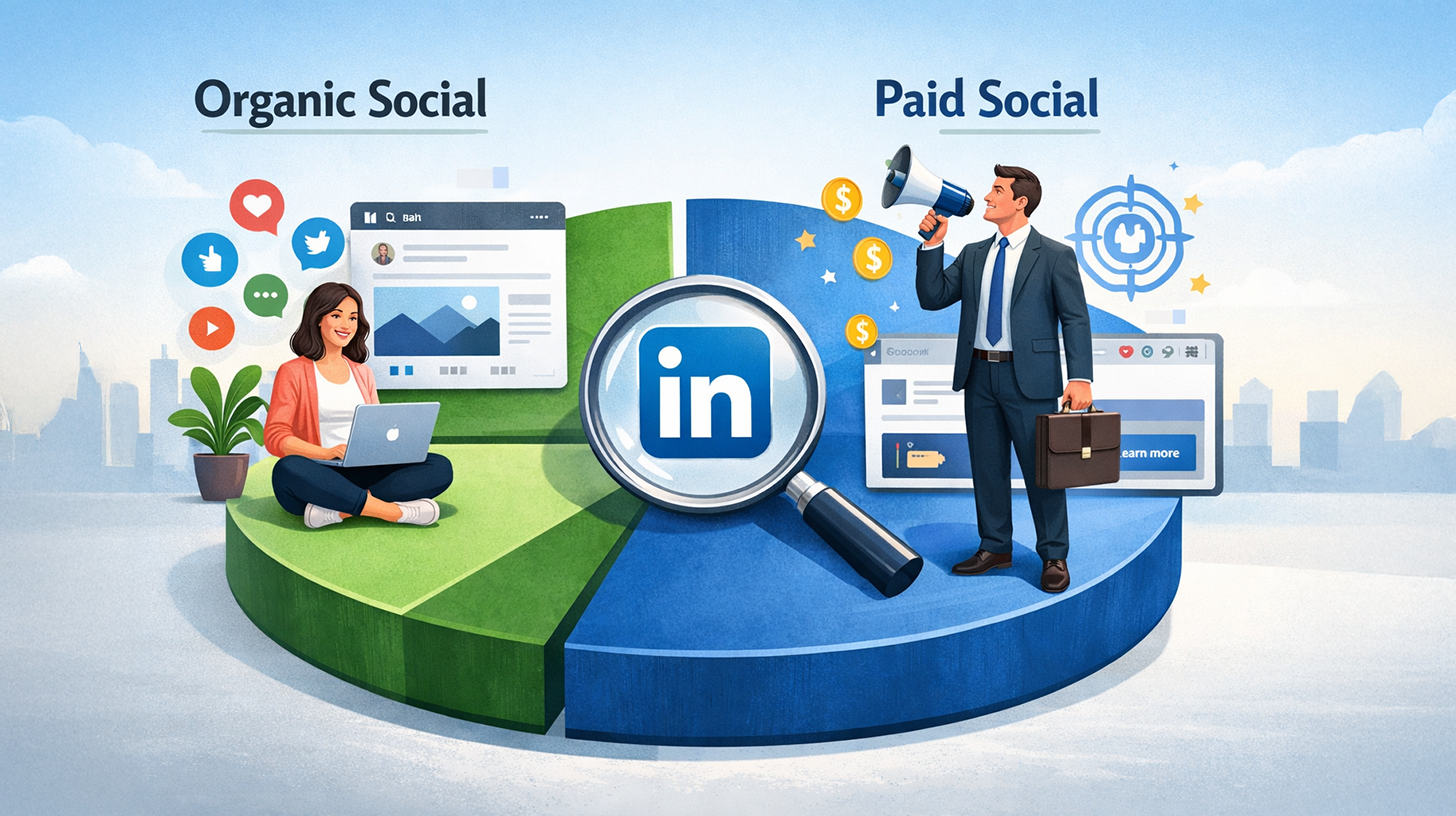
Organic Social vs. Paid Social Media: What percentage of social media posts on LinkedIn are paid? – Image: Xpert.Digital
Algorithm check: Why organic posts often hit a 40 percent wall
Posting on a whim? That's the harsh reality of LinkedIn reach
LinkedIn strategy: Paid posts or hoping for the algorithm? A comparison
LinkedIn has long since become an indispensable platform for B2B communication and professional networking. But anyone publishing content today quickly encounters a crucial question: How much organic visibility is still possible, and when does the advertising budget take over? Many companies and creators still rely on the principle of "hope," posting content "on a whim" in the feed, expecting the algorithm to favorably distribute it. However, the reality in the user feed increasingly looks quite different.
Recent analyses of LinkedIn feed composition show that the era of pure organic dominance is over. A significant portion of what users see on their screens daily is no longer the result of viral chance, but rather of targeted budgeting. With around 40 percent of the feed now consisting of paid or platform-driven content, the balance is clearly shifting towards "paid social." Nevertheless, organic posts remain the backbone of content production.
This article explores the tension between paid reach and organic visibility. We clarify how the feed is actually composed, why the difference between "paid publication" and "paid ad placement" is so important, and why a hybrid strategy is often the only way for modern businesses to escape the vicious cycle of declining reach.
Related to this:

What does "paid" mean in the LinkedIn context?
A paid post on LinkedIn generally refers to content that is specifically distributed via the platform's advertising infrastructure. This includes sponsored posts, newsfeed ads, follower ads, lead generation forms, and various LinkedIn formats such as text ads, video ads, or carousel ads. These posts are not only displayed organically within the existing network but are also distributed to additional target groups, for whose visibility the company or individual user pays LinkedIn.
In addition to these classic paid social media posts, there are also paid advertising formats such as paid job postings, event promotions, or spotlight ads, which are also part of the "paid" portion. For comparison, there are organic posts, meaning all those posts published without an advertising budget – such as status updates, articles, polls, or images that only reach their audience through the user's own network and the algorithm.
How is the LinkedIn feed structured?
Analyses of the LinkedIn feed show that a large portion of the content is no longer "purely" organic. Recent reports on feed composition indicate that approximately 40 percent of the content in the feed comes from advertising and LinkedIn's own posts. This means that roughly two out of every five posts a user sees are paid advertisements.
The remaining 60 percent or so is distributed among content from one's own network, meaning posts from people one directly follows, is connected to, or whose content the algorithm deems relevant. Within this organic share, significant portions are accounted for by personal profiles and creator content, while posts from company pages often represent only a very small fraction of the visibility.
Percentage of paid posts compared to "random posts"
In practice, the proportion of paid posts on LinkedIn cannot be globally determined by a single percentage that remains the same for all users, because the feed varies significantly depending on target audience, region, and usage habits. However, several perspectives can be combined to obtain a realistic picture:
- At the platform level, it is estimated that around 40 percent of the content in the feed is paid for, i.e., advertising or LinkedIn's own ads.
- Within the business and marketing community, it is often pointed out that significantly more content is published without an advertising budget because many companies primarily post organically.
- Studies on social media marketing show that among companies active on LinkedIn, only about a quarter specifically run LinkedIn ads; the rest rely on unpaid posts.
That means:
- Of all social media posts on LinkedIn, the proportion of paid posts is relatively manageable because the absolute number of organic content posts is very high.
- From the user's perspective in the feed, the proportion of paid content is significantly higher because LinkedIn specifically promotes these posts more prominently.
Difference between "paid playout" and "paid publication"
It is important to distinguish between two types of paid posts:
- Paid posts:
A company or creator explicitly launches an advertising campaign to promote a specific post via the campaign manager or the "Boost" button. These posts appear in the statistics as paid advertising and contribute to the aforementioned 40 percent mark. - Organically published, but algorithmically favored:
Some posts are algorithmically classified by LinkedIn as particularly relevant (e.g., through high interactions, quality score, or LinkedIn's own features such as "Suggested") and are therefore displayed more frequently – without incurring additional fees for placement.
Many companies initially post organically on a winged chance, hoping for good reach, and then only selectively switch to paying for individual high-performing or strategic posts. This results in:
- A large proportion of organic posts are launched "on a whim" without an advertising budget.
- Only a portion of these posts are later specifically paid for in order to reach certain target groups.
🎯🎯🎯 Benefit from Xpert.Digital's extensive, five-fold expertise in one comprehensive service package | BD, R&D, XR, PR & Digital Visibility Optimization

Benefit from Xpert.Digital's extensive, five-fold expertise in a comprehensive service package | R&D, XR, PR & Digital Visibility Optimization - Image: Xpert.Digital
Xpert.Digital possesses in-depth knowledge across various industries. This allows us to develop tailored strategies precisely aligned with the requirements and challenges of your specific market segment. By continuously analyzing market trends and monitoring industry developments, we can act proactively and offer innovative solutions. The combination of experience and expertise generates added value and provides our clients with a decisive competitive advantage.
More information here:
Purchased reach versus trust: The great duel in your LinkedIn feed
Estimated percentage shares: Overview
Based on current studies and feed analyses, the following rough proportions can be derived (at the platform or feed level):
In a user's personal LinkedIn feed
- Approximately 40 percent of the content comes from advertising and LinkedIn's own ads.
- The remaining 60 percent is organic content, meaning posts from individuals, pages, or companies that were not directly paid.
Total number of published posts (excluding feed view)
- The absolute number of organic posts is significantly higher than the number of paid posts.
- Approximately only a quarter to a third of clicks and interactions on LinkedIn come from paid advertising formats, depending on the industry and target group.
For companies in social media marketing
- According to industry studies, only about 25 percent of companies actively use paid ads on LinkedIn; the rest primarily rely on organic growth.
- At the same time, many companies are planning to increase their budgets for paid social media, which will further increase the proportion of paid posts in the feed in the long term.
Related to this:

Why is the proportion of paid posts in the feed so high?
LinkedIn is a business that primarily finances its platform through advertising and recruitment revenue. Therefore, its algorithm manages the feed to give high visibility to paid content, as this is the platform's financial foundation.
Additionally, there are structural reasons why the proportion of paid posts in the feed is increasing:
- The organic reach of posts – especially from company pages – has declined significantly in recent years, meaning that teams without paid promotion are reaching fewer and fewer people.
- At the same time, the advertising budgets of companies that use LinkedIn as a central platform for B2B communication, lead generation and employer branding are increasing.
This leads to a vicious cycle:
- Companies are finding it increasingly difficult to achieve reach with purely organic posts.
- They are therefore investing more in paid social media to reach people.
- This further increases the proportion of paid posts in the feed.
Advantages of paid posts compared to "random posts"
Paid posts on LinkedIn offer a number of clear advantages over purely organic posts that rely on luck:
Target group management
Paid posts can be very precisely targeted to functions, companies, locations, interests, or industries, which increases efficiency.
Measurability
For paid campaigns, comprehensive key performance indicators (KPIs) such as click prices, CTR, cost-per-lead or ROAS are available, allowing success and optimization to be measured very precisely.
Faster and scalable range
While organic posts are only visible where the algorithm displays them, paid advertising can generate thousands or even millions of impressions in a very short time.
At the same time, posts that are "random to guess" also have their place
- They often generate higher engagement rates than traditional ads because they appear more natural and personal.
- They build long-term credibility and trust, which is essential for employer branding and corporate trust.
A combination of paid and "on the off chance"
In practice, the best approach today is seen as combining both strategies. Companies therefore use:
- Organic posts “on a whim” to build a community, test content, and generate authentic interactions.
- Selected posts are paid for in order to bring particularly relevant news (e.g. product launches, events, job ads) specifically to certain target groups.
This hybrid strategy leads to an increase in the proportion of paid posts in the feed, but at the same time, a lot of content continues to be published without an advertising budget. This maintains the impression of "lucky" activity, while the platform as a whole remains economically viable thanks to the numerous paid placements.
What is the actual percentage?
In summary:
- In a LinkedIn user's personal feed, approximately 40 percent of the content consists of paid posts, i.e., advertising and LinkedIn's own formats.
- The remaining 60 percent are organic posts, published without an advertising budget and landing in the feed "by chance".
- The proportion of purely organic posts is significantly higher in the total number of published posts, as many companies and creators start content without paying extra.
Consequently, companies are increasingly using paid posts specifically for key topics, while the majority of daily content continues to be produced without an advertising budget. This leads to an economic environment in which the proportion of paid posts in the feed is visibly increasing, but the vast majority of content production is still based on a "lucky" approach.
Your global marketing and business development partner
☑️ Our business language is English or German
☑️ NEW: Correspondence in your native language!

Konrad Wolfenstein
I and my team are happy to be available to you as your personal advisor.
You can contact me by filling out the contact form here or simply call me at +49 7348 4088 965. My email address is: [email protected]
I'm looking forward to our joint project.
☑️ SME support in strategy, consulting, planning and implementation
☑️ Creation or realignment of the digital strategy and digitization
☑️ Expansion and optimization of international sales processes
☑️ Global & Digital B2B trading platforms
☑️ Pioneer Business Development / Marketing / PR / Trade Fairs
📈🔵 Order acquisition and organizational development: From classic sales to a strategic business function💡

Order acquisition and organizational development - Image: Xpert.Digital
Xpert.Digital supports companies in this complex transformation, whether it's building a modern order acquisition function from the ground up or optimizing existing processes. With comprehensive expertise in marketing, sales, data analysis, digital transformation, and organizational development, we guide your company toward strategic repositioning. Our approach is holistic: We not only optimize processes but also develop the people and organizational culture necessary to achieve sustainable, measurable success.
More information here:










