
LinkedIn, 360Brew and the silent dispossession of digital voices – When machines decide who gets to be heard
Xpert Pre-Release

Available in 27 languages 📢
Prefer Xpert.Digital on GoogleⓘPublished on: May 7, 2026 / Updated on: May 7, 2026 – Author: Konrad Wolfenstein
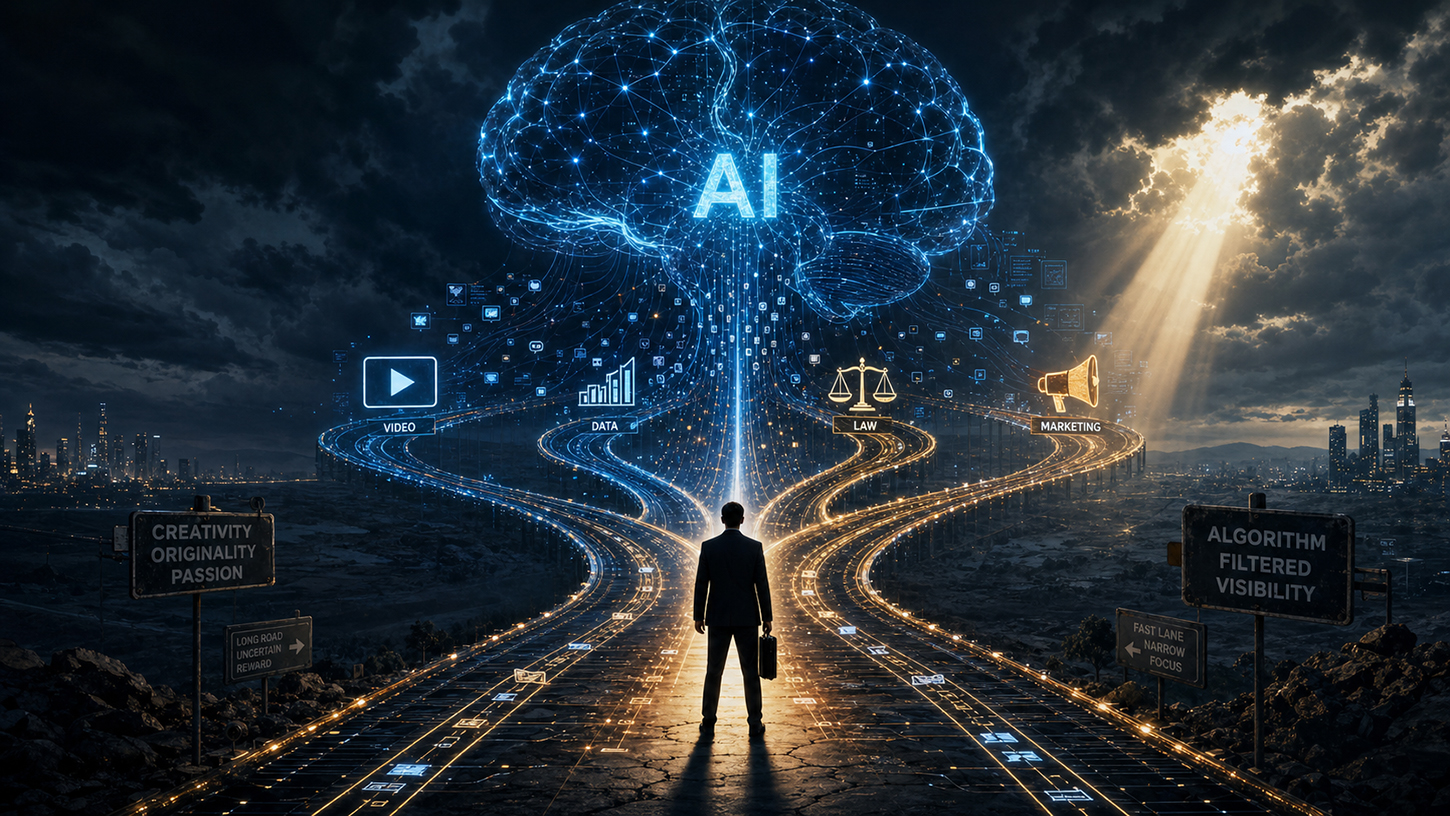
LinkedIn, 360Brew and the silent dispossession of digital voices – When machines decide who gets to be heard – Image: Xpert.Digital
The secret AI update: How LinkedIn's "360Brew" is destroying organic reach
The end of free visibility: How LinkedIn is pushing small business owners into the paid trap
Those who jump around between topics become invisible: The new survival strategy on LinkedIn
For years, LinkedIn was considered the digital Eldorado for organic growth, personal branding, and B2B networking. Those who regularly shared authentic content and actively participated were rewarded with visibility and new business contacts. But that era is over. Millions of users—from seasoned digital marketers to dedicated freelancers—are currently facing a puzzle: their reach is plummeting, even though the quality of their posts remains consistently high. The reason isn't a whim of the user base, but a radical architectural shift behind the platform. With the introduction of the new AI model "360Brew," LinkedIn has fundamentally changed the rules of the game. The algorithm no longer rewards versatility and human complexity, but instead enforces a radical, almost machine-like thematic specialization. Anyone posting outside their narrowly defined niche becomes invisible. We examine what the new system means for the digital identity of creators, why the platform economy is heading towards a creeping expropriation of organic voices – and what strategic consequences entrepreneurs and experts must now draw in order not to disappear completely from the feed.
Related to this:

The dictatorship of the average
A seasoned digital marketer with nearly two decades of industry experience, two published books, and thousands of followers finds that his posts are barely reaching anyone anymore. Not because he's gotten worse. Not because his network has shrunk. But because an algorithm that never sleeps has decided that thematic diversity is a mistake. This situation is not an isolated incident. It's structural—and it has profound economic consequences that extend far beyond the personal discomfort of a LinkedIn user.
The end of thematic freedom: What LinkedIn has really changed with 360Brew
In early 2025, LinkedIn published a scientific paper that initially received little attention within the professional community but marked a fundamental turning point. The new AI system is called 360Brew, and it is far more than a typical algorithmic update. It represents a complete architectural shift: Instead of dozens of specialized individual models for feed ranking, job recommendations, search results, and ad delivery, there is now a single, unified Foundation model with 150 billion parameters. The architecture is a so-called decoder-only transformer, technologically related to the same language models that underpin ChatGPT or Claude – but finely tuned to the proprietary data repository of the so-called LinkedIn Economic Graph.
What does this mean in concrete terms? The model no longer reads a post as an isolated object trying to accumulate likes and comments. It reads the post, author profile, and viewer history as a coherent text sequence. It understands semantics, context, and meaning—at least as a machine understands them. Previous systems categorized content based on keywords and measurable interaction signals. 360Brew, on the other hand, attempts to model whether a post fits the author's content identity, whether this identity is clearly defined, and whether there is a target audience that consistently benefits from this type of content.
That sounds like progress. And in some ways, it is. The system can perform zero-shot reasoning: It assesses relevance even for content or job titles it has never seen before by interpreting language from context. It recognizes local relevance, semantic depth, and professional credibility in ways that previous systems couldn't. But this newfound insight comes at a price—and that price is paid by LinkedIn's active users.
Related to this:

Reach as an economic asset: The economic dimension of loss of visibility
Visibility on LinkedIn is not an abstract concept. It is an economically relevant resource that has a direct impact on acquiring new customers, recruiting, brand building, and ultimately, company revenue. Entrepreneurs, consultants, and service providers active on LinkedIn are not simply engaging in casual communication – they are generating business, building trust, and positioning themselves in an increasingly digital market.
The figures are alarming: According to an analysis of 318,842 LinkedIn posts from the third quarter of 2025, organic reach on the platform has fallen by 65 percent compared to its peak. Average impressions dropped by 18 percent year-over-year, and average creator growth slowed by 20 percent compared to the second quarter of 2025. Another study found that 95 percent of active LinkedIn users experienced a significant decline in reach, with a drop of almost 50 percent by February 2025 compared to the previous year. While engagement stabilized somewhat, it settled at only 75 percent of its previous level.
For micro-entrepreneurs, freelancers, and solo experts—precisely the target group that LinkedIn has cultivated as its primary business platform over the years—this decline represents nothing less than the loss of a crucial sales channel. Those who previously garnered 10,000 views with an organic post now struggle to reach 3,000. This isn't a cosmetic issue. It's a fundamental shift in the cost-benefit ratio for organic reach, one that simply no longer exists for many small businesses.
The platform dilemma: Between monopoly power and user needs
LinkedIn was acquired by Microsoft in 2016 for $26.2 billion and has since become the dominant professional social media platform worldwide. In fiscal year 2024, the company generated revenue of approximately $16.4 billion, a year-over-year increase of around 10 percent. In the second quarter of fiscal year 2025, which ended on December 31, 2024, LinkedIn alone generated approximately $4.6 billion in revenue. Premium subscription revenue exceeded $2 billion annually for the first time.
These figures tell a story about platform power – and the consequences of that power for its users. The economic logic of the platform economy is well-known: network effects create natural monopoly tendencies because the value of a social network increases exponentially with the number of its users. Once a critical mass is reached, switching costs become so high that users remain on the platform despite growing dissatisfaction. LinkedIn has long since passed this phase. With over a billion registered users worldwide, the platform is simply without alternative for professional networking.
This very lack of alternatives creates the conditions for what is described in the platform economy as rent extraction: A platform that has once achieved a monopoly can begin to collect rents – and in this case, that means increasingly worsening the conditions for organic visibility while simultaneously offering paid advertising as a solution. Sponsored content and advertising already account for almost 40 percent of the LinkedIn feed. Personal content from creators makes up only around 28 percent of the feed, while content from company pages has been massively deprioritized.
The algorithm as an ideologization machine: How 360Brew constructs identities
What makes the 360Brew case particularly interesting from a philosophical perspective is the implicit theory of human identity that underlies the system. The algorithm assumes that people—and especially experts and professional communicators—can be clearly categorized. Two to four core themes are supposed to be sufficient to fully describe a person. The platform, for which 360Brew is responsible, consistently rewards those who fall within this narrowly defined spectrum and penalizes everyone else.
The problem is fundamental: people are not niche algorithms. They are interdisciplinary, curious, and complex beings. A marketing professional who has worked in the digital sector since 2008 doesn't just think about video conferencing software. They think about data protection, remote work, EU regulations, AI tools, typography, and the changing world of work—all simultaneously and interconnectedly. It is precisely this complexity, which constitutes the value of human expertise, that is not rewarded by the algorithm, but systematically devalued.
The model doesn't evaluate individual posts, but rather the average content of all a user's past posts. Thematic consistency over time is the signal 360Brew uses to connect a person with a specific audience. Those who jump around thematically become algorithmically diffuse and therefore invisible. The platform thus forces a reduction of personality to what can be represented as a repeatable pattern. It's about categorizability, not substance.
The paradox of quality orientation: More depth, less breadth
LinkedIn and its communications strategists like to emphasize that the algorithm changes are in the service of quality. The platform now favors substantive interactions over superficial likes, expert articles over generic how-to posts, and genuine discussions over performative agreement. That sounds reasonable enough. Who would seriously argue against higher quality?
However, empirical reality paints a more nuanced picture. In fact, the new conditions primarily benefit those who are already narrowly positioned thematically and possess a dedicated following within a specific niche. According to an analysis from the third quarter of 2025, the top 1 percent of creators on LinkedIn grew 157 times faster than the average. This isn't a concentration of quality—it's an extreme concentration of algorithmic rewards at the top of the distribution, coupled with a simultaneous impoverishment of the breadth of content.
The recommendation experts derive from this is symptomatic: 80 percent of the content should focus on two to three core topics, the profile should be explicitly tailored to these topics, and the model requires 90 days of consistent implementation before it has reliably categorized a user. This is, in effect, a recommendation to optimize oneself as a person to the needs of a machine. The machine doesn't adapt to the human – the human adapts to the machine.
🎯🎯🎯 Data-driven B2B industry hub as a quasi-in-house solution

The quasi-in-house solution: How Xpert.Digital closes operational gaps in B2B marketing and sales – Smart Content-Driven Business - Image: Xpert.Digital
Xpert.Digital is a data-driven B2B industry hub led by Konrad Wolfenstein . The company acts as an external, quasi-in-house solution for industrial partners, closing operational gaps in marketing, content, and sales – without requiring additional resources on the client side.
More information here:
Who determines your professional identity? LinkedIn, algorithms, and the end of autonomy
The digital identity crisis: Who am I on LinkedIn, and who owns this answer?
The questions we ask ourselves – video conferencing or data protection? Remote work or EU software? Marketing or AI tools? – are not questions born of disorientation. They are the questions of a thoughtful communicator seeking an honest answer to the challenge of remaining authentic while simultaneously maintaining visibility. The fact that these questions even need to be asked is the real problem.
The need to define one's professional identity according to the categories of an algorithm represents a new form of external control. Personal branding on LinkedIn was long a creative process of self-discovery and positioning—an act of external communication, but also of internal reflection. With 360Brew, this process is increasingly dictated: The platform defines which identities may be visible and rewards those who behave in accordance with this definition.
For corporate influencers – employees and entrepreneurs who leverage their personal brand to benefit their company – this development is particularly critical. The logic that people trust brands more than faceless institutions is well-supported by empirical evidence. Corporate influencers who communicate authentically and credibly about their work are more valuable than any traditional PR campaign. However, if this credibility is reduced to narrow niche topics due to algorithmic pressure, the very authenticity that constitutes the value of this communication suffers.
Related to this:

Visibility as a strategic decision: What the platform economy teaches us about dependency
The most honest statement in the article quoted at the beginning is the self-criticism: The author admits to having made precisely the mistake he had always warned others against. His failure to adapt to platform changes resulted in a decline in visibility. This self-reflection is valuable – but it obscures a more structurally problematic truth.
The problem isn't a lack of adaptability on the part of the individual. The problem lies in the architecture of platform dependency itself. Anyone who has built their professional visibility entirely on a proprietary platform has locked their capital in a vault whose key is held by another company. LinkedIn can change the rules of the game at any time—and it does so regularly. The investment in organically building a community can be effectively rendered worthless by a single algorithm update.
This dynamic is not unique to LinkedIn. It describes the structural power imbalance between platforms and users in the modern digital economy. Facebook went through this cycle earlier: free reach during the growth phase, progressive restriction of organic visibility, and the introduction of paid promotion as a replacement. Instagram followed suit. TikTok is showing the first signs of the same pattern – its reach has fallen by 19 percent year-on-year, and interactions by as much as 32 percent. LinkedIn is on the same path, but with an additional dimension: The platform targets a professional audience for whom visibility is directly economically relevant and for whom alternatives are virtually nonexistent.
The winners of the new system: When specialization becomes the only survival strategy
It would be unfair to portray the new system solely in a negative light. For a certain type of LinkedIn user, the changes introduced by 360Brew are indeed an improvement. Those who consistently communicate within a narrow, specialized field, who clearly focus their profile on two or three core topics, and who pursue a strategy geared towards long-term expertise communication rather than short-term engagement maximization, can benefit from the new system.
An IT service provider who regularly writes about digitalization, process automation, and practical tips for SMEs will be featured more consistently in the feeds of relevant decision-makers by 360Brew than someone whose content jumps between technical and personal topics. The model recognizes patterns and rewards consistency. For highly specialized experts in B2B domains—tax advisors, mechanical engineers, logistics specialists, data protection lawyers—the new logic can even help them reach the right target group more precisely, without the previous scattering across unspecific follower networks.
The question that every serious LinkedIn user with a broad content range must ask themselves is therefore not just a matter of adaptation, but a strategic decision: Am I prepared to narrow my communication in order to remain algorithmically visible? And what price am I paying for that in terms of intellectual breadth and personal authenticity?
The market's response: Paid reach as the new normal
The trend is heading towards a clear goal that is perfectly rational from a business perspective: LinkedIn is moving towards becoming a platform where organic reach for non-specialized users is becoming increasingly expensive – or simply non-existent. Sponsored content and advertising already make up almost 40 percent of the LinkedIn feed. Revenue from premium subscriptions has risen to over $2 billion, and the platform's total revenue grew year-over-year to $16.4 billion. The platform is growing – even as the organic reach of its users is declining.
For small businesses and freelancers, this represents a fundamental shift in strategy. Those who previously built visibility through time and creativity must now either invest time in maintaining a closely focused thematic presence or spend money on paid visibility. From LinkedIn's perspective, this is an elegant monetization strategy. From the users' perspective, it's the gradual privatization of a good that was once free.
The question this development raises is one that extends far beyond LinkedIn: How much control should private platforms have over people's professional visibility? In an economy where personal visibility is increasingly becoming a prerequisite for economic success—for freelancers, founders, consultants, and experts—control over algorithmic gatekeepers is not a trivial matter. It is a question of economic power.
Consequences and options: What users can – and cannot – do
The practical recommendations stemming from the new algorithmic regime are clear, if somewhat unsatisfactory. First, focusing on two to four core areas is no longer optional, but a structural necessity for anyone aiming for organic reach on LinkedIn. Second, the quality of individual posts—substantive text, authentic perspectives, and in-depth discussions—is more important than posting frequency. The algorithm update clearly emphasizes that posting too frequently is detrimental to visibility; two to three high-quality posts per week are optimal. Third, AI-generated content is recognized by the platform and systematically penalized—according to the 2024 Algorithm Report, AI-powered posts achieve approximately 30 percent less reach, 55 percent less engagement, and up to 60 percent fewer clicks than authentically human-created content.
Equally important is what users cannot do: They cannot influence the fundamental architecture of the system. They cannot force LinkedIn to reward thematic diversity. They cannot stop the platform's monetization strategy. What remains is strategic adaptation—or diversification across other channels. Newsletters, personal websites, podcasts, and communities outside the LinkedIn ecosystem are regaining importance as complementary strategies—not because they perform better algorithmically, but because they allow the author to retain control.
Structural conclusions: What the LinkedIn dilemma says about the digital economy
The LinkedIn and 360Brew case is a textbook example of the structures of the digital platform economy. It shows that network effects produce not only economic concentration but also communicative concentration: Anyone who wants to remain visible on a monopoly platform must submit to its algorithmic imperatives. The price for this is intellectual narrowing, strategic heteronomy, and an increasing commodification of personal expertise.
The question that arises – What do I actually stand for here? – is therefore far more than a question of personal identity. It is a question of economic policy relevance: Who decides what a person is allowed to stand for? If the answer is that a 150-billion-parameter AI model effectively makes this decision through algorithmic filtering, then this deserves more attention than it receives in the current debate.
Visibility, as the author himself puts it, is a decision made anew every day. That's true – but it's no longer a free choice when the framework for that decision is controlled by a platform with economic interests that don't align with those of its users. That's the real unease behind the drop in reach on LinkedIn: not the loss of impressions, but the loss of autonomy.
Your global marketing and business development partner
☑️ Our business language is English or German
☑️ NEW: Correspondence in your native language!

Konrad Wolfenstein
I and my team are happy to be available to you as your personal advisor.
You can contact me by filling out the contact form here simply call me at +49 7348 4088 965. My email address is [email protected]:or
I'm looking forward to our joint project.
☑️ SME support in strategy, consulting, planning and implementation
☑️ Creation or realignment of the digital strategy and digitization
☑️ Expansion and optimization of international sales processes
☑️ Global & Digital B2B trading platforms
☑️ Pioneer Business Development / Marketing / PR / Trade Fairs
B2B support and SaaS for SEO and GEO (AI search) combined: The all-in-one solution for B2B companies

B2B support and SaaS for SEO and GEO (AI search) combined: The all-in-one solution for B2B companies - Image: Xpert.Digital
AI search changes everything: How this SaaS solution will revolutionize your B2B ranking forever.
The digital landscape for B2B companies is undergoing rapid change. Driven by artificial intelligence, the rules of online visibility are being rewritten. For companies, it has always been a challenge not only to be visible in the digital mass, but also to be relevant to the right decision-makers. Traditional SEO strategies and managing local presence (geo-marketing) are complex, time-consuming, and often a battle against constantly changing algorithms and intense competition.
But what if there were a solution that not only simplified this process but also made it smarter, more predictive, and far more effective? This is where the combination of specialized B2B support with a powerful SaaS (Software as a Service) platform comes into play, specifically designed for the demands of SEO and GEO in the age of AI search.
This new generation of tools no longer relies solely on manual keyword analysis and backlink strategies. Instead, it leverages artificial intelligence to more accurately understand search intent, automatically optimize local ranking factors, and conduct real-time competitive analysis. The result is a proactive, data-driven strategy that gives B2B companies a decisive advantage: they are not only found, but perceived as the leading authority in their niche and location.
Here's the symbiosis of B2B support and AI-powered SaaS technology that transforms SEO and GEO marketing, and how your company can benefit from it to grow sustainably in the digital space.
More information here:










