
Heise.de subjected the Pimax Dream Air to a comprehensive practical test
Xpert Pre-Release

Available in 27 languages 📢
Prefer Xpert.Digital on GoogleⓘPublished on: June 27, 2026 / Updated on: June 27, 2026 – Author: Konrad Wolfenstein
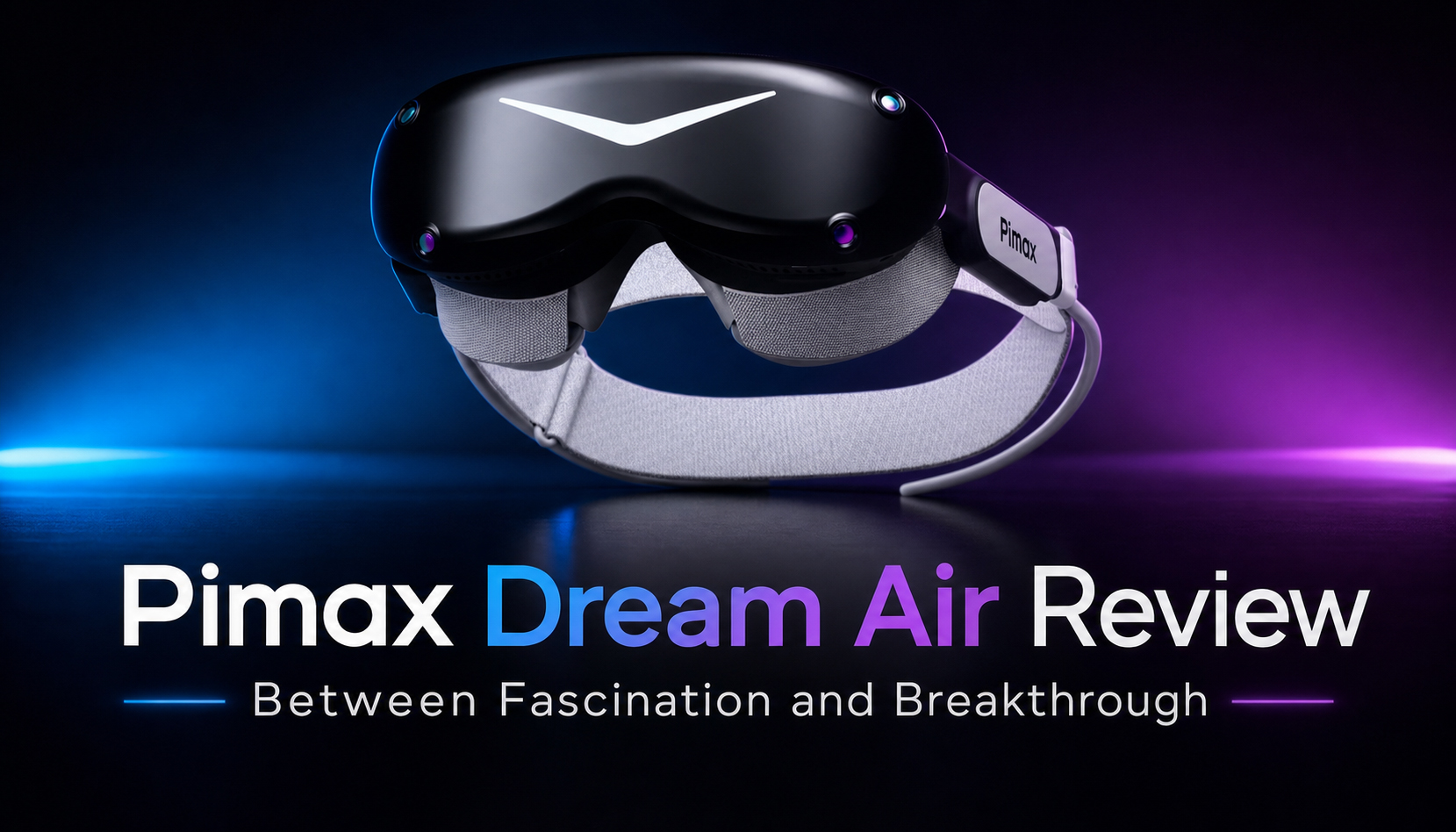
Heise.de subjected the Pimax Dream Air to a comprehensive practical test – Image: Xpert.Digital
Apple technology for PC gamers: Why this 170-gram headset is shaking up the VR world
Better than Meta and Apple? How an outsider builds the perfect VR headset for sim fans
170 grams, Micro-OLED & 8K: Is this the new king of PC VR headsets?
VR enthusiasts and simulation fans have been waiting for months, and now it's here: The Pimax Dream Air promises nothing less than a technological revolution for home PC gaming. Weighing in at a mere 170 grams and featuring high-resolution Sony Micro-OLED panels – the same cutting-edge display technology used in Apple's Vision Pro – the Chinese manufacturer Pimax aims to completely redefine the high-end VR headset segment. Gone are the days of bulky headsets that resemble motorcycle helmets, strain neck muscles, and hamper immersion with distracting screen-door effects. But can this ambitious underdog, with its bold change in strategy, live up to the community's extremely high expectations? And does this compact premium package justify the hefty price tag? Our in-depth review reveals why the Pimax Dream Air is a true milestone, where the technology still needs refinement, and for whom the investment is truly worthwhile.
Between fascination and new beginnings: The Pimax Dream Air in practical testing
A small company dares to do something big – and delivers an impressive step forward
Heise.de subjected the Pimax Dream Air to a comprehensive practical test – and the result is as nuanced as the device itself. The Chinese manufacturer Pimax, on the market since 2014 and known primarily for its ambitious wide-angle headsets, is entering completely new territory with the Dream Air: The compact device, weighing only 170 grams, is finally intended to deliver what VR enthusiasts have been demanding for years – namely, crystal-clear image quality in a form factor that doesn't resemble a motorcycle helmet.
That Pimax would take this step was long considered unlikely. The Shanghai-based company had made a name for itself by experimenting with the largest possible field of view – at the expense of weight and elegance. The Crystal series and its predecessors were technically respectable, but ergonomically a compromise. The Dream Air, on the other hand, marks a bold change in strategy: away from a technical showroom device and towards a premium product suitable for everyday use, one that aims to keep pace with a new generation of micro-OLED competitors. And that – given the resources of a relatively small company – is a remarkable achievement.
The technological core: Sony panels as the heart of the system
At the heart of the Dream Air are two Sony Micro-OLED panels, each with 3,840 × 3,552 pixels – the same display technology used in the Apple Vision Pro. This results in a combined resolution of nearly 7,680 × 3,552 pixels and a pixel density that virtually eliminates the so-called screen-door effect, a flaw that plagued older VR headsets.
Micro-OLED panels differ fundamentally from the LCD panels used in entry-level headsets. While LCDs rely on backlighting, making true black levels impossible, each pixel in a micro-OLED panel emits its own light – or remains completely dark when needed. The result is a contrast ratio of up to 1,000,000:1 compared to a meager 10,000:1 for typical VR LCDs. Furthermore, response times in the nanosecond range minimize motion blur and significantly reduce VR sickness.
Pimax complements the optical chain with its own ConcaveView pancake lenses featuring a concave outer layer – a design that, according to the company, enables the widest field of view of any compact micro-OLED headset, while simultaneously delivering high edge sharpness. Tobii supplies the 120 Hz eye-tracking system, which not only enhances social applications but also allows for dynamic foveated rendering: Here, only the area of the image the user is currently looking at is rendered in full resolution, while the rest of the image field is calculated with reduced detail density – significantly reducing the load on the graphics card.
Image transmission is lossless via DisplayPort cable directly from the PC. This might seem like a step backwards for users accustomed to wireless freedom – but it's the crucial technical innovation that ensures exceptional image quality and makes the extremely lightweight design of just 170 grams possible. Wireless solutions require a battery, processor, and encoder chips inside the device; all of these are deliberately omitted here to maximize image quality.
Lightness as a promise and a standard
The weight comparison is remarkable: The Dream Air, in its configuration with head strap and cushion, weighs 310 grams, roughly the same as a modern smartphone. For comparison, the Meta Quest 3 weighs nearly 515 grams, and older Pimax models were significantly heavier. Even the previous lightweight champion, the Bigscreen Beyond 2, with its 107-gram head, benefits from a custom-fit face cushion, which isn't available on the Dream Air – however, Pimax offers considerably more functionality right out of the box and is designed for a much wider range of face shapes.
From an ergonomic perspective, weight is the decisive factor for long sessions. Simulation enthusiasts who spend hours playing flight simulators like Microsoft Flight Simulator or racing games like Assetto Corsa Evolution are familiar with the problem of neck strain caused by heavy headsets. The Dream Air directly addresses this issue, and initial detailed reviews confirm that it is significantly more comfortable to wear than previous models – a real improvement that is immediately noticeable.
The fact that the face seal doesn't fit perfectly on every face shape indicates potential for improvement in future revisions, but it's not a fundamental problem. Pimax specifies a horizontal field of view of 110 degrees – a very good value for a compact headset, more than sufficient for most application scenarios, and delivering an impressive sense of immersion in practice.
The price of ambition: Pricing policy and variant model
Pimax sells the Dream Air in two fundamentally different versions. The Lighthouse version, which relies on the proven SteamVR tracking ecosystem with external base stations, costs from around €2,035 including VAT on idealo.de, but without controllers. Those who already own Lighthouse base stations and controllers from previous headsets can jump right in and benefit from a sophisticated tracking system.
The SLAM version, which Heise.de used for the test, costs around €2,499 in German stores, including a controller for inside-out tracking via built-in cameras. This version does not require external base stations, making setup significantly simpler. A subsequent upgrade from the SLAM version to Lighthouse tracking is technically impossible – a point that potential buyers should consider carefully before purchasing.
This clearly positions the Dream Air in the premium segment. A direct competitor is the Bigscreen Beyond 2, which, while even lighter at only 107 grams and boasting a customizable face cushion, offers a lower resolution of 2,560 x 2,560 pixels per eye, lacks eye tracking and integrated audio, and relies solely on Lighthouse tracking. The Dream Air thus offers a significantly more comprehensive feature set – largely justifying the price difference.
SLAM tracking: A growing system with real potential
SLAM tracking – that is, room measurement using built-in cameras without external base stations – is a technically demanding undertaking. Meta has optimized this technology for the mass market over years with considerable engineering effort. The fact that Pimax, a significantly smaller company, is entering the market with its own internally developed SLAM system is, first and foremost, remarkably bold.
User experiences are mixed, but overall revealing: Many report very reliable tracking, while others perceive occasional inaccuracies under certain environmental conditions – such as walls with little texture or unfavorable lighting. The system requires visual anchor points in the environment, which isn't a problem for most furnished living and working spaces, but can lead to occasional jitter in very bare rooms.
What's particularly positive is that Pimax has proven it responds to feedback. With Pimax Play 2.0 and recent firmware updates, numerous users are reporting significantly improved stability and considerably reduced CPU usage. This commitment to continuous improvement is exactly what you'd expect from a dedicated technology company that takes its product seriously – and it demonstrates that Pimax listens to its users. For those who prioritize maximum tracking precision, the Lighthouse variant remains the more robust choice – and here, too, the community has explicitly praised Pimax's progress.
🗒️ Xpert.Digital: A pioneer in the field of Extended and Augmented Reality

Finding the right Metaverse agency, planning office, or consulting firm - Image: Xpert.Digital
🗒️ Finding the right Metaverse agency, planning office, or consulting firm – Search and search: Top Ten Tips for Consulting & Planning
More information here:
Delivery delay or quality strategy? The background to the Dream Air
Software as a maturation process: On the right track
Pimax is known in the VR community not only for its optics, but also for its years-long software development journey. Pimax's proprietary software suite has undergone a noticeable evolution: from the early PiTool versions, which tested the patience of some users, to the current Pimax Play 2.0, which represents a significant leap in quality.
Pimax Play 2.0 is significantly more user-friendly, easier to set up, and many of the previous compatibility issues have been specifically addressed. The fact that a small company builds and maintains a complete driver and software ecosystem for a highly complex device alongside hardware development is no small feat – and deserves recognition. The active developer community on platforms like the OpenMR forum, which works closely with Pimax, is a key driver of quality and demonstrates that the company has built a loyal and engaged user base.
The fact that further updates follow the launch is normal for such a complex product and not a sign of poor quality, but rather of a genuine commitment to support. Anyone buying the Dream Air today is buying a device that improves with each firmware generation – a characteristic that speaks to long-term satisfaction.
The VR market in 2026: Structural change and new rules of the game
The Pimax Dream Air is entering a market undergoing fundamental change. The global market for VR headsets was estimated at nearly US$16.8 billion in 2025 and is projected to grow to US$76.4 billion by 2034 – an annual growth rate of over 18 percent. The German market for VR headsets recorded sales of approximately €270 million in 2025, with an upward trend.
Within this growth market, the balance is shifting noticeably. The mass market is dominated by large corporations like Meta, whose Quest series, with its easy onboarding and wireless operation, appeals to the broad consumer. The high-end PC VR segment, in which Pimax operates, is smaller, but technologically highly dynamic and boasts high purchasing power. The fact that a comparatively small company like Pimax can compete with heavyweights like Apple and Samsung here – and keep pace in terms of image quality – is a remarkable entrepreneurial achievement.
The market penetration of micro-OLED displays is accelerating this shift. While just a few years ago the technology was reserved for the Apple Vision Pro as an exclusive differentiating feature, several manufacturers are now relying on Sony panels or comparable solutions. Pimax is among the pioneers of this development in the compact PCVR segment – and has demonstrated with the Dream Air that an independent innovator can help shape the technological agenda.
Delivery delays in context: Quality takes time
The Dream Air was originally slated for delivery in May 2025 but didn't reach a wider user base until early 2026. For many who pre-ordered, this was a test of patience. At the same time, it's worth putting this timeline into perspective: Pimax develops highly complex hardware with proprietary optics, its own SLAM tracking system, and deeply integrated eye-tracking – and does so as a relatively small company without the resources of an Apple or Samsung.
Pimax's decision to use the time to directly incorporate feedback from early demos at CES 2026 into the final firmwarespeaks to a responsible product policy. Around a thousand people tested the headset at CES, and Pimax responded to their feedback with targeted improvements before the market launch. This isn't a failure, but rather the expression of a company that prefers to deliver a more mature product later rather than a half-finished one earlier – an approach that strengthens the trust of the user community in the long run.
Positioning in the competitive landscape: Focus on strengths
In direct comparison with the competition, the Dream Air presents a clearly defined and compelling profile. In terms of raw screen resolution, the headset boasts the sharpest display in its class within a compact form factor – its 3,840 × 3,552 pixels per eye significantly surpass the Bigscreen Beyond 2 with its 2,560 × 2,560 pixels. Eye tracking, integrated spatial audio, and the flexible tracking system make the Dream Air a more functionally complete device than many competitors, which require expensive accessories for comparable features.
For discerning simulation enthusiasts who want the highest possible visual fidelity in flight, racing, or training simulations, the Dream Air is an exceptionally strong choice. The flight and racing simulator sector is not a niche market: with titles like Microsoft Flight Simulator 2024 and Assetto Corsa Evolution, PC VR simulation has recently gained a significant user base, and this user group benefits most from the Dream Air's image sharpness and comfort.
The wired DisplayPort connection isn't a flaw, but a deliberate design choice: it ensures lossless image transmission without compression, which is immediately noticeable in direct comparison to compressed wireless solutions. Anyone who has looked through the lenses of the Dream Air understands why this compromise isn't a compromise for many users, but rather exactly what they need.
Technological perspective: Pimax as a pioneer
Pimax's decision to use Sony Micro-OLED panels as the core of the Dream Air is not just a product feature, but a strategic signal with implications for the entire industry. Silicon wafer-based Micro-OLED technology enables pixel densities of over 1,000 PPI while maintaining low weight and energy consumption – characteristics that are crucial for wearable computing in the long term.
That an independent company like Pimax is making this technology accessible in a practical form factor long before major consumer electronics manufacturers follow suit is a true pioneering achievement. Anyone investing in a micro-OLED headset today is buying into the display technology of the next decade – and with the Dream Air, Pimax has demonstrated that this technology is feasible in the first truly portable PCVR headset.
In the long term, Micro-OLED is likely to remain the dominant display technology in the high-end VR segment until MicroLED panels become commercially affordable. The ten technical advantages of this technology—from deep blacks and a large sweet spot to lighter weight and consistent quality—play directly into Pimax's hands and make the Dream Air a device that will not only gain relevance over time, but will continue to do so.
Economic conclusion: An impressive step by an ambitious company
The Heise review of the Pimax Dream Air can be summarized in one sentence: The line between enthusiasm and frustration is often just a matter of moments – but enthusiasm prevails. The Dream Air is the most technologically ambitious PC VR headset ever released in a compact form factor. The Sony Micro-OLED panels, eye-tracking, image sharpness, and low weight are exceptional – and a clearly compelling combination for the right target group.
It's important to put Pimax into perspective: The company isn't a megacorporation with access to enormous development and quality assurance budgets. It's a dedicated innovator developing products with comparatively limited resources that technologically rival Apple and Meta – and in some areas even surpass them. That some software features or the SLAM tracking aren't yet perfectly polished is understandable and perfectly normal.
Crucially, Pimax is actively working on these issues and taking its user community seriously. Those who buy the Dream Air aren't just investing in a device, but in an ecosystem that improves with every update, and in a company that brings genuine passion to VR technology. For VR enthusiasts who want to get the most out of PC VR and accompany Pimax on this journey, the Dream Air is already a fascinating device today – and perhaps tomorrow an undisputed benchmark.
Your global marketing and business development partner
☑️ Our business language is English or German
☑️ NEW: Correspondence in your native language!

Konrad Wolfenstein
I and my team are happy to be available to you as your personal advisor.
You can contact me by filling out the contact form here [email protected]:or simply call me at +49 7348 4088 965. My email address is
I'm looking forward to our joint project.
☑️ SME support in strategy, consulting, planning and implementation
☑️ Creation or realignment of the digital strategy and digitization
☑️ Expansion and optimization of international sales processes
☑️ Global & Digital B2B trading platforms
☑️ Pioneer Business Development / Marketing / PR / Trade Fairs
🎯🎯🎯 Data-driven B2B industry hub as a quasi-in-house solution

The quasi-in-house solution: How Xpert.Digital closes operational gaps in B2B marketing and sales – Smart Content-Driven Business - Image: Xpert.Digital
Xpert.Digital is a data-driven B2B industry hub led by Konrad Wolfenstein . The company acts as an external, quasi-in-house solution for industrial partners, closing operational gaps in marketing, content, and sales – without requiring additional resources on the client side.
More information here:









