

Published on: March 1, 2026 / Updated on: March 1, 2026 – Author: Konrad Wolfenstein
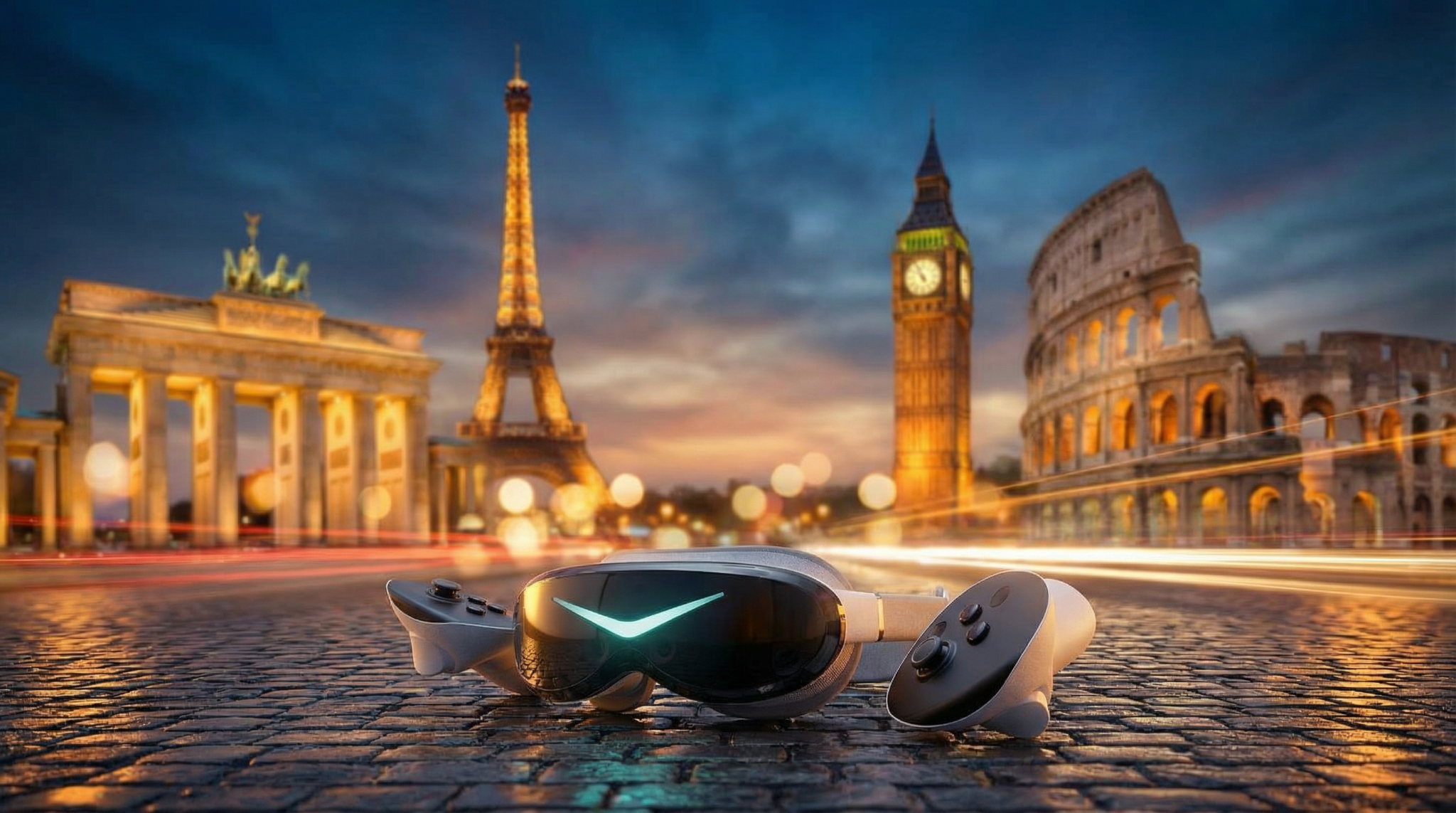
High-end VR from Pimax – Ingenious trick for VR fans with Crystal & Dream Air: Why importing from the US is really worthwhile with Pimax – Image: Xpert.Digital
The transatlantic price-performance gap: When location determines the experience
Less features for more money: The annoying price problem with Pimax VR headsets
Pimax has established itself as a major player in the virtual reality scene, impressing sim racers, flight simulator enthusiasts, and VR professionals alike with razor-sharp resolutions and wide fields of view. With high-end headsets like the "Crystal" series and the brand-new, ultra-lightweight "Dream Air," the company is aiming for the VR crown – especially since industry giants like Meta are increasingly neglecting the absolute premium segment. However, for European buyers, this technical brilliance comes with an unfortunate catch: a closer look at the pricing reveals a noticeable disadvantage compared to the US market. While American customers benefit from comprehensive bundles, European VR enthusiasts often end up paying more for fewer accessories. We examine why Pimax pursues this strategy, why direct import from the US is often the smartest solution despite customs fees, and what challenges the VR market faces in 2026.
A niche player with growing relevance
Pimax has carved out a unique position for itself in the virtual reality industry. Since its highly successful Kickstarter campaign in 2017, which raised nearly $4.3 million, the Chinese company has established itself as a specialist in high-resolution VR headsets with wide fields of view. In a market dominated by Meta, Sony, and increasingly Apple, Pimax consistently serves the niche of the most demanding users: sim racers, flight simulator enthusiasts, and VR professionals who require maximum image sharpness and immersion.
The product range now comprises four main models: the entry-level Crystal Light, the premium Crystal Super, and the new ultralight Dream Air and Dream Air SE. Shipping of the Dream Air began in February 2026 after an extensive testing and demonstration phase at international technology trade shows in Los Angeles, San Jose, Düsseldorf, and CES 2026 in Las Vegas.
The price discrepancy between markets
A detailed price comparison between the US and European markets reveals systematic differences that go beyond mere currency conversion. The Crystal Light costs $899 in the US shop and €853 in the European shop. With an exchange rate of approximately $1.05 per euro in February 2026, the European price equates to a calculated dollar value of around $896, which appears almost identical.
The Crystal Super is offered in the US starting at $1,799, and in Europe starting at €1,636. At first glance, Europe seems cheaper. But the devil is in the details. German Idealo prices for the Crystal Light start at €949, which is significantly higher than the price in the European Pimax store and reflects the retail markup.
The Dream Air, with a total price of $1,999 to $2,299, is the most expensive model in the lineup. The Dream Air SE starts at $899. Both models use a split-pay model, requiring an upfront payment and a Prime Fee payable after delivery and a 14-day trial period.
The bundle problem
The real discrepancy lies not primarily in the base price, but in the regional bundle differences. US-exclusive packages often include the DMAS audio system and a premium comfort kit, which are not included in the standard European version. Technically speaking, European customers are therefore paying a premium for a product with fewer features.
A detailed cost analysis shows that even taking into account currency conversion, international shipping costs, and import sales tax, the US import price for the complete bundle can be significantly lower than the local German retail price. One German sim racer reported saving approximately €140 when importing the US bundle with DMAS audio to Germany.
The VR market in numbers
The global VR market reached a volume of US$20.83 billion in 2025 and is projected to grow to US$26.71 billion in 2026. A volume of US$171.33 billion is forecast for 2034, representing an annual growth rate of 26.2 percent.
North America dominates the market with a share of 35.6 percent and a volume of US$7.33 billion in 2025. The US market alone is projected to reach a volume of US$4.79 billion in 2026. Europe is also growing dynamically, with the British market projected to reach US$1.70 billion and the German market US$1.35 billion by 2026.
Pimax strategy in regional comparison
Pimax's differentiated market treatment is economically understandable, but strategically problematic. The US market is the most important single market for VR hardware manufacturers due to the higher purchasing power within the enthusiast niche, the proximity to the Silicon Valley ecosystem, and the cultural affinity for gaming and simulation. The more attractive bundles and, in some cases, lower effective prices reflect the competitive pressure from Meta and the need to achieve maximum penetration in this core market.
Europe, and Germany in particular, represents a growing but secondary market for Pimax. The company has created a dedicated platform with its European store, eu.pimax.com, and offers European prices in euros. The demonstrations in Düsseldorf, part of the global tour, show that Pimax is taking the German market seriously. Nevertheless, the product range and the availability of bundles still lag behind the US offerings.
The technological positioning
Technically, Pimax headsets are at the absolute top of the market. The Crystal Super offers a resolution of 3,840 by 3,840 pixels per eye, a choice between QLED and Micro-OLED displays, aspherical glass lenses, eye tracking, and an automatically adjustable IPD between 58 and 72 millimeters. The Crystal Super with Sony 8K Micro-OLED goes even further at a price of $2,199, offering a 116-degree HFOV with Pimax's proprietary ConcaveView optics.
The Dream Air weighs less than 170 grams, making it impressively lightweight for a fully equipped VR headset with a Sony Micro-OLED display, eye tracking, hand tracking, and spatial audio. These specifications directly target users who spend hours a day in VR and therefore rely on weight and comfort.
Outlook and market dynamics
The VR industry will reach a turning point in 2026. After a period of massive investment, Meta has partially withdrawn from the high-end segment, which analysts interpret as a potential comeback for PCVR hardware. Pimax is positioned to capitalize on this vacuum, provided the company addresses the price discrepancies and availability gaps in the European market.
Pimax's fundamental challenge remains scaling. As a niche provider with comparatively small production volumes, the company is less flexible in its pricing than mass-market suppliers. Regional price differences and bundle asymmetries are partly a reflection of this structural limitation. For European enthusiasts, this means that, for the time being, informed direct import from the USA remains the more economically sound option in many cases, even if it involves warranty complexities and shipping risks.
The VR market will be driven by a growth rate of over 26 percent annually in the coming years. In this dynamic environment, Pimax must sharpen its European strategy if it doesn't want to risk losing the important DACH market to competitors who are prepared to offer more attractive overall packages across all regions.
Your global marketing and business development partner
☑️ Our business language is English or German
☑️ NEW: Correspondence in your native language!

Konrad Wolfenstein
I and my team are happy to be available to you as your personal advisor.
You can contact me by filling out the contact form here or simply call me at +49 7348 4088 965. My email address is: [email protected]
I'm looking forward to our joint project.


