

How ten routes of a post-war order with Bulgaria became the nine strategic axes of the 21st century
Xpert Pre-Release

Available in 27 languages 📢
Prefer Xpert.Digital on GoogleⓘPublished on: July 1, 2026 / Updated on: July 1, 2026 – Author: Konrad Wolfenstein
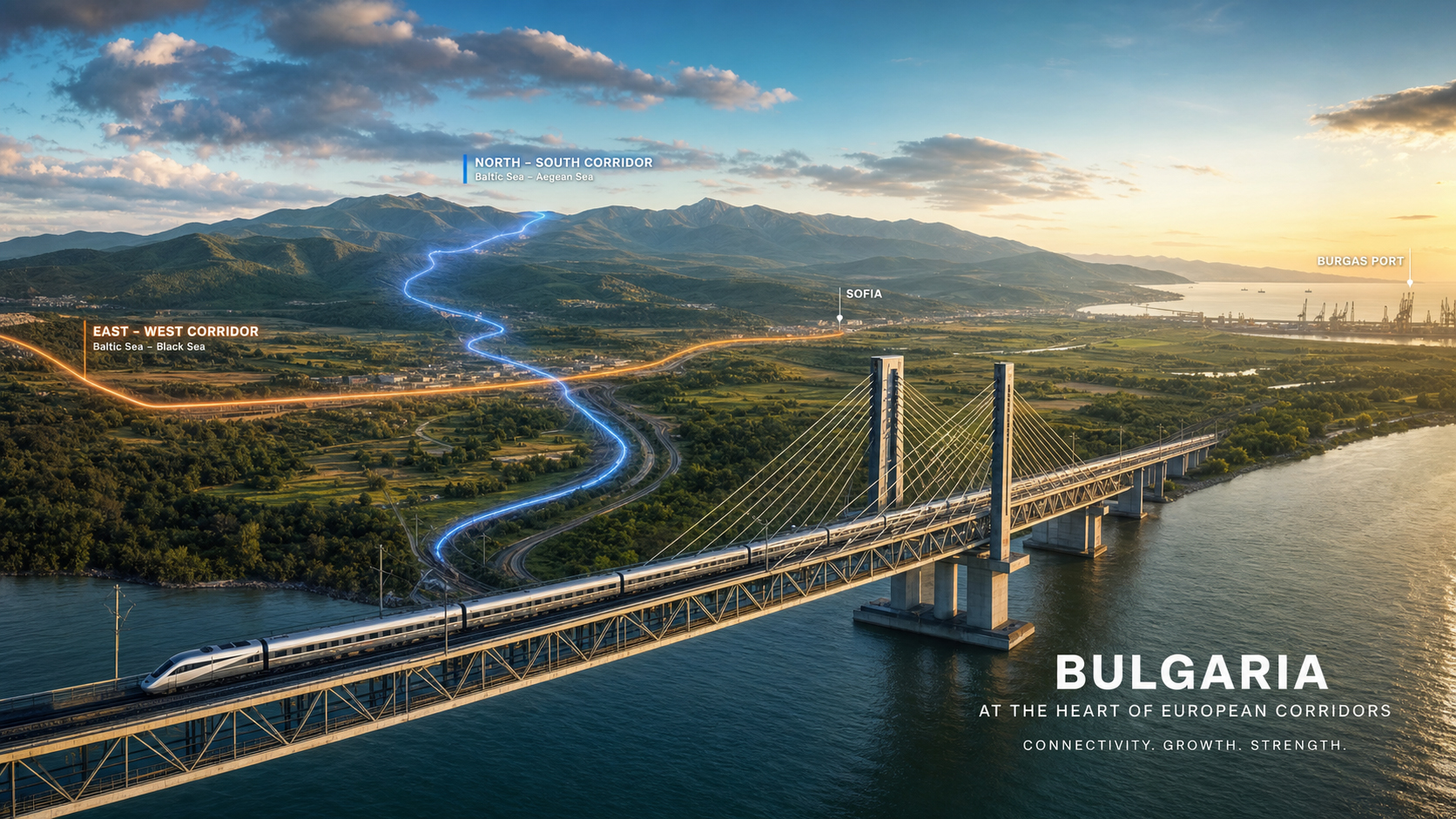
How ten routes of a post-war order with Bulgaria became the nine strategic axes of the 21st century – Image: Xpert.Digital
Why Bulgaria is more than just a transit country: From a peripheral country to a hub
Europe's new gateway to the East: Why Bulgaria is suddenly becoming indispensable
No longer just a transit country: Why China's and Europe's goods now meet in Bulgaria
For a long time, Bulgaria was considered a neglected cornerstone of European infrastructure planning – a difficult periphery of a continent that has long since blanketed its west with state-of-the-art high-speed rail lines. But those days are over. Thanks to the sweeping reform of the Trans-European Transport Network (TEN-T) and recent geopolitical upheavals, the Balkan nation has suddenly moved to the center of strategic interests. From the historic Helsinki Corridor network of the 1990s to the multi-billion-euro expansion projects of today, Bulgaria is developing into an indispensable bridge between the EU single market, Turkey, and the booming Eurasian Central Corridor. Learn how a mere transit country is becoming a geopolitical asset, which mega-projects are set to forever transform the country's rail and port landscape, and why the path from strategic promise to operational reality is still fraught with significant structural challenges.
Related to this:

Bulgaria in the European corridor network – From Helsinki to Brussels
In the European infrastructure debate, Bulgaria is often seen as a peripheral country, a difficult southeastern corner of a continent that has long since blanketed its west with high-speed rail lines. This view is not only incomplete, it is dangerously short-sighted, both politically and economically. With the far-reaching reform of the Trans-European Transport Network (TEN-T) through Regulation (EU) 2024/1679, Bulgaria has gained a new dimension within the overall structure of European connectivity. The country now lies at the intersection of two of the nine core European corridors and has thus become – at least on paper – a strategic bridge between the EU's core market, Turkey, and the Eurasian Central Corridor. However, the transition from the old pan-European routes to the new corridors is not a simple renaming. It is a political, technical, and financial story spanning three decades of European struggle over infrastructure, sovereignty, and cohesion.
Why Helsinki 1997 was the starting point of everything: The birth of the pan-European corridors
The starting point for understanding today's TEN-T architecture lies not in Brussels, but in Helsinki. In 1997, the Conference of European Transport Ministers (ECMT/CEMT) defined ten pan-European transport corridors, the so-called Helsinki Corridors. These corridors emerged at a historically unique moment: The end of the Cold War had suddenly expanded Europe to include dozens of countries whose infrastructure, after decades of socialist planned economies, urgently needed modernization and integration into the Western network. The pan-European corridors were not a bureaucratic exercise, but a political instrument for stabilization and rapprochement.
Bulgaria was directly affected by two of these ten routes: Corridor IV connected Dresden via Budapest, Bucharest, and Sofia to Istanbul, making it one of the continent's most important east-west axes. Corridor X, on the other hand, ran from Salzburg and Vienna via Ljubljana, Zagreb, Belgrade, and Niš to Sofia and on to Thessaloniki, with a central branch leading through Serbia and via Sofia towards the Turkish border. These two routes were of paramount economic and geopolitical importance to Bulgaria, as they connected the country with two of Europe's wealthiest markets in the northwest and the burgeoning Turkish market in the east. In addition, there was the pan-European Corridor VIII, an east-west axis in the southern Balkans that connected the Albanian Adriatic ports near Durrës, via Skopje and Sofia, with the Bulgarian Black Sea ports of Burgas and Varna.
However, all these corridors had one crucial drawback: they were created within a geopolitical and institutional framework that, while sensible at the time of their inception, increasingly lost its binding force as the EU expanded. The Helsinki Corridors defined routes, not concrete quality standards, binding deadlines, or uniform technical norms. They were a political declaration of intent, not an operational planning instrument. This needed to fundamentally change.
From political symbol to engineering plan: The TEN-T reform of 2013
The profound realignment of European infrastructure policy began with a dual decision in 2013. In December of that year, the European Parliament and the Council adopted Regulation (EU) No 1315/2013 on guidelines for the Trans-European Transport Network. This reform did not represent a gradual adjustment, but rather a conceptual reorganization. The ten political Helsinki routes were replaced by a two-tiered network: a comprehensive overall network, to be completed by 2050, and a priority core network, to be finished by 2030. Within this core network, nine core network corridors were defined, each established as an operational planning unit with its own governance mechanism, a European coordinator, and binding work plans.
This structural change had immediate consequences for Bulgaria. The old pan-European Corridor IV became the Orient/Eastern Mediterranean Corridor (Corridor 4), the primary TEN-T corridor for Bulgaria. The Rhine-Danube Corridor (Corridor 9) integrated the Bulgarian section of the Danube as an inland waterway. The old Helsinki Corridors VIII and X disappeared as formal planning categories but continued to exist in the form of sections, strategic supplementary axes, and freight corridors. The crucial paradigm shift lay in the fact that the new system was no longer based on the logic of political connection but on the logic of economic necessity and technical interoperability. The focus was no longer on the question "Which countries should be connected?" but rather on "What infrastructure does Europe need to keep its internal market competitive?"
The Orient/Eastern Mediterranean Corridor: Bulgaria's primary European integration
The Orient/Eastern Mediterranean Corridor, often referred to as Corridor 4 in official EU terminology, is far more than a transit route for Bulgaria – it is the country's primary connection to the core European market. The route runs from the German North Sea ports of Hamburg, Bremen, and Rostock via Hanover, Dresden, and Prague, then via Vienna and Bratislava to Budapest, continuing through Timișoara and Craiova to the Vidin–Calafat Danube bridge, which connects Bulgaria with Romania. From Vidin, the corridor continues to Sofia, where it branches into three strategically important lines.
The first branch leads from Sofia via Plovdiv to Burgas on the Black Sea, the second from Plovdiv via Svilengrad to the Turkish border, and the third connects Sofia via Thessaloniki and Athens to the Greek port of Piraeus and from there via a maritime highway to Cyprus. This geometry clearly illustrates the extraordinary strategic concentration at a single point: Sofia is the crucial intersection of four directions – northwest to the heart of Europe, east to the Black Sea, south to the Aegean, and southeast to Turkey. No other EU member state has a comparable branching of a single core corridor.
The Vidin–Calafat Danube Bridge, opened in 2013 after decades of political delay, serves as the crucial link between the corridor on the Romanian and Bulgarian sides. The structure, with a total length of 3,598 meters, 1,791 meters of which span the Danube, combines road and rail traffic on a shared route and was financed by the EU, the European Investment Bank, the French Development Agency (AGF), and the German KfW. It is thus itself a symbol of the logic behind the new TEN-T project: not political declarations of intent, but concretely financed, technically realized infrastructure.
Immediately after the border crossing, modernization of the Sofia–Vidin railway corridor begins on the Bulgarian side. This 280-kilometer section is electrified, but two-thirds of it is single-track and, with an operating speed of under 100 km/h, falls significantly short of TEN-T requirements. Accordingly, the EU has identified four strategically important modernization projects within its 2021–2027 Transport Connectivity Programme, including the modernization of the Elin Pelin–Kostenets section and the rehabilitation of the Plovdiv–Burgas line. According to the Bulgarian Ministry of Transport, a total of more than 550 kilometers of railway lines are currently undergoing modernization, most of them along Corridor 4.
The Rhine-Danube Corridor: The waterway as an underestimated backbone
The Rhine-Danube Corridor (Corridor 9) primarily affects Bulgaria through its function as an inland waterway and a multimodal transport axis connecting Western Europe with the Black Sea region. The corridor begins in the North German ports of Wilhelmshaven, Bremen, Hamburg, and Rostock and runs via Hanover and Berlin, as well as along the Rhine-Main-Danube axis, to Constanța in Romania and Sulina at the Danube Delta. Bulgaria's involvement in this corridor is primarily through the section of the Danube within its territory, stretching from Vidin in the northwest to Silistra in the northeast – a total of more than 470 kilometers of waterway, which is among the busiest inland waterways in Europe.
The economic value of the Rhine-Danube Corridor for Bulgaria is often underestimated because public discourse is dominated by the glamorous rail projects. Yet the Danube port of Ruse is one of Bulgaria's most important freight transshipment points and fulfills a central function as a multimodal hub where inland waterway, rail, and road transport converge. The corridor encompasses nine EU member states as well as Serbia and Ukraine, thus connecting the entire Central European industrial zone with the Black Sea region. Bulgaria is not on the periphery, but at the terminus of this European inland waterway, giving the country a role as a maritime gateway that extends far beyond mere transit.
The complementarity of Corridor 4 and Corridor 9 is particularly evident at the Vidin junction: Here, the Danube bridge, part of the Orient Corridor, and the Danube River, part of the Rhine-Danube Corridor, physically converge. It is the only point in Bulgaria where both core European corridors meet at a single geographical junction – a constellation that makes Vidin one of the most theoretically important logistics hubs in Southeast Europe, even if the actual infrastructure still falls far short of its strategic potential.
What became of the old routes: Corridor VIII and X in a new guise
The replacement of the pan-European Helsinki corridors with the new TEN-T system did not mean the end of these historical routes, but rather their integration into a new system under altered circumstances. The more politically sensitive of these transformations concerns pan-European Corridor VIII, the west-east axis running from the Albanian Adriatic ports near Durrës, via Skopje and Sofia, to the Bulgarian Black Sea ports of Burgas and Varna. Since EU Regulation 2024/1679, this route has been explicitly enshrined as a priority element in the TEN-T corridor "Western Balkans–Eastern Mediterranean," thus undergoing a formal upgrade that goes beyond a mere continuation of the Helsinki framework.
The story of Corridor VIII is a story of perpetually postponed promises. For three decades, the continuous rail link from the Adriatic to the Black Sea has been featured on various European policy documents, yet its full realization has never been even remotely in sight. The central obstacle has always been the missing rail link between Bulgaria and North Macedonia – specifically, the section from the Bulgarian railway station Gyeshevo to the entrance of the Deve Bair Tunnel on the Macedonian border, a mere 2.4-kilometer stretch that remained unfinished for decades. Political tensions between Sofia and Skopje, bureaucratic blockages, and unresolved financing issues transformed this minimal missing piece into a symbol of the widespread failure of regional infrastructure cooperation.
The breakthrough came in November 2025: On November 6, Bulgaria and North Macedonia signed the intergovernmental agreement in the Bulgarian village of Gyueshevo for the preparation, construction, and operation of a cross-border railway tunnel. The European Commission, represented by Valentina Superti, Director for the Western Balkans in the Directorate-General for Enlargement Policy, described the tunnel project as a leading initiative within the framework of the Global Gateway strategy, with far-reaching socio-economic benefits for the entire region. For the Macedonian section, Team Europe – consisting of the EU, the EIB, and the EBRD – mobilized a financing package of €560 million in December 2023, comprised of Global Gateway funds, EIB loans, and cohesion funds. On the Bulgarian side, Transport Minister Grozdan Karadzhov launched the tender process in July 2025 for the construction of the 2.4-kilometer railway line between Gyueshevo and the state border, financed with 69 million euros from the 2021-2027 Transport Connectivity Programme. The Bulgarian Deputy Prime Minister stated that Bulgaria will invest a total of over 1.5 billion euros in modernizing the railway connection from Sofia to the Macedonian border.
On the Macedonian side, the €79 million Kumanovo–Beljakovci section has already been completed, while the Beljakovci–Kriva Palanka section, with an investment volume of €155 million, is scheduled for completion in October 2026. The tender process for the Kriva Palanka to Bulgarian border section, which will cost approximately €455 million, is to be restarted by the end of 2025; an additional €110 million will be spent on signaling systems and the electrification of the Kumanovo to border section. The section on Bulgarian territory – the final 747 kilometers of the total 1,350-kilometer route within Bulgaria – is expected to be completed by 2030.
The transformation of the pan-European Corridor X took place via a different institutional path: Instead of continuing as an independent designation, the route was incorporated into the Alpine-Western Balkan Rail Freight Corridor (RFC AWB), a rail freight corridor established under Regulation (EU) No. 913/2010, connecting Austria, Slovenia, Croatia, Serbia, and Bulgaria. This corridor runs from Salzburg via Ljubljana, Zagreb, and Belgrade to Sofia and on to Svilengrad on the Turkish border, a total of 2,165 kilometers of railway through five countries and under the management of five infrastructure managers. It is a direct operational continuation of the Helsinki Corridor X, but now institutionalized as a binding freight transport structure with priority track capacity and a joint Corridor One-Stop-Shop for track access requests.
Our EU and German expertise in business development, sales and marketing

Our EU and German expertise in business development, sales and marketing - Image: Xpert.Digital
Industry focus areas: B2B, digitalization (from AI to XR), mechanical engineering, logistics, renewable energies and industry
More information here:
A thematic hub offering insights and expertise:
- Knowledge platform covering global and regional economies, innovation and industry-specific trends
- A collection of analyses, insights, and background information from our key areas of focus
- A place for expertise and information on current developments in business and technology
- A hub for companies seeking information on markets, digitalization, and industry innovations
Central Corridor and ReBirth 28: Bulgaria's chance as an EU gateway via the Black Sea
The TEN-T revision of 2024: Another paradigm shift
TEN-T 2024: How Bulgaria will become a geopolitical gateway between Asia and Europe
The most recent reform of TEN-T was enacted with Regulation (EU) 2024/1679, which was adopted on 13 June 2024 and entered into force on 18 July 2024. This legal act replaces the 2013 regulation and adds a third layer to the existing two-layer model (core network and overall network): the extended core network, which is to be completed by 2040. This results in a three-tiered hierarchy for planning: core network by 2030, extended core network by 2040, overall network by 2050.
Of particular significance for Bulgaria is the formal linking of the ten old Helsinki corridors with the new "Western Balkans–Eastern Mediterranean" corridor, which incorporates the main route of the former pan-European Corridor X as well as branches A to C. This formally implemented what had been discussed politically for years: the Western Balkan states, which are not yet EU members, were fully integrated into the European core network, and the historical routes were granted the same operational status as the Western European core corridors. The extension of the corridors to Ukraine and Moldova—proposed by the Commission in May 2022, immediately after the Russian war of aggression—underscores that TEN-T is no longer merely a tool for economic cohesion, but also a geopolitical instrument for stabilization and rapprochement.
The 2024 revision also introduced stricter technical requirements for the rail network: minimum speeds, axle loads, interoperable ERTMS signaling, and specifications for platform heights and train lengths were made mandatory for all core network lines. For Bulgaria, this means significant investment commitments: large sections of the railway network – particularly on the Sofia–Vidin, Sofia–Svilengrad, and Plovdiv–Burgas lines – do not yet meet TEN-T standards and must be upgraded by 2030 or 2040.
Related to this:

Burgas, Varna and Ruse: Bulgaria's ports as geopolitical assets
The true strategic depth of Bulgaria's position within the TEN-T network only becomes apparent when its ports are considered. Burgas and Varna are the country's two Black Sea ports and thus the only EU ports on the Black Sea east of the Romanian coast. Since the Russian invasion of Ukraine in 2022, they have experienced a geopolitical revaluation that would have seemed unthinkable just a few years ago.
The Central Corridor – officially known as the Trans-Caspian International Transport Route (TITR) – connects China via Kazakhstan, the Caspian Sea, Azerbaijan, and Georgia to the Black Sea, and from there via Turkey or directly to Bulgaria to Europe. Since the northern route through Russia became unusable due to sanctions and increased risk premiums on cargo insurance, the Central Corridor has become the preferred land-based alternative. Kazakhstan, the corridor's main hub, increased its cargo volume from 1.5 million tons in 2022 to 4.5 million tons in 2024 and expects a volume of ten million tons by 2028. Goods from Central Asia can reach Bulgaria on this route in twelve to fifteen days, significantly faster than via conventional sea routes.
Burgas and Varna serve as the first EU gateways for goods arriving from the Georgian Black Sea ports of Poti and Batumi. A direct rail link, the modernization of port capacities, and the simplification of customs procedures are therefore not only infrastructural but also genuinely geopolitical investments. In October 2025, at the Burgas Connectivity Forum, Bulgaria presented its vision for the strategic role of its Black Sea ports as primary EU gateways to the Central Corridor; Deputy Minister Anna Natova emphasized the geostrategic importance of the country as an EU member with direct Black Sea access. The mega-project "ReBirth 28" in Burgas, which includes a 15.5-meter deep-water quay, €85 million in investment, and a direct rail link, is the most concrete expression of this strategy.
In June 2025, President Rumen Radev visited Kazakhstan and Uzbekistan to solidify Bulgaria's role as the European gateway to the Central Corridor. A Memorandum of Understanding was signed with Kazakhstan for the joint development of the Central Corridor and the establishment of a joint working group on transport and logistics issues. With Uzbekistan, a strategic declaration and a cooperation program for 2026–2027 were signed. This diplomatic initiative aligns with the economic policy logic that Bulgaria can only achieve a prominent position in the global competition among transit countries if it reinforces its strategic position through robust bilateral cooperation.
The Danube port of Ruse completes the logistics triangle. As part of the Rhine-Danube Corridor, it connects the Black Sea dimension with the Central European inland waterway and provides freight transport from the Danube region with a direct connection to the Bulgarian Black Sea coast. In April 2026, the Black Sea-Aegean Cooperation Platform (BACP) was established, in which Greece, Bulgaria, and Romania participate with the support of the European Commission to coordinate their transport projects along an eastern axis from Thessaloniki via Alexandroupolis and Burgas to Bucharest. Plans include, among other things, additional Danube bridges between Nikopol and Turnu Măgurele, as well as between Silistra and Călărași, which would significantly enhance the strategic value of Bulgaria's Danube frontage.
Related to this:

Structural weaknesses and the gap between aspiration and reality
The strategic vision is impressive; the operational reality is sobering. Bulgaria is grappling with structural obstacles that extend far beyond individual construction projects. The Sofia–Thessaloniki railway line, a key link in Corridor 4's southern branch, has been out of service for nine years following a dispute between Bulgaria and Greece. The Hemus motorway from Sofia to Varna, under construction since 1974, remains only half-completed. The Plovdiv–Svilengrad section on the Turkish border, crucial for freight traffic to Istanbul and onward to Turkey, suffers from outdated signaling technology and single-track sections.
Behind these specific infrastructure deficits lies a deeper weakness: the institutional fragmentation of Bulgarian transport and investment policy. Actors from the transport, economic, and foreign policy sectors often operate without sufficient strategic coordination, and the country's years of political instability—with several changes of government in quick succession—have severely disrupted the continuity of long-term infrastructure planning. The EU has recognized this and, within the framework of the 2021–2027 Transport Connectivity Programme, is relying particularly on the European Investment Bank and JASPERS technical assistance to support Bulgarian authorities in project preparation, tendering, and implementation.
Competition with the Romanian port of Constanța, which, with its significantly larger throughput and superior hinterland connections, remains the dominant Black Sea hub in the EU, continues to pose a structural challenge for Burgas and Varna. Bulgaria is therefore focusing on complementarity rather than direct competition: specializing in Ro-Ro traffic, containerized Central Corridor goods, and intermodal services for the Trans-Caspian route, while Constanța maintains its focus on bulk goods and grain exports. This division of labor appears realistic, but it presupposes that Bulgaria actually modernizes its port capacities and upgrades the rail hinterland connections of both ports to TEN-T standards – a prerequisite that, according to current projections, will not be met until the late 2030s at the earliest.
Financing: CEF, Cohesion Fund and the logic of participation
In Bulgaria, the transformation from political declaration of intent to physical construction depends to an extent of EU funding that far exceeds the country's own fiscal contribution. The Connecting Europe Facility (CEF), the primary EU funding instrument for TEN-T projects, awarded €23.2 billion in grants across Europe in the period 2014–2020; €25.8 billion is available for the period 2021–2027, of which €11.3 billion is reserved for cohesion-eligible states – including Bulgaria.
The financing logic for Corridor VIII is particularly complex because the route passes through non-EU member states. The EU's Global Gateway Initiative, conceived as an alternative to China's Belt and Road Initiative, plays a key role here: Team Europe – consisting of EU grants, EIB loans, and EBRD financing – provides the necessary funds to bring North Macedonia and Albania up to the same infrastructure standard as EU member states. Specifically, the EU has allocated €150 million in grant funding from the Western Balkans Investment Framework and up to €60 million from the Pre-Accession Assistance Instrument for the Macedonian section of Corridor VIII's eastern branch, supplemented by €175 million each in loans from the EIB and EBRD. According to official Bulgarian figures, the planned investment volume for the Sofia–North Macedonia railway line on Bulgarian territory exceeds €1.5 billion.
Military mobility is also part of the strategic dimensioning of these investments: Regulation (EU) 2024/1679 explicitly establishes the dual-use principle for TEN-T infrastructure for the first time and ensures that roads, bridges, and railway lines are upgraded to support heavy military transport. For Bulgaria, as a NATO member on the alliance's eastern flank, this lends additional security policy legitimacy to the already significant infrastructure investments.
Geopolitical reassessment: Why Bulgaria's position after 2022 has a new quality
Russia's war of aggression against Ukraine has altered the geopolitics of European infrastructure in ways whose full implications are not yet foreseeable. For Bulgaria, this change signifies a structural enhancement of its geostrategic position, manifesting itself in three dimensions.
First, trade geography: The blockade of the northern Eurasian land bridge by Russian territory has made the Central Corridor the main alternative for trade between China and Europe. Bulgaria's Black Sea ports occupy a topographically privileged position as a direct EU entry point for goods from the South Caucasus. The diplomatic offensive in Kazakhstan and Uzbekistan, the political support for the Trans-Caspian International Transport Route, and the modernization projects in Burgas are all expressions of a coherent government strategy to exploit this opportunity.
Secondly, energy geography: With the EU's phasing out of Russian gas imports by 2028, Bulgaria gains a new function as a hub of the southern gas corridor. The gas interconnector with Greece, opened in 2022, enables the onward transport of liquefied natural gas (LNG) from the Mediterranean towards Romania, Ukraine, Moldova, and further to Slovakia. The planned EASTRING pipeline and the BRUA expansion in Romania would make Bulgaria an indispensable energy transit country.
Thirdly, security geography: As a NATO member with a Black Sea coastline, as a bordering country of Turkey, and as a direct neighbor of Greece and Romania, Bulgaria fulfills functions for maritime situational awareness and military logistics, which are increasingly being addressed openly with the dual-use principle of the new TEN-T agreement. The militarization of the Black Sea by Russia and its destabilizing effects on maritime trade significantly increase the strategic value of stable and efficient ports on the EU side of the sea.
Balance sheet: Between strategic rise and structural incompleteness
Bulgaria's position within the TEN-T network can be precisely described as follows: The country occupies an exceptionally important geostrategic location, but its infrastructure does not yet meet the demands of this position. The transformation from the ten pan-European Helsinki corridors to the nine European core corridors has formally enhanced Bulgaria's standing: It now lies at the intersection of the Orient/East Mediterranean Corridor and the Rhine-Danube Corridor, both parts of the European core network with binding quality standards and completion deadlines. The breakthroughs in Corridor VIII – from the Deve Bair Tunnel agreement to the railway modernizations on Bulgarian territory – signal that the years-long deadlock can be overcome.
However, the structural weaknesses are equally undeniable: the outdated railway lines, political instability, institutional fragmentation, and the persistent lag behind the Romanian port of Constanța. A gap exists between the strategic promise and the operational reality, a gap that cannot be closed by financing alone. What Bulgaria also needs is governance capacity: the ability to plan, coordinate, and implement complex multinational infrastructure projects on schedule.
The history of pan-European corridors demonstrates how long these processes can take. Pan-European Corridor IV – the precursor to today's Corridor 4 – was first defined at the Crete Meeting in 1994; the Vidin–Calafat Danube bridge, its key infrastructure element on the Bulgarian-Romanian section, was only opened in 2013. Corridor VIII was also first discussed at the European level in 1994; the complete rail link from the Adriatic to the Black Sea will not become a reality until the early 2030s at the earliest. It doesn't require short bursts of political attention, but rather the long-term commitment of institutions and investors to transform strategic lines on the map into robust corridors in space.
The EU has created the institutional and financial prerequisites with Regulation (EU) 2024/1679, the Global Gateway Initiative, and the CEF Programme 2021–2027. Bulgaria has generated the political momentum with the Deve Bair Agreement, ongoing railway modernizations, and diplomatic opening towards Central Asia. What will now be decisive is the speed of implementation—and the ability to actually put bulldozers, tracks, and terminal infrastructure into action based on strategic documents.
🎯🎯🎯 Data-driven B2B industry hub as a quasi-in-house solution

The quasi-in-house solution: How Xpert.Digital closes operational gaps in B2B marketing and sales – Smart Content-Driven Business - Image: Xpert.Digital
Xpert.Digital is a data-driven B2B industry hub led by Konrad Wolfenstein . The company acts as an external, quasi-in-house solution for industrial partners, closing operational gaps in marketing, content, and sales – without requiring additional resources on the client side.
More information here:
Your global marketing and business development partner
☑️ Our business language is English or German
☑️ NEW: Correspondence in your native language!

Konrad Wolfenstein
I and my team are happy to be available to you as your personal advisor.
You can contact me by filling out the contact form here [email protected]:or simply call me at +49 7348 4088 965. My email address is
I'm looking forward to our joint project.





