
Online embarrassment: Experts tear apart an “AI painting” – but it was a real Monet
Xpert Pre-Release

Available in 27 languages 📢
Prefer Xpert.Digital on GoogleⓘPublished on: May 16, 2026 / Updated on: May 16, 2026 – Author: Konrad Wolfenstein
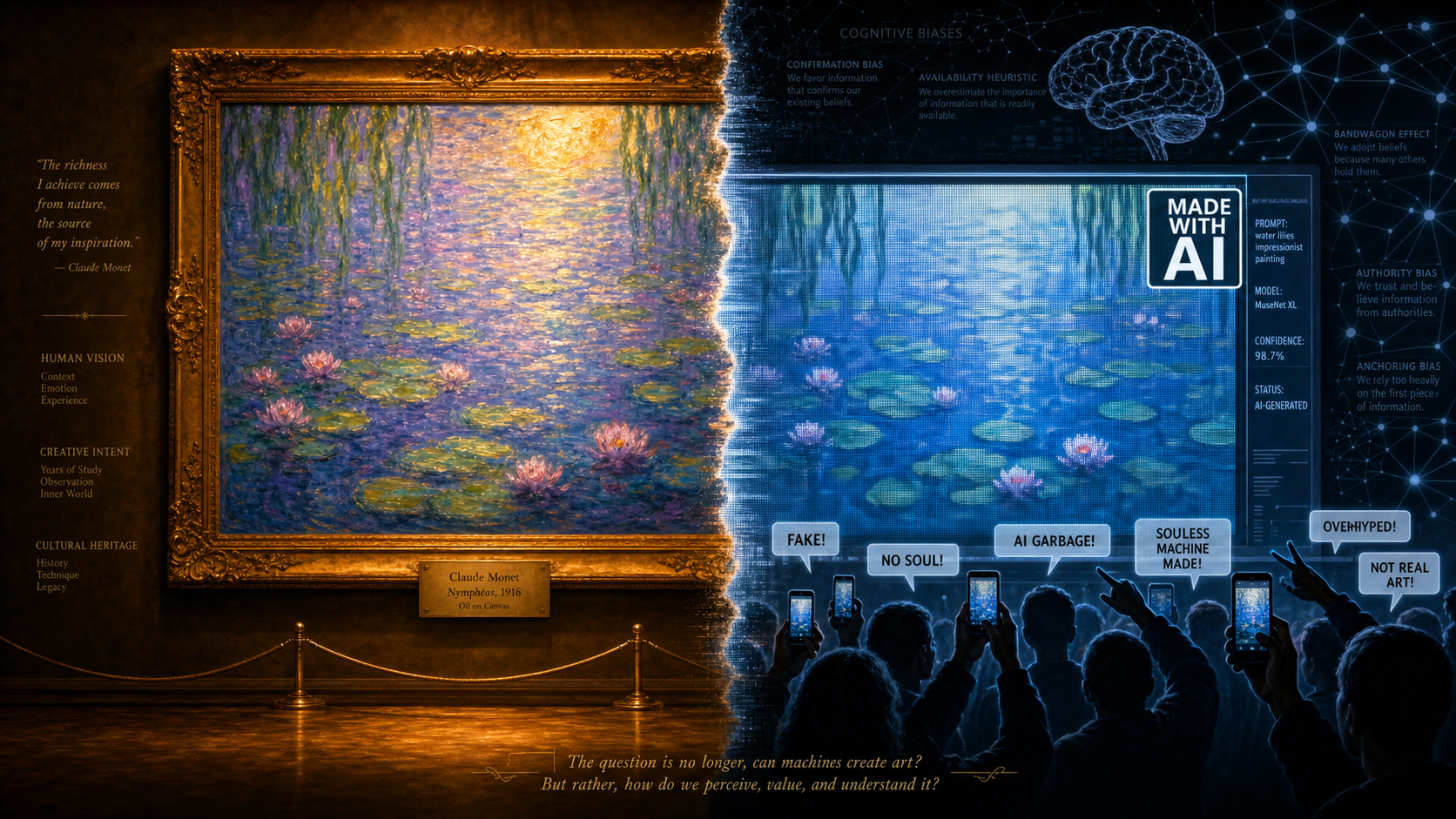
Online embarrassment: Experts tear apart an “AI image” – but it was a real Monet – Creative image: Xpert.Digital
The Monet Experiment: How three little words ("Made with AI") completely manipulate us
Why we hate AI: A startling experiment reveals our deepest fears
Art or AI junk? This simple experiment exposes our perception
Imagine looking at one of the most famous masterpieces in art history – and mistaking it for soulless, mechanical junk, simply because a small sign claims it was created by artificial intelligence. That's exactly what happened in a fascinating social experiment that shook up the internet and ruthlessly exposed the fact that our perception is far more manipulable than we realize.
When a genuine Claude Monet painting is suddenly torn apart on social media for its supposedly "machine-like surface," it's no longer about sound art criticism. It's about deeply ingrained cognitive biases, the Dunning-Kruger effect, and sheer economic fear of a technology that is massively shaking our worldview. Scientific studies now impressively confirm what this viral experiment showed: The mere label "AI" not only changes our rational opinion, but literally what our eyes believe they see. Delve into the psychology of AI skepticism and learn why the biggest flaw lies not in the technology—but in our own minds.
Why the rejection of AI art has less to do with aesthetics than with fear
On May 12, 2026, a user on Platform X conducted an experiment that was frighteningly revealing in its simplicity. He uploaded an image—a genuine painting from the early 20th century, a work by Claude Monet from his famous "Water Lilies" series, now housed in the Neue Pinakothek in Munich—and labeled it with a clearly visible tag: "Made with AI." He then posed a simple question: What exactly makes this image inferior to a real Monet?
The social media reaction was swift, loud, and unsettling in its self-assurance. Within hours, the post garnered 2.3 million views, 819 comments, and over a thousand reposts. Experts, designers, and art connoisseurs vied to identify the painting's flaws: the lack of authenticity in the brushstrokes, the absence of soul, the mechanical-looking surface, the inability to convey genuine emotion. All this despite the fact that the painting was literally one of the most important works by one of the most important Impressionists in history.
The twist came later. The user revealed that the image was not an AI creation—it was a genuine Monet. The reaction to this revelation was less one of humility than of rationalization. Many commentators stuck to their initial assessment, offered new explanations, or remained silent. A few had actually recognized the artwork's authenticity—but their voices were lost in the digital noise of others' certainty.
This experiment was not an isolated incident or a mere anecdote. It is a lesson in cognitive bias, perception of economic threat, and the profound psychological disruption that artificial intelligence is causing in our society – especially in creative industries like those in German-speaking countries.
One label changes everything: The science behind distorted perception
What became visible in this viral experiment has long been the subject of serious scientific investigation. A meta-analysis published in February 2026 by Alwin de Rooij, Assistant Professor at Tilburg University, analyzed 191 effect sizes from studies conducted between 2017 and 2024. The result is clear and far-reaching in its implications: the mere knowledge that a work of art was generated by AI diminishes the aesthetic experience of viewers—and this occurs on several psychological levels simultaneously.
De Rooij used the so-called Aesthetic Triad model, which divides the art experience into three systems: the sensorimotor system (basic visual processing such as color and form perception), the knowledge-meaning system (interpretation, intentionality, ability assessment), and the emotion-evaluation system (subjective perception of beauty, awe, personal preference). The result: The AI label produced negative effects in all three systems. Viewers perceived colors as less vibrant, attributed less creativity and depth to the work, and felt less emotionally engaged.
The crucial finding is that this distortion even affected basic visual perception. People literally saw the same image differently—less colorful, less vibrant—simply because a label had shifted their cognitive attitude. This is more than a difference of opinion or personal taste. It is a profound, largely unconscious manipulation of one's own experience by external information—a classic anchoring effect.
The anchoring effect, primarily described by Nobel laureates Daniel Kahneman and Amos Tversky, states that the first piece of information presented—the anchor—disproportionately influences all subsequent judgments, even if that information is factually irrelevant. In the context of the Monet experiment, the "Made with AI" label was the anchor. Once established, the brain sought confirmation—and found it, even where none existed.
The brain functions differently: Cognitive reflexes in the AI age
The mechanism visible in the Monet experiment is not limited to art criticism. It is an expression of a broader cognitive reflex that artificial intelligence seems to trigger in the population – especially when the topic is linked to economic threat, loss of status, or questions of identity.
A study by the University of British Columbia, the Vrije Universiteit Amsterdam, and the University of Applied Sciences Vorarlberg, involving more than 1,700 participants, specifically investigated why people reject AI-generated art. The result was revealing: the rejection was strongest among those who view creativity as a genuinely human trait that distinguishes humans from the rest of nature. For these individuals, AI creativity is not a neutral technological fact, but a threat to their worldview. The study links this reaction to speciesism and anthropocentrism—the deeply ingrained belief that humankind is the crown of creation.
German behavioral scientist Florian Buehler, who participated in the study, summed it up perfectly: Creativity has been humanity's last bastion – and this bastion is being attacked by AI. Interestingly, participants in this study didn't judge the image itself, but primarily its creator. The work as an artifact was irrelevant; attribution was everything.
Furthermore, neuroscientific findings show that the rejection of AI-generated art is not only based on explicit evaluations, but is also detectable in the neural processing itself. Brain activity measurements suggest that people react differently to artworks labeled as AI-generated – not just verbally, but physiologically. The aversion is more deeply ingrained than a purely rational debate about quality would suggest.
The Dunning-Kruger effect and its AI-specific perversion
The Monet experiment demonstrates a specific variant of the Dunning-Kruger effect—the psychological phenomenon described in 1999 by psychologists David Dunning and Justin Kruger at Cornell University. In its basic form, it states that people with low competence in a field systematically overestimate their abilities because they lack the necessary knowledge to recognize their own incompetence. Conversely, true experts tend to underestimate their competence because they can grasp the depth of the subject matter.
The Monet experiment revealed this structure in its purest form: people who clearly possessed only a superficial knowledge of Impressionist history appeared with maximum self-confidence and explained, using a Monet painting as an example, why it looked like AI. Art experts, on the other hand, who could actually assess the brushstrokes, the fidelity of texture, and the historical context, were in the minority – and their more cautious assessments were lost in the noise of the self-assured ignoramuses.
But science goes even further. A study published in February 2026 in the journal Computers in Human Behavior by Aalto University (Finland) in collaboration with German and Canadian researchers arrives at a disturbing finding: Anyone working with AI tools like ChatGPT systematically overestimates their own performance – without exception, regardless of their actual level of competence. Even more surprising: The higher the AI competence of the users, the greater the overestimation.
The study, which followed 500 participants as they solved logic problems with and without ChatGPT, reveals a mechanism the researchers call "cognitive offloading": users ask a single question, accept the answer without further scrutiny, and then believe they have solved the problem themselves. Actual critical thinking no longer takes place—and with it, the ability for realistic self-assessment diminishes. The Dunning-Kruger effect is not eliminated; it is democratized and transformed into a new, more dangerous form.
When feelings of threat replace judgment: The economic dimension
The psychological explanation alone falls short. The angry reaction of many people to the AI label is not merely cognitive – it has tangible economic roots, which are particularly noticeable in German-speaking countries.
According to a 2026 ZDF Politbarometer survey, two-thirds of all Germans expect AI to lead to job losses in Germany. A representative study by the R+V insurance group from the summer of 2025 revealed that 32 percent of the German population fears that AI poses a threat to society – in eastern Germany, this figure rises to 36 percent. According to the Xing Labor Market Report 2025, one in six employees in Germany is personally worried about losing their job due to AI – a figure that has increased compared to 2024.
Creative professions bear this burden particularly heavily. A survey of 378 verified professional visual artists, published in 2026, shows that the vast majority strongly reject generative AI and face massive income losses, reputational damage, and copyright infringements. Copywriter Christa Goede from Hanau described this experience as a prime example on the ZDF program "Am Puls" in May 2026: She said she had been "expropriated twice"—once through the use of her texts as AI training material and once through the loss of her long-standing clients, who had switched to their own AI solutions.
International studies confirm this pattern. According to a 2025 survey of creative professionals in Great Britain, over two-thirds of all those working in creative fields feel their job security is threatened by AI; one in two novelists fears being displaced by AI. This experience of existential threat colors every encounter with AI products – and turns the AI label into an emotional trigger, not a neutral category description.
🎯🎯🎯 Data-driven B2B industry hub as a quasi-in-house solution

The quasi-in-house solution: How Xpert.Digital closes operational gaps in B2B marketing and sales – Smart Content-Driven Business - Image: Xpert.Digital
Xpert.Digital is a data-driven B2B industry hub led by Konrad Wolfenstein . The company acts as an external, quasi-in-house solution for industrial partners, closing operational gaps in marketing, content, and sales – without requiring additional resources on the client side.
More information here:
Avoiding communication errors: How companies should deal with the AI label
The DACH paradox: Skepticism despite potential uses
The German-speaking world occupies a special position in this global context. An international study by TOPdesk from August 2025, which surveyed 6,000 IT professionals in Europe, including 3,000 from the DACH region (Germany, Austria, and Switzerland), shows that only 22 percent of German companies have fully integrated AI – far behind Switzerland (30 percent) and the UK (36 percent). Germany ranks only fifth among the six countries surveyed.
The PwC study “Global Workforce Hopes and Fears 2025,” which surveyed nearly 50,000 employees worldwide, paints a contradictory picture for Germany: 49 percent are curious about how AI will change work. At the same time, only 9 percent of German employees work with generative AI on a daily basis – a drastic gap compared to the global average. However, those who already use AI report significant productivity gains: 65 percent improved the quality of their work, and 62 percent increased their productivity.
McKinsey's analysis of Austrian companies from 2025 illustrates the structural problem: Only 19 percent of Austrian companies belong to the top 20 percent globally in terms of AI maturity; 68 percent are in the bottom 40 percent of their global peer group. This is not solely due to technological backwardness – it is also the result of a culturally ingrained caution towards change, which manifests itself in the experimental context as a reflexive rejection of the AI label.
A YouGov study from December 2025, exclusively presented to ZEIT, paints a more nuanced picture: one-third of Germans have a positive view of the AI era and see the opportunities as outweighing the risks; almost two-thirds expect AI to make everyday life and work easier. The country is deeply divided – and this division lends the AI label a urgency in public discourse that extends far beyond art criticism.
The context principle: When prejudices disappear
It is noteworthy that the research does not unequivocally demonstrate a blanket rejection of AI-generated art. A 2023 study from the University of Hohenheim revealed an important context-dependency: In direct competition between AI-generated and human-created art—that is, when both are presented side by side—people prefer the human-created version. However, when AI-generated artworks are judged independently, without direct comparison, this negative bias largely disappears.
Even more significant is the interpretation: The Hohenheim researchers suggested that what is happening is not a devaluation of AI art, but rather an appreciation of human art, as soon as context and comparison come into play. People value products of human labor more highly when they are aware of the difference – out of empathy and prosociality, not out of technological rejection per se. This is a far more nuanced diagnosis than the simple formula "people hate AI art.".
De Rooij confirms this context-dependency in his meta-analysis, pointing out that the bias is significantly stronger in laboratory experiments that frame AI as an autonomous artist than in more realistic scenarios where AI is presented as a tool in a creative process. Furthermore, the effect was more pronounced in online studies than in real gallery settings. The context—media-related, social, institutional—shapes perception at least as much as the artwork itself.
When AI changes the brain: Cognitive costs of outsourcing
The Monet commentator effect has another side, one that lies beyond direct art criticism. A 2025 study by the MIT Media Lab, which monitored 54 students using EEG measurements while they wrote essays, showed that those who wrote with ChatGPT produced significantly less neural activity than those who worked without AI. The texts were rated by instructors as "soulless" or lacking in individuality. The students had difficulty recalling the content. And particularly revealing: after the AI users had to work without AI in a later round, their brains showed significantly less activity than the group that had worked without AI from the beginning—a measurable cognitive atrophy.
These findings are indirectly, but highly relevant to the Monet experiment. If AI use reduces cognitive performance while simultaneously increasing overconfidence—as the Aalto study shows—then a socially dangerous pattern emerges: People who work with AI become worse at critically evaluating their own actions, while those who reject AI remain stuck in reflexive distrust, which also replaces any critical engagement with the actual product. This is the real cognitive trap: not AI per se, but the shortcut taken to thinking—in both directions.
A study from 2026, published in the Proceedings of the National Academy of Sciences, further demonstrates that people distinguish between abstract fears about the future and concrete risks in the present – and take the latter very seriously. Concern about AI is therefore not irrational hysteria, but an understandable reaction to real economic disruption. The problem lies not in the concern itself, but in the way it takes over the cognitive system and replaces rational judgment.
AI as a mirror of social tensions: What the experiment really shows
The Monet experiment is ultimately not an experiment about art criticism. It is an experiment about trust, threat perception, and identity. The commentators who tore the painting apart were not primarily defending aesthetic standards—they were defending a worldview in which human creativity is unique and worthy of protection. The label "Made with AI" activated this defensive mode before any aesthetic perception could even take place.
This phenomenon has a structural parallel to earlier technological upheavals. When photography emerged in the 19th century, painters and critics feared the end of painting. Impressionism itself—Monet's style—was a response to photography, an attempt to make visible what the camera could not: the fleeting qualities of light, emotion, and subjective perception. De Rooij explicitly points to this parallel and interprets current skepticism toward AI as a potentially transitory phenomenon, much like the rejection of photography as an art form, which is now fully accepted.
Nevertheless, there are fundamental differences. Photography did not displace human artists to the extent that generative AI threatens to do. It expanded the creative field. AI, on the other hand, enables the mass production of works based on the training of human labor—without consent, without compensation, without recognition. The sense of threat that drives the reflexive rejection of the AI label thus has a real, material basis, even if its form of expression—the denigration of a genuine Monet—takes on an irrational character.
The Economic Intelligence of the Unconscious: A Summary
What the Monet Experiment 2026 reveals is a societal equation consisting of several reinforcing variables: cognitive bias through the anchoring effect, Dunning-Kruger overconfidence in a commentary culture that confuses expertise with volume, deep anthropocentric beliefs about creativity, and tangible economic anxieties about job security and income prospects.
The error revealed by the experiment isn't simply a sign of stupidity. It's a symptom of our times. The crucial point isn't that the commentators were wrong—it's that they weren't looking. They reacted to the label, not the image. This is human, perfectly understandable, yet dangerous in its societal impact. A society that bases judgments on labels rather than content makes itself vulnerable to manipulation in all directions—to AI propaganda as well as anti-AI propaganda.
Science shows that this bias is neither inevitable nor stable. It depends on the context, the framing, the experience of the judges, and the environment in which art is presented. This is good news—and at the same time, an obligation. The answer to the knee-jerk AI-hater is not silence, not sarcasm, and not withdrawal from public discourse. The answer is epistemic care: pausing before judgment, looking at the image itself, being open to surprise.
In an ever-accelerating and noisy information landscape, pausing is perhaps the most subversive cognitive gesture there is. Claude Monet practiced it throughout his life—painting his water lilies with failing eyesight late in life, he created works that blurred the perceptual boundaries between figuration and abstraction. Today, these works are dismissed as "AI junk" by thousands on a social media platform—and the real message behind this has less to do with art than with the attention economy, the psychology of threat, and how we as a society deal with something that fundamentally challenges us.
Practical consequences for communication, business and education
The implications of the Monet experiment and the research it generated are equally concrete for companies, institutions, and individuals. The AI label is now an attention-grabbing tool that replaces rational evaluation – and those who ignore this are communicating in a vacuum.
For creative companies and content producers, this means that the origin labeling of content—whether AI-supported or not—triggers reactions that may have little to do with the actual content. The quality of the product matters less than the label that accompanies it. This is a serious economic reality, not a moral complaint.
For educational institutions and human resources development, the MIT findings on cognitive atrophy caused by the uncritical use of AI are a wake-up call. Those who equip employees or students with AI tools without simultaneously developing critical skills risk not only short-term losses in quality but also a long-term erosion of analytical abilities. The PwC study shows that 65 percent of AI users in Germany report improved work quality – this is real and significant. But without the meta-competence to critically evaluate AI output, this productivity increase is built on shaky foundations.
Finally, regarding the societal discourse: Research suggests that the anti-AI reflex is neither static nor immutable. It depends significantly on how AI is communicated and embedded. A discourse that frames AI as an autonomous actor and a threat generates stronger defensive reactions than one that situates AI as a responsive tool within human creative processes. This is not a question of downplaying real risks, but of precision – and precision is the true luxury in a field as quickly permeated by myths and counter-reactions as the AI debate.
The Monet experiment shows that the brain reacts differently when it's labeled AI. That's the trick. But the trick only works because we allow it.
Your global marketing and business development partner
☑️ Our business language is English or German
☑️ NEW: Correspondence in your native language!

Konrad Wolfenstein
I and my team are happy to be available to you as your personal advisor.
You can contact me by filling out the contact form here simply call me at +49 7348 4088 965. My email address is [email protected]:or
I'm looking forward to our joint project.









