
When the hype gets its comeuppance: Spatial Commerce as a true value creator in B2B
Xpert Pre-Release

Available in 27 languages 📢
Prefer Xpert.Digital on GoogleⓘPublished on: April 12, 2026 / Updated on: April 12, 2026 – Author: Konrad Wolfenstein
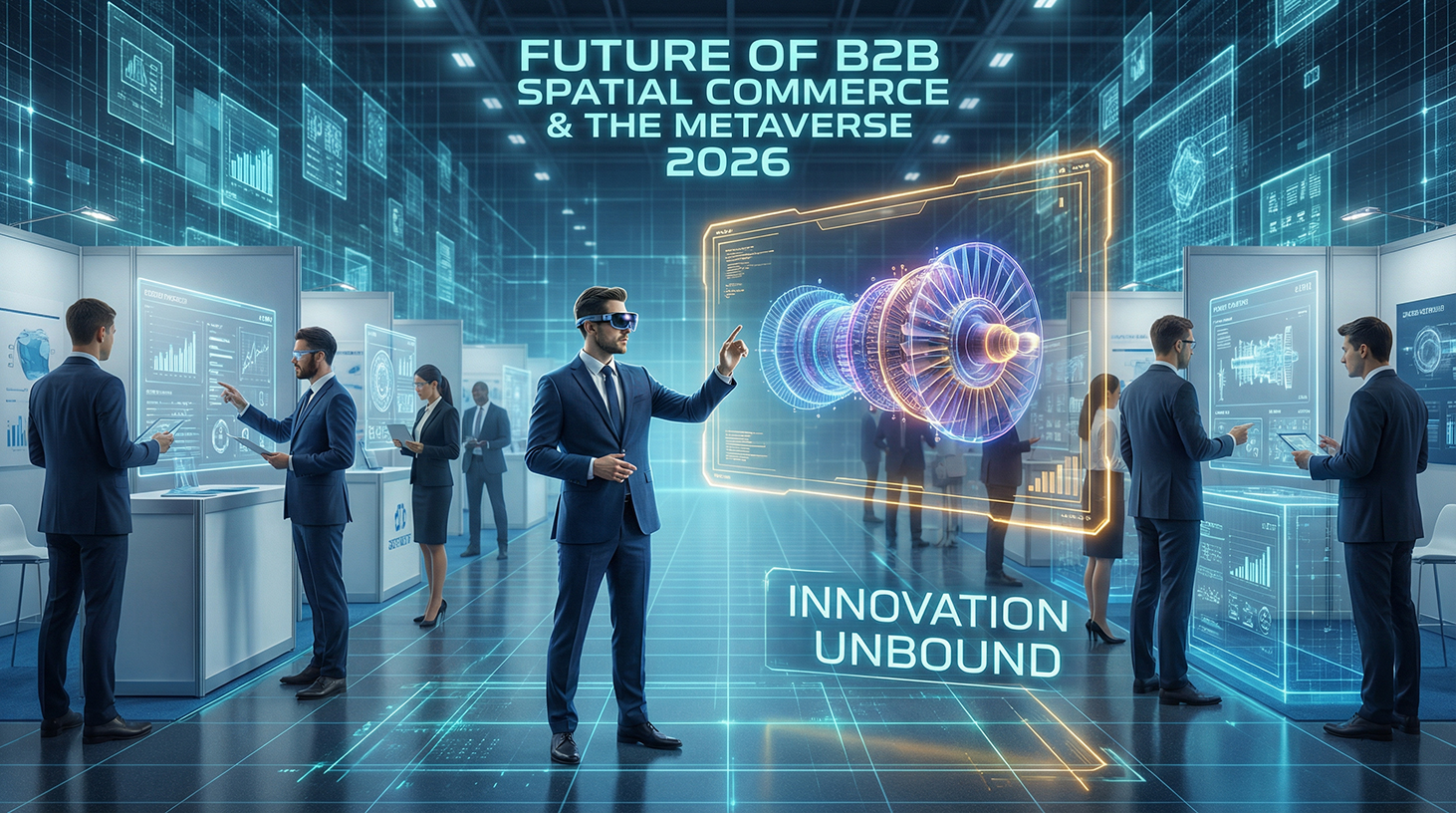
When the hype gets its comeuppance: Spatial Commerce as a true value creator in B2B – Image: Xpert.Digital
Spatial Commerce: Does this technology now replace or complement physical sales in B2B?
More revenue, less costs: The true ROI behind the Enterprise Metaverse
No more games: How Apple and Microsoft are turning the industrial metaverse into a billion-dollar market
The hype surrounding the metaverse seemed to have died down long ago. While the colorful, consumer-oriented dream worlds of Mark Zuckerberg and his ilk largely burst as expensive visions, a far more lucrative revolution has been taking place away from the public eye. By 2026, it's clear: the metaverse isn't dead – it's now dressed in a business suit. Under the banner of "spatial commerce," augmented reality (AR) and virtual reality (VR) are conquering the B2B sector and solving real, multi-billion-dollar business problems. Whether it's virtual showrooms for multi-ton industrial machines or AR-supported maintenance on the high seas, spatial computing is suddenly delivering what the consumer market has been missing – a measurable, tangible return on investment (ROI). The following analysis reveals why this year will be the ultimate strategic crossroads for B2B companies and how a ridiculed gimmick has matured into a rapidly growing multi-billion-dollar market.
Between disappointment and breakthrough – why 2026 is the year of change
The metaverse hasn't failed. It has shed its skin. Anyone who remembers the euphoric announcements of 2021—Mark Zuckerberg's billion-dollar bet on virtual worlds, Meta's name change as a symbolic bombshell, the NFT fantasies, and the predictions of a complete shift of social life into digital spaces—will initially recognize a story of failure in the reality of 2026. Horizon Workrooms, Meta's ambitious attempt at a virtual enterprise environment, was discontinued in February 2026. The consumer market proved more sluggish than hoped. And yet, it would be a fundamental analytical error to conclude that the metaverse concept is obsolete. Because while the consumer-oriented castles in the air crumbled, something crucial shifted in the less conspicuous but far more economically relevant B2B sector: The enterprise metaverse is growing, consolidating, and beginning to deliver measurable returns.
Market research firm Grand View Research estimates the global enterprise metaverse market at $59.87 billion in 2026 – with a compound annual growth rate of 41.1 percent until 2033, projecting a total market of $667 billion. These figures are not the result of a new hype, but rather a genuine market consolidation: those who remain are building something that works. Technology accelerators like Apple, Microsoft, and Metaverse itself continue to invest heavily, but with a fundamentally shifted focus. In February 2026, Apple expanded its spatial computing ecosystem with new enterprise developer tools. Microsoft integrated AI-powered spatial mapping capabilities into its mixed reality platform for industrial applications. The overall market for spatial computing – the foundation beneath the metaverse – is projected to grow from $20.43 billion in 2025 to $85.56 billion by 2030, with an annual growth rate of 33.16 percent.
Spatial Commerce: The concrete added value behind the abstract concept
To understand why the B2B metaverse succeeds where the B2C metaverse failed, one must take a closer look at the concept of spatial commerce. Spatial commerce refers to the integration of augmented reality (AR) and virtual reality (VR) into retail and business processes to enable immersive, three-dimensional shopping experiences that combine the best of the online and offline worlds. In the B2C sector, AR was already a familiar experience for end customers – they could virtually place furniture in their own homes or try on clothes virtually. For B2B companies that sell complex, difficult-to-transport industrial machinery, equipment, or technical systems, spatial commerce is not a convenience, but a structural necessity.
The decisive ROI driver for B2B companies is the ability to make complex products tangible without having to physically present them. A manufacturer of production equipment no longer needs to transport a machine weighing several tons and costing hundreds of thousands of euros to a trade fair. A virtual showroom allows potential customers to configure, experience, and understand the equipment in their planned production environment – including maintenance access, safety distances, and integration points with existing infrastructure. Norwegian battery producers are equipping gigafactories with metaverse experiences; Danone uses 3D spatial scanning technology to make production facilities virtually accessible; and Burckhardt Compression relies on spatial computing for remote support of supertankers in the middle of the ocean.
🗒️ Xpert.Digital: A pioneer in the field of Extended and Augmented Reality

Finding the right Metaverse agency, planning office, or consulting firm - Image: Xpert.Digital
🗒️ Finding the right Metaverse agency, planning office, or consulting firm – Search and search: Top Ten Tips for Consulting & Planning
More information here:
Spatial Commerce in B2B: How AR and digital twins are redefining ROI
The numbers behind the promise: What spatial commerce actually delivers in B2B
In B2B decision-making processes, the question of return on investment is not a secondary consideration, but rather the central decision criterion. And this is where Spatial Commerce 2026 begins to offer compelling data. AR-supported product visualizations reduce return rates in certain industries by up to 40 percent. Immersive shopping experiences achieve conversion rates of between 3.5 and 5 percent in the B2B environment, compared to 2 to 3 percent for traditional e-commerce platforms. Platforms like TrueFan AI report increases in click-through rates and "add to cart" actions of over 30 percent compared to non-immersive content.
But the ROI of spatial commerce isn't limited to improved sales conversion rates. Far more significant for a company's bottom line are the efficiency gains in employee training and after-sales service. When service technicians are equipped with AR glasses that display relevant product information down to the last shift, the error rate during maintenance work is significantly reduced. 75 percent of industrial companies that widely implement VR report a 10 percent increase in operational efficiency. The economic significance of AR-integrated IoT in manufacturing is estimated at 90 to 110 billion US dollars by 2030.
From pilot phase to scaling: The maturation of the enterprise market
What fundamentally distinguishes 2026 from previous years is the transition from the experimental phase to scaling. Over 75 percent of Fortune 500 companies have already implemented XR technologies through pilot programs or in production. Enterprise applications will generate over 60 percent of total VR revenue by 2030. The consulting firm Deloitte describes spatial computing as an "interfaces in new places" shift: The way employees interact with digital systems is fundamentally changing. Wipro is investing in spatial computing platforms to support customers in operationalizing spatial strategies. HPE is explicitly positioning its edge computing infrastructure as the backbone for spatial experiences in the enterprise context.
The fastest-growing market segment, offering the most immediate applications for B2B companies, is the industrial metaverse layer, defined as digital twins, remote collaboration, and enterprise simulations. ABI Research estimates spending on industrial metaverse solutions will reach $6.3 billion by 2030, while the broader market, including digital twins and related infrastructure, is projected to reach $400 billion to over $1 trillion. Of particular relevance to B2B decision-makers is the fact that the digital twins and industrial metaverse market segment is growing faster than both the consumer and general enterprise sectors.
Strategic barriers to entry and the question of platform architecture
The underlying technological architecture for enterprise spatial commerce consists of four layers: a 3D content pipeline for product data management, an experience layer for AR/VR modules, an identity layer for customer data platforms, and a trust layer for blockchain verification. For companies seriously considering investing in spatial commerce, the choice of platform architecture is binding in the long term. The market for spatial computing operating systems, valued at $7.2 billion in 2025, is projected to grow to $62.4 billion by 2034 – an indicator of the increasing importance of the infrastructure layer.
The practical implementation recommendation, according to experts, is to identify two to three highly ROI-relevant use cases, typically from the areas of training, remote expert support, leadership communication, customer-oriented service, or complex 3D decision-making processes. Then scale as soon as measurable results are available. The most common mistake: starting too broadly, measuring too little, and not formulating a watertight business case.
Obstacles that are still hindering the breakthrough
Despite the positive developments, honesty remains essential. VR has only gained traction slowly in the B2C sector due to hardware limitations, and even in B2B, factors such as the comparatively high investment in equipment, the need for robust IT infrastructure, and the shortage of skilled implementation experts are hindering faster rollout. Latency, device management, and security requirements for enterprise deployments remain fundamental challenges. And let's not forget: the most immersive experiences are of little use if the content pipeline—that is, the 3D models of the products—is either missing or outdated. Spatial commerce strategies are, first and foremost, content strategies.
Those who act now will build a competitive advantage
The year 2026 marks a strategic crossroads for B2B companies. Those who view spatial commerce as a purely technological project will fail. Those who understand it as a fundamental redesign of sales, service, and qualification processes, and link it to clear KPIs, can achieve measurable ROI effects within twelve to eighteen months. The market for AR/VR spending in Europe (EMEA) alone is projected to reach US$8.4 billion by 2029. The consolidation of the market after the hype peak means for B2B companies: technological solutions are more mature, service providers are more focused, costs have decreased, and the measurability of ROI has significantly increased. The metaverse hasn't died. It has finally come of age.
Your global marketing and business development partner
☑️ Our business language is English or German
☑️ NEW: Correspondence in your native language!

Konrad Wolfenstein
I and my team are happy to be available to you as your personal advisor.
You can contact me by filling out the contact form here or simply call me at +49 7348 4088 965. My email address is : [email protected]
I'm looking forward to our joint project.









