

China and Germany: The Great Imbalance: 89 Billion Euros in the Red – How China is Tightening the Grip on the German Economy
Xpert Pre-Release

Available in 27 languages 📢
Prefer Xpert.Digital on GoogleⓘPublished on: July 13, 2026 / Updated on: July 13, 2026 – Author: Konrad Wolfenstein
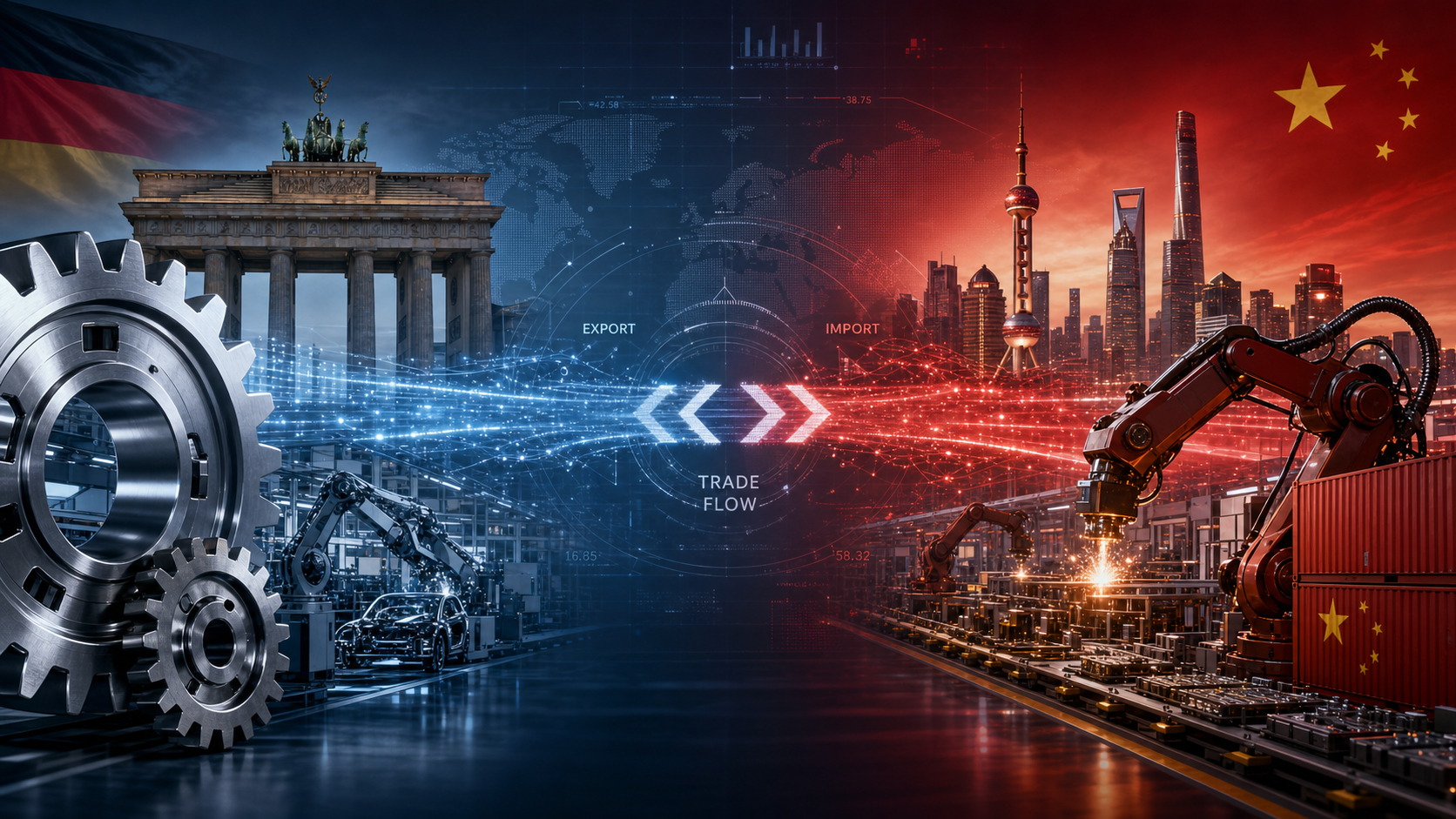
China and Germany: The Great Imbalance: 89 Billion Euros in the Red – How China is Tightening the Grip on the German Economy – Image: Xpert.Digital
Sell-off of competitiveness: How Beijing is displacing Europe's key industries
The billion-dollar paradox: Why German corporations are investing massively in China despite warnings
The most dangerous bet of the post-war era: Why Germany can't break free from China
Economic relations between Germany and China are facing a historic turning point. While the trade deficit has reached record levels of almost 90 billion euros and dependence on critical raw materials is dangerously close to 100 percent, flagship companies like BASF continue to pump billions into the People's Republic. It is a dangerous economic paradox: Politicians in Brussels and Berlin have long been preparing drastic protective measures against the growing influence of a systemic rival, yet domestic industry is becoming ever more operationally entangled in its web. Between the threat of countervailing tariffs, state-distorted competition, and the desperate call for diversification, Europe's largest economy faces what is probably the most painful economic policy decision of the post-war era.
Between dependence and deterrence – why Europe's largest economy is making the most dangerous bet of the post-war era
When the most important partner becomes a systemic rival
Trade relations between the European Union and China are undergoing a state of accelerated transformation. What was long marketed as a partnership is increasingly revealing itself as a structural imbalance, the extent of which few foresaw. At the heart of this development are Germany and its economy, which is more deeply embedded in the Chinese tangle than any other in Europe – and which now faces a painful reassessment of this relationship.
The newly established consultation mechanism between the EU and China, whose first meeting took place in Brussels at the end of June 2026 under the leadership of Chinese Commerce Minister Wang Wentao and EU Trade Commissioner Maroš Šefčovič, marks a new attempt at diplomatic rule-making. Four key areas of focus were defined: trade and investment balance, export controls, intellectual property protection, and reform of the World Trade Organization. A second ministerial meeting is already planned for the autumn – the Chinese side has invited Šefčovič to Beijing. Whether this diplomatic mechanism will be sufficient to address the structural tensions remains highly questionable.
Numbers that describe an imbalance
The Federal Statistical Office has published data for 2025 that are shockingly sobering. Total trade volume between Germany and China amounted to €251.8 billion – making China Germany's most important trading partner, having overtaken the USA. German imports from the People's Republic rose to €170.6 billion, an increase of 8.8 percent compared to the previous year. At the same time, German exports to China fell by 9.7 percent to €81.3 billion. The result is a trade deficit of €89.3 billion – an increase of more than €20 billion in a single year, compared to €66.9 billion the previous year.
These figures are not isolated but reflect a trend observable across Europe. The EU's trade deficit with China reached approximately €359.3 billion in 2025 – a figure described by Šefčovič as "simply unsustainable." In the first four months of 2026, this deficit grew by around ten percent. For the first time, all 27 EU member states recorded a negative trade balance with China. EU Industry Commissioner Stéphane Séjourné publicly warned that without countermeasures, the deficit could rise to €500 billion annually by 2027.
The sectoral breakdown of trade changes is particularly revealing. In German merchandise trade with China, exports fell by 33.0 percent in 2025 compared to 2024 in the motor vehicle and motor vehicle parts sector, by 12.9 percent in metal products, by 11.7 percent in rubber and plastic products, by 9.8 percent each in pharmaceuticals and machinery, and by 9.3 percent each in electrical equipment and chemical products. Imports from China, on the other hand, increased significantly across the board: pharmaceuticals and electrical equipment each grew by 14.8 percent, metal products by 12.8 percent, and rubber and plastic products by 12.6 percent. This symmetrical divergence – falling exports, rising imports – is not a cyclical phenomenon, but rather an expression of structural shifts.
The erosion of competitiveness through government control
Behind the dry trade data lies a fundamental economic policy debate: Are Chinese companies more successful because they are more innovative and efficient, or because the Chinese state gives them competitive advantages that cannot be compensated for by market economy means?
The Federation of German Industries (BDI) estimated the cost disadvantage faced by European companies compared to their Chinese competitors at around 40 percent over the past two to three years. This difference arises from the complex interplay of government subsidies at various levels, distorted capital costs due to government-controlled financing conditions, undervalued currency effects, and significantly lower energy costs resulting from government-subsidized industrial electricity prices. Sandra Detzer, the economic policy spokesperson for the Green Party parliamentary group, clarified at a VDMA conference that no amount of deregulation, tax cuts, or innovation promotion could close this cost gap domestically. It is simply not mathematically possible. Therefore, structural protective measures are unavoidable.
CDU Member of Parliament and China expert Johannes Volkmann underscored this assessment with a remarkably clear statement: It would be impossible to reduce so much bureaucracy, lower so many taxes, or reform so many ancillary costs to offset this market-distorting advantage domestically. Volkmann, who presented a joint black-green position paper on China together with Green Party politician Anton Hofreiter, strongly advocates EU countervailing tariffs as the only effective remedy. The fact that a conservative foreign policy expert and a Green economic policy expert have reached almost identical conclusions is an unusual sign of political convergence in an otherwise contentious debate.
The growing global dominance of Chinese manufacturers is particularly evident in the mechanical engineering sector. According to the VDMA (German Engineering Federation), Chinese producers already control a third of global mechanical engineering production – and this figure is rising. VDMA President Bertram Kawlath described the coming months as crucial and called for a robust European regulatory policy that combines openness with the ability to act. The goal must be fair competition on an equal footing – which implicitly means that this level playing field currently does not exist. For an industry that has been considered the heart of German engineering exports for decades, this is a bitter assessment.
Critical raw materials: The Achilles' heel in the supply chain
Even more alarming than the trade balance is the growing dependence on raw materials. A recent analysis by the Friedrich Naumann Foundation, based on preliminary data from the Federal Statistical Office, shows how dramatically Germany's reliance on Chinese supplies has intensified in just a few years. For the strategically important metal magnesium, indispensable in the aluminum and steel industries, the Chinese share of German imports rose from 79.1 percent in 2023 to 84.5 percent in 2025. For gallium, needed for semiconductor manufacturing and high-performance electronics, this share increased from 28.9 to 47.4 percent.
But the dynamics surrounding rare earth elements are even more serious. For lithium-ion batteries, the Chinese import share jumped from just under half in 2023 to around two-thirds in 2025. For solar panels, it now stands at 92.6 percent. For antibiotics, it rose from around 65 to approximately 73 percent. German importers source praseodymium and neodymium, rare earth elements used in electric motors, almost exclusively from China – import volumes nearly doubled between 2023 and 2025. This concentration on a single supplier represents a systemic risk that extends far beyond purely economic considerations.
The political weight of this dependency became glaringly obvious in early 2026 when China imposed export restrictions on critical raw materials. In April 2026, global exports of gallium plummeted to just three kilograms – all to Malaysia. German Federal Minister for Economic Affairs Katherina Reiche subsequently traveled to Beijing with a delegation of leading managers to advocate for fair trade access. The fact that such a trip was even necessary underscores the extent of the vulnerability. Businesses and policymakers are now facing the realization that supply chain security without geographical diversification is no guarantee of true security.
The paradoxical investment wave: More capital, less control
Given all these warning signs, one might expect German companies to cautiously reduce their presence in China. The opposite is true. According to an analysis by the German Economic Institute (IW Cologne) based on Bundesbank data, German direct investment in China rose to around seven billion euros in 2025 – an increase of 55.5 percent compared to 4.5 billion euros the previous year. This is the highest figure since 2021 and exceeds the long-term average of six billion euros for the years 2010 to 2024.
This wave of investment can be explained by a changed geopolitical landscape. While German direct investment in the US plummeted by around 45 percent between February and November 2025 – a direct reaction to the Trump administration's tariff policies – China was reassessed as an anchor of stability. Chinese planning certainty and market access were weighed against the volatility of American trade policy, and many decision-makers in large German companies concluded that Chinese investment would likely be more profitable in the long run than American investment. This shift is strategically understandable, but fraught with considerable political risks.
The paradox is obvious: Germany loudly laments the imbalance in trade relations with China, yet at the same time invests more than ever in the same market. The economists at the German Economic Institute (IW) point out that increasing direct investment tends to diminish Germany's export opportunities – because value creation increasingly takes place locally in China rather than at home. Simultaneously, import pressure is rising, as Chinese suppliers, through their technological catch-up, are becoming competitive in the German domestic market as well. Thus, these investments paradoxically reinforce precisely the dependency that is recognized as a problem by policymakers.
The BASF paradigm: When strategy and system critique collide
No single case illustrates the investment paradox better than BASF. In March 2026, the Ludwigshafen-based chemical company officially inaugurated its new integrated production site in Zhanjiang, Guangdong Province – the largest single investment project in the company's history to date, with total investments of around €8.7 billion. Completed on schedule and under budget, the site is the company's third largest integrated production site worldwide, after Ludwigshafen and Antwerp, and its seventh overall.
The project's dimensions are impressive: four square kilometers of land, 18 plants, 32 production lines, and over 70 products ranging from basic chemicals and intermediates to specialty chemicals for transportation, consumer goods, electronics, and home and personal care. A steam cracker with a capacity of one million tons of ethylene per year forms the industrial heart of the operation. And—remarkably for a petrochemical project of this scale—the site is powered entirely by renewable electricity, reducing CO2 emissions by up to 50 percent compared to a conventional site.
BASF CEO Markus Kamieth described the Zhanjiang project as an "important building block" of the company's growth strategy and as proof of "long-term confidence in the world's largest chemical market." In 2025, BASF generated sales of around €8.2 billion with customers in Greater China and employed almost 13,000 people – with total group sales of around €60 billion, this represents approximately 14 percent of consolidated sales. BASF expects this share to increase to between 15 and 20 percent once Zhanjiang is operational.
In terms of earnings, however, the project is a long-term gamble. Stephan Kothrade, BASF's Asia board member, expects a positive contribution to earnings only from 2027 onwards; until 2026, EBITDA in Zhanjiang will remain slightly negative due to start-up costs and ongoing infrastructure optimizations. By 2030, the site is expected to generate between €1 billion and €1.2 billion in EBITDA, with anticipated sales of €4 billion to €5 billion – roughly ten percent of the current sales of BASF's core businesses. The vast majority of products manufactured in Zhanjiang are delivered directly to customers in China, thus following the company's global "local-for-local" strategy.
Critics accuse companies like BASF of not only increasing their own risk profile through such investments, but also facilitating Chinese technology and knowledge transfers that ultimately harm European competitors. CDU politician Johannes Volkmann is among those who explicitly criticize German corporations for risky investments in China. On the other hand, a withdrawal from the world's largest chemical market would be virtually inconceivable for BASF without structurally weakening the company. The dilemma is real: those who don't invest lose market share to Chinese competitors. Those who invest risk geopolitical exposure and contribute to strengthening the very competitors they fear in their own market.
Our China expertise in business development, sales and marketing

Our China expertise in business development, sales and marketing - Image: Xpert.Digital
Industry focus areas: B2B, digitalization (from AI to XR), mechanical engineering, logistics, renewable energies and industry
More information here:
A thematic hub offering insights and expertise:
- Knowledge platform covering global and regional economies, innovation and industry-specific trends
- A collection of analyses, insights, and background information from our key areas of focus
- A place for expertise and information on current developments in business and technology
- A hub for companies seeking information on markets, digitalization, and industry innovations
Europe's protection offensive: How the EU is safeguarding its industry against China – Why the 60 percent rule and tariffs are just the beginning
Brussels' response: From self-criticism to protective architecture
The EU has undergone a noticeable shift in strategy in recent months. For a long time, Brussels relied on dialogue and gradual pressure; now, there is a growing willingness to implement structural safeguard measures. At the end of May 2026, EU Industry Commissioner Stéphane Séjourné outlined four new instruments with which Europe intends to protect its industry from Chinese overcapacity: First, companies in strategic sectors will be required to diversify their supply chains – with the stipulation that no more than 60 percent of deliveries may originate from a single country. Second, existing trade defense instruments will be applied more quickly and broadly. Third, the Commission is planning a new sector-wide safeguard mechanism that can protect not only individual products but entire industries with countervailing duties. Fourth, the EU regulation against foreign subsidies will be tightened.
In parallel, the EU is working on expanding existing safeguard mechanisms. In the steel sector, safeguards are to be extended beyond the current eight-year period. New rules have been introduced for small e-commerce consignments. And since July 2026, EU tariffs have applied to passenger car tires from China – a first concrete sign that the announced change of course is becoming operational reality. By the end of 2025, the EU had already implemented 172 anti-dumping and anti-subsidy measures, more than three-quarters of which targeted Chinese companies. These include additional tariffs of up to 35.3 percent on electric vehicles manufactured in China.
France, Spain, Italy, the Netherlands, and Lithuania, in a joint position paper, have blamed systematic and structural Chinese industrial overcapacity for one million lost jobs in EU-wide industry between 2019 and 2025. They are calling for sector-wide tariffs and a fundamental reorientation of European trade policy. The German government welcomes this initiative, which marks a remarkable shift in attitude given Germany's traditionally export-oriented reluctance to impose protective tariffs.
The diversification problem: Between desire and structural reality
The political goal of diversification is undisputed. How it can be achieved in practice is a completely different question. Alternatives to China as a supplier of critical raw materials are currently either nonexistent or not sufficiently scalable. Gallium is processed on a commercial scale almost nowhere else but in China; rare earth elements for permanent magnets also come primarily from the People's Republic. Building alternative supply chains takes not months, but years or even decades – mining projects, processing capacities, logistics infrastructure, and technology transfers cannot be created overnight through political decisions.
Added to this is the problem of price competitiveness. Even if alternative sources can be developed, these will in many cases be more expensive than Chinese offers – which increases the production costs of dependent industries and further reduces their global competitiveness. Sandra Detzer put it succinctly: A massive restructuring of the German business model is the price for greater resilience. In plain terms, this restructuring means that Germany must relinquish some of its industrial competitiveness in order to buy strategic independence.
The EU Commission has therefore set a medium-term goal that no single third country should account for more than 60 percent of deliveries of strategic raw materials or goods. This is a reasonable guideline – but it stands in fundamental contradiction to the current reality, in which China accounts for 66.5 percent of lithium-ion batteries, 92.6 percent of solar panels, and almost 100 percent of certain rare earth elements. The gap between the political goal and the economic reality is immense.
Germany in a pincer grip: The price of an asymmetrical partnership
Germany, with its prominent position, is not alone, but it is particularly hard hit. No other major European country's industrial model is so heavily reliant on the Chinese market – as a sales market, a supplier of raw materials, and increasingly as an investment location. The automotive industry, long the engine of German prosperity, is dramatically losing market share in China to local electric vehicle manufacturers; exports of motor vehicles and motor vehicle parts plummeted by 33 percent in 2025. The mechanical engineering sector is facing competition from Chinese companies that now control a third of global production.
At the same time, German imports are rising in almost all relevant categories. The People's Republic has not only established itself as a supplier but has become the only viable real-economy option in many sectors. China has been the most important supplier of German imports since 2015. The structural trap lies in the fact that withdrawing from this network would be more painful for Germany in the short term than remaining within it – even though remaining within it accumulates long-term risks.
A more serious debate about China has begun in Berlin's political circles. The Green Party parliamentary group speaks of a new balance between efficiency and resilience, while the CDU speaks of fair competition and countervailing tariffs. This convergence across party lines is remarkable and signals a shift in the political consensus. Germany is now relying on the dual approach that the EU has established as a guideline: cooperation where it makes sense and decisive protective measures where distortions of competition can be proven.
The consultation mechanism: Hope with an expiration date
The EU-China consultation mechanism, established in June 2026, is a diplomatic step forward, but not a structural panacea. Šefčovič has promised tangible results for the autumn meeting in Beijing. Both sides have agreed to address the trade imbalance through growth and broader market access, rather than by reducing trade volume – a signal intended, from Beijing's perspective, to protect its own exports. Joint efforts will focus on cooperation in artificial intelligence, the green transition, and trade in services.
The question of whether these dialogue formats address the underlying asymmetries remains open. China clearly has no interest in a fundamental restructuring of its state capitalism or its industrial subsidy policies. Beijing's willingness to negotiate stems primarily from its desire to limit EU protectionist measures. Brussels' expectations, however—concrete concessions on market access, reduction of subsidy distortions, and easing of export restrictions on critical raw materials—will, at best, be met by China only in baby steps. The gap between the timeframes in which European industries suffer and the timeframes in which diplomatic negotiations have an effect is considerable.
Resilience as a new paradigm: What needs to be done now
The economic policy debate must move beyond the binary thinking of decoupling versus unrestricted integration. Neither a complete decoupling from China – economically absurd and politically unfeasible – nor a naive continuation of current practices will meet the challenges. The realistically achievable goal is a well-considered diversification of risks while simultaneously maintaining economically sound collaborations.
Specifically, this means: First, critical raw material supply chains must be diversified with genuine urgency. Developing alternative sources of gallium, magnesium, rare earth elements, and battery materials is not a political option, but an industrial policy necessity. Second, trade defense instruments must be used effectively—that is, quickly and sectorally—without resorting to a protectionist reflex that harms Germany's own export-oriented economy. Third, companies investing in China should submit transparent risk analyses that incorporate geopolitical scenarios. Fourth, Germany should push for a coherent industrial policy within the EU that keeps key European industries technologically competitive—without imitating a centrally planned economy, but with clear strategic guidance.
Sandra Detzer spoke of a massive restructuring of the German business model as a possible outcome of this realignment. That sounds alarming – and it's meant to. But the alternative, continuing the existing model without reflection, carries a greater long-term risk. A trade deficit of €89.3 billion with China alone, growing raw material dependencies approaching 100 percent in certain categories, and a 55.5 percent increase in investment in the very economy that threatens European jobs – that's not a balanced partnership. It's a structural dependency that undermines political capacity for action.
Between rationality and realism: What remains
It would be wrong to view the entire German-China complex as a mistake. Decades of economic interdependence have created prosperity on both sides. Companies like BASF, which not only sell but also produce and conduct research in China, create real value and connect two of the world's most complex chemical industries. The site established in Zhanjiang is a masterpiece of industrial engineering – sustainable, digital, and integrated. The corporate decision to invest there follows a clear business logic.
But business administration and geopolitics are not the same. What might be rational for an individual company is not automatically good for a national economy or a geopolitical community. The EU and Germany face the task of developing a new economic policy that takes both into account: the economic realities of global value chains and the political realities of a systemic rival that understands trade not only as a transaction but also as an instrument of strategic influence. The coming months of negotiations between Wang Wentao and Šefčovič will show whether diplomacy alone is sufficient, or whether Europe has learned to use economic strength as leverage.
The message from the data is unmistakable: The window for orderly, participatory change is open – but it is closing.
Your global marketing and business development partner
☑️ Our business language is English or German
☑️ NEW: Correspondence in your native language!

Konrad Wolfenstein
I and my team are happy to be available to you as your personal advisor.
You can contact me by filling out the contact form here [email protected]:or simply call me at +49 7348 4088 965. My email address is
I'm looking forward to our joint project.
☑️ SME support in strategy, consulting, planning and implementation
☑️ Creation or realignment of the digital strategy and digitization
☑️ Expansion and optimization of international sales processes
☑️ Global & Digital B2B trading platforms
☑️ Pioneer Business Development / Marketing / PR / Trade Fairs
🎯🎯🎯 Data-driven B2B industry hub as a quasi-in-house solution

The quasi-in-house solution: How Xpert.Digital closes operational gaps in B2B marketing and sales – Smart Content-Driven Business - Image: Xpert.Digital
Xpert.Digital is a data-driven B2B industry hub led by Konrad Wolfenstein . The company acts as an external, quasi-in-house solution for industrial partners, closing operational gaps in marketing, content, and sales – without requiring additional resources on the client side.
More information here:





