
The great tech war after 8 years: €4.1 billion fine – ECJ seals Google's historic defeat against the EU
Xpert Pre-Release

Available in 27 languages 📢
Prefer Xpert.Digital on GoogleⓘPublished on: July 2, 2026 / Updated on: July 2, 2026 – Author: Konrad Wolfenstein
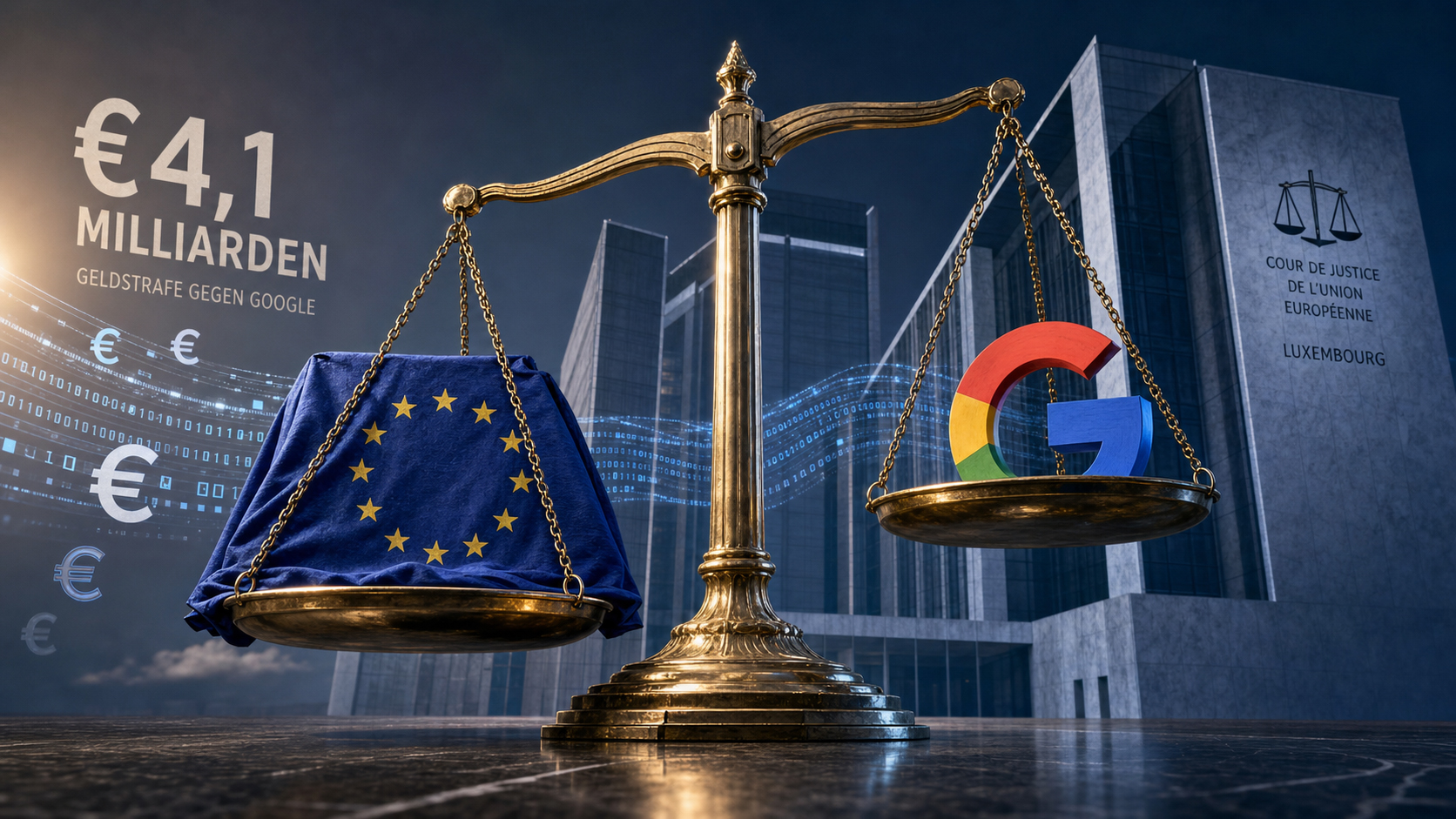
The great tech war after 8 years: €4.1 billion fine – ECJ seals Google's historic defeat against the EU – Image: Xpert.Digital
The end of the Android monopoly? The true consequences of the $4.1 billion fine against Google
After the 4 billion dollar ruling: Why Google's real nightmare in Europe is only just beginning
After eight long years of legal wrangling, the verdict is in: The European Court of Justice (ECJ) has definitively upheld a record fine of €4.1 billion against Google. At the heart of the dispute were far-reaching anti-competitive practices surrounding the Android operating system, with which, according to EU judges, the tech giant systematically exploited its market power and squeezed out alternative competitors. But anyone who thinks this bombshell is the end of the story is sorely mistaken. While the billion-euro fine is a relatively minor financial blow for the highly profitable parent company Alphabet, the ruling sends an unmistakable signal to the entire platform economy. It marks the transition to a new, far stricter era of regulation in Europe, spearheaded by the Digital Markets Act (DMA). The following analysis reveals why Google's biggest challenge is yet to come, how the ruling is revolutionizing the global technology market, and why Europe is thus making a geopolitical statement.
Google vs. Europe: The end of an eight-year power struggle
How the EU's highest court inflicted a historic defeat on one of the world's most valuable companies – and why this is just the beginning
On July 2, 2026, the European Court of Justice (ECJ) in Luxembourg, the highest court of the European Union, ruled that the record fine of €4.1 billion imposed on Google remains legally binding. The judges rejected the appeal by Google and its parent company Alphabet in its entirety, thus upholding a ruling whose implications extend far beyond a mere fine. The court's press release stated succinctly and unequivocally: "The Court rejects the appeal brought by Google and Alphabet against the General Court's judgment, thereby confirming the sanction imposed on them for their anti-competitive practices in connection with the Android operating system."
This moment marks the end of a legal battle that lasted eight years and permanently altered the relationship between American technology companies and the European regulatory state. In July 2018, the European Commission imposed the initial fine of €4.343 billion, finding that Google had systematically violated EU competition law through its Android contract structure. In September 2022, the General Court of the European Union (EGC) slightly reduced the fine to €4.125 billion but largely upheld the Commission's findings. Google then appealed to the European Court of Justice (ECJ), which has now brought the case to a definitive close.
The length of this process is no accident, but rather deliberate. Technology companies have learned over the past decades that a targeted and resource-intensive use of legal remedies can delay the implementation of regulatory decisions by years, if not decades. In this case, the delaying strategy took eight years. The immediate market effects of the original infringement had long since materialized, become entrenched, and in some cases irreversible, before the EU's highest court issued its final ruling.
The economic anatomy of the android ecosystem
To understand the implications of the ruling, it is essential to analyze the economic architecture of the Android system and the specific practices that the European Commission has deemed anti-competitive. Android is not an ordinary product. It is a two-sided market that simultaneously targets device manufacturers (OEMs, Original Equipment Manufacturers), app developers, and end users, thereby generating profound network effects.
The core of Google's Android business model consisted of a bundle of contractual obligations that device manufacturers had to enter into if they wanted access to the Google Play Store, the de facto standard app marketplace. Specifically, Google required OEMs who wanted to pre-install both the Google Play Store and other Google services to sign so-called Mobile Application Distribution Agreements (MADAs). These agreements contained three types of clauses that were significant from a competition law perspective. First, a pre-installation obligation: OEMs had to pre-install an entire suite of Google apps, including Google Search as the default search engine and the Chrome browser. Second, a placement obligation: Google Search and the Google Play Store had to be prominently displayed on the first screen. Third, an anti-fragmentation clause: OEMs who wanted to pre-install Google apps on a device were prohibited from offering Android variants (so-called Android forks) on other devices in their product line. This clause was directly aimed at structurally preventing the emergence of competing Android-based ecosystems.
The economic logic of this setup was remarkably elegant. Android itself was offered as free, open-source software, seemingly keeping the barriers to market entry low for OEMs. In reality, however, this "gift" created a dependency structure: Without the Google Play Store, its proprietary APIs, and the associated app infrastructure, an Android device was worthless to consumers. Since users couldn't install the apps they expected, they didn't buy the devices. Since the devices didn't sell, OEMs couldn't offer alternative versions. Since alternative versions didn't exist, the search engine from Microsoft (Bing), Yahoo, or other competitors had no chance of being pre-installed as the default. The result was a virtually hermetically sealed distribution of the most valuable digital commodity of all: access to the attention of billions of mobile users.
Globally, Android now controls 72.77 percent of the mobile operating system market and powers approximately 3.9 billion active devices worldwide. In Europe, its share is even higher. This market power was not solely the result of the contractual practices described – Android is undoubtedly a technically superior and well-integrated ecosystem. However, the Commission found, and the courts upheld, that Google had used its dominant market position to structurally distort competition where it could not be won by technical superiority alone.
Google's argument: Innovation versus market power
Google's legal strategy over eight years was multifaceted and intellectually sophisticated. Google argued that bundling apps was not an anti-competitive practice, but rather an integral part of its business model, which made the entire Android platform economically viable. The company primarily finances the development and maintenance of Android through advertising revenue generated from Google Search. Without the pre-installed search engine, the argument went, the business model would not be viable, and OEMs would lose their access to a high-quality, freely available operating system.
Furthermore, Google argued that consumers had the option to change default settings, download alternative browsers, and use other search engines. Pre-installation was not mandatory, but merely a starting point. Google CEO Sundar Pichai had repeatedly emphasized that the Android ecosystem creates choices, not suppresses them.
The European Court of Justice (ECJ) rejected this argument entirely. In its ruling, the Court found that the General Court was "not wrong in assessing the anti-competitive effects of the pre-installation conditions of the Android agreements." The Court dismissed all other legal arguments put forward by Google and also ordered the company to pay the Commission's legal costs. Prior to this, in June 2025, Advocate General Juliane Kokott of the ECJ had already issued an opinion supporting the penalty. She had found that Google had held a dominant market position for years in various markets connected to the Android ecosystem and had used this position to direct users to its services such as Google Search.
The financial dimension: 4.1 billion euros in perspective
From a purely business perspective, the penalty for Alphabet is manageable, but that by no means implies it is irrelevant. In fiscal year 2025, Alphabet achieved annual revenue of more than $400 billion for the first time in its corporate history – specifically, $402.8 billion, an increase of 15 percent compared to the previous year. Net income for the year amounted to $132.2 billion, representing an increase of 32 percent. Operating income for the full year 2025 was $129 billion.
The €4.1 billion fine is equivalent to roughly $4.7 billion – less than two weeks of Alphabet's net profit based on its 2025 results. According to calculations made during EU debates on the deterrent effect of fines, Google could have covered a nearly €3 billion fine in 2024 with less than three weeks' cash flow. This ratio is politically explosive because it reveals a structural flaw in the European enforcement regime: even record fines can degenerate into a calculable operational risk for companies of this size if they are not accompanied by genuine changes in behavior.
However, a purely financial analysis falls short. The true cost of the proceedings for Google is not just the €4.1 billion fine, but the sum of the actual payment, eight years of legal battles with considerable consulting expenses, the forced changes to its behavior from 2018 onward, and the reputational and precedent-setting damage. Overall, Google's confirmed EU fines over the past decade have totaled more than €8 billion – €2.42 billion for the shopping case, €4.1 billion for Android, and a new €2.95 billion fine in September 2025 for anti-competitive practices in the advertising technology sector.
Google's regulatory history in the EU: A pattern emerges
The Android ruling is not an isolated event, but part of a consistent European regulatory history that has been ongoing since 2010 and has expanded remarkably in its consequences. Over the past 15 years, the European Commission has pursued three main areas of focus: the shopping case, the Android case, and the AdSense case.
The shopping case ended in September 2024 with a final defeat for Google before the European Court of Justice (ECJ), which upheld the €2.42 billion fine originally imposed in 2017. The court found that Google systematically favored its own shopping results in general search results, thereby disadvantaging price comparison services such as Foundem, Kelkoo, and others. The AdSense case took a different course: In September 2024, the General Court of the European Union overturned the €1.49 billion fine originally imposed in 2019 because, in the court's view, the Commission had not sufficiently demonstrated that Google's exclusivity clauses for search engine advertising partners were actually anti-competitive. This was a partial legal victory for Google, but it only slightly diminished the company's overall record before EU courts.
In September 2025, a fourth major sanction was added: The European Commission imposed a €2.95 billion fine on Google for anti-competitive self-preferencing in the advertising technology sector. In this case, the Commission found that Google was simultaneously exploiting its dominant position as a publisher ad server (Google Ad Manager), ad exchange (Google AdX), and demand-side platform to disadvantage competitors across the entire programmatic advertising supply chain. Beyond the financial penalty, the Commission ordered, for the first time, that Google must propose structural measures to eliminate conflicts of interest—a formulation that leaves open the possibility of breaking up parts of its advertising business.
🎯🎯🎯 Data-driven B2B industry hub as a quasi-in-house solution

The quasi-in-house solution: How Xpert.Digital closes operational gaps in B2B marketing and sales – Smart Content-Driven Business - Image: Xpert.Digital
Xpert.Digital is a data-driven B2B industry hub led by Konrad Wolfenstein . The company acts as an external, quasi-in-house solution for industrial partners, closing operational gaps in marketing, content, and sales – without requiring additional resources on the client side.
More information here:
Why the EU ruling against Google is just the beginning of a digital reorganization
The Digital Markets Act: The real strategic threat
While the public rightly appreciates the historic fine, the real transformative regulatory challenge for Google lies not in the concluded competition proceedings, but in a new legal framework that is fundamentally different in its conception: the Digital Markets Act (DMA).
The DMA, which has been directly applicable since May 2023, takes a fundamentally different approach than traditional competition law. While the latter operates retrospectively—sanctioning past misconduct after extensive investigations—the DMA establishes ex-ante obligations for so-called gatekeepers. Companies designated as gatekeepers must refrain from certain behaviors from the outset, regardless of whether they are demonstrably anti-competitive in a specific case. Alphabet was classified as a gatekeeper for several of its core services in September 2023, including the Android operating system, Google Search, Google Play, Google Chrome, Gmail, and Google Maps.
In 2025, the Commission began actively enforcing the DMA with financial sanctions. The first non-compliance decisions and fines were issued in April 2025. In April 2026, the European Parliament increased pressure on the Commission to bring the ongoing DMA proceedings to a swift conclusion. MEPs complained that the fines imposed so far had been too low and lacked sufficient deterrent effect, and called for a more consistent use of all available enforcement tools. In November 2025, the Commission opened a formal procedure against Google for potential breaches of DMA obligations in the area of search rankings, following evidence that Google was systematically devaluing news media outlets and publisher websites in search results due to its so-called "Site Reputation Abuse Policy".
The structural difference from traditional competition law is of enormous economic significance. Under the DMA regime, Google bears the burden of proof that its conduct complies with ex-ante obligations. This reverses the traditional investigative logic and considerably increases compliance efforts. According to estimates from industry observers and law firms, Google will have to allocate significantly more financial and human resources to DMA compliance in the medium term than it did to defending against previous competition proceedings.
Geopolitics of regulation: Tariff simulation or sovereignty policy?
The ruling of July 2, 2026, and the broader pattern of European Big Tech regulation cannot be fully analyzed without considering a geopolitical dimension. In recent years, the European Union has imposed substantial fines not only on Google, but also on Apple, Meta, Amazon, and other primarily American platform companies. In 2025 alone, EU-imposed Big Tech fines totaled at least €3.77 billion. Nearly all of the sanctioned companies are headquartered in the United States.
This concentration has triggered political reactions in Washington. The US Congress and government have repeatedly accused EU regulation of being, at its core, a covert form of trade protection – a digital import barrier that shields European companies from competition by subjecting American champions to legal proceedings and penalties. In 2025, analysts at the London-based BISI Institute characterized EU fine practices as a "de facto tariff regime" that primarily affects US platforms and restricts their ability to monetize European users.
This debate is not without merit. It is a fact that Europe has not produced a single global search engine, social media, or app platform company with genuine market power. Regulation therefore inevitably disproportionately affects American companies. At the same time, the opposing view is equally valid: competition law must apply to market players who are truly dominant, regardless of their nationality. A European competition authority that protects US corporations for geopolitical reasons, despite demonstrable antitrust violations, would have abandoned its regulatory mandate.
A more nuanced economic analysis reveals a different picture: The EU proceedings against Google have led to real changes in behavior. Following the Android case, Google introduced selection screens in the European Union in 2018, allowing users to choose a search engine when setting up new Android devices. While this measure contributed to a slight increase in the usage of alternative search engines like DuckDuckGo or Bing on mobile devices in the EEA, it did not fundamentally shake Google's dominant position. This points to a deeper economic truth: Structural market power, built up over many years and anchored in network effects, habits, and ecosystem lock-ins, cannot simply be dismantled by a one-off compliance measure.
Google's economic position: Strength despite headwinds
Despite regulatory burdens, Alphabet is in a remarkably robust business position. Its 2025 financial results vividly illustrate this. Annual revenue of $402.8 billion made Alphabet the first company in technology history to surpass the $400 billion mark in annual revenue. Google Cloud saw 48 percent growth in the fourth quarter of 2025, reaching an annual revenue rate of $70 billion and dramatically expanding its operating margin to 30.1 percent. YouTube achieved combined annual revenue from advertising and subscriptions exceeding $60 billion for the first time. The monthly active user base of its Gemini AI app surpassed 750 million.
For 2026, CEO Sundar Pichai announced capital expenditures of $175 billion to $185 billion – primarily for AI infrastructure, data centers, and energy supply. This scale underscores that Google operates in a strategic growth mode that is not fundamentally affected by EU fines. The company's free cash flow for the last twelve months of 2025 was $73.3 billion, providing ample flexibility to meet all regulatory obligations.
Nevertheless, it would be wrong to underestimate the cumulative regulatory risks. The ongoing DMA proceedings, the potential restructuring of the ad tech business, and the uncertainty surrounding future structural requirements could collectively create a strategic complexity that puts long-term pressure on the core business model. The advertising technology division, historically one of the most profitable and highly integrated parts of the Google group, is particularly at the center of this regulatory scrutiny. Should the Commission actually succeed in enforcing a structural separation of parts of the ad tech stack, this would fundamentally affect Google's vertically integrated revenue model.
Consequences for the entire Big Tech ecosystem
The European Court of Justice (ECJ) ruling of July 2, 2026, will not only be studied by Google analysts. It is a precedent with far-reaching implications for the entire platform economy. First, it confirms the full applicability of European competition law to multi-sided platform business models. The bundling of apps, the pre-installation of services, and the exploitation of ecosystem dependencies can be classified as an abuse of a dominant market position, even if the core component of the platform—the operating system—is offered free of charge. This logic can be applied to other platform players.
Secondly, the proceedings have demonstrated that the EU regulatory apparatus is capable of enforcing its mandate through all legal channels, despite massive legal resistance from resource-rich companies. It may have taken eight years, but the final ruling of the EU's highest court is clear. This sends a signal to other companies that investing in years of judicial obstruction may delay enforcement, but ultimately does not prevent it.
Third, the ruling shifts the regulatory focus to the DMA as the more efficient instrument. As this ruling impressively demonstrates, traditional competition proceedings take many years. The DMA, with its ex-ante rules and shorter decision deadlines, is intended to be structurally faster and therefore more economically effective. Europe's MEPs have recognized this and are consistently calling for accelerated DMA enforcement. The ruling thus also implicitly confirms the strategy of shifting the regulatory architecture from reactive to preventive control.
Competition, innovation and the unresolved system question
Any serious economic analysis of the Android case must also take the opposing view seriously: competition law is not an end in itself, but a means to the end of promoting welfare and innovation. Despite its anti-competitive elements, Google's Android strategy has given the world a powerful, widely used, and fundamentally open operating system that has massively accelerated digitalization, particularly in emerging and developing countries. Without the economic viability provided by pre-installed Google services, the model might not have scaled to this extent.
At the same time, it is also true that market power achieved through structural exclusion strategies, rather than solely through product quality, harms dynamic competition and, in the long run, the innovation system. The fundamental systemic question raised by the ruling is therefore: How can a regulatory balance be established that, on the one hand, does not inhibit digital platform companies' willingness to invest, and on the other hand, prevents structural market distortions? With the DMA, the European Union has chosen a regulatory framework that is uniquely ambitious on a global scale. Whether it strikes the right balance will become clear in the coming years.
Given that Google plans to invest $175 to $185 billion in AI infrastructure in 2026, while simultaneously operating under comprehensive DMA oversight, this question will not be merely theoretical. The answer will be a key factor in determining whether Europe remains a hub for the next generation of digital technologies—or whether regulatory stringency encourages structural shifts in investment to less regulated regions. This is the true economic lesson of the July 2, 2026 ruling: it is not the end of a story, but the beginning of a new phase in the struggle to shape the digital economy.
The ruling of the European Court of Justice marks the legal conclusion of an eight-year legal battle – and simultaneously a starting point for the next, potentially even more consequential phase of European regulation of digital power. The €4.1 billion fine has been paid, but the structural questions remain unresolved. Anyone who reduces this conflict to the fine fails to grasp the true nature of the issue.
Your global marketing and business development partner
☑️ Our business language is English or German
☑️ NEW: Correspondence in your native language!

Konrad Wolfenstein
I and my team are happy to be available to you as your personal advisor.
You can contact me by filling out the contact form here [email protected]:or simply call me at +49 7348 4088 965. My email address is
I'm looking forward to our joint project.










