
US military buildup outside Iran, EU designation of the Revolutionary Guard as a terrorist organization and further sanctions: Analysis and consequences
Xpert Pre-Release

Language selection 📢
Published on: January 30, 2026 / Updated on: January 30, 2026 – Author: Konrad Wolfenstein
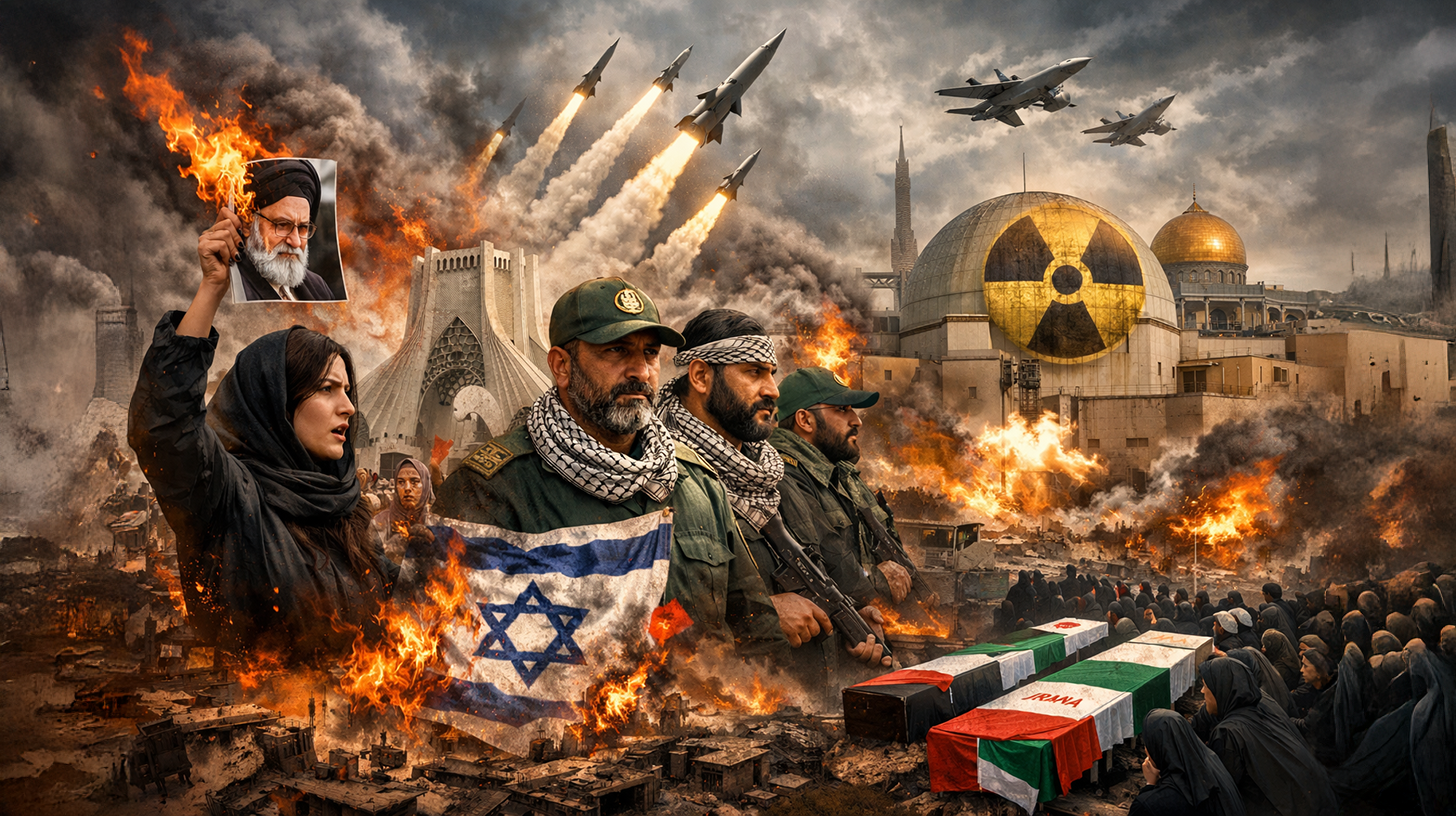
US military buildup outside Iran, EU designation of the Revolutionary Guard as a terrorist organization, and further sanctions: Analysis and consequences – Creative image: Xpert.Digital
Secret Operation "Midnight Hammer": How the US is preparing militarily for a worst-case scenario
A powder keg about to explode: Iran at a historic turning point
At the beginning of 2026, the world watches the Middle East with bated breath. The Islamic Republic of Iran is at the center of a perfect storm of internal collapse and extreme external pressure, unprecedented in its intensity since the 1979 revolution. What began as a currency crisis and economic despair has escalated within days into a bloody popular uprising, to which the regime is responding with unimaginable brutality: tens of thousands of deaths and a vicious wave of repression mark the leadership in Tehran's attempt to cling to power at any cost.
But unlike in previous crises, this time the regime also faces a geopolitical back-and-forth. While the traditional allies of the “axis of resistance”—from Hamas to Hezbollah—are massively weakened, a formidable military threat is forming in the Persian Gulf. The US, under President Donald Trump, has made it unequivocally clear with a massive naval presence and strategic bombers that the time for patience is over. This military buildup is flanked by a historic shift in Europe: By designating the Revolutionary Guard as a terrorist organization, the EU is sending a long overdue signal of resolve.
The following analysis illuminates the multifaceted dimensions of this escalation – from the economic abyss and massacres in the interior to Washington's military options and the possible scenarios for the future of a region on the brink of a major war or a historic upheaval.
Suitable for:

What is the current situation in Iran and why is the situation escalating right now?
At the beginning of 2026, the Islamic Republic of Iran found itself in its most severe domestic and foreign policy crisis since its founding in 1979. At the end of December 2025, the Iranian currency, the rial, collapsed dramatically within days, the inflation rate reached over 42 percent, and economic despair initially drove merchants in Tehran's Grand Bazaar into the streets. Within a few days, these initially economically motivated protests spread into nationwide demonstrations that challenged the entire political system in at least 70 cities.
The Iranian leadership responded with unprecedented brutality. According to consistent reports from international human rights organizations, thousands of demonstrators and uninvolved civilians were killed by security forces between January 8 and 10, 2026. The exiled Iranian portal Iran International reports over 36,000 deaths, while the US magazine TIME speaks of 30,000 fatalities within just two days. Human Rights Watch has documented evidence of systematic mass killings in which protesters were deliberately shot in the head and torso. The independent human rights organization HRANA has so far verified over 6,100 deaths and is investigating a further 17,000 cases.
These massacres, among the bloodiest in modern Iranian history, took place under near-total digital darkness: The Iranian government imposed comprehensive internet and telephone shutdowns, closed universities, government offices, and banks, ostensibly due to cold weather and energy shortages, but in reality to suppress the protests. Tens of thousands were arrested, many abducted without a trace, and the injured were denied access to medical care or arrested directly in hospitals.
Suitable for:

What exactly does the US military buildup look like, and what goals is Washington pursuing?
In January 2026, the United States established its largest military presence in the Middle East in decades. The aircraft carrier USS Abraham Lincoln, along with its entire escort fleet of guided-missile cruisers and destroyers, arrived in the region. US Secretary of State Marco Rubio confirmed that between 30,000 and 40,000 American troops were stationed at eight or nine facilities in the region. In addition, several B-2 stealth bombers, which had already been used in Operation Midnight Hammer against Iranian nuclear facilities in June 2025, were redeployed.
US President Donald Trump speaks of a “massive armada” larger than the one sent to Venezuela. In addition to the USS Abraham Lincoln, another aircraft carrier group is to be deployed to the region. The US Central Command (Centcom) announced several days of air force exercises, and the Centcom commander met personally with the head of the Israeli armed forces for direct consultations on possible coordinated military operations.
The military objectives of this unprecedented troop buildup are multifaceted. According to the Wall Street Journal and Axios, Trump is considering several options, ranging from limited attacks on Revolutionary Guard facilities to comprehensive strikes against Iran's nuclear program and ballistic missile technology. CNN reports that, in the event of military action, Trump is considering a "strong, decisive strike" intended to force Tehran to accept US conditions for a new nuclear agreement.
On January 28, 2026, Trump himself issued an ultimatum: “Hopefully, Iran will quickly come to the negotiating table and strike a fair and just deal – NO NUCLEAR WEAPONS. Time is running out. The next attack will be far worse.” This threat explicitly refers to Operation Midnight Hammer in June 2025, in which US forces severely damaged Iranian nuclear facilities with bunker-buster bombs.
What exactly does the EU's classification of the Revolutionary Guard as a terrorist organization mean?
On January 29, 2026, EU foreign ministers unanimously decided in Brussels to classify the Iranian Revolutionary Guard Corps (IRGC) as a terrorist organization. This places this elite military unit, which reports directly to Supreme Leader Ayatollah Ali Khamenei, on the same level as al-Qaeda, the Islamic State (IS), and Hamas.
This step is historically unprecedented: For the first time, the European Union has classified a central part of a state apparatus as a terrorist organization. The Revolutionary Guard comprises nearly 200,000 fighters in various branches of the armed forces and is not only the regime's main military pillar, but also, with its numerous businesses, the country's largest economic player. It includes the Basij militia, a paramilitary unit used to monitor society and suppress the opposition, and which played a key role in the brutal crackdown on the recent protests.
The legal basis for this listing was a 2023 ruling by the Higher Regional Court of Düsseldorf, which found that an Iranian state agency had commissioned an attempted arson attack on a synagogue in Bochum. The EU Council's legal service confirmed that this ruling was sufficient grounds for EU terrorism listing, as EU criteria require a court decision or prohibition order in at least one member state.
The practical consequences are far-reaching: All assets of the Revolutionary Guard in the EU must be frozen. EU citizens and companies are prohibited from providing the organization or its members with financial or economic resources. Affected individuals will be subject to EU entry bans. Furthermore, the list of goods that may no longer be exported from the EU to Iran will be expanded.
In parallel with the designation of the Revolutionary Guard as a terrorist organization, EU foreign ministers decided on sanctions against 31 other Iranian actors, including Interior Minister Eskandar Momeni, Attorney General Mohammad Movahedi-Azad, and the head of the security police, Seyed Majid Feiz Jafari. In total, the EU has now imposed sanctions against over 700 Iranian organizations, companies, and individuals.
The political symbolism of this decision is enormous. German Foreign Minister Johann Wadephul described the Revolutionary Guard as "henchmen of the Iranian regime" with "blood on their hands." EU High Representative Kaja Kallas emphasized: "Those who behave like terrorists should be treated like terrorists." Chancellor Friedrich Merz called the classification a "clear signal" that the EU stands with the peaceful demonstrators in Iran.
However, the practical effect is limited, as the Revolutionary Guard has been subject to comprehensive EU sanctions for over a decade, including asset freezes and funding bans. These sanctions were primarily imposed to prevent Iran from proliferating weapons of mass destruction. The designation as a terrorist organization is therefore primarily political and symbolic, sending an unambiguous message of solidarity with the Iranian civilian population.
What are the economic consequences of the sanctions for Iran?
The Iranian economy has been in a severe structural crisis for years, exacerbated by international sanctions. Gross domestic product (GDP) shrank from approximately US$600 billion in 2010 to an estimated US$356-437 billion in 2025. The International Monetary Fund (IMF) forecasts real GDP growth of just 0.3 percent for 2025, coupled with a dramatic 43.3 percent inflation rate – a toxic mix that destroys both purchasing power and investment.
The inflation rate reached a peak of 48.6 percent in October 2025 and was still at 42.2 percent in December. The Iranian rial collapsed dramatically at the end of December 2025, losing massive value within a very short time. This currency crisis was the immediate trigger for the mass protests, as traders could no longer calculate their prices and the population was confronted with skyrocketing living costs.
Paradoxically, despite international sanctions, Iran exported record amounts of crude oil in 2025, primarily to China, which accounts for between 85 and 90 percent of Iranian oil exports. These shipments are transported via a sophisticated shadow fleet and are often delivered to small, independent refineries in China's Shandong province, operating outside the major Chinese state-owned enterprises. Exports remained at approximately 1.5 to 1.7 million barrels per day.
Nevertheless, the Iranian regime's actual revenues from the oil business plummeted dramatically. Estimates suggest that Iran exported approximately $30 billion worth of crude oil in 2025, but retained only about $20 billion as profit. The reason: A network of intermediaries and buyers is exploiting Iran's precarious situation, demanding ever-increasing discounts and fees for handling the sanctioned oil. Players in the Iranian oil trade are demanding higher commissions, and buyers are using the sanctions to acquire oil at massive price reductions.
The new EU sanctions from January 2026 further exacerbate this situation. The asset freezes, financing bans, and expanded export restrictions hit Iran at a time when its foreign exchange earnings are already diminished and the country desperately needs them to pay for imports and prop up its dramatically weakened currency.
The US administration under Trump pursued a “Maximum Pressure 2.0” strategy and significantly increased the naming of key enablers of Iranian oil exports, including refineries in China and companies in India, Turkey, and the UAE. In addition, Trump imposed 25 percent tariffs on countries that trade with Iran.
The economic consequences for the Iranian population are devastating. The official unemployment rate is around nine percent, but is likely much higher. The once prosperous middle class has been largely impoverished. Private consumption, which accounts for well over half of GDP, has come under massive pressure from rampant inflation. A water crisis and dramatically rising food prices are exacerbating the humanitarian situation.
According to the Iranian leadership, international sanctions are solely to blame for the economic crisis. The main reasons given for these sanctions are the Islamic Republic's nuclear and missile programs, serious human rights violations, regional destabilization, and the financing of terrorism. Other key causes of the economic crisis, such as corruption, government inefficiency, and mismanagement, are systematically ignored by the leadership in Tehran.
Our global industry and economic expertise in business development, sales and marketing

Our global industry and business expertise in business development, sales and marketing - Image: Xpert.Digital
Industry focus: B2B, digitalization (from AI to XR), mechanical engineering, logistics, renewable energies and industry
More about it here:
A topic hub with insights and expertise:
- Knowledge platform on the global and regional economy, innovation and industry-specific trends
- Collection of analyses, impulses and background information from our focus areas
- A place for expertise and information on current developments in business and technology
- Topic hub for companies that want to learn about markets, digitalization and industry innovations
Iran's house of cards is collapsing: The end of the feared axis of resistance?
What is the situation of Iran's regional allies?
The so-called “axis of resistance,” the network of Iranian allies and proxy militias in the region, has been dramatically weakened. This represents a fundamental loss of power for Tehran, which for decades projected its regional influence through these proxies.
Hamas in Gaza has been massively decimated by the war against Israel since October 7, 2023, although not completely eliminated. Key leaders such as Ismail Haniyeh and Yahya Sinwar have been killed. The organization has largely lost its military power and is no longer able to serve as an effective proxy for Iran.
Hezbollah in Lebanon, traditionally Iran's most powerful and best-equipped ally, is facing an existential crisis. The war against Israel at the end of 2024 dealt the organization a massive blow: almost its entire leadership, including its long-time leader Hassan Nasrallah, was killed. Its infrastructure lies in ruins, and its military capabilities are severely diminished. Political scientist Mustafa Kamel as-Sayyed of Cairo University states: "Hezbollah is extremely weakened." Maha Yahya of the Carnegie Institution in Beirut adds: "Hezbollah currently needs to redefine itself. It is in an existential crisis.".
During the current Iran crisis, Hezbollah has been conspicuously reserved. While the new Secretary-General, Naim Qassem, declared that an attack on Iran could set the entire region ablaze and that killing Khamenei would be “a murder of stability in the region,” it remains unclear whether the militia is actually still capable of fighting or whether this reticence is strategically motivated.
The Yemeni Houthi rebels, however, are demonstratively showing their readiness for battle and threatening new attacks on ships in the Red Sea. They released a video captioned "Soon," signaling their willingness to support the Iranian regime in the event of an escalation. During the war between Hamas and Israel, the Houthis bombed over 100 ships and attacked the Jewish state with ballistic missiles and drones.
Iraqi Hezbollah brigades also weighed in. The Secretary-General of the Iraqi Hezbollah Brigades, in a dramatic speech, called for war preparations to support the Iranian regime in the event of an escalation. Kataeb leader Abu Hussein al-Hamidawi promised that a war against Iran “will not be a walk in the park” and urged his followers to “reach the level of a suicide attack.”.
The fall of the Assad regime in Syria in 2025 dealt another severe blow to Iran. Syria was a key component of the Shiite supply route Iran-Iraq-Syria-Lebanon, through which weapons and military support were transported to Hezbollah. With Assad's fall, this land bridge was severed.
Experts agree: Iran's ability to project power is severely limited. Lebanese political commentator Ronnie Chatah states: “Hezbollah's responsiveness is unlikely to be the same as before the war. The same strong front no longer exists. And this will drive Iran towards diplomacy, because its options in the region are limited.”.
What diplomatic options remain and what are the prospects for negotiations?
The diplomatic situation is extremely tense, and negotiating options appear limited. Trump has issued an ultimatum to Iran, demanding that it come to the negotiating table and negotiate an agreement that categorically excludes Iranian nuclear weapons. Washington is also demanding that Iran completely abandon domestic uranium enrichment and transfer its stockpiles of highly enriched uranium to third countries. Particularly explosive is the fact that the US is also demanding a limitation or even the complete abolition of Iran's missile program.
This last demand represents a red line for Tehran. Iran considers the demand for missile limitations unacceptable, especially since Israel is not subject to any comparable restrictions, and the Israeli airstrikes on Iranian nuclear facilities in June 2025 only deepened mistrust. Iran's nuclear chief, Mohamed Eslami, rejected Trump's demands, stating that Iran, like the US, has the right to utilize advanced nuclear technology: "We therefore reject the American demands for any restrictions on our nuclear program.".
Iranian Foreign Minister Abbas Araghchi clearly stated his country's conditions: “Diplomacy and military threats are neither effective nor useful. If the US wants to negotiate, it must put aside threats and illogical demands.” He emphasized that Iran has not yet received a concrete proposal for diplomatic negotiations from the US.
Despite these hardened fronts, diplomatic activity is underway. Turkish President Recep Tayyip Erdogan is positioning himself as a mediator and, in a phone call with Trump, proposed a direct conference call between Trump and Iranian President Masoud Pezeshkian. Turkish Foreign Minister Hakan Fidan traveled to Tehran, and Iranian Foreign Minister Araghchi is in Istanbul, attempting to avert war at the last minute. Trump is said to have been quite receptive to Erdogan's mediation proposal.
Interestingly, Trump himself suggested in an interview with Axios that he believed Iran wanted a deal: “They want to make a deal. I know that. They’ve called multiple times. They want to talk.” On January 29, 2026, Trump stated that he had already held talks with Tehran and planned to hold further talks, and hoped he would not have to use the deployed aircraft carrier strike group.
These conflicting signals point to a classic negotiating gamble: maximum military pressure combined with a narrow diplomatic door. US Secretary of State Marco Rubio assessed that the Iranian leadership was weaker than ever before and was struggling with economic collapse. From this weakened position, Washington hopes that Tehran will be willing to make substantial concessions.
However, there are considerable doubts about the success of this strategy. Iran expert Cornelius Adebahr of the German Council on Foreign Relations argues that it does not correspond to the prevailing logic in Tehran to show a willingness to negotiate right now under massive pressure. Even high-ranking Israeli officials are skeptical. An Israeli security expert told Reuters: “If you want to overthrow the regime, you have to use ground troops. Even if the US were to kill Khamenei, a new leader will replace him.”.
The talks between the US and Iran, which began in Oman in April 2025, were put on hold after the Israeli attacks in June 2025. At that time, the talks initially focused only on procedural matters, and both sides wanted to avoid war. However, the current escalation has destroyed these fragile attempts at reconciliation.
What role does Europe play and how does Germany position itself?
The European Union plays an ambivalent role in this crisis, characterized by hesitancy and limited capacity for action. While the EU has sent a clear signal by designating the Revolutionary Guard as a terrorist organization and imposing new sanctions, its actual ability to influence developments on the ground remains limited.
In a remarkable speech on January 28, 2026, the new EU High Representative for Foreign Affairs and Security Policy, Kaja Kallas, addressed the fundamental changes in transatlantic relations. She declared that the changes were “structural and not temporary” and warned: “No great power in history has ever outsourced its survival and survived.” Europe must adapt to the new realities in which it is no longer Washington’s primary center of gravity.
Kallas painted a bleak picture of the global situation: Russia as a “major security threat”, China as a “long-term challenge”, and the Middle East as a “completely unpredictable” region. She warned: “The danger of a complete return to a policy of coercive force, to spheres of influence, and to a world where might makes right is very real.”.
The EU's practical policy on Iran, however, lags behind its rhetoric. After years of debate and resistance, primarily from France, the Revolutionary Guard was only designated a terrorist organization at the end of January 2026. Even the Israeli and US military strikes against Iranian nuclear facilities in June 2025 did little to change the wait-and-see approach in Brussels. The President of the European Commission, Ursula von der Leyen, was sharply criticized for her motto being "wait and see.".
Remarkably, trade volume between the EU and Iran still amounted to €4.3 billion in 2024, the second year after the suppression of the 2022 protests. According to the EU statistics agency Eurostat, Germany is the Islamic Republic's largest trading partner among the 27 member states. The 2016 Joint Declaration between then EU High Representative Federica Mogherini and Iranian Foreign Minister Javad Zarif on building cooperative relations has never been officially revoked.
Germany, under Chancellor Friedrich Merz (CDU), has taken a significantly tougher stance. During a visit to India in mid-January 2026, Merz declared: “If a regime can only cling to power through violence, then it is effectively finished. I assume that we are currently witnessing the final days and weeks of this regime.” These remarks led the Iranian Foreign Ministry to summon the German ambassador, Axel Dittmann, and accuse Merz of “irresponsible interference in Iran’s internal affairs.”.
German Foreign Minister Johann Wadephul called for stricter sanctions and announced that Germany and the US would work together to ensure that the G7 countries issue a joint statement. Following a meeting with US Secretary of State Marco Rubio in Washington, Wadephul emphasized that the international community must make it clear that it stands in solidarity with the Iranian people.
Merz described the listing of the Revolutionary Guard as a “clear signal” that the EU stands with the peaceful demonstrators in Iran. Wadephul called the listing “urgently necessary” because of the events in Iran and described the political leadership as an “unjust regime.”.
On January 16, 2026, the German Bundestag debated a motion from the Left Party parliamentary group on “Solidarity with the People of Iran.” The motion calls on the Federal Government to strengthen the democratic aspirations of civil society, expand humanitarian aid, refrain from deportations to Iran, and establish protection programs for Iranian opposition members.
Critics, however, point out the lack of concrete measures. While Merz predicted the imminent end of the Islamic Republic, he did not reveal what specific contributions he intended to make. As the Jewish Allgemeine newspaper observed, Europeans remain largely "hesitant bystanders" in this crisis.
What are the medium-term consequences for regional stability in the Middle East?
Developments in Iran have the potential to fundamentally shift the geopolitical order across the Middle East. The weakening of the “Axis of Resistance” and the possible collapse or radical transformation of the Iranian regime create a power vacuum that presents both risks and opportunities.
Since October 7, 2023, Israel's military operations have significantly contributed to weakening Iran's sphere of influence. The dismantling of the Hamas leadership, the substantial weakening of Hezbollah, and the disruption of the Shiite supply route following the fall of the Assad regime in Syria have drastically curtailed Iran's projection of power. Furthermore, Israel's military strikes in June 2025 have opened new operational avenues, such as in Syrian airspace, enabling strategic attacks against Iran's nuclear program.
This weakening of Iran is not only in Israel's interest, but also in the interest of the region's Sunni-majority states, which felt pressured by Iranian expansionism. Saudi Arabia, Jordan, the United Arab Emirates, and Qatar are likely to welcome this change with relief. The Gulf states have begun to look elsewhere for security, having realized that the US is no longer a reliable regional security guarantor.
Particularly noteworthy is the repositioning of the UAE and Saudi Arabia. Following the Israeli attack on Qatar in September 2025, which specifically targeted the Hamas leadership in Doha, Israel crossed a red line: if the US could not prevent an Israeli attack on an ally, its role as a regional security guarantor had effectively failed. The Gulf states are now increasingly seeking alternative security partners, with India playing an increasingly important role.
Turkey is massively strengthening its geopolitical position, not least through its growing role in Syria and its mediation efforts in the Iran crisis. President Erdogan is using the situation to position himself as an indispensable player on the world stage.
Several scenarios are conceivable for the stability of the region. The optimistic scenario, advocated by some analysts, sees the current crisis as a long-term impetus for political and social reforms. Should Iran be forced to scale back its foreign policy ambitions, domestically, room for change could open up. A return to the reform approaches of 2015 and greater openness—also with regard to human rights, women's rights, and religious freedom—would be possible consequences.
The pessimistic scenario warns of chaos and fragmentation. Experts fear a development like that in Syria, with rival factions, provinces, and a splitting of the country. The most serious risk is not the overthrow of the regime, but the chaos that follows. Although the 86-year-old Khamenei has withdrawn from day-to-day governance, he retains ultimate authority over war, succession, and nuclear strategy. His incapacitation threatens a bitter power struggle between various factions within the elite.
Another massive risk is a wave of refugees heading to Europe. Middle East expert Ragıp Soylu issued a stark warning: Should Iran “explode,” 90 million people would not only remain in the region and Turkey – they would definitely migrate to Europe. Turkey would play a key role as a transit country in this scenario, giving Erdoğan considerable negotiating power with the EU.
The Strait of Hormuz, through which over 25 percent of the world's seaborne oil and around 20 percent of global liquefied natural gas (LNG) trade is transported, represents another potential risk. A blockade by Iran or Iranian proxy militias could, according to estimates by investment banks like JPMorgan, catapult the price of oil to as high as $120 per barrel and cause gas prices in Europe to rise dramatically.
Russia would be significantly weakened by a change in Iran. From the Kremlin's perspective, almost any conceivable political development in Iran is problematic. A change in leadership or a systemic upheaval in Tehran would likely lead to the rebuilding of relations with Europe and the country's return to global markets. Increased Iranian oil and gas exports would drive down prices and limit Russia's ability to use energy scarcity as leverage. A change in Iran would undermine one of Russia's few remaining strategic partnerships under sanctions and isolation.
Hub for security and defense - advice and information

Hub for security and defense - Image: Xpert.digital
The hub for security and defense offers well-founded advice and current information in order to effectively support companies and organizations in strengthening their role in European security and defense policy. In close connection to the SME Connect working group, he promotes small and medium -sized companies (SMEs) in particular that want to further expand their innovative strength and competitiveness in the field of defense. As a central point of contact, the hub creates a decisive bridge between SME and European defense strategy.
Suitable for:
Collapse, reform, or chaos: Where is Iran really headed?
What long-term scenarios are conceivable for the future of Iran?
The future of the Iranian political system is at a historic turning point. Several fundamentally different development paths are conceivable, the likelihood of which depends on internal and external factors.
The first scenario is a continuation of the status quo with gradual reform. In this case, the regime would suppress the current protests, as it did during the mass demonstrations of 2009, 2019, and 2022, and then implement limited reforms to reduce pressure. The Islamic Republic has repeatedly demonstrated in the past that it possesses considerable repressive capabilities. The Revolutionary Guard, the Basij militia, and the security police form a comprehensive apparatus of repression.
However, the conditions are different this time. The economic crisis is so fundamental that cosmetic reforms are unlikely to suffice. The population, especially the youth, has almost completely lost faith in the system's reformability. Slogans like "Death to the dictator" and "Islamic Republic – we don't want it!" can be heard on the streets. This sustained social backlash represents the greatest obstacle to the system's continued success.
The second scenario is an orderly transition within the system. Supreme Leader Ayatollah Ali Khamenei, now 86 years old, announced his vision for the future back in 2019 with the “Second Step of the Revolution.” At its core is a change of elites intended to ensure the transition from the Khamenei to the post-Khamenei era. Khamenei aims to transform the “Islamic Republic” into an “Islamic State”—effectively abolishing the remaining republican features of the political system.
For this transition, the regime has systematically built up new, young, radical forces sworn to Khamenei. However, it is currently questionable whether the desired transition to the post-Khamenei era can succeed. Besides potential power struggles within the political elites, it is above all the ongoing societal resistance that poses the greatest obstacle to successful implementation.
The third scenario is an abrupt regime change, either through a popular uprising or military intervention. Iran expert Azadeh Zamirirad of the German Institute for International and Security Affairs (SWP) explains: “Regime change is at least a possibility.” The situation is “extremely tense,” not least because the Israeli attacks have effectively disabled Iranian air defenses.
Chancellor Merz believes the regime is on the verge of collapse, stating: “I am convinced that we are witnessing the final days and weeks of this regime.” However, this assessment is not shared by all experts. Even Israeli security sources warn that airstrikes alone cannot bring about regime change and that ground troops would be necessary. Furthermore, even if Khamenei were killed, a new leader would simply replace him.
The fourth scenario is fragmentation and chaos. This is the scenario most feared by many observers. Iran could transform into an “early Syria” with rival factions and provinces. The most serious risk is not the overthrow of the regime, but the chaos that follows. Iran is a multi-ethnic state with significant ethnic tensions between Persians, Azerbaijanis, Kurds, Baloch, and Arabs. A collapse of central power could unleash these tensions and lead to secessionist movements.
The fifth scenario is a democratic transformation. This is the most optimistic scenario, hoped for by parts of the Iranian opposition and some Western politicians. In this case, a democratic transition process would begin after the fall of the mullah regime, possibly led by secular or reform-oriented forces. A constitutional monarchy or a secular republic would be conceivable forms of government.
However, there are considerable doubts as to whether Iranian society, after decades of authoritarian rule and given deep ethnic, religious, and social divisions, could manage a peaceful democratic transition. It lacks functioning democratic institutions, the rule of law, and experience with pluralistic politics. The opposition is fragmented and lacks a unified leader or a coherent political agenda.
Realistic analysts expect Iran's future to be a combination of several of these scenarios: a period of sustained instability with gradual reforms, internal power struggles and possibly regional fragmentation, before a new, more stable order emerges – be it authoritarian-reformist or democratic.
How will international relations and the global order develop?
The Iran crisis marks a turning point in international relations and the global power architecture. It illustrates the ongoing shift from a unipolar, US-dominated world order to a multipolar constellation with complex regional power centers.
Transatlantic relations are undergoing a fundamental transformation. EU High Representative Kaja Kallas stated this unequivocally: the changes are “structural and not temporary.” Europe is no longer Washington’s primary center of gravity, and this shift began even before the current Trump administration. According to Kallas, the danger of a complete return to a politics of coercion, to spheres of influence, and a world where might makes right is very real.
This assessment is confirmed by the concrete handling of the Iran crisis. The US is acting largely unilaterally, without substantial coordination with European partners. Washington is meeting with high-ranking representatives from Israel and Saudi Arabia for talks about Iran and is possibly planning military options without seriously involving Europe. The EU is limiting itself to sanctions decisions and diplomatic statements, but has no discernible influence on actual developments.
Germany and the EU have begun to draw the consequences from this new reality. The EU has set 2030 as a common deadline for achieving "full defense readiness" and repelling a potential Russian attack on an EU member state. Several multi-billion-euro initiatives have been launched to rapidly increase defense spending, promote domestic industry, and reduce dependence on US weapons.
China plays an ambivalent role in the Iran crisis. Beijing is Iran's most important trading partner and primary energy customer, importing record amounts of crude oil. The 25-year agreement between China and Iran includes long-term oil, gas, and petrochemical investments of up to $400 billion. China would lose both economically and geopolitically from an Iranian collapse, as it would lose a vital energy source and a strategic partner in the Middle East.
At the same time, China has no interest in a nuclear-armed Iran, which could destabilize the region and potentially motivate other states to develop their own nuclear weapons. Beijing's strategy is therefore characterized by a two-pronged approach: reconciling immediate energy security with long-term geopolitical opportunism.
Russia would be significantly weakened by a change in Iran. The strategic partnership between Moscow and Tehran is one of Russia's few remaining alliances in an era of international isolation. Iran supplies drones for the war in Ukraine, and the two countries coordinate their policies in the Middle East. A reformed or Western-oriented Iran would end this cooperation and weaken Russia's position in both the Middle East and the Ukraine conflict.
Russia conducted several transport flights to Iran during the first week of January 2026, presumably to deliver weapons and ammunition, while also flying out large quantities of Iranian gold. These activities demonstrate Moscow's desperate attempts to stabilize the Iranian regime.
The regional power shifts in the Middle East are fundamental. The weakening of Iran and its proxies creates space for Sunni powers such as Saudi Arabia, the UAE, and Turkey. These states are diversifying their security partnerships and increasingly aligning themselves with Asian powers, particularly India. The planned 2026 summit between the EU and the Gulf Cooperation Council countries in Saudi Arabia will reveal what new avenues for cooperation in trade and energy will become possible.
Through its military successes, Israel has not only reduced the Iranian threat but also created new realities. The de facto elimination of Iranian air defenses and the achievement of air superiority over large parts of Iran provide Jerusalem with unprecedented operational capabilities. This fundamentally alters the strategic balance in the entire Middle East.
For the global order, the Iran crisis represents a further weakening of multilateral institutions and international norms. The United Nations plays virtually no role in the crisis. The Iranian nuclear program, which was originally intended to be regulated by the 2015 Joint Comprehensive Plan of Action (JCPOA), is uncontrolled following the unilateral US withdrawal in 2018. The International Atomic Energy Agency (IAEA) is being systematically obstructed in its work by Iran.
Analysts predict that 2026 will be a pivotal year in the global reorganization, a time when power, markets, and alliances will be realigned. The Iran crisis serves as a key catalyst in this process. It exemplifies how the old, rules-based international order is under immense pressure and is being replaced by a new order shaped by power politics and regional spheres of influence.
The coming years will show whether this transition proceeds in a relatively orderly fashion or descends into widespread chaos. Much depends on how the Iran crisis is resolved – or whether it escalates and triggers an even larger regional conflict. The international community faces the challenge of weighing short-term military or geopolitical gains against long-term regional stability.
Advice - planning - implementation

Konrad Wolfenstein
I would be happy to serve as your personal advisor.
contact me at wolfenstein ∂ xpert.digital
Just call me on +49 7348 4088 965 (Munich) .










