
Silesia in focus: Pyskowice – Rossmann's strategic hub for the Polish drugstore market
Xpert Pre-Release

Available in 27 languages 📢
Prefer Xpert.Digital on GoogleⓘPublished on: October 10, 2026 / Updated on: October 10, 2026 – Author: Konrad Wolfenstein
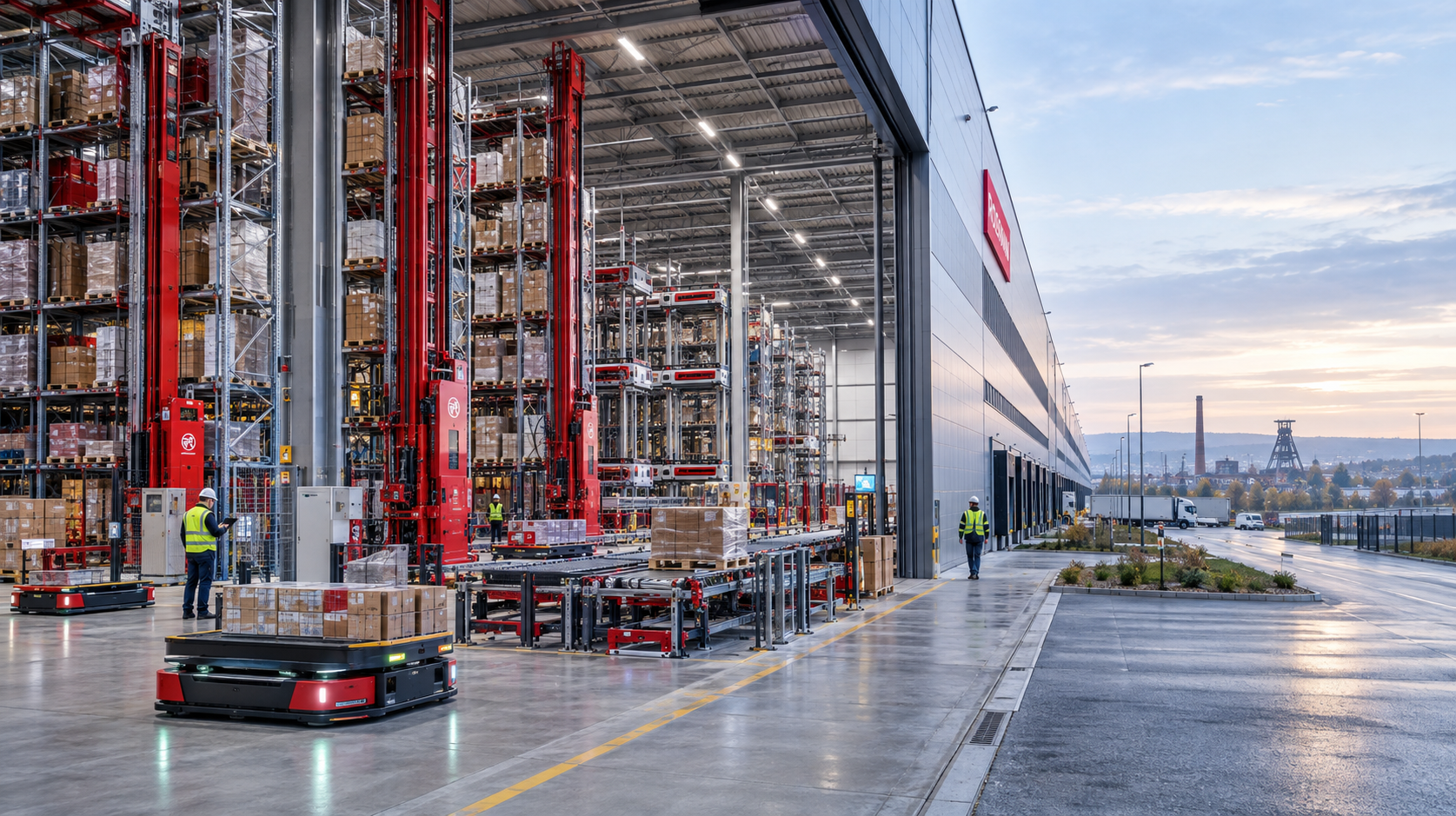
Silesia in focus: Pyskowice – Rossmann's strategic hub for the Polish drugstore market – Creative image on the topic, created with AI: Xpert.Digital
The drugstore competition: How Rossmann is setting new standards with automated logistics
Logistics 2.0: Rossmann's path to a highly automated future
Rossmann's investment as a catalyst for growth and innovation
The drugstore chain Rossmann is taking a monumental step into the future: With an investment of 500 million złoty in the expansion of its logistics center in Pyskowice, Poland, the company aims not only to increase its storage capacity but also to revolutionize the efficiency and automation of its entire logistics processes. This decision is not only a response to the accelerated growth of the Polish cosmetics market but also a strategic bet on the future of retail, where companies' performance is increasingly determined by intelligent logistics solutions. Pyskowice will become a key location where Rossmann can implement its ambitious plans to meet the demands of a growing store network and rising customer demand. In this context, the investment will be an important building block that not only secures Rossmann's competitiveness but also strengthens the regional job market and economic infrastructure in Silesia.
It's not the price that decides the drugstore competition – it's the warehouse
Rossmann is expanding its logistics center in Pyskowice, Silesia, for 500 million złoty, making the site a strategic hub for its Polish business. The investment is far more than just adding warehouse space. It represents a fundamental transformation of the value chain: away from predominantly manual warehouse logistics and towards a data-driven, highly automated system designed to manage the flow of goods for more than 2,135 stores faster, more accurately, and with greater capacity reserves.
The economic significance therefore lies not solely in the record sum. Crucially, Rossmann is simultaneously driving forward physical expansion, process automation, and a regional reorganization of its distribution network. The area in Pyskowice is growing by 23,000 square meters to a total of 66,000 square meters. This makes the center, alongside Łódź, the company's second most important logistics location in Poland. The expansion is scheduled for completion by the second half of 2027. Plans include a high-bay warehouse with approximately 27,000 pallet spaces, automated small parts storage, multi-stage picking areas, transport technology, and digital systems for comprehensive material flow control.
These dimensions illustrate how competition in the retail sector has changed. Drugstore chains visibly compete on price, product range, private labels, store locations, and apps. However, their actual performance is increasingly determined in areas that customers barely notice: inventory planning, replenishment speed, availability, error rate, transport capacity utilization, and the ability to distribute thousands of different items economically to thousands of locations. The new center in Pyskowice is therefore not an ancillary facility to the retail business. It is an integral part of the core business model.
Growth needs an industrial base
Rossmann plans to open approximately 160 new stores per year in Poland. This pace means that, on average, a new location must be integrated into the delivery network every two to three days. Each additional store not only expands the sales area but also generates new order items, delivery windows, routes, inventory risks, and seasonal demand peaks. At the same time, at least 1.18 million customers visit the chain's Polish stores daily. Even minor forecasting errors can result in significant stockouts, overstocking, or additional transportation costs at this scale.
Logistics must therefore grow faster than the number of stores. If Rossmann were to simply open more stores without expanding its distribution capacity accordingly, a gradual bottleneck would develop. Initially, deliveries would be scheduled more frequently, existing space would be used more intensively, and employees would be deployed more intensively. Later, search times, internal transport, picking errors, and disruptions would increase. Ultimately, store growth would weaken the efficiency of the entire system. The investment in Pyskowice is intended to proactively address precisely this problem.
The expansion is therefore a classic capacity investment, but with a crucial difference: Rossmann isn't simply buying more space, but more controllable capacity. The company is combining the new space with automated storage, precise sequencing, and software-supported material flow. This allows the additional capacity to be used more productively than in a conventional warehouse. The planned increase in logistical efficiency of nearly 30 percent therefore refers not only to the Pyskowice site, but also to effects across the entire Polish network.
Why Pyskowice is becoming a key location
Pyskowice is located in Upper Silesia, one of Poland's most important industrial and logistics regions. The region combines a large sales area with efficient transport and commercial infrastructure. From there, the south and southwest of the country, in particular, can be supplied. At the same time, the location lies within an economic corridor that is just as important for domestic Polish transport as it is for connections to the Czech Republic, Slovakia, and further into Central Europe.
The regional warehouse market underscores this importance. At the end of 2025, Silesia boasted over six million square meters of modern industrial and logistics space. This made the region, along with the greater Warsaw area and Lower Silesia, one of Poland's largest warehouse locations. While a vacancy rate of approximately eight percent indicated available space, demand for modern facilities remained strong. For a retailer with a long-term expansion strategy, a dedicated site tailored to their specific processes is therefore strategically more valuable than simply renting standardized warehouses.
Pyskowice is also not a greenfield experiment. The center has been operating as a logistics base for southern Poland since 2014. Following a previous expansion, it reached approximately 43,000 square meters in 2023. The current expansion by 23,000 square meters represents an increase in area of about 53 percent compared to that level. This reduces some of the location's risk: transport connections, the labor market, supply chains, and operational processes are already established. At the same time, however, the technical complexity increases considerably because existing manual structures must be integrated with new automated areas.
500 million zlotys for more than just concrete
Dividing the investment volume of 500 million złoty by the additional 23,000 square meters of floor space, purely mathematically, yields a figure of approximately 21,700 złoty per new square meter. However, this value would be misleading as a standard comparison of construction costs. The sum finances not only the building envelope, flooring, and technical building equipment, but also an integrated production system for retail logistics. This includes stacker cranes, shuttle technology, conveyor systems, rail vehicles, order picking areas, control software, security architecture, and the connection between the new and existing buildings.
The investment therefore aims to improve capacity, speed, and availability simultaneously. A traditional warehouse can accommodate more goods by adding more space. An automated center, on the other hand, should accelerate access to these goods, reduce movement, and ensure orders are fulfilled in the correct sequence. This is particularly relevant in the drugstore sector, where large quantities of diverse items with widely varying sales rates are common. Shampoo, cosmetics, detergents, baby food, household goods, and seasonal promotional items each have different storage and replenishment requirements.
From an economic perspective, Rossmann is shifting part of its cost structure. The company is currently accepting high fixed investment costs in order to limit variable costs per unit processed in the future. However, this mechanism only works with sufficient capacity utilization. The more containers, pallets, and store orders pass through the system, the more depreciation, maintenance, and system operation are distributed across individual units. Continued store growth provides the necessary volume base. Without this expansion, an investment of this magnitude would be significantly more difficult to justify.
The high-bay warehouse as a central buffer
The new high-bay warehouse will have a capacity of almost 27,000 pallets. Eight aisles and the corresponding number of automated storage and retrieval systems enable dense storage with standardized inbound and outbound processes. The high-bay warehouse not only serves as a large storage facility but also acts as a buffer between goods receiving, repacking, automated small parts storage, and the area that still operates partly manually.
Such a buffer has significant economic value. Deliveries from manufacturers don't always arrive at the same frequency as stores need goods. Furthermore, sales volumes fluctuate due to promotions, holidays, weather, trends, and short-term price changes. The high-bay warehouse decouples these timeframes. It receives larger deliveries and forwards pallets to downstream processes as needed. This allows Rossmann to better coordinate procurement quantities, transport capacity, and store requirements.
Higher storage density also reduces the space required per pallet. This is important not only for land and construction costs. Shorter distances and automated vertical movements can also reduce internal transport costs. However, this creates new dependencies: If a storage and retrieval machine or the higher-level control system fails, some inventory may be temporarily difficult to access. Therefore, redundancy, preventive maintenance, and spare parts management are among the most crucial business factors. Nominal capacity alone is of little use if technical availability is not consistently high.
Miniload makes branch orders machine-readable
The centerpiece of the new system is the miniload area. This refers to an automated small parts warehouse where goods are stored in containers and prepared for specific store orders. The plan includes a seven-aisle shuttle warehouse with approximately 110,000 storage locations and picking zones on three levels. An additional three-aisle shuttle area will serve as a buffer for outgoing goods.
The key advantage lies in decoupling individual process steps. After repacking, the goods can initially be stored automatically. As soon as a branch order is due, the system delivers the required containers to the picking stations. Employees no longer have to walk long distances through static aisles. Instead, the goods arrive at the correct station according to the "goods-to-person" principle. This increases productivity per working hour and can reduce ergonomic strain.
This is particularly important for Rossmann because store orders can consist of many small items. A drugstore doesn't necessarily need entire pallets of a single product, but rather carton-based or individual quantities from a wide range of products. The miniload system translates this fragmented demand into a machine-controlled flow of goods. A downstream sequencer arranges the containers in the sequence intended for the respective store. This not only makes the warehouse more efficient, but also simplifies unloading and product distribution in the stores, as the load is already prepared accordingly.
48 repacking stations connect two worlds
An automated small parts warehouse can only function if delivered goods are transferred into suitable load carriers. Therefore, 48 repacking stations are planned, connected to the other areas via conveyor technology. There, items are transferred from pallets or larger packaging units into standardized containers. This step may seem unspectacular, but it is process-critical: Incorrect master data, incorrect container selection, or poorly secured products can later disrupt the entire automated process.
The repacking zone forms the interface between the diverse world of suppliers and the standardized world of the automated warehouse. Manufacturers deliver varying carton dimensions, pallet configurations, and packaging qualities. Automation, on the other hand, requires defined dimensions, weights, and surface finishes. This creates an economic standardization effect. The better Rossmann manages its product and packaging data, the more reliably the system can operate.
This significantly increases the importance of master data. Dimensions, weight, sensitivity, hazardous material properties, minimum shelf life, and storage conditions must be reliably recorded. An incorrect weight can strain conveyor technology, an incorrect size specification can prevent storage, and incomplete labeling can lead to incorrect inventory allocation. The digital quality of the data thus becomes just as important as the physical quality of the system. Automation does not automatically eliminate disorganization; rather, it forces the company to consistently discipline its processes and data.
Two transport lines for continuous operation
The new and existing buildings are linked by two above-ground connections. One serves personnel traffic, the other the automated transport of load carriers. This separation is more than just a structural feature. It improves safety, reduces intersections, and allows people and materials to move at different speeds.
A multimodal conveying system is planned for pallets, containers, and roll carriers. This includes extensive conveyor lines as well as rail-guided vehicles operating on two levels. Such RGV systems can handle high transport volumes over clearly defined routes. They are particularly useful when large volumes regularly flow between fixed points. In addition, specialized machines will stack roll carriers and prepare them for shipment.
The economic impact arises from the interplay between the components. A single, high-speed storage device is of little use if the subsequent transport becomes a bottleneck. Similarly, a high-performance conveyor system is of little use if order picking or shipping buffers can't keep up. The system must therefore be designed as a whole. The slowest continuously operating process determines the actual throughput. The planned material flow control system should coordinate precisely these dependencies and distribute orders in such a way as to avoid local bottlenecks as much as possible.
Software becomes the invisible management system
With increasing automation, the operational control of human and paper-based processes is shifting to software. The K.Motion PMS material flow system is designed to connect the various technologies and warehouse areas. Simultaneously, the warehouse management software is being modernized. These systems determine where goods are stored, which order receives priority, which route a container takes, and when a load carrier is ready for shipment.
This makes software a production-critical asset. A mechanical failure often affects a clearly defined component. In contrast, a faulty update, a malfunctioning interface, or inconsistent master data can affect multiple areas simultaneously. Risk management must therefore combine traditional maintenance with IT operations, cybersecurity, data management, and robust restart procedures.
The benefits of digital control are nevertheless considerable. The system can coordinate thousands of movements, adjust priorities at short notice, and identify bottlenecks. It also generates data on throughput, waiting times, capacity utilization, and disruptions. When used correctly, this creates a continuous improvement process: The company can not only recognize that a problem exists, but also at which station, at what time, and with which product group it occurs. This transforms a warehouse into a measurable, adaptive infrastructure.
Thirty percent efficiency is a network promise
Rossmann expects the expansion to increase efficiency in its Polish logistics operations by approximately 30 percent. This figure is ambitious and should not be misinterpreted as a blanket 30 percent cost reduction. Logistics efficiency can refer to throughput, processing time, output per working hour, error rate, inventory turnover, or a combination of these factors. Even if physical output increases by 30 percent, total costs will not necessarily decrease by the same amount, as depreciation, energy, maintenance, and highly skilled personnel also play a role.
The key lies in the network. After its expansion, the supply chain will be based on four main hubs: Łódź, Pyskowice, Grudziądz, and Dąbrówka Wielka. Pyskowice will focus particularly on southern Poland, while Łódź will retain its central function. A clearer regional division of labor can reduce transport distances, smooth out peak demand, and better support the growth of individual regions.
At the same time, a four-part network increases resilience, provided that inventory and processes can be partially relocated. However, highly specialized centers are not entirely interchangeable. The more automated Pyskowice is and the more tailored it is to specific goods flows, the more difficult it can be to replace its capacity with other locations at short notice in the event of a major disruption. Rossmann must therefore weigh efficiency against redundancy. A network operating at maximum capacity is cost-effective but prone to disruption. A network with deliberate reserves costs more but can better absorb spikes in demand, technical failures, and traffic problems.
Your intralogistics experts

Consulting, planning and implementation of complete solutions for high-bay warehouses and automated storage systems - Image: Xpert.Digital
More information here:
Silesia as a key region for drugstores
Automation does not simply replace work
Despite extensive automation, approximately 300 additional jobs are expected to be created in Pyskowice. At first glance, this contradicts the widespread assumption that robots and automated storage systems inevitably lead to job losses. Rather, this case demonstrates that expansion and automation can occur simultaneously. Rossmann is not automating an unchanged store, but creating additional capacity for a growing branch network. Machines are taking over certain handling, storage, and sorting tasks, while the larger system generates new personnel requirements.
However, the composition of the workforce is changing significantly. In addition to warehouse workers, specialists in IT, automation technology, maintenance, and plant operation are needed. Furthermore, skilled workers and managers are required to organize shifts, quality, safety, and continuous improvement. The work is thus becoming more technical and data-driven. Malfunctions must be diagnosed, software messages interpreted, and mechanical and electrical components proactively maintained.
In purely mathematical terms, an investment volume of 500 million złoty equates to approximately 1.67 million złoty per newly created job. However, this figure should not be interpreted as the cost price of a job. The investment primarily serves to supply more than 2,100 branches, expand storage capacity, and increase productivity. The employment effect is an additional regional benefit. This is precisely where the nature of modern industrial and logistics investments becomes apparent: they are capital-intensive, but at the same time create more skilled and often more stable jobs.
The Silesian labor market remains a bottleneck
Silesia boasts a long industrial tradition and a large pool of skilled technical workers. At the same time, logistics centers, manufacturing companies, automotive suppliers, and service providers are competing for similar qualifications. Mechatronics engineers, electricians, automation technicians, maintenance workers, shift supervisors, and IT specialists are particularly in demand. These shortages are exacerbated when several modern facilities in the same region are simultaneously seeking personnel.
Rossmann is responding to this with a comprehensive package of social and employee benefits. Such benefits are not merely voluntary additional costs from an economic perspective. In highly automated companies, low employee turnover can generate a measurable productivity advantage. Experienced employees are familiar with malfunction patterns, safety regulations, and the interactions between different departments. When experienced personnel leave the company, recruitment, training, and start-up costs arise. Furthermore, the risk of errors and downtime increases during the transition phase.
Automation therefore does not automatically reduce dependence on people. It changes it. Instead of a large number of relatively easily interchangeable tasks, the company needs fewer manual movements, but more reliable knowledge at critical points. A single qualified technician can influence the performance of a large area of the plant in the event of a malfunction. Employee retention, shift models, training partnerships, and internal career paths thus become integral parts of securing the investment.
Poland's drug market provides the demand base
The investment comes at a fundamentally growing market. The Polish cosmetics market already reached a value of around 25.4 billion złoty in 2023 and has grown by an average of more than five percent per year since joining the EU. Drugstores are the most important sales channel, accounting for almost 30 percent of cosmetics sales. Products for household, health, baby, personal care, and seasonal needs further expand the market volume relevant to Rossmann.
Real retail sales data also showed robust growth in 2025. For example, in the pharmaceuticals, cosmetics, and orthopedic products category, real sales in May were six percent higher and in July almost five percent higher than the respective figures for the previous year. While such increases do not prove a sustained exceptional boom, they do support the assumption that health and personal care products will remain relatively resilient consumer categories.
This stability is crucial for a long-term logistics investment. An automated center doesn't pay for itself within a few quarters. It requires high volumes over many years. The drugstore sector offers favorable conditions for this: many products are regularly repurchased, part of the assortment is less sensitive to economic fluctuations, and the density of stores creates recurring goods flows. At the same time, Rossmann must not underestimate consumer price sensitivity. Inflation, rising housing costs, and fluctuating confidence can drive customers to private label brands, promotional purchases, or cheaper channels. In such an environment, efficient logistics protects profit margins.
The branch remains central despite online retail
The Polish retail sector has become more digital, but brick-and-mortar stores remain dominant for drugstore items. Customers want to buy many products quickly, examine packaging, test fragrances, or combine shopping with other errands. This explains why Rossmann continues to invest in a dense network of stores, even as online orders and digital customer programs gain in importance.
For logistics, this doesn't create an either-or situation. A modern distribution center must support various forms of demand. Store deliveries remain the high-volume core, while digital data improves planning. Apps, loyalty cards, and online interactions provide signals about promotions, shopping carts, and regional preferences. When this information is combined with inventory and sales data, Rossmann can forecast demand more accurately and trigger replenishment earlier.
In the long term, this also opens up opportunities for closer integration of brick-and-mortar stores and online channels. Stores can serve as collection points, return locations, or local inventory buffers. For this to work, inventory levels must be visible and reliable in near real-time. The automated center in Pyskowice is therefore not just a response to the need for more branches. It also creates the infrastructural foundation for a retail landscape where physical and digital touchpoints are increasingly converging.
Silesia benefits from over 300 jobs
The regional impact is not limited to the immediately announced jobs. During construction, installation, and commissioning, orders are generated for construction companies, plant engineers, technical service providers, transport companies, and planners. During ongoing operations, demand follows for maintenance, cleaning, security, spare parts, energy management, and facility management. A large logistics hub can also encourage suppliers and specialized service providers to establish their own facilities nearby.
For Pyskowice, the investment strengthens the local economic and tax base. At the same time, it increases demands on roads, traffic safety, energy supply, and vocational training. The benefits for the region therefore depend on whether public and private infrastructure grows accordingly. If additional truck traffic causes local bottlenecks or skilled workers can only commute from afar, external costs will arise. Good transport connections, coordinated shift schedules, and efficient public transport can mitigate these burdens.
The project is also noteworthy from a structural policy perspective. Silesia is undergoing a long-term transformation from mining and heavy industry to diversified production, logistics, and technology-intensive services. While an automated distribution center doesn't create a research institution, it does require expertise in software, electronics, mechatronics, and process management. This contributes to a broader industrial knowledge base. The crucial question is whether regional educational institutions and companies will capitalize on this demand to develop appropriate training and professional development programs.
Productivity becomes a shield against costs
Poland's cost advantage over Western Europe persists, but it is less secure than it was ten or fifteen years ago. Wages, construction costs, energy prices, and regulatory requirements have all risen. At the same time, the labor market remains tight in key logistics regions. Companies can therefore no longer rely solely on lower personnel costs to maintain their competitiveness. They must achieve greater value creation per hour worked, per square meter, and per unit transported.
The investment in Pyskowice follows precisely this logic. High storage density, automated transport, and goods-to-person order picking will enable the same employee to process more orders with less walking and search time. More precise sequencing can reduce waiting times at loading docks. Improved inventory management lowers the risk of goods being in the wrong place or being moved unnecessarily multiple times.
Productivity is not synonymous with maximum speed. A system that achieves very high peak performance in the short term but frequently fails or incurs high error costs is economically weak. Sustainable productivity arises from the relationship between throughput, quality, availability, and resource utilization. Rossmann must therefore not only demonstrate that the system is theoretically capable of 30 percent more output. The crucial factor will be whether this advantage can be consistently achieved in daily operation over several years.
Energy and sustainability are becoming cost factors
Automated logistics is not automatically energy-efficient. Storage and retrieval machines, shuttle vehicles, conveyor technology, servers, cooling systems, and security systems all require a continuous power supply. This makes the Pyskowice center more dependent on energy prices and grid quality. At the same time, modern systems can save energy by shortening routes, intelligently combining movements, recovering braking energy, and reducing the space required per storage unit.
The transport side also offers potential. Better regional allocation of branches, higher vehicle utilization, and more precise departure planning can reduce empty runs and waiting times. Even the correct sequence of load carriers influences how quickly a truck can be unloaded and whether branch staff can efficiently handle goods. Sustainability is therefore not only achieved through solar panels or energy-saving building technology, but through the entire process from supplier to shelf.
For economic evaluation, Rossmann should directly link energy and emissions indicators to productivity. Useful metrics include, for example, electricity consumption per processed container, emissions per delivered unit, or transport kilometers per branch. Such indicators prevent a higher overall throughput from being mistakenly interpreted as an efficiency gain when resource consumption increases disproportionately. Furthermore, for a system with a decades-long lifespan, energy efficiency and adaptability become a safeguard against future price and regulatory risks.
The greatest risks lie in the integration
The construction of a warehouse can be planned, but the commissioning of a complex, automated system is considerably less so. In Pyskowice, high-bay warehouses, shuttle systems, conveyor technology, repacking stations, shipping buffers, inventory storage, and software must be integrated into a stable process. Every interface can cause delays or performance issues. The conversion is particularly challenging because existing operations must continue and the supply to the branches must remain guaranteed.
The first risk is the ramp-up phase. Automated systems rarely reach their target capacity on the first day. Employees need to be trained, master data needs to be cleaned, control rules need to be adjusted, and real-world load profiles need to be tested. Rossmann therefore needs sufficient time buffers between technical completion and full operational load. Overly aggressive transition plans could jeopardize precisely the delivery capability that the project is intended to improve.
The second risk is technological dependence. The more processes are tailored to specialized technology, the more important long-term spare parts availability, software maintenance, and supplier expertise become. The third risk concerns demand. If branch growth falls short of expectations or the product range changes significantly, some capacity could initially remain unused. Conversely, an undersized system can reach its limits early on if growth is faster. Therefore, the modular scalability of the technology used is just as economically important as its current performance.
Resilience must not be sacrificed for efficiency
The past few years have shown that supply chains must cope not only with normal demand, but also with the effects of pandemics, geopolitical tensions, energy price shocks, border issues, and extreme weather events. A modern distribution center can react more flexibly to such disruptions because inventory and goods movements are more transparent. However, automation alone does not create resilience. It can also introduce new vulnerabilities in the event of power outages, software failures, or network outages.
Rossmann therefore needs manual emergency procedures, alternative supply routes, and clearly defined priorities. Particularly sensitive or high-volume items should be able to be processed selectively in the event of a disruption. The four logistics centers must also be coordinated so that they can support each other to a limited extent. Complete redundancy would be too expensive, but total specialization would be risky.
Resilience possesses an economic value that is often underestimated in traditional investment calculations. While a reserve capacity can prevent just a few days of empty shelves, it can secure significant sales and customer confidence. Conversely, unused reserves incur ongoing costs. The right solution lies not in maximizing capacity, but in a robust balance. Therefore, Pyskowice should not be judged solely on low unit costs, but also on its ability to maintain delivery capacity under unusual circumstances.
Data can create a competitive advantage
Each automated order generates large amounts of operational data. Rossmann can identify how long individual items remain in the warehouse, which branches exhibit similar ordering patterns, when bottlenecks occur, and how promotions affect material flow. This data enables more precise forecasts, more dynamic inventory distribution, and improved workforce planning.
Artificial intelligence can support this process, but should not be seen as an end in itself. Its greatest benefit lies initially in reliable forecasts and clear decision-making. Models can combine regional sales patterns, seasonal trends, weather, promotions, and holidays. They can detect anomalies, such as unusually rapid sales or inventory levels that move more slowly than expected. In maintenance, sensor data can be used to detect wear and tear early and schedule maintenance before a breakdown occurs.
The quality of such applications depends on clean data and clear responsibilities. An algorithmically generated order suggestion remains prone to errors if action data is entered late or local specifics are not taken into account. Rossmann's success, therefore, will not come from having as many AI models as possible, but from an organization that effectively combines data quality, expertise, and automated decision-making. Pyskowice can become a real-world learning lab for this, with insights that can be applied to the entire Polish network.
The real return on investment is generated in the branches
The project's economic success isn't solely visible in the warehouse. The decisive effects are felt in the stores and at the customer's location. Increased product availability prevents lost sales. Better-sequenced deliveries shorten receiving times. Fewer stockouts reduce rework and customer complaints. More reliable supply allows stores to operate with lower safety stock levels and utilize sales floor space more productively.
Especially in a network of more than 2,135 stores, small improvements can have a significant overall impact. If each branch saves just a few minutes a day processing merchandise, this adds up to a considerable amount of work over the course of a year. Even a slight decrease in the error rate can prevent thousands of incorrect or late orders. Therefore, a costly central investment can pay for itself through many small, decentralized productivity gains.
Customer experience also benefits indirectly. Customers don't perceive logistics as a separate service, but they do notice empty shelves, missing promotional items, or disorganized restocking processes. A stable supply chain thus increases the likelihood that the desired product will be available, freeing up staff to spend more time on the sales floor. Logistics becomes a subtle indicator of brand quality.
A strategic bet with plausible logic
Rossmann's expansion in Pyskowice is a bet on three developments: further growth of the Polish drugstore market, continued expansion of its own branch network, and a lasting productivity advantage through automation. All three assumptions are plausible, but none is without risk. Consumer spending can fluctuate, competitors can invest more aggressively, and technological systems can fall short of expectations.
Nevertheless, the project's structure suggests a long-term decision. The location is established, the sales market in southern Poland is large, the branch network is growing, and current manual logistics are reaching their limits with increasing complexity. The investment combines additional space with modern technology, creates approximately 300 jobs, and strengthens the network of four distribution centers. It is therefore neither mere rationalization nor pure expansion, but a combination of both.
The provocative claim that future drugstore competition will be decided in the warehouse is therefore more than just an exaggeration. Prices and product ranges can be copied relatively quickly. An integrated logistics infrastructure built up over years is significantly harder to imitate. If Rossmann achieves the promised efficiency gains, manages technical risks, and utilizes the new capacity fully, Pyskowice will become a structural competitive advantage. If the integration fails, however, the same high degree of automation will transform into a costly dependency.
This is precisely where the economic significance of the 500 million złoty investment lies. Rossmann isn't simply building a larger warehouse. The company is opting for a business model in which growth can only be managed with industrial precision, high-quality technology, and consistent data utilization. For Silesia, this means new jobs and additional technological expertise. For Polish retailers, the project sets a benchmark: anyone who wants to further expand a nationwide branch network must develop the invisible infrastructure behind it at least as quickly as the visible sales areas.
Your global marketing and business development partner
☑️ Our business language is English or German
☑️ NEW: Correspondence in your native language!

Konrad Wolfenstein
I and my team are happy to be available to you as your personal advisor.
You can contact me by filling out the contact form here [email protected]:or simply call me at +49 7348 4088 965. My email address is
I'm looking forward to our joint project.










