
Swinemünde in focus: Cape Pomerania – Poland's new deep-water port as a key to European container flows
Xpert Pre-Release

Available in 27 languages 📢
Prefer Xpert.Digital on GoogleⓘPublished on: October 6, 2026 / Updated on: October 6, 2026 – Author: Konrad Wolfenstein
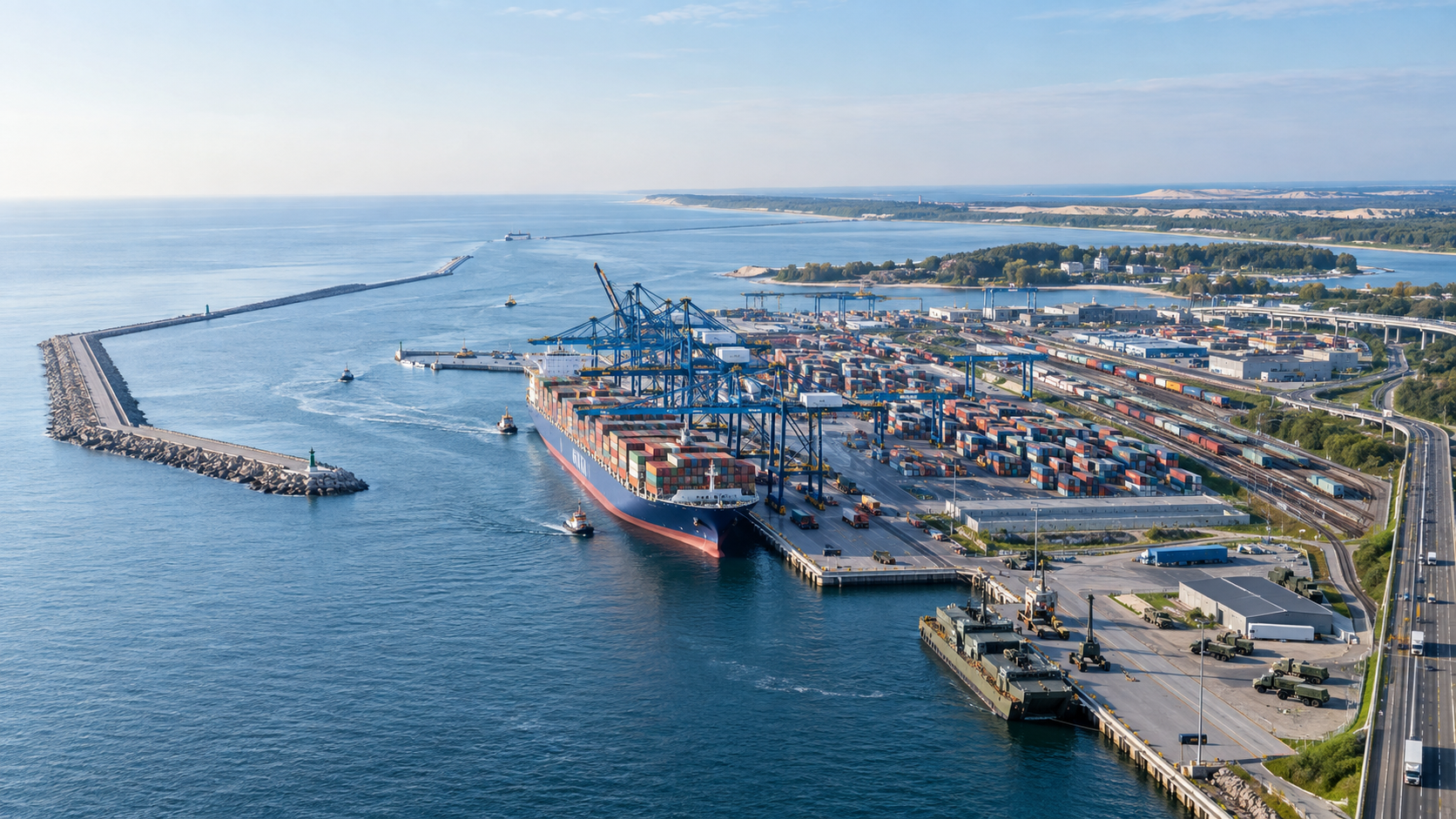
Swinemünde in focus: Cape Pomerania – Poland's new deep-water port as a key to European container flows – Creative image on the topic, with AI: Xpert.Digital
Strategic importance of Swinemünde: Cape Pomerania and its influence on logistics in Europe
Port development in Poland: Cape Pomerania and the challenges for German logistics centers
Located directly on the German-Polish border, the deep-water port of Cape Pomerania in Świnoujście (formerly Swinemünde) is one of the most strategically important infrastructure projects in the southern Baltic Sea region. With a total volume of approximately €2.3 billion, equivalent to around 10 billion złoty, this port will not only revolutionize the Polish logistics landscape but also have far-reaching effects on pan-European container flows. The plans include the creation of 186 hectares of reclaimed land, three kilometers of new quays, and an annual handling capacity of up to two million standard containers. Poland is thus aiming not merely for a regional port, but for a fully-fledged deep-water hub for the largest container ships capable of operating in the Baltic Sea.
The economic relevance of Cape Pomerania extends beyond the Polish coast, as Świnoujście is only about 250 kilometers from Berlin – closer than the German ports of Hamburg and Bremerhaven. This gives the new port a potential competitive advantage, especially in conjunction with planned new rail lines and efficient road connections, which could attract cargo from eastern Germany, the Czech Republic, and other parts of Central Europe. This analysis examines the strategic implications of Cape Pomerania, discusses the challenges for existing German ports, and considers the potential changes in the European logistics landscape.
Cape Pomerania is not a port project – it is Poland's attack on the old logistics order
Located directly on the German-Polish border, the deep-water port of Cape Pomerania in Swinemünde (Polish: Świnoujście) is one of the most strategically important infrastructure projects in the southern Baltic region. The total project volume, including the sea access and land-based connections, is estimated at approximately €2.3 billion or around 10 billion złoty. Plans include 186 hectares of reclaimed land, nearly three kilometers of new quays, a 17-meter-deep harbor basin, a 1.3-kilometer-long container terminal, and an annual handling capacity of up to two million standard containers. Poland is thus planning not a regional supplementary port, but a fully-fledged deep-water port for the largest container ships capable of navigating the nautical conditions of the Baltic Sea.
Its economic significance extends far beyond the Polish coast. Swinemünde is only about 250 kilometers from Berlin by land, making it closer to the German capital than Hamburg (approximately 290 kilometers) and significantly closer than Bremerhaven (around 390 kilometers). While distance alone doesn't determine port selection and cargo flows, this geographical advantage, combined with new rail lines, efficient road corridors, deep water, available logistics space, and a business model focused on Central Europe, can transform it into a structural competitive factor. Cape Pomerania is therefore intended not only to handle Polish imports and exports but also to attract cargo from Eastern Germany, the Czech Republic, Slovakia, Austria, Hungary, and other parts of Central and Eastern Europe.
The project is also an expression of Poland's growing sense of self-confidence in European logistics. Poland no longer wants to be primarily the hinterland of foreign seaports, but rather to control the maritime gateways through which goods, energy, and, in times of crisis, military equipment enter the region. The crucial question, therefore, is not whether Świnoujście can displace Hamburg or Bremerhaven in the short term. Rather, the relevant question is whether Poland will permanently redirect a portion of its currently westward-oriented supply chains northward and eastward. Cape Pomerania is creating the necessary technical infrastructure for precisely this purpose, a first on Poland's western Baltic coast.
From ferry port to deep-water gateway
Swinemünde has primarily been known as a ferry, bulk cargo, and energy port. The existing Szczecin-Swinemünde port complex occupies an important position at the mouth of the Oder River, but its container handling capacity has thus far been relatively small. In the first half of 2025, the entire complex handled just over 50,000 TEU. Compared to major European container ports, this is marginal. Therefore, the Cape Pomerania expansion would increase the site's theoretical capacity not gradually, but by an entire order of magnitude.
This shift in scale alters the economic function of the port. A location with an annual capacity of two million TEU can attract direct intercontinental liner services, provided shipping companies can consolidate sufficient cargo volumes. Without a deep-water terminal, a port often remains dependent on feeder services, where containers first transit through major hubs such as Hamburg, Bremerhaven, Rotterdam, or Gdańsk. Direct calls, on the other hand, eliminate the need for transshipment, reduce potential delays, and can lower transit times and overall costs. However, whether these advantages actually materialize depends on capacity utilization, schedules, port productivity, and hinterland connections.
Cape Pomerania is therefore conceived as a combination of port, transport corridor, and logistics hub. In addition to the container terminal, areas are planned for storage, distribution, and value-added services. The new port is to be built east of the existing LNG terminal on reclaimed land in Pomeranian Bay. Its location outside the historically developed port areas allows for largely new planning without the spatial constraints of many traditional urban ports. At the same time, this significantly increases construction costs and the impact on coastal and marine areas.
Two million TEU as a strategic threshold
The planned handling capacity of two million TEU is large enough to influence the balance of power in the Baltic Sea region, but not large enough to overtake the established North Sea ports on its own. Hamburg will still handle several times this volume in 2025; Bremerhaven also significantly exceeds it. Furthermore, the capacity figure only describes the technically feasible maximum. For economic evaluation, what matters is how quickly actual throughput grows and which types of cargo use the port.
The scale is nevertheless strategically relevant. Two million TEU roughly corresponds to the entire historical growth that some regional port locations have accumulated over decades. Even with an initial capacity utilization of only 40 to 50 percent, Świnoujście could divert several hundred thousand containers from existing corridors or absorb newly emerging volumes. At high capacity utilization, the terminal would rise to the ranks of major European container ports and become a serious western counterpart to Gdańsk.
The plan anticipates a target utilization of approximately 1.5 million TEU with a technical capacity of around two million TEU. This difference is economically sound because a terminal should not operate permanently at its absolute capacity limit. Reserves are necessary to handle seasonal peaks, delayed vessels, fluctuating schedules, and short-notice transshipments. A port that is fully utilized on paper often becomes less reliable in practice.
This results in a challenging ramp-up phase for profitability. The fixed costs of breakwaters, fairway, harbor basins, railways, roads, and terminal technology are largely independent of the initial throughput. The slower the growth of cargo volumes and liner services, the higher the infrastructure costs per container. Therefore, the project cannot be judged solely on the basis of private-sector profitability criteria. Poland is pursuing regional, industrial, fiscal, security, and strategic objectives, the benefits of which cannot be fully expressed in terminal fees.
Why Berlin suddenly has to look east
Swinemünde's strongest geographical advantage lies in its proximity to the greater Berlin-Brandenburg area. The road distance of approximately 250 kilometers is significantly shorter than Bremerhaven and at least slightly cheaper than Hamburg. However, this doesn't automatically translate into lower overall costs for shippers. Port logistics aren't determined by distance alone, but rather by the sum of sea freight rates, port fees, turnaround time, customs clearance, rail or truck costs, schedule frequency, availability of empty containers, and reliability.
Despite the greater distance, Hamburg possesses a deeply entrenched advantage. The port boasts dense rail connections, well-established freight forwarding networks, numerous shipping services, extensive logistics areas in the surrounding region, and decades-long relationships with German industry. A new port cannot replace this network effect with a mere few kilometers of distance advantage. Swinemünde must therefore simultaneously impress in terms of price, speed, reliability, and service.
Nevertheless, proximity to Berlin is more than just a marketing argument from an economic perspective. The capital region is growing as a consumer, technology, industrial, and distribution hub. Brandenburg is home to production facilities, large logistics centers, and areas for further development. If containers from Asia or America arrive directly in Świnoujście without additional transshipment via the North Sea and are then transported to Berlin on competitive rail connections, a viable alternative emerges. This route could be particularly attractive for goods destined for locations east or southeast of Berlin.
The actual market therefore extends beyond Berlin. Via the Oder corridor, the S3 and A2 highways, and international rail connections, Świnoujście can serve parts of Saxony, the Czech Republic, and western Poland. The further east the target region moves, the more pronounced the geographical advantage over North Sea ports becomes. For southern Germany, however, the picture remains mixed, because Hamburg, Bremerhaven, Rotterdam, Koper, and Trieste compete for the same hinterland markets and, in some cases, offer very efficient rail services.
The competition will be decided in the hinterland
Modern container ports don't win their market share solely at the quayside. The decisive competition takes place on the rails, on the roads, and in the hinterland terminals. A high-performance deep-water port without reliable cargo handling generates congestion, long waiting times, and additional costs. Swinemünde's success therefore depends particularly on whether the planned road and rail infrastructure is completed simultaneously with the terminal and offers sufficient capacity from day one.
Plans include new rail connections, the modernization of key rail links, and an efficient road connection to the Polish expressway network. The S3 expressway forms the central north-south axis, connecting the Baltic coast via western Poland to the Czech border and forming part of a larger European corridor towards the Adriatic. Additionally, the connection to the A2 motorway improves access to Poznań, Warsaw, and Berlin. This combination can make Świnoujście attractive for both east-west and north-south traffic.
A four-lane road connection is important for the ramp-up, but it cannot be the sole basis for a two-million-TEU terminal. If too large a proportion of the containers were transported by truck, the burden on roads, border crossings, residents, and the climate would be considerable. Therefore, a high proportion of rail transport makes economic sense. Block trains can transport large quantities over long distances more cost-effectively and with less land use. This requires regular connections to terminals in Berlin-Brandenburg, western Poland, the Czech Republic, Slovakia, and southeastern Europe.
Rail transport is also the biggest operational uncertainty factor. Cross-border rail traffic in Europe often suffers from differing operating regulations, construction sites, bottlenecks, track conflicts, and insufficient digitalization. A modern port terminal alone cannot solve these structural problems. Poland must therefore not only build tracks to the port gate, but also work with infrastructure operators and logistics companies to develop viable connections with fixed timetables. Only when shippers can reliably book containers will infrastructure become a logistics product.
Gdańsk shows how quickly power shifts
The Polish port strategy gains credibility through the development of Gdańsk. The Baltic Hub there handled approximately 2.77 million TEU in 2025, about 23 percent more than the previous year. The entire port reached nearly 2.8 million TEU. This means Gdańsk has transformed from a regional port into a direct deep-water gateway and Baltic Sea hub. This development refutes the earlier assumption that large intercontinental container ships would necessarily have to transship their Baltic cargo in the Northern Range.
The success is based on several factors: deep water, long-term shipping partnerships, growing Polish demand, a large domestic market, expansion of terminal capacity, and Poland's increasing role as a production and distribution hub. Gdańsk no longer just handles domestic cargo but also takes on transshipment functions for other Baltic Sea ports. This creates a network advantage that attracts further services and volumes.
Swinemünde cannot simply copy this model. Gdańsk is more favorably situated for central and eastern Poland, as well as for feeder traffic to the eastern Baltic Sea region. Swinemünde's strength, on the other hand, lies in western Poland, eastern Germany, and along the corridors to the Czech Republic and southeastern Europe. The two ports could therefore complement each other: Gdańsk as a major eastern hub, Swinemünde as a western gateway. At the same time, they will compete with each other in specific markets and in attracting global shipping companies.
The growth data also shows that demand is not static. If Polish ports gain market share, this does not necessarily have to happen exclusively at the expense of German ports. Part of the increase in demand stems from economic growth, production relocations, nearshoring, rising consumption, and new distribution structures in Central and Eastern Europe. Nevertheless, it remains true that in a weak European market, every new capacity intensifies competition for existing services and cargo volumes.
The attack on the Northern Range has limits
Hamburg and Bremerhaven will not become irrelevant because of Cape Pomerania. German ports boast high productivity, specialized terminals, established rail networks, comprehensive maritime services, and a large number of direct liner services. Shipping companies choose ports not only based on their geographical proximity to the end customer, but also on how well a port fits into their overall schedule. An additional port call costs time, fuel, and capital. Swinemünde must therefore consolidate sufficient cargo to make its inclusion in intercontinental itineraries worthwhile.
Competition is likely to be selective at first. Container flows originating or destined for western Poland, Berlin-Brandenburg, parts of Saxony, and the Czech Republic are particularly vulnerable. For these routes, Świnoujście can offer shorter or at least equivalent hinterland routes. For cargo from northern and western Germany, Hamburg and Bremerhaven retain a clear locational advantage. Rotterdam and Antwerp-Bruges also remain extremely strong for globally interconnected transshipment traffic due to their size and service frequency.
Shipping alliances play a crucial role. Large carriers can shift significant volumes between ports by relocating individual services. This creates opportunities for new terminals but also increases dependency. If Świnoujście were too reliant on a single major customer, price negotiations and capacity utilization could become problematic. A resilient port needs multiple services, diverse trade routes, and a balanced mix of imports, exports, and transshipment.
Cape Pomerania should therefore be seen more as an additional competitor than as a direct replacement for the North Range. In its first years of operation, the terminal will have to gain market share through aggressive pricing, state-supported infrastructure, and targeted rail services. If the ramp-up is successful, it could become a structural competitor within five to ten years. If, however, the consolidation of sufficient volumes fails, the risk is a modern but underutilized facility with high subsequent public costs.
Your intralogistics experts

Consulting, planning and implementation of complete solutions for high-bay warehouses and automated storage systems - Image: Xpert.Digital
More information here:
Your container high-bay warehouse and container terminal experts

Container terminal systems for road, rail and sea transport in the dual-use logistics concept of heavy-lift logistics - Creative image: Xpert.Digital
In a world marked by geopolitical upheavals, fragile supply chains, and a new awareness of the vulnerability of critical infrastructure, the concept of national security is undergoing a fundamental reassessment. A state's ability to guarantee its economic prosperity, the provision of essential goods and services to its population, and its military capability increasingly depends on the resilience of its logistical networks. In this context, the concept of "dual-use" is evolving from a niche category of export control to a broader strategic doctrine. This shift is not merely a technical adjustment but a necessary response to the "paradigm shift" that demands a profound integration of civilian and military capabilities.
Related to this:
Strategic advantages of Cape Pomerania for the region
Tax policy becomes a port instrument
In addition to infrastructure, Poland uses regulatory incentives to attract imports. The simplified treatment of import VAT is particularly relevant. Under certain conditions, registered companies can account for the tax via their VAT return instead of paying it directly upon import. This improves liquidity for companies because they don't have to pre-finance a large amount of tax that would later be reclaimed as input tax.
In the competition between ports, this point is not insignificant. Importers incur not only transport costs, but also financing costs, administrative expenses, and risks due to delays. A tax procedure with lower capital commitment can therefore influence the choice of import port. Poland is thus moving closer to models that other European port locations have been using for years to attract international distribution business.
However, the advantages should not be overstated. The use of simplified procedures is contingent upon tax registration, proper reporting, and other requirements. For businesses, the quality of the entire customs process is also crucial. Fast digital processes, reliable controls, sufficient staffing, and predictable clearance times are at least as important as the formal tax regulations. Therefore, in addition to concrete and cranes, Świnoujście needs an efficient administrative and service infrastructure.
If this succeeds, the port can attract additional value creation. Containers don't just need to be transshipped. They can be stored, consolidated, cleared through customs, processed, or picked and packed for various sales markets in regional logistics centers. The greater economic benefit often arises not at the quayside, but in downstream services, industrial developments, and distribution centers. It is precisely there that the decision is made whether Cape Pomerania merely handles transit traffic or creates lasting employment and tax revenue in the region.
Independence as an economic guiding principle
Poland's investment follows a broader strategy of bringing critical infrastructure more under national control. In recent years, the country has diversified its energy supply, expanded its road and rail networks, and strengthened its role as a logistics hub between Western Europe, Ukraine, the Baltic states, and Southeast Europe. A major deep-water port in western Poland adds a maritime element to this strategy.
From an economic perspective, an additional gateway port reduces dependence on foreign transshipment hubs. In normal times, increased competition can lower costs and improve services. In times of crisis, it creates alternative options when individual ports, waterways, railway lines, or political relationships are disrupted. This resilience has real value, even if it is difficult to quantify in a traditional investment calculation.
Independence, however, does not mean self-sufficiency. Swinemünde remains integrated into global shipping networks, European customs regulations, international capital flows, and cross-border transport systems. The project can shift dependencies, but not eliminate them. Instead of relying on German ports, the location could become more dependent on a few global shipping companies, terminal equipment suppliers, or Asian trade flows.
State funding simultaneously increases political pressure to deliver results. When billions of euros of public funds flow into ports, shipping channels, breakwaters, railways, and roads, success is not measured solely by economic returns. Expectations include employment, regional development, increased port revenues, a larger tax base, strategic security, and greater foreign trade capabilities. This broad objective can justify the investment, but it later complicates transparent performance monitoring.
A port with a secondary military function
Cape Pomerania is designed from the outset for both civilian and military use. In a crisis, the terminal is intended to receive heavy equipment, vehicles, and materiel from allied armed forces and transport them onward by road and rail. This makes the port part of European military mobility and the NATO concept of supporting allied forces through the host nation.
The location is strategically advantageous. Swinemünde is situated in the far west of Poland, has direct access to the Baltic Sea, and is closer to German infrastructure than the eastern Polish ports. Reinforcements could land by sea and then be deployed eastward via several land corridors. An additional port reduces the concentration of forces on a few existing transshipment points and makes it more difficult for an adversary to disrupt logistical supply by disrupting individual hubs.
For the economy, dual use has two opposing effects. On the one hand, it improves political financing because expenditures simultaneously serve trade, security, and defense objectives. Robust quays, wide transport routes, high load-bearing capacities, and redundant systems can also make civilian operations more reliable. On the other hand, demands on security, access controls, cyber defense, and operational planning increase. In a crisis, military needs could temporarily take precedence over commercial traffic.
The military dimension is therefore not an add-on, but an integral part of the investment logic. Since Russia's attack on Ukraine, the assessment of European transport infrastructure has fundamentally changed. Ports, railway lines, bridges, and logistics centers are increasingly seen as elements of the security architecture. Cape Pomerania connects this new priority with Poland's economic goal of becoming a leading logistics hub in Central and Eastern Europe.
The multi-billion bill remains challenging
The total investment volume of approximately €2.3 billion encompasses more than just the actual container terminal. Significant costs arise from land reclamation, the construction of breakwaters and harbor basins, the deepening or reconstruction of the access channel, new quays, and road and rail connections. This division of resources is important because part of the infrastructure can also serve other port functions and public purposes.
A simple calculation illustrates the scale of the issue. If the entire sum were allocated solely to the container terminal and spread over 30 years at 1.5 million TEU annually, this would amount to a good 51 euros per TEU, excluding financing costs, operation, maintenance, and replacement investments. With an average utilization of just one million TEU, this would be around 77 euros. These model figures do not represent actual terminal costs, but they demonstrate how strongly profitability depends on volume and operating time.
The economic benefits can be significantly higher than direct port revenues. Shorter transport routes reduce logistics costs, new businesses create jobs, and additional import and export activities increase regional value creation. Furthermore, military resilience and security of supply have insurance value. However, these effects should not serve as a blanket justification. A sound evaluation requires measurable targets for cargo handling, rail transport share, jobs, subsequent private investment, and environmental impact.
Another risk is cost increases. Large maritime projects are sensitive to rising construction prices, unexpected geological events, stricter environmental regulations, and delays. Land reclamation and work in open coastal areas are technically demanding. Even moderate percentage cost increases can amount to hundreds of millions of euros in a billion-euro project. Therefore, realistic risk management is more important than politically attractive but overly restrictive budget and timeframes.
The Baltic Sea is not an empty building site
The economic opportunities are outweighed by significant environmental risks. The project is located in a sensitive coastal and marine region near protected landscapes and touristically important sites on Usedom. Large quantities of sediment must be moved for the construction of a shipping channel, harbor basin, breakwater, and land reclamation. This could alter habitats, cause turbidity, mobilize pollutants, and affect current and sediment patterns.
The Baltic Sea is particularly vulnerable due to its limited water exchange. Nutrient surpluses, oxygen depletion, legacy pollution, shipping traffic, and warming are already putting a strain on the ecosystem. Additional interventions must therefore be assessed more rigorously than in a more ecologically robust marine environment. Cumulative effects are especially critical: not just the individual port, but the sum of the shipping channel, shipping, coastal protection measures, LNG infrastructure, road traffic, and further development determines the overall burden.
Accident risks also deserve attention. Larger ships and increased traffic do not automatically lead to a proportional increase in the number of accidents, because modern navigation and traffic monitoring can reduce risks. However, the potential for damage from individual incidents remains high. A credible safety concept requires efficient pilotage, towing, monitoring, and emergency response capabilities, as well as cross-border cooperation with German authorities.
Environmental protection and port development are not inherently incompatible. Shore power, low-emission handling equipment, electric terminal vehicles, a high proportion of rail transport, and digital traffic management can reduce ongoing pollution. However, such measures do not solve all the problems associated with the construction phase and land use. Therefore, an economically sound approach is one that combines avoidance, technical mitigation, offsetting, and long-term monitoring. A port that positions itself as a modern European gateway must measure its environmental performance transparently and must not reduce sustainability to a mere label.
The court ruling provides clarity, but not a final conclusion
At the end of September 2026, Poland's highest administrative court completely rejected the appeal against the environmental permit. This cleared a major legal hurdle for the project. A previous appeal in a lower court had already been unsuccessful. The now legally binding environmental decision increases planning certainty and allows the project developers to continue with the work.
For investors, shipping companies, and logistics firms, legal clarity is crucial. No one will develop regular liner services or build large distribution centers as long as a core project is fundamentally in question. The ruling therefore reduces a significant project risk. However, it does not eliminate all possibilities for further disputes. Individual permits, specific construction phases, or supplementary environmental decisions can still be subject to legal review.
Economically, it would be wrong to dismiss the objections simply as a blockade of the project. Large-scale projects of this magnitude generate real cross-border impacts. German municipalities and environmental organizations are particularly concerned about coastal protection, tourism, shipping, and the state of the Baltic Sea. Poland, on the other hand, considers the port a project of paramount public, economic, and security policy importance. Both perspectives represent legitimate interests.
The viable solution, therefore, does not lie in a prolonged political confrontation. What is needed are transparent environmental measurements, joint emergency planning, regular data exchange, and robust complaint mechanisms. The German-Polish border region can benefit economically from the port if new traffic, services, and jobs are created. However, it can also bear costs if noise, traffic, and environmental damage are not adequately addressed. Cross-border cooperation is therefore not merely a diplomatic add-on, but an integral part of economic risk management.
Tourism and industry must coexist
Usedom and Swinemünde are among the most important tourist regions on the southern Baltic Sea. A large industrial port in the immediate vicinity of seaside resorts therefore creates a classic conflict of use. Tourism thrives on scenery, tranquility, clean water, and an attractive coastline. Port operations require space, transport routes, lighting, and 24/7 operation.
However, the conflict line is not simply between the economy and the environment. Tourism is itself a significant economic sector, generating employment, investment, and municipal revenue. Conversely, a port can create well-paid industrial and logistics jobs that are less seasonal. A balanced regional strategy must protect both value creation systems, rather than pitting one against the other.
Spatial and technical design is crucial. Traffic flows should bypass tourist areas as much as possible. Lighting, noise, and emissions can be reduced through modern technology. Visual barriers and landscape planning can mitigate visual impacts, even though a port of this size will not become invisible. It is also important that a reasonable share of the economic benefits benefits the region, for example, through education, local services, business taxes, and infrastructure improvements.
When the population primarily experiences burdens while value creation and decision-making are concentrated elsewhere, social resistance remains high. Acceptance cannot be achieved simply by pointing to national importance. It grows when impacts are openly measured, commitments are verified, and local interests are consistently integrated.
The schedule is ambitious
Depending on the project's progress, commissioning is targeted for 2028, 2029, or 2030. Earlier plans aimed for a start in 2028, while the broader concept for Cape Pomerania suggests completion around 2029 and full operational ramp-up by 2030. This range is not unusual for a project of this size but should be factored into the financial planning.
Several critical steps lie between the start of construction and full commercial operation. These include seaside structures, land reclamation, harbor basins, access roads, quays, cranes, IT systems, customs and security infrastructure, as well as rail and road connections. Even a delay in a single key component can postpone the entire start of operations. A completed quay without a sufficient shipping channel is just as unusable as a terminal without a hinterland connection.
In addition, there is the commercial preparation. Shipping companies plan their networks long-term, terminal staff must be recruited and trained, rail services require slots and customers, and customs procedures must be tested. A successful launch therefore requires a phased ramp-up rather than a symbolic opening date. Realistically, it would be best to initially activate selected services and partial capacities and then increase the volume over several years.
For the evaluation, a distinction should therefore be made between structural completion, technical operational readiness, the first ship call, and target economic capacity utilization. Even if the first large container ship docks in 2029, it will likely take years for Swinemünde to reach 1.5 million TEU. The actual competitive impact on Hamburg, Bremerhaven, and Gdańsk will therefore probably not fully materialize until the 2030s.
What German ports now need to answer
For Hamburg and Bremerhaven, it would be a mistake either to dramatize or ignore Cape Pomerania. The immediate threat remains limited because a new port first needs to establish services, customers, and operational experience. Nevertheless, the strategic challenge is real: Poland is investing not just in a terminal, but in an alternative logistics architecture for Central Europe.
German ports must first and foremost resolve their own bottlenecks. These include reliable shipping channels, faster permitting processes, digitized handling, sufficient rail capacity, competitive energy prices, and better coordination of infrastructure policy. The greatest threat does not stem from a single Polish port, but from a combination of weak German investment and Poland's rapid modernization.
At the same time, Swinemünde offers opportunities for cooperation. Ports can complement each other in networks, exchange data, coordinate rail services, and collaborate on safety and environmental issues. Shipping companies often organize their services across multiple ports, allowing for both competition and division of labor. For German logistics companies, Cape Pomerania could also become a new location for freight forwarding, rail transport, warehousing, and terminal services.
From the shippers' perspective, increased competition is generally positive. Additional capacity expands the range of options and increases pressure on prices and service quality. However, this is contingent on preventing the creation of permanently publicly subsidized overcapacities that crowd out efficient providers and later require support themselves. Transparent costs, non-discriminatory access, and comparable environmental standards are therefore crucial in European port competition.
Cape Pomerania can change the map, but not alone
Swinemünde possesses several compelling advantages: its proximity to Berlin and western Poland, direct access to the Baltic Sea, the planned handling of ships up to 400 meters in length, a capacity of two million TEU, new road and rail connections, tax breaks, and a strategic dual function for trade and defense. Together, these factors create a project that is far more than just a local port construction project.
The opportunities are particularly strong because Europe's economic weight is shifting eastward. Poland has become a significant industrial, consumer, and logistics market. Companies are diversifying supply chains, building regional warehouses, and seeking robust alternatives to congested or distant corridors. A deep-water port in western Poland would therefore be entering a structurally growing market.
At the same time, success remains contingent on stringent conditions. The terminal requires sufficient direct liner services, competitive pricing, high productivity, and efficient rail connections. Costs and schedules must be controlled, environmental impacts credibly mitigated, and regional conflicts addressed. Military use reinforces the project's political rationale but does not replace viable commercial demand.
Cape Pomerania won't dethrone Hamburg and Bremerhaven overnight. However, the port can redistribute some of Central European container flows and increase Poland's negotiating power with shipping companies, neighboring countries, and established logistics centers. This possibility alone is changing investment decisions. Ports are no longer just competing with existing capacity, but also with credible future options.
The rationale is therefore this: Swinemünde will not become a dominant new port in the North Range in the short term, but in the medium term it will be a serious gateway for western Poland, eastern Germany, and parts of Central and Eastern Europe. With consistent infrastructure development and the successful acquisition of multiple shipping services, the terminal could become a structural competitor in the 2030s. If hinterland connections, capacity utilization, or cost control fail, it will remain an expensive symbol of national ambition. If these goals are achieved, Europe's logistics map will indeed shift eastward.
Consulting - Planning - Implementation

Konrad Wolfenstein
I would be happy to serve as your personal advisor.
You can contact me at wolfenstein∂xpert.digital or
Just call me on +49 7348 4088 965 .
Your container high-bay warehouse and container terminal experts

Container high-bay warehouses and container terminals: The logistical interplay – expert advice and solutions - Creative image: Xpert.Digital
This innovative technology promises to fundamentally change container logistics. Instead of stacking containers horizontally as before, they will be stored vertically in multi-story steel racking structures. This not only allows for a drastic increase in storage capacity within the same area, but also revolutionizes all processes at the container terminal.
More information here:










