
Steel production at the traditional site in southern Duisburg continues, but…
Xpert Pre-Release

Available in 27 languages 📢
Prefer Xpert.Digital on GoogleⓘPublished on: July 12, 2026 / Updated on: July 12, 2026 – Author: Konrad Wolfenstein
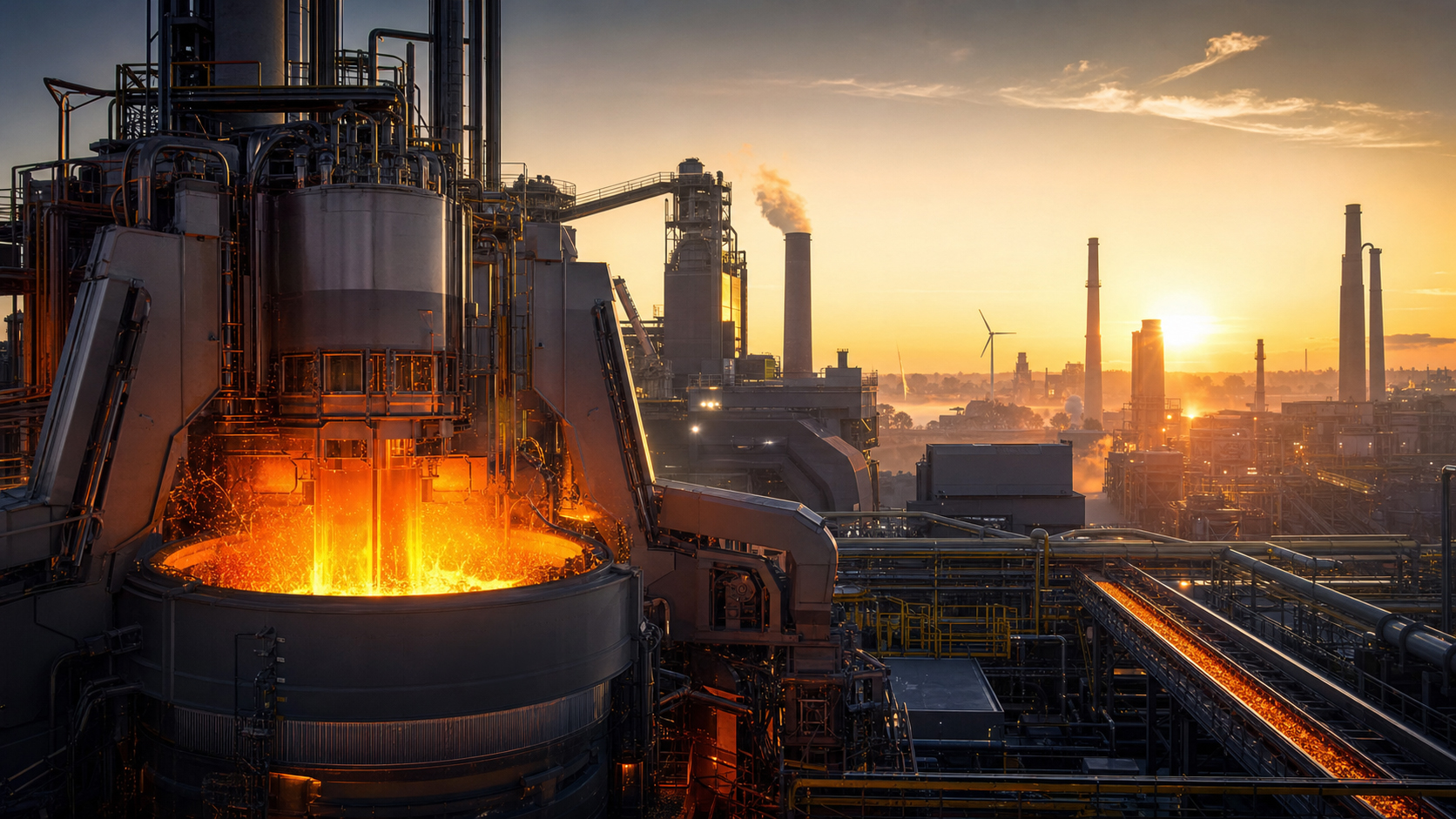
Steel production continues at the traditional site in southern Duisburg, but… – Image: Xpert.Digital
Salvation or devastation? What the Salzgitter deal means for the German steel industry
Steel earthquake in Duisburg: Salzgitter takes over HKM completely – 2,000 jobs at risk
End of an era on the Rhine: Why the traditional steelworks HKM is being radically restructured
What at first glance appears to be the mere reorganization of a traditional site in southern Duisburg, reveals itself upon closer inspection as a striking blueprint for the unstoppable structural transformation of the entire German heavy industry. This article delves deeply into the complex background of the deal – from the consequential withdrawal of major customer thyssenkrupp and the relentless pressure from Asian overcapacities to the massive technological shift from the classic blast furnace to the state-of-the-art electric arc furnace. The analysis examines not only the sober business logic that entails the painful loss of around 2,000 jobs, but also the far-reaching industrial policy implications: The question at hand is whether Duisburg will become a model for a successful green transformation in Germany – or whether the industry will lose its footing.
When tradition meets survival pressure: A traditional location reinvents itself – or dies
On July 8, 2026, an era ended in southern Duisburg – and simultaneously began a new one. On that day, Salzgitter AG signed the contracts for the complete takeover of Hüttenwerke Krupp Mannesmann (HKM), thus completing a transaction of significance far beyond the boundaries of a single company. It is an event that exemplifies the extent to which German heavy industry is under pressure, what radical structural change can look like, and what price must be paid by those who ultimately find themselves on the wrong side of this transformation.
A joint venture with historical roots breaks apart
HKM's history stretches far back, to 1909, when the Essen-based company Schulz-Knaudt built a steelworks in Duisburg-Huckingen. What followed was over a century of industrial history that significantly shaped the Ruhr region: the construction of an integrated steelworks in the late 1920s, phases of expansion, the upheavals of the Second World War, reconstruction, and finally, in 1990, the founding of the present-day company by the Krupp and Mannesmann corporations. The two most important German steel companies at the time pooled their Duisburg capacities in a joint steelworks, which henceforth supplied the intermediate products for their further processing. In the late 1990s, through modernization and process optimization, the plant achieved a pig iron production of over 5.5 million tons per year.
The ownership model appeared stable for decades: thyssenkrupp Steel Europe held 50 percent of the shares, Salzgitter 30 percent, and the French pipe manufacturer Vallourec the remaining 20 percent. Each partner sourced slabs and pig iron from the joint plant and used HKM as a cost-effective source of crude steel. The approximately 3,000 employees produced over four million tons of crude steel annually, generating sales of nearly three billion euros – equivalent to about 12 percent of total German crude steel production. The joint venture functioned as long as all participants were interested in the shared supply of crude steel.
This strategic foundation began to crumble when thyssenkrupp Steel terminated its supply contract with HKM in April 2024, effective at the end of 2032. The move sent an immediate signal: its largest customer was turning away. Faced with its own massive economic problems, thyssenkrupp Steel was no longer willing to maintain long-term supply relationships that no longer offered any strategic added value. Without its dominant customer, HKM's business model lost its foundation.
The structural causes of an industry crisis
The withdrawal of thyssenkrupp Steel is symptomatic of a profound structural crisis that has gripped the entire European steel industry. In 2025, German crude steel production fell to 34.1 million tons – the lowest level since the 2009 financial crisis. This figure represents an industry that has come under pressure from multiple sides simultaneously, and whose structural problems are mutually reinforcing.
The core problem is global overcapacity pressure, spearheaded by China. The World Steel Association recorded a crude steel production of around 961 million tons for China in 2025 – more than half of total global production. This steel, subsidized by the state, floods world markets at prices that European manufacturers simply cannot undercut while still covering their costs. For the EU, this meant that the European market was inundated with cheap steel from Asia, particularly from China, India, and Turkey. The consequences were depressed steel prices and low capacity utilization in domestic plants.
Added to this were structural weaknesses in demand in the most important European customer sectors. The automotive industry, traditionally one of the most significant steel customers, is itself undergoing a profound transformation towards electromobility, which is dampening demand for certain steel grades in the short term. The overall economic slowdown in Germany, triggered by weak investment and subdued consumption, led to a decline in orders. At the same time, high energy prices significantly burdened the cost structures of the energy-intensive blast furnace route. For Salzgitter, for example, these factors resulted in losses of €347.9 million in fiscal year 2024, before a noticeable improvement to a loss of €69.8 million was achieved in 2025.
The EU responded to these developments with a gradual tightening of its trade defense measures. In April 2026, the European Parliament and member states agreed on a dramatic increase in steel tariffs: the duty-free import quota was reduced to 18.3 million tons annually, a decrease of approximately 47 percent compared to previous years. Imports exceeding this quota are now subject to a tariff of 50 percent – twice as high as before. These measures come at a critical juncture for the European steel industry, but they do not eliminate the fundamental cost disadvantages compared to Asian producers; at best, they buy the industry some time to complete its transformation.
Months of uncertainty: Between closure and new beginnings
After thyssenkrupp Steel announced its withdrawal, months of uncertainty began for the 3,000 HKM employees. In December 2025, signs intensified that Salzgitter was at least considering continuing operations at the plant on a reduced scale. At that time, it was still considered a plausible scenario that around 1,000 jobs could be saved – if the shareholders reached an agreement and the state provided co-financing.
IG Metall took control of the situation, increasing pressure. Since April 2025, the union had been demanding a social plan that would guarantee reliable severance packages in the event of a plant closure or massive job cuts. When the employers refused to meet these demands, IG Metall called for a warning strike in January 2026. The mood among the rank and file was tense: employees stood in front of locked gates, expressing their anger at months and years of stalling. The strike call had an effect: the impact of the work stoppages led to production cuts and forced a new round of negotiations.
In February 2026, the framework agreement was published, marking a decisive step forward. Mediated by former Hessian Minister-President Roland Koch, Salzgitter and thyssenkrupp Steel agreed on the basic principles of a takeover. thyssenkrupp Steel was to sell its 50 percent stake to Salzgitter AG, while HKM's supply agreement with thyssenkrupp Steel would be extended to the end of 2028 – instead of the originally planned end of 2032. This four-year reduction was strategically necessary for thyssenkrupp Steel to accelerate its own production consolidation in northern Duisburg. For HKM, it meant that a large portion of its existing sales market would disappear much sooner than initially anticipated.
The European Commission granted antitrust clearance in May 2026 without conditions. The authority determined that, given the limited impact on the market structure, the acquisition did not raise any competition concerns. This was a logical decision: In an industry suffering from global overcapacity pressure and where total European production is hardly affected by a single plant, an antitrust issue seemed contrived. The final contract was signed on July 8, 2026. With the closing on the same day, Salzgitter assumed full control of HKM.
The economic rationality of a painful decision
Salzgitter's takeover of HKM follows an industrial logic that, while understandable from a business perspective, is devastating for those affected. The Salzgitter board's core argument is that a complete takeover would simply not have been possible without a drastic reduction in the workforce and production capacity – and the alternative would have been the complete closure of the integrated steelworks in southern Duisburg. This argument is transparent and its implications must be taken seriously.
The basis for this calculation lies in the cost structure of the traditional blast furnace route. Two blast furnaces, a coking plant, a sintering plant, a steelworks, and all associated facilities are designed for a production of over four million tons of crude steel per year. This capacity requires a corresponding workforce and a substantial fixed cost base. If the most important customer disappears and the remaining market can only absorb two million tons per year, the business model of the existing blast furnace operation is no longer arithmetically viable. The high capital tied up in the traditional production facilities, which would have to be replaced soon anyway due to decarbonization requirements, makes this even clearer.
Salzgitter had already been forced to write off its HKM stake completely on its balance sheet prior to the takeover, reducing its book value to zero, resulting in a write-down of €110 million. This fact underscores that the market no longer considered the old HKM to have any positive going concern potential. The purchase price for the shares of the previous co-shareholders – the exact amount of which all parties have agreed to keep confidential – was therefore likely symbolically low or included the assumption of liabilities. It would be remarkable if substantial purchase price payments had been made for a company with an already written-off book value and massive structural challenges.
The strategic logic for Salzgitter itself lies in securing intermediate products and strengthening vertical integration. As a steel processor dependent on reliable quantities of crude steel, it is vital to control sources that cannot simply be cut off during difficult market phases. At the same time, the acquisition makes it possible to strategically integrate the Duisburg plant into the overall group's transformation program, thereby advancing the path to green steel production along the Rhine.
The radical transformation: An electric arc furnace as the centerpiece
The industrial concept that Salzgitter developed for HKM is clear in its basic direction: The two existing blast furnaces will be decommissioned and replaced by an electric arc furnace. This step is not merely a technological modernization, but a fundamental system change in production philosophy.
The blast furnace, for decades the heart of steel production, produces steel from iron ore using coal as a reducing agent. This process is CO₂-intensive and inextricably linked to fossil fuels. The electric arc furnace, on the other hand, primarily melts steel scrap or directly reduced iron using electrical energy. Therefore, CO₂ emissions depend on the composition of the electricity mix, but can be reduced to almost zero by using renewable energy sources. Salzgitter plans to reduce CO₂ emissions from steel production in Duisburg by up to 90 percent in the long term by using such a furnace. Radio Duisburg reported that it will be the largest electric arc furnace in Germany.
This technological shift is not unprecedented within the Salzgitter Group. At its main site in Lower Saxony, the first phase of the SALCOS program (Salzgitter Low CO2 Steelmaking) has been running since the end of 2025, commissioning a direct reduction plant with a capacity of over two million tons of directly reduced iron per year. This program was financed with approximately one billion euros in subsidies from the German federal government and the state of Lower Saxony, as well as over one billion euros in equity. The HKM site in Duisburg is slated to become the first green steel plant in Duisburg from 2029 onwards – at least that is the communicated plan.
However, this perspective is fraught with considerable economic and technical uncertainties. Operating an electric arc furnace is significantly more sensitive to energy price fluctuations compared to a blast furnace. A cheap and reliable electricity supply is a *conditio sine qua non* for the economic viability of this technology. In Germany, where energy prices remain high by international standards and security of supply, while improved by the accelerated expansion of renewable energies, is not yet fully guaranteed, this remains a critical factor. Green hydrogen, as a long-term reducing agent, will remain scarce and expensive in Germany for the time being, as was also acknowledged in connection with the thyssenkrupp restructuring program.
The investment costs for an electric arc furnace of this size typically run into the hundreds of millions of euros. Salzgitter is apparently hoping for government subsidies to finance the project. As early as December 2025, the WDR (West German Broadcasting) reported that the company was awaiting a grant of over 200 million euros from the federal government to finance the construction of Germany's largest electric arc furnace. The IG Metall (German Metalworkers' Union) pointed out that policymakers have pledged a total of around eight billion euros in subsidies for the transformation of the steel industry. The conflict between industrial policy necessities and budgetary constraints makes the reliability of these commitments a constant source of uncertainty.
🎯🎯🎯 Data-driven B2B industry hub as a quasi-in-house solution

The quasi-in-house solution: How Xpert.Digital closes operational gaps in B2B marketing and sales – Smart Content-Driven Business - Image: Xpert.Digital
Xpert.Digital is a data-driven B2B industry hub led by Konrad Wolfenstein . The company acts as an external, quasi-in-house solution for industrial partners, closing operational gaps in marketing, content, and sales – without requiring additional resources on the client side.
More information here:
From blast furnace to electric arc: Can Duisburg's steel revolution succeed?
Thyssenkrupp Steel: Concentration in the north as a strategic breakthrough
For thyssenkrupp Steel Europe, the exit from HKM represents a significant strategic relief. The group's steel division had been in deep crisis for years: In the first quarter of fiscal year 2025/26, it recorded a net loss of €353 million, primarily due to restructuring costs of €401 million. For the full year, the group expected a loss of between €400 million and €800 million.
The restructuring collective agreement, concluded in December 2025 after tough negotiations with the IG Metall union and running until September 2030, created the contractual basis for a transformation affecting up to 11,000 jobs – through internal job cuts, outsourcing, and the separation of jobs at affiliated companies such as HKM. Production capacity is to be reduced from 11.5 million tons to between 8.7 and 9.0 million tons per year. According to management, concentrating production in Duisburg North – the core thyssenkrupp site – without the dependence on HKM will increase capacity utilization, efficiency, and profitability.
The reduction of slab deliveries by HKM from 2032 to the end of 2028 is consistent in this context: thyssenkrupp Steel thereby gains more flexibility in its own production control and is no longer dependent on intermediate products from a plant whose conversion phase is naturally associated with uncertainties. At the same time, the company is divesting itself of a stake that no longer offers any strategic synergy and whose book value had long been questionable on its own balance sheet.
For Vallourec, the French pipe manufacturer with a 20 percent minority stake in HKM, the sale of the shares was a logical step in its corporate strategy. CEO Philippe Guillemont had previously announced his intention to divest the stake in order to focus on the core business. HKM no longer supplied Vallourec with strategic intermediate products to the extent that would have justified the investment.
The human cost: 2,000 jobs at risk
The most sobering and difficult truth of this transaction lies in the job cuts. From approximately 3,000 employees currently, only about 1,000 are expected to remain at HKM by the end of 2028 – a reduction of two-thirds. This cut is brutal in its scale, even if those involved portray it as an unavoidable alternative to a complete shutdown.
The social dimension extends beyond the factory itself. Duisburg is a city that has already undergone decades of deindustrialization. The structural transformation in the Ruhr region, which has been ongoing since the 1980s, has left deep social scars. Every further wave of industrial job cuts affects people who often have no easy alternatives in the job market and, in many cases, will depend on severance pay to manage the transition.
Human Resources Director Birgit Dietze described the move as difficult but necessary and announced that the changes would be implemented responsibly and in a socially responsible manner. The IG Metall union considers the job cuts a bitter pill to swallow, but at the same time welcomes the fact that the site will not be completely closed and that at least 1,000 industrially secure jobs will be preserved in North Rhine-Westphalia. This is a realistic assessment: A complete closure would have destroyed all 3,000 jobs and simultaneously posed far greater challenges to the community.
The question of social safety nets, however, remains largely unresolved. All contracting parties have agreed to maintain confidentiality regarding the financial terms of the agreement. What exactly will happen to the 2,000 people who will have to leave HKM by the end of 2028 – what severance packages they will receive, what early retirement options are available, what retraining programs will be offered – all of this had not yet been publicly communicated at the time of the takeover announcement. Given the complexity of such a social plan and the fact that dialogue with employee representatives has been announced as a central component of the further process, intensive negotiations are to be expected in the coming months.
Andreas Betzler, the managing director of several Mannesmann companies, is to supplement the management of HKM and report directly to the Salzgitter board – a personnel signal of integration into the group structures.
Salzgitter AG in transformation mode: Financial strength and strategic reach
The acquisition of HKM represents a significant strategic undertaking for Salzgitter, one that is only partially supported by its own financial situation. While the group significantly reduced its loss to €69.8 million in 2025 – down from a loss of €347.9 million in 2024 – it is still in the process of returning to profitability, not yet in a phase of comfortable financial strength. For 2026, the company is targeting adjusted pre-tax profit of between €75 million and €175 million and aims for revenue of around €9.5 billion. In the first quarter of 2026, the company already demonstrated a promising recovery with EBITDA of €280 million and EBT of €95 million.
Regarding the balance sheet situation in detail: In the first quarter of 2026, Salzgitter reported equity of €4.57 billion, compared to debt of €6.25 billion. The net financial position was negative €679 million. These figures show that the group is capable of acting, but not financially strong enough to undertake arbitrarily large investment packages without external support. Salzgitter plans to quantify the impact of the HKM acquisition on its 2026 revenue and earnings forecast only on August 11, 2026, as part of its interim financial report. This reticence is understandable from a business perspective, but also indicates that the financial consequences are complex and difficult to calculate.
A key pillar of Salzgitter's balance sheet is its stake in Aurubis, the leading European copper producer. In the first quarter of 2026, the Group's strong earnings were largely driven by the exceptionally high contribution of this investment. This structural diversification provides Salzgitter with an essential safety net during challenging steel market conditions.
The group's efficiency program is also making a significant contribution: Instead of the originally planned €500 million improvement in earnings by 2028, an increase of €575 million is now expected. Of the initial €250 million targeted for 2025, the group reports having already achieved a third more than planned. This demonstrates that operational management is consistently driving efficiency improvements forward.
Duisburg as a test case for green industrial transformation
What happens in Duisburg-Huckingen in the coming years has symbolic and industrial-political significance that extends beyond the fate of a single plant. HKM is to become the first green steel plant in Duisburg – a city that, like no other in Germany, stands for steel, but also for the pain of industrial structural change.
If the plan succeeds and the electric arc furnace begins operation in 2029, this would be concrete proof that green steel transformation works at traditional German sites – not only at the company's headquarters in Salzgitter, where the SALCOS program is underway, but also in the heart of the Ruhr region. This would send an encouraging signal to the entire industry.
If the plan fails – because subsidies are not forthcoming, energy prices remain too high, or the market for green steel does not offer the hoped-for price premiums – HKM would ultimately be doomed despite the takeover, only with a postponement. This risk should not be downplayed. In this context, the IG Metall union has issued a strong warning against slowing down the transition to climate-neutral production or weakening climate targets. Should the political framework – EU emissions trading, electricity prices, subsidy programs – be changed in a way that disadvantages companies that have already invested in green production, then precisely those pioneers like Salzgitter would lose their economic footing.
The political dimension of this process is also significant. Chancellor Friedrich Merz had already convened a steel summit in November 2025 after studies predicted a potential loss of €50 billion in added value per year should German steel production relocate abroad. The state has a vital interest in maintaining the steel industry as critical infrastructure – not only for employment policy reasons, but also for security and strategic ones, as demonstrated by the growing interest of the arms industry in domestic steel suppliers.
An industry at a crossroads: What the HKM takeover means for Germany
Salzgitter's takeover of HKM is not an isolated event. It is part of a broader paradigm shift affecting the German and European steel industry. Thyssenkrupp Steel is cutting up to 11,000 jobs. HKM is losing two-thirds of its workforce. And even those who remain after the transformation are working in a fundamentally different production environment than their predecessors.
What is happening in Duisburg, in its most extreme form, is a blueprint for what awaits German heavy industry as a whole: capacity reduction, technological transformation, job cuts, and at the same time, massive investments in new, lower-emission processes. The pain is real and immediate. The opportunities lie in the future and are fraught with considerable uncertainty.
That Salzgitter is taking over HKM instead of simply letting it die is therefore, first and foremost, positive news. The fact that this opens the way to a gradually transformed, albeit dramatically downsized, site is more valuable from an industrial policy perspective than the alternative of a complete closure. The question of whether the 1,000 remaining jobs will still exist in two years, whether they will truly be secured by an operating electric arc furnace in five years, and whether they will actually be employed in a competitive, green steel plant in ten years, cannot yet be answered. It depends on decisions made in boardrooms in Salzgitter, in ministries in Berlin and Brussels, and on the global raw materials and energy markets.
One thing is certain: July 8, 2026, marks the end of a joint venture that has been a central element of the German steel industry for decades. The blast furnaces in southern Duisburg will fall silent. Something new is to be built in their place – smaller, cleaner, and with fewer people. Whether this is the right price to pay for industrial sustainability will be decided in the coming years.
Your global marketing and business development partner
☑️ Our business language is English or German
☑️ NEW: Correspondence in your native language!

Konrad Wolfenstein
I and my team are happy to be available to you as your personal advisor.
You can contact me by filling out the contact form here [email protected]:or simply call me at +49 7348 4088 965. My email address is
I'm looking forward to our joint project.
☑️ SME support in strategy, consulting, planning and implementation
☑️ Creation or realignment of the digital strategy and digitization
☑️ Expansion and optimization of international sales processes
☑️ Global & Digital B2B trading platforms
☑️ Pioneer Business Development / Marketing / PR / Trade Fairs
📈🚀 From visibility to trust 👀🤝 Your scalable path with Xpert.Digital

From visibility to trust: Your scalable path with Xpert.Digital - Image: Xpert.Digital
In industrial B2B, sustainable business relationships rarely emerge overnight. They develop step by step – through visibility, professional relevance, recurring touchpoints, and growing trust. Xpert.Digital's 4-stage model addresses precisely this: It offers a structured path that begins with a manageable entry point and can evolve into deeper collaboration in business development if needed.
Instead of relying on loud marketing promises, this model puts the relationship at the forefront. Companies start with clearly defined, easily calculable measures and then decide, based on their own experience, how far they want to expand the collaboration. A key factor for this undisturbed trust-building process: The platform completely avoids annoying advertising ads, so the editorial focus remains solely on the companies' expertise.
More information here:










