
Trump's state visit to China: When the dealmaker meets the system configurator – and returns home empty-handed
Xpert Pre-Release

Available in 27 languages 📢
Prefer Xpert.Digital on GoogleⓘPublished on: May 15, 2026 / Updated on: May 15, 2026 – Author: Konrad Wolfenstein
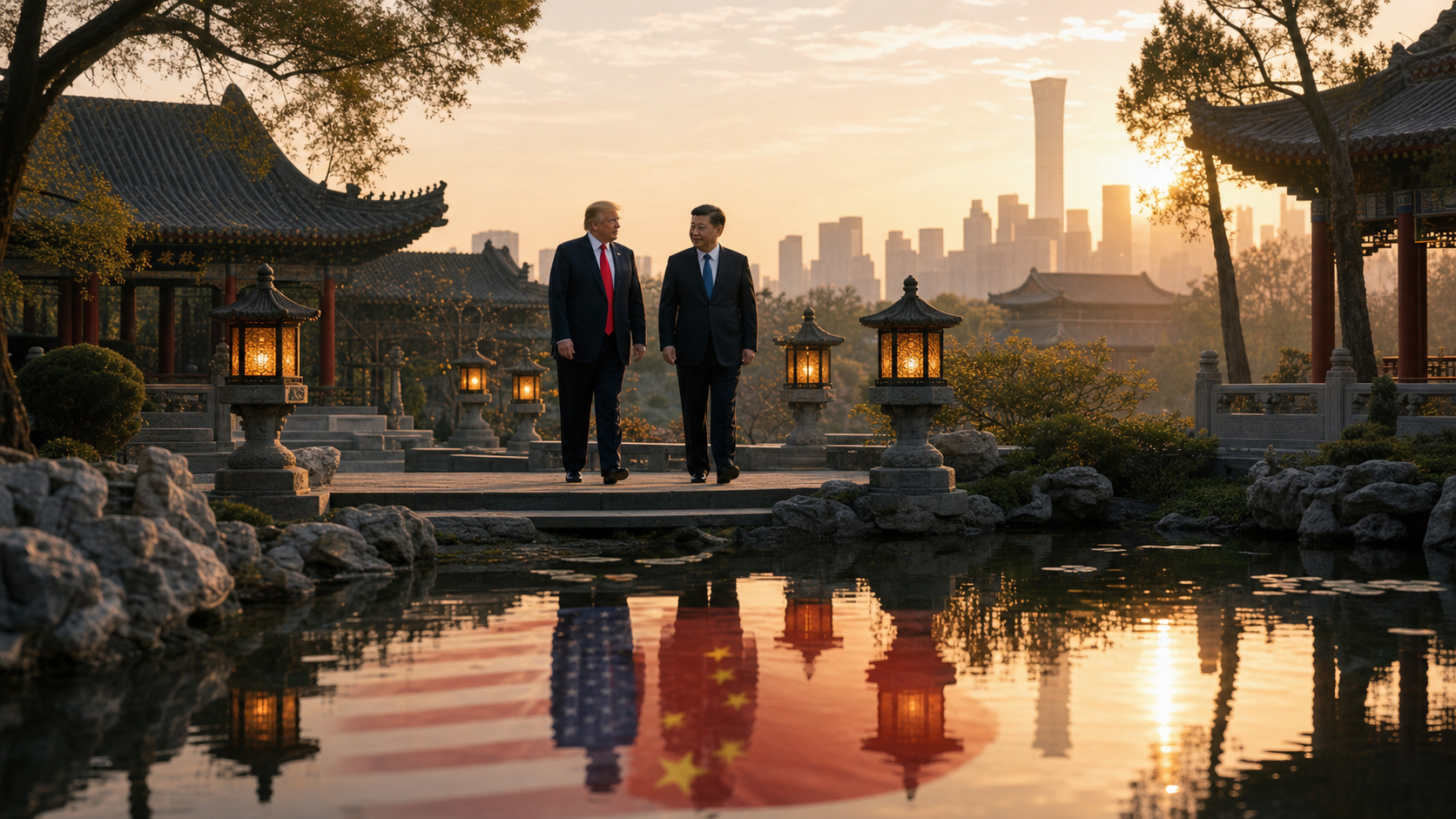
Trump's state visit to China: When the dealmaker meets the system configurator – and goes home empty-handed – Creative image: Xpert.Digital
State visit with empty hands: The bitter truth about Trump's trip to China
Rare earths as a weapon: The real reason for the sudden truce between the USA and China
Why Trump's mega-deal is actually a bluff
Donald Trump is welcomed in Beijing with military honors and a red carpet – but the pomp and circumstance are deceptive. Behind the scenes of the much-publicized state visit, a historic and profound power shift is revealed. While the US president celebrates domestically useful but ultimately insubstantial "mega-deals" like a preliminary Boeing order, Chinese President Xi Jinping has long been pulling the strategic strings. With its targeted control over rare earth elements, Beijing has found a geopolitical weapon that strikes Washington at its most vulnerable industrial point. The US is no longer the undisputed rule-maker dictating terms, but rather a defensive player. This is an in-depth analysis of a summit that reveals far more about the new multipolar world order and China's rise to global prominence than about alleged American negotiating successes – and which ultimately results in a truce with a clear expiration date.
Trump's state visit to Beijing: A world power in search of balance
Donald Trump spent 42 hours and 48 minutes in Beijing during his state visit – the first by a US president to the People's Republic in almost a decade. The red carpet was rolled out, the honor guard impeccably formed, 21 gun salutes thundered across the Great Hall of the People, and children, perfectly rehearsed, cheered the two leaders. On the second day, Xi Jinping personally guided his American guest through the gardens of Zhongnanhai – the heavily guarded power center of the Communist Party in the heart of Beijing, which is rarely granted access to a foreign dignitary. Trump appeared unusually impressed: "A beautiful place. I could easily get used to this," he reportedly exclaimed to reporters.
But behind the facade of glamour and the demonstrated friendship, a meeting of fundamentally asymmetrical significance was revealed. What Trump described as "fantastic trade deals" was, from a sober analytical perspective, little more than the confirmation of an already agreed-upon truce—a political peace whose terms China had significantly helped to shape. The global attention with which the summit was followed underscored a profound shift in the geopolitical landscape: The United States is no longer the undisputed rules-setter dictating terms to a subordinate China. It is a negotiating partner under pressure.
Beijing speaks plainly – Washington hears what it wants to hear
The first and most revealing rift between the narratives of both sides emerged immediately after the talks, when their respective statements were released. The US side emphasized issues such as curbing fentanyl precursors, planned agricultural purchases from America, China's support for keeping the Strait of Hormuz open, and the shared rejection of an Iranian nuclear bomb. These points were designed to appeal to Trump voters: the fight against drugs, agricultural exports for farmers in the Midwest, and stability in the Middle East.
What was striking was the absence of any of these points in the Chinese statement: not a single one was mentioned. Instead, Beijing placed the Taiwan issue at the heart of its public message. George Chen, China expert at The Asia Group, summed it up perfectly: Xi Jinping used the meeting from the outset to set clear boundaries for Washington. The red line of Taiwan's independence wasn't mentioned in passing, but prominently placed at the center – as the meeting's main message. China's leader made it unequivocally clear that a miscalculation on the Taiwan issue could lead to an extremely dangerous situation between the two nations.
These diverging narratives are not a communication mishap. They reflect a fundamental asymmetry of priorities: The US is trying to bring home deals that are politically advantageous domestically. China is setting a strategic framework for the next decade. While Washington is talking about soybeans, Beijing is drawing red lines.
The Boeing deal as a reflection of limited negotiating leverage
No deal symbolizes the summit's outcomes more aptly than the Boeing order. Trump announced with visible enthusiasm that Xi Jinping had agreed to the purchase of 200 passenger planes—the first order from a Chinese customer to the US aircraft manufacturer in nearly a decade. It was the centerpiece of his economic success narrative: American jobs secured, American industry strengthened.
The reaction of the financial markets told a different story. Boeing shares fell by more than four percent that same day. Analysts had not expected 200 aircraft, but rather up to 500 – the investment firm Jefferies, for example, had published corresponding estimates. Consequently, the market interpreted the announcement not as a triumph, but as a disappointment compared to expectations. Furthermore, the commitment is, for the time being, purely political. Concrete contract details, financing arrangements, and binding delivery and payment agreements are still entirely lacking. Anyone who seriously assesses what was negotiated at this summit sees this announcement as a well-sounding declaration of intent – nothing more.
The economic and political calculations behind the Boeing offer are by no means illogical for Beijing. For years, China has been the world's largest growth market for commercial aviation. The US's decision to forgo Boeing aircraft is a painful blow, but not an existential threat to China. In recent years, the People's Republic has systematically strengthened the market share of Chinese aircraft manufacturers – most notably COMAC – and strategically reduced its dependence on Western aircraft producers. The seemingly generous commitment from Boeing is therefore also a signal: Beijing can use and withdraw this leverage at will.
The turning point: When rare earths redefined the question of power
To fully understand the summit, one must look back a year. When Trump announced new tariffs on Chinese products in the spring of 2025, escalating the economic confrontation, Xi Jinping responded with a measure whose strategic brilliance can hardly be overstated: export controls on rare earth elements. On April 4, 2025, China first introduced export controls on seven strategically important rare earth elements—including dysprosium, terbium, and gadolinium, all essential for the defense industry, electric vehicles, and high-performance magnets in virtually every modern industrial product. Further restrictions followed in October 2025, affecting holmium, erbium, thulium, europium, and ytterbium, as well as key metals such as gallium, germanium, and antimony, indispensable for semiconductor production.
The effect was immediate and devastating. American industrial companies, defense contractors, and technology manufacturers reported a state of alarm. A panic, the likes of which Washington's China policy had previously rarely triggered, gripped the US economy. Beijing itself was apparently surprised by the sting of this weapon. Trump, the dealmaker, recognized the market signals and relented. At the meeting in Busan in October 2025, both sides reached an agreement: China suspended export controls for one year and granted general licenses for the export of strategic raw materials to US companies – in return, Washington refrained from imposing the threatened 100 percent tariffs and extended existing exemptions.
This moment marked a qualitative shift in the balance of power. China had proven that it could not only mirror American tariffs but also inflict significant damage on American industrial production. Since then, as the chronology of events shows, the tone has changed considerably. The US is negotiating more defensively, China more assertively.
China's quiet ace: The power of resource dependence
According to current estimates, China controls between 60 and 85 percent of global rare earth mining and processing – and the share is even higher for some categories. This dominance is no accident, but the result of decades of state-led industrial policy: subsidies, state-directed consolidation of the industry, targeted acquisitions of foreign mines, and the systematic development of processing capacities along the entire value chain. The People's Republic has not only acquired mining rights, but has also developed refining and processing technology that few Western countries possess.
This dependence is Beijing's silent ace in the negotiating hand. Gallium and germanium—essential for semiconductor chip production—were subject to a complete export ban by China before the Busan agreement provided temporary relief. Antimony, needed for military detonators and infrared sensors, was also affected. For the US, embroiled in a technological arms race with China, any disruption of these supply chains is a high-priority strategic risk.
Added to this is the West's structural weakness in rare earth processing. Even if the US or Europe were to develop new mines—a challenge that would take many years due to environmental regulations and lengthy permitting processes—the processing infrastructure would be lacking. China has built up a lead of decades in this area that cannot be overcome in the short term. Washington knows this, and Beijing knows that Washington knows this.
The technology paradox: Chips for the enemy
Another chapter that illuminates the ambivalent relationship between the two superpowers is the issue of semiconductor exports. For a long time, export control policies for chips were the sharpest weapon of US technology policy toward China. The Biden administration had successively tightened export restrictions, preventing Nvidia from supplying its most powerful AI chips to the People's Republic. Trump reversed this logic, at least partially: In December 2025, he announced that he would authorize the export of Nvidia's H200 chips to China—at a 25 percent premium, from which the US government directly profits. The corresponding regulations were formalized in January 2026.
The deal includes numerous conditions: Exporters must verify the identity of their customers, independent laboratories must pre-test the chip specifications, and shipments to China are limited to a maximum of 50 percent of the quantities intended for the US market. Nevertheless, the political signal is clear: In the name of economic interests, Washington is relaxing security restrictions that its predecessor had treated as sacrosanct. Critics in Congress and the security establishment warn that even the H200 chips—despite their perceived inferiority to the latest Blackwell and Rubin generations—are significant for China's military AI development. Trump countered that the US directly benefits through the 25 percent government share of the sales revenue, and that the complete ban had, in any case, encouraged China to develop its own chips.
This dilemma is indicative of the structural predicament of Western China policy: Every export restriction accelerates Beijing's domestic development – as demonstrated by the shock over Huawei's Kirin chips and, more recently, DeepSeek's AI model. Conversely, every liberalization strengthens China's technological base in the short term. Washington has no comfortable option here.
🎯🎯🎯 Data-driven B2B industry hub as a quasi-in-house solution

The quasi-in-house solution: How Xpert.Digital closes operational gaps in B2B marketing and sales – Smart Content-Driven Business - Image: Xpert.Digital
Xpert.Digital is a data-driven B2B industry hub led by Konrad Wolfenstein . The company acts as an external, quasi-in-house solution for industrial partners, closing operational gaps in marketing, content, and sales – without requiring additional resources on the client side.
More information here:
China's tactical victory: Why Trump's Beijing visit was more symbolic than substantial
Fentanyl: A deal that isn't one yet
Another issue Trump sought to elevate domestically is the fentanyl crisis. More than 100,000 Americans die annually from opioid overdoses, and a significant portion of the fentanyl used is produced from precursors that find their way to Mexico via Chinese supply chains. Trump had urged Xi to crack down harder on fentanyl producers and is even said to have called for the death penalty for such offenses.
China has responded to US pressure in the past: In 2019, Beijing placed all forms of fentanyl under state production control, leading to a significant decline in direct shipments from China. In the Busan Agreement, the People's Republic again committed to halting the export of certain chemicals to North America and to strictly controlling other substances globally. Nevertheless, the structural challenge remains: The virtually unlimited number of chemical compounds that can be used to synthesize fentanyl makes a complete ban practically impossible. Beijing can credibly point to regulatory progress without solving the underlying problem—a situation that Trump is touting as a success, but which does little to change the reality of the American opioid crisis.
The systemic question: Who can endure longer?
The core of the strategic rivalry between Washington and Beijing boils down to a simple question: Whose system can lead its population through economic sacrifices for longer without losing political cohesion? This question is becoming increasingly urgent because the era of cooperative coexistence is definitively over – and both sides know it.
In the United States, the response is limited by democratic structures. Rising fuel and food prices resulting from trade conflicts are immediately noticeable; they are reflected in inflation statistics, and voters have the opportunity to express their discontent in congressional elections. Trump himself experienced the limitations of this logic during his first term, when farmers in the Midwest protested loudly against Chinese retaliatory tariffs, necessitating multibillion-dollar subsidy programs to stabilize agriculture.
Xi Jinping operates under fundamentally different conditions. A comprehensive surveillance apparatus, state control over traditional media channels, and a powerful security police force allow the leadership to manage economic losses without fear of political destabilization. For years, Xi has been preparing his own people for a historic competition—a long struggle for Chinese sovereignty and modernization that would also require sacrifices. This narrative gives the government a degree of leeway that democratic systems structurally lack. It is not a strength of autocracy from a humanistic perspective—but it is a real power-political advantage in the economic and political war of nerves.
China without the dollar: The limits of Beijing's power
This analysis would be incomplete without a sober look at China's structural weaknesses. The dollar system remains Washington's most powerful instrument. As the global reserve currency, the dollar grants the US a level of financing flexibility unmatched by any other country. The ability to impose sanctions by excluding countries from the SWIFT payment system has proven effective in the history of recent geopolitical conflicts—from Russia to Iran.
China is actively trying to reduce this dependence. The internationalization of the renminbi, the development of alternative payment infrastructures such as CIPS (Cross-Border Interbank Payment System), and the promotion of trade settlements in non-dollar currencies—including with Russia—are steps in this direction. However, structural change is slow. The renminbi's share of global payments remains at just a few percent, far from being a serious alternative to the dollar. For the foreseeable future, the global financial architecture will remain a terrain in which the US operates significantly more cost-effectively.
China also faces significant domestic challenges: the ongoing crisis in the real estate sector, weak domestic demand, structural overcapacity in several industries, and a demographic time bomb posed by its aging population. The record trade surplus of nearly $1.2 trillion projected for 2025 masks the fact that a substantial portion of this surplus resulted from a collapse in imports—a sign of domestic weakness, not export-driven strength.
Trump between ideology and transaction
The fact that Beijing is dealing with Trump 2.0 far better than during his first term stems from a simple realization: Trump is not an ideologue. Almost all of his closest foreign policy advisors are avowed China hardliners – but this group has increasingly lost real influence over the course of his second term. Trump sets the foreign policy direction, and as a transactional dealmaker, he lacks the ideological blinders of his inner circle. On the contrary: A certain fascination with authoritarian power, with strength, and with the style in which Xi governs his vast empire is regularly audible in Trump's pronouncements.
This characteristic makes Trump more predictable for Beijing than a conservative-ideological foreign policy leader would be. Xi Jinping knows that Trump is primarily interested in results he can market as a victory domestically. As long as China can play into this narrative—through symbolic concessions like Boeing orders, soybean purchases, and fentanyl pledges—it hardly has to compromise on the actual strategic issues. The equation works as long as Trump's ego and China's strategic calculations are kept in a productive tension.
Rush Doshi of Georgetown University identified the core problem: The dynamics have fundamentally changed since 2025. The US no longer acts from a position of strength, but rather reacts to the negotiating framework that China has actively set. It's a truce that doesn't resolve the underlying tensions, but merely freezes them for a limited time.
The trade balance dilemma and Trump's structural problem
A central tenet of Trump's foreign trade policy is the reduction of the trade deficit with China. The figures do indeed show progress: The US deficit with China fell from $382 billion in 2022 to around $202 billion in 2025. In the first quarter of 2026, the deficit stood at $33 billion – a further reduction on an annual basis.
But this apparent success masks a structural irony: Imports from China fell by nearly 44 percent – but were not replaced by American production, but rather by imports from other Asian countries. Vietnam, Thailand, Malaysia, and, not least, Taiwan gained significant market share. Taiwan even surpassed China as the US import source for certain categories for the first time, primarily driven by the AI boom and semiconductor orders. The US trade deficit with Taiwan doubled during the same period to nearly $147 billion. The overall deficit in US merchandise trade remains structurally immense.
This points to a fundamental problem: The US imports more than it can produce and export – and this is not a question of tariff policy, but a question of investment in education, infrastructure and industrial capacity, which cannot be solved by short-term trade policy alone.
Beijing as a hub of world politics
Perhaps the most remarkable sign of the shifting geopolitical balance is not what was agreed upon at the summit, but what followed immediately afterward: No sooner had Trump boarded Air Force One and raised his fist in farewell than Moscow was preparing for its own visit to Beijing. According to the South China Morning Post and Kremlin sources, Vladimir Putin is scheduled to arrive in Beijing on May 20 for a one-day summit. It would be the first time that Beijing has hosted the presidents of the two most important rival powers to the US within a few days – a circumstance that is seen internationally as a highly symbolic signal.
Xi Jinping is thus positioning himself as a global mediator, a point of contact for the world's most powerful players. The message is unmistakable: Beijing is the center of the world – at least in this new multipolar order. China is receiving the American president not as a supplicant, but as an equal host. And it is receiving the Russian president immediately afterward – not despite the American visit, but deliberately following it. This is geopolitical choreography at its finest.
The deeper significance of this calculation lies in the fact that Beijing can simultaneously maintain strategic ambiguity vis-à-vis both Washington and Moscow. China is neither entirely on Russia's side nor prepared to make fundamental concessions to Washington. It navigates confidently between these two poles – thereby gaining strategic freedom of action that was unavailable to it a decade ago.
A truce with an expiration date
What remains of Trump's visit to Beijing? A state banquet, photos in Zhongnanhai's garden, a pledge for 200 Boeing aircraft without firm contract details, and an extended truce in a trade conflict that at best masks, but does not overcome, the deep structural tensions between two competing visions of world order.
The Busan Agreement of October 2025, which suspends export controls on rare earth elements for one year, expires at the end of October 2026. Both sides will then have to renegotiate – at a time when the US midterm elections are approaching and Trump is facing increasing domestic pressure. Beijing will wait for this moment with strategic patience. The strength of the Chinese system lies not in its speed, but in its persistence.
The summit in Beijing ended on a conciliatory note – but above all, it revealed a new balance of power. China has learned to deal with a transactional US president who values deals for their symbolic value. The People's Republic caters to this expectation with measured generosity, without compromising its own strategic positions. It is a truce between two powers, both of which know they are not yet ready for a real confrontation – and who are awaiting this moment with watchful calm.
Your global marketing and business development partner
☑️ Our business language is English or German
☑️ NEW: Correspondence in your native language!

Konrad Wolfenstein
I and my team are happy to be available to you as your personal advisor.
You can contact me by filling out the contact form here simply call me at +49 7348 4088 965. My email address is [email protected]:or
I'm looking forward to our joint project.










