

Solar park in Ivancha, Bulgaria: 5 megawatts and a battery storage system – This village shows the future of our electricity grid

Available in 27 languages 📢
Prefer Xpert.Digital on GoogleⓘPublished on: September 22, 2026 / Updated on: September 22, 2026 – Author: Konrad Wolfenstein
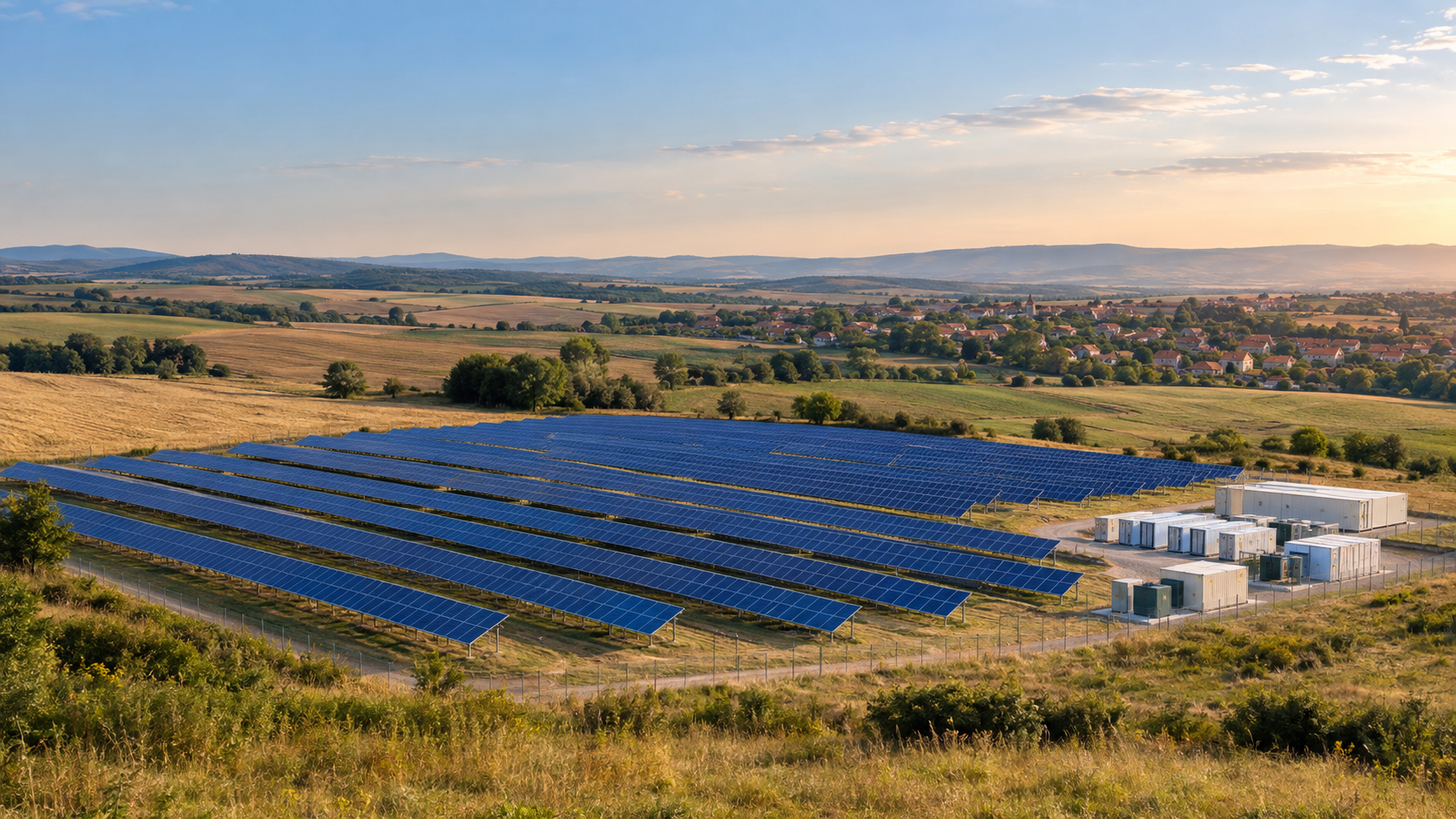
Solar park in Ivancha, Bulgaria: 5 megawatts and a battery storage system – This village shows the future of our electricity grid – Creative image on the topic, with AI: Xpert.Digital
Grid connection as a bottleneck: Why new solar parks without storage are suddenly worthless
From a simple power generator to a fully digitized power plant: The energy transition is entering its next phase.
For a long time, a simple rule applied to the solar market: the more photovoltaic modules installed, the better. But this unregulated boom is now taking its toll. Congested power grids and a massive oversupply at midday are driving prices down – even into negative territory. The example of an unassuming, planned solar park in the Bulgarian village of Ivancha now illustrates how the new economics of the European electricity market work. With a precisely calculated output of five megawatts, a strict limit on grid connection, intelligent software, and an integrated battery storage system, the project demonstrates what really matters today: Economic success is no longer determined by the sheer quantity of electricity generated, but by flexibility, controllability, and precise timing. Learn why grid connection is becoming the scarcest resource in the energy transition and why batteries will ensure the survival of future solar projects.
It's not the sun that's in short supply: Why this solar project solves the biggest problem of the energy transition
The planned solar park in the village of Ivancha, in the northern Bulgarian municipality of Polski Trâmbesch, appears at first glance to be a manageable regional energy project. It envisions a 5-megawatt photovoltaic system, supplemented by a battery storage system. On two plots of land, 9,504 solar modules, 16 inverters (each with a maximum output of 330 kilovolt-amperes), and one additional inverter (with a maximum output of 185 kilovolt-amperes) are to be installed. The maximum feed-in power to the grid is limited to 4.985 megawatts. Central software will coordinate the photovoltaic inverters and the battery's power conversion system to ensure that this limit is never exceeded under any operating conditions.
It is precisely this technical limitation that makes the project more economically attractive than its size would suggest. The project exemplifies the transition from the first to the second phase of solar industry development. In the first phase, the primary goal was to install as many cost-effective photovoltaic modules as possible and feed every kilowatt-hour generated into the grid. In the second phase, installed capacity alone no longer determines economic success. The timing of the feed-in, the availability of guaranteed grid capacity, the quality of operational management, and the ability to react flexibly to market prices and the grid operator's requirements become more important.
The planned battery storage system is therefore not merely a decorative add-on or a symbol of technological modernity. It can become the crucial link between weather-dependent power generation and a grid with limited capacity. However, the storage system's true significance depends on technical data that has not yet been made public. Crucially, this includes its power output in megawatts, its usable capacity in megawatt-hours, its potential discharge time, its efficiency, the expected number of charging cycles, and the planned marketing strategy. Without this information, neither its impact on the grid nor its economic viability can be definitively assessed.
Despite this uncertainty, the project allows for a clear classification. Ivancha is not an isolated special case, but rather part of a profound structural transformation in the Bulgarian energy sector. The rapid expansion of photovoltaics is increasingly creating hours with very high solar production, low or even negative wholesale prices, and growing demands on grid control. In such a market, it is no longer sufficient to simply produce electricity cheaply. It must be available as often as possible when it is scarce and valuable. The economic core of the project therefore lies not in the five megawatts alone, but in the combination of generation, storage, digital control, and limited grid connection.
From solar park to controllable energy system
The project design shows that the system is intended as an integrated energy system. The sum of the specified maximum inverter outputs is calculated to be 5.465 megavolt-amperes. This contrasts with a permissible maximum grid feed-in of 4.985 megawatts. Apparent power and active power are not technically identical, which is why a simple one-to-one comparison is only possible to a limited extent. Nevertheless, the configuration clearly shows that the installed conversion capacity is above the specified feed-in point and that active power limitation is necessary.
This oversizing can be economically advantageous. Photovoltaic systems only achieve their nominal output under specific irradiance and temperature conditions. For many hours of the year, the actual output is significantly lower. A larger generator or inverter configuration can therefore ensure that the grid connection point is better utilized for more hours. Short-term generation peaks must then either be curtailed, stored, or used in other ways. A storage system reduces the amount of energy lost, provided its power, capacity, and control system are suited to the generation characteristics.
Intelligent management plays a central role in this process. It must continuously monitor current solar production, battery charge level, inverter availability, and permissible feed-in power. As soon as current generation threatens to exceed the grid connection limit, the system can charge the battery. If the storage capacity is full or unavailable, photovoltaic output must be limited. If solar production later decreases, stored electricity can be fed into the grid, provided this is technically feasible and economically viable.
This transforms a purely generation-oriented solar park into a controllable unit. In an electricity system with a growing share of weather-dependent generation, this controllability has its own economic value. It can smooth load peaks at the grid connection point, avoid feed-in peaks, reduce curtailment losses, and potentially enable additional revenue through short-term electricity markets or system services. However, this is contingent on the metering concept, grid connection agreement, market registration, and storage operation actually allowing for these revenue streams.
The value of energy storage doesn't arise automatically. A battery doesn't produce additional primary energy. It shifts electricity from one time to another, losing some energy in the process through conversion and storage losses. This shift is only economically viable if the avoided loss or the price difference between charging and discharging is large enough to compensate for efficiency losses, aging, financing, and operating costs. The mere existence of a storage system, therefore, guarantees neither higher profits nor grid stabilization. Its optimized use is crucial.
Grid connection as the scarcest resource
The 4.985 megawatt limit is more than just a technical detail. It highlights one of the central problems of the expansion of renewable energies in Europe, and especially in Southeast Europe: New generation plants can be planned and built more quickly than grids can be reinforced. Photovoltaic modules, inverters, and battery systems are largely standardized industrial goods. Power lines, substations, and grid protection systems, on the other hand, require complex planning, land rights, permits, investment decisions, and construction time.
This makes grid connection a scarce production factor. In traditional project calculations, solar irradiance, land price, system costs, and financing were the main focus. Today, the available grid connection capacity often determines whether a project is even feasible. A location with excellent irradiance but without a reliable grid connection can be economically worthless. Conversely, a location with only good solar irradiance can become attractive if a dependable connection, short cable runs, and clearly defined technical specifications are in place.
The almost precise limitation below five megawatts likely reflects regulatory and grid connection considerations. However, the published information does not allow for a reliable conclusion as to whether the threshold was deliberately chosen to meet specific permitting, licensing, or grid connection requirements. Such a conclusion would be speculative without access to the project documentation. The only certainty is that the approved feed-in capacity is to be treated as a hard upper limit and secured by software.
For the investor, this concept has two sides. On the positive side, compliance with a fixed connection limit becomes technically verifiable, potentially allowing the project to fit better into a limited grid window. On the negative side, any control system failure or insufficient coordination between inverters and the battery system could lead to breaches of contract, protective shutdowns, or yield losses. The quality of the software, sensors, communication links, and operational redundancies therefore becomes a significant part of the investment risk.
At the same time, the function of the grid connection is changing. It is no longer just a passive transfer point, but an actively managed bottleneck. The project company must utilize the limited connection capacity as profitably as possible. This argues for an operating strategy that not only charges the storage system during peak generation, but also incorporates price forecasts, weather data, battery status, and potential grid demands. Economic competition is thus increasingly shifting from hardware to optimization.
Bulgaria's solar boom meets reality
Bulgaria possesses favorable natural conditions for photovoltaics, with relatively available land and a growing project pipeline. At the same time, the rapid expansion has altered market conditions. During sunny hours, the electricity supply increases sharply, while demand does not grow at the same rate. As a result, wholesale electricity prices fall precisely when solar power plants are producing the most. This mechanism, known as the cannibalization effect, reduces the average achievable market value of solar power.
For older projects with long-term guaranteed feed-in tariffs, the timing of grid feed-in was less critical. Market-based new installations, on the other hand, carry a significantly higher price risk. While they can achieve very low levelized costs of electricity (LCOE), they sell a large portion of their production during the same hours as numerous competitors. The more installed photovoltaic capacity grows, the more frequently the price falls below the daily average at midday. In extreme cases, it becomes negative because flexible consumers and storage facilities are lacking, or conventional plants cannot ramp down quickly enough.
Developments in Bulgaria demonstrate that this issue is no longer a theoretical question for the future. As early as spring 2025, the national transmission system operator reported significant amounts of unrealized solar production. 130,000 megawatt-hours were cited for April, and another 50,000 megawatt-hours for the first five days of May. Such figures indicate that, without flexibility, additional solar capacity can hardly be fully integrated into the market at times.
It is precisely in this environment that a project like Iwantscha gains importance. The storage system can absorb a portion of the midday production instead of curtailing it or selling it at very low prices. Later, the energy can be released during hours with lower solar production and higher prices. The economic advantage depends on the daily price range. The greater the difference between cheap charging times and expensive discharging times, the more attractive the arbitrage becomes. However, with each new storage system, competition for these same price differences also increases. Successful projects must therefore flexibly combine multiple revenue streams.
Furthermore, the development of electricity prices should not be considered in isolation. High daily fluctuations are a symptom of a lack of flexibility, but at the same time, they form the business model of many battery storage systems. When a large number of storage facilities are built, they smooth out the price curve and thus reduce their own arbitrage profits in the long term. This is desirable from a macroeconomic perspective, but it can negatively impact the returns of later projects. Investors are therefore facing a typical transitional market: Currently, there are attractive price signals, but the expansion of storage capacity could weaken these signals more quickly than expected.
The storage capacity determines the return on investment
The lack of information regarding storage capacity is the most significant gap in the project's data. A battery storage system is described by at least two parameters: the maximum charging and discharging power in megawatts and the usable energy capacity in megawatt-hours. A system with 5 megawatts of power and 5 megawatt-hours of capacity can theoretically discharge at full power for about one hour. A system with the same power and 20 megawatt-hours of capacity achieves approximately four hours. Both variants have the same power rating but fulfill very different economic and grid-related functions.
A short-term storage system is particularly suitable for rapid balancing power, power limitation, and smoothing short generation peaks. A storage system with a discharge time of two to four hours can shift larger amounts of energy from midday to the evening hours. For the Ivancha solar park, the optimal sizing would depend on how frequently the photovoltaic output exceeds the grid limit, what price differences are expected on the Bulgarian market, and whether participation in balancing power markets is planned.
The coupling architecture is also relevant. With AC coupling, the photovoltaic system and battery each have their own inverters or power conversion systems and connect on the AC side. This increases operational flexibility and allows the storage system to be used independently of the solar park on the electricity market. With DC coupling, solar energy can potentially be charged directly into the battery with fewer conversion steps. However, retrofitting or independent grid use can be more complex. The published description of a battery power supply unit (PSU) suggests an independent power conversion system, but this is insufficient for a definitive technical classification.
For profitability, aging and warranty conditions are also crucial. Lithium-ion batteries lose some of their usable capacity with each cycle and over time. An aggressive trading strategy can generate high revenues in the short term, but this can accelerate battery aging. Therefore, professional energy management should not focus on maximizing the highest revenue of a single day, but rather on the discounted total return over the battery's lifespan. This includes limits on state of charge, temperature control, depth of discharge, and cycle count.
Safety and insurance considerations also come into play. Battery storage systems require a robust fire protection concept, thermal monitoring, sufficient spacing between units, emergency shutdown mechanisms, and clear operational plans for the fire department and operators. In rural areas, accessibility for emergency services may be more critical than in industrial zones. These requirements increase investment costs but are essential for obtaining permits, securing insurance coverage, and achieving public acceptance.
Profitability beyond simple electricity sales
A conventional solar park generates its revenue primarily from the amount of electricity it sells. A solar park with storage, on the other hand, has several potential revenue streams. It can trade electricity at different times of day, avoid curtailment, improve grid connection utilization, and potentially offer balancing power or other system services. Depending on market rules, it can also react to short-term price fluctuations in intraday trading.
The first revenue model is the direct sale of solar power production. This can be achieved through the day-ahead market, the intraday market, bilateral supply contracts, or a long-term power purchase agreement. A long-term contract can facilitate financing because it reduces price risks. However, it can also limit the opportunity to profit from high short-term prices. For a smaller project, the creditworthiness of the buyer is often just as important as the nominal contract price.
The second revenue model is energy arbitrage. The battery charges when prices are low and discharges when prices are higher. However, the gross margin is not simply the price difference. Energy losses, variable grid fees or levies, marketing costs, and the economic value of battery aging must be deducted. A seemingly attractive spread may prove insufficient after these costs are accounted for. Successful operators therefore use automated trading models and continuously updated price forecasts.
The third revenue model concerns ancillary services. Battery storage systems react very quickly and are fundamentally suitable for frequency control and reserve markets. These markets can enable higher revenues per megawatt provided than pure energy arbitrage. However, prequalification, minimum technical requirements, communication systems, and availability verification are necessary. Furthermore, prices can fall when many new storage systems compete for a limited market volume.
The fourth revenue model lies in avoided losses. If excess solar production can be stored, curtailment decreases. The economic value then corresponds to the otherwise lost net revenue from this energy. This advantage is particularly relevant if the generator output frequently exceeds the potential feed-in or if the grid operator imposes restrictions in strained situations. It is less significant if surpluses only occur for a few hours or if market prices are already heavily negative during those hours.
The key strength of a hybrid project lies in so-called revenue stacking, i.e., the combination of multiple revenue streams. The same battery can perform different tasks at different times. It can reserve capacity for peak solar output in the morning, absorb excess electricity at midday, sell energy in the evening, and provide balancing power at night. This flexibility increases its potential value but makes planning and financing more complex. Banks prefer predictable cash flows, while optimized storage operation thrives on variable market opportunities.
New: Patent from the USA – install solar parks up to 30% cheaper and 40% faster and easier – with explanatory videos!

New: Patent from the USA – Install solar parks up to 30% cheaper and 40% faster and easier – with explanatory videos! - Image: Xpert.Digital
The core of this technological advancement is the deliberate departure from conventional clamp mounting, which has been the standard for decades. The new, more time- and cost-effective mounting system addresses this with a fundamentally different, more intelligent concept. Instead of clamping the modules at specific points, they are inserted into a continuous, specially shaped support rail and held securely in place. This design ensures that all forces – whether static loads from snow or dynamic loads from wind – are distributed evenly across the entire length of the module frame.
More information here:
How regional communities can benefit from solar projects
Investment costs and financial sensitivity
Without information on storage capacity, land area, grid connection costs, and financing structure, a reliable investment figure is not possible. Nevertheless, the order of magnitude can be estimated. For European ground-mounted photovoltaic systems, typical investment costs in 2024 and 2025 were roughly in the mid-three-figure euro range per kilowatt of installed capacity. At 5 megawatts, the solar park alone can therefore cost several million euros. Grid connection, project development, planning, land acquisition, permits, safety technology, and reserves can significantly increase the total cost.
The range of costs is even greater for energy storage. These costs depend on usable capacity, discharge duration, cell chemistry, power conversion system, fire protection, cooling, construction work, and grid connection. A small storage system for short-term peak loads is significantly cheaper than a system that can shift large portions of daily production over several hours. Therefore, any concrete total cost estimate without specifying megawatt-hours would be unreliable.
The specific annual yield is crucial for the economic viability of photovoltaics. In Bulgaria, a well-planned ground-mounted system can achieve an attractive yield due to the irradiance conditions. However, the actual value depends heavily on orientation, tilt, shading, module technology, temperature, soiling, availability, and grid losses. Even slight deviations in the long-term yield assumption have a significant impact on the net present value over twenty or more years of operation.
The impact of the financing rate can be even greater. Solar and storage projects are capital-intensive and have relatively low operating costs. Rising interest rates or higher risk premiums therefore hit them particularly hard. A project with a sound technical concept can fail economically if the financing is too expensive or the lender demands overly conservative revenue assumptions. Conversely, subsidies, favorable loans, or a long-term power purchase agreement can significantly reduce capital costs.
A proper assessment should include at least three scenarios. The conservative scenario assumes low solar prices, narrow arbitrage spreads, limited revenue from ancillary services, and higher capital costs. The baseline scenario uses average price and revenue assumptions. The optimistic scenario considers high flexibility and successful multi-market strategies. The crucial factor is not which scenario yields the highest internal rate of return, but whether the project can adequately service its debt and cover its operating costs even under unfavorable conditions.
Approval is not yet a formality
The investor has informed the local administration and the municipality of Polski Trâmbesch about the project. The regional environmental inspectorate in Veliko Tarnovo will decide whether an environmental impact assessment is required. According to published information, the two proposed sites are not located within Natura 2000 areas. This reduces certain environmental risks, but does not eliminate them entirely.
The fact that a project is located outside a Natura 2000 site does not automatically mean that a more in-depth assessment is not required. Relevant factors may include impacts on species, habitats, landscape, soil, water balance, drainage, glare, noise from inverters and storage units, as well as cumulative effects with other projects. Access roads, cable routes, and grid connection facilities must also be considered. The authorities may therefore request additional documentation or information on protective measures.
The current use of the land deserves special attention. If high-quality agricultural soils are permanently converted to energy production, a conflict of objectives arises between electricity generation and agricultural production. In an agriculturally dominated region, site selection should therefore not be based solely on low land prices. Areas with existing environmental impacts, low yields, or favorable infrastructure can be more economically beneficial than particularly productive soils.
At the same time, land use can be managed in a more differentiated way. Extensive greening, sheep grazing, biodiversity-promoting maintenance, and avoiding unnecessary sealing of surfaces can create ecological benefits. Such measures do not replace careful assessment, but they can improve the environmental footprint and reduce conflicts with the local population. Crucially, they must be planned and financed in a binding manner and monitored throughout their entire operational lifespan.
The approval process also carries a time risk. Delays can affect supply contracts, grid connection deadlines, financing, and construction costs. Especially with rapidly falling technology prices, a later implementation might not initially seem disadvantageous. However, this is countered by potential changes in market regulations, rising connection costs, and the loss of reserved grid capacity. Therefore, a reliable schedule is just as important for the project company as the technical design.
Regional value creation without illusions
For a small, rural community, a solar park can generate additional revenue and economic activity. During the construction phase, contracts arise for earthworks, access roads, fencing, cable laying, surveying, security services, and logistics. Depending on the ownership structure, landowners may receive lease payments. The community can indirectly benefit from local expenditures and potentially from taxes or fees.
However, the long-term employment impact should not be overestimated. A modern solar park operates largely automatically. Once commissioned, only a few people are needed for monitoring, maintenance, landscaping, cleaning, security, and repairs. The project is therefore not a replacement for a large industrial employer. Its regional economic value lies more in steady revenue, the use of local services, and a potential improvement in energy infrastructure.
This classification is particularly important for Polski Trâmbesch. The municipality has only around ten thousand inhabitants and is predominantly rural. In a region experiencing demographic decline, additional investment can be welcome, but it alone will not solve structural problems such as emigration, an aging population, and limited job opportunities. Therefore, credible communication should avoid making exaggerated promises.
Greater benefits arise when the project is integrated into a broader local development strategy. Possible approaches include collaborations with vocational schools, regional maintenance contracts, participation of local businesses, or voluntary contributions to municipal energy and education projects. Direct supply to local businesses could also be attractive in the long term, provided that grid and market regulations allow for suitable contract models. Such approaches increase acceptance but should not be used solely as a communicative accompaniment.
Transparency is also crucial for the public. They should know which areas will be used, how tall the facility will be, what traffic impact will occur during construction, how fire protection for the storage facility is organized, and who is responsible in case of malfunctions. Providing concrete information early on reduces the risk of a technically sound project being jeopardized by mistrust or rumors.
Storage boom: between opportunity and oversupply
Bulgaria is now pursuing a highly dynamic energy storage strategy. The state-funded and European-funded RESTORE program originally aimed for at least 3,000 megawatt-hours of usable storage capacity. Demand significantly exceeded this target. The selection process considered dozens of projects with a combined capacity considerably higher. This could quickly make Bulgaria one of the most important battery storage markets in Southeast Europe.
For Ivantscha, this boom is ambivalent. On the one hand, a growing storage market improves the availability of technology, integrators, operational expertise, and financing experience. Standardized solutions can reduce investment costs and familiarize regulatory authorities with the requirements. On the other hand, every new storage facility increases competition in the balancing energy and arbitrage markets.
The classic investor argument is that more solar energy automatically requires more storage. This is fundamentally true, but economically incomplete. Not every technically required flexibility automatically generates sufficient private revenue. Markets can temporarily produce too much storage at the same grid points or for the same services. Then, the prices for balancing power and the daily arbitrage spreads fall faster than expected.
A smaller hybrid project can still offer advantages over large, stand-alone storage systems. It utilizes a shared location, can share infrastructure, and specifically avoids losses from its own solar production. Its business model is therefore not solely dependent on external markets. This advantage is particularly valuable when the battery is sized to solve a specific local problem, rather than simply speculating on general price differences.
Furthermore, subsidy programs can distort competition. Subsidized storage facilities may accept lower market revenues than fully privately financed plants. For Iwantscha, it would therefore be necessary to clarify whether and in what form subsidies are being claimed and what operating conditions are associated with them. A project without subsidies must generate higher revenues or have lower costs, but may be able to operate more flexibly.
Risks behind the green narrative
The public presentation of solar and storage projects often focuses on climate protection, security of supply, and regional development. These goals are relevant, but they must not obscure the risks. The greatest market risk lies in further declines in solar revenues. If very low or negative prices regularly occur at midday, every additional unsecured kilowatt-hour loses value.
The second risk concerns the storage system. Battery prices have fallen significantly in recent years, but low purchase costs alone do not guarantee a high return. Warranty conditions, actual degradation, spare parts availability, software quality, and integrator risk are at least as important. Failure of the power conversion system or the central control unit can affect not only storage revenue but also the permissible feed-in of electricity from the entire solar park.
The third risk lies in the network. A contractually guaranteed connection capacity does not necessarily protect against all subsequent operational limitations. Network operators can demand intervention in critical system conditions. Delays in connection or necessary reinforcement measures can also increase costs. The investor should therefore clearly define technical and legal responsibilities.
The fourth risk is regulatory in nature. Market rules for storage, grid fees, double charges for charging and discharging, accounting requirements, and access to ancillary services can change. A business model that only works under a specific fee structure is vulnerable. A project is robust if it retains multiple marketing options even if the rules change.
The fifth risk concerns the supply chain. Photovoltaic modules, battery cells, and power electronics largely originate from international supply chains. Trade conflicts, transportation problems, quality defects, or manufacturer insolvencies can affect the supply of spare parts and warranties. A purely price-oriented procurement approach is therefore short-sighted. Bankable warranties, reliable integrators, and documented safety standards are economically valuable.
The sixth risk arises from extreme weather events. Hail, heavy rain, heat, flooding, storms, and vegetation fires can reduce yields or cause damage. Site planning, drainage, module quality, substructure, insurance, and preventative maintenance must take these risks into account. Climate change not only increases the value of low-emission power generation but also exacerbates physical risks to the installations themselves.
What would make the project credible
The most important next step would be the transparent publication of storage data. Without information on performance and usable capacity, it remains unclear whether the battery merely absorbs short-term feed-in peaks or can shift a substantial portion of solar production. Equally important would be information on cell chemistry, safety concept, expected discharge time, and operating strategy.
Secondly, the investor should present a comprehensible network concept. This includes the exact transfer point, the technical implementation of the 4.985-megawatt limit, the procedure in case of communication failure, and the redundancy of the power limitation. A purely software-based assurance is only sufficient if the protection technology, measurement, and fault scenarios are designed to be robust.
Thirdly, the project needs a realistic environmental and land-use plan. Its location outside of Natura 2000 is advantageous, but it is no substitute for a site-specific assessment. Soil quality, drainage, biodiversity, glare, noise, and decommissioning should be addressed in detail. Setting aside funds for future decommissioning will increase the project's credibility.
Fourth, the economic viability calculation should not be based on persistently high electricity price spreads. Bulgaria's storage expansion can reduce the currently attractive differences between midday and evening prices. A conservative model must account for declining arbitrage revenues, battery aging, and temporarily low revenues from ancillary services.
Fifthly, a local user agreement would be beneficial. It could stipulate which services are to be contracted out regionally, how the community is to be informed, and what measures are planned for fire safety, access roads, or ecological maintenance. This would transform an externally developed energy project into a more locally rooted undertaking without creating unrealistic job creation promises.
The strategic importance for Bulgaria
Bulgaria faces a dual challenge. The country must integrate its growing solar energy resources while simultaneously maintaining a stable electricity system that continues to rely heavily on nuclear power, coal, hydropower, regional trading, and limited flexibility. Individual small and medium-sized hybrid projects cannot solve this problem, but they can be an important component.
The updated national energy and climate plan raises the target share of renewable energies in gross final energy consumption to almost 35 percent by 2030. For the electricity sector, a share of almost half is planned. These targets will require further expansion of solar and wind power. However, without parallel investments in storage, grids, flexible demand, cross-border trading, and digital control, additional capacity expansion would increasingly lead to curtailment and low market prices.
Battery storage should not be misunderstood as the sole solution. Batteries are particularly suitable for periods of seconds, minutes, and several hours. For longer periods of low wind or seasonal fluctuations, they would only be economically viable to a limited extent at current costs. Bulgaria therefore needs a portfolio of pumped storage, flexible hydropower, high-performance grids, demand-responsive design, regional electricity trading, and various storage technologies.
The project in Ivancha fits into this portfolio because it combines generation and short-term flexibility at the same location. Its benefits are primarily local and temporal: smoothing feed-in peaks, shifting solar power, and better utilizing the grid connection. It should not be confused with baseload generation or long-term energy storage. This straightforward classification is precisely what makes its true function clear.
At the macroeconomic level, digitalization plays a key role. Thousands of decentralized systems will need to react in a coordinated manner in the future, without overloading the grid. Software, forecasts, measurement systems, and automated trading will therefore become just as important as modules and battery cells. Bulgaria can not only gain additional electricity production from this expansion, but also develop expertise in system integration, operation, and energy optimization.
A project on the cusp of the new electricity market
The Ivancha solar park is neither a spectacular large-scale project nor an insignificant local facility. Its significance lies in the precise combination of several developments: cost-effective photovoltaics, limited grid capacity, increasing price volatility, falling battery costs, and software-supported operation. This very combination will determine the economic success of many future energy projects.
The planned 9,504 modules and 17 inverters constitute the visible infrastructure. However, the real value lies in the invisible: in the quality of the control system, the design of the storage system, the grid agreement, the marketing, and the risk management. Anyone who focuses solely on the installed five megawatts is missing the new logic of the market.
The project has favorable starting conditions. The properties are located outside Natura 2000 areas, the feed-in limit is explicitly taken into account, and a battery storage system is planned from the outset. At the same time, significant questions remain unanswered. The lack of storage capacity prevents a final assessment, the environmental impact assessment process is not yet complete, and the business model has not been publicly explained.
A positive assessment is therefore justified, but only under certain conditions. The project can be technically sound and economically viable if the storage system is appropriately sized, the grid connection is legally secured, the control system operates reliably, and revenue projections remain conservative. It can generate regional added value, but should not be presented as a job creation program. It can support the grid, but only if its operation is actually optimized to benefit the grid.
The provocative truth is: Bulgaria doesn't simply need more solar panels. The country needs more economically viable solar power. There's a growing gap between these two things. Storage, grids, and intelligent control systems will determine whether new photovoltaic capacity contributes to security of supply and more stable prices, or merely increases the surplus during already sunny hours.
Ivantscha can demonstrate what the next stage of development looks like: not maximum feed-in at any cost, but controlled output; not electricity production without time value, but time-optimized marketing; not a single power plant, but a digitally controlled system of generation and flexibility. If this logic is consistently implemented, the solar park will be a small but economically remarkable example of the future of the Bulgarian energy market.
Your partner for business development in the fields of photovoltaics and construction
From industrial rooftop PV to solar parks and larger solar parking lots
☑️ Our business language is English or German
☑️ NEW: Correspondence in your native language!

Konrad Wolfenstein
I and my team are happy to be available to you as your personal advisor.
You can contact me by filling out the contact form here [email protected]:or simply call me at +49 7348 4088 965. My email address is
I'm looking forward to our joint project.





