
Singulus and SpaceX: A German machine manufacturer between a multi-million dollar order and a billion-dollar vision
Xpert Pre-Release

Available in 27 languages 📢
Prefer Xpert.Digital on GoogleⓘPublished on: November 14, 2026 / Updated on: November 14, 2026 – Author: Konrad Wolfenstein
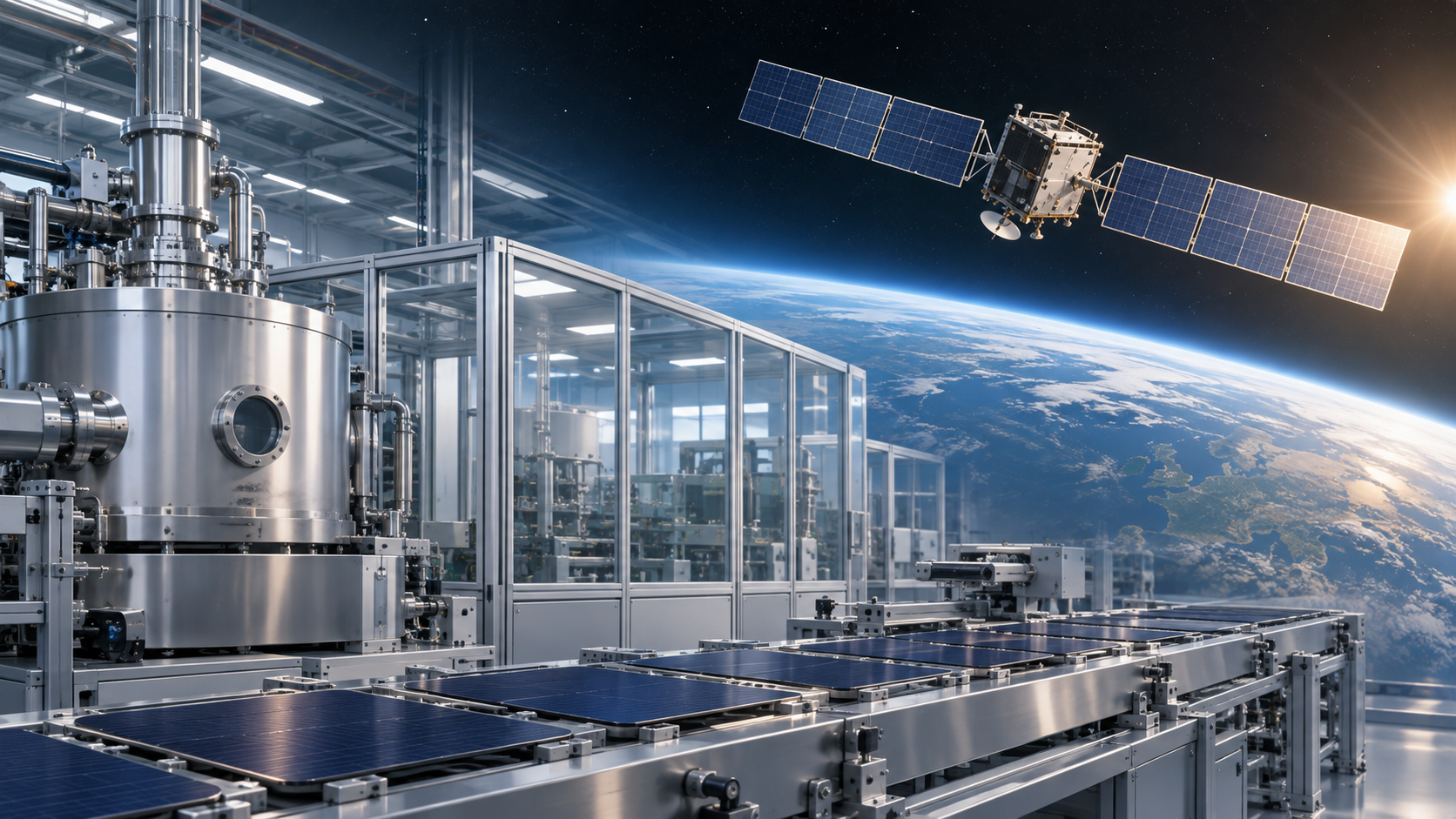
Singulus and SpaceX: A German machine manufacturer between a multi-million-euro order and a billion-euro vision – Creative image on the topic, with AI: Xpert.Digital
SpaceX relies on German solar technology – but Singulus still has to deliver
More than the previous annual revenue: What the SpaceX order means for Singulus
Space, solar cells, AI: Why the contract is both an opportunity and a risk for Singulus
An order worth more than 60 million euros might be routine for a large industrial group. For Singulus Technologies, however, such an order changes its economic outlook. The special-purpose machinery manufacturer from Kahl am Main is to supply SpaceX with a turnkey production line for manufacturing high-performance heterojunction solar cells. The first line is scheduled for the first half of 2027; further lines are to follow as part of a strategic partnership. This brings together the industrial expertise of a relatively small German company with one of the most ambitious projects in the American space industry.
Public attention is focused on Elon Musk, rising stock prices, and the prospect of enormous production capacities. However, the economic crux of the matter lies elsewhere: A financially struggling plant engineering company is given the opportunity to deploy its technology with a major client, increase capacity utilization, and redefine its market position. At the same time, the risk grows that its own resources will not keep pace with expectations.
The order is therefore neither merely a stock market spectacle nor proof of a completed restructuring. It is a business milestone whose value will only become apparent during implementation. What matters are not the most spectacular visions of the future, but the quality of the machinery, the financing of the production ramp-up, the contract terms, and Singulus's ability to generate a reliable cash flow from increasing revenues.
The stock market is already celebrating the space company – but Singulus still has to prove that Musk's vision will translate into profits
An order worth more than €60 million might be routine for a large industrial group. For Singulus Technologies, however, such an order changes the economic landscape. The special-purpose machinery manufacturer from Kahl am Main is to supply SpaceX with a turnkey production line for manufacturing high-performance heterojunction solar cells. The first line is scheduled for the first half of 2027. Further lines are to follow as part of a strategic partnership. This combines the industrial expertise of a relatively small German company with one of the most ambitious projects in the American space industry.
Public attention is focused on Elon Musk, soaring stock prices, and the prospect of massive production capacity. However, the economic crux of the matter lies elsewhere: A financially struggling plant engineering company is given the opportunity to deploy its technology with a major client, increase capacity utilization, and redefine its market position. At the same time, the risk grows that its own resources will not be able to keep pace with expectations.
The order is therefore neither merely a stock market spectacle nor proof of a completed restructuring. It is a business milestone whose value will only become apparent in its implementation. The decisive factors will not be the most spectacular visions of the future, but rather the quality of the machinery, the financing of the production ramp-up, the contract terms, and the ability to generate a reliable cash flow from increasing revenues.
A single project exceeds the previous annual revenue
The economic significance of the business becomes clear when viewed in relation to the company's size. Singulus generated revenue of €48.3 million in 2025, compared to €75.9 million the previous year. This represents a decline of approximately 36 percent. At the same time, the company recorded an operating loss of €11.7 million in 2025. This corresponds to a negative operating margin of roughly 24 percent and illustrates the extent to which the company suffered from its business performance at that time.
SpaceX's first order exceeds its total 2025 annual revenue by at least €11.7 million. Its value is more than 1.24 times that annual revenue. This is an extraordinary comparison, but one that needs to be put into perspective: an order intake is not the same as revenue, and an order value certainly is not the same as profit.
The order initially represents a contractually agreed-upon economic perspective. When revenue is generated depends on the performance of the services, the agreed-upon acceptances, and the accounting treatment. The actual receipt of funds, in turn, depends on the payment terms. Significant time gaps can elapse between contract signing, production, delivery, commissioning, and final payment.
This distinction explains why a large order can simultaneously strengthen and burden a company. It improves the outlook for employment and revenue, but initially may increase the need for materials, personnel, and working capital. Growth in plant engineering is not automatically self-financing.
The operational recovery began even before the share price surge
Singulus's financial performance had already improved before the announcement of the SpaceX supply contract. In the first half of 2026, revenue reached €45.3 million. Operating profit was a positive €2.7 million. This meant the company achieved almost 94 percent of its total revenue for the previous year within just six months. The operating margin was approximately six percent.
This comparison is meaningful, but it shouldn't be extrapolated mechanically. For a project-oriented machine manufacturer, revenues and profits aren't necessarily distributed evenly throughout the year. Individual completions, deliveries, or acceptances can significantly impact a single half-year. Therefore, a strong first half of the year doesn't automatically translate into an equally high profit contribution in the second.
Nevertheless, the positive interim operating results change the interpretation of SpaceX's business. The order is not solely for a company in a continuing downward trend, but for a provider with a noticeable improvement in earnings. It could reinforce an already ongoing stabilization.
The central question, therefore, is whether this improvement stems from more sustainable structures in the long term or primarily from a favorable timing of individual projects. For a robust recovery, Singulus would need to demonstrate over several reporting periods that higher revenues are indeed accompanied by sufficient margins, controlled costs, and improved liquidity. Only then would an operational improvement have transformed into a viable business model.
Why SpaceX buys machines and not just solar cells
Singulus is not a typical manufacturer of solar modules for rooftops or large-scale ground-mounted installations. The company develops production equipment and processes that other companies use to manufacture solar cells, semiconductor structures, and functional surfaces, among other things. Its economic role therefore lies one stage before the actual final production.
This position within the value chain is crucial. Manufacturers of solar modules must compete on several fronts, including production costs, quality, delivery capacity, and sales channels. In contrast, plant manufacturers sell the industrial capability to economically produce such products to a specific quality and quantity.
With a turnkey production line, SpaceX is not just acquiring individual machines. The company is securing a coordinated manufacturing capability. Depending on the specific scope of supply, this includes the integration of process steps, control systems, quality monitoring, and preparation for stable series production.
From a customer perspective, this approach can reduce the number of interfaces. Instead of integrating various plant suppliers into a single overall system, a larger share of the integration responsibility is consolidated. For Singulus, this potentially means more added value, but also greater responsibility. The more comprehensive the service promise, the more important project management, supplier coordination, and the precise definition of contractual obligations become.
The transition from specialist machine supplier to responsible system provider can be economically attractive. However, it requires more than just technological excellence in individual process steps.
The real value lies in the mastery of extremely thin layers
Heterojunction technology combines crystalline silicon with very thin additional silicon layers. In simplified terms, the goal is to convert as much sunlight as possible into usable electricity while simultaneously reducing surface losses. Passivation is particularly important in this process: surface defects are treated in such a way that fewer of the charge carriers generated by light are lost.
However, the economic benefit doesn't arise simply from the fact that this principle works in the laboratory. An industrial production line must reproduce the desired layer properties thousands and millions of times. It must operate reliably, achieve high throughput, and generate as little waste as possible.
This is precisely where coating technology, chemical surface treatment, and the controlled management of production processes become a competitive advantage. Even minor deviations can affect efficiency, reliability, and yield. What seems insignificant at the level of a single cell can have considerable economic consequences in large production runs.
A high-performing plant engineering company therefore sells not only hardware, but also process knowledge. This knowledge is demonstrated by how stable a production process runs under real-world production conditions and how quickly malfunctions are detected and resolved.
For Singulus, this represents a strategic opportunity: if its technology makes a valuable contribution to cost-effective manufacturing, the company can be more than just an interchangeable machine supplier. However, whether this translates into a strong negotiating position in the long term also depends on alternative suppliers, intellectual property rights, and the customer's own expertise.
High efficiency is important, but not sufficient for space travel
For satellites, a reliable power supply is a fundamental technical requirement. Solar cells must provide electricity for communication, control, data processing, and other onboard systems. If computing power in space is to be expanded, the efficiency of the power supply becomes even more crucial.
Higher cell efficiency can help generate a specific electrical power output on a smaller active area. This can offer advantages for system design. However, it would be an oversimplification to conclude that high efficiency automatically makes a cell suitable for every space application.
Space environments are subject to different stresses than those on Earth. Radiation can damage solar cells and reduce their performance over time. Therefore, economic evaluation must consider not only the initial performance but also the expected performance development throughout the entire lifespan.
In addition, there are requirements for the overall system. Cells must be electrically connected, mechanically integrated, and embedded in a structure suitable for the respective application. The finished power supply must be able to cope with start-up loads, temperature fluctuations, and the intended operating concept.
For economic analysis, this means that industrially proven manufacturing processes are an important starting point, but they do not replace the qualification required for a specific satellite platform. The success of the production line and the success of the subsequent space system are related, but not identical.
Behind the artificial sun lies an industrial infrastructure project
Musk's description of a thinking or sentient sun attracts attention, but it lacks a precise technical or economic definition. In the context of Starmind, it refers to the concept of solar-powered satellites designed to perform extensive computing tasks. This integrates energy supply, satellite production, and artificial intelligence into a unified infrastructure concept.
For economic analysis, it is helpful to break this concept down into individual functions. First, solar cells must be manufactured. These are then used to create operational energy supply systems. These systems, along with computing hardware, communication systems, and other components, must be integrated into satellites. Subsequently, the satellites are transported, commissioned, and operated in orbit.
Each of these stages incurs costs and carries its own risks. Cheaper solar cell production can improve the overall system, but it doesn't automatically solve issues of startup capacity, heat dissipation, data transmission, or maintainability.
Within this concept, Singulus acts as an upstream technology provider. The company does not need to prove that every conceivable form of orbital computing infrastructure is economically superior. However, it must consider that the need for further facilities ultimately depends on technological advancements and the customer's willingness to invest.
The first order therefore has a different economic character than the overall future vision. It is a concrete industrial project within a much larger development path that is still fraught with numerous uncertainties.
The 100-gigawatt figure describes a perspective, not a complete order backlog
The publicly stated scale of more than 100 gigawatts lends the partnership particular prestige. However, this must be clearly distinguished from the initial order. A production line valued at more than €60 million has been definitively committed initially. Further lines are planned. Singulus's announcement mentions scaling up to more than 100 gigawatts of production capacity, but does not disclose a specific output for the first line or a corresponding breakdown of the total order value.
Furthermore, there is a discrepancy between the company announcement and Musk's public statements. While Musk describes an annual production capacity of 100 gigawatts, this timeframe is not explicitly stated in Singulus's announcement. For a reliable assessment, a seemingly precise total investment should not be calculated from this difference.
Generally speaking, annual solar cell production capacity in gigawatts refers to the nominal power output of the cells that can be manufactured within a year. It does not indicate how much electrical energy these cells actually generate.
Similarly, a factory capacity of 100 gigawatts does not mean that solar cells of this power will immediately be produced, launched, or operated in space. Numerous other prerequisites would have to be met for that to happen. The figure therefore primarily indicates the potential industrial scale of the project, not its current stage of implementation.
Why a 60 million euro order cannot be extrapolated to a billion-euro order
A common temptation is to extrapolate the price of the first production line to the total long-term stated capacity. However, a crucial piece of information is missing: the specific production output promised by this first line.
Without this figure, a reliable plant price per gigawatt cannot be determined. Even if it were known, a linear extrapolation would remain problematic. Later lines could have a different technical design, achieve a higher throughput, or become cheaper due to standardization. Conversely, additional requirements could increase the cost.
It is also not automatically guaranteed that Singulus will assume the same share of the value creation in every subsequent expansion. A customer can build up manufacturing expertise, procure certain components themselves, or change their supplier structure. The company's long-term role depends on the specific details of the collaboration.
A sound economic assessment therefore distinguishes between the secured initial project and its additional potential. The first contract has a contractually defined scope. Subsequent projects represent an opportunity whose value increases with further development.
This distinction is not excessive caution. It prevents a long-term capacity vision from being treated as if all orders, delivery dates, and payment commitments were already in place. Especially with small, publicly traded companies, this confusion can lead to particularly large valuation errors.
🎯🎯🎯 Data-driven B2B industry hub as a quasi-in-house solution

The quasi-in-house solution: How Xpert.Digital closes operational gaps in B2B marketing and sales – Smart Content-Driven Business - Image: Xpert.Digital
Xpert.Digital is a data-driven B2B industry hub led by Konrad Wolfenstein . The company acts as an external, quasi-in-house solution for industrial partners, closing operational gaps in marketing, content, and sales – without requiring additional resources on the client side.
More information here:
Singulus: Share price rally and its significance for mechanical engineering
The price rally reflects a surge in expectations, not a completed success
The stock market reaction was correspondingly sharp. In regular Xetra trading on Tuesday, the share price initially rose by around ten percent to €12.70. After the release of the crucial news in the evening, it reached approximately €17.85 in subsequent trading in Stuttgart. Compared to a previous closing price of €11.55, this represents an increase of almost 55 percent.
These figures describe different times and trading venues. Therefore, they should not be interpreted as representing a single, unchanging daily price movement under identical conditions. Especially with smaller stocks, prices outside of regular trading hours can fluctuate more significantly.
The reassessment is economically understandable. A large customer can increase the perceived likelihood of stabilization. At the same time, expectations arise for additional orders, improved access to financing, and greater international visibility.
Nevertheless, a price surge initially only measures how the willingness of market participants to pay has changed. It proves neither the later project margin nor the long-term competitiveness of the company.
The more strongly a stock reacts to future opportunities, the more vulnerable it can become if the actual implementation is slower. Therefore, exceptionally positive news can simultaneously mark the beginning of an economic recovery and the starting point for new overvaluation.
The company's value depends on more than just the order volume
Whether a stock is cheaply, fairly, or expensively valued after a strong rise cannot be determined from the price alone. At a minimum, the number of shares outstanding, the current market capitalization, financial liabilities, available liquid assets, and realistic earnings expectations would be required.
Revenue alone only tells part of the story. A company can generate high revenues but create little value if its projects yield low margins or tie up capital indefinitely. Conversely, a smaller, well-funded project with high repeatability can be more economically attractive than a large, high-risk single contract.
Therefore, several levels should be considered separately in the SpaceX business. The first concerns the immediate contribution of the production line to earnings. The second encompasses potential follow-up orders. The third consists of a potential referral effect towards other customers.
These levels differ in their degree of uncertainty. The first contract provides the most concrete basis, even if its profitability is not yet publicly established. Follow-up orders depend on further decisions. Additional business with third parties is even more indirect.
A sound valuation would take these differences into account, instead of assigning equal probabilities to all conceivable advantages. Especially after a significant price movement, the crucial question is not only whether the future can improve, but how much of that improvement is already priced in.
Why a record order can initially cost extra money
In plant engineering, numerous expenses arise before a project is fully paid for. Components must be ordered, skilled workers hired, machines assembled, and systems tested. In addition, there may be costs for transport, installation, and support during production start-up.
If customer payments are closely aligned with these expenses, the financing requirement can be limited. However, if the supplier has to provide long-term pre-financing, a large order can significantly strain liquidity temporarily. Therefore, a growing order backlog and a tight cash balance are not mutually exclusive.
This question is particularly important for Singulus because the order is so significant relative to the company's existing size. Even a financially attractive line could become difficult if payments are delayed or unplanned additional costs arise.
A simplified example illustrates the connection. With a hypothetical project volume of €60 million, a cost overrun of five percent would already amount to €3 million. That would be more than the operating profit of €2.7 million from the first half of 2026. This comparison is not a forecast for the SpaceX contract, but rather highlights the vulnerability of large projects.
Therefore, payment milestones, amendment agreements, and the monitoring of rework are just as economically important as technical performance. The quality of the contract is reflected not only in the total price but also in how risks and financial burdens are distributed.
SpaceX is both a sales opportunity and a financing partner
The collaboration began in March 2026, when SpaceX provided Singulus with initial funding. This was followed in October by further financing in the form of a subordinated, secured loan. The American corporation is therefore not only a customer but also a financing partner.
This dual role can facilitate implementation. A customer who financially supports a strategically important supplier can thereby strengthen its development and delivery capabilities. For Singulus, this can expand its scope of action and help create the conditions for production.
At the same time, a closer economic bond develops. When a single partner provides both significant orders and financing, several dependencies become concentrated in the same relationship. Changes to investment plans could then not only affect future demand but also complicate financial planning.
The designation of a loan as subordinated and secured does not, in itself, allow for a complete assessment of its risks. For this, details such as the loan term, interest rate, priority ranking, collateral, and any additional contractual rights would need to be known.
In particular, financing should not automatically be equated with equity. A loan remains, in principle, a contractual obligation. The crucial question is whether it provides Singulus with sufficient time and stability to develop a sustainably improved earnings and liquidity position from the financial support.
Customer proximity can create competitive advantages but also cost negotiating power
A close development relationship can be extremely valuable from a technological perspective. The plant manufacturer gains early insight into the customer's requirements and can tailor its processes accordingly. The customer, in turn, benefits from solutions that better align with its production goals.
Such collaborations can lead to learning curves. Shared experiences in development and operation help to reduce errors, standardize processes, and implement future lines more quickly. This can improve the competitive position of both sides.
The downside is the potential for specialization on a single customer. The more closely machinery, development resources, and production capacities are tailored to that customer's needs, the more difficult a short-term reorientation can become. Investments that make sense for this customer do not necessarily have the same value in other markets.
Negotiating power must also be considered. A significantly larger customer typically has more financial resources and alternative courses of action than a small supplier. Therefore, an exceptional business opportunity does not automatically translate into exceptional margins.
For Singulus, the partnership would be particularly valuable if customer-specific development work could be partially translated into generally applicable processes, standardized plant modules, and additional market opportunities. Long-term success therefore also depends on whether customer proximity translates into a broader competitive advantage.
The first line determines the credibility of the scaling
Delivery in the first half of 2027 is an important milestone. However, it does not necessarily equate to fully stable series production. Further steps may occur between the completion of a plant and the achievement of its intended production output.
Depending on the project, this includes on-site installation, process coordination, staff training, and verification of agreed-upon performance targets. Only under real-world conditions can it be determined whether production operates at the intended speed, quality, and availability.
The yield is particularly important. In simplified terms, it describes the proportion of produced cells that meet the requirements. A high theoretical capacity loses economic value if too large a portion of the production is unusable.
For subsequent orders, the timely arrival of the machines is therefore not the only decisive factor. Equally important is whether the first line enables a convincing production operation. It thus serves as technical and economic proof for further scaling.
From Singulus's perspective, a successful initial installation would be doubly valuable: it could fulfill contractual obligations and simultaneously lay the foundation for repeat business. If standardization fails, however, there is a risk that each additional line will incur high development and adaptation costs again.
Repeatable projects can be more valuable than spectacular one-off projects
Individual projects generate revenue, but not automatically a scalable business model. A real economic breakthrough often only occurs when large parts of a solution can be reused multiple times.
For recurring production lines, design, procurement, and assembly can be standardized. Employees gain experience, suppliers understand the requirements, and known errors can be avoided. This can reduce the cost per additional machine.
However, it remains unclear how much of this advantage the manufacturer actually retains. A large customer could demand lower prices for future orders. Additional technical requirements could also negate any savings.
Besides selling additional production lines, service offerings could prove attractive. Maintenance, spare parts, process optimization, and modernization all offer potential for recurring revenue. However, whether and to what extent Singulus can benefit from this in the SpaceX project depends on the specific agreements.
The strategic value of a first-line provider therefore lies not solely in its purchase price. It can also consist of building an installed base and a long-term technical relationship. However, for valuation purposes, a distinction must be made between this plausible possibility and already secured service revenues. An attractive business model only emerges when technical relationships translate into economically viable revenue streams.
Orbital data centers have to solve more than just power supply issues
The idea of providing computing power in space has an obvious appeal: solar energy could be used directly for orbital infrastructure. However, this does not automatically imply a fundamental superiority over data centers on Earth.
A particularly important aspect is heat dissipation. Computing chips generate waste heat that must be removed from the system. The vacuum offers no ambient air to carry this heat away through convection. It must be channeled within the satellite and ultimately radiated outwards via suitable surfaces. Reliable solar radiation also depends on the specific orbit and any potential shading.
From an economic perspective, several systems must therefore be considered together: energy generation, power distribution, computing hardware, cooling, communication, and transport. Improvements in solar cells may be limited by additional costs elsewhere.
Another factor is the question of renewal. High-performance computing hardware is evolving rapidly. A business model must therefore consider how new technology gets into orbit and how older systems are replaced or decommissioned.
For Singulus, this primarily represents a limit to its own ability to influence the market. The company can successfully deliver its production equipment, while the overall economic viability of a particular space application remains uncertain. Conversely, a significant expansion of these applications could substantially increase the demand for additional production lines.
The order is a signal for mechanical engineering, but not proof of an industrial renaissance
This partnership demonstrates the role that specialized production technology can play in emerging industries. A company doesn't need to manufacture satellites, data centers, or finished solar modules itself to participate economically in their development. It can gain access to such markets through a technologically crucial production step.
This presents a relevant opportunity for Germany. The combination of process engineering, coating, automation, and industrial integration can be in demand internationally, even if the actual production facilities are located at the customer's site abroad.
However, a single order should not be interpreted as a comprehensive revival of an entire industry. A plant for a Texas location initially strengthens the supplier's business and the production capabilities of its customer. The additional value creation that remains in Germany depends on development, vertical integration, the supplier structure, and workforce expansion.
Similarly, a prominent customer alone does not prove a lasting technological monopoly. Sustainable competitive advantages over other providers would be required for that.
The sober industrial policy conclusion is therefore: Specialized German suppliers can participate in new global investment waves. However, for this to translate into broader industrial strength, such successes must be repeatable and linked to sustainable financing, a skilled workforce, and a reliable supply base.
Three development paths illustrate the economic range
A favorable scenario would be for Singulus to deliver the first line on schedule, meet the technical performance targets, and generate a convincing margin. Further firm orders could then improve capacity utilization. With increasing standardization, the cost per line would decrease, while the company stabilizes its financial position.
A more moderate scenario would be less dramatic. The first plant could theoretically work, but would require more time or additional adjustments. Follow-up projects would come later than initially hoped. Singulus would remain financially viable, but would still have to manage liquidity and capacity carefully.
An unfavorable outcome would be characterized by delays, significant rework, or a slower rollout at the customer's site. In such cases, existing commitments could be affected by delayed payments. The close relationship with a large partner would then become a more apparent risk.
These development paths are not forecasts and cannot be reliably assigned probabilities without further information. Rather, they illustrate where the crucial differences lie: in technical implementation, cash flow, repeatability, and the actual volume of subsequent orders.
For economic evaluation, therefore, the maximum conceivable future scenario is less important. What matters more is the verifiable progress the company can demonstrate on the way to achieving it.
Ultimately, what matters is the transformation of technology into free scope for action
The SpaceX order presents Singulus with an exceptional opportunity. It combines a significant initial delivery contract with a strategic partnership, financial backing, and the prospect of a considerably larger market. For a company with recently volatile revenues and only just beginning its operational recovery, this combination is economically significant.
The decisive perspective, however, remains an entrepreneurial one, not a spectacular one. Singulus must translate technical expertise into reliably deliverable systems, systems into profitable projects, and balance sheet results into genuine financial stability.
Several pieces of evidence will be required: controlled implementation of the first line, manageable pre-financing requirements, sufficient project margins, and further concrete orders. Equally important is that the partnership does not lead to a dependency that permanently restricts one's own scope of action.
The stock market primarily assesses the potential for a larger and more successful company. The operational business must then gradually realize this potential. This is precisely where the tension lies: a single order can change a machine manufacturer's outlook, but it cannot guarantee its future.
Long-term economic success will therefore not be measured by how impressive the vision of computing in space sounds. It will be measured by whether, after delivery, commissioning, and expansion, Singulus is financially stronger, technologically more advanced, and more independent from a business perspective than before.
📈🚀 From visibility to trust 👀🤝 Your scalable path with Xpert.Digital

From visibility to trust: Your scalable path with Xpert.Digital - Image: Xpert.Digital
In industrial B2B, sustainable business relationships rarely emerge overnight. They develop step by step – through visibility, professional relevance, recurring touchpoints, and growing trust. Xpert.Digital's 4-stage model addresses precisely this: It offers a structured path that begins with a manageable entry point and can evolve into deeper collaboration in business development if needed.
Instead of relying on loud marketing promises, this model puts the relationship at the forefront. Companies start with clearly defined, easily calculable measures and then decide, based on their own experience, how far they want to expand the collaboration. A key factor for this undisturbed trust-building process: The platform completely avoids annoying advertising ads, so the editorial focus remains solely on the companies' expertise.
More information here:
Your global marketing and business development partner
☑️ Our business language is English or German
☑️ NEW: Correspondence in your native language!

Konrad Wolfenstein
I and my team are happy to be available to you as your personal advisor.
You can contact me by filling out the contact form here [email protected]:or simply call me at +49 7348 4088 965. My email address is
I'm looking forward to our joint project.










