
Simulation instead of steel: How artificial intelligence and software are radically changing European defense
Xpert Pre-Release

Available in 27 languages 📢
Prefer Xpert.Digital on GoogleⓘPublished on: June 18, 2026 / Updated on: June 18, 2026 – Author: Konrad Wolfenstein
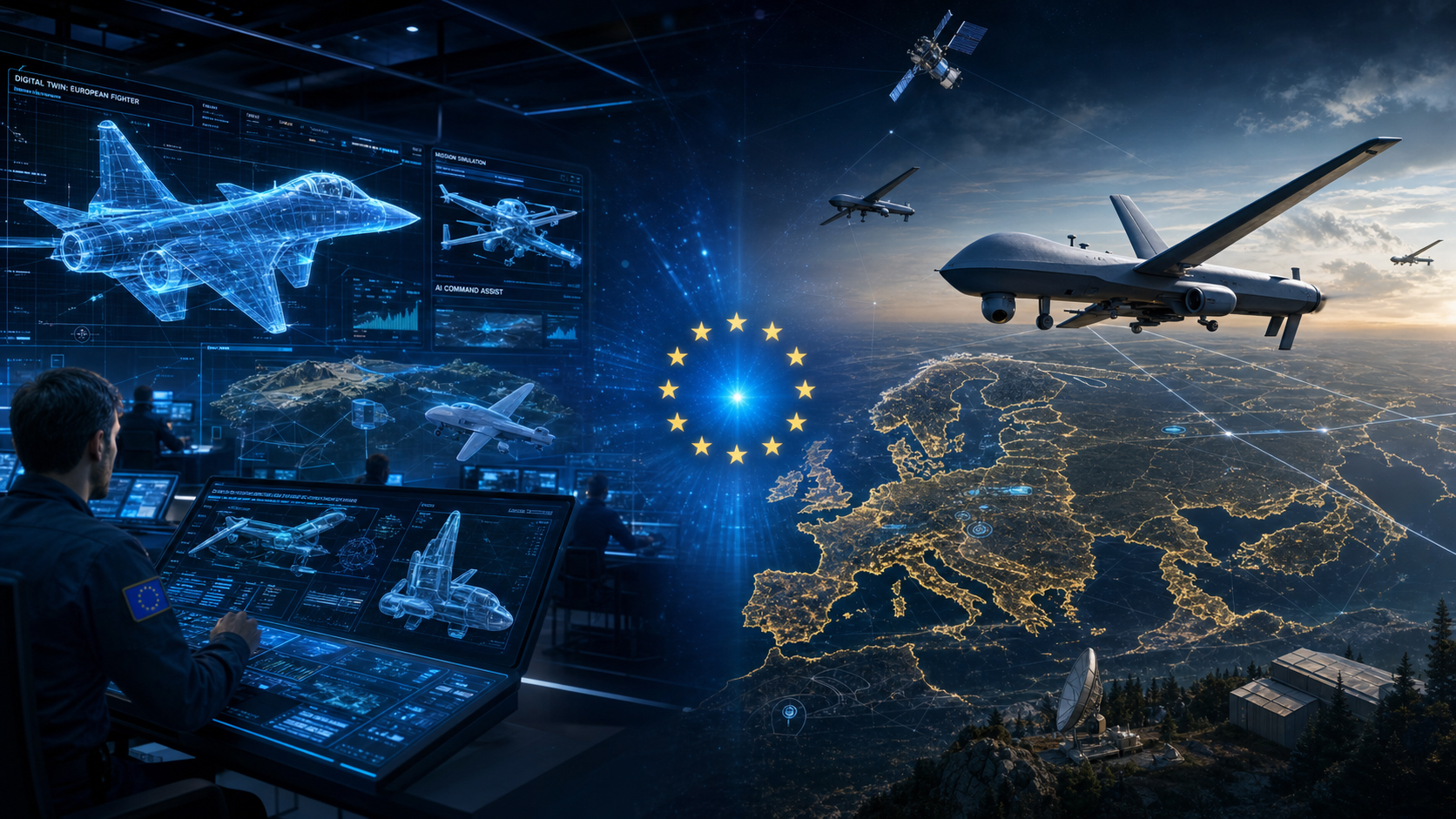
Simulation instead of steel: How artificial intelligence and software are radically changing European defense – Image: Xpert.Digital
Digital Engineering as the key to European defense sovereignty
Software as a weapon: Why Europe's strategic independence now depends on programmers
The foundations of European security have been shaken in recent years. Faced with geopolitical upheavals, Russia's ongoing war of aggression, and an increasingly uncertain transatlantic partnership, Europe is under unprecedented pressure to rebuild its own defense capabilities in record time. But while the political debate mostly revolves around record budgets, NATO quotas, and the €800 billion ReArm Europe plan, the real "turning point" is taking place far from parliaments: in the continent's laboratories, software companies, and start-up incubators.
The future of defense is no longer determined solely by steel and hardware, but by digital engineering, artificial intelligence, and software-defined systems. It's a fundamental paradigm shift that offers enormous opportunities but also exposes painful shortcomings. Even the largest defense budgets are wasted if there's a lack of digital standards, agile procurement processes, and—above all—skilled workers. The industry will be short over 750,000 specialists in the coming years. Learn why Europe's strategic sovereignty isn't just a question of money, but depends crucially on how quickly the defense industry can be transformed into the digital age.
Europe's arms industry is facing its biggest transformation since the Cold War – but money alone is not enough
From battlefield to software factory: Why the turning point is more than a political slogan
Europe is facing a security crisis of unprecedented proportions. Russia's war of aggression against Ukraine, the increasingly unpredictable stance of the United States under President Donald Trump toward NATO, and growing hybrid threats from state and non-state actors have fundamentally shifted the coordinates of European security policy. What was long taken for granted—namely, the American security umbrella over Europe—is now in question. The suspension of US military aid to Ukraine in the spring of 2025 was not an isolated event, but a signal with strategic implications: Europe must build its own defense capabilities, and quickly.
The term "turning point," coined by former German Chancellor Olaf Scholz after the Russian invasion of Ukraine, has long since transcended the boundaries of political rhetoric. It describes a fundamental structural transformation affecting the entire industrial and technological base of Europe. But this turning point is not just a question of quantity—how much money is spent on defense—but above all a question of quality: How quickly and how intelligently can highly complex, modern defense systems be implemented? And what role do engineering expertise, digital engineering, and software-based development approaches play in this?
This is precisely the crux of the debate, which is often overlooked in public discourse. While politicians argue about budget quotas and procurement programs, a quiet revolution is taking place in Europe's laboratories, development centers, and startup incubators. Engineers, software developers, and AI experts are working on systems that will shape the future of defense – and they are doing so under increasing pressure to deliver results faster, in a more interconnected way, and with greater resilience than ever before.
The arms boom in numbers: Historic expenditures, fragile structures
The facts speak for themselves. In 2024, defense spending by the 27 EU member states reached a historic high of €343 billion – a 19 percent increase over the previous year. For the first time since the European Defence Agency (EDA) began collecting data, defense investments exceeded €100 billion, accounting for 31 percent of total spending. The EDA forecasts further increases to around €381 billion for 2025, which would, for the first time, exceed the NATO target of 2 percent of GDP.
The medium-term framework is even more ambitious. At the NATO summit in The Hague in 2025, member states committed to an investment framework of 5 percent of GDP – 3.5 percent for nuclear defense spending by 2035 and a further 1.5 percent for security infrastructure, cybersecurity, and resilience. This would mean additional annual spending of over €254 billion for the 23 EU member states alone. The European Commission's ReArm-Europe plan aims to mobilize a total of over €800 billion, including loans of over €150 billion from the SAFE instrument and fiscal leeway of up to €650 billion through the activation of the escape clause in the Stability and Growth Pact.
These figures sound impressive. But a McKinsey study from 2026 highlights the central paradox: despite historically high spending, fragmentation, a lack of interoperability, and insufficient digital infrastructure significantly hinder the actual effectiveness of these investments. Consolidating European defense supply chains alone—particularly in the highly fragmented Tier 2 and Tier 3 segments such as electronics, materials, and mechanical components—could unlock annual savings of around €9 billion, totaling €45 billion by 2030. The money is there; the challenge lies in using it efficiently.
Software as a weapon: The paradigm shift to software-defined defense
Perhaps the most profound conceptual shift in modern defense technology is the move away from hardware-centric platforms toward software-defined systems. The concept of Software Defined Defense (SDD) transfers principles from modern civilian IT—modularity, scalability, interoperability, and continuous updates—to military systems. The core idea is compelling: The performance of a weapon system no longer depends primarily on its physical hardware, but on the software that controls that hardware. New capabilities, improved response times, and greater adaptability can be achieved through software updates without having to replace the underlying hardware.
The Fraunhofer Institute for Cognitive Systems IKS is actively driving this transformation in Germany. Fraunhofer FKIE has opened a Joint Research & Testing Lab in Löbau, which focuses explicitly on the fields of "Software Defined Defense," "Cybersecurity and Resilience," and "Transformation." The goal is to rapidly translate research findings into applicable industrial solutions and to bridge the gap between scientific excellence and the specific needs of the defense industry. Fraunhofer FKIE is working closely with the Central German Institute for Security Industries (MISI) to develop dual-use technologies such as drone systems, communication networks, and logistics infrastructure.
The legal and strategic dimensions of this approach are by no means trivial. Software-defined weapon platforms promise agility and interoperability within NATO and EU member states, but also raise complex questions regarding certification, security requirements, and long-term software sovereignty. EU programs such as the European Defence Fund (EDF) are increasingly emphasizing precisely these requirements, as systems with proprietary, non-interoperable architectures will lead to new dependencies in the long run—only these dependencies will be on European rather than American suppliers. According to experts, the solution lies in open standards and open-source architectures that enable genuine interoperability while simultaneously safeguarding strategic sovereignty.
Simulation instead of steel: The transformative power of digital twins
One of the most effective levers in modern defense engineering is the consistent use of digital twins and physics-based simulation. A digital twin is a dynamic virtual representation of a physical system that is continuously updated based on real-world data and combines real-time analysis, simulations, and machine learning. In a defense context, this technology makes it possible to virtually rehearse operational scenarios and enemy responses before physical systems are even built or deployed.
The economic arguments for this approach are compelling. Studies show that late design changes in the development of defense systems are 50 to 100 times more expensive than proactive corrections in early phases. Defense companies that consistently employ model-based systems development reduce integration problems by up to 75 percent and shorten development time by almost 30 percent. In the field of electronic warfare, digital twins offer flexible, model-based simulators that improve the reliability of EW systems and significantly reduce the complexity risk in development and application.
Specifically, this means that where previously a physical prototype of a fighter jet or drone had to be built and extensively tested, today the control software can be linked to a highly precise digital simulation model and validated under realistic conditions – without material costs, without risk, and in a fraction of the time. Digital factories complement this approach on the production side: factory simulations enable robust production design, integrated platforms control and optimize production with real-time data, and AI automates quality checks. For example, in a European defense project, Capgemini was able to use data analysis to identify planning deficiencies in the production ramp-up and define targeted measures to ensure the desired production rate.
Model-based systems engineering: MBSE as the backbone of complex defense projects
In the aerospace and defense industries, Model-Based Systems Engineering (MBSE) is no longer just an academic concept, but an operational standard for the development of highly complex systems. MBSE is the formalized application of modeling methods to support requirements definition, system architecture, analysis, verification, and validation – from the early concept phase through to the operational phase and beyond. Instead of distributing information in isolated documents, MBSE creates interconnected digital models that serve as central reference points for all project stakeholders.
The added value of MBSE lies particularly in the integration of heterogeneous systems and the traceability of safety-critical requirements. For defense systems, which consist of hardware, software, sensors, communication, and tactical context, this end-to-end traceability is crucial: it makes it possible to trace every design decision back to an original requirement and ensures that changes in one subsystem do not trigger unintended cascading effects in other areas. Model-Based Product Line Engineering (MBPLE), an evolution of MBSE, combines feature-based product line engineering with MBSE methods and utilizes machine-readable standards such as ISO/IEC 26580 to efficiently manage variants and maintain the digital thread across multiple system generations.
The end-to-end digitalization of the entire lifecycle – from concept through development, production, and operation to decommissioning – is more than just a technical optimization measure. It is a strategic productivity driver that enables early testing of software and hardware before physical prototypes are created, significantly shortens validation cycles, and systematically reduces costs and development risks. Dassault Systèmes, Siemens, and other European platform providers are explicitly positioning their MBSE solutions as the industrial backbone for the next generation of European defense programs.
The AI Age of Defense: From Drones to AI-Supported Combat
No other technological field is changing the military balance of power as profoundly as artificial intelligence. And Europe is catching up with remarkable momentum. The Munich-based startup Helsing exemplifies this new generation of European defense technology: With a valuation of €12 billion and $1.6 billion in funding, it has become the flagship of the European defense tech ecosystem. Helsing's AI software, Centaur, is already capable of supporting fighter pilots on missions, executing combat tactics beyond visual line of sight, and autonomously planning flight maneuvers. Together with the Swedish manufacturer Saab, integration into the Gripen fighter jet is being prepared, and the autonomous CA-1 Europa combat drone, 11 meters long and weighing up to 4 tons, is scheduled to make its first flight in 2027 and be ready for series production by 2031.
In parallel, France is testing the AI-powered combat management system Arcadia in a NATO exercise in June 2026 as a European alternative to the US Palantir system Maven. Developed with the participation of Mistral AI, Safran, Thales, and Airbus, Arcadia demonstrates Europe's readiness to assert strategic digital sovereignty even in the most sensitive area of military decision-making. This development is of considerable symbolic and practical importance: An AI-powered combat management system under European control not only strengthens operational independence but also prevents sensitive intelligence from being passed through American systems.
The entire European defense tech ecosystem has developed at an impressive pace. According to the European Defence Tech Report 2025, 384 defense technology startups were identified, around a third of which were founded in the last ten years. These companies have a combined equity capital exceeding $3 billion, 119 venture capital investors are active, and there have been 27 acquisitions and 15 IPOs. Venture capital investments in European defense tech startups rose to around €2.6 billion by 2025 – more than a tenfold increase since 2021. This growth signals that markets are already anticipating the strategic shift, while political institutions are still negotiating the legal and bureaucratic frameworks.
Hub for Security and Defense - Advice and Information

Hub for Security and Defense - Image: Xpert.Digital
The Security and Defence Hub offers expert advice and up-to-date information to effectively support companies and organizations in strengthening their role in European security and defence policy. Working closely with the SME Connect Defence Working Group, it particularly promotes small and medium-sized enterprises (SMEs) that wish to further develop their innovative capacity and competitiveness in the defence sector. As a central point of contact, the Hub thus creates a crucial bridge between SMEs and European defence strategy.
Related to this:
From the lab to the front line: Why Europe needs to radically shorten its innovation cycles
The European funding architecture: EDF, ReArm Europe and the digital modernization impulse
In recent years, the European Union has established a remarkably complex, yet increasingly coherent, funding architecture for defense innovation. The European Defence Fund (EDF), with a total budget of €7.3 billion until 2027, supplemented by a further €1.5 billion through the Strategic Technologies for Europe Platform (STEP), finances collaborative defense research and prototype development. The 2025 work program has already selected 57 projects with a total volume of €1.07 billion, covering areas such as AI, cyber defense, drones, and drone countermeasures. The key project STRATUS, for example, aims to develop an AI-supported cyber defense system against drone swarms.
In addition, the Digital Europe Programme, with €7.59 billion, explicitly enables the funding of dual-use technologies – that is, technologies that can be used for both civilian and military purposes. Horizon Europe, with a budget of €93.5 billion, has also been opened to support dual-use research. The Connecting Europe Facility, with €25.8 billion, and the cybersecurity budget within Horizon Europe, which increased from €60.4 million in 2024 to €90.5 million in 2025, complete the picture. Furthermore, the SAFE (Security Action for Europe) mechanism, launched in May 2025 as part of the ReArm Europe plan, provides loans of up to €150 billion for joint defense procurement.
The Commission has also presented a dedicated innovation strategy, the “EU Roadmap for the Transformation of the Defence Industry,” which addresses four priorities: supporting investment in defence companies, accelerating the development of new technologies, expanding access to defence capabilities, and fostering skills to ensure Europe’s technological edge. By 2030, 600,000 people in the EU are to be retrained or upskilled for the defence industry to address the worsening skills shortage. The European Parliament added that technological sovereignty encompasses the ability to build capacity and resilience, reduce strategic dependencies, and protect critical technologies.
The skilled worker paradox: When capital meets empty workbenches
One of the biggest bottlenecks on the path to a powerful European defense industry is not capital, but human capital. Europe faces a fundamental skills paradox: historically high order books are colliding with an acute and worsening personnel shortage. A study by the management consultancy Kearney from March 2025 arrives at an alarming conclusion: just to reach the NATO target of 2 percent of GDP, Europe needs an additional 163,000 skilled workers. At a level of 3.5 percent – as agreed at the NATO summit in The Hague – the need rises to at least 760,000 additional specialists.
The situation is particularly dire in key technological sectors. AI experts, software developers, autonomous systems engineers, and cyber specialists are at the top of the demand list, but are extremely difficult to recruit due to intense competition from the civilian technology sector. The defense industry is not only struggling with wage disparities—some companies have already increased salaries by 8 to 10 percent—but also with a persistent image problem among younger generations. While automotive plants in Europe are reducing capacity and laying off skilled workers, the transition to the defense industry is not automatic, as the specific qualification requirements differ significantly.
The European Commission is attempting to counteract this with its transformation roadmap for the defense industry: a talent platform to promote internships in SMEs and dual-use startups, as well as a comprehensive training program for 600,000 workers by 2030, are the key instruments. However, whether these measures will be sufficient to overcome the structural bottleneck remains an open question. The competition for technical talent is not limited to Europe – it is global. Companies from the US, Israel, and Asia are competing for the same engineers and AI experts, often offering significantly more attractive terms.
Collaboration as a system requirement: How industry, research and politics must grow together
Europe's technological strength historically lies in the depth and breadth of its industrial base and the quality of its research institutions. However, this strength can only be effectively utilized in the defense context if the fragmented national ecosystems merge into a functioning pan-European innovation system. This may sound like wishful thinking – yet there are concrete approaches that demonstrate how this integration can succeed.
A Collaborative Working Environment (CWE) is far more than a technical toolset or cloud storage. It forms the digital backbone of cooperation: a secure, sovereign platform on which nations, government agencies, and industry partners can jointly develop and operate complex systems throughout their entire lifecycle. Without such an infrastructure, true collaborative development, which is essential for multinational defense projects, is virtually impossible – teams remain trapped in national silos, data is maintained inconsistently, and insights do not spread beyond company boundaries.
European harmonization requires an explicitly open architectural approach. Open standards and transparent development processes form the basis for genuine interoperability and enable systems to be adapted quickly and security gaps to be closed immediately. At the same time, open source prevents dependence on individual vendors and safeguards strategic sovereignty. Collaborations such as the one between Fraunhofer FKIE and MISI demonstrate how the development of information and innovation networks between industry, research, and politics can work in practice: Shared exchange, analysis, and feedback formats create the necessary foundation of trust for effective cooperation. Technological capability is synonymous with security today – and this capability can only be developed collaboratively, not through national isolation.
Supply chains as a security policy weak point: Resilience through diversification
Besides the technological dimension, the resilience of supply chains is an often underestimated factor for Europe's defense capabilities. Decades of disinvestment in the domestic defense industry have led to a problematic dependence on external suppliers – not only American, but also Asian, and especially Chinese, suppliers for critical components such as semiconductors, rare earth elements, and specialized electronics. In the event of a crisis, these dependencies pose a serious security risk.
The European White Paper on the Future of Defence identifies seven priority capability gaps, including explicitly AI, quantum and cyber capabilities, and electronic warfare. In addition, 500 critical infrastructure projects are to be modernized. Securing critical inputs – including raw materials, key components, and chips – is among the explicit objectives of the ReArm Europe plan. The EU aims to create a common procurement platform for raw materials and to merge the fragmented European defence market into a genuine EU-wide market through standardization and joint procurement.
McKinsey's analysis shows that the fragmentation of European defense supply chains is leaving significant efficiency potential untapped. Particularly in the highly fragmented Tier 2 and Tier 3 segments – defense and security electronics, materials, and mechanical components – targeted mergers and standardization can drastically improve the cost base. Digital infrastructure is the crucial enabler: A modular "Defense Tech Stack" architecture comprising platforms, computing power, secure networking, and AI applications creates the conditions for the rapid integration of new capabilities and a resilient supply chain.
From research to deployment: How the speed of innovation is determined
The war in Ukraine has dramatically demonstrated that the speed of technological development and application can be decisive on the modern battlefield. Drones deployed today are fundamentally different technologically from those used at the beginning of the conflict – and this development cycle is measured in weeks and months, not years. Europe's traditional arms procurement, characterized by lengthy tendering processes, grueling bureaucratic procedures, and a lack of risk appetite, is simply not designed for this pace of innovation.
The EU Omnibus package for defense readiness, launched in March 2025, aims to reduce bureaucratic hurdles. However, the approach of rapidly moving technology from the laboratory to deployment requires not only regulatory simplification but also a fundamentally different culture of cooperation between industry, research institutions, and procurement agencies. Start-ups like Helsing, which progressed from their founding year to delivering equipment to the front lines in Ukraine within three years, demonstrate what is possible when bureaucratic cycles are broken. Crucial to this is the establishment of efficiency partnerships between industry and procurement agencies, which accelerate programs and free up resources – a model that is already being successfully tested in individual pilot projects.
Europe must learn from the experiences in Ukraine and build a new defense ecosystem that brings together leading representatives of established industry, new innovators, and the tech community, enabling faster and more efficient capability delivery. This means less linear thinking in procurement cycles and more iterative engineering in the style of modern software development. It also means that military stakeholders, who have traditionally been customers at the end of a long process chain, must become active development partners who provide feedback and set priorities early in the process.
Technological sovereignty as a political project: Europe's strategic interests
Ultimately, all technological and industrial considerations lead to a genuinely political question: What does technological sovereignty mean for Europe, and what price is Europe prepared to pay for it? The European Parliament has clearly defined in its reports that European sovereignty includes the ability to build capacity and resilience, reduce strategic dependencies, and protect critical technologies – not through isolation, but by building its own competitive capabilities.
Technological capability is synonymous with security today. In concrete terms, this means that without European AI systems, sovereign cloud infrastructure, domestic semiconductor production, and digitally sovereign defense platforms, any political rhetoric about independence remains hollow. The Federal Ministry of Education and Research explicitly emphasizes in its FITS 2030 framework program that maintaining and expanding technological sovereignty not only strengthens competitiveness but also directly enhances the defense capabilities of Germany and the EU. The initiative of a European "SPARTA" project – an alliance for strategic high technology aimed at strengthening resilience, innovation, and digital sovereignty – points in the right direction: technology must not only exist, it must be controllable and in European hands.
The consolidation of the European defense industry is progressing, driven by increased defense budgets and EU funding instruments. AI, aerospace, and semiconductors can shorten development cycles and significantly reduce costs. The political will is clearly present – in the European Commission, the Parliament, and most member states. The real challenge now lies in transforming this will into functioning industrial structures, recruiting and training the necessary talent, overcoming national rivalries in joint procurement projects, and boldly redesigning procurement processes to keep pace with the dynamics of modern technological development. Europe has the resources, the technology, and – increasingly – the political backing. What it needs now is speed.
Consulting - Planning - Implementation

Markus Becker
I would be happy to serve as your personal advisor.
Head of Business Development
Chairman SME Connect Defense Working Group
Consulting - Planning - Implementation
Konrad Wolfenstein
I would be happy to serve as your personal advisor.
You can contact me at wolfenstein∂xpert.digital or
Just call me on +49 7348 4088 965 .





