
Shadow fleet in distress? Surprising withdrawal: Why Putin's fleet is suddenly leaving the Mediterranean
Xpert Pre-Release

Available in 27 languages 📢
Prefer Xpert.Digital on GoogleⓘPublished on: August 23, 2026 / Updated on: August 23, 2026 – Author: Konrad Wolfenstein
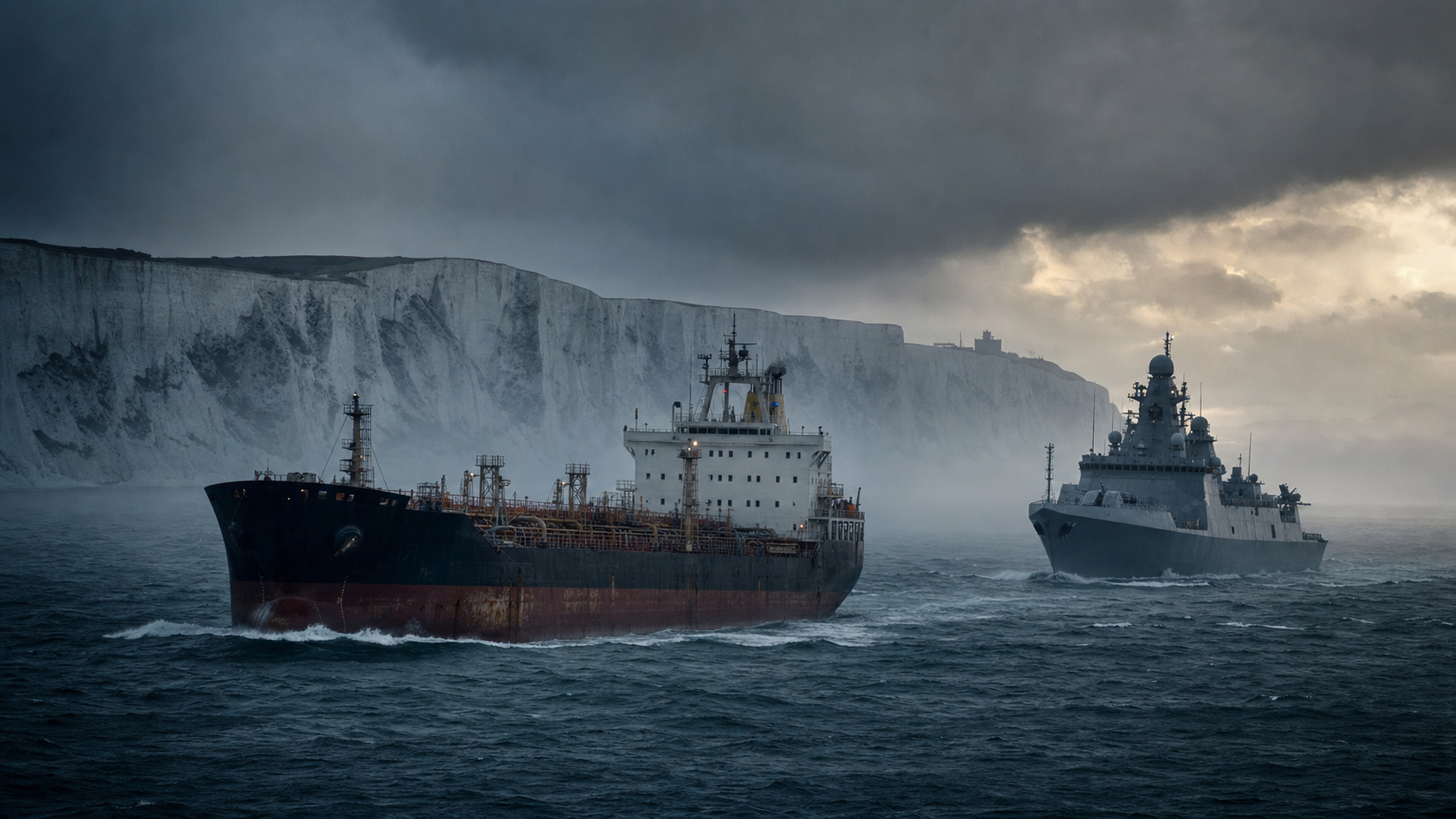
Shadow fleet in distress? Surprising withdrawal: Why Putin's fleet is suddenly leaving the Mediterranean – Creative image on the topic, created with AI: Xpert.Digital
Strategic setback: How Western sanctions are bringing Putin's navy to its knees
Historic turning point: Prestige project fails – Putin's war fleet flees the Mediterranean
For more than a decade, Russia demonstrated military strength in the Mediterranean – now, according to NATO sources, the notorious Mediterranean Task Force has completely disappeared. But this historic withdrawal is by no means a sign of peaceful intentions, but rather the result of an unprecedented strategic predicament: Under the massive pressure of Western sanctions, the Kremlin is forced to use its dilapidated surface fleet almost exclusively to protect its lucrative "shadow fleet" – with a new, highly volatile flashpoint in the heart of Europe, in the English Channel. It is a dramatic shift in priorities, in which securing war-financing oil and gas exports now carries far more weight than geopolitical prestige. The following analysis shows how the sanctions spiral is eroding Russia's maritime power, why the fleet resembles a "heap of rubble," and why Moscow's focus is now entirely on the liquefied natural gas trade.
Withdrawal from the Mediterranean: Russia's maritime strategy under pressure: When the price of evading sanctions becomes higher than the geopolitical prestige gain
The complete withdrawal of the Russian navy from the Mediterranean marks one of Moscow's most remarkable strategic setbacks since the start of the Ukraine war and reveals the true cost of Western sanctions against the so-called shadow fleet.
A decade of maritime power demonstration ends abruptly
Since September 2013, Russia maintained a standing task force in the Mediterranean, consisting of at least ten warships from all five major Russian naval units and operationally subordinate to the Black Sea Fleet. This so-called Mediterranean Task Force was far more than a mere collection of ships: it served to secure Russia's involvement in Syria, project power to NATO's southern flank, and symbolically demonstrate that Russia had once again risen to the status of a global naval power after the end of the Cold War. After more than ten years of continuous presence, this formation completely disappeared in June 2026, as confirmed to the British newspaper "The Telegraph" by an unnamed NATO official. For a navy that once established its Mediterranean presence as a geopolitical prestige project, this step is not a tactical footnote, but a strategic admission of limited resources.
The origins of this formation date back to the early stages of the revival of Russia's naval power. As early as January 2013, the Russian Navy conducted its largest maneuvers in the Mediterranean since the end of the Cold War, while Defense Minister Sergei Shoigu described the region as "the core of all significant threats to Russia's national interests." The formal activation of the task force took place in September of the same year, its initial configuration already comprising sixteen ships, including nine warships and seven support vessels. With the start of the Russian military intervention in Syria in September 2015, the formation gained entirely new significance as the logistical backbone of operations around the Hmeimim airbase and the port of Tartus.
A trade deal between two war zones
The withdrawal is not a voluntary troop reduction, but a forced redistribution of scarce maritime resources under the pressure of an increasingly stringent Western sanctions regime. Because Western states are increasingly targeting the so-called shadow fleet tankers, with which Russia continues to sell oil and gas despite price caps and export bans, the Kremlin is increasingly forced to use its remaining warships as escort vessels for this civilian merchant fleet. A NATO official bluntly described the state of the Russian surface fleet to the Telegraph as "a complete wreck," indicating massive logistical problems and a shortage of supply ships.
This assessment aligns with independent analyses of the structure of Russia's shadow fleet, which show that almost half of Russia's oil exports are handled via the Baltic Sea and that around 1,000 ships are deployed annually for this purpose. The true significance of the Mediterranean withdrawal thus lies less in a symbolic weakness than in a sober cost-benefit analysis: Protecting the multi-billion-dollar oil and gas exports, which directly finance Russia's military budget, now outweighs the Kremlin's show of force in the eastern Mediterranean.
The English Channel as a new frontier for sanctions evasion
The immediate trigger for the redeployment of Russian naval capabilities lies in a series of high-profile seizures that have made the English Channel a new focal point of the confrontation between Russia and the West in recent months. On June 14, 2026, British Royal Marines Commandos, together with officers from the National Crime Agency, boarded the Cameroonian-flagged tanker "Smyrtos" approximately 25 miles south of the Isle of Wight. The tanker had departed the Russian Baltic port of Ust-Luga on June 5, en route to Port Said in Egypt with over 700,000 barrels of Russian crude oil. The six-hour operation, supported by Chinook helicopters, the frigate HMS Sutherland, the minesweeper HMS Ledbury, and a Poseidon P-8 aircraft, was the first British-led hijacking of a shadow fleet tanker since the beginning of the war. The unusual aspect of the case: Cameroon had previously removed the ship from its own register, effectively rendering the tanker stateless, which gave Great Britain the legal basis to board it under Article 110 of the UN Convention on the Law of the Sea.
President Vladimir Putin responded to the seizure with undisguised threats to "respond in kind," to which the British government declared that its actions were fully compliant with international law. The tanker's captain, Indian national Ajay Pant, has since been charged with violating sanctions regulations. This episode is by no means an isolated incident: since 2025, NATO countries such as Germany, France, and Finland have intensified their practice of detaining ships, resulting in a total of 13 such vessels being blocked. To prevent further seizures, the Russian warship "Neustrashimy" has been regularly patrolling the English Channel and even conducted a 30-minute live-fire exercise in July 2026 approximately 74 kilometers south of Plymouth, with the Russian side informing the British frigate HMS Tyne in advance. The "Neustrashimy" thus assumed the role previously held by the frigate "Admiral Grigorovich," marking Moscow's attempt to achieve maximum protection for its merchant fleet with minimal resources. The British Royal Navy therefore registered a 25 percent increase in its surveillance operations against Russian activities from January to July 2026 compared to the same period of the previous year.
The scale of the sanctions spiral against the Shadow Fleet
To fully understand Russia's strategic predicament, it is worth examining the scale of international sanctions efforts. According to analyses by the Kyiv School of Economics Institute, in April 2026, approximately 192 loaded tankers belonging to the shadow fleet were transporting crude oil and petroleum products from Russian ports, 92 percent of which were over fifteen years old. As part of its twentieth sanctions package in April 2026, the European Union had already placed 632 tankers on its sanctions list, meaning that an estimated 17 percent of all oil tankers worldwide are now considered part of the shadow fleet. By July 2026, the EU had sanctioned 671 ships, compared to just 25 in July 2024, while the UK increased its number of sanctioned ships from 17 to 621 during the same period.
These figures highlight a paradox of Western sanctions policy: Despite the massive expansion of sanctions lists, analyses by the German Institute for International and Security Affairs (SWP) show that this has had virtually no noticeable impact on actual Russian export volumes, as practically every second tanker used for Russian oil exports is now sanctioned, without any significant change in sales figures. At the same time, more recent data show increasing operational effectiveness: In April 2026, 69 percent of all Russian maritime oil exports were handled by already sanctioned tankers, while sanctioned vessels carried a record high of 54 percent of all Russian fossil fuel exports in the same month. This means that Russia is increasingly forced to operate with already identified and monitored vessels, which significantly increases the vulnerability of Western coast guards and navies and intensifies the need for military escorts.
The sheer size of the fleet remains impressive: According to estimates by the Center for Strategic and International Studies, the shadow fleet transports approximately 3.7 million barrels of oil daily, representing 65 percent of Russia's total maritime oil trade and generating annual revenues of between 87 and 100 billion US dollars. Also noteworthy is a growing trend of re-flagging suspicious vessels to the Russian flag itself, in order to protect them from Western seizure; in December 2025 alone, seventeen such ships were newly registered in Russia.
Hub for Security and Defense - Advice and Information

Hub for Security and Defense - Image: Xpert.Digital
The Security and Defence Hub offers expert advice and up-to-date information to effectively support companies and organizations in strengthening their role in European security and defence policy. Working closely with the SME Connect Defence Working Group, it particularly promotes small and medium-sized enterprises (SMEs) that wish to further develop their innovative capacity and competitiveness in the defence sector. As a central point of contact, the Hub thus creates a crucial bridge between SMEs and European defence strategy.
Related to this:
Military overextension: The forced change of strategy of the Russian Navy – shadow fleet in focus
The economic logic behind military priorities
From a purely economic perspective, Russia's decision to redeploy its limited naval capabilities from the Mediterranean to the English Channel follows a clear calculation regarding war financing. Oil and gas exports via the shadow fleet remain one of the central sources of revenue for the Russian treasury and thus for the continuation of the war effort in Ukraine. Every seized tanker not only means the loss of cargo worth millions of dollars, but also a significant disruption to the insurance and logistics chains, which are already operating under difficult conditions, since sanctioned ships no longer have access to regular Western marine insurance from the International Group of P&I Clubs.
In contrast, the Mediterranean presence has increasingly fulfilled a primarily symbolic function in recent years, after the active combat phase in Syria subsided following 2017 and the task force's role was limited to supplying the remaining bases in Tartus and Hmeimim, as well as sporadic presence missions. The political prestige of a permanent naval presence in the Mediterranean apparently weighs less for the Kremlin than the immediate economic damage caused by lost oil shipments, especially since the Western sanctions coalition is now operating with sufficient precision to identify critical gaps in the supply chain. This shift in priorities can be interpreted as a symptom of the structural overextension of the Russian Navy, which simply no longer possesses sufficient operational warships, supply units, and maintenance capacity to simultaneously maintain a permanent presence in two geographically distant theaters of war.
New fleet expansion despite withdrawal: The focus on liquefied natural gas
Parallel to its military withdrawal from the Mediterranean, Russia is pursuing a remarkably aggressive strategy in expanding its LNG shadow fleet, illustrating its dual strategy of tactical retreat and strategic adaptation. According to analyses by the shipping and sanctions services provider Windward, Moscow already possessed 23 specialized LNG tankers by mid-June 2026, with at least two more Russian-built vessels having been added since then, according to the Financial Times. This targeted fleet expansion serves a clear purpose: Russia is systematically preparing to continue selling natural gas on world markets even after the EU-wide LNG import ban has fully come into effect.
The legal basis for this development lies in the nineteenth EU sanctions package of October 2025, which establishes a complete import ban on Russian liquefied natural gas (LNG), implemented in two phases: Short-term contracts had to be terminated within six months of its entry into force, while long-term contracts expire on January 1, 2027. In June 2026, the European Commission further clarified this regulation, stating that EU companies would no longer be permitted to trade Russian LNG from 2027 onwards, even if the buyers were located outside the European Union. This effectively eliminates any intermediary role for European shipping companies and trading houses in the global trade of Russian LNG. Additionally, in the twentieth sanctions package of April 2026, the EU tightened the rules for maintenance services on Russian LNG tankers and icebreakers, further forcing Russia to develop its own maintenance and repair capacities, as Western ports and shipyards will be off-limits for such services.
This development reveals a fundamental pattern in Russia's handling of Western sanctions: Instead of complying with the restrictions, the Kremlin is systematically investing in its own infrastructure to reduce its dependence on Western service providers, insurers, and trading partners. The parallel military withdrawal in the Mediterranean and simultaneous fleet expansion in the LNG sector demonstrates a clear prioritization: Economic viability under sanctions pressure takes top priority in the Kremlin's resource allocation, while geopolitical prestige projects must take a back seat.
The geopolitical implications for NATO's southern flank
The complete withdrawal of Russian naval units from the Mediterranean simultaneously opens up new strategic opportunities for Western actors in a region that has been characterized for years by the presence of Russian warships. Without a permanent Russian naval presence, the remaining bases in Tartus and at the Hmeimim airbase lose considerable operational security, which, especially after the fall of the Assad regime and the changed political landscape in Syria, casts further doubt on the future of these facilities. For NATO member states on the southern flank, particularly Italy, Greece, and Turkey, the withdrawal means a noticeable reduction in maritime surveillance requirements, as Russian reconnaissance and combat ships, which previously regularly observed NATO maneuvers and patrolled the eastern Mediterranean, are now absent.
At the same time, the focus of the maritime confrontation between Russia and the West is visibly shifting to northwestern Europe, where the English Channel and the North Sea are becoming new flashpoints. This geographical shift is by no means reassuring for European security planners, as it is taking place directly off the coasts of Great Britain, France, and the Benelux countries, and is thus closer to core European territories than the eastern Mediterranean. The increasing patrols of Russian warships like the "Neustrashimy" through busy European waters, combined with occasional live-fire exercises in the immediate vicinity of British coasts, signal Moscow's willingness to establish a symbolic presence and deterrent effect in a region more sensitive for the West, even with significantly reduced capabilities.
A forced strategic adjustment
The withdrawal of the Russian navy from the Mediterranean after more than a decade of continuous presence is ultimately less an expression of a conscious geopolitical realignment than the result of structural overextension under the cumulative pressure of Western sanctions regimes. The combination of a shrinking surface fleet, described in some parts as a "pile of wreckage," escalating seizures of shadow fleet tankers by NATO states, and the sheer economic necessity of protecting war-financing oil and gas exports at all costs has forced the Kremlin into a painful prioritization. While Russia is simultaneously aggressively expanding its LNG fleet to prepare for the complete EU import ban starting in 2027, a pattern of economic adaptability despite military exhaustion is emerging. For Western policymakers, this development provides important evidence that targeted, consistently enforced sanctions against the shadow fleet do indeed generate real strategic costs for Moscow, even if overall export volumes have remained remarkably stable so far.
Consulting - Planning - Implementation

Markus Becker
I would be happy to serve as your personal advisor.
Head of Business Development
Chairman SME Connect Defense Working Group
Consulting - Planning - Implementation
Konrad Wolfenstein
I would be happy to serve as your personal advisor.
You can contact me at wolfenstein∂xpert.digital or
Just call me on +49 7348 4088 965 .





