
Secret oil route in the Gulf: How the US military is breaking the Iranian blockade – American oil companies as clear war winners
Xpert Pre-Release

Available in 27 languages 📢
Prefer Xpert.Digital on GoogleⓘPublished on: August 21, 2026 / Updated on: August 21, 2026 – Author: Konrad Wolfenstein
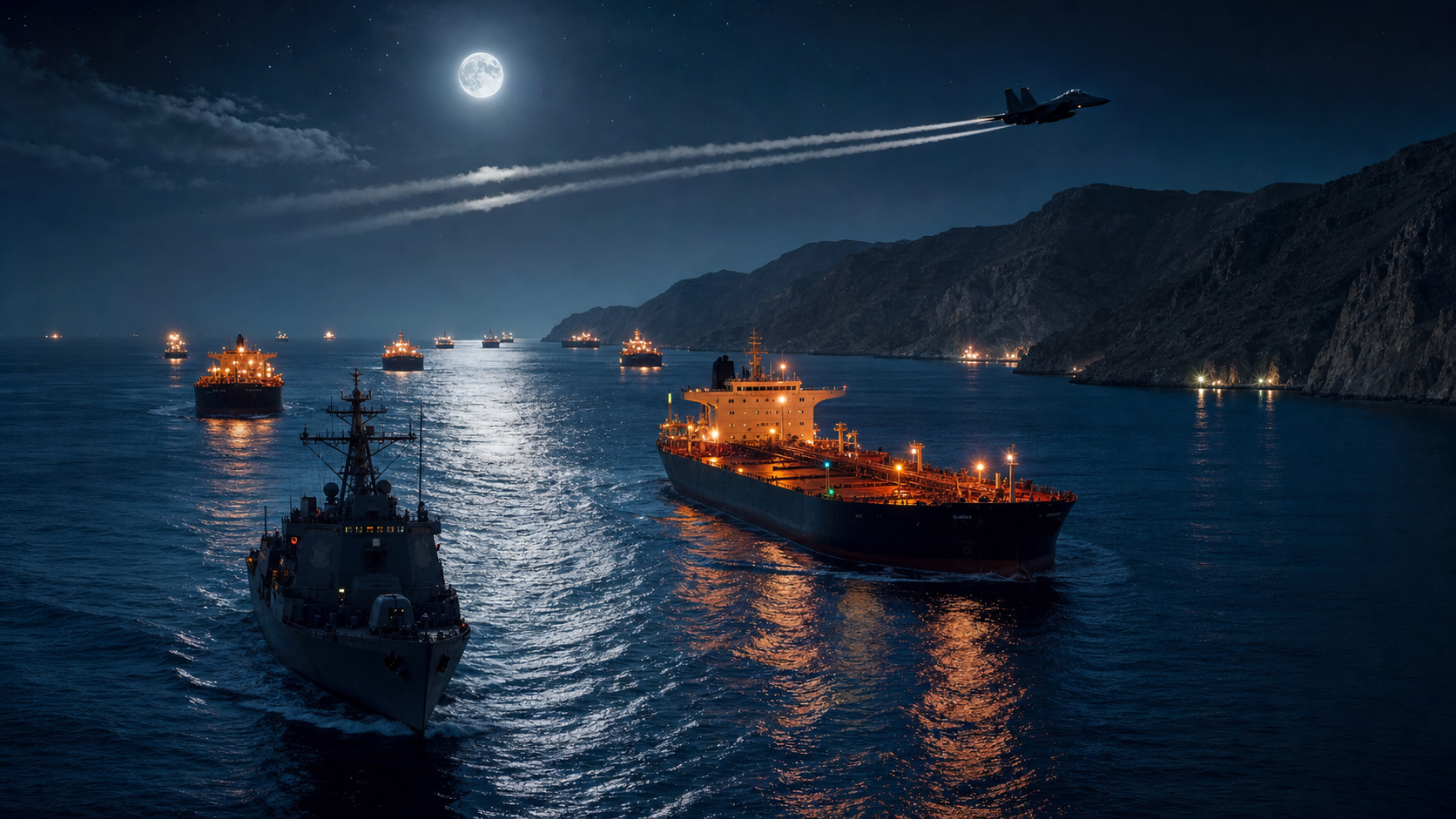
Secret oil route in the Gulf: How the US military is breaking the Iranian blockade – American oil companies as clear war winners – Creative image on the topic, with AI: Xpert.Digital
10 million barrels per night: The risky back road of the USA through the Strait of Hormuz
China's triumph, Europe's problem: Who really benefits from the oil war in the Persian Gulf?
“Huge amount of oil”: How Trump is using a secret military operation in the Gulf for his own benefit
For months, an unprecedented military conflict between the US, Israel, and Iran has gripped the world – and struck the global economy at its most vulnerable point: the Strait of Hormuz. While world markets grapple with exploding energy prices, volatile supply chains, and the constant fear of full-blown escalation, the US military has quietly constructed a secret lifeline. Under cover of darkness and massive military protection, American forces are smuggling millions of barrels of crude oil through a corridor off the coast of Oman night after night. It is a logistical masterpiece that President Donald Trump is publicly celebrating as a historic victory. But a look behind the scenes of the global oil markets reveals a far more complex truth: While China emerges as the laughing third party from the crisis and American oil companies reap historic profits in the billions, industrialized nations like Japan, South Korea, and even Europe risk becoming the big losers in this geopolitical high-stakes game. An in-depth analysis of America's shadow route, the true profiteers of the war, and the question of why prices for consumers remain relentlessly high.
America's shadow route in the Gulf: How Washington is circumventing the oil blockade and who really benefits in the end
A war, a strait, and the question of who benefits from control
Since the end of February 2026, a conflict has raged between the US, Israel, and Iran that has shaken global energy supplies more severely than almost any event since the Russian invasion of Ukraine. At its heart is the Strait of Hormuz, the narrow waterway just under 55 kilometers wide between Oman and Iran, through which, before the war began, roughly one-fifth of the world's crude oil trade and a significant portion of the global liquefied natural gas trade flowed. When Iran effectively blocked the passage after the first American and Israeli attacks, shipping traffic plummeted within days from a good 130 to 140 daily crossings to a fraction of that, and the price of oil temporarily soared to over $119 per barrel of Brent crude. American media are now reporting that the US military is maintaining a southern route along the Omani coast, through which 15 to 20 tankers operate nightly, transporting a total of up to ten million barrels of crude oil per day from the Gulf, and on some nights even 15 to 20 million barrels. This corresponds to about half the pre-war volume and thus marks one of the most tangible operational successes the US has achieved so far in this conflict.
How the back road along the Omani coast works
The operation is technically remarkably sophisticated and follows a clear logistical plan that goes far beyond simply escorting loaded tankers. First, the US military guides empty tankers from the Arabian Sea through the Strait of Hormuz into the Persian Gulf, where they load crude oil at the Gulf states' transshipment terminals. Then, American warships and fighter jets secure the departure of the now fully loaded tankers back into the open sea. A senior US official explained to the Axios news portal that they completely control the southern route along the Omani coast, while Tehran, although able to cause disruption, cannot truly control the strait. The entire undertaking is coordinated by a special military unit at Fort Bragg Army Base in North Carolina, which compiles daily lists and fixed time slots for incoming and outgoing ships. Every night, the tankers move in two large, tightly scheduled convoys—one entering, one leaving—with US Air Force fighter jets shielding the formations against Iranian cruise missiles and drones. This corridor was only made possible by a two-week campaign by US Central Command, which targeted and disabled or severely damaged Iranian radar and maritime surveillance systems, as well as numerous Revolutionary Guard speedboats.
A weakened, but not defenseless regime
Iran's military position has deteriorated significantly due to weeks of American attacks, though Tehran has not been rendered completely incapacitated. Reports indicate that the Iranian armed forces are now largely operating blind, as their radar and maritime surveillance systems have been destroyed or severely damaged, and a large portion of the fast patrol boats previously used by the Revolutionary Guard to track shipping movements have been disabled. Consequently, the regime often fires indiscriminately at areas where it suspects tankers are present, drastically reducing its success rate. Nevertheless, Iran remains dangerous: at the beginning of this week alone, eight drones and two cruise missiles were intercepted by American defense systems, demonstrating that Tehran still possesses significant offensive capabilities and that the route is by no means risk-free. Iran had previously even signaled its willingness to allow limited free passage for allied states such as China, India, and Russia, while simultaneously issuing targeted threats to Western shipping, creating a highly inconsistent and unpredictable situation for international shipping companies.
The political symbolism for Donald Trump
For President Donald Trump, the opening of this corridor comes at a time when the overall military course of the war is considered a stalemate and diplomatic negotiations have repeatedly failed. Trump described the amount of oil flowing through as enormous and demonstratively displayed confidence in victory by dismissing further negotiations with the mullah regime as a waste of time. This rhetoric can be interpreted as an attempt to elevate a limited operational success to a strategic victory, while the actual military and diplomatic situation remains deadlocked. As early as the beginning of August, Trump had publicly declared that the road was open and many ships were passing through. This shows that the administration is actively using this success story for domestic political communication—especially since high fuel prices at American pumps are leading to growing criticism from senators like Elizabeth Warren, who accuse the administration of allowing the oil industry to profit from the war while American families suffer under the price hikes.
Why oil prices remain high despite this
A key contradiction in this narrative lies in the fact that despite the opening of the corridor in mid-August 2026, the price of oil has risen significantly again – most recently to around $93 to $94.50 per barrel of Brent – whereas it had temporarily fallen to as low as $72 shortly after a ceasefire reached in June but which collapsed again in July. Commerzbank commodities expert Barbara Lambrecht offers a sober assessment: Because only a few shipments continue to pass through the strait, the hope for a de-escalation remains, for the time being, more wishful thinking than a reliable forecast, and an even tougher US sanctions policy against Iran could further tighten global supply. The reason for this apparent paradox is that while the ten million barrels of oil flow through the secret corridor represent a noticeable improvement compared to the total collapse during the war months, they are still significantly below the previous 13 to 13.4 million barrels that flowed through Hormuz daily before the war, meaning the market continues to price in a structural supply gap. Added to this is the sheer uncertainty: As long as the conflict is not diplomatically resolved, traders assess every new escalation, every intercepted cruise missile and every threat from Tehran as a risk premium, which keeps prices nervous and volatile.
China as the biggest beneficiary of the new order
Among Asia's major oil consumers, China has so far most skillfully exploited the war months and is likely to benefit disproportionately from the partial reopening of the corridor. Even before the war began, Beijing had massively stockpiled oil and now possesses the world's largest strategic crude oil reserves, estimated at 1.2 to 1.6 billion barrels, which, with average refinery runs, corresponds to more than 100 days of import coverage. At the same time, China has structurally reduced its dependence on the Strait of Hormuz, as the country now obtains only about 40 to 50 percent of its seaborne oil imports via the strait and instead relies more heavily on pipeline oil from Russia and a so-called shadow fleet system to circumvent sanctions. This system involves disguising Iranian oil through transshipments near Malaysia and officially declaring it as oil from Malaysia or Indonesia. In 2025, China sourced over 80 percent of Iran's exports, but increasingly conducts these purchases via renminbi payments and barter transactions to circumvent US sanctions. Thus, despite a temporary drop in imports to the lowest level in a decade in June 2026, the country was largely able to maintain supplies to its independent teak boiler refineries in Shandong province. The combination of vast storage reserves, diversified sources of supply, and a willingness to purchase sanctioned oil at a discount makes China the country suffering the least economic damage from the crisis and, at the same time, best positioned to immediately benefit from any improvement in the passage of Hormuz.
India between Russian discount oil and American pressure
As the world's third-largest oil importer, India has adopted a far more fragile adaptation strategy, heavily dependent on political vagaries in Washington. Following the outbreak of war, New Delhi radically shifted its supply sources toward Russia, whose share of Indian imports surged to a record high of around 50 percent in March 2026, while the Middle East's share plummeted to a historic low of 26.3 percent. However, this strategy has been repeatedly disrupted by the expiration of US sanctions exemptions for Russian oil, most recently in April 2026, which temporarily plunged India into a serious supply crunch, as Middle Eastern imports also collapsed by an estimated three million barrels per day. The situation is further complicated by the fact that the US imposed punitive tariffs of 25 percent on Indian exports last year, accusing India of indirectly financing Russia's war against Ukraine with cheap Russian oil. This forced New Delhi to temporarily reduce its Russian purchases before the outbreak of the Iran-Iraq War derailed this strategy once again. To compensate, India diversified its sources unusually broadly, including the US, Brazil, West Africa, and even Venezuela, whose oil has appeared among India's top five suppliers for the first time since April 2026. The ongoing volatility of discounts on Russian Urals oil, which at times exceeded ten dollars per barrel and have recently narrowed to one or two dollars, exemplifies how strongly India's cost advantage depends on the prevailing global political climate and how little structural security the country has been able to build on its own.
Our global industry and economic expertise in business development, sales and marketing

Our global industry and economic expertise in business development, sales and marketing - Image: Xpert.Digital
Industry focus areas: B2B, digitalization (from AI to XR), mechanical engineering, logistics, renewable energies and industry
More information here:
A thematic hub offering insights and expertise:
- Knowledge platform covering global and regional economies, innovation and industry-specific trends
- A collection of analyses, insights, and background information from our key areas of focus
- A place for expertise and information on current developments in business and technology
- A hub for companies seeking information on markets, digitalization, and industry innovations
Energy crisis 2026: Who benefits and who loses when the Strait of Hormuz is blocked?
Japan as the clear loser of the crisis
Few other major industrialized nations were hit as hard by the blockade as Japan, whose oil imports plummeted by almost 66 percent in April 2026 compared to the previous year, falling to their lowest level in over sixty years. Japan traditionally sources around 95 percent of its crude oil from the Middle East, the vast majority of which is shipped across the Strait of Hormuz. Unlike China, Japan lacks a comparable diversification strategy because it has virtually no domestic oil production and is geographically heavily reliant on tanker imports. Liquefied natural gas (LNG) imports from the Middle East also collapsed by more than 76 percent in April, leading to a shift in the energy mix toward coal, as Asian LNG prices temporarily climbed above US$16 per MMBtu, making coal the cheaper alternative. Japan possesses substantial strategic reserves of an estimated 350 million barrels of crude oil, which, at current refinery throughputs, would theoretically provide around 150 days of supply security, as well as LNG stockpiles that could bridge several weeks even in the event of a complete disruption of Hormuz deliveries. By June 2026, Japan had managed to increase alternative procurement to around 80 percent of normal levels, aiming for a full return to normal by July. However, economic models from Japanese institutes indicate that a persistently high oil price of $120 per barrel could dampen real economic growth by around 0.5 percentage points, while an extreme scenario with $150 per barrel and a 10 percent supply decline could even plunge Japan into recession.
South Korea's structural vulnerability
South Korea shares with Japan a pronounced dependence on the Middle East, but unlike Japan, it derives somewhat more diversification potential from North American sources. Traditionally, around 70 to 71 percent of South Korea's crude oil imports come from the Middle East, while just under 23 percent come from the Americas. The four major refining companies, SK Innovation, GS Caltex, S-Oil, and HD Hyundai Oilbank, reacted to the crisis to varying degrees. While S-Oil remained relatively inflexible due to its close ties to its major shareholder, Saudi Aramco, HD Hyundai Oilbank had already reduced its Middle Eastern dependence to around 40 percent before the crisis and secured additional supplies from Guyana, Brazil, and the North Sea. SK Innovation established alternative sources of supply via the Canadian Trans Mountain pipeline, and GS Caltex via Kazakh Kaspi Pipeline oil from the Russian port of Novorossiysk. At one point, seven tankers, each carrying up to two million barrels, were stranded off the strait, representing almost a week's worth of South Korea's total consumption. Some refineries even considered reducing their capacity to near-shutdown levels in the worst-case scenario. While South Korea has a solid safety buffer with reported state and private reserves totaling approximately 157 million barrels, theoretically covering around 208 days of consumption, practical experience shows how quickly even well-prepared industrialized nations can stumble under acute supply shortages.
Europe's indirect but real impact
Europe imports hardly any direct crude oil from the Persian Gulf via the Strait of Hormuz, but is significantly affected by the global oil price and, in particular, the natural gas market. Because the blockade also considerably delayed Qatari liquefied natural gas (LNG) deliveries, the Dutch gas price benchmark (TTF) climbed to over €60 per megawatt-hour at times in the summer of 2026, reaching a four-year high, while European gas storage facilities were only around 54 percent full at the end of the summer, compared to 64 percent in the same period of the previous year. Analysts at the consulting firm ICIS warned that Europe might have to pay around €54 and, in the worst-case scenario, up to €60 per megawatt-hour in the autumn to replenish storage for the winter, which could ultimately necessitate costly government intervention to ensure security of supply. For German consumers, the conflict had an immediate impact in the first days of the war, when heating oil prices temporarily climbed to over €120 per 100 liters and the Brent crude price rose by eight to nine percent within just a few trading days. Unlike the oil-dependent Asian economies, Europe is therefore primarily bearing the brunt of the crisis through gas prices and imported inflation, which presents the European Central Bank with the difficult task of weighing how much new price surges threaten the painstakingly achieved stabilization of consumer prices.
American oil companies as clear war winners
While consumers in almost all affected countries are suffering from high energy prices, the major American oil companies are experiencing a veritable profit boom. ExxonMobil and Chevron reported net profits of $15 billion and $9.7 billion, respectively, for the second quarter of 2026, more than three times the previous quarter's figures. Refinery companies like Marathon and Valero also benefited exceptionally from high diesel and kerosene prices. The American shale oil industry also reacted remarkably quickly to the price rally, with producers such as ConocoPhillips, EOG Resources, and Diamondback Energy activating existing but not yet completed wells, primarily in the Permian Basin, to bring additional volumes to market in the short term. As a result, US oil production climbed to over 13.7 million barrels per day and is projected to exceed 14 million barrels by 2027, while American crude oil exports surged by more than 60 percent to a record high of nearly 6.5 million barrels per day, thus bridging a significant portion of the supply gap in Asia and Europe. This development underscores that the United States, in its role as a global swing producer, has become considerably more independent compared to previous oil crises and can even profit from a conflict that its own government helped to instigate, further fueling the sharp domestic criticism of the oil industry's alleged war profiteering.
The Gulf States are in an ambivalent position
Saudi Arabia, the United Arab Emirates, Kuwait, Iraq, and Qatar, as exporters, bear the most immediate physical risks of the conflict, but high global market prices financially offset a significant portion of the lost volume. OPEC+ has already increased production several times throughout 2026, most recently for the sixth consecutive month in September, to capitalize on high prices and simultaneously signal geopolitical compliance to Washington. At the same time, the Gulf states are losing considerable foreign exchange earnings due to the reduced export capacity, because even high prices do not guarantee full compensation for the shortfall, especially when entire export categories such as liquefied natural gas, urea, methanol, and ammonia have temporarily plummeted by 75 to 95 percent, as data from the International Trade Centre for the same period in April shows. The new American backwater route along Oman may help the Gulf states insofar as they regain at least some of their export capacity, but the structural dependence on an American military presence to secure their own export business also reveals the limited strategic autonomy of these states in a crisis that is ultimately decided outside their own control.
A fragile success with limited reach
Overall, the analysis shows that while the American secret route through the Strait of Hormuz represents a remarkable operational and propaganda achievement, it neither ends the war nor structurally solves the global energy crisis. Halving the pre-war volume is a significant improvement over the near-total collapse of shipping during the worst months of the war, but it falls far short of the actual needs of the global economy, as the continued volatile and generally rising oil price vividly demonstrates. The winners of this interim phase are primarily those actors who had already made structural provisions before the war began, above all China with its gigantic reserves and diversified supply structure, and the American oil and gas industry, which directly benefits from high prices and growing export opportunities. The losers are those economies that are geographically and structurally most dependent on unimpeded passage through the strait, especially Japan and, to a somewhat lesser extent, South Korea, while India and Europe each oscillate in their own way between adaptability and structural vulnerability. As long as no lasting diplomatic solution is in sight, the opened corridor remains a clever but ultimately provisional answer to a problem whose real root cause – the unresolved conflict between Washington and Tehran – remains unresolved.
🎯🎯🎯 Data-driven B2B industry hub as a quasi-in-house solution

The quasi-in-house solution: How Xpert.Digital closes operational gaps in B2B marketing and sales – Smart Content-Driven Business - Image: Xpert.Digital
Xpert.Digital is a data-driven B2B industry hub led by Konrad Wolfenstein . The company acts as an external, quasi-in-house solution for industrial partners, closing operational gaps in marketing, content, and sales – without requiring additional resources on the client side.
More information here:
Your global marketing and business development partner
☑️ Our business language is English or German
☑️ NEW: Correspondence in your native language!

Konrad Wolfenstein
I and my team are happy to be available to you as your personal advisor.
You can contact me by filling out the contact form here [email protected]:or simply call me at +49 7348 4088 965. My email address is
I'm looking forward to our joint project.










