
Satellite storage beyond the either-or: The economics of hybrid warehouse architectures in modern intralogistics
Xpert Pre-Release

Available in 27 languages 📢
Prefer Xpert.Digital on GoogleⓘPublished on: April 6, 2026 / Updated on: April 6, 2026 – Author: Konrad Wolfenstein
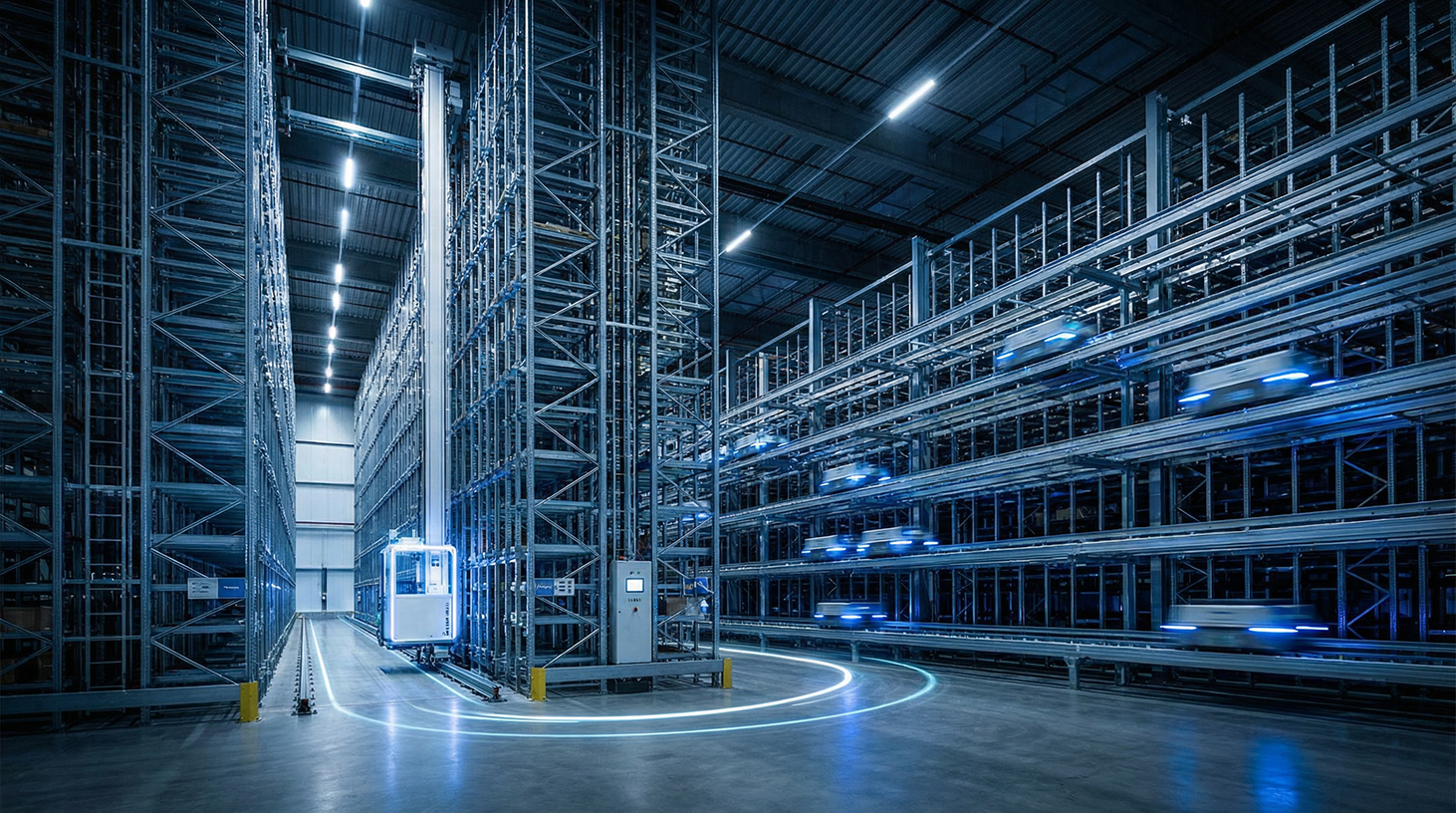
Shuttle or RBG? Why this system question is wrong in logistics today – Image: Xpert.Digital
Shuttle or RBG? Why this system question is wrong in logistics today
The cost trap in warehouse construction: Why pure shuttle systems are often too expensive
Intralogistics is facing a technological and economic paradigm shift. For years, a seemingly simple system question shaped the planning of automated warehouses: Should one rely on the high-frequency dynamics of a shuttle system or on the powerful vertical mobility of classic storage and retrieval machines (SRMs)? However, driven by the e-commerce boom, volatile product ranges, and the relentless demand for maximum flexibility, this traditional black-and-white thinking is no longer sufficient. Neither the shuttle nor the SRM can meet the complex requirements of modern supply chains as a monolithic, standalone solution without encountering physical or economic limitations. The solution lies in convergence: hybrid warehouse architectures that seamlessly combine the strengths of both worlds – intelligently networked through AI-supported software and digital twins – in a single system. This article explores why hybrid systems are not merely a compromise but the new economic standard, how innovative concepts are breaking down system boundaries, and why a purely purchase-price-based approach inevitably leads companies into the TCO trap.
Between camp dogma and market pressure: Why the system question needs to be re-examined
Anyone who believes that choosing between a shuttle system and a storage and retrieval machine (SRM) is a standard technical task with clear-cut answers fundamentally underestimates the complexity of modern warehouse planning. Practice paints a different picture: Many operators of automated warehouses face the problem that their system decisions made ten or fifteen years ago are now reaching the limits of their adaptability. The demand for flexibility, driven by the e-commerce boom, volatile product ranges, and shortened delivery cycles, has profoundly changed the traditional shuttle versus SRM debate. Increasingly, the most economically sensible answer is no longer "shuttle or SRM," but rather: both – in an integrated system architecture that strategically combines the strengths of both technologies.
This shift in thinking is neither a coincidence nor a short-term trend. It reflects a fundamental change in the requirements that logistics operators must meet today. A food retailer with 40,000 items, supplying brick-and-mortar stores and a growing online business daily, simultaneously needs the load-bearing capacity and storage density of a classic high-bay warehouse for heavy pallets and the high-speed dynamics of a shuttle system for small, fast-moving items. No single monolithic system concept can resolve this tension alone.
Why black-and-white thinking fails when comparing systems
To understand the superiority of hybrid approaches, a sober look at the limitations of each individual technology is necessary. Shuttle systems are virtually unsurpassed in their core competency – the high-frequency storage and retrieval of light to medium-weight load units up to approximately 1.5 tons. Their decentralized vehicle architecture creates natural redundancy: If a single shuttle fails, the remaining vehicles seamlessly take over its tasks, and operations continue. For e-commerce fulfillment centers that require thousands of picks per hour from a small-scale assortment, shuttle systems are the economically viable benchmark solution.
However, these systems reach their structural limits at greater building heights. Above approximately 30 meters, the requirements for the racking structure and, in particular, for the lifting mechanisms of the vertical conveyors become so complex and costly that the economic advantage over the stacker crane begins to erode. Shuttle systems are also designed for higher acquisition costs per storage location because a large number of active components – shuttle vehicles, separate lifts, infrastructure rails, and sophisticated control software – must be procured and operated simultaneously. The cumulative maintenance costs for this fleet of active vehicles can be considerable in large systems.
Storage and retrieval machines (SRMs), on the other hand, are the technologically advanced solution for heavy loads, high ceilings, and long-term stable storage processes with low product range volatility. An SRM can handle loads of up to 7.5 tons or more in special configurations – making shuttle systems simply uncompetitive. In conventional high-bay warehouses with heights of 30 to 45 meters or more, the SRM maximizes capacity on a minimal footprint and offers comparatively low maintenance costs, as only a single unit needs to be operated per aisle. However, if throughput requirements increase or the product range changes rapidly and significantly, the SRM reaches its inherent limitations.
When strengths complement each other: The business logic of hybrid systems
The hybrid strategy is not a compromise solution, but rather a targeted, modular approach: For each product category and throughput requirement, the technologically and economically superior principle is employed. Such a hybrid warehouse is typically divided into two functional zones. In the stacker crane area, palletized heavy goods, seasonal items, or slow-moving goods are stored in high-bay racking zones that utilize heights of 30 meters and more. In the shuttle area, on the other hand, the small-item, fast-moving goods assortment with high picking volumes rotates in lower, modularly expandable racking blocks. Both zones are coordinated by a higher-level warehouse management system that controls material flows, capacity utilization, and prioritization in real time.
The economic advantages of this differentiation are considerable. Companies that previously operated a purely automated storage and retrieval system (AS/RS) for their entire product range often struggled with the bottleneck of aisle-bound access frequency for fast-moving items – a structural problem that cannot be solved by mere optimization within the technology. Conversely, pure shuttle systems fail in scenarios with heavy load units and extreme heights due to physical and economic limitations. The hybrid solution avoids both cost traps simultaneously and optimizes the total cost of ownership (TCO) over the entire system lifecycle, which typically lasts 15 to 25 years.
The satellite storage facility as a bridge between the different system worlds
A particularly elegant technological answer to the hybrid challenge is provided by Westfalia Technologies' patented satellite storage system, which celebrated its 40th anniversary in 2023. This system represents, in a sense, the complete fusion of both systems: Conventional stacker cranes are equipped with a small, channel-traveling shuttle vehicle – the so-called satellite – which detaches from the stacker crane and autonomously navigates multi-deep storage channels. The stacker crane handles positioning in front of the target channel and vertical transport, while the satellite autonomously performs the high-density, multi-deep storage and retrieval within the channel.
The result is technically and economically remarkable: The satellite storage system combines the load-bearing capacity and height capability of a classic stacker crane – loads well over 1.5 tons, system heights of 45 meters and more – with the space-optimizing multi-deep storage otherwise reserved for shuttle systems. Storage density increases dramatically because no aisles need to be kept clear between storage blocks. This makes the system particularly attractive for production warehouses, food manufacturers, and the beverage industry, where heavy load units are stored in large quantities and maximum storage density is required on a limited footprint. A current example is the Emsland Group, which plans to commission a new automated high-bay warehouse based on the Westfalia satellite system for its starch products in Emlichheim by mid-2026. Technologically, this system can thus be classified as belonging to both the stacker crane and multi-level shuttle families – the boundaries between the system families are fluid, and such innovations are making the classification itself increasingly obsolete.
LTW Intralogistics Solutions

LTW Intralogistics – Engineers of Flow - Image: LTW Intralogistics GmbH
LTW offers its customers not individual components, but integrated complete solutions. Consulting, planning, mechanical and electrotechnical components, control and automation technology, as well as software and service – everything is networked and precisely coordinated.
In-house production of key components is particularly advantageous. This allows for optimal control of quality, supply chains, and interfaces.
LTW stands for reliability, transparency, and collaborative partnership. Loyalty and honesty are firmly anchored in the company's philosophy – a handshake still means something here.
Related to this:
Hybrid warehouse purchasing decision: Economic efficiency, location and total cost of ownership
Market concentration and systemic competence: Who is shaping convergence?
The convergence of technologies is not happening in a vacuum, but is being actively driven by the major providers of intralogistics automation. The KION Group – with Dematic, acquired in 2016, as its central automation arm – is now one of the few companies worldwide that offers both advanced shuttle systems and stacker crane-based high-bay warehouses as integrated, turnkey solutions from a single source. The acquisition of Dematic – then valued at US$3.25 billion – was strategically aligned precisely with this goal: the ability to serve customers with a complete solution, regardless of their specific system requirements. The KION Group now presents not only pallet shuttles, but also AutoStore systems and autonomous mobile robots (AMRs) as part of its Flexible Automation portfolio, signaling the direction of the future: towards modular, combinable automation systems.
The same applies to SSI Schäfer, Swisslog, Vanderlande, and Jungheinrich, which also rely on integrated complete systems. KNAPP from Austria recorded sales of around €1.98 billion in the 2024/25 financial year – an increase of approximately 10 percent compared to the previous year and the best result in the company's history. This underscores the strong current demand for integrated automation solutions that transcend traditional system boundaries. Daifuku from Japan, one of the world's largest players with sales of around US$3 billion, presented a pallet stacker crane at LogiMAT that can be operated together with a shuttle rack in a single aisle – another example of the technological convergence now becoming visible at the product level.
The competition between shuttle and RBG systems is therefore also a competition among system integrators to develop and market the most compelling hybrid architectures. The ability to not only offer both technology lines in their portfolio but also to combine them into a coherent overall system is becoming a key differentiator in the fiercely competitive intralogistics market.
A market in expansion mode: figures, drivers and forecasts
The global market for intralogistics automation solutions is experiencing exceptionally strong expansion. Various market research institutes arrive at different absolute size estimates – depending on the definition of market segments – but agree on the direction of growth. While one analysis estimates the market at around US$48 billion in 2024 and projects it to grow to nearly US$87 billion by 2035, other institutes forecast significantly more aggressive growth rates of up to 25 percent per year for certain sub-segments. The European market for intralogistics automation alone is expected to reach a volume of approximately €6.9 billion by 2026. The growth driver has been clearly identified: e-commerce expansion, an increasing shortage of skilled workers in warehousing, rising demands for delivery precision and speed, and the growing pressure to reduce costs in the supply chain are making automation investments profitable for a growing number of companies.
The technological maturity of hybrid systems is arriving at precisely the right time. Companies investing in warehouse automation today are no longer demanding individual products, but rather complete solutions that scale with their business. The market environment is thus rewarding precisely those providers and system architectures that combine flexibility, modularity, and technological convergence.
Digitalization as an enabler: When software dissolves system boundaries
An often underestimated aspect of hybrid warehouse architectures is the role of software. Only a high-performance Warehouse Management System (WMS) and a higher-level material flow computer make it possible to operate stacker crane zones and shuttle zones within a single warehouse coherently. The software must synchronize item master data, current inventory levels, order priorities, and system capacities in real time and determine the optimal system route for each putaway and retrieval order.
Two reinforcing trends come into play here: the digital twin and artificial intelligence. Digital twins make it possible to model the entire hybrid warehouse as a virtual representation and simulate operational scenarios without risk – expansions, peak loads, and outages. Companies like PSI Software already offer WMS systems with an integrated AI layer and digital twin that runs thousands of operational scenarios in real time, thus continuously optimizing the control of the physical system. In a hybrid warehouse that coordinates two fundamentally different system environments, this software intelligence is not a luxury, but an operational necessity. System convergence at the hardware level requires corresponding software intelligence at the control level – and thus simultaneously drives the digitalization of the entire intralogistics industry.
Decision logic for companies: What hybrid system selection requires
The decision to implement a hybrid warehouse architecture is not a standardized purchasing decision, but a strategic choice with long-term consequences. It first requires a detailed assortment analysis: Which product groups account for what percentage of the throughput, how heavy are they, and what is their turnover rate? Only on the basis of this data can it be meaningfully determined what proportion of the assortment belongs in an automated storage and retrieval system (AS/RS) zone and what proportion belongs in a shuttle zone.
Equally crucial is site analysis. Existing buildings with limited ceiling heights or irregular floor plans favor shuttle systems due to their greater adaptability to architectural constraints. New buildings, on the other hand, can be designed from the outset for the optimal combination of building height, floor plan, and system architecture. The economic analysis must be based on a total cost of ownership (TCO) that includes not only acquisition costs but also energy, maintenance, personnel costs, and capacity reserves over a system lifespan of 15 to 25 years. Those who only compare the purchase price generally make the wrong decision.
System convergence as the industrial norm
Hybrid intralogistics solutions are no longer niche programs for special cases, but are evolving into the new standard for complex warehousing requirements. The technological convergence between shuttles and automated guided vehicles (AGVs) – evident in products like the Westfalia satellite system or the Daifuku Shuttle-Rack-RGV – demonstrates that traditional system boundaries are being dissolved not only in hybrid plant concepts, but also at the component level. Leading intralogistics providers have not only recognized this development, but are actively shaping it through portfolio expansions, acquisitions, and product innovations.
For companies investing in warehouse automation today, this means: The question shouldn't be which of the two systems to choose, but rather which combination, system architecture, and software intelligence will best support their processes over the next two decades. The market has already provided the answer. Practical application is following suit.
Consulting - Planning - Implementation

Konrad Wolfenstein
I would be happy to serve as your personal advisor.
contact me at wolfenstein ∂ xpert.digital
Just call me on +49 7348 4088 965 .
Your intralogistics experts
Consulting, planning and implementation of complete solutions for high-bay warehouses and automated storage systems - Image: Xpert.Digital
More information here:










