

Secure cold chains and reduced CO₂ emissions: How AI and robotics are improving fresh food logistics
Xpert Pre-Release

Available in 27 languages 📢
Prefer Xpert.Digital on GoogleⓘPublished on: July 3, 2026 / Updated on: July 3, 2026 – Author: Konrad Wolfenstein
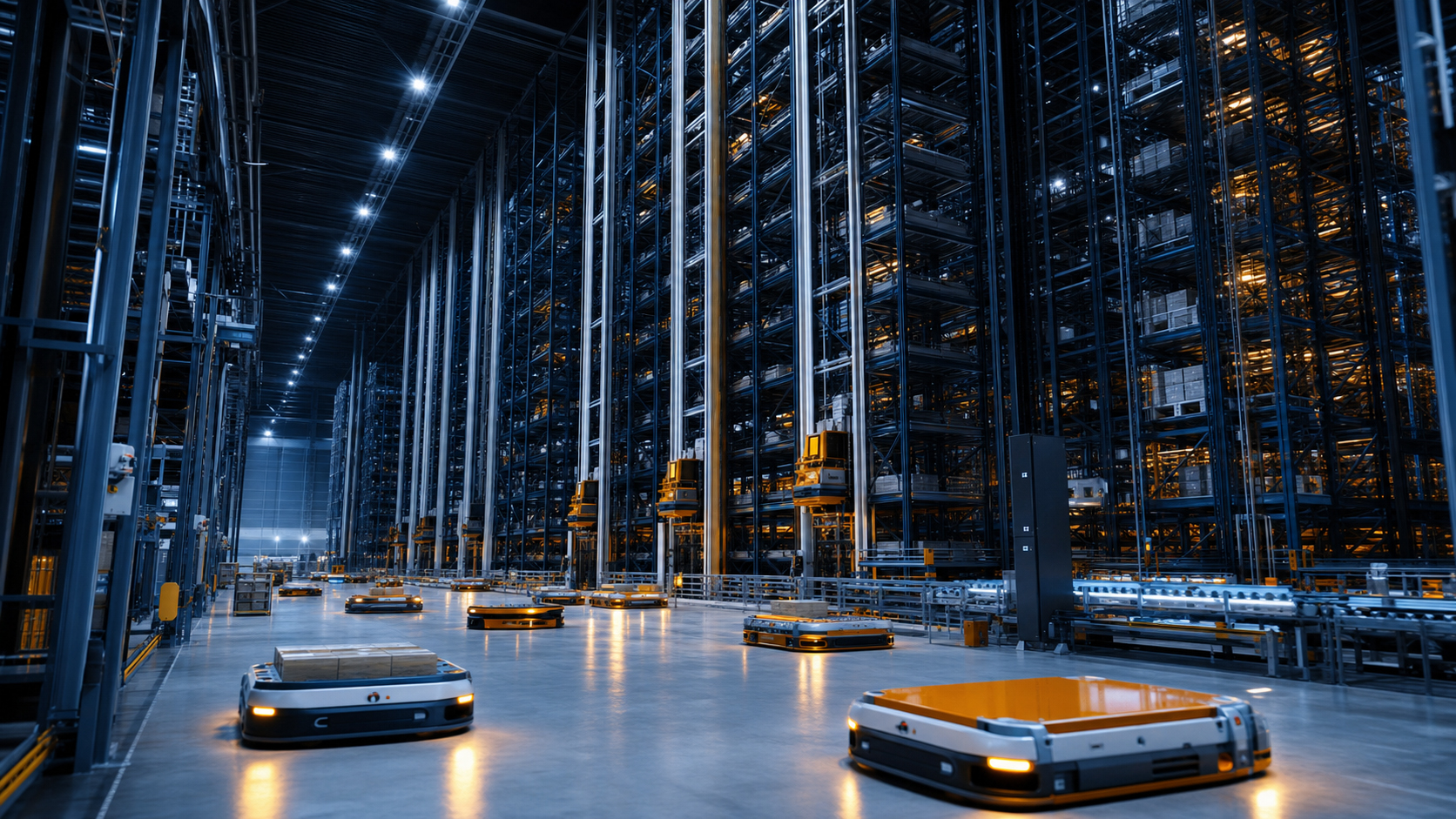
Secure cold chains and reduced CO₂ emissions: How AI and robotics are improving fresh food logistics – Image: Xpert.Digital
Investing in cold storage: When automated deep-freeze warehouses really pay off
Too cold for humans? How intelligent systems form the backbone of food logistics
In modern intralogistics, temperature-controlled storage is considered the ultimate challenge – and simultaneously one of the biggest cost drivers. While automation already achieves considerable efficiency gains in conventional environments, it unfolds its true strategic potential in the cold chain. At temperatures as low as minus 25 degrees Celsius, human workers reach their physical limits. At the same time, skyrocketing energy costs, a severe shortage of skilled workers, and extremely stringent quality assurance requirements are forcing companies to radically rethink their approach. Those who continue to rely solely on manual processes in frozen and fresh food logistics not only risk the health of their employees but also their economic competitiveness. The use of cold-resistant robots, intelligent high-bay warehouses, and AI-supported software not only provides the answer to pressing staffing issues but also drastically reduces energy consumption through space efficiency and minimized cold loss. Simultaneously, it guarantees the uninterrupted maintenance of the cold chain. The following analysis highlights why automation, especially in temperature-controlled environments, is no longer a luxury but an economic imperative, and how this technological transformation is fundamentally redefining intralogistics.
The silent revolution in the warehouse – automation as an economic imperative of intralogistics
Those who don't automate now will lose their market tomorrow
Logistics is often perceived by the public as the backbone of the economy – indispensable, but lacking in glamour. However, a fundamental structural transformation has taken place in recent years, the economic significance of which can hardly be overstated. Automated warehousing solutions, from fully automated high-bay warehouses and intelligent small parts storage systems to flexible palletizing robots and autonomous mobile robots, have become strategic capital goods. Companies that miss this transition not only risk falling behind in efficiency but also jeopardize their competitiveness. This analysis examines the economic drivers, technological architectures, economic considerations, and future prospects of warehouse automation in ambient and cold chain environments.
Market dynamics: A sector undergoing structural change
The global market for intralogistics automation solutions was valued at approximately US$48.21 billion in 2024 and is projected to grow to nearly US$86.72 billion by 2035, representing a compound annual growth rate (CAGR) of 5.48 percent. Other market observers, encompassing a broader intralogistics market, project even more dynamic growth: from US$63.16 billion in 2026 to US$140.73 billion by 2034, corresponding to a CAGR of 10.4 percent. The range of estimates reflects differing market definitions, but the trend itself is undeniable.
The situation on the continent is particularly relevant for the European economic area: The European market for intralogistics automation is projected to experience a CAGR of approximately 11.60 percent between 2024 and 2029, significantly exceeding the global average. Market volume in Europe is estimated at US$7.72 billion in 2026, with growth expected to reach US$12.89 billion by 2031. Dominant players in this segment include companies such as Jungheinrich, SSI Schäfer, KION Group, Swisslog, Dematic, and Vanderlande – all companies with strong European roots, which characterizes the continent not only as a sales market but also as the technological origin of this transformation.
What is driving this growth? The answer lies in a convergence of pressures that leave companies with little alternative. Skilled labor shortages, minimum wage increases, rising customer expectations regarding delivery speed and accuracy, and growing cost pressures from energy prices and real estate combine to create an environment in which manual warehousing processes are no longer economically viable.
The shortage of skilled workers as the strongest driver of automation
No single factor has accelerated the automation debate in logistics more than the persistent shortage of qualified and willing workers. Warehouse work is perceived by many as physically demanding, monotonous, and offering little career prospect. The willingness to fill these positions is declining structurally – and demographic change is further exacerbating the situation. The vast majority of order picking warehouses are still operated manually according to the person-to-goods principle, even though automation could significantly increase productivity. This discrepancy between technological possibility and operational reality highlights the untapped potential within the industry.
At the same time, personnel costs are rising continuously. Minimum wage increases in Germany and other European countries are hitting the logistics sector disproportionately hard, as it traditionally depends on the availability of cheaper labor. Every round of minimum wage increases the economic pressure to replace repetitive tasks through automation. The calculation is not trivial: A robot works around the clock, without sick days, vacation entitlement, or night shift bonuses. In periods of 24/7 operation, this feature amortizes particularly quickly.
Autonomous mobile robots can increase efficiency by 200 to 500 percent compared to manual processes, depending on the application and seamless integration. This figure sounds overwhelming, but upon closer examination, it becomes understandable: If a robot never loses its way, never goes down the wrong aisle, always prioritizes optimally, and never needs to rest, productivity gains of this magnitude arise compared to an average human employee in a poorly organized warehouse. Humans are not necessarily replaced, but rather freed from physically demanding, monotonous tasks – and relegated to coordinating, monitoring, and problem-solving roles.
The high-bay warehouse: Space efficiency as an economic argument
High-bay warehouses (HBWs) are the most iconic symbol of modern intralogistics. Their architecture utilizes the vertical dimension of available space in a way that manual warehouses simply cannot. Automated high-bay systems, referred to in English-language technical literature as Automated Storage and Retrieval Systems (AS/RS), combine narrow aisles, great heights – often more than 30 meters – and computer-controlled storage and retrieval machines (SRMs) that perform storage and retrieval operations with high precision and speed.
The investment costs for a medium-sized, fully automated high-bay warehouse typically range between €5 and €20 million – depending on volume, throughput requirements, and level of integration. At first glance, such sums seem prohibitive, but considering the total cost of ownership (TCO) over the entire life cycle puts this into perspective considerably. A company that achieves the same capacity on a 3,000-square-meter site with an automated high-bay warehouse – capacity that would require 9,000 square meters in a manual warehouse – not only saves on land costs but also proportionally reduces energy costs for heating, lighting, and air conditioning.
The energy-saving aspect is often underestimated. In an automated high-bay warehouse, there's no need for generously sized aisles that people have to navigate. The aisles are optimized for the dimensions of the storage and retrieval machines, the lighting can be dimmed or switched off when no machine is in use, and the braking energy of the machines is increasingly designed to be regenerative. The bilstein group logistics center in Gelsenkirchen, for example, can save up to 1,500 tons of CO₂ per year and reduce its footprint by around 75 percent thanks to its automated warehouse operation, compared to a manual warehouse of the same capacity. This isn't a minor point – it's a substantial economic and environmental advantage.
Automated small parts warehouse: The precision tools of intralogistics
While high-bay warehouses are the most impressive examples of warehouse automation in terms of volume, automated small parts warehouses (AS/RS) play an equally critical operational role in many industries. AS/RS are specialized systems for the efficient storage and picking of small goods in containers, boxes, or on trays, typically weighing up to 50 kilograms – and in some high-performance systems, up to 450 kilograms.
At its core, an automated small parts warehouse (AS/RS) follows the "goods-to-person" principle: Instead of warehouse employees covering long distances through the warehouse, the system delivers the required items directly to an ergonomically designed workstation. This topological reversal of traditional warehouse work has far-reaching consequences. Travel time, which in manual picking warehouses can account for up to 50 or 60 percent of total working time, is almost completely eliminated. The remaining working time is then concentrated on value-adding activities – picking, checking, and packing the items.
The cost of an automated small parts warehouse (AS/RS) storage location varies considerably depending on the technology. Systems with conventional stacker cranes cost around ten euros per location, while more efficient shuttle solutions with integrated rails cost an average of around 20 euros per location. These seemingly small sums accumulate into significant investments in warehouses with hundreds of thousands of storage locations. Nevertheless, the resulting space efficiency and process speed justify the investment in most scenarios: High throughput around the clock, optimal space utilization through vertical storage design, near-complete automation of storage and retrieval, and seamless, real-time inventory transparency ensured by warehouse management software are the key value drivers.
The limitations of automated small parts warehouses (AS/RS) lie in their specific nature: the standardization of storage containers restricts the product groups that can be integrated. Irregular, bulky, or particularly heavy items cannot be easily fitted into an existing AS/RS. Furthermore, AS/RS require significant upfront investments in construction and precise planning of future load profiles – errors in dimensioning are extremely difficult to correct after commissioning. For companies with volatile demand or frequently changing product ranges that exceed the capabilities of standard container geometry, the question of cost-effectiveness therefore remains a crucial planning parameter.
Pallet warehouses in transition: When the backbone of logistics becomes intelligent
While small parts warehouses and high-bay racking systems are tailored to specific product groups, pallet warehouses form the volumetric backbone of physical logistics. Here, the heavy, bulky goods that constitute the actual substance of the flow of goods are stored – raw materials, semi-finished products, and packaged consumer goods in large units. The automation transformation in pallet warehouses is in full swing and is fundamentally changing the economics of this seemingly simple infrastructure.
Automated pallet warehouses primarily rely on two system architectures: stacker cranes in narrow aisles and automated shuttle systems that operate on rails within the racking structure. Stacker cranes are a proven technology with high reliability and long operating times; they are particularly suitable for warehouses with high ceilings and medium to high throughput. Shuttle systems, on the other hand, enable a significantly higher load density because they can use multiple independent units per aisle, which exponentially increases throughput – albeit at the cost of higher investment costs and greater system complexity.
What makes the economic analysis for pallet warehouses particularly interesting is the aspect of space productivity in an urban context. With rising land prices in metropolitan areas and increasingly stringent regulatory requirements for logistics properties, the ability to create more capacity on a smaller footprint is gaining strategic importance. Automated compact pallet warehouses can increase storage density by a factor of three to five compared to conventional block storage – a value that translates directly into rent savings or the avoidance of new construction projects.
The cold chain as a special challenge and a special opportunity
Automation in temperature-controlled environments deserves special consideration, as it offers benefits on several levels simultaneously: economic, quality assurance, and humane in terms of occupational safety. Deep-freeze logistics at temperatures of -18 to -25 degrees Celsius is extremely physically demanding for human employees and, despite protective clothing and regulated rotation times, can cause long-term health problems. Automated systems, on the other hand, operate without limitations in these temperature ranges – provided the hardware used is designed accordingly.
The technical requirements for systems in deep-freeze environments are considerable. Cold-resistant batteries, heated displays, and fully encapsulated electronics are minimum requirements for any component that operates continuously at such temperatures. Storage and retrieval machines for deep-freeze warehouses must be made of materials that retain their dimensional stability and precision during temperature fluctuations—for example, when entering from an ambient temperature range. The investment costs for cold-temperature-compatible automation technology exceed those for normal-temperature applications, but the specific advantages usually more than justify these additional costs.
Automated systems reduce the opening and closing of cold storage doors, thus preventing heat build-up and ensuring the cold chain is maintained more reliably than manual processes. Every door opened by an employee allows warm air to enter, increasing the energy consumption of the refrigeration units. Automated warehouses with airlock systems and highly optimized material flows minimize this effect. Furthermore, the smaller footprint of automated systems directly correlates with the cooling volume: less volume to be cooled means significantly less energy consumption. Swisslog, a leading provider of cold storage technology, emphasizes that automated systems, with their smaller footprint and higher storage density, drastically reduce the need for walls and volume, thus considerably lowering energy consumption. In times of rising energy prices, this is a compelling business argument.

Expert partner in warehouse planning and construction
AMR vs. high-bay warehouse: When do mobile fleets really pay off?
Mobile robots: Flexibility as the new core virtue of intralogistics
Alongside stationary, permanently installed automation systems such as high-bay warehouses and automated small parts warehouses (AS/RS), a new class of technologies has come to the fore: autonomous mobile robots, or AMRs for short. These systems differ fundamentally from their stationary counterparts in their flexibility and adaptability. They are not bound to fixed infrastructures, can dynamically adjust their routes, and support hybrid workflows in which humans and machines coexist.
A modern AMR knows its current task, knows where the required goods are located in the warehouse, moves autonomously through the storage area, retrieves containers from their storage locations and brings them to the picking station – or, in the goods-to-person concept, the shelf with the pre-sorted contents leads directly to the picking station. The intelligent sequencing of these movements, optimized by AI-supported route planning in real time, enables a fleet of robots to achieve a throughput comparable to or exceeding that of a significantly larger workforce of manual employees.
The decisive economic advantage of AMRs lies in their scalability and adaptability. While a high-bay warehouse or automated small parts warehouse (AS/RS) represents a long-term, fixed infrastructure designed for specific product groups and throughput scenarios, AMR fleets can be flexibly expanded, reduced in size, or reconfigured for other tasks. This feature makes them particularly attractive for companies with seasonal peaks or changing product ranges, as well as for brownfield integration into existing warehouses that do not allow for a complete infrastructure restructuring. Unlike stationary conveyor technology, mobile robots can serve as temporary storage locations or prepare tasks for subsequent process steps during transport, such as pre-sorting or order picking preparation.
The research community is intensively investigating the optimal deployment strategy for these systems. In the "roboKOM" research project at TU Darmstadt, potential applications of mobile order picking robots are systematically analyzed and compared with established order picking systems. The results are intended to enable warehouse operators to assess, based on their specific data, whether the use of mobile robots is economically advantageous. This practice-oriented research underscores that there is no one-size-fits-all answer – profitability depends on throughput, product range structure, warehouse geometry, and the specific cost drivers of the respective company.
Profitability and ROI: What the numbers really say
The question of return on investment is the central test for every automation decision. And here lies a common pitfall in the analysis: Many companies only consider the direct investment costs and compare them to the personnel cost savings. This simplified view falls short.
A complete ROI calculation must consider both quantitative and qualitative factors. On the cost side, this includes capital expenditures (CAPEX), ongoing operating costs for energy and maintenance, software license fees, and costs for training and change management. On the revenue side, it includes savings in personnel costs, reduced error rates and associated cost avoidance (returns, rework, quality defects), gains in space efficiency, increased throughput and delivery reliability, and strategic competitive positioning. The typical amortization period for warehouse automation projects ranges from three to seven years, depending on the system and framework conditions. For AMR solutions with lower CAPEX, the break-even point can be reached sooner; for fully automated high-bay warehouses with high initial investment volumes, amortization takes correspondingly longer, but this is compensated for by significantly longer operating times of the systems.
A key, often underestimated value driver is error reduction. In manual order picking processes, the error rate ranges from 0.5 to 3 percent of picked items, depending on the source. Automated systems achieve error rates below 0.1 percent. Zalando, for example, uses AI-powered picking robots with computer vision that achieve a picking accuracy of over 99 percent. Every error avoided means fewer returns, less rework, and—particularly relevant in the B2C context—less customer loss due to negative experiences. According to a McKinsey report, AI-powered warehouse solutions have improved picking accuracy by up to 30 percent and reduced operating costs by up to 20 percent.
Software architecture: The invisible heart of automation
An automated warehouse is only ever as good physically as the software that controls it. Warehouse Management Systems (WMS) and Warehouse Execution Systems (WES) are the digital brains that orchestrate putaway, order picking, inventory management, resource planning, and system integration. Without powerful software, even the most modern mechanical systems degenerate into expensive, suboptimally utilized investments.
The Fraunhofer WMS Market Report Compact 2024 shows that one-third of all warehouse management systems now use AI support. This share is growing rapidly, driven by three identified key trends: predictive analytics, deep learning, and digital security. Predictive analytics makes it possible to forecast demand, dynamically allocate storage locations, and optimize picking routes before an order is even triggered. Deep learning improves pattern recognition in complex datasets and makes systems better over time—a feature that static, rule-based systems fundamentally cannot possess.
In 2026, five key AI trends are emerging in logistics: AI as a co-pilot in WMS and WES, swarm intelligence for AMR fleets, computer vision for zero-touch quality control, AI-supported forecasting with digital twins, and AI-supported sustainability management. The integration of digital twins—real-time virtual representations of the physical warehouse—is particularly important, as it allows scenarios to be simulated before decisions are implemented in actual operations. Bottlenecks are identified before they occur; resources are proactively reallocated rather than reactively corrected. PSIwms AI, which received the Best Product Award at LogiMAT 2025, analyzes thousands of possible warehouse operating scenarios every hour and generates concrete optimization recommendations—an example of how AI transforms the manual optimization efforts of experts into automated, continuous processes.
Sustainability: Automation as a lever for ESG strategy
Warehouses are not a minor factor in the environmental impact assessment. The logistics sector as a whole is responsible for 7 to 11 percent of global greenhouse gas emissions, with warehousing alone contributing approximately 11 percent of this figure. Given the increasing regulatory requirements due to ESG reporting obligations, which are increasingly extending to medium-sized companies as well, sustainability is evolving from a voluntary ambition into a mandatory requirement.
Automation makes a substantial contribution in this context. The introduction of sustainable automation technologies can help warehouses reduce their CO₂ emissions by up to 30 percent. The Addverb Sustainability Report indicates that automation can reduce energy consumption by up to 25 percent. These savings result from several mechanisms: reduced lighting requirements in unmanned automated areas, the use of regenerative braking from storage and retrieval machines, smaller volumes of space requiring heating or cooling, and optimized routes that minimize empty runs.
Modern energy management in logistics properties combines large-scale photovoltaic systems, fossil-free heating and cooling concepts with heat pumps, and intelligent monitoring via smart meters. Linked to AI-supported load optimization, which avoids energy peaks and anticipates consumption patterns throughout the day and year, logistics sites are created that operate not only economically but also ecologically at the cutting edge. This is not altruism – it is a response to market realities: ESG-compliant supply chains are increasingly used by business customers as a selection criterion, and financing costs for sustainable projects are systematically lower than those for conventional investments in a low-interest-rate environment.
Hybrid architectures: No system fits all
One of the key insights of modern intralogistics is that there is no universally superior automation system. High-bay warehouses, automated small parts warehouses (AS/RS), palletizing systems, and automated guided vehicles (AGVs) are not alternatives to each other, but rather complementary modules that must be combined into a customized logistics system depending on the product structure, throughput, building geometry, and investment budget.
The hybrid integration of different system types is the rule, not the exception. A modern distribution center typically combines a fully automated AS/RS for fast-moving small parts, an automated pallet warehouse for the core product range, an AMR fleet for flexible sorting processes and dynamic picking tasks, and manual or semi-automated areas for bulky, irregularly shaped goods. The control logic that coordinates these subsystems resides in the WES – a system that prioritizes orders in real time, allocates resources, and optimizes material flow across all system boundaries.
Mobile robots offer a unique strategic option for companies that want or need to automate gradually: They can be integrated into existing brownfield warehouses without fundamentally altering the building infrastructure. Unlike a high-bay warehouse, which necessarily requires a specific building geometry, AMRs can be deployed in existing storage areas – with manageable initial costs and the possibility of gradually expanding the fleet as automation needs increase. This modular approach significantly lowers the barrier to entry for automation and makes it a realistic option even for medium-sized businesses.
Investment decision: When automation pays off
The crucial question that logistics managers and CEOs ask is not "whether," but when and in what form automation makes economic sense. There are clear operational indicators that point to a favorable automation approach: a high order volume with many items per order, a product range with manageable variance in dimensions, recurring and predictable processes, a high proportion of repetitive picking tasks, limited space coupled with increasing storage volume, and a structural shortage of personnel in the region.
Conversely, there are scenarios where automation would be economically unwise: very small warehouse complexes with low throughput, an extremely heterogeneous product range with constantly changing product dimensions, and companies undergoing fundamental business model changes where their warehousing strategy is not yet stable. In these cases, the capital costs and rigidity risk outweigh the achievable efficiency gains. Assessing this threshold is a strategic management task that requires careful scenario analysis and depends on a precise understanding of the company's own logistics cost drivers.
The window of opportunity
The automation of intralogistics is not a temporary hype, but a structural change driven by the convergence of demographic, economic, technological, and regulatory forces. The market is growing dynamically, technologies are maturing rapidly, and entry costs are falling due to scalable production and increasing competition among suppliers.
This presents companies with a strategic timing problem: those who invest too early bear the brunt of the technology's teething problems; those who act too late lose market share to more efficiently operating competitors. The window in which a company can catch up in automation without incurring substantial competitive disadvantages is not unlimited. In highly consolidated markets such as the food retail or pharmaceutical industries, where leading companies have been investing in fully automated logistics centers for years, the technology is increasingly setting the operating cost base that the market considers the benchmark.
The question is therefore no longer whether automated high-bay warehouses, small parts storage facilities, pallet systems, and mobile robots will become the standard in intralogistics. That question has already been answered. The crucial question is: With what strategy, with what technological portfolio, and within what timeframe will a company position itself in this transformation – proactively as a shaper of the future or reactively as a follower? The answer to this has far-reaching consequences for competitiveness in the next decade.
Your intralogistics experts

Consulting, planning and implementation of complete solutions for high-bay warehouses and automated storage systems - Image: Xpert.Digital
More information here:
Your global marketing and business development partner
☑️ Our business language is English or German
☑️ NEW: Correspondence in your native language!

Konrad Wolfenstein
I and my team are happy to be available to you as your personal advisor.
You can contact me by filling out the contact form here [email protected]:or simply call me at +49 7348 4088 965. My email address is
I'm looking forward to our joint project.
☑️ SME support in strategy, consulting, planning and implementation
☑️ Creation or realignment of the digital strategy and digitization
☑️ Expansion and optimization of international sales processes
☑️ Global & Digital B2B trading platforms
☑️ Pioneer Business Development / Marketing / PR / Trade Fairs
Our global industry and economic expertise in business development, sales and marketing

Our global industry and economic expertise in business development, sales and marketing - Image: Xpert.Digital
Industry focus areas: B2B, digitalization (from AI to XR), mechanical engineering, logistics, renewable energies and industry
More information here:
A thematic hub offering insights and expertise:
- Knowledge platform covering global and regional economies, innovation and industry-specific trends
- A collection of analyses, insights, and background information from our key areas of focus
- A place for expertise and information on current developments in business and technology
- A hub for companies seeking information on markets, digitalization, and industry innovations










