

Record-breaking solar park in Schafhöfen, Bavaria: 370,000 modules, 268 megawatts, and the secret beneficiary, Deutsche Bahn

Available in 27 languages 📢
Prefer Xpert.Digital on GoogleⓘPublished on: September 7, 2026 / Updated on: September 7, 2026 – Author: Konrad Wolfenstein
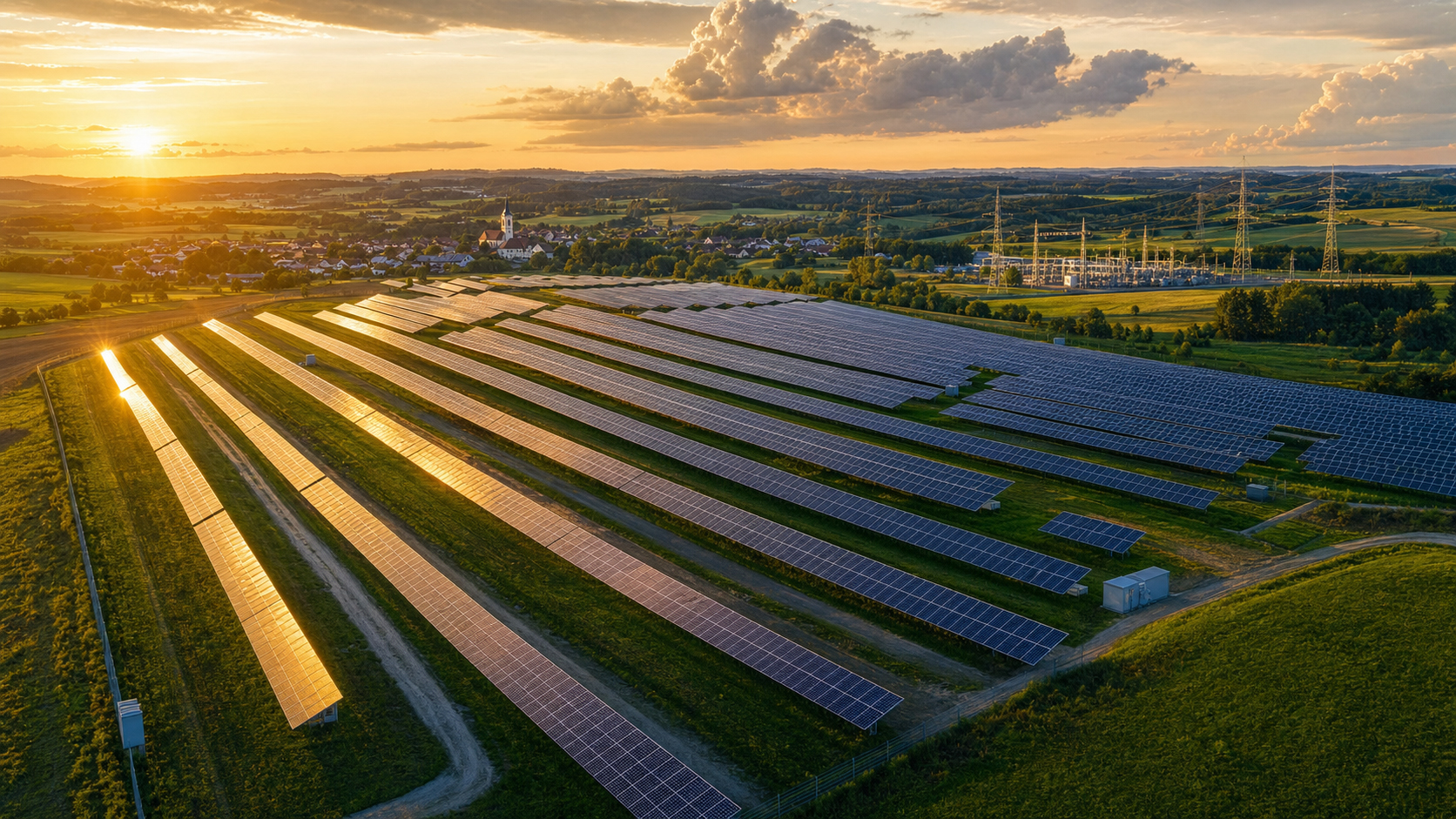
Record-breaking solar park in Schafhöfen, Bavaria: 370,000 modules, 268 megawatts, and the secret beneficiary Deutsche Bahn – creative image on the topic, created with AI: Xpert.Digital
268 megawatts, but no storage? A billion-dollar deal without state aid: How this field in Bavaria is transforming the German electricity market
The new face of the energy transition: Why a Bavarian village is now making electricity history
The Schafhöfen solar park in Mötzing, Bavaria, is an infrastructure project of superlatives: With almost 370,000 modules and a peak output of 268 megawatts, it is one of Germany's largest ground-mounted solar power plants. But anyone who sees this multi-billion-euro project merely as another milestone in climate protection is overlooking its true significance. Its construction marks a radical shift in the German electricity market of the late 2020s. Where government subsidies once formed the foundation of the energy transition, negative electricity prices, the struggle for battery storage capacity, and powerful major consumers like Deutsche Bahn now dictate the rules of the game. Schafhöfen demonstrates, in a stark and unflinching way, that the sheer number of new solar installations is no longer enough. Anyone who wants to invest successfully in renewable energies today must completely rethink the market and make enormous financial compromises.
Why Bavarian farmland is becoming a symbol of Germany's energy transition
When nearly 370,000 solar modules are installed on an area of approximately 200 hectares in the Schafhöfen district of Mötzing, Bavaria, it's not just another renewable energy construction project, but a prime example of how the German electricity sector is reorganizing itself in the second half of the 2020s. The Schafhöfen solar park, being built by the EPC contractor Goldbeck Solar for the investor Blue Elephant Energy, will reach a peak output of 268 megawatts, making it one of the largest ground-mounted solar power plants ever built in Germany. Groundbreaking took place on May 21, 2026, and commissioning is scheduled for September 2027. At first glance, this project tells a success story of technological progress and climate protection. However, closer examination reveals the deep structural contradictions of an electricity market that is changing rapidly without the corresponding regulations and grids keeping pace.
The sheer scale of the project warrants some sobering perspective. With a planned annual electricity generation of approximately 296,000 megawatt-hours, the plant could theoretically supply around 147,000 households and save about 200,000 tons of carbon dioxide per year. For comparison, Germany's largest existing solar power plant, a ground-mounted park in Böhlen, Saxony, has a capacity of approximately 162 megawatts. Schafhöfen will therefore surpass this plant by more than half, thus placing it at the forefront of Germany's solar park landscape. It is also noteworthy that this project, together with the smaller, 53-megawatt Aulendorf solar park in Baden-Württemberg, is part of a joint investment initiative by Blue Elephant Energy, which is expected to deliver a total of over 300 gigawatt-hours of green electricity per year.
Who is pulling the strings behind the scenes and what interests are intertwined?
Behind the project is a network of specialized players, each playing a distinct economic role. Goldbeck Solar, based in Hirschberg an der Bergstraße, acts as the EPC partner, i.e., the general contractor, combining planning, procurement, and construction under one roof, and describes Schafhöfen as its largest solar project in Germany to date. The investor and client is Blue Elephant Energy GmbH, an international investment company founded in 2016 and headquartered in Hamburg, specializing in solar, wind power, and storage projects in eight countries, and currently boasting a contracted capacity of more than 2.3 gigawatts. The technical equipment is being supplied by the Chinese module manufacturer Trina Solar with its TSM-NEG21.C.20 module type and the German inverter manufacturer SMA with its MVPS 4400 series devices. The transmission system operator Bayernwerk is responsible for constructing the substation and connecting the system to the grid.
The real economic backing for this multi-billion-euro project, however, comes from an actor who, at first glance, has nothing to do with the energy sector: Deutsche Bahn. Through its subsidiary DB Energie, the state-owned company concluded two long-term power purchase agreements (PPAs) with Blue Elephant Energy in December 2025, totaling approximately 2.5 terawatt-hours of solar power, with a contract term of up to 13 years. The electricity generated in Schafhöfen is theoretically sufficient to power around 14 million ICE train kilometers annually, thus further increasing the share of renewable energy in the railway's power grid, which is already supplied by renewable sources to a degree of around 70 percent. This arrangement is highly attractive from an economic perspective: A long-term purchase agreement with a creditworthy, state-owned buyer like Deutsche Bahn significantly reduces the project's sales risk and, as the financing bank Commerzbank emphasizes, was the crucial foundation for the successful completion of the project financing in April 2026.
How external capital makes a major project possible in the first place
Financing a solar park of this size requires a three-figure million-euro sum, and Commerzbank acted as the sole lender, representing a remarkable concentration of credit risk at a single institution in the construction financing of infrastructure projects of this scale. Dorothee Klinkmann, CFO of Blue Elephant Energy, described the financing agreement as a significant milestone for the company and emphasized that the partnership with Commerzbank sends a clear signal in support of the energy transition. From a banking perspective, such financing is attractive only because the cash flow risk is largely calculable thanks to the long-term power purchase agreement with Deutsche Bahn. Without such protection, the project would be exposed to the full fluctuations of the electricity market, which would have significantly increased financing costs or made obtaining the loan more difficult overall.
This situation points to a fundamental shift in the financing logic of large-scale renewable energy projects in Germany. While in the early stages of the energy transition, the guaranteed feed-in tariff under the Renewable Energy Sources Act (EEG) was the central hedging instrument, the economic foundation is increasingly shifting to bilateral, company-specific power purchase agreements. For investors like Blue Elephant Energy, this means greater dependence on the negotiating power and creditworthiness of individual large customers, while for customers like Deutsche Bahn, it creates the opportunity to hedge against price fluctuations in the electricity market for decades and simultaneously credibly underpin their own corporate climate targets.
Why the statistics on photovoltaics in Germany show two faces
The Schafhöfen solar park is being built in a market environment that appears exceptionally dynamic at first glance. Installed photovoltaic capacity in Germany exceeded 128 gigawatts for the first time in August 2026, thus fulfilling the expansion target for that year set out in the Renewable Energy Sources Act well ahead of schedule. More than six million individual photovoltaic systems now feed electricity into the German grid. A striking structural shift is evident: In the first half of 2026, ground-mounted photovoltaics overtook rooftop installations in terms of net new capacity for the first time, demonstrating that large-scale projects like Schafhöfen are increasingly driving market growth, while the traditional rooftop segment is losing momentum.
Despite achieving the interim target, the German Solar Association (BSW) warns of a dangerous slowdown. To reach the 2030 target of 215 gigawatts of installed capacity, the annual expansion would have to almost double, as the first half of 2026 saw only about a third of the planned increase for the entire year, at just over 7.4 gigawatts. The association also criticizes the fact that the recent amendment to the Renewable Energy Sources Act (EEG) and the planned grid package could actually counteract the expansion target, as they weaken investment incentives instead of strengthening them. This contradiction between achieved milestones and structural obstacles is a major factor in the current debate surrounding German solar policy.
New: Patent from the USA – install solar parks up to 30% cheaper and 40% faster and easier – with explanatory videos!

New: Patent from the USA – Install solar parks up to 30% cheaper and 40% faster and easier – with explanatory videos! - Image: Xpert.Digital
The core of this technological advancement is the deliberate departure from conventional clamp mounting, which has been the standard for decades. The new, more time- and cost-effective mounting system addresses this with a fundamentally different, more intelligent concept. Instead of clamping the modules at specific points, they are inserted into a continuous, specially shaped support rail and held securely in place. This design ensures that all forces – whether static loads from snow or dynamic loads from wind – are distributed evenly across the entire length of the module frame.
More information here:
From subsidy model to market logic: How new rules are radically changing the solar industry
Why cheap solar power is increasingly becoming an economic boomerang
The real economic crux of the solar energy transition, however, lies not in the expansion figures, but in the pricing of electricity on the market itself. In the first half of 2026, negative day-ahead electricity prices were recorded for 291 hours. While this represents a decrease compared to the record year of 2025 with 573 hours for the entire year, it still stands at an increase of about a third compared to 2024. More remarkable than the frequency is the increasing magnitude of these price fluctuations: On May 1, 2026, the price fell to minus €499.99 per megawatt-hour, the lowest level since 2023. The electricity exchange reacted within four weeks by introducing a new price floor of minus €600 per megawatt-hour, effective May 29, 2026. These negative prices are concentrated almost exclusively during the sunniest midday hours, precisely the time windows in which photovoltaic systems like those at Schafhöfen achieve their highest feed-in capacity.
The legislative response to this phenomenon, the so-called Solar Peak Act, has been in effect since February 25, 2025, and has fundamentally changed the remuneration logic. Since then, new installations no longer receive feed-in tariffs or market premiums as soon as the market price turns negative for any quarter of an hour. This regulation now applies to installations with an installed capacity of two kilowatts or more, whereas previously a threshold of 400 kilowatts was decisive. As compensation, the twenty-year funding period is extended by the number of lost quarter-hours. However, for solar installations, only half of the lost time is credited, and this adjustment only occurs after the regular funding period has expired, so that a noticeable economic disadvantage remains in the present value analysis.
Why storage is becoming a matter of destiny for large solar parks
For a project like Schafhöfen, this regulation has a direct economic consequence: A solar park without battery storage inevitably sells its electricity precisely during the hours when prices are lowest or even negative, while generating no significant output during the more lucrative evening and morning hours. Significantly, available sources vary regarding whether Schafhöfen will actually be equipped with battery storage. While an early press release from Deutsche Bahn in December 2025 mentioned a parallel storage system intended to ensure efficient grid connection, later construction start and financing announcements from May and April 2026 make no mention of a storage system. This could indicate a possible change in the project plans or at least a later implementation phase.
This uncertainty is anything but a minor economic issue. Analysts in the energy storage sector now argue unequivocally that purely photovoltaic calculations without a discount for negative prices can no longer be considered reliable, because the structural decoupling of feed-in and sales time through storage has become the decisive economic differentiator for new solar parks. A solar park that can market its electricity at a later time when needed avoids zero feed-in during periods of negative prices and also benefits from the significantly higher price spreads that can occur throughout the day. In May 2026, these averaged around €208 per megawatt-hour, with a peak of almost €733 per megawatt-hour on a single day. Against this background, securing sheep farms via the long-term electricity supply contract with Deutsche Bahn appears to be a pragmatic, albeit not risk-free, way out of the dilemma of volatile spot market prices, since contractually fixed purchase quantities and prices partially decouple the project from the fluctuations of the free market.
How regional value creation and climate balance can actually be interpreted
Beyond the financial intricacies, the project also generates tangible regional and macroeconomic benefits. The construction of a solar park of this size involves local construction companies, logistics providers, and skilled workers in the Regensburg region throughout the entire construction phase, thereby creating temporary but economically significant employment opportunities. At the same time, the district benefits from lease payments and business taxes typically associated with such ground-mounted solar installations. The estimated annual savings of approximately 200,000 tons of carbon dioxide are roughly equivalent to the annual emissions of a medium-sized city and thus represent a quantitatively significant contribution to Germany's climate balance, although this figure must be put into perspective given that total national emissions remain in the hundreds of millions of tons.
Interestingly, slightly different sources provide varying figures regarding the magnitude of CO₂ savings. An analysis by Clean Energy Pipeline from April 2026 cites approximately 103,000 tons annually and a supply for around 100,000 households, while Goldbeck Solar itself calculates around 200,000 tons and 147,000 households. Such discrepancies are not uncommon in the industry, as different calculation methods are used for average household consumption and the national electricity mix. However, they also illustrate how imprecisely, in some cases, seemingly compelling key figures are used to communicate the societal impact of such projects.
Why Deutsche Bahn is becoming the secret kingmaker of the solar industry
A previously underestimated aspect of recent developments in the German solar market is the increasing role of large, state-owned companies as purchasers of renewable electricity through direct supply contracts. With its two contracts for Schafhöfen and Aulendorf, Deutsche Bahn has demonstrated its ability to act as a reliable anchor customer for project financing worth billions. Given the company's goal of making rail transport largely climate-neutral, this role is likely to become even more important in the coming years. For private project developers like Blue Elephant Energy, this opens up a sales channel that is significantly more stable than sales via the short-term spot market. However, this also results in a more competitive negotiating position, as large purchasers like Deutsche Bahn can leverage their market power to secure extremely attractive terms.
This development can be interpreted as a kind of privatization of investment security, which was previously primarily guaranteed by the state through the Renewable Energy Sources Act. Where a legally guaranteed feed-in tariff once formed the central basis for calculations, the creditworthiness and long-term electricity demand of individual large corporations are increasingly taking its place. For the energy transition as a whole, this means a shift in market power towards those companies that have sufficient capital reserves and a predictable, high electricity demand, while smaller commercial consumers or private households are effectively excluded from such tailor-made contractual arrangements.
What the project reveals about the future of Germany's energy transition
The Schafhöfen solar park is ultimately more than the sum of its technical specifications. It exemplifies how the German solar market is transforming from a subsidy-driven growth phase into one of differentiated, risk-based capital allocation. In this new reality, large-scale projects are only financially viable if they are secured against increasing price volatility through robust power purchase agreements or flexible marketing structures such as battery storage. The parallel development of record installed capacity and a growing number of hours with negative electricity prices clearly demonstrates that purely quantitative growth targets, without intelligent flexibilization of generation and consumption, inevitably reach their economic limits.
For the coming decade of Germany's energy transition, a clear lesson can be drawn from the Schafhöfen case: Competitive advantage will no longer be determined solely by installed megawatt capacity, but rather by the ability of project developers to intelligently link generation, marketing, and storage. Investors, banks, and grid operators are thus faced with the task of establishing a market design that guarantees investment security without stifling the price-dampening effect of solar expansion through excessive government intervention. The German government will have to strike a difficult balance between the ambitious expansion target of 215 gigawatts by 2030 and a market framework that prevents ever-increasing amounts of solar power from being produced during ever-increasing hours without economic value. The Schafhöfen solar park, with its clever interplay of industrial construction expertise, institutional financing, and a large, state-affiliated purchaser, may already provide a model that could serve as a precedent far beyond this individual case.
📈🚀 From visibility to trust 👀🤝 Your scalable path with Xpert.Digital

From visibility to trust: Your scalable path with Xpert.Digital - Image: Xpert.Digital
In industrial B2B, sustainable business relationships rarely emerge overnight. They develop step by step – through visibility, professional relevance, recurring touchpoints, and growing trust. Xpert.Digital's 4-stage model addresses precisely this: It offers a structured path that begins with a manageable entry point and can evolve into deeper collaboration in business development if needed.
Instead of relying on loud marketing promises, this model puts the relationship at the forefront. Companies start with clearly defined, easily calculable measures and then decide, based on their own experience, how far they want to expand the collaboration. A key factor for this undisturbed trust-building process: The platform completely avoids annoying advertising ads, so the editorial focus remains solely on the companies' expertise.
More information here:
Your partner for business development in the fields of photovoltaics and construction
From industrial rooftop PV to solar parks and larger solar parking lots
☑️ Our business language is English or German
☑️ NEW: Correspondence in your native language!

Konrad Wolfenstein
I and my team are happy to be available to you as your personal advisor.
You can contact me by filling out the contact form here [email protected]:or simply call me at +49 7348 4088 965. My email address is
I'm looking forward to our joint project.







