
From world market leader to restructuring case – The profitability problem of German automotive suppliers
Xpert Pre-Release

Available in 27 languages 📢
Prefer Xpert.Digital on GoogleⓘPublished on: July 7, 2026 / Updated on: July 7, 2026 – Author: Konrad Wolfenstein
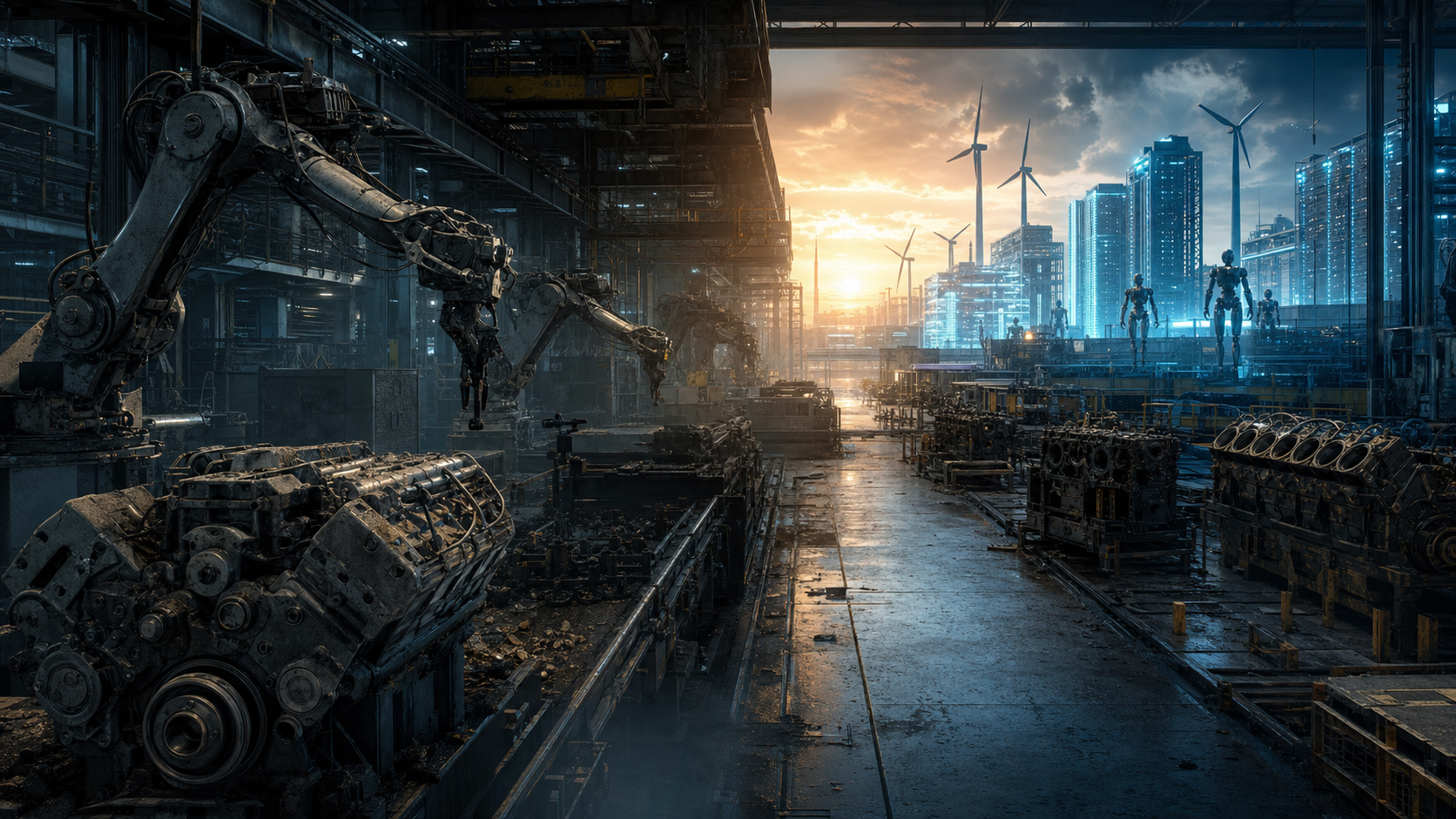
From world market leader to restructuring case – The profitability problem of German automotive suppliers – Image: Xpert.Digital
Profit shock: Why suppliers from Japan and China are now leaving Germany behind
Out of cars, into robotics: The radical secret plan of German suppliers
The German automotive supplier industry is facing what is likely the biggest turning point in its history. Although more vehicles are rolling off assembly lines worldwide, the sales and profit margins of domestic industry giants like Bosch, ZF, and Continental are plummeting. A recent study reveals a profound and threatening structural problem: While Japanese and Chinese competitors are growing highly profitably thanks to clever networks and new technologies, many German companies are trapped in a dangerous cost and transformation cycle. Hundreds of thousands of jobs are at stake, and an unprecedented wave of bankruptcies threatens the coming years. But there are also ways out. To survive, traditional suppliers must radically reinvent themselves – from classic combustion engine experts to tech pioneers in robotics, semiconductors, and green energy. A deep dive into the paradox of a key industry that now has to decide: gradual demise or a radical restart?
Produced more, earned less: The great paradox of a key industry
The year 2025 revealed a remarkable anomaly, one whose starkness is symptomatic of the state of the German industrial economy: More vehicles were produced worldwide than in the previous year, yet the total revenue of the world's 100 largest automotive suppliers fell from €1.135 trillion to €1.085 trillion – a decline of 4.6 percent. This marks the abrupt end of a three-year growth phase following the COVID-19 pandemic, and it is not a cyclical respite, but rather the first visible symptom of a fundamental structural shift. More cars, less money: This contradiction encapsulates the full economic drama of an industry that for decades was considered the backbone of the German export model.
Behind this aggregated figure lies an asymmetric crisis. The declining demand for electric vehicles is one of the main causes – it not only derailed the growth plans of battery manufacturers but also dragged down the entire supply chain. At the same time, original equipment manufacturers (OEMs) are under geopolitical pressure from tariffs and intensified global price competition, causing their margins to plummet from 6.9 to 4.2 percent. Suppliers, whose overall revenue-weighted margin remained comparatively stable at 5.8 percent, present a deceptively positive picture – because behind the average lie abysmal realities.
When the supplier is more profitable than the manufacturer: A historic reversal
For the first time in several years, the average automotive supplier has a higher margin than the vehicle manufacturer it serves. With an average margin of 5.2 percent, suppliers as a group exceed the OEM margin of 4.2 percent. This sounds like a triumph for the suppliers – but in reality, it's a message with two parts.
The first part: Manufacturers are doing exceptionally badly. Global price competition, additional investment obligations in electromobility, software and platform architectures, as well as geopolitical turmoil caused by tariffs and supply chain risks are eroding returns. The second part: The umbrella term "supplier" is misleading. It lumps together chip manufacturers and seat makers, tire companies and battery producers. A handful of high-profits – particularly in semiconductor technology and the glass sector – are raising the overall average, while a large part of the industry is performing considerably worse. What you build, where you build it, and to whom you sell – these three factors ultimately determine profit or loss.
The segment as destiny: semiconductors versus batteries, glass versus drive
No other variable explains the disparity in returns as precisely as the product segment. The range is enormous: semiconductor manufacturers achieve a typical margin of 24.6 percent, the glass sector reaches 23.2 percent, and tire companies are at 10.2 percent. These are not outliers, but structurally embedded advantages – stemming from high barriers to entry, patents, economies of scale, and oligopolistic market structures. At the other end of the scale: the classic powertrain with 4.5 percent and – most painfully – the battery segment with a margin of minus 11.3 percent.
Ironically, the battery segment, which all industry analysts consider the future of the automotive industry, is burning through the most cash. This is no coincidence, but rather the result of a specific economic logic: Battery manufacturers have invested billions in gigafactories that are operating at insufficient capacity due to slower-than-expected demand for electric vehicles in 2025. At the same time, fierce global price competition – spearheaded by Chinese suppliers backed by government subsidies – is driving cell prices down. The result: soaring revenues coupled with negative profitability. The battery segment has seen annual revenue growth of 27.9 percent since 2020 – yet it is still incurring losses. Investing in the wrong segment drags down the average profits of the entire country. South Korea serves as a prime example: With an average margin of just 2.9 percent, its suppliers are suffering significantly from the deep losses of their major battery manufacturers.
Bosch, ZF, Continental: The failure of a system, not just individual companies
The most serious finding of the Berylls-by-AlixPartners study concerns Germany. Seventeen German companies are among the world's 100 largest automotive suppliers – and Germany ranks second globally in terms of revenue. Yet, at 1.7 percent, the average operating margin of a German supplier is the lowest of all major supplier nations. Revenue strength without profitability: this is the structural core of Germany's problem.
Bosch, by far the world's largest automotive supplier with sales of nearly €56 billion, achieves a margin of only 1.8 percent despite its size. The company plans to cut up to 22,000 jobs in its automotive division by 2030, following the initial announcement of 9,000 and then a further 13,000 job reductions. ZF Friedrichshafen, the second-largest German supplier, is burdened with a massive debt of almost €11 billion – partly a consequence of an overpriced acquisition – and reports a negative margin of minus 2.8 percent in its powertrain segment. Continental responded by spinning off its entire automotive supplier division on the Frankfurt Stock Exchange on September 18, 2025, under the new name AUMOVIO – a move that Continental CEO Nikolai Setzer described as "the most profound restructuring in the company's history.".
Five of the ten companies with the weakest margins among the world's 100 largest automotive suppliers are German. This is no statistical coincidence. It is the result of decades of strategic monoculture: specialization in combustion engines, dependence on a few German OEM customers, and concentration of production facilities in one of the world's most expensive manufacturing countries.
The expensive location: When ten factories close and only one opens
The cost comparison is sobering. Producer prices in Germany rise by around 6.7 percent annually, while in China they rise by only 0.8 percent. This gap is gradually but surely destroying international competitiveness in cost-intensive manufacturing processes. In 2025, ten plants closed in Germany and only one new one opened – making Germany the only major automotive region in the world where more plants are disappearing than opening.
Continental has closed its plants in Wetzlar and Schwalbach by the end of 2025 as part of a program that will cut 7,150 jobs worldwide. ZF has already closed plants in Gelsenkirchen and Eitorf. Between June 2024 and June 2025, the German automotive industry lost a total of around 50,000 jobs. The German Association of the Automotive Industry (VDA) estimates that up to 225,000 jobs in the entire German automotive industry could be at risk by 2035. These are not temporary restructuring measures – this is a tectonic shift in Germany's industrial landscape.
Added to this is a perverse capital market logic: Thin margins are forcing companies to restructure their business models. This restructuring requires substantial investments. These investments cannot be financed from ongoing operations – companies simply aren't earning enough. Therefore, they must take on debt. However, those who barely earn any money and are already heavily indebted either receive no new capital from lenders at all or only at significantly higher interest rates. Berylls therefore anticipates a wave of bankruptcies and consolidations in the sector in 2027 and 2028.
Japan earns three times as much: The secret of the Keiretsu
The comparison with Japan is the most revealing finding of the entire analysis – because it shows that the problem is not technological or cyclical, but systemic. Japan has 21 suppliers among the world's 100 largest, Germany 17. The starting points are comparable: an old, traditional combustion engine nation, strong domestic brands, a similarly export-oriented economic model. And yet: A typical Japanese supplier achieves an average margin of 5.9 percent – more than three times that of a German counterpart.
The secret doesn't lie in a superior product or lower production costs. It lies in the structural relationship between manufacturer and supplier. In Japan, these relationships are characterized by the traditional keiretsu system: close, long-term, reciprocal business relationships, often underpinned by mutual equity stakes. Toyota, Honda, and their suppliers, such as Denso, Aisin, and Toyota Industries, are interwoven in an economic ecosystem. The manufacturer doesn't simply drive down prices because doing so would damage its own network. Crises are weathered together, risks are shared, and investments are coordinated.
In Germany, the reality is different. Suppliers to Mercedes, Volkswagen, or BMW are ultimately seen primarily as a cost item in a procurement calculation. Price pressure is consistently passed down the chain – throughout the entire value chain. Smaller and medium-sized suppliers at the end of this chain can neither leverage economies of scale nor negotiate alternatives. This is not only damaging in the short term – it destroys the production ecosystem on which German OEMs depend in the long run. The irony is bitter: by viewing their suppliers as mere cost-cutting partners, German automakers are sawing off the branch they're sitting on. The three-fold difference compared to Japan is entirely self-inflicted.
Our EU and German expertise in business development, sales and marketing

Our EU and German expertise in business development, sales and marketing - Image: Xpert.Digital
Industry focus areas: B2B, digitalization (from AI to XR), mechanical engineering, logistics, renewable energies and industry
More information here:
A thematic hub offering insights and expertise:
- Knowledge platform covering global and regional economies, innovation and industry-specific trends
- A collection of analyses, insights, and background information from our key areas of focus
- A place for expertise and information on current developments in business and technology
- A hub for companies seeking information on markets, digitalization, and industry innovations
Restructure or disappear: The decision deadline for suppliers
China is growing the fastest and earning the most: The threat scenario
A look at China also contradicts common assumptions. The expectation would be: fierce price competition, low margins, many losers. The reality is the opposite. Fifteen Chinese companies are among the top 100, three of them new this year. A typical Chinese supplier grows by 11.0 percent per year and achieves an average margin of 9.6 percent – more than five times that of a German company. It should be added, however, that only seven of the 15 Chinese companies in the study even publish margin information. Major players like CATL, the global market leader for battery cells, are not fully included. CATL reported a place among the top three largest suppliers worldwide for the first time in 2025 – a historic milestone symbolizing the shift in power within the global automotive supply industry.
Even more threatening than the current margin is the speed of Chinese growth. Eight of the world's ten fastest-growing suppliers are Chinese. In terms of total revenue by country, China has overtaken the US and now ranks third – directly behind Germany and Japan. So far, Chinese growth has come primarily at the expense of Japanese suppliers: Since 2020, Japan has lost six places in the top 100, while China has gained eight. Germany has maintained its 17 positions – but the question is, for how long? Analysts at Berylls describe maintaining these 17 positions as "very difficult.".
What's truly new about the Chinese challenge is its quality. Previously, Chinese suppliers competed on price – now they are attacking technological market segments that were previously considered safe havens. Chinese automakers are increasingly sourcing from Chinese suppliers, rather than German ones. And these companies are also trying to win over European and American customers in the global market. This puts German suppliers under pressure from two sides: from customers and from competitors simultaneously.
The structural triple problem of German suppliers
German suppliers are thus facing not a single challenge, but a simultaneous strain from three directions. First, their core business is shrinking: everything related to the combustion engine – injection systems, transmissions, exhaust aftertreatment, lubrication technology – is steadily losing relevance. This is a long-term, structural decline that cannot be halted by efficiency programs. Second, Chinese suppliers are taking market share from them – and increasingly so even from customers who were previously considered loyal. Even German OEMs are now buying from China if the technology is right and the price is lower. Third, Chinese automakers are growing as potential new customers, but they hardly buy from external suppliers – and when they do, they prefer to buy from Chinese suppliers.
The defense strategy that worked in previous crises – becoming more efficient, offering lower prices, winning back orders – no longer applies here. Philipp Raasch, former Mercedes manager and publisher of the newsletter "Der Autopreneur," puts it aptly: The key lies not in a better implementation of the same model, but in a fundamental redefinition of the business model itself. This realization is slowly gaining traction in boardrooms – but time is of the essence.
The transformation has begun: Between debt reduction and new markets
The restructuring strategies of German automotive suppliers are as diverse as the initial situations of the individual companies. Two fundamental directions can be identified: either a shift to more profitable segments within the automotive industry, or a targeted move into new markets outside the automotive sector.
ZF's primary focus is on financial relief: The company has sold its entire Advanced Driver Assistance Systems (ADAS) division to the US-based interior electronics specialist Harman International – a Samsung subsidiary – for €1.5 billion. The proceeds are expected to significantly reduce the company's debt of nearly €11 billion. Around 3,750 employees will transfer to Harman as part of this transaction. This is a painful but logical step: freeing up capital to enable a restructuring.
Continental has taken an even more radical approach. The spin-off of its entire automotive supplier division under the name AUMOVIO and its stock market listing in September 2025 marks one of the most profound structural changes in the history of the German conglomerate. Continental will now focus on its tire business – a segment that, with an industry margin of 10.2 percent, is significantly more profitable than the automotive division. AUMOVIO must now find its way as an independent, publicly listed company – with an adjusted EBIT of just €59.2 million on sales of €1.532 billion in the first half of 2025.
MAHLE has already made the transition from the automotive sector to supplying cooling modules for stationary battery storage systems used for grid stabilization and renewable energy storage. The company is transferring its thermal management expertise from the automotive sector to the rapidly growing energy storage market. Schaeffler is positioning itself as a technology supplier for humanoid robots – with key components from its eight product families – thereby tapping into a market that could explode by the end of the decade. By 2035, Schaeffler plans to integrate a mid-four-figure number of humanoid robots into its own production.
Infineon demonstrates where the journey can lead: The German semiconductor company achieves a margin of 21.5 percent, a figure that would make even leading international companies envious. The contrast to ZF's negative margins in its powertrain division illustrates in a single comparison just how crucial segment selection is.
From administrator to founder: The mental challenge of change
All these transformation strategies have one thing in common: they presuppose that companies are willing to question their own business model – not just optimize it. That is the truly difficult task, far beyond all strategic analyses and restructuring plans.
Germany's major automotive suppliers have developed their strengths through decades of highly efficient, core business operations. Bosch, Continental, ZF – some have existed for over 100 years. Their origins lie in an entrepreneurial gamble: someone took a risk and tapped into a market that didn't yet exist. This led to decades of quiet refinement and optimization. Core competencies shifted: from discovery to management, from risk-taking to hedging. This expertise was valuable and made Germany prosperous. But it is not the expertise needed now.
What's needed now is a return to the founder's mindset: from administrator to founder. The ability to let go of existing markets, identify new ones, and invest in them without knowing the outcome. The ability to relearn how to learn. This sounds abstract, but it's fundamental. Companies that have been built for decades on stable customer relationships, proven processes, and predictable cash flows must now develop structures that allow exploration alongside exploitation—that is, trying new things alongside processing existing business.
The diagnosis from Berylls analysts is clear: The core of a company is not necessarily what it has made its money with for the last 100 years. What is currently happening is not a temporary dip, but a new reality.
Wave of bankruptcies or consolidation: The possible scenarios
What happens next? Berylls anticipates a wave of bankruptcies and mergers between 2027 and 2028. Those who haven't embarked on a credible transformation path by then, who are too heavily indebted and earn too little to finance themselves, risk being swept away by the next economic downturn. The door locking system supplier Kiekert already filed for insolvency in 2025 – a taste of what might be to come.
The Oliver Wyman study on the German automotive supplier industry in 2026 confirms this picture: cost pressures, relocation to Asia, and the demands of electromobility are placing German suppliers under combined transformation pressure that can only be countered by decisive strategic measures. The study emphasizes that the framework for successful transformation exists – but the pace is lacking.
In this scenario, it's possible that in a few years, fewer than 17 German companies will be among the top 100. However, this doesn't necessarily mean that these companies have failed. Some may simply have moved into significantly more lucrative markets outside the automotive sector – and disappeared from the automotive supplier statistics because they have long since become robotics companies, energy technology corporations, or semiconductor suppliers.
A new ecosystem or the end of an era: What Germany must decide now
The automotive supply industry is far more than just a single sector for Germany. It lies at the heart of the productivity model that underpins Germany's status as a world-leading exporter. 740,000 jobs depend directly on it, with countless more in upstream and downstream sectors. A dysfunctional supply chain not only jeopardizes individual companies, but also the innovation ecosystem upon which OEMs themselves rely.
The structural weakness of German suppliers is therefore a top-priority industrial policy challenge. The Japanese approach – close OEM-supplier partnerships, joint crisis management, and mutual capital commitment – is not a romantic concept, but a measurable economic advantage: a threefold increase in margins compared to international standards. An industrial policy that ignores this finding and continues to rely solely on market mechanisms will only prolong the agony.
The crucial variable is time. Those who place the right bet now – in semiconductors, robotics, energy storage, AI infrastructure – can not only survive but emerge stronger from this crisis. Conversely, those who wait and hope that the combustion engine market recovers or price pressure eases will lose not only time but also capital, talent, and market position. The companies that are still in the top 100 in ten years will not be the largest. They will have been the ones that made the right bet at the right time.
Your global marketing and business development partner
☑️ Our business language is English or German
☑️ NEW: Correspondence in your native language!

Konrad Wolfenstein
I and my team are happy to be available to you as your personal advisor.
You can contact me by filling out the contact form here [email protected]:or simply call me at +49 7348 4088 965. My email address is
I'm looking forward to our joint project.
☑️ SME support in strategy, consulting, planning and implementation
☑️ Creation or realignment of the digital strategy and digitization
☑️ Expansion and optimization of international sales processes
☑️ Global & Digital B2B trading platforms
☑️ Pioneer Business Development / Marketing / PR / Trade Fairs
🎯🎯🎯 Data-driven B2B industry hub as a quasi-in-house solution

The quasi-in-house solution: How Xpert.Digital closes operational gaps in B2B marketing and sales – Smart Content-Driven Business - Image: Xpert.Digital
Xpert.Digital is a data-driven B2B industry hub led by Konrad Wolfenstein . The company acts as an external, quasi-in-house solution for industrial partners, closing operational gaps in marketing, content, and sales – without requiring additional resources on the client side.
More information here:










