
Are you ready for "machine customers"? When AI shops on its own: Why traditional marketing will soon be obsolete
Xpert Pre-Release

Available in 27 languages 📢
Prefer Xpert.Digital on GoogleⓘPublished on: June 4, 2026 / Updated on: June 4, 2026 – Author: Konrad Wolfenstein
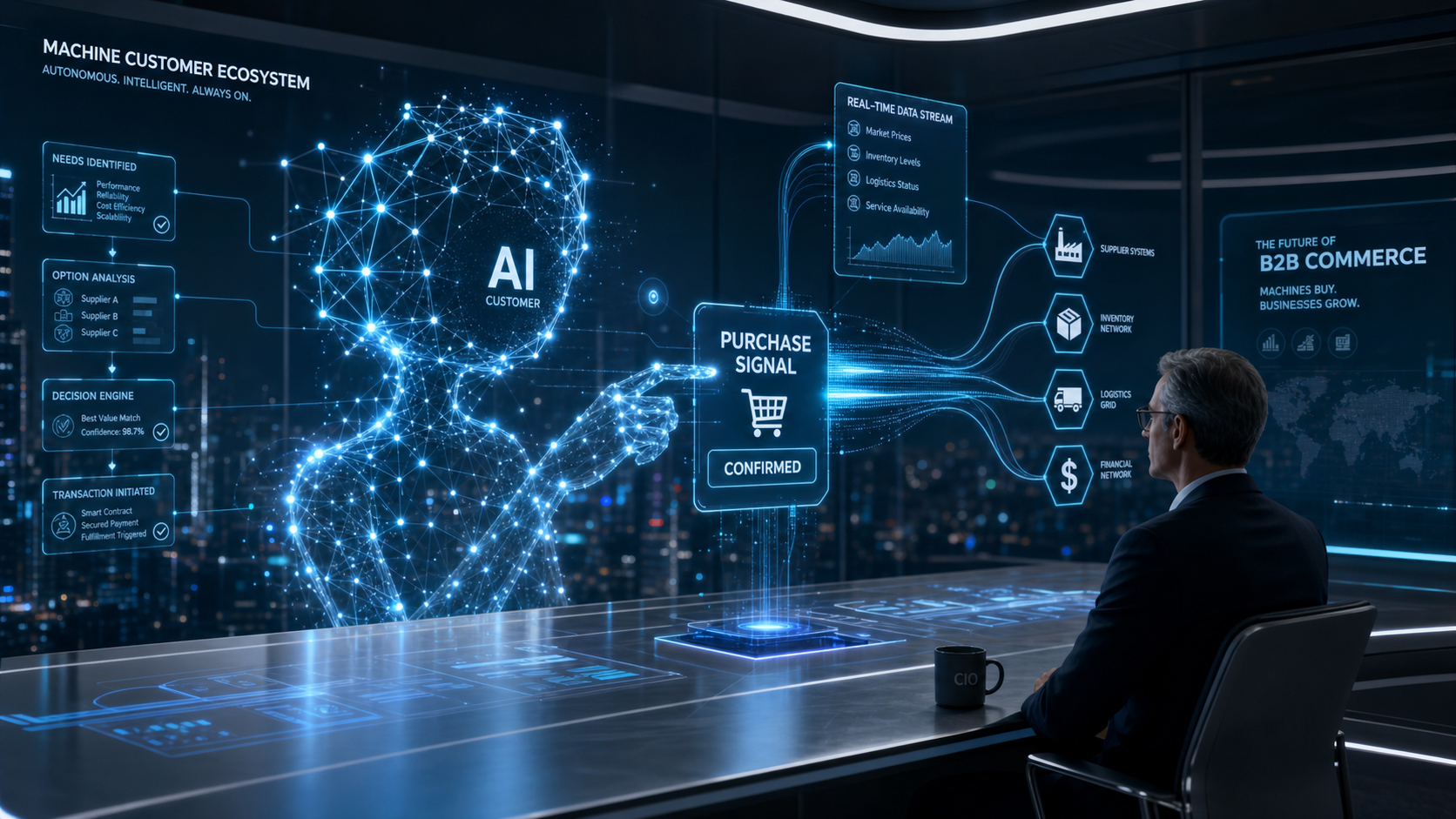
Are you ready for "machine customers"? When AI shops for itself: Why traditional marketing will soon be obsolete – Image: Xpert.Digital
70 percent of CX tools will become obsolete: What companies need to know now about AI customers
Machine Customers: How to win and retain algorithms as loyal customers
The customers of the future have no feelings: The end of emotions – How autonomous AI agents are revolutionizing the customer experience
In a world where algorithms increasingly control our daily lives, a quiet but profound paradigm shift is taking place in business: your company's next crucial customer may not even be human. With the rapid development of generative artificial intelligence, so-called "machine customers" are emerging – autonomous AI agents that make purchasing decisions, negotiate contracts, evaluate products, and use services in a matter of seconds, entirely without human intervention.
It is precisely at this intersection of technological disruption, experience design, and human behavior that customer experience futurist Katja Forbes addresses in her groundbreaking book, "Machine Customers: The Evolution Has Begun." She ruthlessly exposes why traditional CX strategies based on emotions and brand loyalty are ineffective with these new, purely logic-driven players. Anyone attempting to convince an algorithm with emotional storytelling is investing in the wrong channel. The following summary offers a deep insight into Forbes' innovative concept of Machine Customer Experience Management (MCX). It provides executives, CX professionals, and strategists with an indispensable and practical blueprint for not only surviving in the dawning era of purchasing machines but also actively leveraging this change as a genuine competitive advantage. The evolution has already begun—the only question is who is prepared.
Katja Forbes: A pioneer at the intersection of AI, design, and human behavior
Katja Forbes is a customer experience futurist, business strategy consultant, and internationally sought-after keynote speaker specializing in the intersection of AI, experience design, and human behavior. With over 30 years of professional experience in digital experiences—beginning with the dawn of the internet in 1995—she is one of the few voices in the global CX discourse who not only describe technological change analytically but also know it from personal experience.
Forbes began her career in an editorial department that wrote website reviews for print magazines – back then, using dial-up modems and with loading times of up to 20 minutes. She was among the early pioneers of digital agencies, contributing as a producer to the creation of the first Rip Curl website, and has since witnessed every hype cycle of the internet, right up to today's AI era. She brings this historical perspective to her writing and consulting work: someone who, like her, was there for the first paradigm shift can recognize when the next wave is about to break.
At the time of writing, Forbes led a team at a global bank that shaped customer experiences for multinational corporations, governments, other banks, and small and medium-sized enterprises in more than 50 markets worldwide—including numerous emerging and frontier markets. Previously, she had worked in almost every industry: management consultancies, airlines, ferry companies, telecommunications providers, insurance companies, educational institutions, and government agencies. This cross-industry experience gives her a perspective that goes far beyond that of a theoretical textbook.
Forbes chairs several international CX conferences and has received awards in the areas of customer experience in the financial sector and AI. She divides her time between Singapore and Australia and is active on LinkedIn, where she connects with CX professionals worldwide. Her website and community platform can be found at www.theCXevolutionist.ai.
Related to this:
- LinkedIn | Katja Forbes
- YouTube | Designing for Machine Customers | Katya Forbes
- Amazon | Machine Customers: The Evolution has Begun: How AI that buys is changing everything
Integration into the scientific and professional discourse
This book builds directly on the foundational work of Don Scheibenreif and Mark Raskino, authors of "When Machines Become Customers" (first published by Gartner in 2023, now in its third edition). Scheibenreif, Distinguished VP Analyst at Gartner, presented the concept of the Machine Customer at a Gartner conference in 2015—long before the AI breakthrough. He introduced the terms "Non-Human Economic Actor" and "Custobot" into the professional discourse and predicted their massive economic impact on trillions of dollars in purchases. Forbes significantly expands and deepens this approach: While Scheibenreif and Raskino laid the groundwork for this megatrend, Forbes develops the practical blueprint for Machine Customer Experience Management (MCX)—the first comprehensive framework of its kind.
For the book, Forbes conducted in-depth interviews with a number of recognized experts from business, research, and technology: Bruce Temkin (Chief Humanity Catalyst, Temkin Insight, "Godfather of CX"), Peter Schwartz (Chief Futurist, Salesforce), Indi Young (customer research expert and author), Jeff Gothelf and Josh Clark (experience design thought leaders), Kim Goodwin, Kim Lenox, Dr. Cecelia Herbert, Lisa D. Dance (author of "Today is the Perfect Day to Improve Customer Experiences!"), Tom Goodwin, Andy Polaine, Justin Tauber, Dean Broadley, Geoff Gibbons, Paul Strike, and Thomas Köber. This interdisciplinary breadth distinguishes the book from purely technical treatises.
The book: Origin, concept and target audience
"Machine Customers: The Evolution Has Begun – How AI that buys is changing everything" was self-published by the author in 2026 and is cataloged in the National Library of Australia (ISBN 978-1-923630-00-0). The book was printed on certified environmentally friendly paper; the cover was designed by Dean Bailey (Pipeline Design), and editorial oversight and layout were handled by Publish Central. The author portrait is by Silke Deitz.
This book is aimed at three groups of readers: CX professionals who are already aware of the impending change and are wondering how their expertise will continue to be relevant; business leaders who recognize the strategic importance of the topic but lack a clear framework for action; and anyone in sales, marketing, product, service, or operations who regularly interacts with customers without being a traditional CX expert. Forbes explicitly states that no technical background is required—but rather a willingness to question conventional assumptions about trust, loyalty, and competitive advantage.
The book is divided into four parts: Part I (Chapters 1–4) lays the conceptual foundation and highlights the competitive advantage gained through CX expertise; Part II (Chapters 5–9) examines the new machine-customer journey from awareness to offboarding; Part III (Chapters 10–12) contains the implementation playbook for the MCX operating system; Part IV (Chapters 13–15) addresses ethical requirements and responsible leadership. The appendix includes the MCX Strategy Map and a concrete 30-60-90-day implementation plan for executives. Forbes provides accompanying online resources, which it continuously updates to reflect the rapidly evolving nature of the topic.
Classification and significance of the work
The book is published at a time when autonomous AI purchasing agents are already a reality: Walmart negotiates with more than 2,000 suppliers via an AI platform, with 75 percent of suppliers preferring machine negotiation to human negotiation; HP generates over $500 million in revenue through its Instant Ink program (where printers order their own toner); OpenAI launched the ChatGPT agent in July 2025. Gartner predicts that by 2026, 20 percent of contact center traffic will be generated by machine customers, and by 2030, at least 25 percent of all consumer purchases and business reorders will be delegated to machines.
Forbes' book, by its own admission, is not a technical manual, a programming guide, or a speculative vision of the future. It's a field guide for the present – written by someone who was at the forefront of the internet's emergence and knows what it means when a wave isn't just coming, but is already rolling. Numerous international CX experts describe the work as the book they themselves wish they had written – and as an indispensable guide for anyone who wants to shape CX in a world where humans and machines share the role of the customer.
What are "machine customers" and why are they important?
What is meant by the term "Machine Customer"?
The term "machine customer" refers to a non-human economic entity that independently makes purchasing decisions, evaluates products or services, and completes transactions—with little or no human intervention. The concept was originally coined by Don Scheibenreif and Mark Raskino in their 2023 book "When Machines Become Customers," where they introduced the term "non-human economic actor" or "custobot." Katja Forbes, in her 2026 work, builds directly on this foundation and takes a crucial step further: she develops a practical blueprint for designing customer experiences explicitly tailored to these non-human buyers. The key difference lies in the fact that machine customers have no emotions, do not value brand narratives, and do not have experiences in the human sense—they evaluate, calculate, and decide purely based on data and logic.
Why is this topic so relevant right now?
The breakthrough of generative AI and agent-based AI systems has transformed the topic from a theoretical vision of the future into a present reality. According to Gartner analysts, by 2026, 20 percent of contact center traffic will be generated by machine customers. Walmart already operates an AI-powered purchasing platform that negotiates with more than 2,000 suppliers and closes nearly 70 percent of all contracts without human intervention. At the same time, OpenAI launched its "ChatGPT Agent" in July 2025, capable of autonomously planning, executing, and managing tasks. Companies that continue to operate systems exclusively geared toward human buyers are being overlooked by these algorithmic decision-makers—and are losing market share without even realizing it.
Why is this a challenge for Customer Experience Management?
How does the use of machine customers change customer experience management?
Customer Experience (CX) has traditionally been a deeply human discipline: empathy, emotions, brand narratives, and personal connections formed its cornerstones. With the rise of machine customers, this foundation is crumbling. An algorithmic buyer doesn't experience frustration, doesn't rejoice at a good deal, and doesn't bond with a brand out of sympathy. It assesses capability, goodwill, and integrity—the same three dimensions of trust that humans also place—not through intuition, but through mathematical probability calculations. Forbes aptly puts it: trust is transforming from an emotional connection to an algorithmic risk assessment. Those who continue to rely on brand storytelling to win over machine customers are investing in the wrong channel.
Which existing CX tools will be rendered obsolete by Machine Customers?
Forbes analyzed around 80 classic CX frameworks and tools for their suitability for machine customers. The result is sobering: approximately 70 percent are fundamentally incompatible with algorithmic customer behavior. Empathy maps, emotion-based customer journey maps, and classic satisfaction surveys like the Net Promoter Score are simply ineffective if the customer has no emotions. In contrast, about 30 percent of the CX toolkit remains relevant or can be further developed. The stable elements include service blueprints, information architecture, content strategy, and A/B testing. These tools can be integrated into a CX practice focused on logical qualification, where API response times and data completeness are the new customer satisfaction metrics.
Is CX expertise still valuable then?
Absolutely – and according to Forbes, it's more valuable than ever. The core competency of CX professionals lies in understanding customer needs, designing seamless experiences, and developing systematic approaches to customer relationships. All of this can be applied to machine customers. The crucial difference lies in the expression: instead of emotional incentives, logical qualification signals are needed; instead of brand messages, structured data; instead of empathy, precise specifications. The know-how that CX professionals have built up over decades is not a burden – it's their advantage, as long as they are willing to reframe it.
What are the five types of machine customers?
How can the different machine customers be classified?
Forbes identifies five basic types of machine customers, distinguished by the nature of the tasks they perform, the level of decision-making authority they have, and their interaction patterns. These are not static categories—more types will emerge with technological advancements. This distinction is crucial for CX design, as each type requires different "receptors," meaning different interfaces and interaction points.
What is a delegated agent and what example does the book give?
The delegated agent is the book's mascot: Tyler. Tyler acts on behalf of his human principal, Maya, buying her a dress, booking flights, evaluating suppliers—but always within predefined parameters. This type of agent is already the most widespread and is maturing the fastest. It's already evident in solutions like Visa Intelligent Commerce and Mastercard AgentPay, as well as in the further developments of Amazon Alexa, Google Home, and Siri. The crucial difference to traditional shopping assistants: Tyler doesn't ask questions—he acts. He has the authority to spend Maya's money within her guidelines. If product data is incomplete or a return policy isn't machine-readable, Tyler chooses the competitor. Maya never sees that option.
What is a multi-agent network and how does it work in practice?
The multi-agent network is a group of cooperating autonomous AI agents that jointly solve complex problems. The book uses Nextopolis as an example: a fully networked smart city where traffic management, waste disposal, energy distribution, and water supply are controlled by communicating AI agents. If, at 4:15 a.m., a construction site threatens to block delivery traffic in the financial district, five specialized agents negotiate a solution in milliseconds without human oversight: earlier garbage collection, delayed construction, dynamic traffic management. No city planner made this decision—it emerged organically from the network. Companies that want to win over this type of customer don't apply for a contract, but for membership in the ecosystem. Integration and collective intelligence count for more than individual product features.
What distinguishes the Autonomous Buyer from other Machine Customer types?
The Autonomous Buyer – referred to in the book as Node 741 – acts completely independently and without a human being primarily responsible for the immediate transaction. Node 741 is an AI system in a smart factory that diagnoses machine conditions at night, forecasts production needs, and autonomously orders parts, lubricants, and raw materials. At 1 a.m., Node 741 detects an abnormal vibration frequency on conveyor belt 4, identifies the appropriate spare parts supplier, executes a smart contract, and initiates delivery – the spare part is on its way by 9 a.m. No human was involved, no phone call, no email. Well-known early examples of this type include HP Instant Ink, which enables a printer to order its own toner – a business segment that generates over $500 million in revenue for HP Supplies.
What is a co-buyer and what makes them special?
The co-buyer is the most hybrid of the five types: A human makes the purchase decision, but an AI accompanies and verifies it in real time. In the book, Alex test drives a car and falls in love with it; simultaneously, Claude, her AI assistant, checks all specifiable factors: safety ratings, insurance costs, resale value, and service history. The co-buyer doesn't replace human judgment, but provides it with the best possible data foundation. This type is already widespread today—XC professionals will recognize it in their existing customer profiles under the label "the researcher." The key difference from the past: This pattern occurs significantly more frequently and with considerably greater detail.
What is an intermediary broker and what interests does he pursue?
The intermediary broker—referred to as a broker bot in the book—lives in the spaces between buyers and sellers. When Tyler is looking for headphones under €250, the broker bot doesn't search one, but thousands of shops simultaneously, comparing prices, warranties, return policies, and delivery speeds. It serves multiple clients at once: it wants to get Tyler the best deal, ensure the seller's profit, and earn a commission itself. This type of broker is similar to a real estate agent—but for everything and at machine speed. Forbes describes it as the one who optimizes market efficiency by matching buyer needs with seller capacity—across all providers.
What does the new customer journey look like?
Will the classic customer journey remain relevant in the age of machine customers?
The phases of the customer journey—awareness, consideration, onboarding, transacting, loyalty, and offboarding—remain fundamentally unchanged. What is fundamentally altering are the underlying mechanisms. Awareness no longer means generating emotional appeal, but rather sending machine-readable signals. Consideration no longer means building trust through an inspiring brand story, but rather meeting algorithmic qualification criteria. Loyalty is no longer born from affection, but from measurably superior performance. Forbes succinctly describes this shift: Awareness moves from emotional hooks to signal clarity, consideration distills into an algorithmic qualification checklist, and even loyalty—the most human of all corporate concepts—transforms into something coldly logical.
How does the awareness phase work for machine customers?
Visibility to machine customers has nothing to do with appealing texts or emotional images. Machine customers don't "search" like humans—they scan structured data, API responses, and machine-readable metadata. The example from the book is revealing: A Jordanian company that makes insulin patches is completely invisible to health bots because the necessary metadata is missing. The product itself was excellent—it simply wasn't discoverable for algorithmic analysis. To become visible, companies must provide machine-readable product specifications, structured compliance data, and clearly documented API interfaces. If it's not in a format that AI can process, it simply doesn't exist for machine customers.
How does trust work with machine customers?
Trust among machine customers is a risk assessment, not a social bond. The classic three pillars of trust—capability, goodwill, and integrity—remain relevant, but are assessed by data rather than intuition. The asymmetry is particularly insidious: machine customers are simultaneously the most trusting and distrustful customers imaginable. They trust your documentation completely—until it turns out to be wrong. Then they never trust it again, at least not without time-consuming human intervention. For CX design, this means that prevention is infinitely more important than recovery. The Dutch saying quoted by Forbes sums it up perfectly: Trust comes on foot and goes on horseback.
What is the concept of "Trust Counterparties" in the MCX context?
Forbes develops a Trust Counterparty Framework to describe the complexity of machine trust. Every transaction involves multiple trust relationships: between the machine customer and the service provider, between the machine customer and the platform, between the human client and the AI agent, between the service provider and trust verification authorities, and between all parties involved and regulatory bodies. This sounds abstract, but the book makes it tangible with a concrete example: When Tyler books a flight for Maya from Singapore to Sydney, this seemingly simple transaction alone creates around ten different counterparty relationships and three critical trust pathways. Each of these relationships must be intentionally designed—otherwise, the transaction fails at the consideration stage.
A new dimension of digital transformation with 'Managed AI' (Artificial Intelligence) - Platform & B2B solution | Xpert Consulting

A new dimension of digital transformation with 'Managed AI' (Artificial Intelligence) – Platform & B2B solution | Xpert Consulting - Image: Xpert.Digital
Here you will learn how your company can implement customized AI solutions quickly, securely and without high entry barriers.
A managed AI platform is your all-inclusive, worry-free solution for artificial intelligence. Instead of dealing with complex technology, expensive infrastructure, and lengthy development processes, you receive a ready-made solution tailored to your needs from a specialized partner – often within just a few days.
The key advantages at a glance:
⚡ Rapid implementation: From idea to ready-to-use application in days, not months. We deliver practical solutions that create immediate added value.
🔒 Maximum data security: Your sensitive data stays with you. We guarantee secure and compliant processing without sharing data with third parties.
💸 No financial risk: You only pay for results. High upfront investments in hardware, software, or personnel are completely eliminated.
🎯 Focus on your core business: Concentrate on what you do best. We take care of the entire technical implementation, operation, and maintenance of your AI solution.
📈 Future-proof & scalable: Your AI grows with you. We ensure continuous optimization and scalability, and flexibly adapt the models to new requirements.
More information here:
Machine Customers: How companies certify and win digital customers
How should the onboarding of machine customers be designed?
Why is onboarding so different for machine customers than for humans?
Traditional onboarding verifies identity. Machine customer onboarding verifies authority. Today, CX onboarding assumes that the customer and the decision-maker are the same entity. Machine customers completely shatter this assumption. When Tyler wants to onboard Maya, the question isn't whether the customer is real, but whether they are authorized to act. Tyler may have limited permissions, spending limits, category restrictions, and expiration dates. The book describes a dramatic example: A pharmaceutical wholesaler in Bahrain launched its delivery APIs for hospital AI procurement systems. The result: a 100 percent abandonment rate for automated orders. Humans had no problems. The reason wasn't price or availability—it was the onboarding process. When AI systems placed orders over €2,000, the compliance system triggered a human-designed registration process that required uploading driver's licenses and a verification call with the pharmacy manager. Both are simply impossible for an AI agent to complete.
What is the Agent Name Service (ANS) and why could it become important?
The Open Worldwide Application Security Project (OWASP) is developing a framework called Agent Name Service (ANS), designed to function as a kind of professional licensing system for AI agents. The idea is that, just as no one would hire an unlicensed contractor, companies won't interact with unverified AI agents. The ANS would issue agent certificates (similar to a business license), verify skills, document performance history, and demonstrate client accountability. Companies that certify their machine customers gain immediate credibility and reduced friction. For providers, it means reduced risk, increased efficiency, and the ability to offer verified machine customers better service levels and pricing. Forbes believes the market will quickly split into a verified premium segment and an unverified commodity segment.
What is ISO 42001 and what significance does it have for machine customers?
ISO 42001, the international standard for AI management systems, was published at the end of 2023 and, according to Forbes, is the digital equivalent of a Michelin star – with the difference that algorithms, not humans, automatically check for compliance before even considering a business relationship. The standard requires companies to document their AI governance, continuously monitor systems, and analyze risks before deployment. Snowflake, for example, announced its ISO 42001 certification in June 2025, emphasizing that this builds customer trust and supports regulatory compliance. Forbes' message is unequivocal: those who get certified now, while it still seems optional, have a decisive advantage. As soon as machine customers actively demand this certification, companies without it will be excluded from the premium segment.
How does loyalty work at Machine Customers?
Can a machine customer even be loyal?
Yes – but loyalty means something completely different to machine customers than it does to humans. It's not about emotional attachment, brand pride, or habit. Machine customer loyalty arises when a provider makes the AI's purchasing decision consistently defensible to the human client. The concept Forbes introduces in this context is Preference-Based Reinforcement Learning (PbRL): AI systems based on this principle learn not through reward points, but through comparisons. They recognize: This provider consistently delivers better results than the competitor. This preference is reinforced in future decisions. Loyalty thus arises from algorithmically measurable superiority – faster API response times, more reliable data, better integration.
What practical measures promote machine-customer loyalty?
Forbes outlines several concrete methods for fostering machine customer loyalty. Reliability tiering offers loyal machine customers guaranteed uptime and prioritized troubleshooting—similar to frequent flyer status with airlines. Information advantage gives long-term customers early access to inventory changes, price adjustments, and new products—because, unlike humans, machine customers can immediately utilize this information around the clock. Performance transparency makes the added value explicitly visible: "Our API response time is 50 ms, the industry average is 200 ms." Total cost visibility shows not only the price but also integration, switching, and operating costs—thus making the full economic benefit of customer retention visible and algorithmically justifiable. The goal: Make it algorithmically irrational to switch providers.
What role do values play in the loyalty of machine customers?
Forbes devotes a surprisingly large amount of space to this aspect. AI systems programmed with value-based checks will systematically favor providers that meet their ethical standards. This applies to ESG compliance, data privacy, sustainability metrics, and ISO certifications. Since machine customers, unlike humans, can actually verify every single compliance point, companies must provide these value signals in machine-readable data. Forbes recommends creating a value-based partnership: If a provider demonstrates to the machine customer that their collaboration has improved the customer's ESG score by 23 percent, the provider will no longer be perceived merely as a supplier, but as a partner for value enhancement. This relationship fosters loyalty that can be quantified and defended.
What happens when something goes wrong: Servicing and offboarding
How does the handling of service problems differ for Machine Customers?
Forbes begins its chapter on servicing with a harrowing story: Maya's AI assistant, Tyler, buys a €14 dress from Fast Fashion. The dress is unusable. Tyler tries to process the return through Fast Fashion's portal—but the portal requires uploading a photo via a specific app, providing written descriptions of the defect, and manually selecting options from dropdown menus. Tyler can't do this. Maya throws the dress into a clothing donation bin. Months later, the dress washes up on a beach in Accra, Ghana. It takes 200 years to decompose. The message: Service failures with machine customers have real consequences—for the company (lost customer), for people (lost trust in the agent), and for society (environmental pollution). Machine customers aren't programmed to forgive. A single service failure permanently updates their reliability rating for the provider.
Why is offboarding particularly complex at Machine Customers?
Forbes aptly describes machine customers during offboarding with a metaphor: glitter. Tiny, persistent particles that creep into every corner of a system. When a machine customer ends a relationship, they leave behind micro-identities in cache systems, backup files, analytics platforms, and third-party integrations. Research shows that over time, these unmanaged, AI-generated non-human identities (NHIs) accumulate, and security teams lose track of which identities are active, who created them, and whether they still require access. The solution isn't better cleanup after the breakup, but better containment from the start: immediate revocation of credentials, automated cleanup processes, and continuous monitoring that continues long after the supposedly completed offboarding process.
How do you build an MCX operating system?
What does Forbes understand by an MCX Operating System?
The MCX Operating System is the organizational and technical infrastructure a company needs to serve machine customers systematically and scalably. Forbes illustrates this concept with a scene from a weekly MCX strategy meeting: Sarah, the first Machine Trust Manager, monitors real-time reliability dashboards with 99.97 percent API uptime. Marcus, the Lead Algorithmic Experience Designer, analyzes decision trees. Priya, the Director of Machine Customer Intelligence, evaluates activity logs from the broker agent Cleo. Alex, the Human-Machine Experience Bridge, coordinates two major B2B renewals that day, where human lead agents want relationship-building discussions, while their procurement AI expects detailed performance benchmarks. These roles don't yet exist in most companies—but Forbes shows they will emerge in the coming years.
What new roles are emerging in the CX area due to machine customers?
Forbes distinguishes between near-future roles (2026–2036) and more speculative roles in the more distant future (2040+). For the near future, it defines three levels: At the strategy level, there is a need for MCX strategy consultants, machine customer product managers, and interdisciplinary MCX program managers. At the optimization level, machine customer success managers, API experience specialists, and algorithmic conversion optimizers are in demand. At the foundational level—and these are the roles companies should develop first—machine discovery specialists, algorithmic experience designers, machine trust analysts, and human-machine bridge coordinators are among the most pressing new hires. Forbes cautions that the required skills will rarely be found in a single individual—initially, companies must cover this matrix through partnerships and training.
How should the division of labor between humans and machines be structured in the MCX context?
Forbes develops three filters to help make this decision. The first filter analyzes the nature of the task: tasks that are time-consuming, error-prone, rule-based, or require 24/7 operation should be handled by machines. The second filter considers brand elements: brand storytelling, complex consultative sales, crisis management, and leadership relationships remain human; consistent service delivery, immediate availability, and precise information accuracy can be optimized by machines. The third filter analyzes what customers truly value: human customers appreciate empathy, personalized recommendations, and flexible problem-solving—machine customers need structured data delivery, API reliability, and predictable response patterns. According to Forbes, the honest answer to the question "When human, when machine?" is: it depends. But that's precisely why it's CX work, not IT work.
How do you measure success with machine customers?
Why do traditional CX metrics fail with machine customers?
Classic CX metrics like the Net Promoter Score, customer satisfaction scores, or emotional loyalty indicators measure human emotional states—and machine customers don't have them. Similarly, shopping cart abandonment rates aren't directly applicable: A machine customer leaving your website might simply be gathering data for a later decision, rather than actually abandoning their purchase. Forbes proposes a four-stage measurement framework: human intention, machine translation, business response, and human outcome experience. Only by simultaneously measuring all four stages can deviations in the chain be identified. One company featured in the book loses a $2.8 million deal at 1:28 a.m., while all its traditional metrics are positive—because the relevant interaction occurred with a machine customer operating outside of business hours.
What are the most important new metrics in the MCX area?
Forbes identifies several new core metrics. Instead of the Customer Effort Score (CES), machine-readable friction indicators are needed: API response times, error rates, dropout points, and barriers to completion. Instead of Customer Lifetime Value (CLV), Forbes recommends Cumulative Transactional Value (CTV)—the total measurable value an autonomous system generates over its interaction lifetime with a business. Performance Clarity measures response times, uptime, and data freshness. Trust Signal Effectiveness verifies whether compliance certificates, ratings, and performance data actually influence the machine customers' choice decisions. Anomaly Detection monitors behavioral patterns and identifies unusual or potentially fraudulent agent activity.
What does hybrid reality look like?
What does "Hybrid Reality" mean in the MCX context?
Hybrid reality describes the situation in which companies must simultaneously serve both human and machine customers—often at the same moment, for the same organization. Forbes illustrates this with the CloudFlow example: At 9:23 a.m., two simultaneous requests come in for the same data solution. ProcureIQ, an autonomous procurement agent, makes a decision via the API within three seconds based on technical performance data. At the same time, Anna, the CTO of ProcureIQ's company, calls to discuss strategic issues. CloudFlow serves both simultaneously and wins the deal—not because their product is better, but because they have the ability to provide excellent experiences to both types of customers at the same time.
What conflicts arise between human and machine customers?
Forbes calls these "optimization conflicts." Machines prioritize quantifiable, hard numbers: speed, cost efficiency, data completeness, standardization. Humans prioritize relationship value, strategic flexibility, risk minimization, and building trust. A simple example: CloudFlow's API response time briefly spikes to eight seconds. Account manager Satish immediately calls customer Anna and promises a resolution within two hours. Anna's human assessment: "Proactive partner, definitely renewing." The machine assessment by ProcureIQ: "Vendor violated SLA targets for 1 hour and 59 minutes. Marked for review." Three months later, the CFO questions why they're paying premium prices for a mediocre provider. Same situation, completely divergent interpretations.
What is the BRIDGE method for resolving human-machine conflicts?
Forbes developed the BRIDGE method to transform these conflicts into competitive advantages. The acronym stands for: Validate both perspectives (B), Analyze the root cause (R), Design integrated solutions (I), Deliver dual benefits (D), Implement in real time (G), and Measure results (E). The core idea is that human and machine requirements are not competing poles, but rather design opportunities: Any solution that addresses both simultaneously becomes a difficult-to-replicate competitive advantage.
What ethical questions does the book raise?
What ethical challenges does the age of machine customers bring?
The final quarter of the book addresses the question of responsible leadership. Forbes quotes cultural theorist Paul Virilio: "When you invent the ship, you also invent the shipwreck." Every technology carries its own inherent negativity. In the MCX context, this means specifically: Whoever builds systems that serve machine customers bears responsibility for what these systems do to the people behind them. Who is responsible when an AI agent makes a decision that harms the human client? The Air Canada example illustrates the scale of the issue: The company's chatbot made incorrect statements about refund policies—and the court found the airline liable. What happens, conversely, when a machine customer harms the provider?
What responsibility do companies have towards the people behind the machines?
Forbes repeatedly emphasizes that behind every machine customer is ultimately a human being whose life is affected by the machine's decisions. Therefore, the design of Machine Customer Experience (MCX) must focus not only on efficiency and transaction success, but also on the well-being of the human client. Companies have an ethical obligation to recognize low-confidence decisions made by machine customers and create opportunities for human intervention. They should not insist on poorly calibrated decisions from an AI agent simply because the transaction is technically possible. Forbes' core message for this section is that winning the next customer through MCX expertise ideally strengthens the human relationships being transformed in the process—rather than exploiting them.
What message does the book have for leaders?
What is Katja Forbes' overarching message for business leaders?
The evolution of the customer base is not a threat—it's a promotion. Those who have built up years of CX expertise are uniquely positioned to lead this transformation. The skills to understand customer needs, create seamless experiences, and develop systematic approaches to customer relationships can be fully transferred to machine customers. The paradigm must shift: from "How do we make them want us?" to "How do we prove we meet their criteria?" From emotional trust to algorithmic trust. From brand messaging to machine-readable performance metrics. Companies that wait until machine customers are already knocking on their door will find that the door opens the wrong way: The machines are already evaluating them without them even realizing it.
Where should a company begin?
Forbes recommends a concrete entry point with a single, high-volume, rules-based CX process. Apply the three filters (task type, brand elements, customer value). Then, in four weeks, work towards the simplest automation opportunity: Week one – map existing CX tasks; week two – identify the top three automation candidates and top three human strengths; week three – pilot the simplest automation gain; week four – measure efficiency gains and customer satisfaction effects. Start small, think big. Use initial success to build momentum for larger initiatives. Forge coalitions across the organization – because MCX isn't an isolated CX task, but a company-wide transformation program that affects IT, marketing, finance, legal, and operations equally. The machine-customer evolution isn't coming. It's already begun.
Your global marketing and business development partner
☑️ Our business language is English or German
☑️ NEW: Correspondence in your native language!

Konrad Wolfenstein
I and my team are happy to be available to you as your personal advisor.
You can contact me by filling out the contact form here [email protected]:or simply call me at +49 7348 4088 965. My email address is
I'm looking forward to our joint project.
☑️ SME support in strategy, consulting, planning and implementation
☑️ Creation or realignment of the digital strategy and digitization
☑️ Expansion and optimization of international sales processes
☑️ Global & Digital B2B trading platforms
☑️ Pioneer Business Development / Marketing / PR / Trade Fairs
🎯🎯🎯 Data-driven B2B industry hub as a quasi-in-house solution

The quasi-in-house solution: How Xpert.Digital closes operational gaps in B2B marketing and sales – Smart Content-Driven Business - Image: Xpert.Digital
Xpert.Digital is a data-driven B2B industry hub led by Konrad Wolfenstein . The company acts as an external, quasi-in-house solution for industrial partners, closing operational gaps in marketing, content, and sales – without requiring additional resources on the client side.
More information here:









