
The myth of wireless VR: Why, in the end, only millimeter precision and detail sharpness count with professional headsets
Xpert Pre-Release

Available in 27 languages 📢
Prefer Xpert.Digital on GoogleⓘPublished on: June 8, 2026 / Updated on: June 8, 2026 – Author: Konrad Wolfenstein
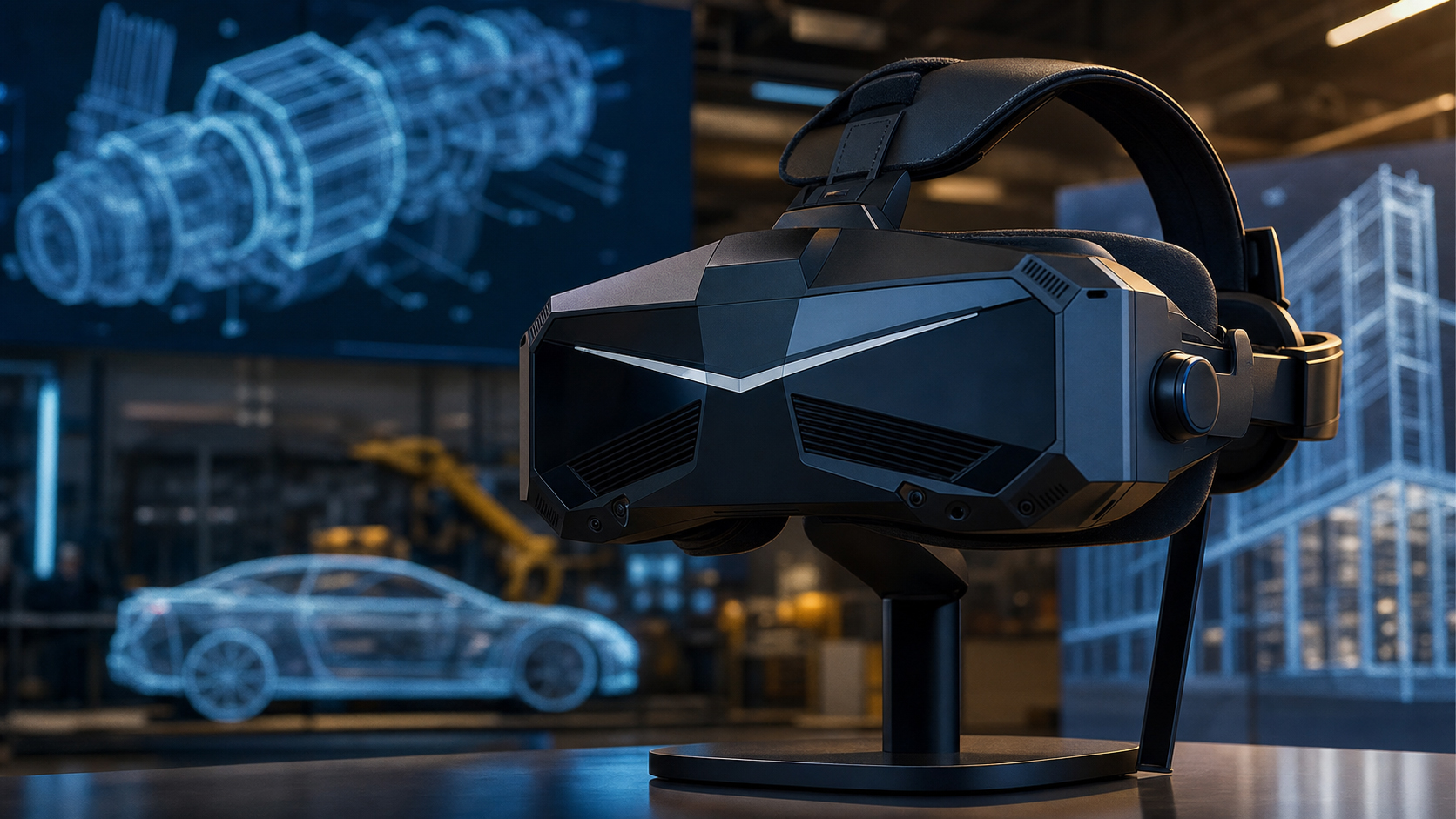
The myth of wireless VR: Why only millimeter precision and detail sharpness ultimately count for professional headsets – Creative image: Xpert.Digital
No more blurry CAD models: Why extreme pixel density is becoming the most important selling point for VR glasses
Avoiding costly design flaws: How gaming glasses with 57 PPD advance industrial visualization
A Meta Quest 3 delivers 25 PPD, Pimax more than double that: Learn what 57 pixels per degree means in practice and why this enormous leap in image sharpness makes all the difference for virtual prototypes and architectural reviews
When virtual reality is discussed in the corporate environment today, the same names almost always come up: MetaQuest, HTC Vive, or Pico. The selling point of these devices is consistently focused on maximum mobility, wireless connectivity, and comfort – ideal prerequisites for simple employee training and onboarding processes. However, this approach falls woefully short for the truly demanding and business-critical tasks in product development, mechanical engineering, or architecture. Here, it's not battery life, but uncompromising image quality that determines the success of a project. An unexpected player is now entering precisely this market gap: Pimax. Originally known as the undisputed market leader for extremely high-resolution VR gaming and flight simulation headsets, the company is increasingly positioning itself as a powerful alternative in the B2B segment. With pixel densities approaching the limit of human vision, Pimax is forcing the industry to re-examine a fundamental question: Is it sufficient to see only "approximately" in VR, or is maximum visual precision no longer a mere convenience feature, but a crucial business decision?
Pimax in B2B applications: When the image decides
Why the market leader in VR gaming is redefining industrial visualization: Image sharpness as a strategic argument – What sets Pimax apart from all others
When discussing VR headsets for industrial use, the first things that come to mind are wireless connectivity, comfort, and battery life. These features determine the selection in training departments, maintenance technician training courses, and company onboarding programs. Consequently, the most frequently mentioned devices are the Meta Quest 3, the HTC Vive XR Elite, or the Pico 4 Enterprise – all headsets that are wireless, lightweight, and easy to handle, and can be used anywhere in the company. This logic is understandable, but it falls short. It answers the question, "How long and how comfortably can someone wear a VR headset?" – but not the truly crucial question in product development, design, and industrial planning: "Can I really evaluate what I see?"
This is precisely where Pimax's argument begins. Founded in Shanghai in 2015, the company has consistently focused on a single core competency: the best possible image quality in a VR headset. While competitors were working with standalone architectures, stripped-down mobile chips, and integrated battery solutions, Pimax pursued the opposite strategy. The connection to powerful PC hardware was not presented as a disadvantage, but rather as a prerequisite for creating an image that truly deserves the name. The result is a product line that clearly stands out from everything else on the market in terms of pixel density, field of view, and image fidelity.
The current flagship model, the Pimax Crystal Super, achieves a resolution of 3,840 × 3,840 pixels per eye with a pixel density of up to 57 PPD (pixels per degree). For comparison, the MetaQuest 3 manages 25 PPD, and the HTC Vive XR Elite around 18 PPD. A PPD value of 57 means that 57 pixels are displayed per degree of the field of view – this is approximately what the human eye can resolve under optimal conditions. In practice, this means: fine text on virtual displays is legible. Micro-details on CAD components are discernible. Material surfaces appear realistic. Distance information can be reliably estimated.
The misunderstanding about the “right” B2B use case
The industrial VR discussion has focused on a few use cases in recent years: employee training, safety training, maintenance support, and remote collaboration. These areas are real and important, but they lead to a systematic misjudgment of hardware requirements. Those primarily conducting training need glasses that are robust, easy to put on, and can be worn for hours. Someone guiding a technician connecting cables in a control cabinet needs, first and foremost, wireless connectivity and stable video transmission.
Pimax is targeting a different need, one that is chronically underestimated in B2B discussions: the high-resolution visualization of complex, precision-dependent objects and environments. This need exists wherever a decision hinges on whether one truly sees something – or only sees it approximately. An engineer examining a 3D model of a turbine blade in VR must be able to assess the surface quality. An architect virtually walking through a planned industrial building before groundbreaking must be able to accurately evaluate proportions, material effects, and spatial structure. A product designer reviewing an automotive prototype in VR must be able to reliably assess light incidence and reflections on body surfaces. In all these situations, image quality is not a convenience feature, but a requirement for the validity of the result.
These use cases differ fundamentally from educational or training applications. They don't require mobility, but they do require realism. They don't require long battery life because the review process takes place in defined sessions. What they do require is an image that is close enough to physical reality to enable reliable aesthetic and functional judgments – and that is precisely Pimax's unique selling point.
The VR market is growing rapidly – but quality remains the unsolved problem
The global VR market is experiencing dynamic growth. Estimates suggest that the total market for VR headsets was valued at $9.1 billion in 2024 and is projected to reach approximately $51.9 billion by 2034, representing a compound annual growth rate (CAGR) of 19.7 percent. Other analysts, using a more narrowly defined market, arrive at lower absolute figures but confirm the same growth trend. Within a broader market framework that also includes VR-based software platforms and content, the total virtual reality market size has already been estimated at over $20 billion by 2025.
This growth is driven by several forces. The decline in hardware costs, the increasing performance of mobile chips, and the growing range of software for enterprise applications have significantly lowered the barrier to entry. At the same time, concepts like the digital twin are becoming a strategic priority for German industry: According to a representative Bitkom survey of 552 German industrial companies, 63 percent now consider digital twins indispensable for remaining internationally competitive – in the mechanical and plant engineering sector, this figure is even higher at 73 percent. The proliferation of digital twins directly creates demand for high-quality visualization solutions, because a digital twin can only realize its full potential if it can be experienced effectively.
The central unresolved problem in the mass VR market, however, is image quality. Meta, Pico, and HTC have made enormous strides in recent years in terms of weight, ergonomics, battery life, and tracking—but not in resolution and pixel density to the extent required for demanding professional applications. The average business VR market has become accustomed to a compromise: sufficient image quality for training and education, but no Retina resolution for design reviews. Pimax is one of the few companies so far that consistently rejects this compromise.
Pimax as market leader in the high-end VR segment: Technological advantage with substance
Pimax operates in 72 countries and positions itself as a leading innovator in the high-end VR sector. This self-description is not mere marketing hype, but rather based on sound technology. The Crystal product line features aspherical glass lenses instead of plastic lenses – a detail that makes a significant difference in practice: Glass lenses are more scratch-resistant, offer more uniform light refraction across the entire surface, and significantly reduce the god ray artifacts common with Fresnel optics. Local dimming with up to 1,000 zones per eye ensures contrast performance approaching that of OLED displays.
A direct comparison with its only serious competitor in the professional segment, the Varjo XR-4, favors Pimax in several respects. With a resolution of 3,840 × 3,840 pixels per eye (Pimax Crystal Super) versus 2,880 × 2,720 pixels (Varjo XR-4) and a horizontal field of view of up to 140 degrees versus 115 degrees (Varjo), Pimax offers more image for significantly less money: The Crystal Super is available for around $1,700, while the Varjo XR-4 costs nearly $9,900. Varjo has its niche in enterprise simulation and the defense sector, where institutional purchasing and support contracts are more important than price. But for the majority of industrial visualization tasks—product design reviews, architectural walkthroughs, and machine design—the Crystal Super is more powerful and cost-effective.
In January 2025, Pimax also completed a funding round of approximately US$13.6 million, making it one of the most significant VR investments in China during that period. The funds will be used for the further development of its PC VR product line and for new Micro-OLED technologies, which have already been announced with the Dream Air and Crystal Super Micro-OLED models. The Dream Air series combines Sony Micro-OLED panels with a resolution of 3,840 × 3,552 pixels per eye and weighs less than 170 grams, and is explicitly aimed at professional users.
PPD comparison: Pimax vs. competitors
| Headset | PPD | Resolution per eye | type | Connection |
|---|---|---|---|---|
| Pimax Crystal Super (57 PPD module) | 57 PPD | 3.840 × 3.840 | PC tethered | Wired |
| Pimax Crystal Super (50 PPD module) | 50 PPD | 3.840 × 3.840 | PC tethered | Wired |
| Varjo XR-4 | 51 PPD | 3.840 × 3.744 | PC tethered | Wired |
| Pimax Crystal Light | 35 PPD | 2.880 × 2.880 | PC tethered | Wired |
| Apple Vision Pro | ~35 PPD | 3.660 × 3.142 | Standalone | Wireless (with external battery) |
| HTC Vive XR Elite | ~20.6 PPD | 1.920 × 1.920 | Standalone/PC | Wireless / optional cable |
| Pico 4 Ultra | 20.6 PPD | 4K+ total | Standalone | Wireless |
| Meta Quest 3 | ~20–22 PPD | 2.064 × 2.208 | Standalone | Wireless |
| Meta Quest 3S | 20 PPD | 1.832 × 1.920 | Standalone | Wireless |
The human eye with 20/20 visual acuity resolves approximately 60 PPD under optimal conditions – the Pimax Crystal Super, at 57 PPD, thus approaches the natural limit of perception. The only real competitor at this level is Varjo (51 PPD), but at a price of almost $10,000 (more on this in the penultimate section of the article) compared to around $1,700 for the Crystal Super.
Most consumer and business standalone headsets (Meta, Pico, HTC) operate in the 20–22 PPD range – less than a third of the Pimax value. The difference is clearly noticeable in everyday use: at around 20 PPD, the so-called "screen-door effect" (visible pixel structure) is still perceptible, and fine text and distant details appear blurry.
🎯🏢🥽 Enterprise XR Solution Hub for B2B projects – from digital twins to customized extended reality solutions

Enterprise XR Solution Hub for B2B projects – from digital twins to customized mixed reality solutions – Image: Xpert.Digital
Xpert.Digital acts as a holistic Enterprise XR Solution Hub, seamlessly integrating high-performance Pimax hardware into industrial B2B workflows. From digital twin analysis in engineering ("top floor") to immersive training on the production floor ("shop floor"), companies receive a customized, comprehensive solution including strategic consulting and support.
More information here:
Architecture and product design: How high-resolution VR is changing mechanical engineering and the automotive industry
Detailed analysis: Which industrial sectors are particularly relevant for Pimax?
Mechanical engineering and plant design
Mechanical engineering is the classic industrial application for high-resolution VR. CAD models of machines and systems contain thousands of individual components with defined dimensions, fits, and surface finishes. A design review in VR only offers real added value if the designer can actually see whether a sealing surface is smooth, whether a cable duct provides sufficient space, or whether a component can be assembled ergonomically. The Pimax Crystal Super, with its 50 or 57 PPD optics, enables precisely this kind of detailed perception, which is simply not achievable with a standard business headset. CAD Schroer, a company specializing in VR-CAD workflows, offers a direct interface between design data and VR visualization with its i4 VIRTUAL REVIEW solution – a platform that directly benefits from high PPD values.
Automotive industry and vehicle design
The automotive industry is among the early adopters of VR in professional contexts and is also the sector where image quality plays a particularly critical role. Body designers judge based on lighting, shadows, color gradients, and surface reflections – qualities that become blurred and indistinct at low pixel densities. Ford, Volkswagen, BMW, and Hyundai are already using VR in product development and manufacturing. The challenge is not the availability of VR, but the reliability of visual judgment. A designer examining a prototype side mirror using a Pimax Crystal Super sees something fundamentally different than their colleague using a Meta Quest 3 – to a degree that is commercially relevant: Design decisions made in VR must be validated in physical production.
Architecture, construction and urban planning
VR is already widespread in the field of architecture. BIM (Building Information Modeling) data can be directly transferred into navigable virtual models, allowing clients, investors, and users to experience the building before the first sod is turned. The crucial question is how credible this experience is. Materials such as polished concrete, exposed brickwork, or wooden planks have a surface texture that only appears convincing in VR with sufficient pixel density. For building construction projects, where a design decision can involve millions of euros, the quality of the visual impression is directly linked to the project's economic risk. Pimax headsets provide the technical foundation for visualizations that truly generate decision-making confidence.
Product design and industrial design
Designers working on consumer goods, medical devices, or industrial components face a similar challenge to automotive designers: the end result of their work will be physical, and the evaluation of a virtual prototype is only as good as the image's realism. Surface quality, proportions, material feel, and color effect are all categories of judgment that require pixel-perfect representation. With the Pimax Crystal Super, CAD models can be viewed with a precision previously reserved for expensive, specialized solutions like the Vrgineers XTAL or Varjo – and at a fraction of the price.
Aerospace and defense
High-resolution VR is nothing new in the aerospace industry. The German Aerospace Center (DLR) has been researching the use of VR for flight simulations, cabin configurations, and medical training for years. Pimax already has a strong presence in this segment thanks to the gaming simulator community. Flight simulations place particularly high demands on image quality because instrument displays, horizon lines, and terrain details must be clearly visible at long distances – precisely the use case that has made Pimax headsets the preferred device among simulation pilots. This core competency translates directly to professional cockpit simulators and training systems.
Energy and renewable energies
The energy sector, particularly the wind power industry, has a growing need for VR visualization – whether for planning and permitting new wind farms, training maintenance technicians, or inspecting plant components in a virtual environment. EnBW has developed the REVisAR solution, an augmented reality application that georeferences wind turbines within the real landscape. In areas requiring precise assessment of spatial relationships and visibility – such as permitting procedures under the Federal Immission Control Act – image quality is a crucial factor for the credibility of the visualization.
Medicine and medical simulation
Surgical training simulators, anatomical visualizations, and medical planning (such as the preparation of complex operations based on CT data) are among the areas where VR image quality is directly related to the quality of decision-making. Fine anatomical structures, tissue differentiations, and implant contours are pieces of information that can only be reliably transmitted in a VR environment with high pixel density.
Gaming as an underestimated indicator of quality
The fact that Pimax is considered the undisputed market leader in high-end VR gaming is not a mere footnote in the B2B context, but a substantial indicator of quality. In the consumer gaming segment, especially within the community of simulation enthusiasts—flight simulator pilots, racing simulator drivers, elite gamers—hardware is tested under extreme conditions. No other user group evaluates image quality, latency, optical errors, and rendering accuracy as meticulously as this community. The fact that the Pimax Crystal Super is considered the reference device within this group—the headset that allows you to read instrument needles in the distance and perceive horizon lines sharply in flight simulations—is no coincidence.
The Pimax Crystal Super has been hailed as the "king" of simulation applications by simulation enthusiasts, boasting 42 to 57 PPD image sharpness and a 140-degree field of view that creates an unparalleled sense of presence. This community recognition fills a gap that conventional enterprise VR manufacturers cannot: While Varjo asserts its technological leadership in the institutional procurement context, Pimax has a much broader, more demanding user base that tests the product's performance limits daily and publicly reviews it. For a potential industrial customer, this translates into a far richer database of real-world, everyday performance data.
The technological learning curve that Pimax experiences in the gaming segment is also steeper and faster than in the enterprise segment. Firmware updates, software fixes, and visual improvements are driven by a gaming-centric development rhythm based on direct user feedback. Varjo and other pure enterprise vendors develop at an institutional pace, which, while offering reliable support, slows down innovation.
Standalone versus PC-bound: A question of purpose, not convenience
The most common argument against Pimax in the B2B context is that its wired connection to a high-performance PC limits its use. This argument is valid, but it's a strength framed as a weakness. For training and educational scenarios requiring mobility, it is indeed a disadvantage. However, for the identified high-value use cases—design review, virtual walkthroughs, construction verification, and simulation training—usage takes place in defined environments: at fixed workstations, in conference rooms, and in simulation labs.
Standalone VR headsets, like the MetaQuest 3, use mobile processors that, despite their impressive efficiency, can't match the graphics performance of an RTX 4090. The disadvantage is immediately apparent in the image quality: fewer pixels, lower frame rates under full load, and a reduced field of view. For an engineer who wants to visualize a complex CAD dataset with millions of polygons, this limitation is unacceptable. PC VR isn't a limitation in these contexts, but a requirement – and Pimax fulfills it at a level unmatched by any other consumer-oriented device.
The next technological development could partially resolve this dichotomy. With its optional "Cobb" compute module, which houses a Snapdragon XR2 Gen 2 chip, Pimax has taken initial steps toward a hybrid architecture. This allows the Crystal headset to be used standalone when needed – with the corresponding limitations in image quality, but with the option of greater flexibility in situations without a PC connection. Further development of this hybrid strategy is strategically important for the B2B market.
Pimax still needs to find its B2B identity
Despite its compelling technological profile, Pimax has a structural communication problem that has limited its B2B success so far. The company primarily communicates in the language of its gaming community: PPD values, FOV specifications, rendering optimizations, compatibility with Steam titles. This language is self-evident to simulation enthusiasts, but largely opaque to a purchasing manager in a mechanical engineering company or a digital manager at an automotive supplier.
The consequence is paradoxical: Pimax possesses the most technologically compelling argument for industrial visualization applications – and communicates it primarily to a target group that doesn't buy it to cut production costs. The potential for industrial B2B positioning is evident, but it requires a complete reframing of product communication. Not "the sharpest image for simulations," but "the most reliable visual decision space for industry and engineering." Not technical specs as an end in themselves, but ROI arguments: How many iterations in product development can be saved by identifying a design flaw early in a VR review? How much travel for international design reviews is avoided through high-resolution VR collaboration?
Market research provides the context: 43 percent of manufacturers expect VR to become standard technology in even more companies before the end of the decade. Anyone who wants to be perceived as a benchmark for quality in this market needs to start establishing their narrative now – before Meta or HTC do it with their next generation of mobile headsets, which, while good enough for most tasks, will never be good enough for the most important ones.
Economic evaluation: costs, benefits and strategic positioning
A complete economic analysis of Pimax in a B2B context must consider the total cost and overall benefit of the solution. The purchase price for a Pimax Crystal Super is around €1,600 to €2,000, plus the cost of a sufficiently powerful workstation (RTX 4080 or 4090, starting at around €2,500 for the GPU alone). This brings the total system cost to around €5,000 to €7,000 – significantly less than the Varjo solution, which costs almost US$10,000 for the headset alone, and far below the historical costs of professional CAVEs or immersive projection technologies, which were the only alternatives for industrial visualization just a few years ago.
The benefit assessment is supported by a clear cost-benefit analysis. In the automotive industry, the costs of a late design error—that is, an error only discovered during the physical prototype phase—are multiplied by factors of 10 to 1,000 compared to an error detected during a digital review. Even a single avoided prototype change can more than offset the investment in a high-quality VR visualization solution. In architecture, a single clearly visualized and communicated design decision to a client eliminates potential additional costs or planning loops that can amount to several times the hardware investment.
While the market for professional VR solutions is characterized by strong growth, the quality segmentation within this market is not yet complete. There is a clear segment for cost-effective, mobile mass-market applications – here Meta dominates. There is a marginal segment for the most expensive enterprise hardware with institutional support – here Varjo operates. And there is a growing, as yet undefined, middle segment: companies that want quality but don't want to pay enterprise prices, and that have long recognized mobile solutions as technically inadequate for their critical use cases. This segment belongs to Pimax – if the company aligns its communication accordingly.
The cost structure in the B2B sector: Understanding the complex pricing model of the Varjo XR-4
Anyone searching online for the Varjo XR-4 will quickly encounter wildly fluctuating prices – ranging from just over €5,000 to well over €10,000. The reason for this lies in the Finnish manufacturer's target audience: Varjo doesn't produce consumer headsets for gamers, but rather highly specialized tools for industry, the military, and research institutions. Consequently, typical B2B (business-to-business) pricing mechanisms apply, which can seem confusing to end customers at first glance.
To understand the actual cost of a Varjo XR-4, one must divide the pricing model into two main factors:
1. The hardware: Net prices and different editions
In B2B shops and search engine ads, net prices excluding VAT are typically displayed. For example, the entry-level XR-4 (the fixed-focus version) often entices customers with a seemingly "affordable" €5,200. However, adding the 19% German VAT brings the price of the basic device to around €6,200. Furthermore, there are different hardware upgrades available: those who need the glasses with autofocus cameras for perfect, eye-tracking mixed reality (the Focal Edition) will pay over €8,600 net, quickly pushing the actual gross price above €10,000. Often, the controllers are also charged separately in the basic offers.
2. Software and licenses: The hidden follow-up costs
Purchasing the hardware alone is often just the first step with enterprise headsets like the Varjo XR-4. The company ties professional use of the headsets to expensive software licenses. A prime example is the so-called offline license: Companies that need to work in high-security environments (e.g., automotive design studios or military simulations) without an active internet connection cannot simply connect the headset to a PC. They must purchase an offline activation code for around €2,400 per headset, as the standard software requires a cloud connection to Varjo's servers. Varjo also charges annual fees, sometimes in the four figures, for additional enterprise features and guaranteed premium support.
Conclusion for the buyer
The initial search engine results showing prices of around €5,000 only reflect a fraction of the truth. Anyone wanting to use a Varjo XR-4 productively must factor in taxes, the choice of the appropriate edition, and, above all, the sometimes mandatory software licenses. For precisely this reason, this technical masterpiece remains, for the time being, the preserve of large corporations and specialized studios, while ambitious private enthusiasts tend to opt for alternatives like the Pimax Crystal Super.
The best image is not a luxury – it's a business decision
The economic and technological analysis leads to a clear conclusion: Pimax is not the VR headset for all B2B use cases, but it is the superior tool for all those applications where the quality of visual judgment directly correlates with the value of the decision. Training, education, and maintenance support are legitimate and important applications for mobile, wireless VR solutions. But design reviews, engineering inspections, virtual prototype validations, architectural walkthroughs, simulation scenarios, and high-quality customer visualizations—these are use cases where Pimax simply offers a different class of tool than any competitor below the Varjo price range.
The industry needs to stop evaluating VR headsets based on a single feature. Wireless connectivity is an advantage in certain contexts. Image quality is an advantage in others. The strategic wisdom lies in recognizing which context has which requirements – and then consistently deploying the technology that meets those requirements. For the growing field of industrial visualization, virtual product design, digital planning, and precision-dependent simulation, that's the Pimax Crystal series.
The market leader in VR gaming has sharpened the picture more than the industry previously considered necessary. Now it's up to the industry to recognize what it can do with this picture.
Your global marketing and business development partner
☑️ Our business language is English or German
☑️ NEW: Correspondence in your native language!

Konrad Wolfenstein
I and my team are happy to be available to you as your personal advisor.
You can contact me by filling out the contact form here [email protected]:or simply call me at +49 7348 4088 965. My email address is
I'm looking forward to our joint project.
☑️ SME support in strategy, consulting, planning and implementation
☑️ Creation or realignment of the digital strategy and digitization
☑️ Expansion and optimization of international sales processes
☑️ Global & Digital B2B trading platforms
☑️ Pioneer Business Development / Marketing / PR / Trade Fairs
🎯🎯🎯 Data-driven B2B industry hub as a quasi-in-house solution

The quasi-in-house solution: How Xpert.Digital closes operational gaps in B2B marketing and sales – Smart Content-Driven Business - Image: Xpert.Digital
Xpert.Digital is a data-driven B2B industry hub led by Konrad Wolfenstein . The company acts as an external, quasi-in-house solution for industrial partners, closing operational gaps in marketing, content, and sales – without requiring additional resources on the client side.
More information here:





