
Trump's Middle East escalation as a lesson in the failure of non-partnership foreign policy
Xpert Pre-Release

Language selection 📢
Published on: March 23, 2026 / Updated on: March 23, 2026 – Author: Konrad Wolfenstein
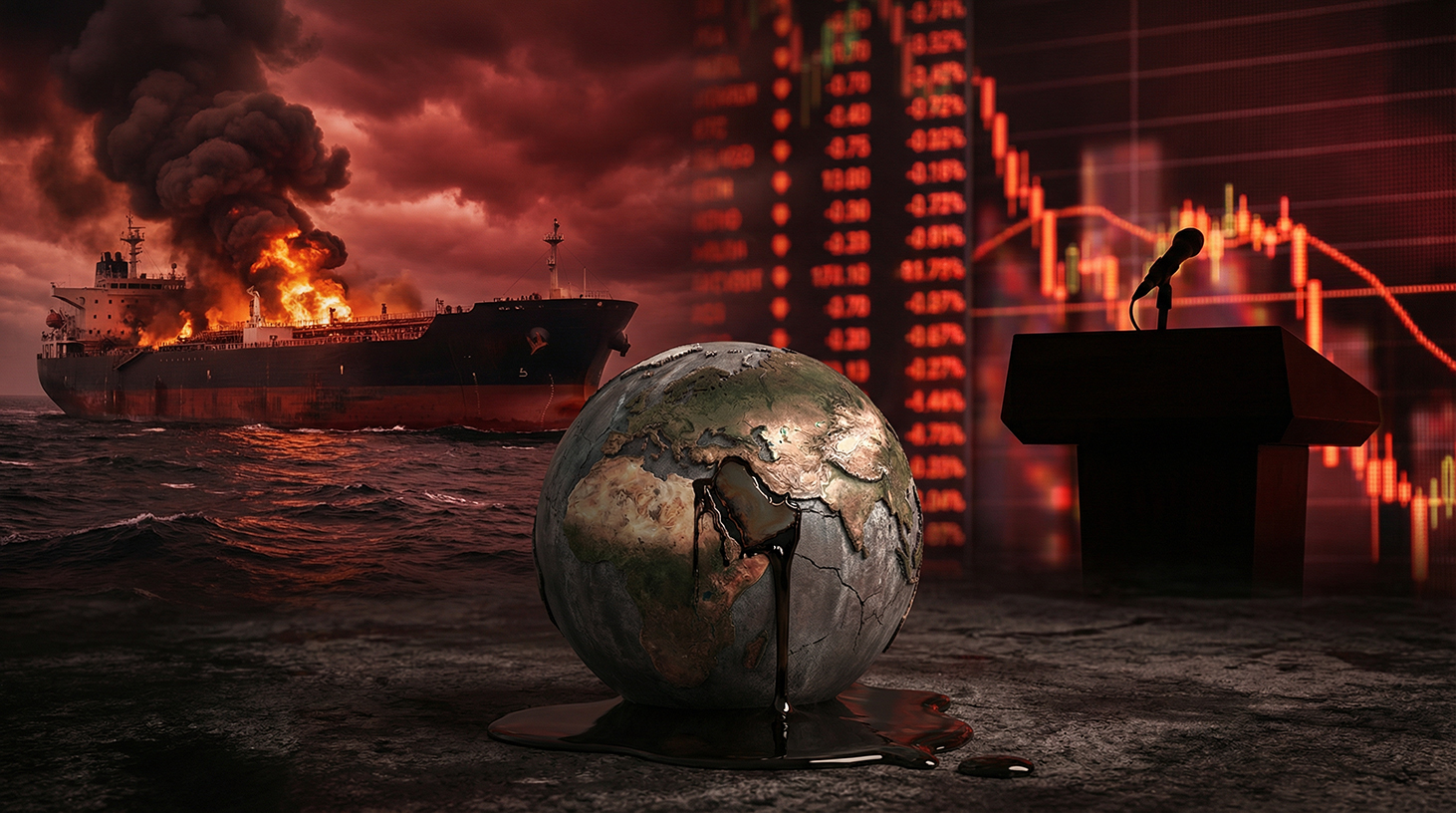
Trump's Middle East escalation as a lesson in the failure of non-partnership foreign policy – Image: Xpert.Digital
Energy War 2026: When the haphazard policies of one individual set the global economy ablaze
The bottleneck of the global economy: Why the escalation in the Gulf threatens our daily lives
The Middle East is ablaze, stock markets are in turmoil, and global energy supplies are facing a historic test. March 2026 vividly illustrates how US President Donald Trump's erratic and egocentric foreign policy around the Strait of Hormuz is not only sending geopolitical shockwaves but also shaking fundamental economic pillars. As the DAX index stumbles due to volatile individual decisions and the International Energy Agency (IEA) warns of the greatest energy threat in history, Germany's energy policy is also coming under intense scrutiny. This is an in-depth analysis of toxic unpredictability, self-inflicted vulnerability, and the pressing question of why reliable multilateral action is more vital today than ever before.
Energy war and ego politics: When unilateralism sets the world on fire
Anyone who views the Middle East in March 2026 as a political and economic laboratory will recognize the events surrounding the Strait of Hormuz as a prime example of a lesson. It's not just about oil, gas prices, or stock market indices. It's about the structural question of how selfish, uncoordinated foreign policy destabilizes global systems based on collective trust. True partners agree on their approach and don't demand changes when their own path fails. This applies on a large scale as well as on a small one.
The political rollercoaster and its consequences for the capital markets
Investors on international stock exchanges witnessed a spectacle at the start of the week whose dynamism is indicative of the current geopolitical situation. The German DAX stock index initially fell by 2.3 percent before recovering to a daily gain of 1.2 percent, closing at 22,653 points. Since the start of the Iran-Iraq War at the end of February, the DAX has lost more than 11 percent overall, a loss that has more than wiped out all the gains made at the beginning of the year.
The trigger for these market volatility was, as so often in this era, a tweet or message on the platform TruthSocial. US President Donald Trump had issued a 48-hour ultimatum to the Iranian regime: either Iran fully opened the Strait of Hormuz without threats, or the US would attack and destroy Iranian power plants, starting with the largest. Tehran promptly responded with counter-threats: a complete closure of the strait and attacks on energy facilities belonging to Gulf states.
The turning point came a few hours later. Trump extended his ultimatum by five days after what he claimed were very good and productive talks about a complete and final cessation of hostilities. The Defense Department was instructed to refrain from attacks on Iranian energy infrastructure for the time being. Shortly thereafter, the regime in Tehran announced that it was not currently holding talks with the US. This contradiction between Trump's announcement and the Iranian account is not accidental, but deliberate. It illustrates how a negotiation strategy based on threats, escalation, and subsequent retreat not only fails to produce lasting results but also systematically undermines the credibility of the actor involved.
The market reaction itself is particularly revealing. The fact that the mere suggestion of a change of course can move the DAX by more than three percentage points up or down demonstrates how extreme the markets' dependence on the political mood of a single decision-maker has become. This dependence is not only economically irrational but also structurally dangerous. Investment and planning security, the foundation of every entrepreneurial decision, is systematically destroyed by such political roller coasters.
The bottleneck of the global economy and its strategic dimension
The Strait of Hormuz is more than just a geographical bottleneck. It is the main artery of global energy supply. At its narrowest point, it is only 33 kilometers wide, and around 20 million barrels of crude oil pass through the strait daily, representing approximately 20 percent of global oil consumption. In addition, it carries about one-fifth of the global trade in liquefied natural gas, primarily from Qatar.
Since the start of the conflict, major shipping companies such as Hapag-Lloyd and Maersk have suspended all voyages through the region. Hapag-Lloyd introduced a war risk surcharge of $1,500 per standard container and $3,500 for refrigerated containers, while both companies began rerouting their vessels around the Cape of Good Hope at the southern tip of Africa. These detours significantly lengthen transit times and increase costs across the entire supply chain. Several major marine insurers have withdrawn their war risk coverage in the region, further exacerbating the situation for trade.
This logistical chain reaction explains why the damage extends far beyond immediate energy prices. The Strait of Hormuz carries not only oil and gas, but also fertilizers, sulfur, and helium. An interruption of these flows would impact agriculture, the semiconductor industry, and numerous other sectors that depend on these raw materials. The economic feedback effects of a prolonged conflict in this region can therefore hardly be overestimated.
The greatest energy threat in history: Birol's verdict
Fatih Birol, the 68-year-old director of the International Energy Agency (IEA), has caused a stir with a stark public warning. He had long refrained from making direct statements about the geopolitical situation. Now he has emphatically broken his silence. He wanted to warn the world, he said in Sydney, because he did not have the impression that political decision-makers had yet truly grasped the magnitude of the problem facing the world.
Birol draws a historical comparison that illustrates the severity of the situation. During the two major oil crises of the 1970s, the world lost approximately five million barrels of crude oil per day. Now, the global shortage is around eleven million barrels per day, more than the combined losses from the two major oil shocks of the 1970s. The current shock thus surpasses even the traumatic crises of 1973 and 1979 for the global economy. The scale of the gas crisis is even more dramatic: Losses in the Middle East amount to around 140 billion cubic meters, almost double the amount lost after the Russian invasion of Ukraine in 2022.
In response to rising prices, the IEA decided in mid-March to release 426 million barrels of oil from the strategic reserves of its 32 member countries. This is the sixth emergency release in the organization's more than 50-year history and by far the largest, more than double the amount released after the Russian invasion of Ukraine. At the same time, Birol made it clear that further steps could follow: consultations are underway with governments in Asia and Europe; 80 percent of reserves are still available. The IEA also recommends drastic energy-saving measures on the demand side: speed limits, mandatory working from home, and reduced driving. Even if the situation were to calm down, idled fields could not be restarted for up to six months.
Our global industry and economic expertise in business development, sales and marketing

Our global industry and economic expertise in business development, sales and marketing - Image: Xpert.Digital
Industry focus areas: B2B, digitalization (from AI to XR), mechanical engineering, logistics, renewable energies and industry
More information here:
A thematic hub offering insights and expertise:
- Knowledge platform covering global and regional economies, innovation and industry-specific trends
- A collection of analyses, insights, and background information from our key areas of focus
- A place for expertise and information on current developments in business and technology
- A hub for companies seeking information on markets, digitalization, and industry innovations
Resilience instead of dependence: Strategies for robust supply chains and energy supply
The inflation shock and its consequences for Europe
The economic consequences of the energy price explosion have already reached the everyday lives of European consumers. Since the beginning of the Iran-Iraq War, the price of oil has at times exceeded $120 per barrel, while gas prices have almost doubled in some regions. In Germany, the effects are directly noticeable at the pump: gasoline, diesel, and heating oil have become significantly more expensive, with prices of more than two euros per liter now commonplace.
The Institute for Macroeconomics and Business Cycle Research (IMK) predicts that the energy price shock triggered by the Iran war will raise the inflation rate in Germany significantly above 2.5 percent in the first and second quarters of 2026. This presents the European Central Bank (ECB) with a classic dilemma: if it raises interest rates to curb inflation, it will further burden the already weak economy; if it allows inflation to run its course, it risks losing credibility. Moreover, according to economic analysts, Europe is already under triple pressure: from US trade policy, from Russian destabilization in the energy sector, and from Chinese competition.
The DAX reached its lowest level since May 2025 in the third week of the war, losing 4.55 percent over the week. While the vast majority of companies suffered, there were some winners: Deutsche Börse's stock rose almost 9 percent in the third week alone, as volatility fueled the trading platform's core business. This is one of the bitterest ironies of the current situation: a lack of planning and volatility, generated by political volatility, create profiteers in the financial system, while the real economy and private households foot the bill.
Trump's foreign policy as an economic risk
The events surrounding the Strait of Hormuz are not an isolated incident, but rather fit into a clearly recognizable pattern of Trump's foreign policy. Trump explicitly defines the unsettling of trading partners and adversaries as a core element of his strategy. This unpredictability may bring short-term tactical advantages, but it destroys the institutional trust upon which functioning trade, investment, and international cooperation depend.
Trump's trade policy is characterized by the same principle. With tariff levels last seen in the 1930s, the Trump administration has severely strained trade relations with all major US partners. An analysis by the Konrad Adenauer Foundation notes that these tariffs have generated record revenues but are permanently hindering growth, increasing unemployment, and amplifying inflationary effects. Regarding transatlantic relations, Trump views key partnerships strictly transactionally, which has significantly damaged the US's popularity among the EU population. German economic researchers identify aggressive US unilateralism as the first of three key geoeconomic challenges for Germany, alongside declining global demand and uncertain access to raw materials.
The core problem lies in the nature of non-partnership-based foreign policy. A partner who makes agreements, honors them, and seeks solutions through dialogue creates predictability. An actor who threatens in the morning, backs down at midday, and escalates again in the evening creates the opposite: structural planning uncertainty. This situation is toxic for companies that have to make long-term investment decisions. Under such conditions, the question of whether a supply chain across the Strait of Hormuz will still be functional in six months simply cannot be answered.
Deutschlandfunk sums it up precisely: Trump is reversing the relationship between economics and politics. He is instigating trade wars, particularly with those countries that were once close partners of the US, while simultaneously making deals with dictatorships and terrorist states. This does not describe a coherent strategy for strengthening the US economy, but rather the systematic dismantling of the rules-based order in favor of short-term tactical gains.
Germany's self-inflicted vulnerability
In this global context, Birol focuses particularly sharply on Germany. The IEA chief's accusation is not new, but it carries particular weight in the current crisis. Germany made a huge strategic error by shutting down its nuclear power plants. He has been addressing this mistake for almost 20 years, he told the Frankfurter Allgemeine Zeitung. The situation would not be so dire today if Germany still had the power plants.
This criticism has a long history. As early as 2024, Birol described Germany's nuclear phase-out as a historic mistake that would negatively impact electricity supply and impair opportunities for emissions reduction. Chancellor Friedrich Merz (CDU) also described the nuclear phase-out as a serious strategic error and advocated for the reactivation of decommissioned reactors and the construction of modular mini-reactors. Birol himself sees considerable potential in these so-called Small Modular Reactors (SMRs) in the medium term and expects them to enter the market in the early 2030s.
The economic logic behind this criticism is clear: nuclear power provides a largely independent, geopolitically resilient electricity supply. It is not dependent on liquefied natural gas from the Persian Gulf, not dependent on Russian pipelines, and not dependent on weather conditions for wind and solar energy. A country that voluntarily forgoes this resilience makes itself structurally vulnerable in times of crisis. Germany is currently a prime example of how ideologically motivated energy policy leads to economic vulnerability.
Birol's historical comparison with the oil crises of the 1970s also contains a constructive component: the shocks at that time forced industry to make massive efficiency gains. Gasoline consumption in cars halved as a direct reaction to the oil crisis. Such adjustments are possible when the political will exists and the framework conditions are right. The question is whether the current crisis will generate the necessary pressure for reform, or whether, as after the 2022 gas price crisis, things will simply return to business as usual once the acute crisis subsides.
Structural lessons for a more resilient economic policy
What lessons can be learned from this accumulation of events? First, and this is the overarching finding: Global economic stability is a collective good. It arises from coordinated action, from rule-based institutions, and from the mutual adherence to agreements. Whoever erodes this foundation destroys the basis of their own economic capacity. Trump's America is a prime example of this. Tariffs that stifle growth. Threats that destabilize markets. Ultimatums that are withdrawn. The result is an economy that remains robust but fails to deliver on the promised golden age.
Secondly, the current crisis demonstrates how dangerous monocausal dependencies are in energy supply. Whether it was Russia's gas dependency in 2022 or the dependence on the Hormuz corridor today: energy security means diversifying sources, transport routes, and energy carriers. Those who forgo this diversification for cost reasons or ideological convictions pay a significantly higher price in a crisis.
Third, the behavior of financial markets in March 2026 underscores the need for geopolitical risk management. Companies that based their investment and supply chain planning on the assumption of stable geopolitical conditions are in a structurally weak position. Scenario planning, geographical diversification of supply chains, and more robust inventory strategies are not excessive caution, but rather an economic necessity in a world that has become structurally more unpredictable.
Fourth and finally, the question arises of the institutional counterweight. The IEA demonstrated impressive collective capacity for action by releasing 426 million barrels of oil. The coordination of 32 states into a unanimous emergency measure worked. This shows that multilateral institutions are not irrelevant in a crisis; they are indispensable. Especially in the face of an actor that has elevated unilateralism to a political doctrine, strengthening such institutions is the most important long-term response that Europe and the rest of the world can offer.










