
Merging warehouse worlds with AutoStore: How hybrid mega-warehouses are transforming the logistics industry
Xpert Pre-Release

Available in 27 languages 📢
Prefer Xpert.Digital on GoogleⓘPublished on: August 27, 2026 / Updated on: August 27, 2026 – Author: Konrad Wolfenstein
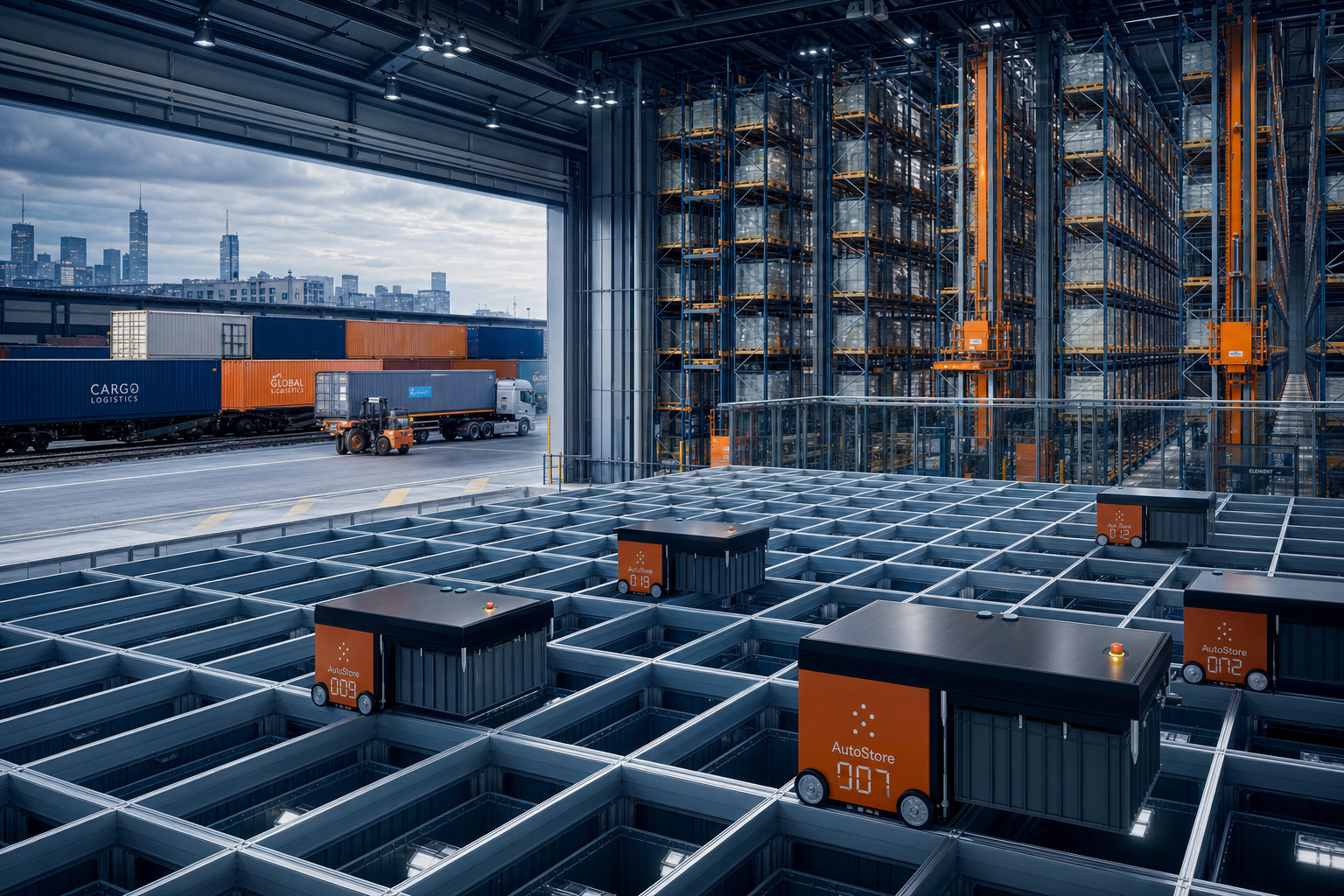
Merging warehouse worlds with AutoStore: How hybrid mega-warehouses are transforming the logistics industry – Creative image on the topic, with AI: Xpert.Digital
Small parts chaos vs. heavy loads: This warehouse concept solves the biggest problem for growing companies
Rail, robots, heavy loads: This is what the ultimate logistics center of tomorrow looks like
Despite a sales slump, a record deal: Why Amazon and others are now focusing on this hybrid super warehouse
Modern industrial logistics is undergoing a paradigm shift. Faced with chronic space constraints, rising personnel costs, and the pressure for ever-shorter delivery times, opting for a single warehouse system is often no longer sufficient. The solution lies in the intelligent fusion of extremes: when agile, high-density AutoStore robots for small parts meet the massive load-bearing capacity of classic pallet high-bay warehouses, top-of-the-line hybrid logistics centers emerge. When these worlds are synchronized in real time via a smart warehouse management system and directly connected to intermodal transport networks such as rail, they unleash enormous economic potential. But when does this multi-million-euro investment pay off, and how can the fundamentally different automation logics be seamlessly integrated from a technical perspective? The following article examines the economic, technical, and strategic facets of a combined warehouse architecture that is far more than just a short-term trend.
When robot cubes meet pallet giants
Anyone planning a modern distribution center today is increasingly combining two seemingly disparate automation philosophies within a single building. On the one hand, there's the AutoStore system, a high-density cube grid in which small robots move across stacked containers, potentially quadrupling storage capacity compared to traditional shelving. On the other hand, there's the classic high-bay warehouse, designed for pallets, heavy loads, and large quantities of goods, served by stacker cranes that have formed the backbone of industrial logistics for decades. The real economic advantage lies not in the existence of both systems, but in their intelligent integration via shared conveyor technology, a central warehouse management system, and increasingly, direct connections to intermodal transport modes such as rail and container shipping.
A practical example illustrates this principle. A logistics center was built for the Austrian iDM Group, the centerpiece of which is an AutoStore small parts warehouse that shares its conveyor technology and all picking workstations with a three-aisle pallet high-bay warehouse. The high-bay warehouse, measuring 57.5 x 22.5 x 31 meters, is directly connected to the receiving area via pallet conveyor technology, while the 16,000 AutoStore bins are stored on seven levels. A central warehouse management system ensures that both palletized goods and goods from the cube storage system can be picked simultaneously at each workstation, creating a single, synchronized material flow from two separate technological environments.
Two automation logics, one common goal
To understand the economic logic of this combination, one must weigh the fundamentally different strengths of the two systems against each other. AutoStore was designed for small, high-frequency items in high volumes and scores particularly well due to its extreme space efficiency and modular, cube-shaped design that can extend over several floors. High-bay warehouses, on the other hand, are the established solution for heavy, bulky, or palletized goods, where throughput capacity for large volumes and weights is more important than compactness. An example of this combination is provided by the German company Amphibolin-Werke, which combined a logistics center with an automated high-bay warehouse for approximately 30,000 pallet spaces and an AutoStore system with 12,000 bins for around 3,500 items under one roof, supplemented by an automated picking buffer with approximately 1,500 pallet spaces. Crucially, both automated warehouses must be integrated holistically and directly into a central enterprise warehouse management system, because only in this way can the individual solutions reach their full economic potential.
The ultimate technical challenge lies in synchronizing the flow of goods from asynchronous storage areas. While the AutoStore system operates decentrally and self-organizingly, a high-bay warehouse with stacker cranes and distribution carts requires a different, often centrally controlled logic. Specialized connectors handle the real-time synchronization of inventory data between the warehouse management software and the AutoStore system, ensuring that a picking order at the workstation is matched with the correct container and pallet at precisely the right time. However, in very large systems with tens or even hundreds of thousands of containers distributed across numerous ports and multiple building sections, the purely self-organizing principle of the system reaches its limits. Therefore, additional central workstation controls become necessary to assign express and standard orders to specific picking stations.
From small parts to heavy loads in one system
The integration of heavy-duty logistics into AutoStore environments marks the logical next step in the development of these combined solutions. A prime example is the Innsbruck-based company Sport Okay, which combined its AutoStore system with an automated connection for automated guided vehicles (AGVs). Based on swarm intelligence, the AGV technology transports large items in shelving units directly to the picking zone, enabling the joint picking of large and AutoStore items. This allows the entire product range, from small to large, to be handled within a single, integrated system. In the second expansion phase, 44 robots with approximately 55,000 bins and twelve workstations already handle around 336 putaways and returns, as well as 800 picking operations per hour. Completed picking is then automatically transferred to the packaging line via additional AGVs, ensuring a seamless material flow from storage to shipping without any manual transfer points.
This merging of small parts and heavy-load logistics solves a classic dilemma for many growing companies. Those who rely solely on high-bay warehouses waste considerable space potential for small, high-frequency items because pallets are completely oversized for individual quantities. Conversely, those who rely exclusively on AutoStore reach the system's physical limits with bulky or heavy goods, as container sizes and load capacities are restricted. The combination allows each product group to be stored in the most economically efficient subsystem and yet still brought together at shared picking workstations, significantly increasing overall warehouse productivity without increasing complexity for personnel.
Connections to rail, road and containers
The truly groundbreaking aspect lies in linking these hybrid warehouse architectures with intermodal transport, i.e., the use of multiple modes of transport such as rail, road, and waterway for a single, seamless journey. Intermodal terminals are thus evolving from mere interfaces between transport modes into fully integrated, cooperative elements of a digital logistics chain. Modern terminal operating systems no longer simply control the handling of containers, but are interlinked with upstream and downstream warehousing processes, enabling incoming containers to be dispatched directly and directed to the appropriate storage area without unnecessary intermediate storage.
For a distribution center with AutoStore and high-bay warehouse components, an intermodal connection to a rail terminal or combined transport system means that incoming goods from rail freight flow directly into the high-bay warehouse via pallet conveyor technology, while smaller items are subsequently fed to the AutoStore system via automated distribution carts and conveyor ports. Specialized software for intermodal transport manages the entire electronic order and booking process, from planning and costing to scheduling and invoicing of combined transport. This integration reduces gaps in the data flow, shortens storage times at the terminal, and ultimately lowers the overall costs of the transport chain because transshipment processes are no longer planned in isolation but as an integral part of warehouse logistics.
LTW Intralogistics Solutions

LTW Intralogistics – Engineers of Flow - Image: LTW Intralogistics GmbH
LTW offers its customers not individual components, but integrated complete solutions. Consulting, planning, mechanical and electrotechnical components, control and automation technology, as well as software and service – everything is networked and precisely coordinated.
In-house production of key components is particularly advantageous. This allows for optimal control of quality, supply chains, and interfaces.
LTW stands for reliability, transparency, and collaborative partnership. Loyalty and honesty are firmly anchored in the company's philosophy – a handshake still means something here.
Related to this:
Warehouse strategy: Why hybrid automation is the answer to rising costs
Economic efficiency in figures
The economic evaluation of such combined projects follows clear key performance indicators, even though the specific investment amount is naturally highly project-dependent. An independent economic analysis of AutoStore investments determined that, for a model company, benefits of €11.08 million over a three-year period compared to costs of €6.18 million, corresponding to a net present value of €4.9 million, a payback period of 18 months, and a return on investment of 79 percent. An Australian lock manufacturer even achieved energy savings of 85 percent after moving to an AutoStore system, with a payback period of less than two years. More generally, the target payback periods for worthwhile warehouse automation projects are usually less than five years, with many even achieving amortization within three years.
The cost structure of manual warehouse processes clearly illustrates why these investments often pay off. In manual warehouses, personnel costs are frequently the largest expense, with order picking alone accounting for over 55 percent of operational warehouse costs. In a concrete example, the total cost per picking position drops from approximately €0.60 in manual operation to €0.24 after automation. With a corresponding volume, this can lead to annual cost savings of around €92,000, allowing the investment to pay for itself within just 18 months. A more detailed model calculation for a medium-sized automation project with total investment costs of €4 million, including acquisition costs, installation, integration, and structural modifications, yields a payback period of approximately 2.3 years and a return on investment of 43.5 percent in the first full year of operation, based on an annual net benefit of €1.74 million. Even in a more conservative scenario with lower throughput growth and halved energy savings, the payback period of 2.75 years remains economically robust.
Crucial for a reliable cost calculation is the complete recording of the Total Cost of Ownership (TCO). Neglecting maintenance, training, software licenses, spare parts, energy, and internal change management in cost accounting will only embellish the results and lead to a harsher reality later on. As a rule of thumb, automation becomes more worthwhile the higher the current picking costs are for personnel, errors, and space requirements, and the greater the expected future volume. For smaller volumes with fewer than 1,000 picks per day or under 2,000 item positions, a well-organized manual warehouse often remains the more flexible and cost-effective solution, which doesn't automatically make a combination strategy the best choice for every company.
The manufacturer benefits from the tailwind of volatile markets
The Norwegian AutoStore Group is experiencing a period of financial volatility, which offers an insightful perspective on the demand dynamics of the entire industry. After revenue of US$646 million in 2022, the group's revenue declined to US$601 million in 2023 and then to US$539 million in 2025. In the third quarter of 2025, the company generated revenue of US$139 million, representing a 3.7 percent increase compared to the previous quarter, but a 3.6 percent decrease year-over-year. Revenue is evenly distributed across the apparel, industrial, third-party logistics, and retail sectors, with industrial (22 percent), apparel and sporting goods (20 percent), and third-party logistics (14 percent) being the largest segments. Geographically, the group remains strongly focused on Europe, the Middle East and Africa, which accounted for around 68 percent of total sales in the third quarter of 2025, while North America contributed 25 percent and the Asia-Pacific region only 7 percent.
The recent recovery in operations is remarkable. In the fourth quarter of 2025, revenue was already 9 percent higher year-over-year and even 29 percent higher quarter-over-quarter, while for the full year 2025, revenue of US$539 million resulted in a gross margin of 72 percent and an adjusted EBITDA margin of 42 percent. In the second quarter of 2026, the company reported a revenue jump of 43.5 percent to a record US$192.1 million, fueled in part by a significant contract with the retail giant Amazon. These figures exemplify how cyclically the willingness to invest in warehouse automation is linked to macroeconomic conditions, interest rates, and consumer sentiment, but also how quickly the business can recover when industrial investment activity picks up again.
Competitive landscape of warehouse architectures
Besides AutoStore, competing automation concepts exist on the market, which must always be considered when deciding on a combined solution. Storage and retrieval machines, shuttle systems, and AutoStore systems differ fundamentally in their design, footprint, throughput, and investment structure. AutoStore, as a robot-assisted compact storage system, operates entirely without traditional aisles. This aisle-free design is the primary reason for its enormous space efficiency, but it also introduces inherent limitations when very high throughput is required for individual items, because accessing containers located deep within the grid generally requires more robot movements than accessing them via an open aisle.
The following overview summarizes the key differences between the two system worlds under focus.
| feature | AutoStore cube system | Classic high-bay warehouse |
|---|---|---|
| Target goods | Small parts, high-frequency items | Pallets, heavy loads, bulky goods |
| Space efficiency | Up to four times the density compared to shelf boards | High building height, but lower density per item |
| Control principle | Decentralized, self-organizing | Centrally via storage and retrieval machines and distribution trolleys |
| Scalability | Modularly expandable over several floors | Expansion is usually subject to structural limitations |
| Typical amortization | Often 18 to 24 months | Project-dependent, usually medium to long term |
The competitiveness of a combined solution ultimately depends less on the technology itself than on the quality of the integration software. Without a robust, real-time synchronized database across all subsystems, even the most sophisticated hardware combination remains a patchwork of parallel, isolated solutions that fails to realize its potential efficiency gains.
AutoStore & Co.: When do multi-million dollar investments really pay off?
Despite the undeniable technical appeal of these combined solutions, a sober economic assessment is warranted. The investment costs for an integrated logistics center with AutoStore, high-bay warehouse, and intermodal connectivity quickly reach the mid-single-digit to low double-digit millions, making such projects primarily economically viable for medium-sized and large companies with correspondingly high and stable throughput. Smaller businesses with fluctuating volumes risk investing in oversized systems whose capacities are never fully utilized, which can significantly extend the projected amortization period.
At the same time, the recent revenue performance of market leader AutoStore demonstrates that the industry's investment cycles are sensitive to macroeconomic fluctuations, making planning more difficult for suppliers, system integrators, and construction companies. The temporary revenue dip between 2023 and 2025, followed by a significant recovery in 2026, suggests that companies are increasingly viewing automation decisions as strategic, recession-proof investments in resilience and efficiency, rather than immediately postponing them in the face of short-term demand fluctuations. This perspective suggests that combining small parts, heavy-duty, and intermodal logistics in an integrated system is not a short-term trend, but rather a structural response to rising labor costs, scarce commercial space, and increasing demands for delivery speed in the European economic area. Those investing in such a hybrid system today are not primarily buying technology, but above all, organizational flexibility for a decade of increasingly challenging logistics conditions.
Consulting - Planning - Implementation

Konrad Wolfenstein
I would be happy to serve as your personal advisor.
You can contact me at wolfenstein∂xpert.digital or
Just call me on +49 7348 4088 965 .
Your intralogistics experts

Consulting, planning and implementation of complete solutions for high-bay warehouses and automated storage systems - Image: Xpert.Digital
More information here:










