
Looking for a digital marketing agency from Esslingen, Göppingen or Geislingen?

Available in 27 languages 📢
Prefer Xpert.Digital on GoogleⓘPublished on: June 3, 2021 / Updated on: June 12, 2021 – Author: Konrad Wolfenstein

Online marketing agency for Esslingen, Göppingen or Geislingen – Image: wavebreakmedia|Shutterstock.com
Personalized customer communication
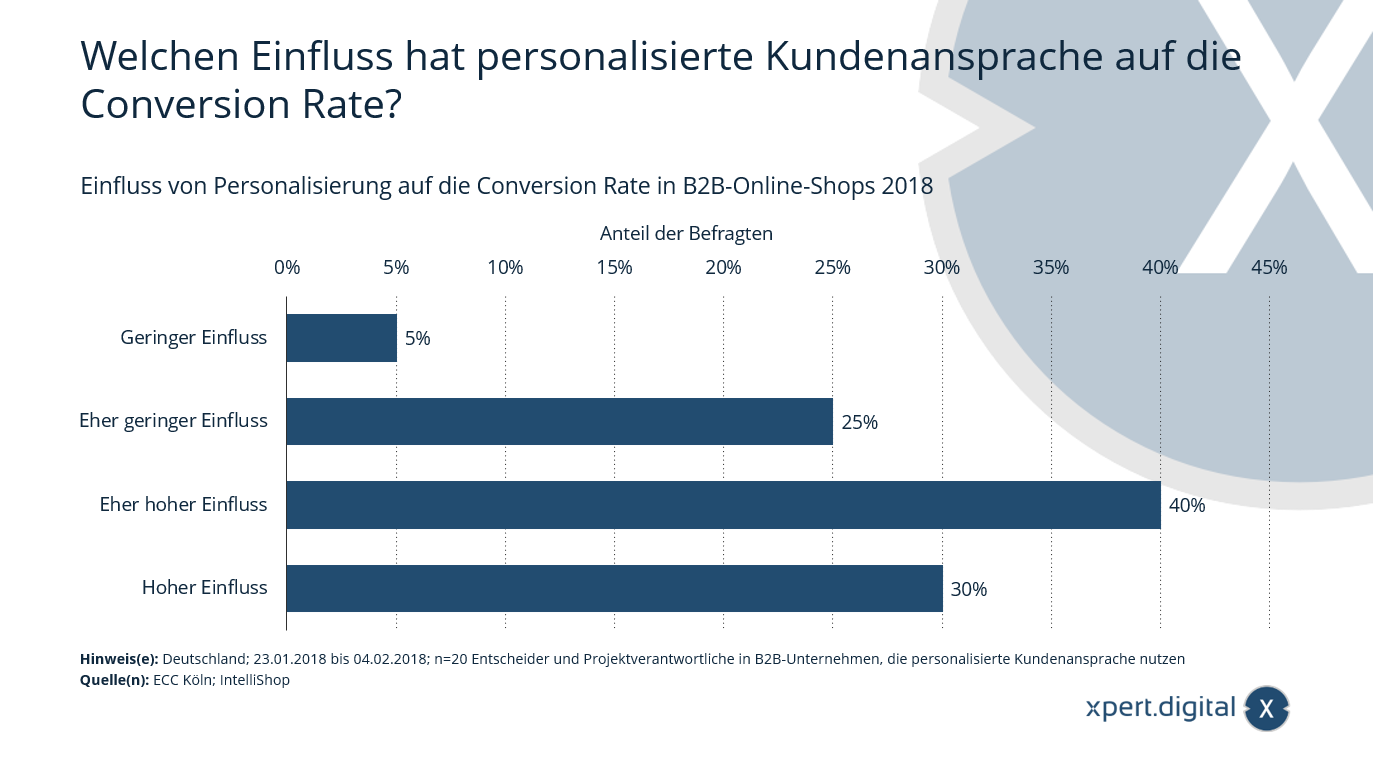
According to a survey, personalized customer communication has a high impact (30%) and a rather high impact (40%) on the conversion rate in B2B. The higher the conversion rate, the greater the brand awareness and brand identity. It also indicates that you know your target audience, provide them with relevant and effective content, and that they, in turn, are grateful and give you their attention.
Personalized customer communication – Image: Xpert.Digital
This statistic shows the results of a survey on the influence of personalized customer communication on the conversion rate in B2B online shops in Germany. At the time of the survey in 2018, 40 percent of respondents stated that personalized customer communication has a rather high influence on the conversion rate.
- 5% – Minor impact
- 25% – Rather little influence
- 40% – Rather high influence
- 30% – High influence
Marketing Personalization
Personalization was named the Marketing Word of the Year 2019 by the Association of National Advertisers (ANA). This decision proved well-founded, as personalization has become one of the most essential marketing strategies among industry experts, particularly in the United States. Marketing personalization, or the practice of using personal data to initiate targeted advertising, has been rapidly adopted by brands and companies across various industries in recent years. While the proportion of marketing budgets allocated to personalization can vary, a recent survey revealed that 33 percent of marketers in the United States and the United Kingdom (UK) spend more than half of their online marketing budgets on personalization efforts. This percentage is likely to increase in the future, as advances in technology, data, and analytics allow marketers to personalize customer experiences across more channels and customer journey stages than ever before.
Marketer's perspective: Personalization is key
Marketers are using personalization tactics in their digital marketing campaigns more than ever before. According to a recent survey, the percentage of professionals using marketing personalization in the US ranges from 78 to 96 percent, depending on the industry, demonstrating how valuable personalization has become in today's competitive marketing landscape. In 2020, email was the most widely used digital channel for personalized communication among US marketers, which is not surprising given that messages delivered via this medium are highly customizable, easily digestible, and non-invasive. The email format allows marketers to address (potential) customers by name, personalize subject lines, and tailor the email text to their target audiences. Other popular techniques include customizing product recommendations based on a customer's search and purchase history, a strategy long employed by e-commerce giants.
When asked about the most important benefits of marketing personalization in 2020, industry experts cited the improvement of customer experience, conversion rate and visitor engagement as the main culprits.
Consumers value personalized experiences more than quantitative content
Personalization is becoming not only a competitive advantage but also something customers now value and expect. A 2019 survey on personalized marketing revealed that 90 percent of US consumers surveyed found company messages that were not personally relevant to them annoying. A 2020 survey on the frequency of using personalized recommendations confirmed these findings, revealing that over 65 percent of internet users in the US and UK shop with product recommendations at least occasionally. In today's highly competitive e-commerce market, purchasing decisions are visibly influenced by the relevance of the content. To receive the most valuable suggestions and a personalized online experience, many internet users are willing to share email addresses or other personal data with companies. This data flow and its use for personalization purposes is likely to accelerate in the future as marketing technology, based on machine learning and artificial intelligence, continues to evolve.
Account Based Marketing is a go-to-market strategy that coordinates personalized marketing and sales efforts to acquire and expand target customers.
Account Based Marketing (ABM)
Account-based marketing (ABM) originated in the USA in the mid-2010s, emerging from key account marketing. In Germany, ABM has been actively used since around 2014, but is still not widespread. ABM is a strategic form of B2B marketing. Relevant business customers are considered "target accounts." These are identified, qualified, and approached in a personalized manner. ABM is typically used in marketing and sales departments to acquire large and medium-sized companies as customers.
Account-based marketing makes sense for companies that
- They want to address a small number of high-quality B2B customers in a highly individualized manner.
- have a highly targeted, clearly defined audience.
- Offer high-priced niche products or services.
- To deepen existing customer relationships in the long term through upselling, cross-selling and reselling.
- not just one decision-maker, but an entire decision-making body (so-called Buying Center) wants to convince of the same business deal.
- to optimally coordinate marketing and sales activities.
- to identify relevant new customers (so-called leads) early and clearly.
- want to conduct targeted automated B2B marketing.
Key tools and topics in German Account Based Marketing
Identification of Target Accounts:
- Website user recognition
- Intent signals
Qualifying leads:
- Company data (Firmographics)
- Technical data (Technographics/technographic data)
Addressing and converting:
- Account-Based Advertising
- Geotargeting by Google Ads
- personalized direct mail
Initially, the term "flip-the-funnel" emerged in Account Based Marketing: While in the "classic marketing funnel" many potential customers are approached, of whom only a few actually become customers, in ABM it works the other way around.
A new funnel concept has emerged for Account Based Marketing (ABM): the ABM funnel is depicted as a double funnel in the shape of an hourglass. First, many potential target customers are identified. These are then filtered in a qualification phase. In the third step, a larger group of people is addressed again through entire "buying centers.".
In Europe, data protection regulations, and in Germany the General Data Protection Regulation (GDPR), place special demands on account-based marketing (ABM). To ensure ABM complies with data protection and GDPR regulations, a strict distinction is made between personal and company-related data. This separation is currently supported by only a few, primarily European, ABM platforms.
Agreement with the statement: “Account Based Marketing (ABM) will replace classic outbound marketing in the coming years”
Account Based Marketing (ABM) – Image: Xpert.Digital
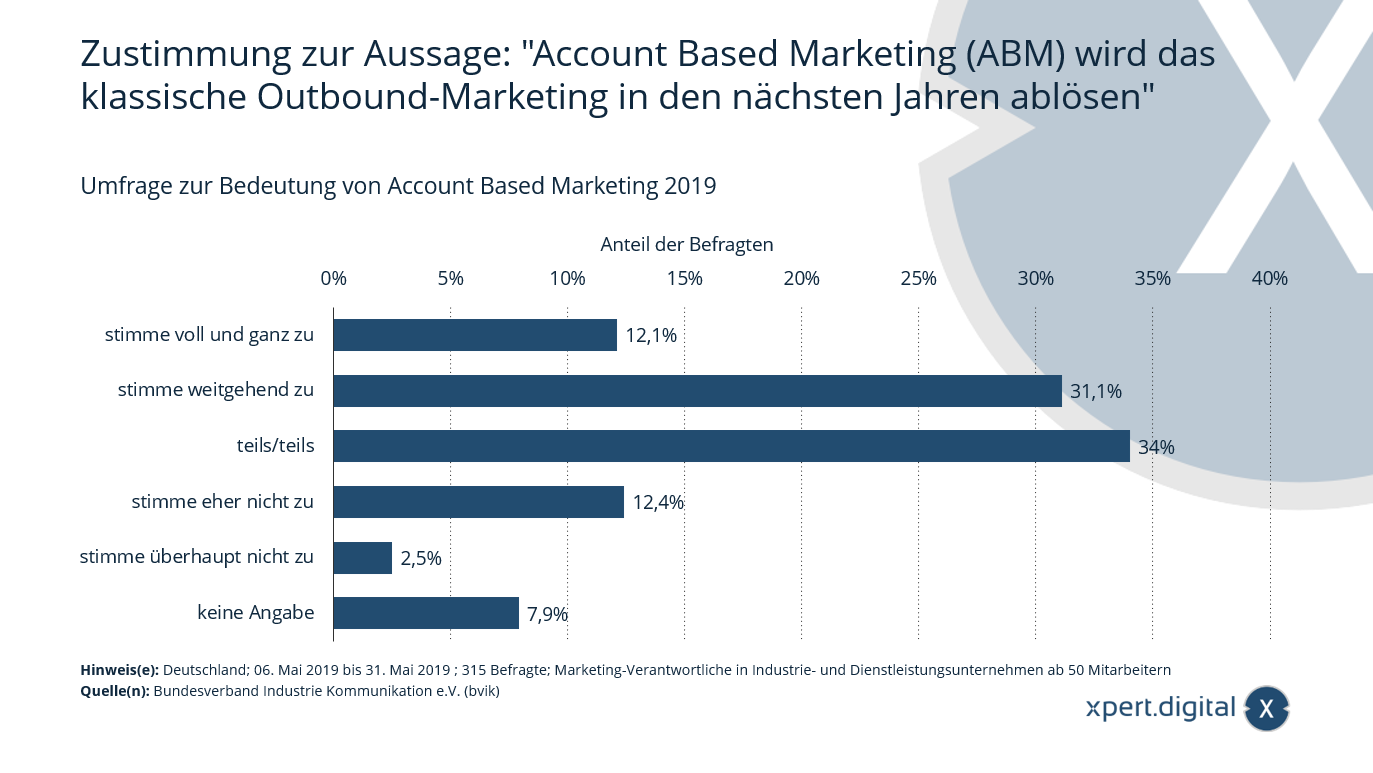
In May 2019, nearly 12.1 percent of B2B marketers from German industrial and service companies fully agreed with the statement "Account-based marketing (ABM) will replace traditional outbound marketing in the coming years." A further 31.1 percent of respondents largely agreed with the statement. The survey included 315 marketing managers from industrial and service companies with 50 or more employees.
- 12.1% – Strongly agree
- 31.1% – Largely agree
- 34% – Partly/partly
- 12.4% – Somewhat disagree
- 2.5% – Strongly disagree
- 7.9% – No information provided
Level of acceptance of account-based marketing (ABM) among B2B marketers worldwide
Acceptance of Account-Based Marketing (ABM) – Image: Xpert.Digital
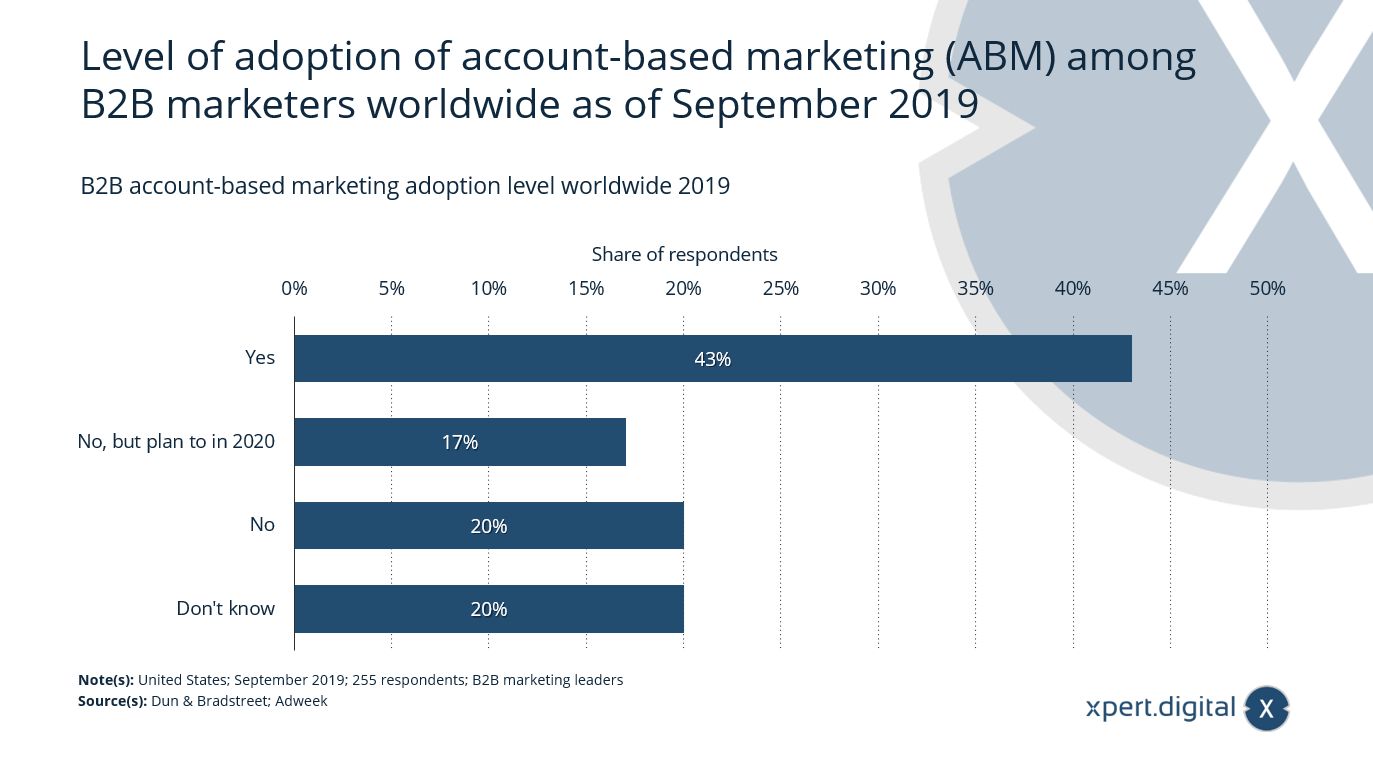
A survey of B2B marketing professionals worldwide, conducted in September 2019, found that 43 percent of respondents already use Account Based Marketing (ABM) as part of their strategy. ABM is based on a focused and collaborative approach to specific customer accounts by marketing and sales departments, enabling them to view the entire customer journey and personalize the customer experience.
- 43% – Yes
- 17% – No, but planned for 2020
- 20% – No
- 20% – Don't know
Current PDF libraries to support your marketing planning and activities
We provide you with numerous further insights into figures, data and facts that can help you optimize and expand your marketing:
- Customer Demographics Library – Demographics Knowledge Database (PDF)
- Online Marketing Library (PDF)
- E-Commerce Library – Knowledge Base (PDF)
- Social Media Marketing Library – Knowledge Base (PDF)
- SEO Library – SEM Knowledge Base (PDF)
- Search Engine Advertising / SEA Library – Search Engine Advertising Knowledge Base (PDF)
- Extended Reality (XR) Library (PDF)
Do you need more input on the topic of marketing?
- Content marketing: The ultimate discipline with obstacles and the most valuable types of content marketing
- The most effective marketing channels for leads, the most effective tactics, the most effective early-stage engagements, and the most effective channels for increasing conversions
- Marketing strategies and trends
- Marketing challenges. Are you new to the company or is your marketing no longer running smoothly? You should ask yourself three questions
More topics on SEO
- The ultimate discipline for search engine optimization and search engine marketing: Mobile SEO
- SEO focus: Mobile-friendly for local information searches
- Local search optimization: "Nearby" search in Google Maps
- Search Engine Advertising
- How your target audience interacts is crucial for SEO, SEA and SEM
- Business Research: Keeping an eye on things
That's why Xpert.Digital is for Esslingen, Göppingen and Geislingen!

Konrad Wolfenstein
I would be happy to serve as your personal advisor.
You can contact me by filling out the contact form below or simply call me on +49 731 37 999 300 .
I'm looking forward to our joint project.
Write to me

Xpert.Digital – Konrad Wolfenstein
Xpert.Digital is a hub for industry focusing on digitalization, mechanical engineering, logistics/intralogistics and photovoltaics.
With our 360° Business Development solution, we support renowned companies from new business to after-sales.
Market intelligence, smarketing, marketing automation, content development, PR, mail campaigns, personalized social media and lead nurturing are part of our digital tools.
You can find more information at: www.xpert.digital – www.xpert.solar – www.xpert.plus
Keep in touch










