

Logistics crisis and the new mega crane for BASF: Why the 100-million-euro project doesn't solve the real crisis
Xpert Pre-Release

Available in 27 languages 📢
Prefer Xpert.Digital on GoogleⓘPublished on: August 19, 2026 / Updated on: August 19, 2026 – Author: Konrad Wolfenstein
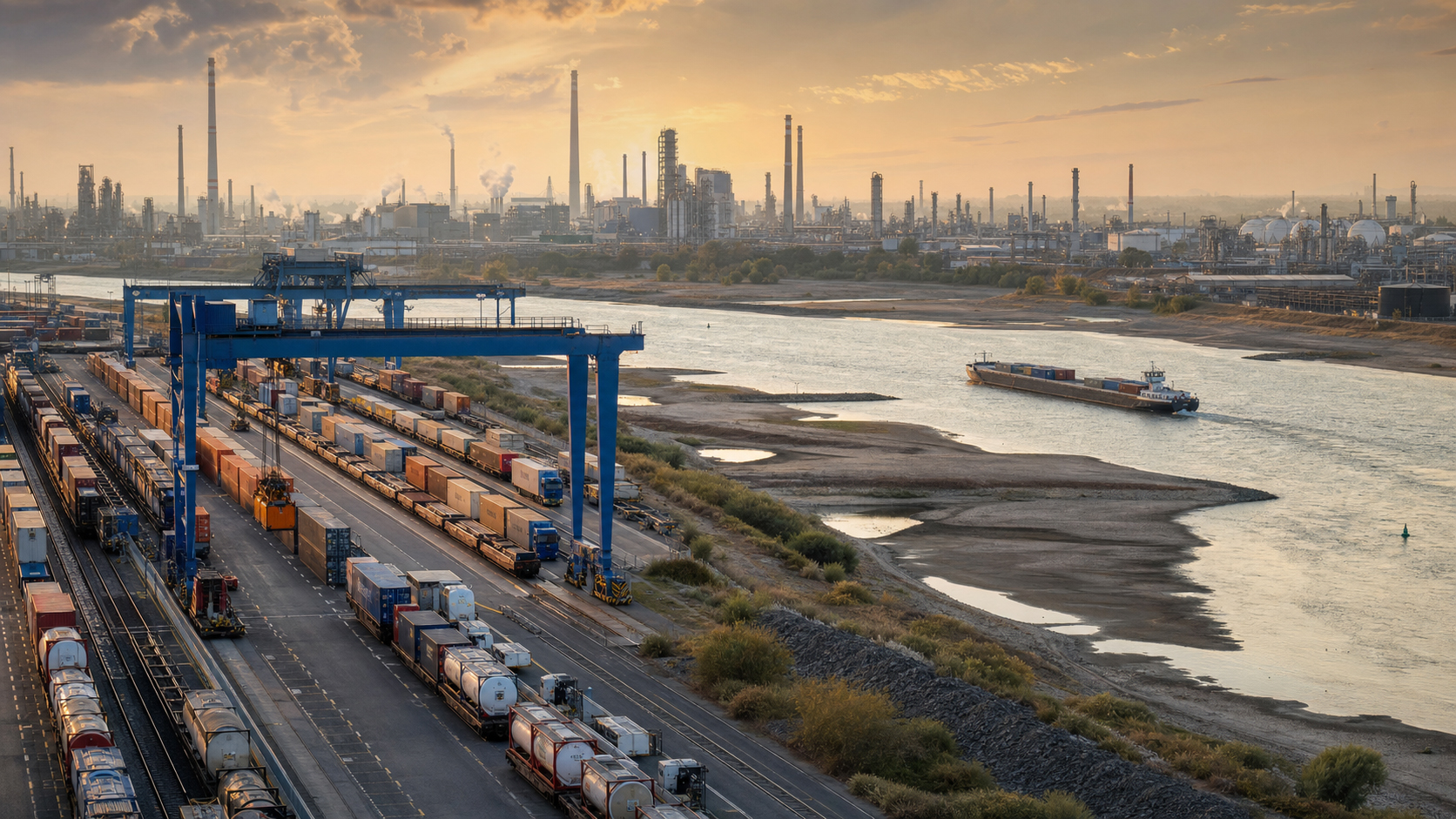
Logistics crisis and the new mega crane for BASF: Why the 100-million-euro project doesn't solve the real crisis – Creative image on the topic, with AI: Xpert.Digital
Record drought on the Rhine: How BASF is now reacting to the historic logistics crisis
Production reduced, freight costs exploding: This is how hard the drought is hitting chemical giant BASF
BASF sounds the alarm: Why the industry's most important river is becoming its Achilles' heel
German industry is facing one of its greatest logistical challenges: The Rhine is experiencing historically low water levels, and one of the most vital arteries of the European economy is in danger of drying up. In the midst of this dramatic hydrological crisis in August 2026, the chemical giant BASF is launching a multi-million-euro expansion project at its main plant in Ludwigshafen. The expansion of the gigantic combined transport terminal is intended to shift significantly more goods to rail, thus reducing dependence on the waterway. But behind the ceremonial groundbreaking lies a harsh economic reality: Even the largest mega-crane cannot replace a flowing river. While cargo ships can only transport a fraction of their usual loads and transport costs are skyrocketing, not only BASF, but the entire German export industry must ask itself how long its decades-old logistics concepts will remain viable. This article sheds light on why the acute drought on the Rhine is far more than just a short-term weather anomaly – and what massive consequences this structural change has for corporations, investors and macroeconomic stability.
BASF between record drought and billion-dollar investment: The battle for logistics on the Rhine
On August 17, 2026, Federal Transport Minister Steffen Bilger and BASF CEO Markus Kamieth officially launched the modernization of the combined transport terminal in Ludwigshafen. At first glance, it appears to be a typical infrastructure announcement, the kind that regularly appears in German business journalism: a corporation invests, the government provides funding, and a minister gives a speech. However, the timing of this event is anything but coincidental, as it falls amidst one of the most dramatic hydrological crises the Rhine has experienced since systematic water level measurements began in 1880. The Kaub gauge, the key reference point for shipping between the Middle and Upper Rhine, temporarily plummeted to levels of around 17 to 19 centimeters in August 2026, significantly falling below the previous record low of 25 centimeters from the drought year of 2018. The symbolic crane lift in Ludwigshafen is therefore far more than just a routine announcement about site development. It is a signal of how much the German chemical industry is now forced to rethink its logistics architecture, which has grown over decades, because a river once considered reliable is increasingly becoming the Achilles heel of industrial production.
The nervous system of the world's largest chemical production site
To understand the significance of this project, one must consider the physical structure of BASF's main plant in Ludwigshafen. It is the world's largest integrated chemical production site, a network of thousands of kilometers of pipelines, steam boilers, reactors, and storage tanks that functions only because raw materials flow in and finished products flow out continuously. Around 40 percent of the volume produced in Ludwigshafen is traditionally transported via the Rhine, a figure that illustrates how deeply inland shipping is integrated into the company's business model. The combined transport terminal on the northern edge of the plant site was deliberately built in 2000 to complement this waterway logistics, with the clear objective of creating a second, weather-independent pillar for freight transport. Since its opening, the facility has handled more than 7.5 million transshipment operations between trucks and freight trains, which, according to the company, corresponds to the same number of truck journeys that could be avoided on longer routes. It is noteworthy that BASF's own products account for only 30 to 40 percent of the handled volumes, while the vast majority is transported by external freight forwarders and shippers. The terminal is therefore no longer merely a plant logistics tool, but a regional infrastructure hub whose failure would have noticeable consequences far beyond the plant boundaries.
An expansion project that has been in the pipeline for months
For a clear and objective assessment, it's important to understand that the terminal's modernization is not a spontaneous reaction to the current drought, but was announced and planned in detail as early as spring 2026. At the end of March 2026, BASF received a federal funding commitment of nearly €51 million after completing its internal review of the grant notification. According to the company, the total investment volume is in the low three-figure millions, although some reports specifically mention more than €100 million. The centerpiece of the construction project is the replacement of the four existing, aging gantry cranes with three new structures with a span of more than 100 meters, which will be able to handle significantly longer freight trains in the future. A later expansion to four cranes remains technically feasible. Simultaneously, the truck entry and exit areas are being optimized to reduce congestion and waiting times. Construction is planned over several years: the old terminal modules are scheduled to be closed and replaced by new buildings by mid-2027. The facility will operate at reduced capacity for approximately one year before full completion is targeted for the end of 2028. CEO Markus Kamieth quantified the climate impact of the new module, internally designated Module 50, at an annual saving of approximately 200,000 tons of carbon dioxide, because additional freight volumes can be shifted from road to the more climate-friendly rail network.
Why a crane cannot replace a river
However, this reveals the central economic weakness of the current communication strategy. The expansion of the combined transport terminal primarily addresses the road-rail axis, while the actual acute burden currently stems from the waterway. According to the German Freight Forwarding and Logistics Association (BVLS), inland navigation on the Rhine is currently losing up to 80 percent of its regular volume, as cargo ships can only transport a fraction of their usual load due to the shallow channel depth. The Rhineland-Palatinate Chamber of Industry and Commerce draws a clear line: below a water level of 40 centimeters at Kaub, economically viable inland navigation is practically impossible, and this threshold was significantly undercut for several weeks in August 2026. For tankers transporting crude oil or chemical products from Rotterdam to Karlsruhe in Rhineland-Palatinate, freight rates have reportedly risen from around €45 per ton at the end of June 2026 to between €120 and €125 per ton – an increase of more than two and a half times within just a few weeks. This cost explosion is hitting the chemical industry particularly hard because many of its raw materials, such as naphtha, ammonia, and other basic chemicals, are transported in large volumes and with low value density, meaning that logistics costs have a disproportionately large impact on the overall calculation.
The physical logic of low water
To understand why the problem is so persistent, it helps to look at the technical workings of inland navigation. According to the regulations of the Waterways and Shipping Administration, a cargo ship may never be loaded in such a way that its draft exceeds the available water depth of the fairway—a condition known in the industry as running aground, which is prohibited for safety reasons. If the water level drops, the cargo must be reduced so that the ship sits higher in the water. At a record low, like the one in August 2026, this means that a push convoy, which under normal conditions could transport several thousand tons, might only be able to utilize 15 to 20 percent of its capacity. Proportionally more trips are then required for the same amount of goods, which in turn requires more ships, more personnel, and more operating time, while the supply of available ships and experienced skippers cannot be scaled arbitrarily in the short term. A board member of the German Inland Waterways Transport Cooperative aptly summarized the historical significance of the situation, stating that he had never experienced such an early and pronounced period of low water in his 45 years in the profession. Particularly alarming is the warning from the Federal Association of German Inland Navigation that, with continued declines in water levels, the Rhine could become virtually unnavigable in its central section, effectively splitting into two separate shipping areas, one north and one south of the Kaub narrows.
Economic magnitudes beyond the chemical industry
Macroeconomic estimates of the consequential costs of this development vary, but paint a consistent picture of a noticeable, though not existential, burden on the German economy as a whole. The Kiel Institute for the World Economy estimates the loss in value added for the third quarter of 2026 alone at one to two billion euros, which corresponds to a dampening of gross domestic product by 0.1 to 0.2 percentage points, while other institutes even consider a decline of up to 0.4 percent possible. By comparison, the low water levels in the drought year of 2018, previously considered a historical outlier, reduced overall economic output by an estimated 0.4 percent. Wolfgang Große Entrup, Managing Director of the German Chemical Industry Association, formulated the causal chain unequivocally: If ships could carry less cargo or were to cease operations altogether, costs would rise, supply chains would come under pressure, and production would be restricted. Even for steel companies like Thyssenkrupp Steel in Duisburg, which rely on large quantities of iron ore and coal being shipped, smaller loads per trip lead to higher transport costs per ton, because significantly more ships and trips have to be paid for the same amount of goods. In light of the situation, the North Rhine-Westphalian Minister of Transport even called for a nationwide task force to mobilize alternative transport capacities in the short term – a proposal that underscores the political sensitivity of the issue
LTW Intralogistics Solutions – Intermodal Transport

LTW Intralogistics Solutions – Intermodal Transport – Image: LTW Intralogistics GmbH
LTW offers its customers not individual components, but integrated complete solutions. Consulting, planning, mechanical and electrotechnical components, control and automation technology, as well as software and service – everything is networked and precisely coordinated.
In-house production of key components is particularly advantageous. This allows for optimal control of quality, supply chains, and interfaces.
LTW stands for reliability, transparency, and collaborative partnership. Loyalty and honesty are firmly anchored in the company's philosophy – a handshake still means something here.
Related to this:
Low water levels on the Rhine: Why BASF is now investing heavily in new logistics
BASF in a state of emergency: First operational cutbacks
For BASF itself, the situation became concrete in August 2026. According to the company, the extremely low water levels of the Rhine meant that it could no longer fully supply some products, forcing it to throttle back production at certain plants. CEO Markus Kamieth emphasized at the groundbreaking ceremony that there had been no significant impact on the current year's financial results so far, but this assessment explicitly refers to the current situation and does not rule out a worsening of the situation if the drought persists. This wording is typical of the communication strategy of large chemical companies in such situations: they acknowledge the problem but simultaneously downplay its current financial impact to avoid unnecessarily amplifying market reactions. From an economic perspective, this reticence is understandable, as periods of low water are inherently volatile and can be alleviated by rainfall within a few weeks, as historical data has repeatedly shown. At the same time, the decision to stage the expansion of the combined transport terminal in a way that attracts public attention during this phase clearly demonstrates that the company takes the structural dimension of the problem very seriously and wants to actively counteract it.
Between resilience strategy and repair shop
The real strategic question arising from this complex situation is whether investments like the expansion of the combined transport terminal are actually suitable for solving the underlying problem, or whether they merely treat the symptoms. The honest answer lies somewhere in between. On the positive side, a more efficient road-rail connection structurally reduces dependence on the waterway and thus increases the site's resilience to future low water levels. With an annual capacity of up to 370,000 loading units on an area of approximately 260,000 square meters and 13 transshipment tracks, the terminal is already one of the largest of its kind in Europe, and the planned extension of the crane span to over 100 meters will allow for the handling of longer and therefore more efficient freight trains in the future. On the negative side, however, even a doubling of the rail capacity cannot nearly compensate for the sheer volume of goods traditionally transported via the Rhine. Germany's rail infrastructure is already suffering from chronic capacity bottlenecks, construction sites, and a backlog of repairs, meaning that shifting additional traffic to rail could create new bottlenecks elsewhere in the network. Furthermore, the expansion project will take more than two years to complete by the end of 2028, while the current crisis is already acute. Therefore, anyone expecting the new crane to alleviate this year's delivery bottlenecks is overestimating the short-term impact of what should be a sound long-term infrastructure decision.
Structural change instead of weather extremes
One aspect often overlooked in public debate is whether recurring periods of low water are still statistical outliers or already a new climatic norm. The available data increasingly supports the latter interpretation. As early as July 2026, unusually early in the year, industry representatives reported historically low water levels, long before the actual summer heat had even reached its peak. This earlier onset of the critical phase is economically significant because it shortens the timeframe in which companies can proactively plan their inventories and alternative transport routes. The increasing frequency of such events since 2018, 2022, and now 2026 suggests that the probability distribution of extreme droughts on the Rhine has indeed shifted, which must have profound consequences for the long-term location planning of water-intensive industries. For companies like BASF, this means that investment decisions can no longer be made solely based on the logic of amortization in normal years, but must explicitly factor in scenarios for recurring, multi-week total shutdowns of the waterway. Against this backdrop, the investment in the combined transport terminal appears less as a short-term crisis response and more as a long-overdue adjustment to a structurally changed risk landscape that has been apparent for years.
The capital market perspective: Between dividend stability and share price caution
From an investor's perspective, this complex situation presents a nuanced picture. BASF is traditionally considered one of the most reliable dividend payers in the German benchmark index, a reputation built on decades of consistent or increasing payouts, even during challenging economic periods. This long-term strength is not fundamentally jeopardized by the current low water crisis, as the company has already weathered similar situations, such as the drought in 2018, incurring significant additional costs but not facing an existential threat. At the same time, it is unwise for investors to ignore the current situation. Should the drought persist for several weeks or even months, the company faces the threat of substantial additional costs, similar to those experienced in 2018, due to more expensive alternative transport routes, reduced plant utilization, and potential delivery delays to customers. This complex situation suggests avoiding hasty purchase decisions in the short term, even if the stock remains attractive to income-oriented investors in the medium term. Investors already holding the stock should closely monitor its price development and keep an eye on standard hedging mechanisms, such as a stop-loss order around €39.00, to limit the risk of a sharp price decline should the logistics crisis worsen. This caution does not preclude a positive long-term outlook for the company, but merely reflects the understanding that short-term operational risks and long-term earnings potential must be assessed separately.
A test case for the entire German export industry
Beyond the specific case of BASF, the current situation raises fundamental questions about the resilience of German industrial logistics. The Rhine is not just any waterway among many, but the backbone of Europe's largest inland navigation system, transporting enormous quantities of raw materials, semi-finished, and finished products annually between the North Sea ports and the industrial heartland of North Rhine-Westphalia, Rhineland-Palatinate, and Baden-Württemberg. If a river of this importance effectively splits into two separate shipping zones for weeks, as the German Federal Association of Inland Navigation described as a real threat in August 2026, then not just a single company, but the entire export-oriented industrial structure of western Germany faces a fundamental logistical disruption. The proposed national task force for improving the transport situation should therefore be understood less as a political symbol and more as an expression of serious concern at the state level that the existing transport infrastructure is no longer adequate to cope with the new climatic realities. In this context, BASF's expansion of the combined transport terminal appears as a sensible but isolated piece of the puzzle in a much larger picture that would actually require a coordinated, supra-regional response, such as systematic deepening of critical fairway sections, accelerated expansion of parallel rail corridors, or increased investment in water-independent pipeline infrastructure for particularly critical raw material flows.
The infrastructure trap: Why BASF and Germany need new logistics concepts
In the end, the overall picture is ambivalent. BASF is acting economically rationally and strategically with the expansion of its combined transport terminal, reducing its dependence on an increasingly unreliable waterway while simultaneously utilizing government funding for a climate-policy-driven infrastructure project. At the same time, the timing of this expansion, coinciding with the most severe low-water crisis in recorded history, starkly illustrates how much the German chemical industry still relies on a 20th-century transport infrastructure that is no longer adequate for the climatic conditions of the 21st century. The new crane in Ludwigshafen will be able to handle more containers faster from 2028 onwards, but it will not add a single drop of water to the Rhine. This sobering realization should prevent both company executives and investors from mistaking individual measures for a complete solution to a structural problem that can only be sustainably addressed through a combination of infrastructure diversification, climate-resilient planning, and ultimately, an honest public debate about the long-term consequences of climate change for Germany's industrial base.
Consulting - Planning - Implementation

Konrad Wolfenstein
I would be happy to serve as your personal advisor.
You can contact me at wolfenstein∂xpert.digital or
Just call me on +49 7348 4088 965 .
Your container high-bay warehouse and container terminal experts

Container high-bay warehouses and container terminals: The logistical interplay – expert advice and solutions - Creative image: Xpert.Digital
This innovative technology promises to fundamentally change container logistics. Instead of stacking containers horizontally as before, they will be stored vertically in multi-story steel racking structures. This not only allows for a drastic increase in storage capacity within the same area, but also revolutionizes all processes at the container terminal.
More information here:










