
Stuck on the rail: Unpunctual freight trains as the core problem of the supply chain - solutions and recommendations
Xpert pre-release

Language selection 📢
Published on: May 3, 2025 / update from: May 3, 2025 - Author: Konrad Wolfenstein

Stuck on the rail: Unpunctual freight trains as the core problem of the supply chain - solutions and recommendations - Image: Xpert.digital
Rail network in need: 4 strategies that Germany's freight transport can transform for the future (reading time: 29 min / no advertising / no paywall)
The German rail network in freight transport: capacity bottlenecks and solution strategies for the supply chain
German rail freight transport is at a critical point. A structural discrepancy between the available infrastructure capacity and the constantly growing transport demand leads to considerable operational deficits. These defects have direct effects on the capacity and quality of the system. This report analyzes this challenge based on available data and critically evaluates four proposed strategic solutions. The urgency of this analysis is underlined by the overarching goals of the federal government in climate protection and the desired transfer of traffic to the environmentally friendly rail. Strengthening rail freight transport is an essential component to achieve these goals. The report is divided into an analysis of the core problem, an assessment of the individual solution steps, a synthesis of the results and final strategic recommendations.
Suitable for:

The challenge of the German rail network: a growing gap
Shrinking network meets increasing demand
The German rail network has experienced a significant reduction since the rail reform in 1994. The route length of the entire network dropped from around 44,600 km in 1994 to currently around 39,200 km. The network of Deutsche Bahn (today DB Infrago AG), as the largest operator, shrank even more in the same period, from 40,385 km to around 33,350 km in late 2024. This corresponds to a reduction in the DB network by about 17 % to 21 %, which corresponds to the number of approx. 21 % mentioned in the user query. Until 2006, this dismantling comprised the reduction of around 13,847 km of tracks and 58,616 soft and intersections in the DB network alone. Although only a few route lighting has been made since 2008, the network length remains significantly below the 1994 level.
At the same time, the transport performance in rail freight transport increased significantly. The user query puts the increase in traffic (in tons of kilometers, TKM) to around 80 %since 1994. While exact, consistent time series from the available sources are difficult to reconstruct, various data points confirm the trend of a massive increase in performance on a reduced network. In 2019, the traffic performance reached 129.2 billion TKM. Data for 2023 show 125.4 billion TKM for the larger railway traffic companies (EVU), after 134.3 billion TKM in 2022. In contrast, 336.8 billion TKM stood in 1994, whereby methodology and database may differ from the source of the user queries. The transport volume in tons in 2023 was 337.1 million t (larger EVU), a decline compared to 359.0 million t in 2022 and 366.9 million t (total survey). Despite these recent declines, the long -term trend of a significantly increased strain on the network remains compared to 1994. The market share of the rail on the entire freight traffic (Modal Split) rose only slowly, from 17.7 % in 2012 to 19.8 % in 2022, and in 2023 again slightly fell to 19.9 % (based on another basis of calculation). This indicates that the total freight traffic market, in particular road freight traffic (+103 % from 1991-2019), was able to grow stronger over long distances than the rail freight transport.
This opposite development - a significantly reduced network must be managed significantly more traffic - represents the fundamental structural problem. The network rationalization after 1994 has created a long -term capacity deficit. The fact that the majority of the dismantling took place before 2008, while the demand will continue to increase and will continue to be forecast growth in the future, means that the capacity gap created at that time was not closed. Rather, it is continuously tightened by the persistently high and potentially increasing demand, which leads to a cumulative pressure on the remaining infrastructure.
Development of the German rail network length vs. freight traffic/amount (selected years 1994-2023)
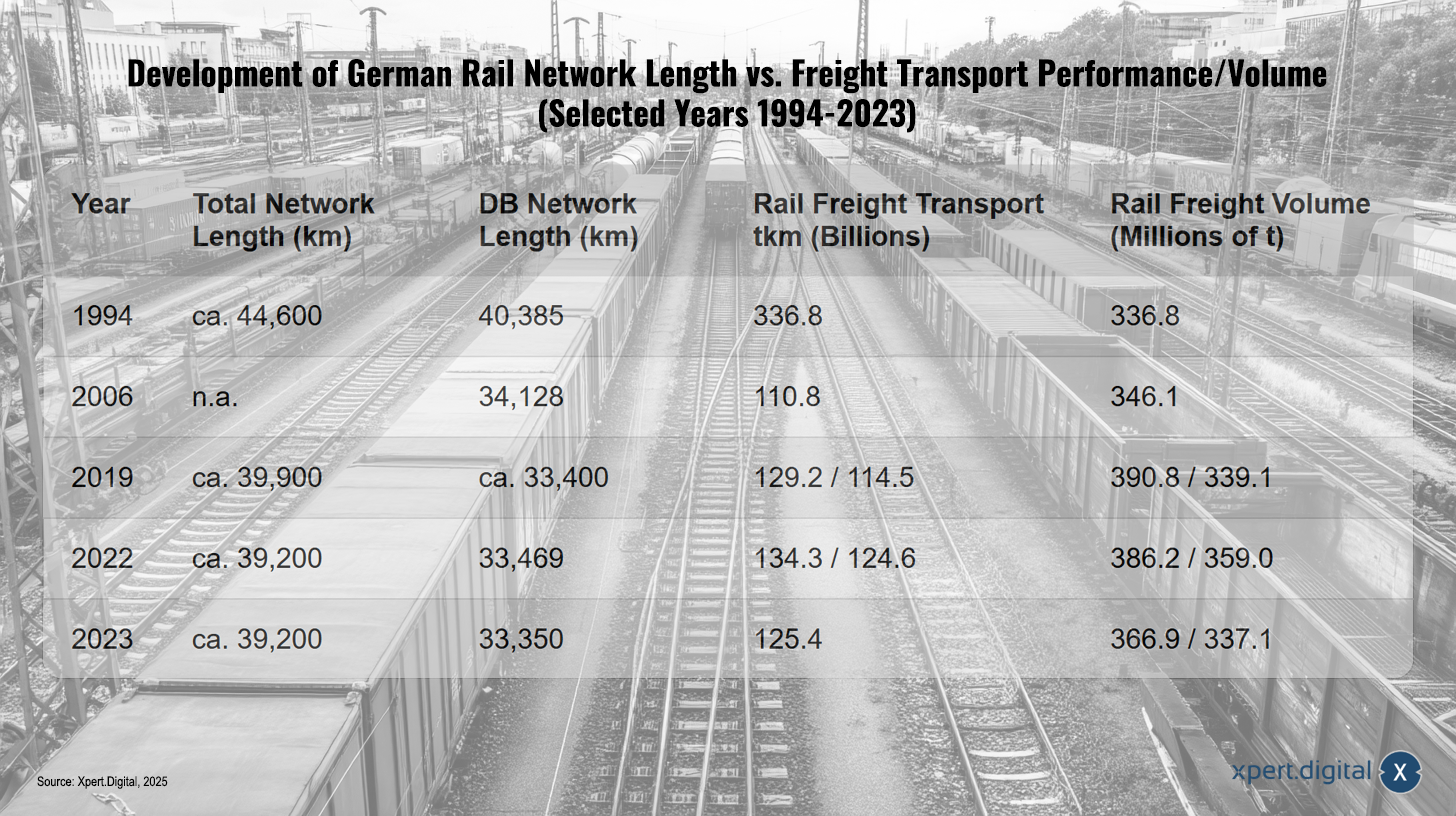
Development of the German rail network length vs. freight transport/amount (selected years 1994-2023)-Image: Xpert.digital
The development of the German rail network length compared to freight transport and quantity shows significant changes between 1994 and 2023. In 1994, the entire network length was around 44,600 kilometers, the length of the DB network was 40,385 kilometers. The rail freight transport reached 336.8 billion tons of kilometers and a lot of 336.8 million tons. By 2006, the DB network was reduced to 34,128 kilometers, while the freight traffic performance dropped to 110.8 billion tons of tons and the amount rose to 346.1 million tons. In 2019, the entire network length was around 39,900 kilometers, including around 33,400 kilometers of DB network. The performance indicators were 129.2 and 114.5 billion tons of kilometers and an amount of 390.8 or 339.1 million tons. In 2022 the entire network length was around 39,200 kilometers, with a DB network of 33,469 kilometers. The freight transport achieved 134.3 and 124.6 billion tons of kilometers and an amount of 386.2 or 359.0 million tons. In 2023, the total network length remained almost constant at around 39,200 kilometers, while the DB network length slightly declined to 33,350 kilometers. The freight transport was reduced to 125.4 billion tons of kilometers, with an amount of 366.9 and 337.1 million tons.
Note: Data for TKM and quantity can vary depending on the source (total survey vs. survey for larger companies with sections) and methodology (e.g. inclusion container weight KV from 2005). The values marked with * come from the survey among larger companies. Value for 2020.
Capacity bottlenecks and traffic jam hotspots
The high load of the shrinked network inevitably leads to bottlenecks. These focus in particular on the main corridors and the large railway nodes such as Cologne, Duisburg, Düsseldorf and Dortmund. An analysis of the rail network in North Rhine-Westphalia (North Rhine-Westphalia) already identified 24 sections of the route with an occupancy rate of over 110 % (massively impaired performance) and a further 50 sections with a load between 85 % and 110 % (at the capacity limit). Forecasts assume that this situation is intensified: by 2025, the number of fully occupied and overloaded sections in NRW should increase to 118, whereby freight traffic is seen as the main driver of growth.
Concrete examples illustrate the problem: The rail trail between Cologne Hbf and Cologne-Mülheim was officially declared overloaded. On the Cologne Hbf - Cologne Messe/Deutz section, up to 26 trains per hour run in one direction in peak hours. Infrastructural deficits, such as missing parallel entry options or crossing roads due to the route, tighten the situation and lead to delays. In addition to the node NRW (Dortmund - Duisburg - Düsseldorf - Cologne), Deutsche Bahn itself identifies further critical bottlenecks in the knots in Hamburg, Frankfurt, Stuttgart and Munich as well as on the routes Mittelrheintal, Oberrhein (Mannheim - Karlsruhe - Basel) and Würzburg - Nuremberg.
In addition, the available capacity is further restricted by extensive construction activities. Although these are essential for the urgently needed modernization and renovation of the network, these lead to route closures, detours and speed reductions in short to medium term, which directly negatively influence punctuality and operating quality.
The network, especially in the highly stressed industrial and transit regions such as NRW, operates on or beyond its performance limits. The mixed traffic of fast passenger transport, local passenger transport and slower freight traffic on the same tracks as well as outdated infrastructure systems and unfavorable node layouts tighten the capacity problems. The concentration of bottlenecks on a few central nodes and corridors make the entire system susceptible. Even the smallest disorders, such as a technical defect on a train or a signaling system, can quickly spread over the network due to a lack of buffer capacities and alternative routes - a domino effect. In view of the central role of Germany in European transit traffic, these local bottlenecks and the resulting systemic fragility not only have an impact on national traffic, but also potentially also on international logistics chains and the European economy.
Falling operating quality
A direct symptom of overload and infrastructure deficiencies is the falling operating quality, especially punctuality. The situation is particularly critical in rail freight transport. The punctuality of DB Cargo (Germany) was only 68.0 % in 2023 and thus deteriorated compared to the low previous year's value of 70.5 % (2022). With 68.1 %, data for the first half of 2024 do not indicate any improvement. These values are strongly contrasted with the overall punctuality of the DB trains in Germany (89.4 % in 2023) and in particular on benchmarks such as the punctuality of 99 % claimed by the Warsteiner brewery. The punctuality in the outer traffic of the DB is also at a historical low at 64.0 % in 2023, which indicates system -wide problems. The definition of punctuality at the DB means that a train arrives at the finish line with less than six minutes.
As the main causes for the low punctuality, the condition of the infrastructure (high number of slow-factory points due to upper buildings, outdated guiding and safety technology with a state grade of 4.12), which is high construction activity with often short-term planning, external events such as extreme weather or strikes as well as the basic overload of the network. Although the overall condition of the network has recently improved slightly according to DB Infrago (grade 3.00 instead of 3.03), the infrastructure remains a central weak point.
The lack of reliability and punctuality significantly affect the attractiveness of rail freight transport and counteract the efforts to shift away from traffic. This is also reflected in the significant decline in rail freight transport in 2023: a minus of 6.1 % for the transported tons and 6.5 % for the tons of kilometers. Business factors also played a role here, but the poor operating quality should have contributed significantly to this development.
The development suggests a problematic circulation: a structural underfunding of the rail infrastructure in the past led to a deteriorating state of the systems. This poor condition in turn causes operational disorders and low punctuality, which weakens the competitiveness of the rail opposite the street and can lead to loss of quantity. In the past, lower performance and market shares may have made political justification more difficult for urgently needed investments. The currently massively increased investment means to break through this cycle. Paradoxically, however, the necessary, intensive construction activity further exacerbates the punctuality problems before long -term improvements can occur.
Punctuality statistics in German rail traffic (selected years)
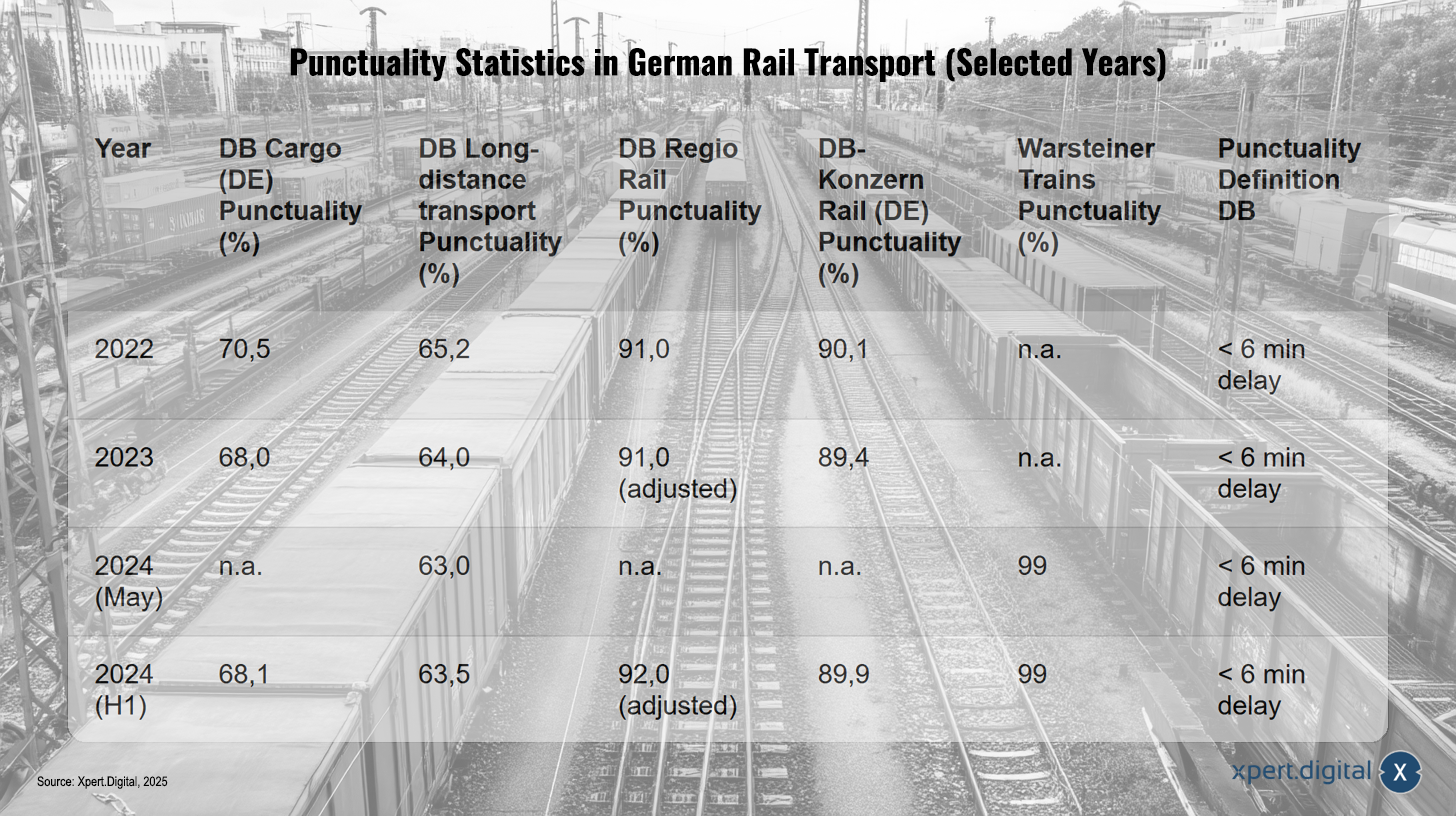
Punctuality statistics in German rail traffic (selected years) - Image: Xpert.digital
The punctuality statistics in German rail traffic shows significant differences between the various areas of Deutsche Bahn for selected years. In 2022, punctuality at DB Cargo was 70.5 %, in DB long-distance traffic at 65.2 %, at DB Regio rail at 91.0 %and in the entire DB group rail 90.1 %. In 2023, the values for DB Cargo fell to 68.0 %, for DB long-distance traffic to 64.0 %, while punctuality at DB Regio rail (adapted) continued to be 91.0 % and 89.4 % in the DB group. In May 2024, a punctuality of 63.0 % was measured for DB of long -distance transport. In addition, the statistics for the first half of 2024 (H1) showed a punctuality of 68.1 % for DB Cargo, 63.5 % for DB long-distance transport, 92.0 % (adapted) in DB Regio rail and 89.9 % for the DB group. Deutsche Bahn defines punctuality as a delay of less than six minutes, whereby it should be noted that these values can vary slightly depending on the source and reporting period and that the punctuality data of DB Regio rail are sometimes presented differently aggregated.
🎯🎯🎯 Benefit from Xpert.Digital's extensive, fivefold expertise in a comprehensive service package | R&D, XR, PR & SEM

AI & XR 3D Rendering Machine: Fivefold expertise from Xpert.Digital in a comprehensive service package, R&D XR, PR & SEM - Image: Xpert.Digital
Xpert.Digital has in-depth knowledge of various industries. This allows us to develop tailor-made strategies that are tailored precisely to the requirements and challenges of your specific market segment. By continually analyzing market trends and following industry developments, we can act with foresight and offer innovative solutions. Through the combination of experience and knowledge, we generate added value and give our customers a decisive competitive advantage.
More about it here:
Strategies for modernizing rail freight transport: reactivation and network expansion in focus
Evaluation of the proposed solutions for revitalizing rail freight transport
Stopping the dismantling and reconstruction: network expansion and reactivation strategies
This first proposed solution step aims directly at the core problem of the capacity deficit identified in Section 1. The strategy includes the end of other network reductions as well as the active expansion, modernization and reactivation of disabled sections of the route.
Several current initiatives indicate the implementation of this strategy:
Massive investments
Significant funds flow into the rail infrastructure. The performance and financing agreement (LufV) III ensures increasing federal funds for the preservation and renewal of the existing network (after 2025 on average 5.6 billion euros per year), supplemented by EUR 31 billion from the rail sector over the term of 10 years. DB Infrago AG has announced record investments of EUR 15.2 billion (gross) for 2024. The funds for new and expansion projects according to the needs plan (to EUR 2.0 billion per year until 2023). A novella of the Federal Railway Expansion Act (BSWAG) should also enable higher and faster federal investments by being able to cover additional cost shares, for example for maintenance, digitization or noise renovation.
Modernization and renewal
One focus is on the renewal of the existing systems. In recent years, thousands of kilometers of tracks and soft have been renewed. The general renovation program provides for a total of 40 high -loaded corridors to be modernized by 2030, starting with the Riedbahn between Frankfurt/Main and Mannheim in July 2024. The aim is to increase the resilience of the network and reduce disruptive restrictions. DB Infrago pursues the goal of stopping the aging of the infrastructure.
Expansion and new building
Over 200 large infrastructure projects are in planning or construction. By 2030, 744 track kilometers are to be rebuilt or expanded. Important projects include route expansion such as Karlsruhe-Basel, the Rhein-Ruhr-Express (RRX), the hinterland connection of the fixed fehmarnbelt crossing, the three-track expansion Emmerich-Oberhausen and the expansion of important nodes such as Cologne, Frankfurt, Hamburg and Munich.
Route reactivation
The reactivation of disabled routes is recognized as an instrument to promote climate protection and to improve the connection of rural areas. The Association of German Transport Companies (VDV) and the Allianz Pro Schiene proposed 325 routes with a total length of 5,426 km for reactivation, which could re -connect 379 cities and municipalities to the rail network. Deutsche Bahn has set up its own “Taskforce route reactivation” and systematically checks suggestions; A first portfolio of 20 routes was identified in 2021. Reactivation are also taken into account as part of the Germany clock, and there are federal funding programs.
Germany
This concept serves as a strategic framework for infrastructure expansion. It defines the requirements of future passenger and freight traffic to the infrastructure in order to enable an optimally coordinated timetable. The timetable thus specifies the expansion goals, not vice versa.
Modernization of the rail: physical expansion and digital disruption in step
There is therefore a clear political and entrepreneurial commitment to reverse the trend of network neglect. The instruments- massive investments, targeted renovation and expansion programs as well as the reactivation- are and are used. The focus on highly stressed corridors addresses the most critical bottlenecks, while the reactivation offers potential for increasing the network density and connecting the area. The strategic orientation provides the Germany time.
However, the challenges are immense. The need for investment is huge, and despite the increased funds, there are indications of possible financing gaps in the event of a plan projects. Planning and approval procedures are often lengthy. In addition, the construction activity even causes considerable disorders in ongoing operation. A clear prioritization of the measures, as required by experts, is crucial for success.
Although the strategic orientation with concepts such as Germany's clock, general renovation and reactivation clearly aims to solve the identified problems, noticeable improvements will only occur in the medium to long term. The immediate future is expected to continue to be shaped by construction sites and the associated operating restrictions. This could temporarily deteriorate the operating quality before the positive effects of modernization. Effective management of this transition phase is therefore of central importance.
In parallel to the physical expansion, digitization plays a crucial role in increasing capacity. The introduction of the European Train Control System (ETCS) and digital signal box (DStW) enables denser tie consequences and more flexible operational management. The BSWAG amendment explicitly takes into account the financing of IT services, and the “Digital Schiene Germany” program aims directly at capacity gains. This underlines that a purely physical expansion of the network is not sufficient. The integration of digital technologies must take place in parallel in order to draw the maximum benefit from the investments and to implement potentially faster capacity increases than through construction measures alone. However, digitization also faces significant challenges in terms of financing and comprehensive implementation.
Dual -use logistics: exploration of the potential of shared infrastructure
The second solution proposal introduces the concept of “dual -use-use logistics”, combined with “Du logistics²”. The term “dual -use” traditionally refers to goods or technologies that can serve both civil and military purposes. The regulation focuses strongly on export controls to prevent abuse for military purposes, terrorism or the spread of weapons of mass destruction.
Modern interpretations, such as those with mix, consider “dual-use” not only as a product category, but as a business strategy. This strategy includes conscious acting in both commercial and state or military markets, which places specific requirements for product development, financing and the navigation of regulatory framework.
According to the information available, the term “du logistics²” stands for “double dual-us logistics” and describes the integration of rail and street infrastructure for combined civil and military logistics purposes. The Regiolog Süd project serves as a specific pilot project for this concept. It provides for the construction of a state-of-the-art, automated regional high-bay warehouse (HRL) with container buffers in South Baden, which is connected to both the rail and road network. This camp is intended to ensure civil care (e.g. rural areas, e-commerce) in peace and in the event of crisis or defense can be quickly converted for military logistics (storage and distribution of material and supply goods). The proximity to important locations of the Bundeswehr is mentioned as an advantage. The aim is to create a network of such centers (“Zivlog-D”) in order to strengthen the resilience of the German economy and the ability to defend.
This concept enables multiple use of expensive logistics infrastructure. Potential advantages lie in a better utilization of the systems, a possible cost division between civil and military budgets as well as strengthening national resilience through secure supply chains and additional capacity for defense logistics. A standardization of processes, possibly using GS1 standards (see section 2.3), could also be funded.
However, challenges exist in the high security requirements (physically and digital) for military goods, potential conflicts in prioritization of resources in times of crisis, the complex integration of civil and military IT systems and process standards as well as the need for public acceptance. A clear demarcation between real dual-use functionality and only spatially bundled but separate civilian and military facilities is required.
The core benefit of concepts such as DU-Logistik² and Regiolog Süd lies in the increase in the total state resilience. The planned flexibility of the infrastructure, which enables a quick change between civil and military use, creates redundancy for military logistics, since there is less dependence on purely military depots. At the same time, civilian supply chains can benefit from the integration of robust and safe infrastructure elements.
Suitable for:

GS1 Datamatrix: A logistics turbo?
The third solution proposal focuses on the use of the GS1 Datamatrix cod to optimize logistics, especially in the military area and in maintenance.
The GS1 Datamatrix is a two-dimensional barcode based on the Data Matrix ECC 200 and is part of the global GS1 standard system. Its technical properties make it particularly suitable for demanding logistics applications:
- High information density on the smallest area: it can encodes large amounts of data on a very small area (e.g. GTIN to <5 × 5 mm).
- Robustness and fault tolerance: The code can still be read for damage of up to 30 % and only requires low contrast.
- Omnidirectional readability: It can be scanned from any direction (360 °).
- Direct Part Marking (DPM): The code can be lasered off, grinded or etched directly directly on components, which enables labeling for decades, even under rough conditions.
Integration into the GS1 system is crucial. By using GS1 Application Identifier (AIS), the encoded data is standardized and structured (e.g. product identification GTIN, serial number, batch, expiry date, location number GLN, transport unit SSCC, investment Giiia). A special control sign (FNC1) signals the GS1 conformity and enables the correct interpretation of the data by scanning systems. This creates interoperability across corporate and industry borders.
Suitable for:

In the military area, the GS1 DataMatrix is explicitly used. According to the technical delivery condition TL A-0032, the Bundeswehr calls for a clear and permanent labeling of supply goods using GS1 data carriers (GS1-128 or GS1 Datamatrix in the event of a lack of space). This enables a clear identification of components, a digital data linkage and, as described in the concept of telemaintenance, can accelerate repair processes and improve the operational readiness. Examples are the use by MBDA Germany for maintaining steering aircraft systems and applications at the US Army. The Concept Regiolog Süd should also rely on this technology to pursue military goods.
The use of GS1 standards, including the GS1 Datamatrix (especially via DPM), is also becoming increasingly important for maintenance logistics in the railway sector. The aim is the clear traceability of (safety) relevant components and components over their entire life cycle-from manufacturing to the supply chain and operation to maintenance and scrapping. This enables improved life cycle management, optimized (predictive) maintenance, more efficient error and warranty management, better supplier management and improved protection against plagiarism. Successful application examples can be found in companies such as Schaeffler (labeling of wheel set camps for the SBB), HFG (labeling of processed rolling bearings), Contitech (labeling of air spring systems) and Siemens Mobility (introduction of uniform GS1 labels). The data exchange standard EPCIS (Electronic Product Code Information Services) also allows cross -company tracking events in the life cycle of a component.
The claim that the GS1 Datamatrix is a “logistics turbo for the military” appears in view of the advantages of standardized, robust and unique identification for maintenance, spare parts management and operational readiness, especially in connection with digital tools such as telemaintenance. The optimization of maintenance logistics in the railway system (“less downtime”) is also a clear benefit that leads to greater availability of rail vehicles and potentially lower costs.
The standardized identification using GS1 Datamatrix or other GS1 data carrier is more than just an efficiency tool; It forms the indispensable basis for further digitization and automation efforts in logistics. It first enables the reliable creation of digital twins from components and systems, the effective use of telemaintness and predictive maintenance, the control of automated storage systems (as intended in the Regiolog Süd concept) as well as potentially automated inspection and repair processes. Without clear, machine -readable and reliable identification on the individual part level, these advanced concepts cannot be effectively implemented.
The use of a common standard system such as GS1 across various domains (military, train, industry in general) also opens up synergy potential. Components that are used both in the civilian rail sector and potentially in the military area (dual-use components) could be seamlessly followed with the same system. This interoperability funded by GS1 simplifies logistics, reduces the need for parallel tracking systems and can improve data exchange between sectors, for example for maintenance optimizations or increased transparency in supply chains.
Suitable for:

Transformation to intermodal trains
Transformation to intermodal trains: teaching from the example of Warsteiner and beyond
The fourth step suggests increased transformation towards intermodal trains and quotes the example of the Warsteiner brewery with its high punctuality. Intermodal traffic refers to the transport of goods in standardized charging units (such as containers, interrogation or saddle wasters) using at least two different transport companies (e.g. street, rail, ship), whereby the loading unit itself is handled, but not the goods in it. The combined traffic (KV) is a special form of intermodal transport, in which the main run is carried out via rail or waterway and the road is only used for the short lead and afterrise (“first/last mile”).
The Warsteiner brewery has operated its own container terminal with a track connection on its factory grounds since about 2005. According to the owner, the original motivation was the owner's request to reduce the environmental impact of truck traffic in Warstein, as well as the expectation of the long-term cheaper transport costs. The investment of around 30 million euros was partially publicly funded, but was initially not directly profitable. Warsteiner transports beer in containers by train to important distribution centers in Germany (e.g. Munich, Hamburg) and to Verona in Italy.
A central element of the Warsteiner model is to maximize the train utilization in order to compensate for the high fixed costs of the rail transport. The brewery reaches this by not only transporting your own products (beer, empty), but also freight for other companies, both on the return trips and on the outward journey to avoid empty trips. The ratio of own to foreign goods varies depending on the relation (e.g. 80/20 to the south, 20/80 to Hamburg). The subsidiary Boxx Intermodal Logistics was founded for marketing these logistics services. Despite the success on the rail, Warsteiner does not completely do without trucks, which are still required for flexible deliveries, action goods and the fine distribution on the last mile.
The most remarkable result is the punctuality of its trains of 99 %specified by Warsteiner. This is in blatant contrast to the punctuality of DB Cargo with around 68 % or that of DB long -distance transport with 64 % in 2023. Warsteiner describes the business with rail transport as profitable.
The example of Warsteiner impressively shows that a privately organized, intermodal rail transport with high punctuality and economy is possible, even if it requires considerable initial investments. Key factors for this success seem to control your own infrastructure (terminal), the consistent focus on high train utilization through the integration of external business and possibly a management or contracts that ensure high reliability and priority on the Internet.
In general, intermodal traffic offers significant advantages: it reduces CO2 emissions, relieves the streets of truck traffic and traffic jams, can offer cost advantages for mass transports and improve working conditions for truck drivers (rest periods, avoid to toll/driving bans). State funding for terminals and certain operational facilities (e.g. 44T weight in the forefront/follow-up, exceptions to driving bans) support the KV. However, the challenges remain the high -fixed costs compared to the truck, the complexity of the coordination between different actors (freight forwarders, operators, railways, terminal operators), the need for efficient envelope terminals and the dependence on the quality of the underlying rail network. Growth is forecast, but the sector is fighting with difficult market conditions. Improving accessibility for small and medium -sized companies (SMEs) is a central task.
The exceptionally high punctuality of Warsteiner compared to general rail freight transport suggests that it depends heavily on control over its own specific logistics chain. Warsteiner can circumvent part of the disorders and capacity bottlenecks that put a strain on general traffic on the public network through its own terminal and possibly due to dedicated trains or prioritized treatments on the network (see section 1). This implies that high reliability in intermodal traffic either requires similarly controlled environments (which is unrealistic for most reladers) or fundamental improvements in stability, capacity and prioritization mechanisms throughout the public rail network are necessary. A mere relocation to the rail guarantees no punctuality if the basic system is overloaded and prone to interference.
The Warsteiner example, in particular the foundation of Boxx Intermodal Logistics and the transport of foreign goods, also illustrates how the investment of a large anchor loader in intermodal infrastructure can create a platform from which other regional companies also benefit. This supports the idea of bundle traffic of smaller companies and developing regional logistics nodes. Successful intermodalter terminals can thus become catalysts for wider regional economic development and improved logistics efficiency that goes beyond the benefits of the original investor.
Promotion of innovations in intermodal traffic
Building on the potential of intermodal traffic, this step aims to further increase its efficiency, accessibility and attractiveness through technological and procedural innovations.
Important innovation fields include:
Terminal operation and handling technologies
- Automation: The use of autonomous vehicles in terminal operation promises efficiency increases. The research project Anita (autonomous innovation in the terminal process) successfully tested the use of autonomous trucks for container envelope in the Duss terminal Ulm and showed a potential for productivity increases of up to 40 %. Likewise, fully automatic shunting locomotives are being worked on (project VAL from DB Cargo and Bosch). These technologies can reduce manual processes, increase the envelope speed and improve safety.
- Covering technologies for non-craneable saddle wasters: Since a large part of the European trailer fleet is not crane, innovations are crucial for the loading in order to fully exploit the market potential of the KV. Examples are the helrom system with swiveling wagon platforms (in use on the Regensburg-Verona Relation), the cargo meave system with laterally movable wagon pallets or the modal ear system with swiveling wagon beds. These systems enable the loading of standard saddle trailers without special adjustments. Further innovations concern special container or wagon systems such as the container station 3000 from innovatrain for fast exchange bridges or flexible wagon concepts such as the InnoFreight.
Digitization and platforms
- Digital booking and management platforms: In order to simplify access to the KV, especially for SMEs, digital platforms are created that convert supply and demand transparently and simplify the booking. Examples are Modality and the Intermodal Capacity Broker (ICB) from Rail-Flow. The aim is to make the booking of KV transports as easy as the commissioning of a truck transport. The integration of these platforms into existing transport management systems (TMS) of the loaders and freight forwarders is important.
- Data exchange and transparency: Consistent digitization requires standardized data formats and interfaces for the exchange of information between all actors involved. Concepts such as the digital twin of transport units or charges, the use of IoT sensorism to monitor the condition of the freight and potentially blockchain technology for safe and transparent data flows play a role here. The establishment of electronic freight letters (ECMR) simplifies the documentation. Improved shipment tracking (tracking & tracing) increases transparency for customers.
- Digital infrastructure: Advanced communication infrastructure (e.g. 5G) is a prerequisite for many automation and real-time applications. The digitization of the terminals and their intelligent link with central network management (e.g. Capacity and Traffic Management System, CTMS) are also necessary.
Rail technology
- Digital automatic coupling (DAK): The DAK is considered a key technology for revolutionizing rail freight transport in Europe. It enables automatic coupling and decoupling freight cars and at the same time creates electricity and data connections. The expected advantages are enormous: faster train formation in outskirts, which means that shorter transport times and higher capacities on the net; Potential for continuous train monitoring (accessibility and integrity), which could make rigid track sections and axis meters superfluous in the long term and enable more dynamic tie consequences; Improved occupational safety for maneuvering staff; Support for fully automated driving. After successful Europe -wide tests, the series of series production is now being sought with the aim of equipping the first pioneering trains by 2026. However, the conversion of the entire European car park (over 500,000 cars) is a huge financial and logistical challenge.
- Automated driving operations (ATO): ATO via ETO (automatic Train Operation Over European Train Control System) enables automated driving of trains. Through optimized acceleration and braking, energy consumption and wear can be reduced and the route capacity can be potentially increased by shorter tie sequences. There are different degrees of automation (GoA), with Goa4 referring to the driverless company. While the development in passenger transport (especially metros and pilot projects in regional traffic) has progressed, ATO is also relevant for freight transport. The implementation requires a high -performance communication infrastructure (FRMCS/5G) and advanced sensors for identification, especially for higher levels of automation.
- Innovative freight cars: Developments aim at lighter, more flexible and more energy -efficient car constructions to increase the payload and reduce operating costs.
In summary, it can be stated that there is a wide range of innovations that have the potential to fundamentally improve intermodal traffic. These range from specific terminal technologies to digital platform solutions to systemic changes in rail technology.
However, many of these innovations are dependent on each other and only develop their full potential in interaction. A fully automated train operation (ATO GOA4) requires, for example, the DAK for automatic shunting processes and a powerful digital infrastructure. Automated terminals require a seamless digital connection to booking platforms and ideally to automated supply manufacturing systems. This illustrates the need for a holistic approach that coordinates the various technological developments.
Although technologies such as DAK, ATO and automated terminals theoretically promise significant efficiency and capacity gains, their successful implementation faces major hurdles. This includes the immense investment costs (especially for DAK conversion), the need for a Europe-wide standardization (DAK, ETO/ATO), the creation of suitable legal and regulatory framework (in particular for ATO GoA4) as well as ensuring interoperability between the systems of different manufacturers and operators. The way from promising pilot projects for broad operational application in the entire network is therefore still wide and requires careful planning, sustainable financing and strong international cooperation.
Our recommendation: 🌍 Limitless reach 🔗 Networked 🌐 Multilingual 💪 Strong sales: 💡 Authentic with strategy 🚀 Innovation meets 🧠 Intuition

From local to global: SMEs conquer the global market with clever strategies - Image: Xpert.Digital
At a time when a company's digital presence determines its success, the challenge is how to make this presence authentic, individual and far-reaching. Xpert.Digital offers an innovative solution that positions itself as an intersection between an industry hub, a blog and a brand ambassador. It combines the advantages of communication and sales channels in a single platform and enables publication in 18 different languages. The cooperation with partner portals and the possibility of publishing articles on Google News and a press distribution list with around 8,000 journalists and readers maximize the reach and visibility of the content. This represents an essential factor in external sales & marketing (SMarketing).
More about it here:
From network modernization to digitization: the way to rail future
Synthesis and strategic recommendations: Innovative impulses for resilient logistics in the rail sector
The analysis confirms the core thesis formulated in the user query: German rail freight transport suffers from a structural capacity deficit, which results from the historical reduction of the network while increasing demand. This leads to overload, especially in nodes and on main corridors, and manifests itself in inadequate operating quality, especially with punctuality. This situation hinders the achievement of the desired transfers of traffic and harms the competitiveness of the rail.
The evaluation of the four proposed solutions results in a differentiated picture:
Network renovation and expansion
This is the fundamental prerequisite for the remediation of the capacity deficit. The measures initiated (investment offensive, general renovation, expansion, reactivation) are necessary and go in the right direction, but require staying power, sustainable financing and intelligent management of short -term construction site consequences. At the same time, the digitization of the infrastructure (ETCS/DStW) is essential.
Dual -use logistics
An innovative concept for increasing resilience and potential cost division between civil and military needs. Realability requires clear regulations for security and prioritization.
GS1 Datamatrix
An established and robust technology that has been proven to increase efficiency in (military and civilian) maintenance logistics. It acts as an important pioneer for more comprehensive digitization and automation strategies through standardized, clear identification.
Intermodal traffic - innovations in intermodal transport
The Warsteiner example shows the high potential for efficiency and punctuality in optimized, well -controlled systems. However, a broad transfer of this success to the general network requires significant improvements in network quality and capacity as well as simplified accessibility, especially for SMEs.
There is a broad spectrum of promising technologies (terminal automation, envelope techniques, digital platforms, DAK, ATO) that can increase efficiency and capacity. However, their implementation is complex, costly and requires coordinated efforts in standardization, regulation and financing.
The four solutions are not to be viewed in isolation, but are in a close dependency and synergy relationship. The network improvement (step 1) is the basis for the successful implementation of dual-use concepts (step 2), the scaling of intermodal transport (step 4) and the introduction of many other innovations. Standardization by GS1 (step 3) is a key requirement for digitization and automation as well as for efficient dual-use processes (step 2). Intermodal transport (step 4) forms the operational framework for many the other innovations mentioned. The dual-use logistics (step 2) can benefit from improved intermodal skills (steps 4 & 5) on a more powerful network (step 1). Significant progress therefore requires an integrated strategy that starts several fronts at the same time.
Suitable for:
Strategic recommendations
Based on the analysis, the following recommendations for action result for the relevant actors:
For politics (BMDV, Bundestag, EU)
Secure and accelerate financing
Protect the financing for network renovation, expansion and modernization (step 1) in the long term and stable beyond current programs. Prioritize gathering passage.
Accelerate planning
Continue to slimming and accelerating planning and approval procedures for infrastructure projects.
Drive European standards and financing ahead
Actively promote Europe -wide standardization and financing of key technologies such as DAK and ETCS/ATO (step 5).
Create regulatory framework
Develop and implement clear legal framework conditions for advanced automation (e.g. ATO GOA4).
Promote dual -use
Support the development of dual-use logistics concepts and define clear guidelines for security, prioritization and interfaces.
Continue KV funding
Existing support programs for intermodal terminals and innovations in rail freight transport (KV funding directive, future rail freight transport) further develop and equip them.
Support digital KV platforms
Promote the establishment and use of digital platforms to simplify access to combined traffic (step 5).
For DB Infrago AG
Efficiently implement construction projects
Create the general renovation and expansion projects (step 1) quickly and efficiently, while minimizing the operational effects through optimized planning (e.g. SB² concept), bundling measures and transparent communication.
Accelerate digitization
Percise the rollout of digital leading and security technology (ETCS/DSTW) in parallel to the physical construction work (step 1 & 5).
Design reactivation
Actively support and promote the implementation of identified route reactivation projects (step 1).
Prepare DAK implementation
Actively participate in the Europe-wide DAK introduction and prepare the network and the processes for the requirements of the DAK (step 5).
Improve network management
Optimize capacity and traffic management (e.g. through CTMS) in order to improve reliability and capacity use, especially during the renovation phase.
Support standardization
Actively participate in the development and implementation of standards (GS1, DAK, ETCS etc.).
For operators (DB Cargo, private EVU, intermodal operator)
Fleet moderation
Invest in DAK-capable freight wagons and ato prepared locomotives.
Implement GS1 standards
Use GS1 standards for the identification and persecution of assets (cars, locomotives) and use programs consistently (step 3).
Use innovations
Use innovative handling technologies and digital platforms to increase your own efficiency and improve customer service (step 5).
Optimize processes
In cooperation with other actors, optimize the processes in terminals and along the transport chain and improve data exchange.
Quality offensive
Focus on service quality, reliability and punctuality in order to regain and maintain the trust of customers.
For loaders and freight forwarders
Check intermodal options
Actively check the use of intermodal transport solutions (step 4) and use digital booking platforms (step 5).
Communicate requirements
Service requirements clearly communicate to the surgeons and support standardization efforts (e.g. GS1).
Holistic evaluation
When choosing the mode of transport in addition to the costs, also take into account long -term aspects such as environmental effects, reliability and resilience.
For technology providers
Develop robust and interoperable solutions
Further development of robust, interoperable systems for automation (terminals, trains), digitization (platforms, sensors) and envelope technologies (step 5).
Secure standard conformity
Ensure consistent compliance and support for established and future standards (GS1, ETCs, DAK).
Find cooperation
Work closely with infrastructure operators and transport companies in the development, testing and implementation of new technologies.
Four steps to transform the German freight rail network
German rail freight transport faces immense challenges that result from a decades of development of network dismantling with increasing demand. The system is overloaded in many places, which leads to considerable deficits in operating quality and endangers the desired transfer of traffic.
The analyzed four-step strategy offers a comprehensive, albeit complex and resource-intensive, approach to coping with this crisis. The steps are closely interwoven and require a coordinated implementation. The renovation and expansion of the network form the foundation on which technological innovations, improved operating concepts such as intermodal transport and new approaches such as dual-use logistics can build up. Standardized identification technologies such as the GS1 Datamatrix are essential pioneers for the necessary digitization and automation.
The path to revitalization of German rail freight transport will be demanding and requires a concerted effort of all actors involved - politics, infrastructure operators, transport companies, shipper and technology provider. Sustainable investments, the consistent implementation of innovations, the establishment of Europe -wide standards and focus on operational excellence are essential. However, if this succeeds, however, there is a realistic opportunity to ensure that rail freight traffic in Germany is sustainable and to secure and expand its important contribution to economic performance, national resilience and climate protection.
Advice - planning - implementation

Markus Becker
I would be happy to serve as your personal advisor.
Head of Business Development
Chairman SME Connect Defense Working Group
We are there for you - advice - planning - implementation - project management
☑️ SME support in strategy, consulting, planning and implementation
☑️ Creation or realignment of the digital strategy and digitalization
☑️ Expansion and optimization of international sales processes
☑️ Global & Digital B2B trading platforms
☑️ Pioneer Business Development
Konrad Wolfenstein
I would be happy to serve as your personal advisor.
You can contact me by filling out the contact form below or simply call me on +49 7348 4088 965 (Munich) .
I'm looking forward to our joint project.
Write to me

Xpert.Digital - Konrad Wolfenstein
Xpert.Digital is a hub for industry with a focus on digitalization, mechanical engineering, logistics/intralogistics and photovoltaics.
With our 360° business development solution, we support well-known companies from new business to after sales.
Market intelligence, smarketing, marketing automation, content development, PR, mail campaigns, personalized social media and lead nurturing are part of our digital tools.
You can find out more at: www.xpert.digital - www.xpert.solar - www.xpert.plus
Keep in touch











