
Extreme resilience and high performance reimagined: Container storage in high-bay racking
Xpert Pre-Release

Available in 27 languages 📢
Prefer Xpert.Digital on GoogleⓘPublished on: April 12, 2026 / Updated on: April 12, 2026 – Author: Konrad Wolfenstein
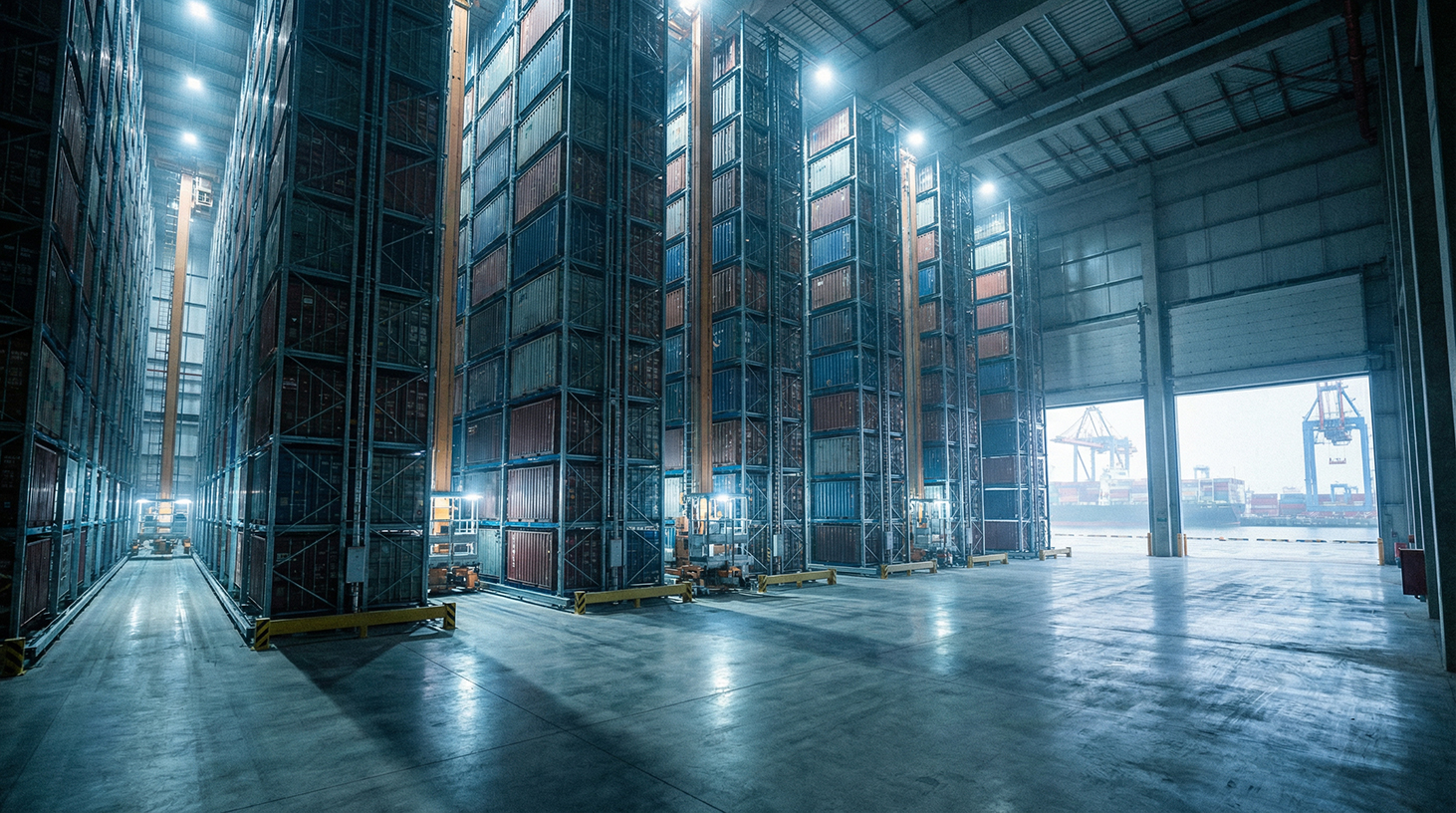
Extreme resilience and high performance reimagined: Container storage in high-bay racking – Image: Xpert.Digital
300 percent more power: Why the end of classic container stacks is sealed
The billion-dollar megatrend: Why 40-ton containers will soon be stored like pallets in high-bay racking
Fully automated mega-racks: How engineers are solving the global logistics chaos
Global container trade is growing relentlessly, but the world's major seaports have long since reached their spatial and environmental limits. Traditional ground storage, where containers are stacked on top of each other in a space-intensive manner, consumes vast, prohibitively expensive areas and causes enormous inefficiencies through constant, unproductive rearranging. The solution to this bottleneck in global trade lies vertically: Fully automated high-bay container warehouses are currently revolutionizing heavy-lift logistics. By hoisting multi-ton ISO containers into gigantic steel structures up to eleven stories high, these systems save up to 75 percent of the required floor space. At the same time, they triple throughput, drastically reduce operating costs, and, through electrification, enable CO2-neutral operation. Learn why vertical heavy-lift storage is no longer just a future scenario, but a multi-billion-dollar megatrend that will sustainably transform not only port terminals, but also industrial and military logistics.
Global container transport is one of the cornerstones of world trade. Around 90 percent of all goods traded worldwide are transported by sea, the vast majority in standardized ISO containers. In 2024, throughput reached a record volume of 928 million TEU – an increase of 7.2 percent compared to the previous year. This rate of growth presents traditional container storage with a fundamental dilemma: space is finite, but demand is not.
In the port areas of the world's major transshipment hubs, reclaimed or developed terminal land costs between €2,000 and €3,000 per square meter – significantly more in prime locations. At the same time, urbanization is increasing in the immediate vicinity of seaports, further restricting the possibilities for expansion through political and planning constraints. Ports, which for centuries served as the logistical backbone of national economies, are now under pressure: they must achieve more in less space, while simultaneously meeting higher demands for environmental sustainability, speed, and efficiency.
Conventional block stacking, where containers are placed directly on the terminal grounds in stacks of three to five layers, is not only space-intensive but also operationally inefficient. Between 30 and 60 percent of all container movements in a typical terminal are so-called unproductive repositioning operations: containers are moved not because they are reaching their destination, but because they are obstructing other containers. Each of these movements costs time, energy, machine capacity, and ultimately money.
Heavy lifting reimagined: The technical architecture of the container high-bay racking system
The principle of high-bay warehouses has been established in intralogistics for decades – pallet racks with stacker cranes in fully automated warehouses are considered standard in modern industrial and commercial logistics. However, transferring this concept to the heavy-duty area of ISO container storage – with individual weights of up to 40 tons per unit – required a complete redesign of all system components.
The core of modern container high-bay racking systems is a steel racking system up to 11 levels high, in which each individual container has its own fixed storage location. Fully automated storage and retrieval machines – specially developed heavy-duty cranes – traverse the racking aisles and are capable of performing up to 22 container operations per hour. An underground conveyor system on rails connects the individual racking aisles and ensures a seamless flow of containers between the racking system and the interfaces to the water and land sides. The entire material flow is coordinated and optimized in real time by a higher-level warehouse management system.
The best-known commercial implementation of this concept is the BOXBAY High Bay Storage (HBS) system, a joint venture between the world's largest port operator, DP World, and the German SMS group. Following successful trials in the Port of Dubai with more than 80,000 container operations, the system was declared market-ready in 2021. In parallel, the Japanese company JFE Engineering developed the so-called Container Hangar, which has been in operation at the Ohi Container Terminal in Tokyo since 2011 and stores 840 TEU in a configuration of 2 × 30 containers across seven floors with a building height of 31 meters. LTW Intralogistics from Austria also implemented a high-bay container warehouse for the Swiss Army (armasuisse) with a 20-meter-high stacker crane and a payload of 18 tons, offering 206 container storage locations on five levels.
The advantage of available space as a key economic argument: It pays to do the math
The core economic principle of the container high-bay warehouse is as simple as it is compelling: replacing floor space with vertical space allows for the amortization of higher investment costs through dramatically reduced land and operating expenses. The figures speak for themselves. The BOXBAY system achieves a storage capacity of over 3,000 TEU per hectare of terminal area. A conventional RTG (Rubber Tyred Gantry) requires approximately four hectares for the same capacity. Based on the aforementioned land costs of €2,000 to €3,000 per square meter, this land saving of three hectares translates into cost savings of €60 to €90 million in the land component of a terminal investment alone.
Annual throughput increases by more than 300 percent with high-bay racking technology compared to a conventional RTG yard. At the same time, operating costs decrease because less handling equipment is required: Unproductive re-sorting operations are completely eliminated in the high-bay system. Every container is directly accessible at any time without having to move other containers. Dock crane performance increases by up to 20 percent due to improved terminal planning and faster container delivery. The overall picture of a cost-benefit analysis thus shifts considerably in favor of high-bay racking technology.
For the broader investment sector – namely high-bay warehouses in industrial and logistics environments away from ports – market data and case studies indicate a payback period of typically five to twelve years, depending on location, degree of automation, throughput, and land prices. A medium-sized, fully automated high-bay warehouse costs between €5 and €20 million to build. The savings arise not primarily from the reduction in floor space alone, but mainly from three other sources: reduced personnel costs, lower error rates, and improved throughput.
Personnel costs, energy efficiency and CO2: The triple economic lever
Full automation is a crucial economic decision with lasting impact. McKinsey analyses show that operating costs in successfully automated port terminals can be reduced by up to 55 percent, while productivity increases by up to 35 percent. For the container high-bay segment, this means a profound shift in the cost structure: The personnel cost base, which is substantial in conventional terminals due to crane operators, marshallers, yard dispatchers, and straddle carrier drivers, shrinks to maintenance and system monitoring personnel. According to BOXBAY data, repair and maintenance costs, as well as personnel expenses, decrease by up to 20 percent compared to conventional terminals.
In addition, there's the energy balance. All relevant container high-bay racking systems are fully electrically powered. The BOXBAY system utilizes energy recovery systems that feed electrical energy back into the system during braking operations. Photovoltaic systems can be installed on the roof of the racking system, generating enough energy in sunny regions to power the entire system – theoretically making CO2-neutral or even CO2-positive operation possible. Compared to conventional terminals, where diesel forklifts, RTG cranes, and straddle carriers generate considerable emissions, this represents a significant leap forward. Measurements of conventional container handling operations show CO2 emissions in the range of 16 to 19 kg per TEU.
The societal and regulatory dimension amplifies this effect. In Europe, regulations regarding emissions and land use in port areas are continuously tightening. Port operators investing in high-bay racking technology not only anticipate operational efficiency gains but also create regulatory resilience. No light pollution, no noise at night, and a smaller footprint—these characteristics significantly improve the social acceptance of terminal expansions in urban areas.
LTW Intralogistics Solutions

LTW Intralogistics – Engineers of Flow - Image: LTW Intralogistics GmbH
LTW offers its customers not individual components, but integrated complete solutions. Consulting, planning, mechanical and electrotechnical components, control and automation technology, as well as software and service – everything is networked and precisely coordinated.
In-house production of key components is particularly advantageous. This allows for optimal control of quality, supply chains, and interfaces.
LTW stands for reliability, transparency, and collaborative partnership. Loyalty and honesty are firmly anchored in the company's philosophy – a handshake still means something here.
Related to this:
Container high-bay racking: How high-bay racking technology efficiently multiplies the capacity of modern terminal operations
Market dynamics and investment climate: Automation as a global megatrend
The macroeconomic drivers behind the rise of container high-bay technology are not a passing fad. The global warehouse automation market was estimated at around US$25 to US$30 billion in 2025 and is projected to grow to over US$107 billion by 2035 – an annual growth rate of over 15 percent. The intralogistics automation market was valued at US$48 billion in 2024 and is expected to reach almost US$87 billion by 2035. The European logistics automation market is growing at an annual rate of 11.18 percent.
The market for container terminal operations itself was valued at US$75.5 billion in 2024 and is projected to grow to US$98.1 billion by 2030 – a compound annual growth rate (CAGR) of 4.3 percent. The global port construction project market was worth approximately US$176 billion in 2024 and is expected to reach around US$347 billion by 2035. Investments in brownfield projects – that is, modernizations and expansions of existing terminals – dominate, accounting for over 60 percent of all global port construction projects. This is precisely where the greatest market potential for container high-bay racking technology lies: existing terminals that cannot expand physically but urgently need to increase their capacity.
Leading terminal operators such as DP World, HHLA, and other major market players are investing heavily in automation and digitalization. The Port of Hamburg, for example, is currently fully automating its largest container terminal, Burchardkai, following the model of the highly automated Altenwerder Container Terminal, which has been considered one of the most modern terminals in the world since 2002. The first remotely controlled container cranes arrived there at the end of 2024 – a further step towards fully autonomous terminal operation.
Investment barriers and structural challenges: What's holding back the high-bay racking solution
Despite its compelling economic advantages, container high-bay racking technology has so far spread more slowly than its potential would suggest. The reasons for this are multifaceted. The initial investment is substantial: a complete container high-bay racking system for a medium-sized port terminal costs hundreds of millions of euros. Amortization over long periods – from 15 to 25 years – requires planning certainty and a long-term capital allocation, which not all port operators can or want to provide in the short term. In addition, regulatory delays in building permits, environmental impact assessments, and stakeholder processes can significantly extend project timelines.
The technical complexity of these systems presents a further structural obstacle. High-bay racking systems for containers are not off-the-shelf standard products, but rather highly specialized engineering solutions that must be precisely tailored to the specific location, existing infrastructure, and operational processes. The static design of the racking structures, taking into account dead load, dynamic loads, seismicity, and wind loads, requires complex calculations and strict adherence to relevant standards such as DIN EN 15512. Integration into existing terminal operations—cranes, trains, trucks—and into higher-level terminal operating systems (TOS) is complex and prone to errors.
Finally, the shortage of skilled workers is a structural risk that paradoxically acts as both a driver and a brake: While it accelerates the pressure to automate, it makes the planning, implementation and operation of highly automated systems more difficult because specialized technical personnel in areas such as system integration, software engineering and maintenance of high-performance storage and retrieval machines are scarce on the labor market.
Beyond the port: Industrial and military applications as a growth segment
The economic and technological maturity of container high-bay racking technology makes it attractive for applications beyond traditional port terminals. The LTW Intralogistics project for armasuisse – the procurement agency of the Swiss Armed Forces – is a prime example. There, a 20-meter-high high-bay racking system was created, storing, maintaining, and repairing 206 ISO containers, truck swap bodies, and roll-off containers across five levels. A unique feature of the system is the integration of gates in the storage areas, enabling maintenance work directly on the stored containers – a functionality that would be simply inconceivable with traditional block stacking.
For intermodal freight hubs – terminals where trains and trucks exchange swap bodies and standard containers – LTW Intralogistics has developed a concept in which the loading track is integrated directly into the high-bay warehouse. Up to 100 swap bodies can be stored within a width of just 12 meters per 100 meters of length. The stacker cranes handle both the loading of the train and the transfer to trucks via gantry cranes on the outside of the building, fully automatically and around the clock. The principle of the vertically automated terminal reduces the footprint of such a hub to a fraction of that of conventional facilities.
In industrial settings, new applications are emerging wherever heavy, bulky, and difficult-to-stack goods such as steel coils, machine components, or building materials need to be stored. Heavy-duty high-bay racking systems with shelf load capacities of up to 6,000 kilograms and bay load capacities of up to 32,500 kilograms offer space-optimized solutions for industries that previously relied on large-scale floor storage. Transferring the container-based high-bay racking principle to these sectors is technically feasible and highly economically attractive.
The model of the future: Digital, autonomous and scalable
Container high-bay storage is not an isolated logistics product, but rather part of a broader paradigm shift in global intralogistics. Automated storage and retrieval systems (AS/RS) are the fastest-growing category within the warehouse automation market and dominate the investment agendas of leading logistics operators worldwide. The integration of artificial intelligence into the warehouse management system—for predictive container positioning, minimizing crane cycles, and dynamically adapting operational strategies—unlocks further efficiency potential that is currently only beginning to be realized.
The BOXBAY system exemplifies what a fully digitized container high-bay warehouse can look like: A single integrated algorithm coordinates all storage and retrieval machines and conveyor elements without the need for separate yard planning by a human dispatcher. System redundancy—achieved through multiple storage and retrieval machines that can cover for each other in case of failure—ensures an operational availability that conventional systems can barely match. Furthermore, the system's modularity allows for gradual and demand-driven capacity expansion without interrupting ongoing operations.
The market supports this vision. The container terminal operations segment is growing, demand for automated solutions is accelerating, and the costs of automation technology are structurally decreasing due to economies of scale and technological maturity. For growth-oriented terminal operators and logistics service providers, the question is therefore no longer whether, but when the transition to vertical high-bay racking technology will reach the point of strategic inevitability.
Overall economic assessment: What the numbers really say
A sober, comprehensive analysis of the available data paints a nuanced but fundamentally positive picture of the economic viability of container high-bay racking technology. The space savings of up to 75 percent compared to conventional container yards are not a marketing promise, but an engineering reality that has proven reliable in the investment calculations of early adopters. The throughput increase of over 300 percent per hectare translates directly into higher terminal revenues and significantly improves capital productivity.
The combination of lower land costs, reduced personnel costs, lower energy consumption, minimized maintenance intensity, and improved crane performance results in cumulative savings potential that more than compensates for the higher initial investments in automation technology in the medium term. In addition, there is the strategic option value: those who invest early in scalable high-bay racking infrastructure secure capacity reserves for further growth in container volume without being dependent on scarce and expensive terminal space.
Container high-bay storage is therefore no longer a niche product for technology-savvy pioneers, but a mature, economically robust, and strategically future-proof solution to the structural challenges of global container logistics. It combines economic efficiency with ecological responsibility and operational excellence – thus setting a new standard for what modern heavy-duty storage can and must achieve.
Consulting - Planning - Implementation

Konrad Wolfenstein
I would be happy to serve as your personal advisor.
contact me at wolfenstein ∂ xpert.digital
Just call me on +49 7348 4088 965 .
Your container high-bay warehouse and container terminal experts

Container high-bay warehouses and container terminals: The logistical interplay – expert advice and solutions - Creative image: Xpert.Digital
This innovative technology promises to fundamentally change container logistics. Instead of stacking containers horizontally as before, they will be stored vertically in multi-story steel racking structures. This not only allows for a drastic increase in storage capacity within the same area, but also revolutionizes all processes at the container terminal.
More information here:










