

44,000 square meters for CLAAS logistics center: Will the mega-warehouse be built in Borgholzhausen?
Xpert Pre-Release

Available in 27 languages 📢
Prefer Xpert.Digital on GoogleⓘPublished on: September 21, 2026 / Updated on: September 21, 2026 – Author: Konrad Wolfenstein
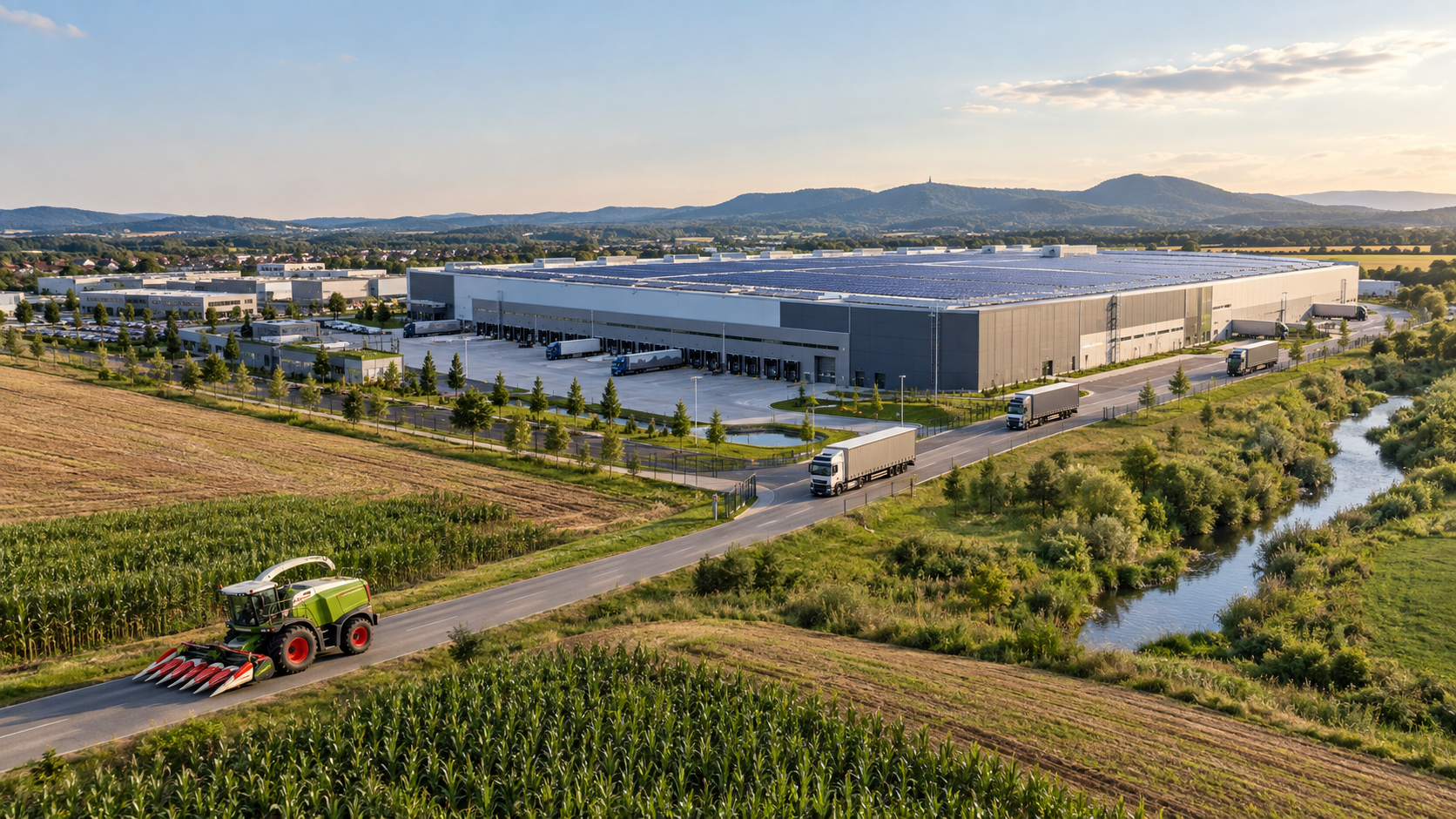
44,000 square meters for the CLAAS logistics center: Is the mega-warehouse coming to Borgholzhausen? – Creative image on the topic, created with AI: Xpert.Digital
Secret plans revealed: This is how CLAAS intends to restructure its vast network
Location conflict erupts: Will the controversial CLAAS logistics center be built?
The buffer paradox: Why CLAAS is now relying on a huge new warehouse
In Borgholzhausen, in the Gütersloh district, a groundbreaking industrial project is taking shape: a planned 44,000-square-meter logistics center is intended to make the supply chains of the renowned agricultural machinery manufacturer CLAAS more resilient to crises and to prepare the regional production network for the future. However, the massive project is not without its critics. While the project developer and some local politicians are hoping for strong economic growth and the long-term security of industrial jobs, the mega-project is raising considerable concerns among the public. The main points of criticism are the looming threat of land consumption, a feared increase in traffic, and significant encroachments on nature and protected landscapes. CLAAS has not yet made a final site decision, but the formal planning process is already well underway. The crucial question remains: Is the planned logistics hub a much-needed industrial engine – or rather a speculative and risky land gamble? This is an in-depth analysis of the economic, environmental, and regional policy dimensions.
CLAAS poised for a logistics leap in Borgholzhausen: The hall has not yet been built – but the location conflict has long since begun
The planned logistics center for CLAAS is far more than an ordinary warehouse project. It exemplifies how an export-oriented German machinery manufacturer can organize its supply chains more efficiently, resiliently, and digitally, while land use, traffic, and environmental and climate protection are gaining increasing societal importance. The crucial point is that CLAAS itself has not yet announced the construction of its own center in Harsewinkel. Rather, the current plans concern a regional logistics center in the "Am Bahnhof" industrial park in Borgholzhausen, which the project developer Greenfield Development, together with a logistics service provider, is offering as a solution for CLAAS's future factory supply needs.
This shifts the economic outlook. The primary focus is no longer on expanding the Harsewinkel plant site, but rather on the spatial reorganization of upstream storage, consolidation, and supply processes within the Gütersloh district. The project could strengthen the region's industrial base, but it is not yet a finalized investment by CLAAS. According to publicly documented information, the company has initiated a tender for a regional logistics center; Borgholzhausen is a potential location, and a final site decision had not yet been made as of mid-August 2026.
From project to procedure
The initial public presentation was remarkably brief. However, the planning documents, which have since become available, paint a much clearer picture. On June 10, 2026, the Borgholzhausen City Council passed a resolution to initiate the seventh amendment to Development Plan No. 9, "Commercial Area at the Train Station." Simultaneously, the 26th amendment to the land-use plan was initiated. Early public participation by authorities ran from July 27 to August 31, 2026; the East Westphalia Chamber of Industry and Commerce (IHK Ostwestfalen) conducted both procedures, with a participation period ending on August 31, 2026.
This stage of the process is important both economically and legally. A preliminary planning resolution neither grants building rights nor guarantees the project's realization. It initiates the formal planning phase, during which aspects such as traffic, pollution control, drainage, species protection, land use, and compensatory measures are examined in detail. Equally important is the explicit project commitment: Should CLAAS not select the site, the planning concept must be reviewed again based on the municipal documents. This reduces the risk that a plan tailored to a specific industrial need could easily devolve into an arbitrary, speculative logistics park, but it does not eliminate this risk entirely.
44,000 square meters with strategic ambition
The current plan envisions contiguous hall sections with a total of approximately 44,000 square meters of hall space. This is supplemented by roughly 6,600 square meters of outdoor storage area, as well as internal traffic areas, parking spaces, and open areas. The area covered by the zoning plan amendment encompasses approximately 12.8 hectares. The parallel amendment to the land-use plan affects approximately 5.4 hectares; of this, roughly four hectares are to be designated as commercial building land and approximately 1.4 hectares as green space, including bodies of water. In the eastern part, the plan includes enhancing the Pustmühlenbach stream and integrating it into a green corridor approximately 50 meters wide.
The sheer scale of the project makes it clear that this is no ordinary external warehouse for short-term order peaks. A hall area of 44,000 square meters represents a large-scale hub for industrial supply. It offers ample space for receiving, quality control, storage, order picking, sequencing, pre-assembly, empty container management, and consolidated transport. The specific functions that will actually be implemented are not yet fully documented. This is precisely why a distinction should be made between the building's capacity and the concrete operational concept: A large hall enables many processes, but it doesn't necessarily guarantee which goods flows, levels of automation, or inventory levels will ultimately be concentrated there.
Three players, three interests
The division of roles is crucial for understanding the project. CLAAS is the industrial entity with the demand and the potential user of the logistics services. Greenfield Development acts as the project developer and investor, intending to develop the site, construct the building, lease it, and, according to its own statements, hold it in its portfolio long-term. Hellmann Worldwide Logistics is named as the likely tenant and operational logistics partner. The new warehouse would therefore likely not be a typical corporate property owned by CLAAS itself, but rather a collaborative solution involving an industrial company, a logistics service provider, and a real estate investor.
This model is common in contract logistics because it distributes capital commitment and operational responsibility. The project developer handles the real estate development, the logistics service provider organizes personnel, systems, and material flow, and the industrial customer purchases a defined service. For CLAAS, this can ease the burden on its own balance sheet and enable faster scaling. At the same time, dependencies arise: contract durations, rent indexation, performance indicators, IT interfaces, liability for supply disruptions, and the distribution of efficiency gains become strategic issues. A modern warehouse is therefore merely the hardware; profitability is determined by the contracts and processes.
Borgholzhausen as a logistics position
From a logistical perspective, Borgholzhausen is not a random choice. The industrial park is located near the A33 motorway, a major north-south transport corridor between East Westphalia and the Osnabrück region. The distance between the inter-municipal industrial park and the motorway is approximately two kilometers. This creates a regional satellite solution for a plant in Harsewinkel: far enough away to allow for large, contiguous areas and a concentration of facilities near the motorway, yet close enough to ensure predictable production supply.
The location logic is particularly compelling when a significant portion of the supplier traffic already originates from northern, eastern, or supra-regional sources. The planning concept assumes that approximately 75 percent of the traffic will flow towards Harsewinkel and around 25 percent towards Paderborn. This would make Borgholzhausen not merely a warehouse location, but a sorting and scheduling hub between long-distance transport and the plant. The economic potential lies in decoupling two systems: Fluctuating, often delayed deliveries from an international supplier network would no longer directly impact the plant's precisely timed production requirements.
The buffer paradox
For decades, modern industry has been trying to reduce inventory. At the same time, pandemics, semiconductor shortages, blocked transport routes, geopolitical tensions, and volatile procurement markets have shown that overly tight supply chains create significant production risks. In this complex environment, a regional logistics center acts as a shock absorber. It can consolidate materials, strategically position safety stocks, and sort deliveries so that the plant is supplied in the sequences required by demand.
This leads to an apparent contradiction: More storage space can be part of a strategy that reduces inventory across the entire system. What matters is not just the absolute quantity of stored parts, but their location, transparency, and turnover rate. If previously distributed warehouses, underutilized space, and numerous individual deliveries are replaced by a centrally controlled hub, space within the factory can be used more productively, missing parts reduced, and transport capacity improved. Conversely, if the central hub merely accommodates additional inventory without replacing existing structures, capital tied up and complexity increase. The economic benefit therefore depends on whether genuine consolidation, rather than mere addition, is achieved.
Factory supply instead of shipping warehouse
In public discourse, logistics is often equated with parcel delivery or large-scale retail distribution. However, the process logic for a supply center for an agricultural machinery factory is different. Agricultural machinery consists of numerous large, heavy, and diverse components. In addition to standard parts and small load carriers, pallets, bulky assemblies, painted parts, and potentially sequence-critical components must be handled. Therefore, the quality of production logistics is measured less by the maximum number of packages shipped than by material availability, error-free delivery, cycle time stability, and responsiveness.
CLAAS and Hellmann already collaborate based on this principle. In 2022, Hellmann opened an 18,000-square-meter warehouse in Oelde, which supplies the largest CLAAS plant in neighboring Harsewinkel. Initially, 9,000 square meters went into operation, with the second half to follow later. The Borgholzhausen project should therefore not be seen as the first step toward external plant supply, but rather as a possible next stage in an already proven partnership. It remains to be seen whether it would supplement the Oelde site, partially replace it, or take over tasks from other warehouses.
A corporation is restructuring its network
The project is part of a broader investment pattern. At its headquarters in Harsewinkel, CLAAS commissioned a new logistics center spanning approximately 5,000 square meters in December 2025. The total investment of around 30 million euros included the expansion and modernization of production facilities, approximately 100 office workstations, and infrastructure for the start of series production of the new JAGUAR 1000 forage harvester series. At the same time, logistics and production processes at the plant were standardized and further automated.
The Bad Saulgau site also underwent extensive renovations. CLAAS invested more than €50 million there in the site infrastructure, production facilities, and a new logistics center spanning approximately 9,600 square meters. The center includes a fully automated warehouse for small load carriers and Euro pallets, order picking areas, storage space for large painted components, and a receiving area where up to three trucks can be unloaded simultaneously. The building meets the KfW 40 energy efficiency standard; a 990-kilowatt-peak photovoltaic system covers the roof.
These projects together present a coherent picture. CLAAS is not just modernizing individual buildings, but its entire production network. Automated internal logistics, regional consolidation, energy-efficient buildings, and digitally linked material flows are intended to make manufacturing more productive. The planned center in Borgholzhausen would be functionally different from the in-house logistics facility in Harsewinkel, which is scheduled to open in 2025. It would reorganize the upstream regional supply chain, while the Harsewinkel investment would directly improve processes within the plant itself.
Investing in a downturn
The timing seems contradictory at first glance. According to the VDMA (German Engineering Association), the German agricultural machinery industry recorded sales of €11.1 billion in 2024, around 28 percent less than in 2023. Tractors and harvesting equipment, in particular, suffered from declining demand and high dealer inventories after the strong performance of previous years. In the first half of 2025, industry sales were again around ten percent below the previous year's figure, even though order intake was already recovering.
Especially in such an environment, long-term infrastructure projects can be beneficial. Construction and start-up phases extend beyond the current economic cycle. Those who only begin planning, land acquisition, and permitting when demand is at its peak risk entering the next growth phase with inadequate infrastructure. However, counter-cyclical investments are only wise if they create structural cost advantages. A new production hall is not justified by optimism, but by demonstrable savings in transportation, inventory, internal space, error costs, and production downtime.
CLAAS remains capable of acting
The financial figures show a company that can invest despite the market downturn. CLAAS achieved sales of €4.9176 billion in fiscal year 2025, compared to €4.9974 billion in the previous year. Operating profit fell from €359.4 million to €288.6 million, and net income declined from €253.3 million to €230.3 million. At the same time, free cash flow increased from €190.3 million to €252.0 million.
The trend is mixed, but not alarming. Sales declined by only around 1.6 percent, while the operating margin came under greater pressure, falling from approximately 7.2 to 5.9 percent. However, the higher free cash flow strengthens the company's ability to finance investments. Furthermore, research and development expenditures of €319.9 million in 2025 demonstrate that CLAAS has not switched to a purely cost-cutting strategy despite the economic cycle.
For the evaluation of the logistics project, this means: The planning is not an obvious fire sale of functions, but rather part of an active modernization. Nevertheless, with declining profitability, the pressure to demonstrate benefits increases. Every additional location must make a measurable contribution to productivity. An outsourced operator and investor model can be attractive in this context because CLAAS does not necessarily have to bear the entire real estate investment itself. Instead, one-time capital expenditures are transformed into long-term contractual obligations and service costs.
Productivity arises within the system
A logistics center doesn't automatically generate productivity. The greatest leverage comes from an integrated control model. Suppliers must book time slots, shipments must be announced digitally well in advance, load carriers must be clearly identified, and inventory levels must be visible in real time. Order picking must be precisely aligned with production sequence and consumption. Consistently digitizing these processes reduces the number of unplanned special deliveries and increases supply security.
For an agricultural machinery manufacturer, the complexity of product variants is particularly challenging. Seasonal production peaks, different machine configurations, and large components make consistent capacity utilization difficult. A regional center can mitigate these fluctuations by flexibly distributing inventory and space between product groups. The planned division into several interconnected hall sections generally supports modular use. Theoretically, this allows for the gradual commissioning of processes or the later repurposing of space. Whether this potential is fully realized depends on conveyor technology, racking systems, building axes, and IT architecture.
Your intralogistics experts

Consulting, planning and implementation of complete solutions for high-bay warehouses and automated storage systems - Image: Xpert.Digital
More information here:
Automation and its impact on logistics at CLAAS
Traffic remains the test case
According to the planning data, approximately 30 to 40 deliveries and another 30 to 40 departures of heavy trucks are expected daily. A broader environmental impact assessment anticipates up to approximately 120 truck movements per day between 6 a.m. and 10 p.m. These differing figures will need to be clarified in the further planning process. They may reflect different counting methods, development stages, or safety margins. For the impact assessment, it is crucial to determine whether a movement is counted as a single entry or exit and whether it includes additional traffic from employees, service providers, and empty vehicles.
Economically, the traffic balance shouldn't end at the property line. Additional trips to Borgholzhausen can be offset by fewer direct deliveries to Harsewinkel. If several supplier shipments are consolidated into fully utilized shuttle services, the total number of truck kilometers driven across the entire network can decrease, even if there is noticeably more traffic at the new location. Conversely, an additional transshipment point can increase kilometers and emissions if shipments are simply transferred without improving capacity utilization or route planning. A convincing traffic impact assessment must therefore depict the origin, destination, capacity utilization, and temporal distribution of trips, not just the congestion at the factory gate.
Jobs without playing with numbers
Large logistics facilities regularly raise high expectations for new jobs. However, in the current planning stage, no reliable figure for public sector employment is discernible. The city primarily argues that the project will secure regional industrial jobs, while simultaneously acknowledging that the immediate job opportunities offered by a logistics center are typically more limited. This sober assessment is appropriate. Modern warehouses are increasingly automated; their employment density can be significantly lower than that of production, research, or labor-intensive order picking.
The regional economic value should therefore not be measured solely by the number of jobs within the hall. More important is the stabilizing effect on CLAAS production and its supply network. In the Gütersloh district, a total of 188,637 employees subject to social security contributions were registered in mid-2025. Raw material extraction, production, and manufacturing accounted for 66,306, or 35.15 percent; transport, logistics, security, and safety represented a further 25,477, or 13.51 percent. This structure demonstrates how closely industrial value creation and logistics are intertwined in the region.
A reliable assessment of the employment impact must distinguish between direct, indirect, and secure employment. Direct jobs are created at the operator level. Indirect effects relate to maintenance, energy, cleaning, security, and regional service providers. Secure employment refers to jobs within the production network whose competitiveness is improved by lower logistics costs. These categories should not be added together as if they were solely new full-time positions.
Tax revenue with limitations
For Borgholzhausen, the project could generate additional business tax revenue, property tax revenue, local contracts, and increased purchasing power. However, the exact amount cannot be directly derived from the size of the building. With a rented property, taxable income is distributed among the owner, operator, and clients. Business tax is generally levied where a business is tax-registered and profits are generated. Therefore, a large building can be a significant urban landmark without generating a correspondingly high level of municipal revenue.
Municipal costs must also be considered. Roads, drainage, fire department capacity, planning services, and potential infrastructure adjustments all generate expenses. A sound fiscal assessment therefore requires a long-term analysis that considers additional revenues, subsequent municipal costs, and risks. It is particularly important that project-specific development and compensation costs are not unfairly shifted onto the general public. The economic policy rationale should be based on the benefits for the entire industrial location and not on unsecured tax promises.
Space is the scarcest factor
The central conflict of objectives lies with the land. Parts of the area have long been designated for commercial development, but have not been developed due to a lack of available land. The new concept requires adjustments to existing zoning regulations and provisions. According to the planning documents, approximately 1.8 hectares will be reclassified as a protected landscape area. Simultaneously, previously designated but poorly accessible commercial areas south of Pallheide Road will be removed from the zoning and reclassified as open countryside.
This reorganization is more nuanced than simply designating new areas on untouched farmland, but it remains a significant intervention. Halls, yards, parking lots, and access roads seal the soil, alter the water balance and landscape, and permanently remove land from agricultural use. The economic benefits must therefore extend beyond mere land utilization. An industrially necessary center with a long-term lease, high energy efficiency, and measurable traffic optimization must be evaluated differently than a speculative, standardized hall whose users can change after a short time.
Balance of nature with limits
The planned renaturalization of the Pustmühlenbach stream and the approximately 50-meter-wide green corridor can mitigate the ecological impact. They can improve retention areas, connect biotopes, and soften the harsh boundary between the industrial area and the agricultural landscape. The planning documents also point to the risks of heavy rainfall: significant flood depths are indicated locally in the stream area. Therefore, maintaining ample open space and allowing for near-natural development is not only a compensatory measure but also an integral part of a robust drainage and climate adaptation strategy.
However, compensation is not a complete substitute for unsealed soil. A renaturalized stream compensates for certain ecological functions, but it does not fully restore agricultural production areas or natural soil functions. Planning should therefore first avoid sealing, then minimize unavoidable interventions, and only then compensate. This includes compact building structures, multi-story office and social areas, space-saving parking spaces, permeable paving, green roofs where compatible with photovoltaics, and a robust rainwater management system.
Energy efficiency as a location factor
Greenfield envisions the project meeting the Efficiency Building 40 standard, including heat pumps, LED lighting with occupancy and daylight control, charging infrastructure, and photovoltaics on the warehouse roofs. Following the project presentation, the annual primary energy demand is expected to be at least 60 percent below the legally mandated reference level. This objective would be economically significant for a property with a lifespan of decades, as energy prices, CO2 costs, and regulatory requirements increasingly determine operating costs and property risks.
The crucial factor is binding implementation. A presentation describes a concept; it only gains economic value through stipulations, permit requirements, a construction contract, a lease agreement, and verifiable operational data. Particularly beneficial would be the most complete possible use of on-site electricity for heat pumps, charging infrastructure, and conveyor technology. Since logistics roofs offer large, contiguous areas, photovoltaics can cover a significant portion of the daily electricity demand. Storage systems should not be planned across the board, but rather sized based on load profiles, grid fees, and feed-in conditions.
Flexibility protects against vacancy
The developer emphasizes the building's multifunctional usability for logistics, production, assembly, component manufacturing, development, and spare parts storage, as well as a targeted service life of more than 60 years. This flexibility serves as an economic safeguard. If production programs, supply chains, or contractual relationships change, an adaptable property can be more easily repurposed. This reduces the risk of a building becoming technically outdated or suitable for only a single process.
The downside is significant from a planning law perspective. The more flexibly a hall is designed, the greater the theoretical range of future uses. The municipality should therefore consider not only the initial user but also realistic subsequent uses. Exclusions for disruptive or politically undesirable uses, clear noise and traffic limits, and adherence to key sustainability standards protect the site in the long term. The restrictions on certain uses proposed in the draft are therefore not unnecessary regulation but rather part of risk management.
Automation changes the equation
Automation is not a trendy add-on in this project. It determines the output achieved per square meter and working hour. Automated small parts warehouses, pallet storage, driverless transport systems, camera-based quality control, and data-driven inventory forecasts can reduce errors and shorten lead times. CLAAS has already demonstrated at other locations that automated warehouse and production logistics are an integral part of its investment strategy.
This creates an economic conflict of objectives. Automation increases capital intensity and reduces the number of simple tasks in some areas, but it also creates more skilled jobs in control, maintenance, IT, and process planning. Therefore, for the regional labor market, not only the number of jobs is relevant, but also their skill profile. Cooperations with vocational schools, universities, and continuing education providers could increase the benefits. A modern center should not be presented as a replacement for skilled workers, but rather as infrastructure that secures productive industrial employment in a high-cost region.
Resilience needs key performance indicators
The frequently used term resilience remains abstract without key performance indicators (KPIs). For CLAAS, the center should be measured by whether it reduces the probability and duration of production downtimes. Suitable metrics would be delivery readiness, missing parts rate, critical component availability, replenishment time, number of unplanned special deliveries, and time to recovery after a disruption. In addition, classic logistics KPIs such as inventory turnover, picking errors, truck utilization, and cost per material movement should be considered.
A large regional buffer can mitigate risks, but it can also concentrate them. Fire, IT failure, severe weather, or blocked access roads would have a greater impact with strong centralization. Therefore, the concept requires redundant data connections, emergency power for critical systems, effective fire protection, alternative transport routes, and clear restart plans. Resilience is not achieved through centralization alone, but through a deliberately designed balance between consolidation and redundancy.
The price of the additional level
Each new node in the network initially creates additional handling. Material is unloaded, inspected, stored, picked, reloaded, and transported to the factory. These steps cost time, energy, and personnel. The benefit only arises if they avoid greater costs elsewhere. This can include reduced waiting times at the factory, higher truck utilization, less inventory in expensive production space, fewer defective parts, and a more stable assembly sequence.
Therefore, a complete total cost analysis should precede any final site decision. This analysis must include real estate costs, personnel, energy, automation, IT, transportation, inventory, financing, and risk costs over the contract term. Equally important is a robust comparison with alternatives: expanding existing sites, extending the Oelde solution, additional space in Harsewinkel, several smaller warehouses, or a more supplier-driven supply chain. Without this comparison, it is impossible to determine whether Borgholzhausen is the best solution or merely the most visible one.
Regional industrial policy in concrete
For the Gütersloh district, the project touches upon a fundamental industrial policy question. The region is heavily influenced by mechanical engineering, manufacturing, and logistics. In 2024, larger industrial companies in the district generated approximately €20.1 billion in revenue, although this was 13.3 percent less than the previous year; nevertheless, the number of industrial employees remained stable at around 65,000. In such an environment, securing efficient production conditions can be more important than maximizing new jobs in a single location in the short term.
However, this argument should not become a blanket justification for every major project. Industrial policy is credible when it considers value creation, land efficiency, infrastructure, and environmental impacts together. The regional connection to CLAAS is a strong advantage because the logistics services are expected to support specific production. Ultimately, however, the project's legitimacy depends on whether this connection is contractually binding and whether the building will still fit into the overall planning objectives if the user changes later.
What remains open
As of September 2026, the project remains in an early planning stage. The initiation of the zoning procedures, the early involvement of authorities, the concept's scale, and the intended role of the site are publicly documented. However, the final site decision by CLAAS, the investment volume, the exact number of jobs, the binding implementation period, the final operator structure, and the detailed economic feasibility study are not yet publicly finalized. The results of the expert reports, which are still to be developed in greater depth, are also essential for a final assessment.
These uncertainties are not a sign of failure, but rather typical for a project caught between the tendering process and building permit approval. Problems would only arise if political or public communication were to portray a potential development as a guaranteed investment. Therefore, the more reliable formulation is: Borgholzhausen is creating the planning law prerequisites to be competitive in the location market. Whether the center is actually built depends further on the awarding of the contract, the land transactions, the expert opinions, the adoption of the zoning ordinance, the building permit, and the contracts between the parties involved.
A reliable benchmark
The project deserves support if five conditions are met. First, a long-term contract must guarantee the concrete benefits for CLAAS's plant supply. Second, a network analysis must demonstrate that consolidation and shuttle services reduce the total number of unnecessary kilometers and special trips. Third, energy and sustainability targets must be made binding, in particular photovoltaics, efficient heat supply, rainwater management, and a space-saving layout. Fourth, nature conservation and flood protection measures must be implemented based on expert reports and financed on a long-term basis. Fifth, the municipality needs safeguards in the event of a change of user.
If these conditions are met, Borgholzhausen can become a productive component of the regional industrial site. Then the hall would not merely be a large land consumer, but rather infrastructure for more efficient and robust agricultural machinery production. If, however, the traffic, environmental, and contractual issues remain vague, a familiar pattern threatens: public space bears the consequences of roads and land use, while the operational benefits remain difficult to verify.
Between securing the future and gambling on land use
The basic economic idea is sound. CLAAS is modernizing its production network during a period of weaker demand in the agricultural machinery sector, but still possesses considerable financial and innovative strength. A regional consolidation center near the A33 motorway can bundle deliveries, relieve pressure on the factory, and stabilize material flows. The existing collaboration with Hellmann and the recent investments in Harsewinkel and Bad Saulgau suggest that the project fits into a longer-term logistics strategy.
The objections are equally plausible. A 44,000-square-meter hall and extensive outdoor areas will permanently alter the landscape, soil, and traffic. The immediate impact on employment is likely to be more limited than the impressive size of the building would suggest. Part of the benefit lies not in newly created jobs, but in securing and increasing the productivity of existing industrial value creation. This is economically relevant, but it must be clearly stated.
The crucial assessment, therefore, is neither an unconditional yes nor a knee-jerk no. Borgholzhausen is a logical location, but this logic must be proven by data. The project makes sense if the 44,000 square meters of space measurably reduce friction within the production system: fewer defective parts, better-utilized transport, lower inventory across the entire network, fewer special deliveries, lower energy costs, and a more robust supply chain for the Harsewinkel plant. Only this performance record transforms a large hall into a strategic investment.
Until then, the project remains a promising but open-ended location option. The planning has received political approval, but not yet economic viability. This is precisely where the opportunity for a transparent process lies: the municipality can set clear conditions, the developer must specify its sustainability commitments, the operator must disclose its transportation and employment model, and CLAAS must demonstrate the site's contribution to the competitiveness of its production network. If this evidence is successfully presented, the center could, for example, serve as a model for how industrial logistics and regional development policy can work together. If it fails to do so, it would primarily be a very large property on very valuable land.
Your global marketing and business development partner
☑️ Our business language is English or German
☑️ NEW: Correspondence in your native language!

Konrad Wolfenstein
I and my team are happy to be available to you as your personal advisor.
You can contact me by filling out the contact form here [email protected]:or simply call me at +49 7348 4088 965. My email address is
I'm looking forward to our joint project.










