Oradea and Dematic: 7,820 storage spaces on 150 square meters – What Plexus is automating in Romania
Xpert Pre-Release

Available in 27 languages 📢
Prefer Xpert.Digital on GoogleⓘPublished on: November 26, 2026 / Updated on: November 26, 2026 – Author: Konrad Wolfenstein
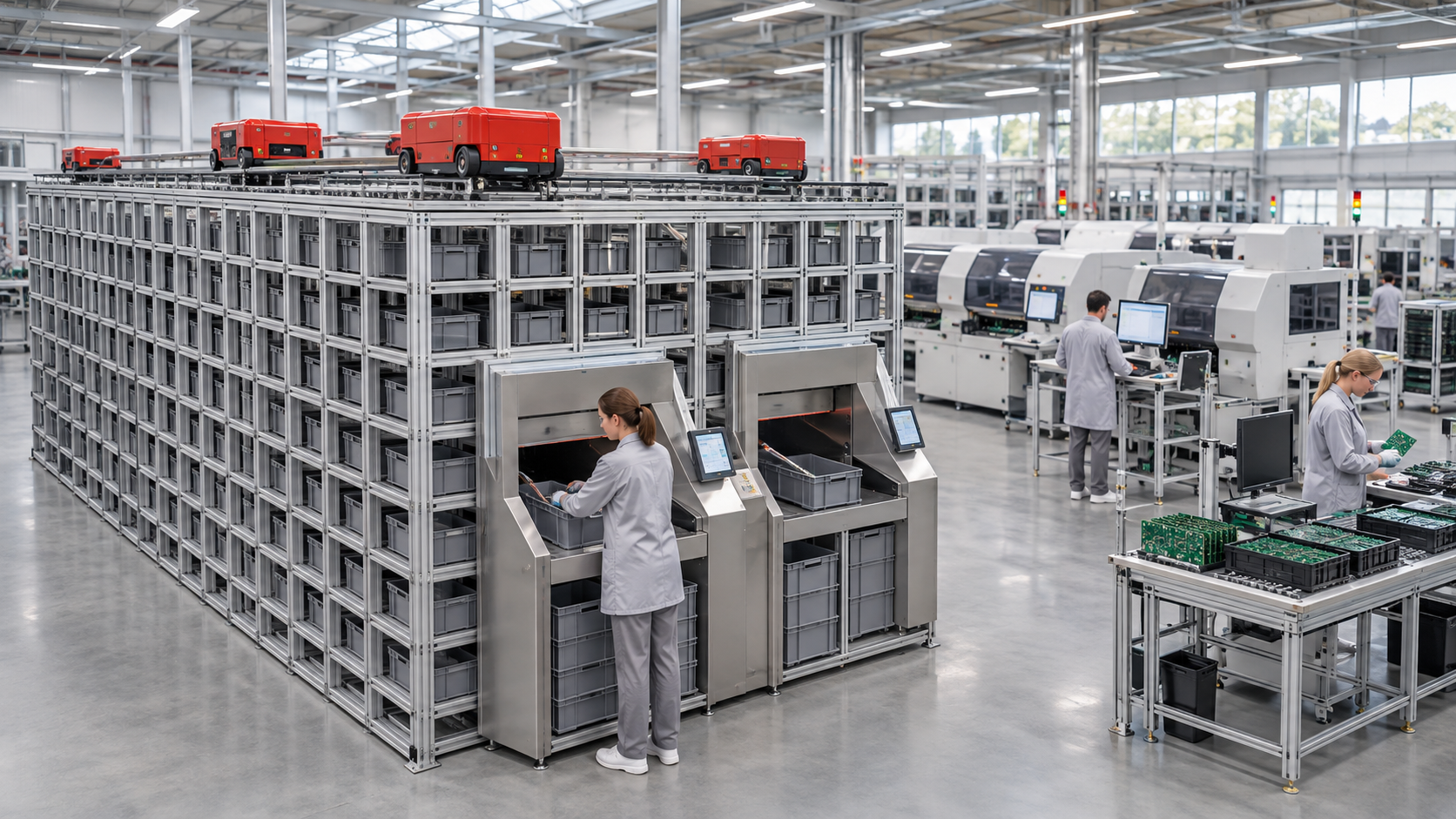
Oradea and Dematic: 7,820 storage spaces on 150 square meters – What Plexus is automating in Romania – Creative image on the topic, with AI: Xpert.Digital
Warehouse space becomes a production factor: Plexus invests in Romania's future
13 robots, 4 workstations: This is how Plexus plans to make its production more efficient
Fewer search paths, more flexibility: What automation is intended to achieve at Plexus
On approximately 150 square meters, Plexus will organize 7,820 storage locations – supported by 13 robots and four workstations. The new facility in Oradea, Romania, is designed to store components compactly, improve their availability for electronics manufacturing, and free up valuable factory space for productive tasks. The crucial factor is not just the number of robots: this investment demonstrates how closely industrial competitiveness is now linked to material flow, software, and the efficient use of existing space. Lower labor costs alone are increasingly insufficient as a competitive advantage. Whether automation actually delivers increased performance also depends on how well it is integrated into the factory's processes – and whether the freed-up space can subsequently be used economically.
More factory instead of more warehouse: What automation at Plexus reveals about Romania's industrial future
Cheap labor is not a business model for the future – what matters is how much added value is created on the available space
The most economically significant figure regarding the new warehouse automation system at Plexus in Oradea, Romania, is not the number of robots. It's the approximately 150 square meters on which 7,820 storage locations will be organized. Within a production facility totaling 27,000 square meters, the system thus occupies only about 0.56 percent of the total area. This ratio illustrates the strategic core of the investment: storage should occupy less space, freeing up more room for productive activities.
Dematic has installed an AutoStore system with 13 R5 robots, four carousel workstations, and a maintenance level. The system is designed to increase storage density, improve inventory accuracy, and support material supply for electronics manufacturing. A warehouse control platform connects the physical automation with operational process control.
Behind this lies a development that extends far beyond a single location. Industrial competitiveness increasingly arises from the interplay of manufacturing, material flow, software, and land use. Lower labor costs alone are not enough. Especially with complex products, reliable processes, controlled inventory, and a robust supply of materials to the production lines determine whether a location can grow economically.
A compact system with far-reaching operational significance
Oradea is located in northwestern Romania near the Hungarian border. Plexus combines electronics manufacturing there with the storage of components, semi-finished goods, and finished products. The site thus fulfills several functions within the same operational infrastructure.
This connection is more complex than a simple spatial analysis might suggest. Components must arrive at the correct production station on time. Semi-finished goods require a clear assignment to production orders and processing stages. Finished products must be available without hindering ongoing production, either spatially or organizationally.
The new facility primarily addresses the question of how to better organize these material inventories in a limited space. Its economic significance therefore does not stem solely from additional storage capacity. The crucial factor is whether the more compact storage makes the entire factory more efficient.
However, an important limitation of the available data remains: The previous storage area, the previous level of automation, and the actual production area freed up are not shown. Therefore, a concrete percentage reduction in space or a quantified increase in productivity cannot be reliably derived from this.
Why storage space within a factory can be particularly expensive
The economic value of a property depends not only on its rent or construction costs. Within an existing factory, additional opportunity costs arise: Space used for storage is not available for alternative uses.
If Plexus can free up space for additional manufacturing steps by consolidating its inventory, this space could be significantly more valuable than ordinary off-site storage. Additional production capabilities could allow for new customer programs, increased output, or a better layout of existing equipment.
This benefit, however, only arises if there is a genuinely economically viable subsequent use for the land. Vacant space alone does not generate revenue. Demand, machinery, personnel, technical approvals, and potentially additional infrastructure are also required.
Warehouse automation initially expands the site's operational flexibility. Whether this directly translates into increased profits depends on further investment and production decisions. This distinction is crucial: improved space utilization is a strategic advantage, but not yet a fully realized return.
What the plant figures show and what they leave open
With 7,820 storage locations on approximately 150 square meters, this equates to a calculated density of about 52 storage locations per square meter of floor space. This figure describes the vertical and spatial density of the system. It explicitly does not mean that there are 52 directly accessible shelves next to each other on every square meter.
Similarly, 7,820 storage locations are not equivalent to 7,820 different items or individual components. The actual number of items that can be stored depends on factors such as container layout, packaging, component sizes, and permissible mixed occupancy.
The 13 robots and four workstations describe the technical equipment, but do not allow for a reliable calculation of the hourly picking performance. Information on access patterns, container movements, picking quantities, and work processes is lacking.
The definition of the area is also relevant. For a complete economic comparison, it would be necessary to clarify which adjacent traffic, staging, and service areas are included in the aforementioned 150 square meters. Only a uniform system boundary allows for a fair comparison with other storage concepts.
How high-density storage works technically
AutoStore stores standardized bins in a grid, close together and stacked on top of each other. Robots move along the top surface, picking up bins and transporting them to connected workstations. If a required bin is located beneath other bins, the bins above it must first be moved. Spatial density is thus achieved through a controlled sequence of transport and relocation movements.
For Plexus, this principle is particularly interesting because large parts of the warehouse area no longer need to be accessed via permanently accessible picking aisles. Access is provided via robots and workstations.
However, the high density changes the planning requirements. Not only the quantity of stored goods is relevant, but also the frequency and timing of access. A warehouse with many rarely needed components presents different challenges than one that continuously supplies the same production lines.
The technical design must therefore match the actual material profile. A compact system is not automatically optimal for every type of production supply.
Why capacity and throughput must be considered separately
Storage capacity answers the question of how much material can be stored. Throughput, on the other hand, describes how many storage and retrieval operations are handled within a specific period. Both quantities are related, but by no means identical.
A warehouse can have sufficient free space and still be too slow if many production orders require materials simultaneously. Conversely, an efficient transport system can reach its limits because there is no suitable space available for additional inventory.
For Plexus, therefore, the number of storage spaces is not the only decisive factor. Equally important is whether the four carousel workstations and the robot fleet can handle the actual peak loads. Situations where goods receipt, production supply, and putaway occur simultaneously are particularly challenging.
A reliable performance evaluation must therefore examine peak loads and cannot be limited to daily averages. Reserves for maintenance, malfunctions, and fluctuating order volumes must also be included. The optimal system is not the one with the highest theoretical performance, but the one with adequate performance under real operating conditions.
From search effort to regulated material provision
The goods-to-person principle changes the division of labor in the warehouse. Employees no longer go to the respective storage location for each retrieval. Instead, the system brings the required containers to a workstation.
The immediate advantage lies in reduced walking and search distances. At the same time, withdrawals can be organized at defined points. This facilitates a standardized process for identification, booking, and material handover.
For electronics manufacturing, this controlled access is particularly relevant because numerous outwardly similar components can have different specifications. Rapid provision is only valuable if the correct material is also available.
Automated container transport does not mean that all work steps are automated. The four carousel ports are interfaces between the system and the operating personnel. How items are checked, counted, removed, or returned at these ports significantly impacts overall performance.
The improvement therefore arises from the combination of technology and work organization. If only transport is automated, while unclear withdrawal and booking processes remain, part of the economic potential remains untapped.
Inventory accuracy as a prerequisite for reliable production
A material inventory is only truly economically viable if its actual condition matches the information in the system. A component that is theoretically present is of no use to production if it is incorrectly assigned, locked, or cannot be located.
Higher inventory accuracy reduces this uncertainty. It can help avoid searches, unplanned recounts, and last-minute replanning. Furthermore, it improves the quality of planning decisions.
However, the automatic movement of containers does not guarantee complete inventory accuracy. The system may know the location of a container even if its contents have been incorrectly recorded. Incorrect withdrawal quantities, incomplete return entries, or faulty master data remain potential causes of discrepancies.
The benefit of the investment therefore also depends on consistent identification, clear responsibilities, and appropriate controls. Inventory accuracy is not an isolated characteristic of warehouse technology. It is the result of a continuous information chain from goods receipt to actual material consumption.
Why small components can trigger large economic risks
In electronics manufacturing, material value and operational importance are not necessarily proportional. A single, inexpensive component can be indispensable for the completion of a significantly more valuable assembly.
If this part is missing, waiting times, additional relocations, or changes in the production sequence may occur. The economic damage is then not limited to the procurement cost of the missing material.
Therefore, when evaluating warehouse automation, the avoided disruption is a key benefit factor. More reliable supply can be more valuable than simply saving a few minutes of transport time.
However, this correlation should not lead to arbitrary assumptions about benefits. To calculate a realistic value, Plexus would need to document how frequently material-related interruptions occurred previously, what their causes were, and what proportion can actually be avoided by the new solution.
Not every production stoppage is a storage problem. Missing deliveries, quality deviations, or technical malfunctions in production facilities cannot be eliminated simply by increasing storage density.
Complex products increase the demands on warehouse organization
Plexus develops, manufactures, and supports complex products for demanding application areas. These include healthcare and life sciences, aerospace and defense, industrial applications, and equipment for the semiconductor industry. In such markets, mastering product and process complexity is of paramount importance.
This results in a greater need for differentiation in warehouse organization. In addition to article number and quantity, factors such as batch, release status, customer assignment, or revision status can be crucial.
In addition, there are material-dependent requirements. Electronic components may require protection against electrostatic discharge or special rules for storage and handling. AutoStore offers, among other things, containers made of antistatic material. However, it is not specified whether and in what form such containers are used in Oradea.
An automated warehouse therefore does not replace material- and product-specific suitability testing. The system must be integrated into the required quality management system. Only then can the spatial density be combined with the necessary process reliability.
The software determines the value of the hardware
The Dematic warehouse control platform is an essential component of the project. Its importance lies in the fact that robots, workstations, and material requirements must not operate independently of each other.
The fundamental task of such a control level is to coordinate operational movements and link technical processes with overarching processes. For economic success, it is crucial what information is taken from the connected company systems and how concrete transport and provisioning orders are generated from this information.
The term WCS alone doesn't specify which functions have actually been implemented in Oradea. Whether, for example, production priorities, material reservations, or certain traceability data are managed directly on this platform or in other systems remains unclear.
This division of tasks must be clearly defined. Duplicated data storage and conflicting responsibilities can significantly reduce the benefits of a modern system. Good integration, therefore, does not mean having as many functions as possible in one software program, but rather clearly defined responsibilities between the systems involved.
LTW Intralogistics Solutions

LTW Intralogistics – Engineers of Flow - Image: LTW Intralogistics GmbH
LTW offers its customers not individual components, but integrated complete solutions. Consulting, planning, mechanical and electrotechnical components, control and automation technology, as well as software and service – everything is networked and precisely coordinated.
In-house production of key components is particularly advantageous. This allows for optimal control of quality, supply chains, and interfaces.
LTW stands for reliability, transparency, and collaborative partnership. Loyalty and honesty are firmly anchored in the company's philosophy – a handshake still means something here.
Related to this:
Innovative warehouse automation in Romania
Uniform processes without rigid standardization
Plexus employs more than 20,000 people worldwide at 27 locations. In such a network, a single warehouse solution is also a matter of operational standardization.
When multiple plants can build on a shared control platform, technical expertise can be transferred more easily. Training, troubleshooting, and support don't need to be completely redesigned at each location. Furthermore, standardized data structures can facilitate the comparison of operational performance.
At the same time, factories differ in terms of customer mix, production processes, buildings, and local conditions. A comprehensive platform is therefore only useful if it allows sufficient room for these differences.
The most economically viable approach lies between two extremes: completely isolated, customized solutions and a centrally prescribed, one-size-fits-all solution without regard to location. Standardization should primarily focus on interfaces, data definitions, and fundamental process rules. The specific technical design must be tailored to local needs.
The plant in Oradea can therefore serve as a transferable operating model, without every other plant needing the same number of robots or the same warehouse size.
Romania's industrial growth requires a differentiated analysis
The investment is taking place in a Romanian industrial and logistics market where the available space has continued to grow. CBRE estimates the modern industrial and logistics stock at approximately 8.60 million square meters by the end of the third quarter of 2026. Leasing activity reached around 694,000 square meters in the first nine months, approximately two percent higher than in the same period of the previous year. The vacancy rate was 5.58 percent.
These figures indicate a significant market, but not a uniform boom. Rental income encompasses various contract types and is not synonymous with additional industrial production. Similarly, the national vacancy rate does not reflect the actual availability of suitable space in the immediate vicinity of a particular factory.
For Plexus, the operational perspective therefore remains crucial. Even if warehouses are available off-site, internal consolidation can be economically superior. It avoids additional spatial separation and keeps materials closer to production.
Why economic weakness increases productivity pressure
A growing real estate stock does not automatically translate into strong overall economic growth. In its autumn forecast from November 2026, the European Commission expects Romania's real gross domestic product to decline by around 0.3 percent. Fiscal consolidation, weak consumer demand, and uncertainty are weighing on this development. For industry, additional risks arise from external demand and energy prices.
This background changes the interpretation of the investment. Warehouse automation does not necessarily have to be an expression of an unrestricted expansion phase. It can also represent a response to increasing pressure for efficiency.
When sales and margins become more uncertain, better utilization of existing resources becomes increasingly important. A factory that can handle additional requirements within its existing building doesn't need to decide on major structural expansions as early.
However, even an automation system remains a capital investment with ongoing costs. Especially in a weaker market, a sober assessment is therefore necessary. Technical modernization is economically compelling if it eliminates clearly identified bottlenecks, not simply because it appears modern.
Oradea's locational advantage does not arise solely from its proximity to the border
The location near Hungary creates a geographical link to important Central European procurement and sales markets. This can result in an advantage for cross-border production networks.
However, geographical proximity is only one prerequisite. Crucial factors are actually available transport links, transport reliability, supplier structures, and the plant's ability to efficiently convert incoming materials into finished products.
Efficient intralogistics thus complements external site connections. Short international transport routes lose their value if components have to be searched for extensively after arriving at the plant, are moved multiple times, or are delivered late.
Conversely, a highly automated warehouse cannot fully compensate for an unreliable external supply. Industrial efficiency arises from the interplay of both levels.
For Romania, this reveals an important economic policy insight: infrastructure investments and operational productivity investments are not alternatives. Roads, energy supply, and digital networks create the necessary conditions. Companies must then transform these into actual added value through appropriate processes.
The low-wage model is losing viability as a sole strategy
The economic attractiveness of a production location cannot be permanently reduced to low wages. What matters are labor costs per economically viable output and thus the relationship between costs, productivity, and quality.
For Romania, the OECD describes how labor costs have risen faster than productivity over an extended period. At the same time, skills gaps and infrastructural weaknesses exist. This combination increases the pressure to secure growth more effectively through improved processes and higher added value.
Automation is one possible answer to this. It can relieve employees of walking distances and repetitive transport tasks, allowing them to focus their working time more on monitoring or value-added activities.
However, this does not automatically lead to staff reductions. Whether positions are eliminated, new tasks are created, or additional production capacity is managed with existing teams depends on capacity utilization and company strategy.
The decisive criterion is therefore not the number of manual steps replaced. It is the question of whether the same location, with its available resources, can produce more reliably and economically.
What a sound economic analysis should look like
Neither acquisition costs nor ongoing operating costs, nor a specific amortization target, have been published for the investment in Oradea. Therefore, a reliable return calculation is not possible.
The underlying logic can nevertheless be determined. On the benefits side, there are potential savings in internal transport, search times, inventory adjustments, and external warehousing solutions. Added to this are the economic value of freed-up space and potentially lower disruption costs.
In contrast, there are hardware, software, integration, structural modifications, training, and commissioning costs. During operation, maintenance, support, energy, spare parts, and internal support are added to the mix.
It is important not to conflate these factors. A one-time release of tied-up capital is different from recurring annual cost savings. Furthermore, additional revenue does not automatically equate to additional profit.
Even avoided investments must be treated with caution. A building expansion that is no longer needed only represents a real advantage if this expansion would have been genuinely necessary and economically justified without the project.
Why double counting can make the benefits appear greater
Automation projects often have several positive effects simultaneously. Precisely for this reason, there is a risk of evaluating the same benefit multiple times.
If shorter search times are already recorded as a productivity gain, they must not be fully included a second time in a general personnel cost saving. If additional production space is valued based on its expected contribution to earnings, it must be verified whether this already includes avoided alternative costs.
The same applies to inventory levels. Lower average inventory can free up capital and reduce certain operating costs. However, the total value of inventory does not contribute to annual earnings.
A sound profitability analysis therefore separates liquidity, profit, and strategic options. It also takes into account when the respective benefits will materialize.
For Plexus, the timing could be crucial: some effects will result from improved warehouse organization. Others, particularly additional production in available space, may only be realized with new customer programs or follow-up investments.
More storage spaces do not automatically mean less tied-up capital
The new facility allows for more efficient storage of stock. Whether this will also reduce the stock volume is another question.
Improved transparency can help reduce safety margins that previously arose from uncertainty about available materials. At the same time, lead times, minimum order quantities, or customer-specific agreements may still necessitate high inventory levels.
It is even conceivable that a company might deliberately use the additional capacity to maintain larger stocks of critical materials. This would potentially increase security of supply, while also increasing the capital tied up in stock.
None of these developments is inherently wrong. The crucial factor is whether the portfolio strategy aligns with the risk and the business model.
Therefore, to evaluate the project, inventory density, inventory value, and delivery capability should be monitored separately. A fuller warehouse is not automatically inefficient. A smaller inventory is not automatically better. The economically sensible inventory level is that which secures the required production and delivery capacity with a reasonable level of capital commitment.
Scalability creates flexibility, but not unlimited expandability
The modular design is intended to allow Plexus to expand its storage capacity as needed without major structural modifications. This is particularly valuable when future demand is difficult to predict.
A phased investment can prevent financing an overly large investment too early. At the same time, it preserves the possibility of responding to growing needs later.
However, this flexibility has technical limitations. Additional containers require space within the grid. More robots do not proportionally increase performance under all conditions. Workstations, traffic patterns, and downstream processes can become limiting factors.
Therefore, an expansion strategy must consider capacity and throughput together. Planning only additional storage space can lead to problems later at the picking stations. Simply increasing transport capacity will not eliminate bottlenecks in manual material inspection.
The economic value of modularity therefore lies in a predictable adaptability within sensibly defined limits.
The dependency is shifting from paths to systems
Automation changes the risk profile of the site. Fewer manual search and transport processes can stabilize daily operations. At the same time, the importance of software, communication, and technical availability increases.
Distributing transport tasks across 13 robots can, in principle, enable operational flexibility. However, this does not guarantee complete protection against common causes of malfunctions. Problems with power supply, control systems, or central interfaces can affect larger parts of the system.
Plexus therefore requires not only maintenance, but also a coordinated operating concept. This includes escalation channels, available spare parts, regulated software changes, and appropriate procedures for exceptional situations.
Production supply should also take into account which materials would be particularly critical in the event of a disruption. Appropriate buffers can reduce dependence on short-term system fluctuations.
Automation does not mean eliminating risks. It replaces a risk profile that is predominantly shaped by personnel and organization with a more technically integrated one.
Energy and sustainability benefits must be demonstrated
More compact storage can offer ecological advantages. If additional buildings or external storage trips are actually avoided, material consumption, transport costs, and building-related energy consumption can be reduced.
These potential advantages are offset by the manufacturing and operation of the automation system. Robots, control technology, batteries, and spare parts require resources. Furthermore, the system consumes electricity.
No reliable data has been published for Oradea from which a concrete energy or emission saving could be calculated. Any corresponding percentage figures would therefore be speculative.
A proper assessment would need to differentiate between several levels: the warehouse's electricity consumption, the plant's total consumption, and the consumption per unit produced. If the freed-up space allows for additional production, the absolute energy consumption may increase, even though space efficiency improves.
Sustainability and economic efficiency can complement each other here. However, they don't do so automatically. What matters are the alternatives actually avoided and the real use of the created capacity.
Which key performance indicators make success visible in everyday life
Economic success should not be measured by how impressive the plant looks. Changes in its operation are what truly matter.
For Plexus, inventory accuracy, lead times, and material-related production interruptions would be particularly relevant. System availability, picking errors, and the personnel effort required for each material transaction are also important.
The area impact should be considered separately. What matters is not only how much space is theoretically freed up, but also what proportion can subsequently be used productively and what economic contribution this use makes.
Equally important is the performance during peak loads. Average values can mask the fact that certain material requirements are regularly addressed too late.
For a fair before-and-after comparison, changes in production volume and product mix must be taken into account. Despite successful automation, increased costs can arise if significantly more or considerably more complex orders are being processed simultaneously.
Only such a differentiated measurement can separate technological progress from actual economic improvement.
What Dematic and Plexus each need to contribute to the project's success
The roles of the participating companies complement each other. Dematic contributes its automation, integration, and software expertise. As part of the KION Group, the company, with more than 10,000 employees and a presence in over 26 countries, has an international base for implementation and support.
For Plexus, such a network is particularly valuable when solutions are to be deployed across multiple locations. However, company size alone does not guarantee short response times or cost-effective operation. Clear responsibilities and actually available services remain crucial.
Plexus, in turn, must create the necessary operational conditions. This includes suitable master data, clear material processes, and the involvement of employees. Priorities between warehousing and production must also be clearly defined.
Project success cannot therefore be attributed to a single technological component. It arises where technical design, operational discipline, and production planning are aligned. Weaknesses at one of these levels can significantly limit advantages at the others.
The actual investment is in the adaptability of the plant
The new warehouse solution in Oradea is more than just a small-scale technical upgrade; it transforms the possibilities for further developing an existing factory.
On approximately 150 square meters, 7,820 storage locations, 13 robots, and four workstations are integrated into a system designed to provide compact material delivery and free up valuable space for manufacturing. The shared software platform also opens up the possibility of leveraging experiences and processes across multiple locations.
A concrete return on investment, a specific reduction in personnel costs, or a quantified increase in performance cannot be derived from the available project data. Investment sums, comparative data, and measured operating results are lacking.
The strategic direction is nevertheless clear: competitiveness increasingly arises from companies better integrating existing buildings, materials, employees, and information. This is particularly important for Romania, because sustainable industrial development requires more than just a cost advantage in labor.
The crucial progress, therefore, does not lie in deploying as many robots as possible. It lies in transforming limited space into productive room for maneuver and organizing the supply of materials to production more reliably. Whether the investment achieves its full potential will depend on this operational impact.
Consulting - Planning - Implementation

Konrad Wolfenstein
I would be happy to serve as your personal advisor.
You can contact me at wolfenstein∂xpert.digital or
Just call me on +49 7348 4088 965 .
Your intralogistics experts

Consulting, planning and implementation of complete solutions for high-bay warehouses and automated storage systems - Image: Xpert.Digital
More information here: