
Dematic and Hai Robotics: Strengthening AMR expertise in Europe – Strategic alliance in the competition for warehouse automation
Xpert Pre-Release

Language selection 📢
Published on: January 14, 2026 / Updated on: January 14, 2026 – Author: Konrad Wolfenstein
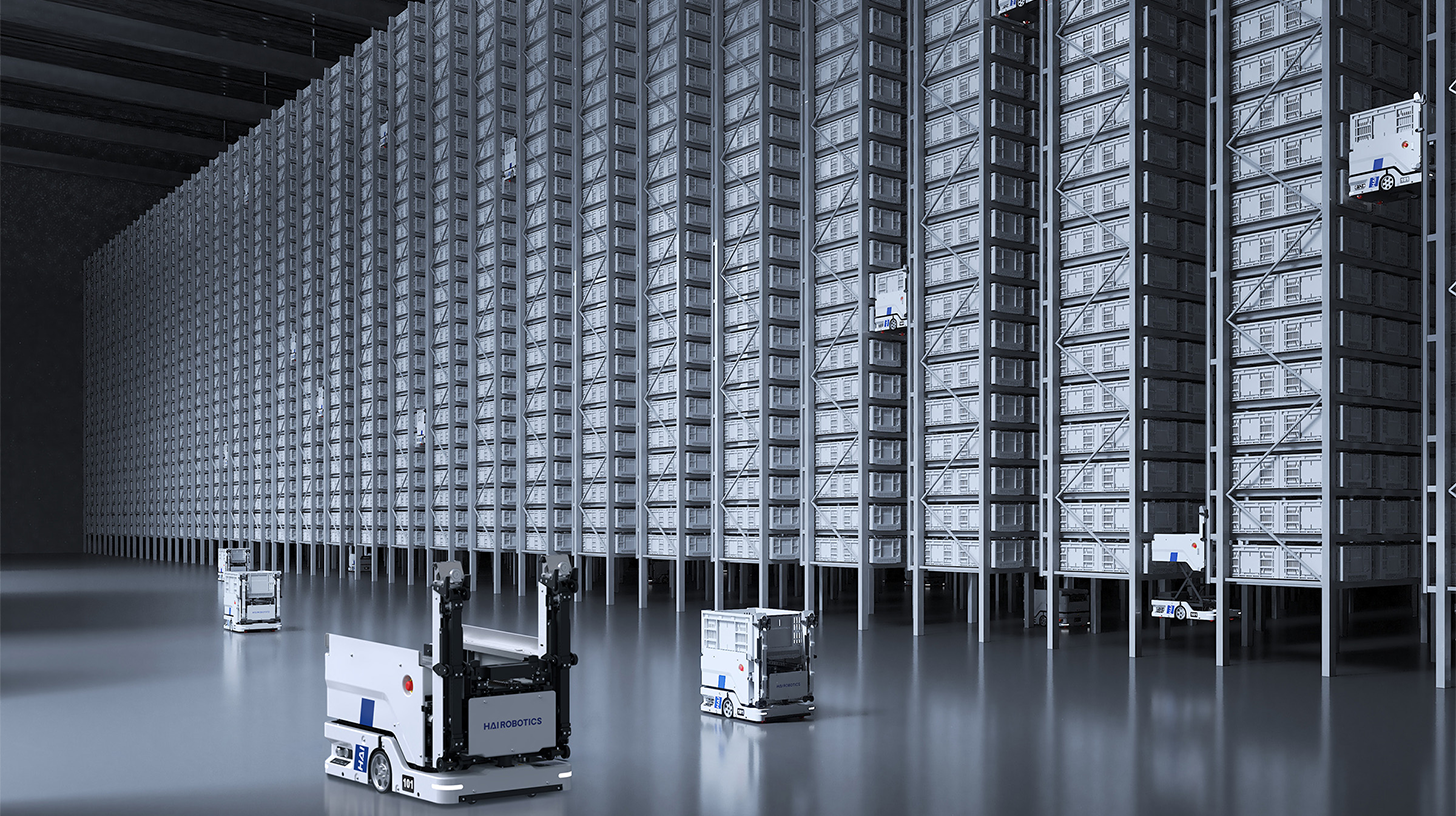
Dematic and Hai Robotics: Strengthening AMR expertise in Europe – Strategic alliance in the competition for warehouse automation – Image: Hai Robotics
Attack on AutoStore & Co.? How the Dematic-Shark partnership is reshaping the market
30% more storage density: KION's Dematic strategic move against space constraints
The year 2026 marks a turning point for European warehouse automation. In a market environment that is growing to almost €6 billion and suffering from a chronic shortage of skilled workers, simply selling robots is no longer enough – it's about the intelligent control of entire value chains. This is precisely where the strategic partnership announced at the beginning of January between industry giant Dematic and the Chinese ACR (autonomous carton handling robot) pioneer Hai Robotics comes in.
This alliance is far more than a standard collaboration. It is the answer to a pressing problem in modern supply chains: the "integration dilemma." While companies desperately seek flexibility without sacrificing the reliability of large system providers, Dematic and Hai Robotics are combining their expertise. On the one hand, there is Dematic, the core brand of the KION Group, known for comprehensive system integration and software intelligence. On the other hand, Hai Robotics contributes its robots, a technology that redefines storage density (vertical utilization) and order picking efficiency.
But what does this merger mean specifically for competition with players like Körber or AutoStore? How will cost-benefit analyses change for European SMEs? And what role does software sovereignty play in an increasingly fragmented technology landscape? The following analysis examines the economic, technological, and strategic dimensions of this partnership and explains why it will transform the robotics market for the next five years.
Why this partnership will transform the AMR market for the next five years
The European market for autonomous mobile robots (AMRs) is at a crucial turning point in 2026. With a projected growth rate of 18.48% by 2032 and a market volume expected to increase from just under €800 million in 2025 to over €5.9 billion, intralogistics is undergoing a fundamental transformation. In this context, Dematic, the world's leading provider of supply chain automation, announced its partnership with Hai Robotics in early January 2026. This agreement is not just another collaboration, but signals a reorientation of the European automation landscape.
As a core brand of the KION Group, Dematic already controls a significant market share in highly automated solutions for e-commerce and industry. In 2023, the KION Group generated total revenue of €11.4 billion, with the Supply Chain Solutions segment (Dematic) contributing approximately €2.9 billion. With over 10,000 employees in more than 26 countries, Dematic stands for integration expertise. Hai Robotics, in turn, has established itself as an innovation driver for autonomous warehouse solutions since 2016. With over 1,600 employees worldwide, more than 1,500 patents, and over 1,800 installed systems, the company possesses proven technology in the field of carton handling robots.
The economic rationale of this partnership becomes clear when looking at the drivers of the European market. While the volume of warehouse automation continues to grow (approximately 14.40% annually until 2029), the focus is shifting from rigid, fully automated systems to flexibility and scalability. Germany, as the largest market, accounts for about 28% of the volume, followed by the UK and France.
The need for flexibility stems from the labor shortage. European logistics is suffering from massive gaps, causing serious difficulties for 37% of companies in fulfilling orders. Warehouse positions remain vacant for an average of five months, while rising wages drive up the costs of manual warehousing. Almost 97% of companies now rely on automation, but the market is fragmented. This calls for modular, rather than rigid, solutions.
Technological core: The connection between "goods-to-person" and vertical storage density
Hai Robotics specializes in systems that operate on the "goods-to-person" principle (ACR systems). These systems are based on high-bay racking systems in which robots transport containers or boxes directly to employees at their workstations. Unlike traditional pallet systems, these robots make optimal use of the available floor space. In practice, this can increase storage density by 30%, while order picking efficiency increases two- to threefold. A project at the fashion manufacturer Anta demonstrated that a 5.7-meter-high warehouse could be expanded to 27,600 storage locations and process 80,000 units daily – figures that far surpass conventional systems.
Dematic, on the other hand, possesses expertise in software control, high-speed multi-shuttle systems, and material flow. The company specializes in "commercial complexity"—the ability to integrate various technologies under a single control system. A KION-owned project in Kahl am Main demonstrates this: A high-bay warehouse with 24,000 pallet spaces, a multi-shuttle system with 110,000 storage locations, and mobile robots work seamlessly together. The result was almost 100% spare parts availability.
The strategy is clear: Hai Robotics supplies the efficient hardware for carton handling, while Dematic provides the system integration and control. Together, they create a modular solution that customers can purchase. A customer can start with a small system and, thanks to Dematic's software architecture, easily integrate it into larger supply chains later.
Your intralogistics experts
Consulting, planning and implementation of complete solutions for high-bay warehouses and automated storage systems - Image: Xpert.Digital
More about it here:
Dematic's smart move: Automation for medium-sized businesses
Market structure and competitive dynamics: The integration dilemma
The European market exhibits a phenomenon that presents both opportunities and risks: fragmentation. While large manufacturers like KUKA, Swisslog, and SSI Schäfer often supply complete systems, the offerings of specialized technology suppliers are growing. Competitors like Körber have already established partnerships with Hai Robotics and Geek+. KUKA also boasts broad portfolios and collaborates with partners. AutoStore is likewise positioning itself as a modular standard system that is installed by various integrators.
In this environment, an integrator like Dematic needs to expand its options to avoid locking customers into rigid standards. The trend is moving away from monolithic systems towards interchangeable modules. The partnership with Hai Robotics solves this problem: Hai becomes Dematic's preferred option in Europe. This benefits both parties: Dematic gains a standardized supplier with efficient technology, and Hai Robotics gains access to Dematic's vast customer network.
Economically, this means that Dematic secures a near-exclusive position as the preferred integrator. This allows Dematic to avoid direct competition with pure robot manufacturers and instead position itself as a platform whose value lies in its control (orchestration) capabilities. For European SMEs, this means they can use Hai robots within the framework of the proven Dematic software, without having to deal with multiple manufacturers.
Economic consequences for different customer groups
The partnership has different effects depending on the customer segment. Large retailers and e-commerce companies, who previously had to choose between expensive full automation and manual labor, now have a middle ground. Analyses show that order picking processes often account for 40% to 60% of warehousing costs. Automation through ACR systems often pays for itself after just two to three years, while traditional high-bay warehouses take five to seven years.
Modularity offers advantages for third-party logistics providers (3PLs) that need to remain flexible. They can build a basic system for one customer and later adapt it for another industry (e.g., pharmaceuticals or electronics) without having to rebuild everything. This reduces risk.
For medium-sized warehouse operators in Germany and the Benelux countries, where labor costs are highest, the barriers to entry are decreasing. Hai Robotics manufactures cost-effectively in China. Combined with Dematic's experience, this could lower the prices for complete solutions without compromising performance.
Strategic context within the KION Group
This partnership must be seen in the context of KION's strategy. KION is increasingly integrating forklifts, warehouse systems, and software. Projects like the collaboration with NVIDIA aim at AI-driven systems. An autonomous vehicle that optimizes its own routes is the future. Hai Robotics brings relevant expertise in robot control and location tracking to the table, complementing this AI strategy.
This makes Dematic the central integrator in Europe. Linde Material Handling and STILL (both KION) already supply vehicles for Dematic systems. Hai Robotics complements this with specialized robots for horizontal transport. The result is a comprehensive package that individual competitors can hardly replicate.
Market shares and long-term consequences
The market will consolidate. The number of independent integrators is likely to decrease as smaller providers come under pressure. Körber remains a strong competitor, given its broad product portfolio. KUKA will continue to compete as a systems manufacturer.
For Hai Robotics, this move is crucial for gaining a foothold in Europe. While the Chinese market is saturated, market penetration in Europe is still below 10%. The partnership with Dematic significantly accelerates market access and eliminates the need for the arduous process of building its own sales structures.
Software as a decisive competitive factor
An often underestimated aspect is the software. Hai controls the robots, Dematic controls the warehouse and the supply chain. Connecting these systems requires standardized interfaces.
This is where Dematic leverages its strength: Dematic defines the standards into which Hai Robotics is integrated. This creates a certain market power. In the long term, Dematic software standards will become the norm. More importantly, a warehouse with Dematic software can utilize various robots. However, a warehouse that relies heavily on Hai robots running Dematic software cannot be easily switched to a different system. This strengthens customer loyalty to Dematic.
Effects on different bearing types
For high-throughput e-commerce hubs, the combination is ideal: robots ensure a constant supply, while the software optimizes the flow.
In automotive logistics with its fixed processes, the software assists with the intelligent placement of numerous part variants.
For pharmaceuticals and food (requiring refrigeration/hygiene), the partnership is initially less relevant, as these sectors often require specialized solutions, even though Hai is developing corresponding options.
For small businesses (under 5,000 storage locations), full integration often remains too expensive; simpler solutions will be necessary in these cases.
Geoeconomic importance for Europe
A subtle but important aspect is the dependence on Chinese technology. Hai Robotics is a Chinese company. Since the EU increasingly values technological independence, too deep an integration could raise questions in the long run. Currently, however, pragmatism prevails: European alternatives in the field of these robots are often scarce or more expensive.
Conclusion: Structural change in competition
The partnership between Dematic and Hai Robotics sends a signal to the industry. Competition is no longer between individual vendors, but between technology ecosystems. Dematic is leveraging its position to establish Hai Robotics as a partner without having to develop the technology itself.
The logic is clear: The market is growing rapidly, but automation is still limited. Both companies are positioning themselves to jointly capitalize on this growth. For customers, this means easier access to flexible automation, faster implementation, and greater adaptability. While further partnerships of this kind will follow in the medium to long term, Dematic and KION have secured a leading position with this initiative.

Xpert.Plus warehouse optimization - high-bay warehouses such as pallet warehouses consulting and planning
Your global marketing and business development partner
☑️ Our business language is English or German
☑️ NEW: Correspondence in your national language!

Konrad Wolfenstein
I would be happy to serve you and my team as a personal advisor.
You can contact me by filling out the contact form or simply call me on +49 7348 4088 965 (Munich) . My email address is: wolfenstein ∂ xpert.digital
I'm looking forward to our joint project.
☑️ SME support in strategy, consulting, planning and implementation
☑️ Creation or realignment of the digital strategy and digitalization
☑️ Expansion and optimization of international sales processes
☑️ Global & Digital B2B trading platforms
☑️ Pioneer Business Development / Marketing / PR / Trade Fairs
Our global industry and economic expertise in business development, sales and marketing

Our global industry and business expertise in business development, sales and marketing - Image: Xpert.Digital
Industry focus: B2B, digitalization (from AI to XR), mechanical engineering, logistics, renewable energies and industry
More about it here:
A topic hub with insights and expertise:
- Knowledge platform on the global and regional economy, innovation and industry-specific trends
- Collection of analyses, impulses and background information from our focus areas
- A place for expertise and information on current developments in business and technology
- Topic hub for companies that want to learn about markets, digitalization and industry innovations










