
JD.com is building a 150,000 square meter logistics center in Abu Dhabi – A huge logistics center will be built in Abu Dhabi by 2028
Xpert Pre-Release

Available in 27 languages 📢
Prefer Xpert.Digital on GoogleⓘPublished on: November 6, 2026 / Updated on: November 6, 2026 – Author: Konrad Wolfenstein
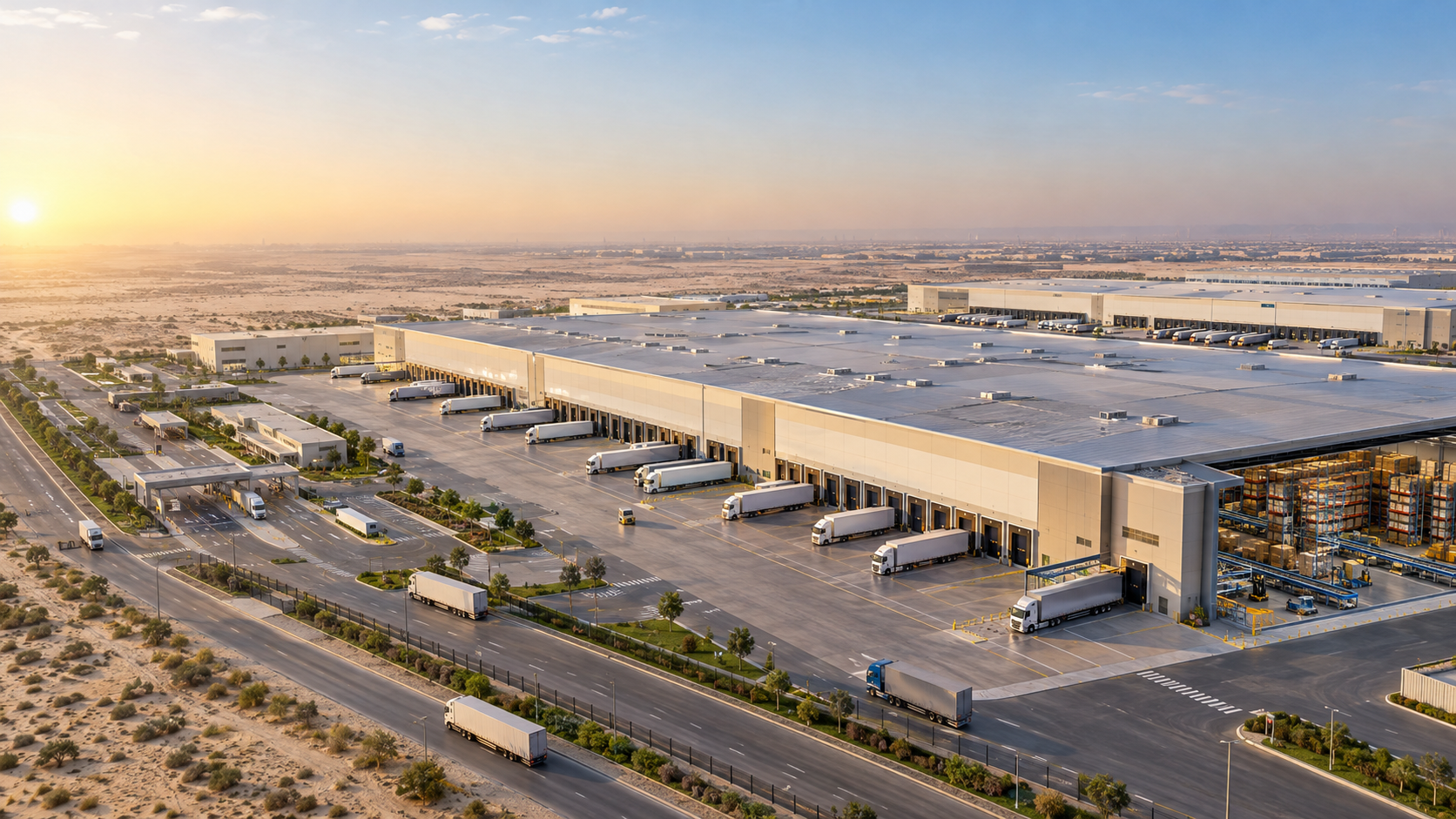
JD.com is building a 150,000 square meter logistics center in Abu Dhabi – A huge logistics center will be built in Abu Dhabi by 2028 – Creative image on the topic, created with AI: Xpert.Digital
JD.com is expanding in the Middle East – but its success hinges on one crucial question
More than just warehouse space: How Abu Dhabi aims to become a logistics hub
Abu Dhabi aims to strengthen its role in international trade – and is relying on a major logistics project with a Chinese partner. JINGDONG Property, the infrastructure and asset management arm of JD.com, is planning a 150,000-square-meter facility together with the KEZAD Group. Completion is scheduled for 2028; once operational, it is expected to create around 1,000 direct jobs. The plans include automated warehousing systems, digital processes, and flexible spaces for companies in sectors such as e-commerce, retail, and manufacturing.
However, the sheer size of the project says little about its success. Crucially, it depends on whether the center is sufficiently utilized, reliably connected to transport networks, and actually encourages companies to establish additional business functions in Abu Dhabi. The project offers the opportunity to do more with logistics than simply provide additional warehouse space. Whether it will become a permanently important hub for regional and international trade flows, however, will only become clear once it is operational.
Related to this:
Abu Dhabi's new logistics powerhouse: How JD.com aims to transform trade flows in the Middle East with 150,000 square meters
Those who control the flow of goods gain more than the warehouse business
A logistics project is underway in Abu Dhabi whose economic significance extends beyond simply providing additional warehouse capacity. JINGDONG Property, the infrastructure investment and asset management arm of JD.com, has partnered with the KEZAD Group to develop a 150,000-square-meter logistics facility. Located in KEZAD Area A – Al Ma'mourah, the site is scheduled for completion in 2028. Plans include automated warehouse systems, digital operational processes, and flexibly adaptable spaces for companies serving regional and international markets. Once operational, the facility is expected to create approximately 1,000 direct jobs, supplemented by unspecified indirect employment effects.
The crucial question, therefore, is not how many goods can be stored in this facility in the future. More economically relevant is what role Abu Dhabi will play within international supply chains and how much added value will remain permanently at the location. A logistics center can be a property that primarily provides space. But it can also become an operational hub where companies consolidate inventories, manage the flow of goods, shorten delivery times, and organize additional services.
The strategic importance of the project lies precisely between these two possibilities. The investment combines the international expansion of a Chinese infrastructure company with Abu Dhabi's interest in expanding its economic role beyond individual sectors. However, its success will not be measured solely by the building's footprint or the number of announced jobs. Crucial factors will be occupancy rates, productivity, customer structure, and the actual integration into robust transport networks.
Why 150,000 square meters does not automatically make for an economic success story
The scale of the project is considerable. An area of 150,000 square meters is equivalent to 15 hectares. This size generally allows for different uses, a separation of goods types, and the parallel operation of various customer processes. However, the area alone does not reliably indicate either the storage capacity or the potential annual goods turnover.
Crucial information is missing. Relevant factors include the usable building height, the number of storage levels, the division between storage and order picking, and the proportion of office, technical, and traffic areas. Equally important is whether the facility primarily handles palletized industrial goods, small e-commerce shipments, or particularly sensitive products. Identical floor space can accommodate vastly different quantities of goods and generate significantly different revenues, depending on the operational concept.
The degree of economic utilization is also open to interpretation. A warehouse where products are stored for extended periods serves a different function than a distribution center that forwards goods within a short time. Both types of operations can be viable, but they differ significantly in terms of staffing requirements, technology, capital commitment, and revenue structure.
The reliable conclusion is therefore: The project significantly expands the potential logistical capacity of the site. How much additional economic activity this generates depends on whether the area is combined with sufficient demand, suitable services, and efficient transport connections.
JINGDONG Property exports more than just real estate expertise
JINGDONG Property, within the JD.com corporate structure, is responsible for infrastructure investment and the management of related assets. This role is distinct from that of an online retailer or an individual transportation provider. The company provides the physical and technical infrastructure upon which trading, manufacturing, and logistics companies can operate.
According to available company figures, the global portfolio comprises more than 300 infrastructure assets with over 28 million square meters of gross floor area. Assets under management exceed US$16 billion. The portfolio includes logistics and business parks as well as data centers. It serves, among others, e-commerce, external logistics providers, manufacturing companies, and retailers. These figures describe the company's global scale, not the investment volume of the project in Abu Dhabi.
This distinction is crucial. The amount of capital being invested in a new investment cannot be deduced from the total assets under management worldwide. Similarly, the number of existing assets provides no information about their individual size, utilization, or profitability.
Strategically, the project nevertheless demonstrates a development: A large Asian technology company is expanding its international presence not only through digital offerings or the direct sale of goods. Through its infrastructure division, it is also establishing a foothold in the physical infrastructure of trade. This creates a position within the supply chain that can extend beyond individual transactions.
Abu Dhabi is focusing on the economic impact behind the handling of goods
From Abu Dhabi's perspective, a modern logistics center is particularly valuable when it attracts additional business activity. While the direct operation of the center creates jobs and demand for services, the greater strategic impact can lie in companies establishing further functions at the location due to improved logistics infrastructure.
This could include regional distribution tasks, spare parts supply, inventory management, or product-related services. For example, a manufacturer doesn't necessarily need a complete production facility immediately to increase its market presence. A regional warehouse may initially suffice to shorten delivery times and serve customers more reliably. Further activities can then develop from this. Such a development path is possible, but by no means automatic.
For the regional economy, the degree to which the logistics center is integrated with local businesses is crucial. If maintenance, transport, packaging, IT support, and other services are procured locally, its economic impact expands. Conversely, if many services are outsourced and local providers are only partially involved, the regional benefits remain limited.
The economic policy benchmark should therefore not be solely the size of a real estate investment. A more meaningful indicator is whether the project creates productive relationships, makes existing businesses more competitive, and permanently establishes new business functions at the location.
The real locational advantage arises between the modes of transport
The planned facility is intended to benefit from KEZAD's transport infrastructure and its connections to regional and international trade networks. Integration into multimodal logistics activities is planned, meaning the combination of different modes of transport. However, the available project information does not specify which concrete connections individual customers will actually use.
This reluctance is economically significant. A favorable location on the map is not enough. A site only becomes a high-performing hub when transitions between transport segments function reliably. This includes coordinated operating hours, available capacities, clear documentation processes, and minimal waiting times.
A company considers the entire supply chain. A cost-effective warehouse becomes less attractive if goods are regularly delayed en route to it or during onward transport. Conversely, a slightly more expensive facility can be economically superior if it improves planning and thereby reduces safety stock or delivery failures.
For Abu Dhabi, the challenge therefore lies in not developing the new property in isolation. Its benefit depends on the quality of the overall system. The interfaces between warehousing, transport providers, customers, and administrative processes will determine whether geographical accessibility translates into a measurable competitive advantage.
Speed is valuable, reliability is often even more valuable
In the public perception, modern logistics is often equated with the fastest possible deliveries. For companies, however, speed is only one part of the equation. Whether promised delivery times are met is at least as important.
A slightly longer but reliable supply chain can be more economically advantageous than a theoretically fast supply chain with significant fluctuations. Unforeseen delays force companies to maintain additional inventory or to organize expensive alternative shipments at short notice. For industrial customers, missing parts can also disrupt downstream processes.
The new center could make a contribution here by combining regional stocks with transparent processes and reliable distribution. However, such benefits don't arise simply from installing automated systems. They require coordinated planning that aligns demand, available stocks, and transport capacities.
The economic quality of a location should therefore be measured by several factors: throughput time, adherence to deadlines, error rate, and the ability to handle fluctuations in demand. High throughput is only a success if it is not achieved at the cost of excessive costs, frequent errors, or unstable processes.
Automation must be a good fit for the product profile
Automated storage systems and digital workflows are part of the announced concept. However, it is not yet possible to deduce which technologies will be used or what the degree of automation will be. Information on specific robot systems, conveyor systems, or software architectures is not available.
Automation can, in principle, take over repetitive tasks, reduce search and transport routes, and make processes more consistent. It becomes economically attractive where these advantages outweigh the additional investments and ongoing operating costs.
The crucial variable is the product profile. Standardized containers and regularly recurring order structures are automated differently than non-uniform, heavy, or fragile products. A system designed for small-scale shipping orders is not necessarily suitable for large industrial components.
Capacity utilization also plays a key role. Technical equipment incurs costs, even if the processed volume falls short of expectations. Oversizing ties up capital in underutilized technology. Undersizing risks bottlenecks and costly retrofits.
A convincing business concept therefore does not necessarily have to strive for the maximum possible degree of automation. It must find the combination of technology, personnel, and process design that is economically viable for the expected customers and can be adapted to changing requirements.
Digital transparency determines the usefulness of the technology
The digitalization of a logistics system is often reduced to the control of individual machines. However, its economic value also lies in the quality of the information. Companies need to know which goods are available, where they are located, when orders will be processed, and what delays are likely.
If this information is incomplete or delayed, even high-performance technical systems cannot reach their full potential. Inaccurate inventory data leads to incorrect promises. Poorly coordinated systems generate queries and manual corrections. High internal processing speed is of little use if customers and transport partners are not informed in a timely manner.
For a location with diverse users, the interoperability of digital systems is therefore particularly important. Companies have various inventory management, ordering, and transport management solutions. The new infrastructure must accommodate these differences without creating a costly, separate system for each customer.
In addition, there are questions of access rights, data security, and operational reliability. A highly digitized center requires robust processes for handling technical malfunctions. Digitization creates transparency and control options, but at the same time increases the importance of functioning IT. Economic benefits only materialize when technology and organizational responsibility are aligned.
Your intralogistics experts

Consulting, planning and implementation of complete solutions for high-bay warehouses and automated storage systems - Image: Xpert.Digital
More information here:
Your container high-bay warehouse and container terminal experts

Container terminal systems for road, rail and sea transport in the dual-use logistics concept of heavy-lift logistics - Creative image: Xpert.Digital
In a world marked by geopolitical upheavals, fragile supply chains, and a new awareness of the vulnerability of critical infrastructure, the concept of national security is undergoing a fundamental reassessment. A state's ability to guarantee its economic prosperity, the provision of essential goods and services to its population, and its military capability increasingly depends on the resilience of its logistical networks. In this context, the concept of "dual-use" is evolving from a niche category of export control to a broader strategic doctrine. This shift is not merely a technical adjustment but a necessary response to the "paradigm shift" that demands a profound integration of civilian and military capabilities.
Related to this:
Abu Dhabi: A new hub for international trade
Four customer groups demand four different performance promises
The project is aimed at companies in e-commerce, contract logistics, manufacturing, and retail. This mix broadens the potential customer base. However, it also means that very different operational requirements must be taken into account.
E-commerce often focuses on numerous individual orders, a wide variety of products, and precise inventory management. For brick-and-mortar retailers, on the other hand, consolidated deliveries to branches may be more important. Manufacturing companies may require a particularly reliable supply of components or spare parts.
External logistics service providers, in turn, must meet the requirements of their own clients. For them, flexible spaces, scalable processes, and a sustainable cost structure are crucial. They can utilize a center without the infrastructure operator having to provide all logistics services themselves.
These differences illustrate why a large facility shouldn't automatically have a uniform operating concept. Dividing it into differently equipped areas can be economically advantageous. At the same time, benefits arise when certain services can be shared.
The challenge lies in enabling diversity without allowing operational complexity to spiral out of control. A broad industry approach is advantageous if it leads to genuinely compatible uses. If it remains too general, costly adjustments and an unclearly positioned offering are likely.
Tailor-made spaces increase tenant retention and vacancy risk
JINGDONG Property will offer customer-specific development services. This means adapting the infrastructure to different requirements. This can be attractive for users because they don't have to adapt all their processes to a rigid, standard property.
From an investor's perspective, however, individualization is ambivalent. Specialized spaces can foster long-term customer relationships and create clear added value. At the same time, it may become more difficult to lease the property to other tenants after a tenant moves out without major renovations.
The economic conflict of objectives is therefore: How much specialization is needed to win customers, and how much standardization remains necessary to keep the property permanently flexible?
A viable approach could be to design the basic building structure for broad usability and to address specific requirements primarily through interchangeable technical modules. Whether this is planned for the specific project is unknown.
Contract terms are also crucial for economic viability. The more a space is tailored to a single user, the more important the contract duration, solvency, and the distribution of adaptation costs become. Technical flexibility and financial security must be considered together.
Around 1,000 jobs: relevant, but not yet a complete value creation balance sheet
According to the project description, the expected 1,000 direct jobs are distributed across logistics, distribution, and administrative functions. Potential indirect employment effects in production, trade, transport, and support services are also anticipated. However, no reliable figure is provided for these additional positions.
In purely mathematical terms, 150,000 square meters and 1,000 direct workstations correspond to approximately 150 square meters per workstation. This ratio serves only as a point of comparison. It does not allow for any conclusions about productivity or personnel efficiency because neither shift patterns nor full-time equivalents nor the expected throughput are known.
Automation and employment need not be mutually exclusive. Technology can reduce certain tasks while simultaneously creating new ones in maintenance, control, IT, and process monitoring. Whether the projected employment levels are actually achieved, however, depends on the actual use of the technology and its organizational structure.
Furthermore, the quality of the work is relevant for the regional impact. Crucial factors include qualification requirements, further training opportunities, and whether expertise is permanently developed at the location. An automated center can achieve more than just additional employment if it also anchors technical and organizational knowledge.
Conversely, a comprehensive impact on prosperity should not be inferred solely from an announced number of jobs. This would require, among other things, information on wages, local procurement shares, and additional business activities.
The investor's calculations begin where the project announcement ends
A large logistics project must ultimately generate sufficient ongoing revenue to cover its costs and risks. However, essential data is missing for a concrete profitability calculation. Among other things, the investment volume, financing, expected rents, operating costs, and already contractually secured tenants are not publicly available.
Without this information, any precise return estimate would be speculative. Even a comparison with average values from other locations would only inadequately reflect the specific characteristics of the project.
In general, the returns depend on the rented or otherwise commercially used area, the agreed price level, and any additional services. On the cost side, there are construction, technical equipment, maintenance, administration, energy, and financing. Which items are borne by the owner, operator, or respective user depends on the contractual structure.
The start-up phase is particularly important. A technically completed building does not automatically generate stable returns immediately. Customers need to move in, systems need to be connected, and processes need to be established. If this process is delayed, costs are incurred while revenues may not yet be flowing in at full.
Therefore, the distinction between structural completion and economic stabilization is crucial for evaluating the project. The planned completion date of 2028 marks an important milestone, but not necessarily the point at which full occupancy will be achieved.
Capacity utilization beats size as a measure of economic success
Public attention often focuses on square footage, investment sums, and job announcements. However, occupancy rates are more crucial for the long-term viability of a logistics property.
Simply reporting a high leasable area is insufficient. A facility may be largely leased while the operating volumes of individual tenants remain weak. Conversely, an intensively used section of the property can generate high economic activity. Therefore, for a sound assessment, property use and operational use should be considered separately.
A balanced customer base can reduce risks. Companies that depend entirely on a single major customer are particularly vulnerable to that customer's business performance. Conversely, a large number of smaller customers may increase administrative and coordination efforts. The economically optimal mix does not necessarily lie at either of these extremes.
Even industry diversification is not a complete guarantee of protection. Companies in different sectors can be affected by weak demand or disrupted supply chains simultaneously. Nevertheless, diverse use of the facility can help to offset individual fluctuations.
The project's appeal lies not only in its scale, but above all in the opportunity to bring together diverse demand structures. Whether this results in a reliable risk diversification will only become clear once actual customer occupancy levels are reached.
Regional warehousing saves time, but ties up additional capital
A distribution center located closer to the sales market can shorten delivery times. At the same time, it requires inventory that needs to be financed and managed. This conflict of objectives is a key issue for potential users.
While maintaining goods in multiple regional warehouses may improve customer proximity, it also spreads inventory across several locations. This can increase the total required stock. Particularly with fluctuating demand, overstocking in one location and shortages in another are a risk.
A regional hub can mitigate this disadvantage by serving multiple markets from a shared inventory. Whether this is successful depends on transport times, administrative requirements, and the geographical distribution of customers. Not every product is equally suitable for centralized regional distribution.
From an economic perspective, the entire cost impact must therefore be considered. Shorter delivery times can enable additional sales or improve service. However, these are offset by storage costs, tied-up capital, and potential depreciation. This risk must be assessed differently for rapidly obsolete products than for long-lasting spare parts.
The benefits of the new location will vary for each customer. The strongest argument is not necessarily the lowest warehouse rental fee, but rather the best combination of availability, total costs, and manageable inventory risk.
Global expansion creates opportunities and new dependencies
For JINGDONG Property, the project represents an important step in its expansion in the Middle East. Feng Guo, CEO of JD.com Middle East, accordingly classifies the development as a strategic milestone for the company's presence in the United Arab Emirates. On the KEZAD Group's side, CEO Mohamed Al Khadar Al Ahmed connects the project to the confidence of international investors in Abu Dhabi's economic environment. Such assessments underscore the strategic intent but are not yet proof of future economic success.
The partnership between an international infrastructure company and a regional site developer can create advantages. One partner brings experience with large portfolios and diverse user requirements, while the other contributes integration into the local economic and infrastructure system.
At the same time, potential dependencies should be considered. The more companies tailor their processes to a specific property, technology, or digital environment, the more complex a later switch can become. High customer loyalty can be attractive for the provider, but it can create additional risks for users.
Long-term, sustainable cooperation therefore requires clear responsibilities, reliable performance agreements, and technically manageable interfaces. International size is an advantage, but it does not replace local operational expertise or a transparent distribution of responsibility.
Energy, maintenance and personnel belong in the same cost calculation
In modern logistics centers, real estate and technology costs cannot be considered in isolation. Automated systems require maintenance, spare parts, and qualified personnel. Digital systems require ongoing support. Buildings and technical equipment consume energy.
It is not known what specific energy or sustainability measures are planned for the site. Therefore, it would be inadmissible to attribute specific efficiency values, certifications, or in-house generation capacities to the project.
The fundamental economic requirement remains clear: investment decisions should be based on costs over the entire service life. A technically cheaper solution initially can become expensive if it frequently fails or requires extensive maintenance. Higher-quality equipment can pay off if it improves availability and lifespan.
This also requires the right personnel resources. Technical systems can only operate reliably if a sufficient number of qualified employees are available and responsibilities are clearly defined. Personnel strategy is therefore not a secondary administrative aspect, but an integral part of investment quality.
Especially with a system of this size, economic advantages do not arise from individual peak values. They arise from the interaction of many reliable components that can be operated with reasonable effort over many years.
A new hub does not automatically make supply chains more resilient
Additional logistics infrastructure can offer companies more options. An extra location may allow them to redistribute inventory or reorganize transport routes. However, this does not automatically translate into greater resilience.
A large hub can also concentrate risks. When a particularly large number of goods flows are concentrated at one location, disruptions there have a correspondingly greater impact. Technical failures, operational bottlenecks, or problems in upstream transport chains can affect numerous users simultaneously.
Resilience therefore arises from alternatives and prepared processes. These include options for alternative deliveries, robust data backup, and clear procedures for business interruptions. Such measures incur costs, but can limit significant damage in the event of a disruption.
For the new plant, this means that its size and digitalization will only improve stability if the operating concept also takes exceptional situations into account. Maximum efficiency during normal operation and sufficient reserves for disruptions must be carefully balanced.
This trade-off also affects customers. Concentrating all regional inventory in one location can achieve economies of scale, but increases location dependency. The economically sound solution depends on the value of the products and the consequences of a supply disruption.
Until 2028, implementation will count more than announcement
The planned completion date sets a timeframe. By then, construction, technical, and commercial tasks must be perfectly coordinated. Delays in one area can spread to others.
Delayed technical integration can, for example, prevent a completed building from being fully utilized. Conversely, a facility that is ready for use too early can incur costs if key customers begin their operations later than planned. Therefore, coordinating construction progress with user needs is economically crucial.
Several development stages are particularly informative for an objective assessment of the project. These include the actual construction progress, the finalization of the technical specifications, the announcement of key users, and the preparation for operation. After the opening, occupancy rates, service quality, and the stability of operations will become more important.
A favorable development scenario would be a gradual, well-coordinated occupancy with customers whose requirements match the infrastructure. A more difficult situation would arise in which extensive specialized equipment is developed without sufficient, guaranteed demand.
A broad spectrum lies between these possibilities. Therefore, the project should neither be prematurely celebrated as an economic breakthrough nor categorically dismissed as a risky over-dimensioning endeavor. The key data known so far allows for a strategic classification, but not yet a conclusive investment assessment.
The real benchmark is the permanently tied-up added value
The most compelling perspective on the project lies at the intersection of real estate and location economics. For JINGDONG Property, the facility must be economically viable. For its users, it must offer measurable advantages over alternative solutions. For Abu Dhabi, it should enable additional productive activities and skills.
These interests overlap, but are not identical. A property that is profitable for the owner can only generate limited local connections. Conversely, a labor-intensive business can be economically weak if its costs are consistently too high. A successful location must bring both levels together.
The unique opportunity presented by this project lies in its ability to connect physical infrastructure, digital control systems, and international business networks. This will allow additional warehouse space to be transformed into a platform for diverse business models. However, this is contingent on the promised flexibility actually being implemented and the transport connections proving effective in daily operations.
The clear economic assessment is therefore: The project is strategically sound, but its success is not yet proven. Its size creates opportunities, not guarantees. The crucial factor will be whether the 150,000 square meters can be transformed into a consistently utilized, adaptable, and reliably operated hub. Only then will Abu Dhabi gain not just another logistics property, but a stronger position in the organization of regional and international trade flows.
Consulting - Planning - Implementation

Konrad Wolfenstein
I would be happy to serve as your personal advisor.
You can contact me at wolfenstein∂xpert.digital or
Just call me on +49 7348 4088 965 .
Your container high-bay warehouse and container terminal experts

Container high-bay warehouses and container terminals: The logistical interplay – expert advice and solutions - Creative image: Xpert.Digital
This innovative technology promises to fundamentally change container logistics. Instead of stacking containers horizontally as before, they will be stored vertically in multi-story steel racking structures. This not only allows for a drastic increase in storage capacity within the same area, but also revolutionizes all processes at the container terminal.
More information here: