
State as a contribution robber? Pension fund under attack: 240 billion euro lawsuit before the Federal Constitutional Court
Xpert Pre-Release

Available in 27 languages 📢
Prefer Xpert.Digital on GoogleⓘPublished on: March 18, 2026 / Updated on: March 18, 2026 – Author: Konrad Wolfenstein
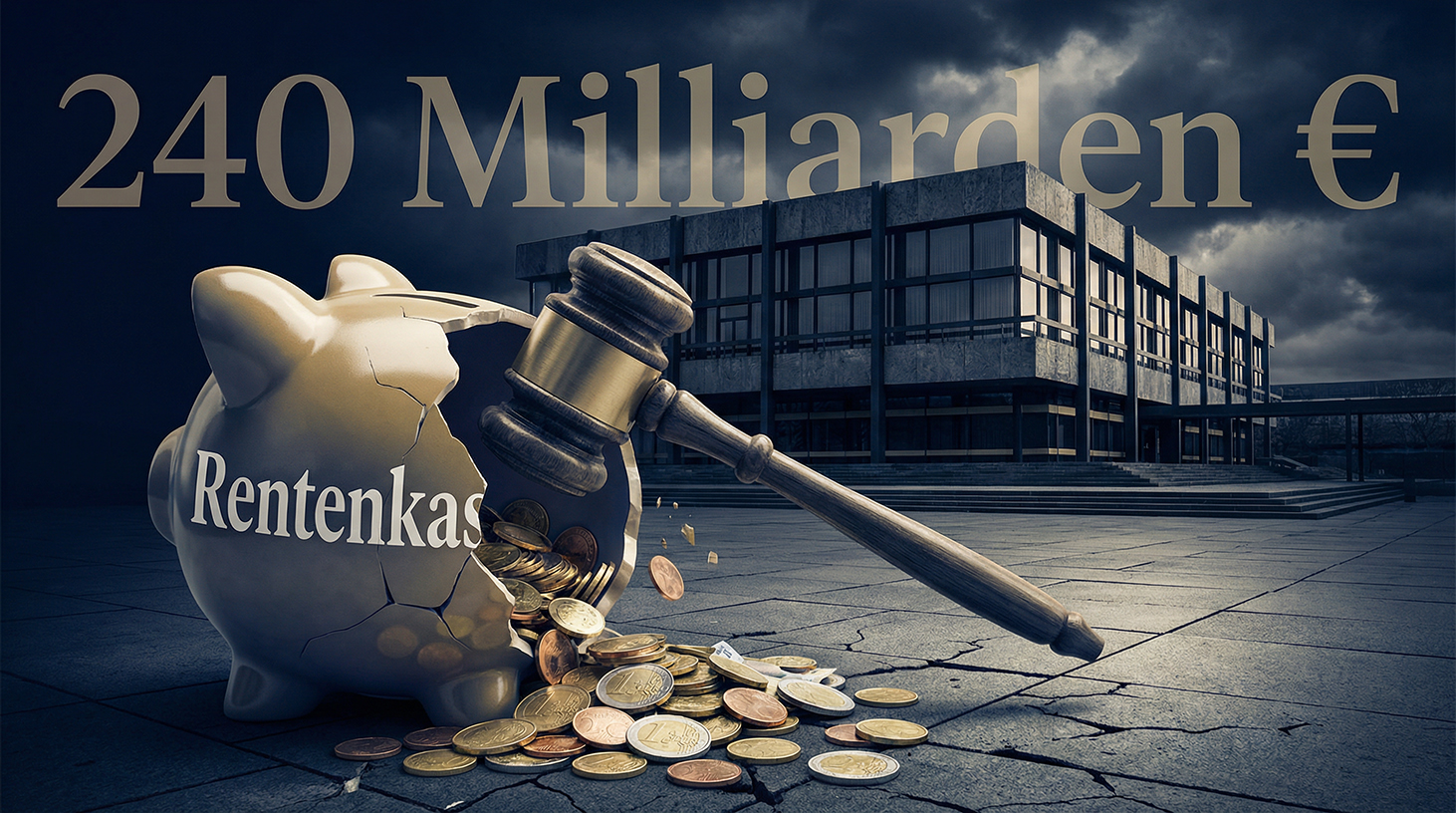
State as a contribution robber? Pension fund under attack: 240 billion euro lawsuit before the Federal Constitutional Court – Image: Xpert.Digital
240 billion euro lawsuit in Karlsruhe: Is the German pension system about to collapse?
The covert raid on the pension fund: Constitutional Court examines historic billion-euro case
It's a legal battle with the potential to shake the very foundations of Germany's financial architecture: The Federal Constitutional Court in Karlsruhe is debating the staggering sum of 240 billion euros. The accusation is grave: Has the state systematically dipped into the pension fund for decades to finance societal responsibilities like the mothers' pension or the transition of pensions to East Germany, instead of properly funding these costs with tax revenue? The "Party of Pensioners" is now demanding precisely this money back for those who paid into the system. Even though the formal hurdles for success in Karlsruhe are incredibly high, the case exposes a raw nerve. It reveals a blatant transparency problem with so-called non-insurance-related benefits and forces politicians into a long-overdue fundamental debate about the future and fairness of our retirement system. Read on to find out what this historic billion-euro dispute is really about, why the opposing sides are so entrenched, and what far-reaching consequences a ruling could have for every contributor.
The state as a contribution robber – or is everything legal after all?
A constitutional dispute as a catalyst for a long-overdue fundamental debate
On February 24, 2026, an application was filed with the Federal Constitutional Court in Karlsruhe that threatens to fundamentally shake up the pension policy debate in Germany. Among the applicants are Volker Rudolph, the federal chairman of the Party of Pensioners, lawyer Wolfgang Maurer, and the federal and Baden-Württemberg state associations of the Party of Pensioners. The defendant is the Federal Government, represented by the Federal Chancellery of Chancellor Friedrich Merz (CDU). The thrust of the lawsuit is unequivocal: pension contributions have been used for decades for so-called non-insurance-related benefits – that is, for social policy tasks of the state which, according to the plaintiffs, should actually have been financed from tax revenue.
The lawsuit is causing a major stir in the political and media sphere, not least because of the sheer scale of the demand: at least €240 billion is to be repaid from the federal budget to the statutory pension insurance system. The plan is to make four annual installments of €60 billion each, starting at the end of 2026. Furthermore, the court is to determine whether previous financing decisions were potentially unconstitutional. What initially sounds like a minor legal issue, upon closer examination, reveals itself to be a symptom of a structural financing problem that extends far beyond this specific case.
The core problem: What are non-insurance-related services – and who pays for them?
To understand the scope of the lawsuit, one must first clarify the concept of non-insurance-related benefits. Generally, non-insurance-related benefits are those pension payments that are not covered by prior contributions, either in terms of their nature or amount. They serve national, socio-political purposes and benefit not only the insured community but society as a whole.
Specifically, this area encompasses a wide range of benefits: the mothers' pension (crediting child-rearing periods as pension points), the pension transition to the East (higher valuation of pension periods in the new federal states), contribution-free periods such as during education or military service, the pension without deductions at age 63 for those with particularly long contribution periods, and compensation for war-related burdens. All these benefits stem from social policy decisions of the legislature that do not correspond to the insurance concept in the strict sense, but are enshrined in pension law.
The fundamental principle is clear: The German Pension Insurance explicitly points out that the federal government's subsidies do not subsidize the pension insurance system, but rather reimburse it for a large portion of the costs of non-contributory benefits. The federal government pays substantial sums annually for this purpose. For the 2026 fiscal year, federal subsidies to the statutory pension insurance system totaling €127.8 billion are budgeted. The ifo Institute calculated that this means one-third of all projected tax revenue flows into the pension insurance system. The general federal subsidy alone is expected to amount to €64.36 billion in 2026.
The plaintiffs' billion-dollar arithmetic: Between valid criticism and methodological weaknesses
The plaintiffs estimate the non-insurance-related benefits at €110 to €125 billion annually, while federal subsidies amount to only €108 to €110 billion. From this difference of up to €17 billion per year, they deduce a hidden burden on contributors that has accumulated over years – and thus justify their total claim of €240 billion.
This argument has a kernel of truth, but also methodological weaknesses. In fact, the amount of non-insurance-related benefits varies considerably depending on the definition. According to calculations by the German Pension Insurance, non-insurance-related benefits amounted to €68.2 billion in 2023 under the narrow definition and €124.1 billion under the broader definition. When individual benefits are reassessed from the perspective of pay-as-you-go financing, the figures are reduced again: to €44.6 billion (narrow definition) and €92.4 billion (broader definition), respectively. For comparison, the federal subsidy amounted to €84.1 billion in 2023. The alleged funding gap is therefore far from being as clear-cut as the plaintiffs claim.
The Federal Court of Auditors also expressed criticism in its 2023 report, albeit in a more nuanced form. The auditors did not criticize the plundering of the pension fund, but rather a blatant lack of transparency. To this day, there is no legal definition of which benefits are considered non-insurance-related, and consequently, no clear statement as to whether the federal subsidies fully cover the actual costs. The lump-sum nature of the subsidies, according to the Federal Court of Auditors, prevents any direct link between the level of benefits and the compensation provided. This structural lack of transparency is a serious problem that facilitates political abuse – even if it is difficult to prove in individual cases.
The specific points of contention: From the mothers' pension to the pension transition in eastern Germany
A closer look at the individual benefits at the heart of the dispute is particularly revealing. The Mothers' Pension I and II, introduced in 2014 and 2018 respectively, were integrated into the pension system without full tax-based financing. The German Pension Insurance explicitly states: It receives no separate reimbursement from tax revenue for the additional expenditures incurred by Mothers' Pension I and II. Only Mothers' Pension III is intended to be fully financed from tax revenue. The costs for the Mothers' Pension are projected to amount to €18.14 billion in 2024, offset by federal contributions for child-rearing periods. This formal reimbursement makes the financing legally permissible, but politically vulnerable, as the federal subsidies are allocated as a lump sum and not earmarked for specific purposes.
The pension transition in the former East Germany is a societal consequence of German reunification. The higher valuation of pensionable periods in the new federal states represents a socio-political decision that goes far beyond the insurance principle. A similar situation exists with the full pension at age 63: From an actuarial perspective, a deduction would be more accurate, because the full pension is paid out without the correspondingly higher contribution. The Federal Court of Auditors had already calculated a narrow figure of around €63 billion for non-insurance-related benefits in 2020; using a broader definition, the figure is even €112.4 billion.
Added to this is the structural problem of the burdens resulting from the war: pension entitlements for wartime, the experiences of displacement, and periods of employment in the GDR that are credited towards pensions are historical liabilities that have burdened the system and, from a societal perspective, clearly extend beyond the circle of today's contributors. Their financing through contributions is at least worthy of discussion.
Constitutional assessment: High hurdles, but a legitimate concern
In its previous jurisprudence, the Federal Constitutional Court has generally placed public-law claims and entitlements under the statutory pension insurance scheme under the property protection of Article 14 of the Basic Law – albeit with significant limitations. Accordingly, property protection exists only for pecuniary rights that are assigned to the legal entity for private benefit in the manner of an exclusive right, are based on substantial contributions by the insured, and serve to secure their livelihood. According to the jurisprudence of the Federal Constitutional Court, the German statutory pension insurance system is characterized by the principle of equivalence, which fundamentally presupposes a relationship between performance and consideration.
However, statutory regulations governing pension insurance also permit interventions in protected positions if they pursue a constitutionally legitimate aim, are proportionate, and comply with the social welfare principle enshrined in Article 20, Paragraph 1 of the Basic Law. This is precisely where the central legal hurdle for the plaintiffs lies: the legislature has broad discretion in designing social security systems. This explicitly includes the possibility of financing societal tasks through the contribution system, provided that adequate compensation is achieved through state subsidies.
Experts point out that both the formal requirements for a constitutional complaint and the existing jurisprudence of the Federal Constitutional Court set high hurdles. An action against a public body, as pursued by the pensioners' party, requires the involvement of a public corporation or a constitutional body. A constitutional complaint, on the other hand, requires proof of a violation of personal fundamental rights in a specific case. Whether the complainants meet these requirements is by no means legally certain. Furthermore, the federal government will likely argue that federal subsidies essentially cover the non-insurance-related benefits – which significantly mitigates the alleged funding gap.
Our EU and German expertise in business development, sales and marketing

Our EU and German expertise in business development, sales and marketing - Image: Xpert.Digital
Industry focus areas: B2B, digitalization (from AI to XR), mechanical engineering, logistics, renewable energies and industry
More information here:
A thematic hub offering insights and expertise:
- Knowledge platform covering global and regional economies, innovation and industry-specific trends
- A collection of analyses, insights, and background information from our key areas of focus
- A place for expertise and information on current developments in business and technology
- A hub for companies seeking information on markets, digitalization, and industry innovations
The 240 billion euro bombshell: This lawsuit could blow up Germany's budget
Fiscal policy dimension: The elephant in the room
Regardless of the legal outcome of the lawsuit, it highlights a budgetary problem that is growing ever larger. The €240 billion claim represents almost half of the entire federal budget. Even now, the federal subsidy to the pension insurance system, at €127.8 billion, is by far the largest single item in the entire 2026 federal budget. The Federal Ministry of Labor and Social Affairs has the largest single budget, at €197.4 billion. By 2029, federal contributions to the pension insurance system are projected to rise to around €154.1 billion – a trajectory that is likely to structurally undermine the federal government's fiscal foundations.
In a study published in November 2025 on the government's draft budget for 2026, the ifo Institute issued a stark warning: Without structural reforms, the federal government will have to permanently allocate more money to the statutory pension system, significantly restricting the scope for future-oriented spending in the regular budget. Even today, pension payments account for almost a quarter of the federal budget. A repayment scenario of €60 billion annually, as demanded by the plaintiffs, would de facto lead to fiscal collapse – and is politically impossible.
At the same time, this demand highlights a fundamental systemic failure: A social insurance system that increasingly assumes societal responsibilities without clear, transparent, and cost-covering financing loses its legitimacy as a contribution-based insurance scheme. The contribution rate has remained stable at 18.6 percent for nine years. The contribution assessment ceiling was raised to €8,450 per month in 2026. Nevertheless, it is foreseeable that without reforms, an increase in the contribution rate will be unavoidable once the large baby boomer generation has fully retired.
Public sentiment: Erosion of trust as the real problem
The public reaction to the lawsuit is revealing. A widespread conviction prevails in public debates that the state has systematically accessed contribution funds for decades and misappropriated them for general state purposes. This perception, even if it is not legally tenable, is politically virulent and socially destabilizing. For even if the use of funds was regulated by law and the federal subsidies formally served as compensation, the opaque, blanket nature of this compensation makes any proof of its appropriateness impossible.
The Federal Court of Auditors has explicitly criticized this: Neither Parliament nor the public can currently assess whether the federal subsidies allocated for this purpose are appropriate. As long as there is no legal definition of non-insurance-related benefits and no direct link is established between their amount and the government subsidies, the system remains structurally vulnerable to criticism and mistrust. This gap between formal legality and perceived legitimacy is the actual breeding ground for lawsuits like the present one.
A particular problem is the unequal treatment of those insured compared to privileged groups. Civil servants, the self-employed, and freelancers are not members of the statutory pension insurance scheme and do not contribute to the fund, which is burdened by non-insurance-related benefits. At the same time, they benefit from tax-funded federal subsidies, as these provide relief for all taxpayers. This structural imbalance is a problem for democracy that has so far received little attention in political discourse.
Mothers' pension as a special case: Extraneous to insurance or inherent to the system?
The mothers' pension is the most visible symbol in public discourse of the debate surrounding non-contributory benefits – and the most controversial. From a regulatory perspective, it is clearly classified as non-contributory: mothers receive pension points for periods of child-rearing, even though no corresponding contributions were paid into the pension insurance system. The costs are formally covered by federal subsidies, but – as mentioned – only in the case of the third phase of the mothers' pension are these costs fully covered.
At the same time, there is a legitimate economic argument for the inherent nature of this benefit: In a pay-as-you-go system, today's contributors finance the pensions of today's retirees. Children ensure the long-term viability of the pay-as-you-go system, because without offspring, the contribution base shrinks and the system collapses. Based on this logic, it can be argued that crediting child-rearing periods is not a non-insurance-related benefit, but rather a system-stabilizing benefit that should be structurally anchored in the pension insurance system. This view is held by prominent pension economists and is also reflected in academic analyses of non-insurance-related benefits that take the pay-as-you-go financing logic into account.
The political decision not to fully finance the first and second phases of the mothers' pension through tax revenue was nevertheless a mistake – not because the benefit itself is illegitimate, but because the financing method dilutes the contribution principle and undermines trust in the system. The result is a distorted debate in which a socially valuable benefit has become a symbol of state arbitrariness, even though the real problem is the lack of transparency in the financing structure.
Long-term consequences: What a decision against the government would mean
Should the Federal Constitutional Court even partially agree with the plaintiffs' arguments—a decision that, given the high formal and substantive hurdles, is unlikely but not impossible—this would have far-reaching consequences. First, clear requirements for the transparency of how funds are used would arise. A statutory definition of non-insurance-related benefits and mandatory, cost-covering co-financing by the federal government would be the logical consequence. This would structurally increase the federal subsidy and simultaneously strengthen the contribution principle of the pension insurance system.
A direct repayment of €240 billion in four annual installments is unrealistic and would overwhelm the federal budget. New borrowing to finance the 2026 federal budget alone amounts to €89.9 billion in the core budget, in addition to special fund debt of another €84.4 billion. In total, more than €850 billion in new debt is projected between 2025 and 2029. An additional burden of €60 billion annually would be impossible under these circumstances without either massive tax increases or drastic cuts in other areas of spending.
The truly significant aspect of the lawsuit is therefore not the claim for repayment itself, but its symbolic impact: For the first time, a central financing issue of the statutory pension insurance system is being raised to the highest legal level. Even if the court rejects the lawsuit or doesn't even accept it for a substantive decision, the public and political debate about the structure of the pension system will be accelerated. The debate about a clearer separation between contribution-based pensions and tax-funded public services is long overdue.
Need for reform: What would really help instead of lawsuits?
The structural problems of the German pension system are undeniable and are worsening due to demographic change. The 3.73 percent pension increase scheduled for July 1, 2026, masks the medium-term challenges. The baby boomer generation is retiring, and the contribution rate of 18.6 percent will likely be unsustainable within just a few years without reforms.
What the system truly needs is a comprehensive, multi-dimensional reform. First and foremost is the demand for a legal definition and transparency requirement for non-insurance-related benefits – a demand explicitly supported by both the Federal Court of Auditors and the German Pension Insurance. Who finances what, for whom, and why – these questions must finally be answered with binding political answers. Furthermore, full, cost-covering tax financing of all benefits classified as non-insurance-related is essential. This would strengthen the contribution principle and relieve the insured community of extraneous burdens. In addition, an honest debate is needed about demographic change and its consequences for the pay-as-you-go system, including the question of expanding the contribution base, for example, by more strongly including the self-employed, civil servants, and other groups currently excluded.
In December 2025, Baden-Württemberg put pressure on the federal government with a Bundesrat initiative, calling on it to finally finance non-insurance-related benefits entirely from tax revenue. This demonstrates that political awareness of the need for reform is growing, even if the federal government's willingness to implement these reforms has been limited so far.
A lawsuit as a seismograph for a crumbling system
The constitutional complaint filed by the pensioners' party is legally ambitious, even risky, but politically it is an act of necessary provocation. The demand for 240 billion euros may seem unrealistic, but the real merit of the complaint lies elsewhere: it forces a public debate on systemic issues that politicians have preferred to keep shrouded in secrecy for decades.
The core message is clear: The statutory pension insurance system finances societal tasks whose full tax coverage has been structurally unclear for years. Whether this constitutes a violation of fundamental rights in a constitutional sense will be decided by the Federal Constitutional Court in Karlsruhe. That it represents an economic and political problem is beyond question. As long as contributors do not know what their pension insurance contributions are actually used for, and as long as the state refuses transparency regarding this use of funds, trust in Germany's largest social security system will continue to erode – with long-term destabilizing consequences for the overall social acceptance of the pay-as-you-go system.
A ruling in Karlsruhe that merely demands transparency obligations and clarifies the financing architecture would be a valuable achievement for democracy – regardless of whether the repayment claim is upheld or not.










