
Hungary's trade in transition: More than 60,000 storage spaces: Why Mixvils' new center is more than a warehouse
Xpert Pre-Release

Available in 27 languages 📢
Prefer Xpert.Digital on GoogleⓘPublished on: November 23, 2026 / Updated on: November 23, 2026 – Author: Konrad Wolfenstein
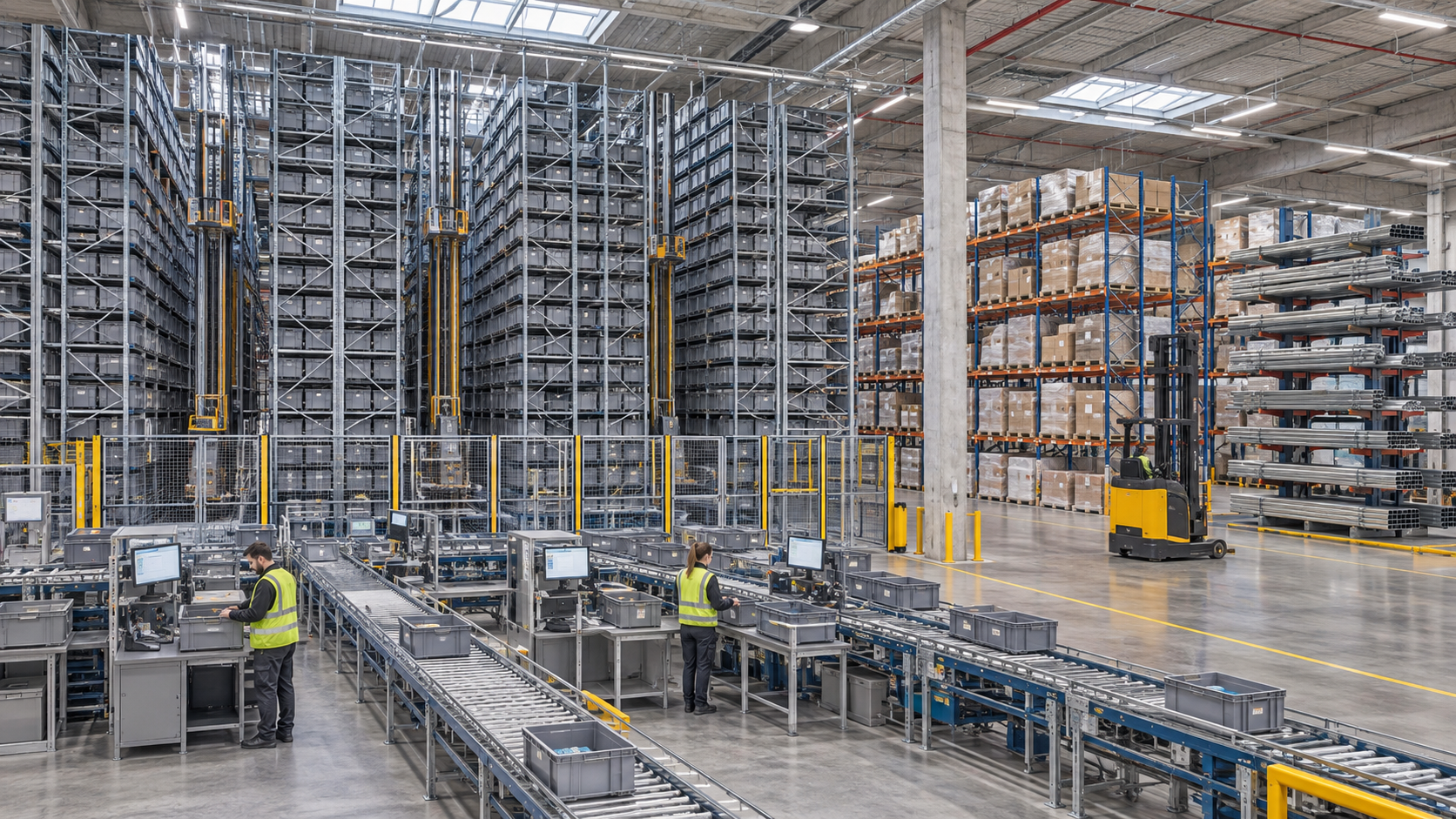
Hungary's trade in transition: More than 60,000 storage spaces: Why Mixvill's new center is more than a warehouse – Creative image on the topic, with AI: Xpert.Digital
Automation and manual labor: This is how Mixvill plans to restructure its logistics
Mixvill is building a new logistics center in Debrecen – what's behind the project?
Four automated lanes, ten specialized vehicles: Mixvils' logistics project in detail
A new logistics center is being built in Debrecen, which the Hungarian wholesaler and retailer Mixvill plans to use to consolidate its previously distributed operations. The plans include an automated small parts warehouse with more than 60,000 storage locations, manual storage areas for palletized goods and long items, as well as dedicated workstations for wholesale and end-customer orders. Commissioning is scheduled for the end of 2027.
The project is more than just an investment in additional warehouse space. Mixvill aims to organize diverse goods, processes, and customer groups within a shared infrastructure. Whether this translates into economic benefits depends not only on the size of the warehouse or the degree of automation. Crucially, the key will be how well technology, personnel, inventory, software, and order management interact in daily operations. The specific investment costs and expected savings are not yet known – therefore, a reliable return on investment assessment is not yet possible.
Those who only count storage spaces overlook the real competition
A logistics center is being built in Debrecen, Hungary, whose economic significance extends far beyond additional storage capacity. The wholesaler and retailer Mixvill is consolidating its previously disparate logistics processes there, combining an automated small parts warehouse with manual areas for palletized goods and long items. The goal is a shared infrastructure for a diverse product range and different customer groups: specialist businesses should be supplied just as reliably as end customers.
The technical center comprises an automated small parts warehouse with more than 60,000 storage locations on approximately 1,500 square meters of floor space and a height of 14.5 meters. Four aisles, each equipped with a stacker crane, handle automated storage and retrieval. In addition, the facility includes conveyor technology, workstations for goods handling, manual racking systems, specialized forklifts, and a shared warehouse management system. Operation is planned for five days a week in a two-shift system. Commissioning is scheduled for the end of 2027.
Economically, this represents a fundamental decision: Mixvill is not simply investing in more space, but in a different organization of its flow of goods. Future growth should depend less on financing additional routes, intermediate storage, and manual coordination. Instead, standardized processes and unified inventory management should form the basis for greater efficiency.
Whether this actually translates into a lasting competitive advantage, however, is not determined by the size of the warehouse. What matters is how well capacity, throughput, product range, personnel, software, and customer demand align. This is precisely where the real economic challenge lies.
The bottleneck is often located between the storage areas
When a trading company reaches its logistical limits, it's not necessarily just a lack of storage space that's the problem. Equally problematic can be scattered inventories, additional internal transport, differing processing methods, and poorly coordinated information systems. A company may theoretically have available storage space and still struggle to process orders on time and cost-effectively.
For Mixvill, consolidating previously distributed processes is therefore a key component of the project. Every additional transition between separate areas potentially generates transport costs, waiting times, and coordination needs. If employees have to search for inventory, temporarily store materials, or postpone orders due to missing components, productive time decreases, even if this isn't immediately apparent as a lack of storage capacity.
A shared location can reduce such inefficiencies. Goods receipt, storage, order picking, and shipping can be organized according to a coherent process model. At the same time, responsibilities can be defined more clearly and inventory movements can be documented uniformly.
Centralization does not automatically eliminate organizational problems. Unclear booking rules or poorly maintained product data do not disappear with a new building. If they are adopted unchanged, they can even have a faster impact on multiple process stages in a more interconnected system.
The economic benefits therefore only arise from the combination of spatial consolidation and operational reorganization. A larger building alone does not create more efficient logistics.
High storage density is an advantage, but not proof of performance
The dimensions of the automated small parts warehouse demonstrate Mixvill's commitment to maximizing available space. More than 60,000 storage locations on approximately 1,500 square meters equate to more than 40 storage locations per square meter of designated floor space. This figure illustrates the high degree of spatial efficiency made possible by utilizing multiple storage levels.
However, this should not be confused with the overall area productivity of the entire logistics center. The area mentioned refers to the automated small parts warehouse. Additional areas for manual storage, goods receiving, shipping, traffic routes, technical equipment, and other functions are not automatically included. Furthermore, a container location is not equivalent to a specific item or quantity.
The economic appeal of high storage density lies primarily in the fact that inventory can be stored on a comparatively small footprint. This can limit space requirements and internal transport routes. However, whether this translates into a financial advantage depends on the necessary investments and operating costs.
The distinction between storage capacity and throughput is particularly important. A warehouse can hold many containers without enabling sufficient retrievals per hour under peak load. Therefore, a reliable assessment would require additional information on container movements, order items, workstation performance, and availability. The number of storage locations describes the capacity, not the overall performance.
Four lanes make voting the decisive factor
The four aisles of the automated small parts warehouse are each served by a storage and retrieval machine. This distributes the technical storage and retrieval across four units. However, operational efficiency depends not only on the speed of these machines. Equally important is how the goods are distributed within the warehouse and in what order they are requested.
If frequently needed items are concentrated in an inconvenient location, one aisle can become heavily used while others remain less so. Intelligent warehouse space allocation must therefore consider access frequencies, item relationships, and expected order patterns. Frequently ordered items should be organized to minimize retrieval times.
The conveyor technology and the connected workstations must also be able to accommodate the movements. A high-performance storage aisle is of little use if containers pile up in front of an overloaded workstation. Conversely, additional picking stations are useless if the automated supply doesn't deliver enough material.
The economically relevant metric is therefore the performance of the entire system. The focus should not be on optimizing the fastest individual component, but rather on the continuous flow of goods from receipt to dispatch.
Furthermore, the number of four lanes does not guarantee complete fail-safe operation. The extent to which a disruption affects operations depends, among other things, on inventory distribution, control options, and shared components.
Why the mix of automation and manual labor makes sense
Mixvill trades in electrical and construction products. This product range encompasses goods with widely varying dimensions, weights, and handling requirements. Small items can be stored in containers and retrieved automatically. Palletized goods require different storage locations and transport methods. Long goods have their own specific requirements regarding shelving, traffic routes, and handling.
Against this background, complete automation would not be a convincing economic goal in itself. Rather, the crucial factor is to achieve an appropriate balance between investment costs, processing costs, flexibility, and reliability for each product group.
The automated small parts warehouse concentrates the more technically demanding automation in an area with standardized loading units. Manual narrow-aisle, pallet, and cantilever racks supplement this structure where different product characteristics apply. This avoids subjecting the entire product range to a single technical logic.
This hybrid design can also facilitate changes within the business. If sales volumes shift or new product groups are added, manual areas can be more easily adapted organizationally under certain conditions. Automated warehouses, on the other hand, offer their advantages where many recurring movements are handled according to clear rules.
The boundary between the two areas remains challenging. Orders can contain items from multiple storage zones. Different processing speeds must then be coordinated to avoid unnecessary waiting times. This combination is only economical if the transitions between the two areas also function smoothly.
Ten vehicles form the mobile addition to the system
A total of ten specialized industrial trucks are provided for manual storage and transport tasks. Two EKX 516 narrow-aisle forklifts serve the corresponding racking systems. Two ETV 316i reach trucks handle storage and retrieval in the pallet racks. One ETV Q25 multi-directional reach truck is used for long goods. Five ERE 120i pallet trucks connect the different storage areas.
This division demonstrates that the manual component is not merely a secondary function. It is an independent part of the material flow. The vehicles perform tasks arising from the product structure that are not covered by the automated small parts warehouse.
Handling long goods is particularly challenging. The planned multi-directional reach truck has all-wheel steering and can transport loads up to eight meters long, even through narrow warehouse aisles. This allows for space utilization tailored to long goods, but requires suitable traffic routes and clearly defined work processes.
The number of vehicles alone does not indicate transport performance. This would require factors such as route lengths, load weights, driving speeds, load states, and order distribution. Similarly, a specialized vehicle does not automatically guarantee high utilization.
The economic challenge is to maintain sufficient capacity for peak loads without permanently tying up too much capital in underutilized resources.
Wholesalers and end customers need different processes
The separate workstations for wholesale and end-customer orders are a key feature of the new location. Both customer groups access a common product range, but do not necessarily have the same requirements for order processing.
In wholesale, larger quantities per item, more extensive shopping carts, or deliveries tailored to construction sites and specialist companies can play a significant role. End-customer orders, on the other hand, may be characterized more by smaller order quantities and different packaging requirements. The actual distribution at Mixvill is not quantified. However, the organizational separation allows for the targeted mapping of different processing profiles.
A shared workstation for all order types initially appears flexible. In practice, however, frequent changes between different processing methods can cause additional setup and coordination times. Separate workstations allow for material supply, packaging, and work organization to be more tailored to the respective channel.
However, this does not guarantee error-free operation. Even geographically separated workplaces require clear identification, reliable recording, and effective controls.
At the same time, the separation must not lead to rigid capacity silos. If one channel is heavily utilized and the other has less work, suitable options for personnel redeployment or flexible order allocation are valuable. An economically sound approach is one that takes differences into account without creating unnecessary inflexibility.
Shared stockpiles do not prevent supply conflicts
A unified inventory can facilitate the interaction between wholesalers and end-customer businesses. Instead of maintaining separate stocks for different sales channels, it's possible to access a shared pool of goods. This can make availability more transparent.
However, this transparency doesn't automatically solve the question of which order gets fulfilled first when stock is scarce. A wholesale order can consume a significant portion of available inventory. At the same time, numerous smaller end-customer orders may be pending. Without clear rules, there's a risk that short-term, individual decisions will replace operational planning.
The warehouse management system must therefore operate with transparent reservation and prioritization rules. These rules can take into account promised delivery dates, already released orders, or defined service requirements. Crucially, the rules must align with the business model and remain understandable in daily operations.
The consolidation of mixed orders also deserves attention. If an order consists of small parts, palletized goods, and long items, the components from different departments must be brought together on time. Otherwise, an early delivery of a partial quantity can occupy valuable space while other items are still missing.
The quality of inventory management is therefore not only reflected in an accurate quantity display. It is reflected in whether available items can be reliably converted into deliverable customer orders.
The warehouse management system becomes the economic hub
Jungheinrich's warehouse management system is designed to manage inventory and orders. In a hybrid facility, this task is particularly important because automated and manual processes must be integrated.
The system needs to know which goods are located where, which quantities are reserved, and which movements are pending next. At the same time, physical processes and digital records must match. A container that has actually been moved but remains in its original location in the system compromises the reliability of the entire process.
The economic importance of the software therefore lies not only in administration. It creates the informational basis for prioritization, replenishment, order picking, and performance evaluation. Without consistent data, neither bottlenecks can be reliably identified nor can inventory be managed effectively.
At the same time, the dependence on functioning interfaces and clearly defined responsibilities is increasing. The warehouse management system must work together with adjacent commercial and technical systems. The quality of this connection depends not only on program functions, but also on standardized terminology, correct units of measurement, and traceable status messages.
Robust digitalization therefore doesn't begin at the screen. It begins with the question of how an item is created, a goods receipt is checked, and an inventory discrepancy is handled. Software can support clear processes. It cannot permanently replace missing operational rules.
Your intralogistics experts

Consulting, planning and implementation of complete solutions for high-bay warehouses and automated storage systems - Image: Xpert.Digital
More information here:
Centralization and disruption concept in the new logistics center
Master data plays a key role in determining productivity
Automated warehouse technology requires reliable information about the stored items. Dimensions, weights, packaging units, and identification characteristics influence how goods can be received, stored, and retrieved.
This task is challenging with a heterogeneous product range. A sales unit does not necessarily correspond to a packaging unit. An item can be ordered individually, delivered in a larger unit, and stored in a container with other units. If these relationships are not accurately recorded, quantity errors and unnecessary processing steps can occur.
For Mixvill, the quality of master data is therefore a key economic factor. It not only influences the smooth operation of the system but also the usability of storage capacity. Inaccurate product dimensions, for example, can lead to storage locations being assigned unsuitably or containers being used inefficiently.
Exceptions are particularly critical. Damaged packaging, unidentifiable items, quantity discrepancies, or goods with unexpected dimensions require defined handling procedures. If such cases are dealt with unplanned within the normal material flow, they can disrupt standardized processes.
Preparing for a new location should therefore not be reduced to the eventual move itself. Data cleansing, article classification, and the definition of exception processes are independent prerequisites for successful commissioning. Their benefits often only become apparent when they are lacking.
Profitability depends more on movements than on inventory levels
Neither the investment amount nor specific savings targets or expected performance improvements have been specified for the project. Therefore, a reliable amortization calculation is not possible. Statements about a specific return or a fixed repayment period would be speculative.
Nevertheless, the economic logic can be understood. On the cost side, there are buildings, storage and conveyor technology, vehicles, software, integration, training, and commissioning. During operation, additional costs include maintenance, energy, personnel, software updates, and potentially spare parts.
This can be offset by shorter transit times, less duplicate processing, higher inventory accuracy, and additional processing capacity. Furthermore, more reliable delivery performance can create economic value if it leads to more frequent customer orders or fewer lost orders due to logistical problems.
The frequency of use of the technology is particularly important. A large inventory with infrequent access generates a different level of efficiency than a similarly large inventory with many daily transactions. Automated retrieval is beneficial not only because it saves space when storing goods, but also because it allows recurring tasks to be performed efficiently.
For Mixvill, the new building is also intended to overcome existing capacity limits. Therefore, the appropriate comparison is not necessarily simply continuing operations unchanged without additional costs. An alternative expansion of the existing structures could also require investment and increased coordination efforts.
Growth creates opportunities but also increases the risk of underutilization
The facility is designed for additional capacity and further business development. This can be beneficial if the existing logistics are already limiting the company. At the same time, a larger technical infrastructure shifts some of the costs into longer-term commitments.
With increasing order volume, these costs can be spread across more processed units. Conversely, if demand falls short of expectations, the costs per order increase compared to higher capacity utilization. This results in a classic conflict of objectives: Insufficiently planned capacity hinders growth, while excessively large capacity ties up capital.
The planned two-shift operation, five days a week, initially describes the intended operating model. It is not proof of the actual achievable capacity utilization. Furthermore, without additional information, it cannot be deduced from this how much additional output would be possible through longer operating hours.
Extending operating hours could, in principle, enable additional use, but requires suitable personnel, maintenance windows, and robust upstream and downstream processes. If goods receipt or dispatch are time-limited, the overall system's performance cannot be increased indefinitely.
Therefore, a realistic development path is economically crucial. Investment, staff expansion, and expected order growth should be closely coordinated without completely excluding necessary reserves.
Greater inventory accuracy can free up capital
Discussions about warehouse automation often focus on productivity and personnel costs. However, for a trading company, the capital tied up in inventory is also of great importance.
A centrally and reliably managed inventory can help limit duplicate stocking and unnecessary stock transfers. If different departments previously kept similar items independently, joint planning can create additional transparency. However, this does not automatically lead to a specific reduction in inventory.
The actual impact depends on factors such as delivery times, minimum order quantities, fluctuations in demand, and desired service levels. Even a technically efficient warehouse requires safety stock when procurement is uncertain or customers expect short-term availability.
However, if inventory accuracy improves, planning becomes more reliable. The company will less frequently have to deal with uncertainty about whether the reported quantities are actually available. Under suitable conditions, incorrect orders and precautionary overstocking can therefore decrease.
This relationship is particularly relevant for Mixvill because its product range includes various types of goods. High-quality small parts, large-volume products, and rarely requested long goods result in different forms of capital and space commitment. A shared warehouse management system can make these differences visible.
The economic goal is not to achieve the lowest possible inventory at any cost. It is to achieve an inventory level that combines the desired delivery capability with a reasonable capital investment.
Productivity changes work, rather than simply eliminating it
The described technical equipment does not allow for any reliable conclusions to be drawn regarding specific staff reductions. Information on the current number of employees, future staffing needs, and the development of order volume is lacking.
A change in tasks is more plausible. In automated small parts handling, travel distances and manual search processes can be reduced. At the same time, the operation of standardized workstations, the handling of exceptions, and the monitoring of material flow become more important.
In manual areas, vehicle-based transport and product-related expertise remain important. Additional requirements include maintenance, system understanding, and data quality. The new system thus combines diverse qualification profiles.
For economic evaluation, the crucial factors are whether productive output per working hour increases and whether the company can handle more business with a controlled increase in staff. A smaller workforce is neither a necessary prerequisite nor the sole measure of success.
Ergonomic aspects also deserve attention. Shorter walking distances and targeted product delivery can reduce physical strain. However, repetitive tasks at fixed workstations also require thoughtful design. Automation is not automatically synonymous with good work.
Training and onboarding are therefore not secondary measures. Employees must understand how the new process works, which deviations are critical, and when intervention is necessary. Without this knowledge, some of the technical potential remains untapped.
Centralization requires a robust disruption concept
Consolidating warehousing processes reduces interfaces but also concentrates operational dependencies. When a central location takes over significant parts of the supply chain, technical or organizational disruptions can have a greater impact.
It's not just the failure of a storage and retrieval machine that needs to be considered. Conveyor systems, power supply, network infrastructure, warehouse management, and shared workstations can also restrict the flow of goods. Which components are particularly critical can only be assessed by examining the specific system architecture.
An economically sound disruption management concept should therefore differentiate between various failure scenarios. For some situations, spare parts and short response times may suffice. Others require alternative processing methods, defined buffers, or the temporary prioritization of particularly urgent orders.
Manual storage areas do not automatically replace an automated small parts warehouse. Goods that are technically inaccessible will not become available simply because of available forklift capacity. Likewise, a high inventory level does not replace functioning access.
Digital operational security includes clear access rights, data backups, and proven restart procedures. These measures require effort, but protect the ability to resume business operations after a disruption.
The economic perspective must therefore consider not only normal operating costs but also potential downtime costs. A seemingly inexpensive operation can become costly if rare malfunctions last an unusually long time.
An integrated system simplifies responsibility and creates dependencies
Jungheinrich covers several closely related areas at Mixvill: warehouse technology, conveyor technology, industrial trucks, control systems, and warehouse management software. This integration can offer advantages for the overall system because fewer technical and organizational transitions need to be coordinated between different system environments.
This is particularly relevant for errors whose cause is not immediately clear. If a container doesn't arrive at the workstation on time, the control system, conveyor technology, order prioritization, or upstream processes could be involved. End-to-end system responsibility can facilitate the clarification of such interrelationships.
At the same time, a long-term commitment is established. Software changes, expansions, maintenance, and spare parts supply can affect economic freedom for many years. Therefore, initial technical compatibility is only one aspect of the evaluation.
For the operator, transparent data structures, suitable interfaces, and clear development opportunities are important. The question of how to integrate new jobs, additional storage areas, or changed product ranges is also crucial for long-term profitability.
A single, unified solution is therefore neither inherently superior nor inherently problematic. Its value depends on whether the advantages of integration outweigh the disadvantages of limited options. The decisive factors are costs and adaptability over the entire usage period, not solely the effort required for commissioning.
The start-up phase determines the first economic impression
The planned commissioning at the end of 2027 marks the transition to practical operation, but not automatically the immediate achievement of all performance targets. Especially with a new, networked system, technical functionality, data quality, and work organization must be perfectly aligned.
While individual components may already be working reliably, overall performance can still be limited by unfamiliar processes or unforeseen exceptions. Relocating inventory is also challenging: goods must remain physically available and simultaneously appear correctly in the new system.
For Mixvill, a realistic ramp-up model is therefore crucial. This includes robust tests with different product types and order combinations. Simple standard orders alone are insufficient to assess the practical suitability of a system for a heterogeneous product range.
Mixed orders, peak loads, and errors deserve special attention. Only when deviations are also managed can a robust operation be achieved.
Success measurement should then be based on comparable key performance indicators (KPIs). Meaningful metrics include, for example, cost per order item, lead time, on-time delivery, inventory accuracy, and technical availability. These metrics must be considered in context.
A shorter lead time would be unconvincing if the error rate increased significantly at the same time. Similarly, higher personnel productivity can be economically insufficient if maintenance and downtime negate the benefit. The overall impact on costs and service is crucial.
Debrecen here represents a specific location, not a proven market trend
The project demonstrates that a Hungarian wholesaler and retailer is further developing its logistics with a sophisticated combination of automation and manual techniques. However, this does not allow us to draw conclusions about the investment volume of the Hungarian retail sector or the growth rate of the Eastern European intralogistics market.
A single installation provides a concrete signal for a company, but it is not representative of the market. More comprehensive conclusions would require data on other projects, investments, storage areas, and levels of automation.
Despite this limitation, the strategic direction is clear. Mixvill views logistics as a prerequisite for further growth and for serving diverse customer groups. The site is intended not only to receive goods but also to support the organization of the business.
The choice of Debrecen cannot be comprehensively assessed from a location economics perspective based on the available information. Information regarding land costs, transport connections, personnel availability, or the geographical distribution of customers is lacking. Therefore, statements about a proven superiority of the location would not be justified.
The interesting economic connection lies elsewhere: Automation is also relevant for companies whose product range does not allow for completely standardized processing. In particular, combining different technical solutions can enable modernization without artificially simplifying the diversity of the retail business.
Sustainability must be measured against actual flows of goods
A high-density warehouse can limit the space required per storage location. Shorter internal routes and more precise inventory management can also contribute to more efficient resource use. However, this does not necessarily translate into a proven overall ecological improvement.
The new logistics center requires building materials, technical equipment, and energy. Storage and retrieval machines, conveyor technology, vehicles, and information technology all generate ongoing consumption and require maintenance. Without additional data, it remains unclear how these costs compare to potential savings.
Centralization does not automatically guarantee a positive transport balance. Fewer trips between existing warehouse locations can be advantageous. At the same time, the impact on external supply routes depends on the location of suppliers and customers and how transport is consolidated.
A reliable assessment would therefore need to consider specific factors: energy consumption per processed unit, space requirements, product damage, packaging consumption, and transport costs. Furthermore, a comparison with the existing organization or a realistic alternative would be necessary.
For company management, this consideration is not only interesting from an environmental perspective. Resource consumption and economic costs are interconnected in several ways. Fewer unnecessary movements can save energy, less damage can prevent write-offs, and better-utilized space can limit expansion pressures.
Sustainability is therefore not achieved by labeling a facility as modern. It arises from demonstrably better processes.
The competitive advantage only arises in daily operations
Mixvill's new logistics center has a sound economic rationale. A highly efficient automated small parts warehouse will work in conjunction with manual areas for palletized goods and long items. Separate workstations cater to the different requirements of the wholesale and retail business. A shared software system will link inventory and orders across the entire facility.
This approach addresses several problems simultaneously: limited capacity, distributed processes, different product forms, and the need to reliably serve various sales channels. The approach is particularly compelling because it does not treat automation as an end in itself.
The crucial limitation remains the lack of a detailed business analysis basis. Without investment sums, order volumes, throughput figures, and comparable costs, no reliable return on investment can be determined. Increased speed and improved inventory accuracy are also initially goals and plausible potentials, not yet measured results.
The company's eventual success will be evident in its ability to handle additional orders economically, reliably meet delivery commitments, and maintain adequate utilization of its technical infrastructure over the long term. Equally important is its capacity to respond to changes in product range and demand.
The real modernization, therefore, doesn't consist of more than 60,000 bin spaces or four automated aisles. It consists of forging a robust operating system for commerce from space, technology, data, and human labor. Only when this interplay functions flawlessly in daily operations will a large investment translate into a lasting economic advantage.
Your global marketing and business development partner
☑️ Our business language is English or German
☑️ NEW: Correspondence in your native language!

Konrad Wolfenstein
I and my team are happy to be available to you as your personal advisor.
You can contact me by filling out the contact form here [email protected]:or simply call me at +49 7348 4088 965. My email address is
I'm looking forward to our joint project.