
500,000 tires in stock: Continental expands its US site in Mount Vernon – $76 million in a new tire warehouse
Xpert Pre-Release

Available in 27 languages 📢
Prefer Xpert.Digital on GoogleⓘPublished on: October 26, 2026 / Updated on: October 26, 2026 – Author: Konrad Wolfenstein
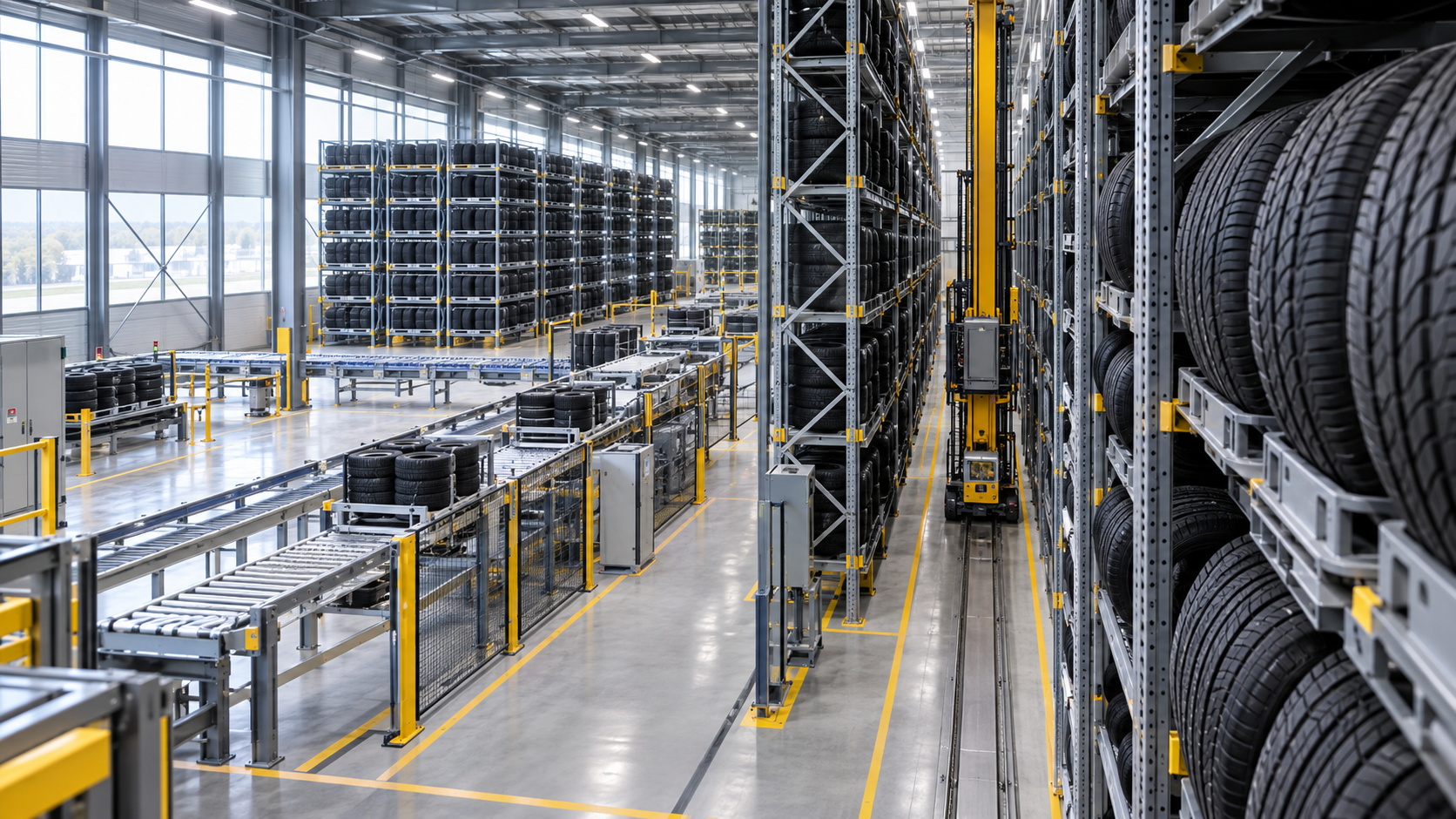
500,000 tires in stock: Continental expands its US site in Mount Vernon – $76 million in a new tire warehouse – Creative image on the topic, created with AI: Xpert.Digital
Continental is focusing on automation: A new warehouse is intended to get tires to customers faster
Tire market under pressure, but Continental is still investing: Why Mount Vernon is becoming more important
Continental is modernizing its largest US tire plant – the crucial question won't come until 2027
Continental is investing approximately $76 million in a highly automated finished goods warehouse at its Mount Vernon, Illinois, US site. The facility is designed to hold up to 500,000 passenger car tires and strengthen the North American distribution network. However, the project comes in a challenging market environment: Sales forecasts for US tires have been significantly revised downwards for 2026. Therefore, the project's economic success depends not only on the sheer size of the new warehouse. Crucially, Continental will be able to manage existing inventory more efficiently, fulfill orders more reliably, and improve processes between production, warehousing, and shipping. The site offers excellent prerequisites for this: Mount Vernon is an established tire plant with more than 3,500 employees and an annual production capacity of approximately 11.4 million tires. The investment is thus less a simple expansion of storage space and more a long-term effort to secure the plant's performance and its ability to deliver. Whether the 76 million dollars will pay off, however, will only become clear when the plant is expected to go into operation towards the end of 2027 and its actual performance can be measured in everyday use.
Continental's 76-million-euro bet on logistics: Premium tires alone are no longer enough
Continental is investing approximately $76 million in a highly automated finished goods warehouse at its Mount Vernon, Illinois, site. The facility will hold around 500,000 passenger car tires and enhance the efficiency of its North American distribution network. However, the economic significance of this decision lies less in the additional storage capacity than in the reliability with which industrial production can be translated into fulfilled customer orders. A tire that is fully produced but not available on time ties up capital without contributing to sales. This investment addresses precisely this interface between manufacturing, inventory management, and sales.
This means the project is neither merely a construction project nor automatically proof of imminent strong market growth. Rather, it should be understood as a long-term investment in productivity, delivery capability, and location quality. Its success will depend on whether Continental can not only store more tires but also better utilize existing inventory, accelerate goods movements, and supply customers with less overall effort. This is a more demanding task than simply equipping a large warehouse with modern technology.
From the development plan to the construction phase
The timeline shows that the project has progressed beyond the mere announcement phase. In May 2026, construction was slated to begin in the summer, with commissioning planned for 2027. On August 20, 2026, the groundbreaking ceremony for the facility, located directly adjacent to the existing plant, took place; a start of operations towards the end of 2027 was given as a preliminary target. This clarification is relevant for the economic evaluation: Revenues from faster processes do not materialize with the investment decision, but only after successful technical and organizational commissioning.
The planned footprint is described as being equivalent to more than six American football fields. This gives an idea of the scale, but it doesn't replace reliable area or performance indicators. Without precise information on building height, storage technology, traffic areas, and shipping zones, it would be irresponsible to derive a precise storage density or a comparison of area productivity. Similarly, the term "highly automated" initially describes a requirement for operation, not a proven level of automation in day-to-day operations.
From a business perspective, there is a crucial transition phase between construction progress and full productive operation. Buildings, machinery, software, and personnel must all function seamlessly together. A plant that is formally operational can still fall far short of its intended performance if interfaces, order management, or troubleshooting procedures have not been adequately tested.
An established site is being upgraded
Mount Vernon is not a new, greenfield production site. The plant opened in 1974 and has been part of Continental since 1987. Today, it is the company's largest tire plant in the United States, with more than 320,000 square meters of production space, a total annual production capacity of approximately 11.4 million tires, and more than 3,500 employees. It produces tires for passenger cars, light commercial vehicles, and heavy commercial vehicles.
Plant manager Nik Pearce associates the expansion with modernizing processes, improving plant logistics, and creating additional development opportunities for the workforce. This existing industrial base changes the logic of the investment. Continental doesn't need to build a completely new local production organization from scratch, but rather complements an already established site with more efficient logistics. Existing process knowledge, well-established manufacturing processes, and years of employee experience can leverage the benefits of the new infrastructure. At the same time, the new facility must be integrated into existing operational structures, whose processes were not necessarily designed for the new automation concept.
This investment strengthens the plant's economic viability. A large production site can only remain competitive in the long term if its downstream processes keep pace with its performance. Additional manufacturing output would be of little value if the flow of goods became a bottleneck. Conversely, improved logistics can facilitate the utilization of existing production capacity without the warehouse itself producing a single additional tire. Therefore, expanding warehouse capacity should not be confused with an equally large expansion of production capacity.
Investing against the weak market
The investment comes at a time when the market environment is far from consistently characterized by growth. In March, the US tire sales forecast for 2026 was still at 338.9 million units. In August, it was reduced to 330.3 million, down from 336.3 million in 2025. This represents a downward revision of 8.6 million tires within just a few months; a decline of 1.8 percent compared to 2025 is now expected for the entire year.
This is not a refutation of the investment decision, but rather a warning against an overly simplistic growth narrative. A company can still meaningfully improve its infrastructure even if the overall market stagnates or temporarily shrinks. The economic benefits must then stem more from market share gains, a better cost structure, or higher service quality. The calculation cannot rely on automatically increasing sales.
Developments within the group also underscore this distinction. In the second quarter of 2026, the tire division achieved an adjusted operating margin of 15.3 percent on sales of approximately €3.3 billion, compared to 12.1 percent in the same quarter of the previous year. At the same time, the North American replacement tire market declined by about one percent during this quarter. The margin improvement was supported, among other things, by a higher proportion of larger premium tires, lower raw material prices, and reduced currency and tariff impacts. Therefore, it does not directly reflect the profitability of the new inventory, but it does demonstrate that sales volume and profitability can develop differently.
The replacement market sets the pace
For economic analysis, the structure of the tire market is more important than the total number of units sold alone. The US forecast for 2026 projects 218.3 million passenger car tires for replacement and 41.0 million for original equipment on new vehicles. For light commercial vehicles, 37.1 million replacement tires and 6.3 million original equipment tires are expected; for heavy commercial vehicles, the figures are 22.9 million and 4.6 million, respectively. Taken together, the replacement market thus accounts for roughly 84 percent of the projected total volume.
This does not necessarily mean that the new warehouse will have the same sales distribution. A precise breakdown of its customers and distribution channels is not known. However, the market structure explains why rapid availability can be so economically crucial. In the replacement parts market, a purchase opportunity arises not only from long-term production plans by vehicle manufacturers, but also from wear and tear, damage, and short-term replacement needs. Therefore, the distribution strategy depends heavily on how well a supplier can meet specific demand for particular models.
From an economic perspective, a manufacturer is not simply selling a tire, but also the probability that precisely that tire will be available at the required time. This creates a relationship between physical product quality and logistical service quality. Both can reinforce each other; however, they cannot completely replace one another.
Capacity is not the same as throughput
The planned storage capacity of 500,000 car tires is an inventory figure. It does not describe how many tires the facility can store, pick, or ship per hour. This distinction is crucial. A large warehouse can be inefficient if bottlenecks on conveyor lines, transfer points, or loading docks restrict the flow of goods. Conversely, a smaller facility with a high turnover rate can support substantial sales volumes.
Comparing this to the total annual plant capacity of 11.4 million tires yields a calculated figure of approximately 4.4 percent. Assuming a perfectly even distribution of this annual capacity throughout the calendar year, this would correspond to roughly 16 days. However, this calculation explicitly does not represent the actual inventory coverage: the plant capacity encompasses several product groups, the new warehouse is intended for passenger car tires, and therefore neither the actual utilization nor the inventory level is known. The comparison merely illustrates the order of magnitude of the buffer relative to the total production potential.
Similarly, dividing 76 million US dollars by 500,000 tires yields an investment of approximately 152 US dollars per nominal storage space. This does not allow for the derivation of storage costs per tire sold, nor a return on investment. A storage space can be used repeatedly throughout its lifespan. Only its actual utilization, the annual throughput, and the avoided costs transform such a ratio into a meaningful economic analysis.
The margin lies in the flow of goods
The potential benefits can be broken down into three interconnected effects. First, more efficient material handling can reduce the effort required per order. Second, improved availability can enable additional or more stable sales. Third, more reliable processes can reduce the consequential costs of errors and delays. These effects must be analytically separated to prevent the same benefit from being recorded multiple times as a cost saving.
Automated warehouse technology can reduce search routes, manual transport, and repetitive handling, as well as track inventory movements more accurately. However, specific savings rates or reduced lead times associated with this technology have not been published for Mount Vernon. Therefore, any claimed productivity increase of a certain percentage would not be reliable. The investment amount alone is not a suitable basis for such an assessment.
The greatest economic leverage can be found at the interfaces. If finished goods are reliably transferred from production and consolidated into complete shipments in a timely manner, planning for the entire site becomes simpler. Conversely, if only the speed within the warehouse increases, while order release, transport planning, or loading remain unchanged and slow, the expected overall benefit may not materialize. Therefore, the crucial factor is the time from the availability of the finished product to the fulfillment of the delivery order, not the peak speed of a single machine.
Variety of product variants changes inventory economics
The operational challenge lies not only in storing a large number of tires. The crucial factor is being able to provide the correct version for each situation. A large overall inventory is of little use if the actually needed variant is unavailable. Therefore, for inventory management, the composition of the stock is at least as important as its quantity. The specific number of product variants to be stored in Mount Vernon in the future is unknown.
A growing variety of stock items can increase the need for precise categorization, suitable storage locations, and differentiated replenishment planning. The economic challenge then becomes not simply stocking every variant as generously as possible, but rather intelligently balancing demand probability, replenishment time, and desired delivery readiness. Safety stocks serve primarily to mitigate uncertainty in demand and supply; their appropriate level depends on this uncertainty.
For premium products, high-quality logistics can therefore be part of the positioning strategy. In 2026, Continental improved its product mix, among other things, by increasing the proportion of tires 18 inches and larger. This analysis suggests that a simple unit cost comparison is insufficient. A logistics system must also be able to consider the varying economic significance of individual orders. An additional tire shipment is not automatically as valuable as any other if margins, customer loyalty, and delivery urgency differ.
Automation begins with reliable data
Highly automated does not necessarily mean unmanned. Neither the exact plant architecture nor specific robot types, the number of storage and retrieval machines, nor the extensive use of artificial intelligence have been published for Mount Vernon. It would therefore be wrong to infer a specific technical configuration from the term alone. What is clearly stated is the goal of further automating finished goods logistics and thereby improving delivery speed, flexibility, and service.
Automated warehouse systems fundamentally combine mechanical goods movement with control technology and a digital mapping of inventory and storage location. The economic starting point, therefore, lies in data quality. If product attributes, inventory status, or order information are unreliable, a fast system might simply process incorrect decisions more quickly. Technology cannot automatically resolve organizational ambiguities.
Therefore, the evaluation of the project should not focus on the number of visible robots, but rather on the quality of the entire information flow. Production, warehousing, and sales all require a consistent picture of which goods are available, reserved, blocked, or already assigned to a shipment. A seemingly minor discrepancy between physical inventory and digital status can otherwise distort several downstream decisions. Automation only reaches its full potential when the digital states reliably reflect the actual movement of goods.
LTW Intralogistics Solutions

LTW Intralogistics – Engineers of Flow - Image: LTW Intralogistics GmbH
LTW offers its customers not individual components, but integrated complete solutions. Consulting, planning, mechanical and electrotechnical components, control and automation technology, as well as software and service – everything is networked and precisely coordinated.
In-house production of key components is particularly advantageous. This allows for optimal control of quality, supply chains, and interfaces.
LTW stands for reliability, transparency, and collaborative partnership. Loyalty and honesty are firmly anchored in the company's philosophy – a handshake still means something here.
Related to this:
Continental's new logistics strategy for Mount Vernon
Experience helps, but it doesn't replace adaptation
Continental already has practical experience with highly automated tire warehouses. In early 2024, a fully automated high-bay warehouse was opened in Otrokovice, Czech Republic, capable of storing more than 930,000 tires on approximately 10,000 square meters. The building is 43 meters high; automated equipment moves tires stored on pallets within. The facility consolidated previously distributed local storage capacities.
This is relevant for Mount Vernon as a basis for experience, but not as a direct construction plan. Neither the American storage height nor the space efficiency there can be derived from the Czech performance data. Different functions, sites, product structures, and interfaces can make different solutions economically viable. Furthermore, it would be wrong to consider the higher capacity in Otrokovice as proof of a better investment without knowledge of the respective requirements.
The potential advantage of an international company lies primarily in transferable knowledge. Experience with plant availability, maintenance, inventory management, and employee training can help reduce avoidable errors. At the same time, every transfer must be tested locally. A proven technical principle may have different performance limits in a different distribution network. Standardization is therefore valuable when it makes established solutions usable without disregarding the actual requirements of the location.
The return requires a complete calculation
A reliable cost-benefit analysis must capture all changes over the entire service life. On the expenditure side, this includes not only buildings and storage technology, but also ongoing maintenance, software updates, energy, spare parts, training, and future upgrades. On the benefit side, potential benefits include lower process costs, avoided external warehousing, fewer errors, and additional contribution margins from better-met demand. Which of these factors will actually be effective at Mount Vernon, and to what extent, is not disclosed.
The distinction between revenue and profit is particularly important. If improved availability enables additional sales, not all of the increased revenue represents a return on investment. What matters is the additional contribution after accounting for the associated costs. Similarly, a theoretically higher labor productivity does not automatically translate into an equally high cash-effective saving if employees take on other necessary tasks or initially perform additional start-up work.
Without information on initial costs, expected throughput, service life, and ongoing expenses, a reliable payback period cannot be determined. A short repayment time would be just as unsubstantiated as the claim that the investment is oversized. The economically sound perspective lies somewhere in between: The project possesses demonstrable potential benefits, the magnitude of which will only become apparent through a complete and verifiable calculation. The crucial question is not whether 76 million US dollars is a lot of money, but whether the additional cash surpluses and strategic advantages justify the capital commitment.
More space should not inflate stock levels
A larger warehouse can make a supply chain more robust, but it can also mask new costs. If additional space simply leads to an accumulation of slow-moving goods, capital tied up in inventory increases without significantly improving customer service. Therefore, the ability to store 500,000 tires is not an economically sound reason to utilize that capacity to its full extent on a permanent basis.
It's important to distinguish between two types of capital. The $76 million relates to the announced infrastructure investment; the value of the tires stored later is an additional factor in ongoing business operations. Therefore, more physical capacity and more tied-up inventory are not the same thing. Improved inventory management could aim to achieve the same delivery readiness with lower average inventory levels. Conversely, additional inventory may be deliberately required if uncertainty or a desired service level justifies it.
The appropriate benchmark is therefore not a warehouse that is as full or as empty as possible, but rather an economically viable inventory level. It would be particularly revealing to determine whether delivery readiness and inventory turnover can be improved simultaneously. If delivery capability increases only through significantly larger inventory, the benefits must be weighed against the higher capital commitment. Conversely, if it results from more precise allocation and fewer process losses, this suggests a structural improvement.
Centralization requires a balanced network
The new warehouse is intended to strengthen the North American distribution network. However, this does not mean that all regional warehousing tasks will be consolidated at a single location. A factory buffer, a supra-regional distribution center, and a customer-focused regional warehouse each fulfill different functions. Their economic role can only be assessed based on their respective demand, delivery times, and transport routes.
Greater consolidation can improve inventory overview and reduce certain redundancies. However, it can also mean longer distances to individual customers or increased dependence on a single location. These opposing effects must be considered together. A locally cost-effective process is not automatically the most cost-effective solution for the entire network if it results in additional transport or longer delivery times.
For Continental, the strategic challenge therefore lies in seamlessly integrating the new facility into its existing distribution network. The central question is which inventory levels make sense at the production site and which should be located closer to the sales regions. Without a published target structure, this balance cannot be definitively assessed. A convincing solution would have to consider both the efficiency of the large site and customer accessibility, rather than equating centralization with progress.
The location advantage remains surprisingly physical
Digitization doesn't negate geography. Mount Vernon has direct access to Interstates 57 and 64 and connections to Norfolk Southern, Union Pacific, and Evansville Western. This transportation infrastructure generally supports its function as an industrial and distribution center. However, it doesn't specify which modes of transportation Continental will actually use for the new warehouse, or to what extent.
A significant advantage also lies in the immediate proximity to existing production facilities. This allows for a more streamlined transition from manufacturing to distribution. Whether this actually results in fewer transports, shorter routes, or reduced effort depends on the specific operational concept. The physical proximity creates a prerequisite, but not necessarily a directly measurable benefit.
This connection is nevertheless important for the economic viability of a location. Competitive industry needs not only low individual costs, but also a functioning interplay of labor, infrastructure, existing facilities, and market access. An automated warehouse can make better use of these existing strengths. However, it cannot replace them indefinitely. If transport capacity, network access, or skilled personnel are insufficient, even the most modern internal logistics system remains dependent on external conditions.
Employment is changing rather than simply disappearing
The site already employs more than 3,500 people. Additional jobs were anticipated for the new warehouse, but their exact number was not yet determined at the groundbreaking ceremony and was to be assessed in conjunction with the planned automation activities. Therefore, neither a significant increase in employment nor a definite reduction in staff can be inferred from this.
The more economically plausible analysis focuses on the activities themselves. Automation can reduce physical transport and repetitive handling, while monitoring, maintenance, and the handling of deviations become more important. The employment effect then depends on how much the processed volume grows, which tasks are shifted, and how well existing employees are trained for the new requirements. An investment amount is not a suitable substitute indicator for this.
The cost pressure is nonetheless understandable. In the US warehouse sector, average hourly wages in August 2026 were provisionally set at $26.74. This nationwide industry figure does not describe the specific wages at Continental, nor does it encompass the full employer costs, and should not be adopted without verification into a local cost-saving calculation. However, it does demonstrate why the productive use of working time remains economically relevant for the industry.
During the construction phase, regional tradespeople, service providers, and other businesses can benefit from additional spending. However, the actual local share of this depends on the origin of the companies and workers involved. A general regional income multiplier would not be reliable without the corresponding data.
For regional development, the quality of long-term employment is also crucial. Continuing education, technical career paths, and reliable prospects can be more valuable than a large number of simple new jobs created in the short term. However, a large industrial site also poses a risk of concentration for its surrounding area. Long-term investments strengthen ties to the region but do not guarantee stable employment throughout all future market cycles.
Security belongs in the productivity calculation
Warehouse operations are not risk-free. In 2024, the US sector reported a total of 4.8 reportable injuries and illnesses per 100 full-time employees. Typical hazards include physical strain, operating forklifts, and handling heavy loads. While these industry figures do not describe the safety situation at the Continental plant, they clearly illustrate why ergonomics and safe material handling are also economically important.
Automation can relieve people of heavy lifting, long walking distances, and certain collision risks. At the same time, improperly integrated conveyor technology and robotics can create new hazards through moving machine parts or entrapment and pinching. Therefore, more advanced technical equipment is not an automatic guarantee of safety. Crucial factors are the interplay of a safety concept, maintenance, training, and clearly defined intervention procedures in case of malfunctions.
Proper storage remains a crucial aspect of quality. Tires should be protected from harmful environmental influences and stored in suitable, clean, and dry conditions. For large warehouses, fire protection and the suitability of the protective systems must also be appropriate for the building and the stored goods. Economically, this means that safety is not an afterthought to efficiency, but rather a prerequisite for ensuring that technical performance remains usable over the long term and that neither people nor goods are exposed to unnecessary risks.
Networking creates new dependencies
The more digitally controlled a warehouse becomes, the more critical the availability of its systems and the ability to mitigate disruptions become. Networked warehouse technology requires protection of the data exchanged between devices, controllers, and software. For industrial systems, separating network segments is a recognized approach to adequately safeguarding different security needs and operational functions.
This results in a clear testing requirement for the project, not a statement about already decided individual measures: The technical architecture should prevent a limited error from bringing the entire flow of goods to a standstill. It must also be clarified which processes can continue during an interruption and how an orderly restart will function. Industrial cybersecurity concepts therefore explicitly include response and recovery after disruptions.
Economically, it's about the balance between efficiency and concentration risk. An integrated system can be more efficient under normal operating conditions, but can also become particularly critical in the event of a comprehensive failure. Backup options and reserves incur costs that can appear negative in a superficial productivity calculation. However, they can be beneficial if they prevent significant anticipated losses due to downtime. Therefore, the best solution is not necessarily the one with the smallest unused reserve, but rather the one with the most compelling balance between ongoing costs and manageable risk.
Climate benefits require a reliable balance sheet
More efficient logistics can offer environmental benefits, such as avoiding unnecessary goods movements or better-coordinated processes. While a reduced environmental impact was mentioned as a goal for Mount Vernon, no specific published savings figures for energy or emissions were provided. Therefore, a reliable assessment of the climate impact is currently not possible.
The evaluation must differentiate between various levels. A new plant initially incurs costs for construction and technology. During operation, electricity consumption and maintenance are added. These can be offset by avoided transport, reduced losses, or more efficient use of space. Which aspect outweighs the other must be examined in comparison to a suitable alternative. It is not sufficient to single out one improved process and automatically derive a positive overall balance from it.
Equally important is the distinction between relative and absolute improvement. If the energy expenditure per shipped tire decreases, but the overall throughput increases significantly, the absolute consumption can still rise. A sound sustainability assessment should therefore consider both the energy expenditure per unit of output and the overall impact. Economically compelling would be a development that improves resource consumption, reliability, and costs simultaneously. Such a correlation is possible, but it must be measured and cannot be inferred solely from the label of automation.
The start determines the outcome
The targeted start of operations towards the end of 2027 provides a timeframe, not a guaranteed start of full capacity. For an economic assessment, it is therefore necessary to distinguish between when initial goods movements are possible, when the planned throughput is achieved, and when ongoing processes stabilize. These points in time may differ.
A demanding test run should not only simulate an ideal standard order. Crucial factors also include simultaneously arriving goods, varying order structures, blocked inventory, and handling technical interruptions. Only under such conditions can it be determined whether the planned processes have sufficient leeway. A system that only achieves its target values under perfect conditions would be too tightly designed for a real supply chain.
The conversion of existing operations must also be factored into the calculation. During the transition, additional coordination, training, and temporary parallel processes may be necessary. Such burdens should not be prematurely dismissed as failure, but they must be managed in a time-limited and transparent manner. The later the stable benefits materialize, the longer capital remains tied up without fully generating the intended returns. Therefore, the start-up phase is not merely a technical addendum, but an essential component of the return on investment.
Performance counts more than investment symbolism
For subsequent evaluation, a baseline before the changeover and a comparison with the stabilized operation afterward are needed. Particularly informative would be the actual throughput achieved, the time to dispatch, the accuracy of inventory levels, and the percentage of orders fulfilled completely and on time. On the cost side, not only labor hours but also maintenance, energy, the consequences of errors, and tied-up inventory should be considered.
The development of these metrics must also be differentiated from changes in demand and product mix. Increased tire sales could be due to a better market or new logistics. Lower tire costs could be attributed to higher capacity utilization, without a corresponding improvement in technical efficiency. A thorough evaluation must separate such effects instead of attributing every positive change to the new plant.
This leads to a well-founded perspective on Continental's decision: The warehouse should be understood as an investment in the ability to connect a large production system more reliably to the market. Its strategic value lies in the combination of cost control, delivery quality, and long-term site development. However, this combination will only translate into economic success when the advantages become apparent in daily operations. Success should then not be measured by the largest possible number of tires in storage, but rather by a better balance between invested capital, fulfilled customer demand, and controlled operational risk.
Consulting - Planning - Implementation

Konrad Wolfenstein
I would be happy to serve as your personal advisor.
You can contact me at wolfenstein∂xpert.digital or
Just call me on +49 7348 4088 965 .
Your intralogistics experts

Consulting, planning and implementation of complete solutions for high-bay warehouses and automated storage systems - Image: Xpert.Digital
More information here: