
Phoenix as a logistics hub: Risks and opportunities of highly automated warehousing – A look at S&S' new center
Xpert Pre-Release

Available in 27 languages 📢
Prefer Xpert.Digital on GoogleⓘPublished on: October 10, 2026 / Updated on: October 10, 2026 – Author: Konrad Wolfenstein
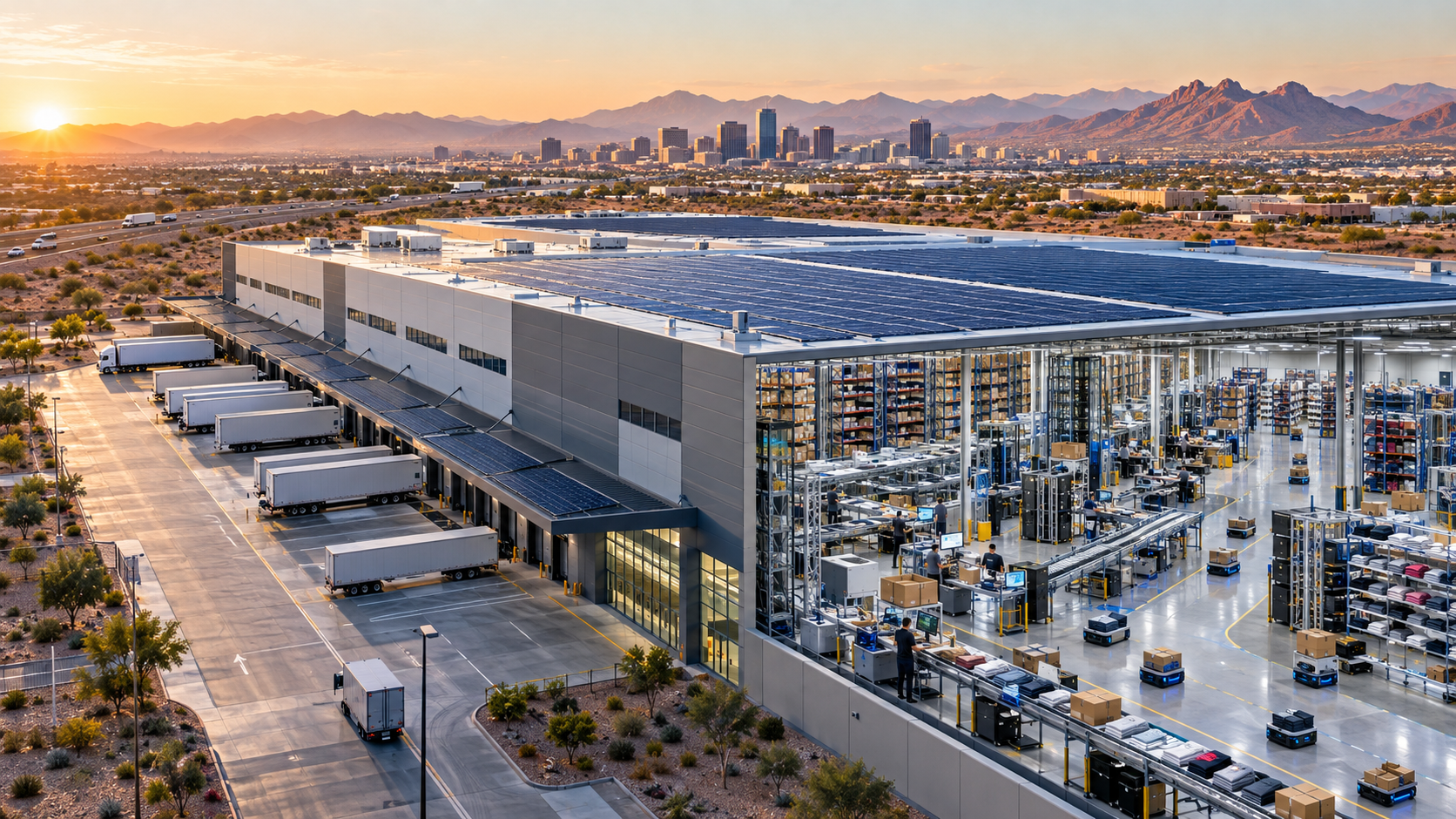
Phoenix as a logistics hub: Risks and opportunities of highly automated warehousing – A look at S&S' new center – Creative image on the topic, with AI: Xpert.Digital
S&S transforms logistics: Highly automated center in Phoenix by 2027
7
Automation in warehousing: Challenge or opportunity? S&S' $200 million bet
The future of order picking: Goods-to-Person technology in Phoenix
S&S plans to build a highly automated distribution center in the greater Phoenix area, scheduled to be operational by late summer 2027. With an impressive 500,000 square feet – approximately 46,450 square meters – the company aims not only to optimize its own logistics but also to initiate a fundamental shift in the North American distribution landscape. This project goes beyond the mere expansion of a textile wholesaler; it is a strategic move at a time when customer proximity, inventory availability, and digital process controls determine market success.
The investment of over $200 million in the new center reflects the company's belief that businesses embracing automation and minimizing manual processes can remain competitive in an increasingly demanding market environment. By establishing a regional warehouse location, S&S aims to shorten delivery times while simultaneously reducing its reliance on manual labor. This could not only increase efficiency but also fundamentally alter the cost structure. However, automation also presents challenges, such as the need for precise inventory management and the consideration of technical complexity. In this context, the new distribution center in Phoenix is seen not only as a logistical hub but also as a crucial element in risk diversification within the distribution network.
S&S is not just building a warehouse in Phoenix, but a new competitive machine
Anyone still manually picking orders in 2027 will have already lost the battle for speed and margin
S&S is planning a highly automated distribution center with 500,000 square feet of warehouse space in the greater Phoenix area. This corresponds to approximately 46,450 square meters, not 500,000 square meters as might appear from an inaccurate conversion of the American unit of measurement. Commissioning is scheduled for late summer 2027. The project is significantly more than a regional expansion of a textile wholesaler: it represents a fundamental transformation of North American distribution networks, where customer proximity, inventory availability, automation, and digital process control are increasingly determining market share.
From an economic perspective, S&S is not primarily investing in concrete, racking, and conveyor technology, but rather in shorter delivery times, higher capacity, and a structurally lower reliance on manual labor. The new facility is intended to supply the western and southwestern United States with more regionally available inventory. This allows the company to move goods closer to demand, shorten transport routes on the last transregional leg, and create the foundation for handling increasing order volumes without having to increase staffing levels proportionally.
The strategic logic is compelling, but not without risk. Large automated warehouses tie up capital, increase technical complexity, and necessitate precise coordination of product range, inventory, software, and material flow. As a growing logistics hub, Phoenix offers a favorable combination of market proximity, available space, and transport connections. At the same time, challenges arise from extreme heat, rising energy demands, a need for skilled workers, and the risk of building up excessive inventory or overly rigid technical capacity in a fluctuating market. Therefore, economic success will not be measured solely by the size of the building, but rather by how productively S&S integrates space, capital, data, and personnel.
Square meters become strategic reach
With approximately 46,450 square meters, the planned center is one of the larger regional distribution facilities, though it doesn't reach the scale of the largest American e-commerce complexes. This size is nevertheless significant for S&S because clothing and promotional textiles have a unique warehousing logic. A single item can be stocked in numerous sizes, colors, and styles. This greatly increases the number of inventory units, even though the products may appear similar. Therefore, the warehouse must not only handle large quantities but also manage a high degree of product variety and reliably provide the correct item, even for small orders.
The space initially creates physical capacity, but its economic value arises from the regional positioning of inventory. The closer a frequently requested item is to the customer, the greater the likelihood of delivering an order within a short timeframe. At the same time, the proportion of expensive long-distance transport and urgent transfers between locations decreases. A regional inventory buffer can also absorb disruptions at other locations. The new center thus becomes an element of risk diversification: capacity, goods, and order processing are not concentrated at a single central point, but are distributed across multiple nodes.
Decentralization, however, does not automatically generate efficiency. Additional locations can multiply safety stock and tie up capital if the same items are kept in too many places. Therefore, the quality of inventory management is crucial. S&S must forecast which brands, colors, and sizes will actually be in demand in the west and southwest. Fast-moving items should be stored regionally, while slow-moving variants can remain concentrated in a few locations. Only such a differentiated inventory model prevents delivery speed from being achieved at the expense of excessive stock levels.
Phoenix will become the distribution center for the Southwest
The choice of the greater Phoenix area follows a logical geographical and demographic logic. The Phoenix-Mesa-Chandler metropolitan region had approximately 5.23 million inhabitants by mid-2025 and gained about 59,000 people within a year. This not only expands the immediate sales market but also increases the number of companies, event organizers, sports organizations, educational institutions, tradespeople, and service providers who may require customized clothing, workwear, and promotional items.
Phoenix is also conveniently located between Southern California, Nevada, Utah, New Mexico, and Texas. Interstate 10 provides a key east-west connection, linking the metropolitan area to the ports and consumer centers of Southern California, as well as to Texas. Additional highways serve the rapidly growing suburbs and industrial areas of the Valley. This creates a large regional catchment area for a distributor, which can be served by trucks within manageable transit times. The location thus complements western capacity rather than simply duplicating an existing warehouse.
At the same time, Phoenix boasts a deep and modern industrial real estate market. Following an exceptionally strong construction boom, vacancy rates rose significantly as new large-scale spaces came onto the market. Depending on the definition used and the data provider, industrial vacancy rates in the second quarter of 2026 ranged approximately between 9.6 and 14.2 percent. This range is not a contradiction, but rather a consequence of differing definitions of submarkets, building classes, direct vacancy, and total available space. For large tenants, this essentially means that Phoenix is no longer the extremely tight landlord market of the early 2020s, but it continues to experience strong demand for modern logistics space.
In 2026, asking rents in many surveys ranged roughly between US$1.09 and US$1.18 per square foot per month on a triple-net basis. In addition to the base rent, the tenant typically bears significant costs for taxes, insurance, and operations. Submarkets vary considerably. Logistics corridors in the west and southwest can be more affordable than scarcer locations near city centers or airports. This market phase offers long-term planning tenants some negotiating leverage before a further decline in vacancy rates intensifies competition for well-located large spaces.
The project is a bet on regional demand
The Phoenix facility demonstrates that S&S is not relying solely on a centralized supply chain for North America. Instead of maximizing the capacity of a few very large warehouses, a network of regional hubs is intended to enable short delivery times. This is particularly important in the business of unprinted textiles and promotional merchandise, as many customers themselves operate under significant time pressure. Printers, finishers, and promotional merchandise distributors often receive short-notice orders for events, corporate promotions, team-building activities, or seasonal campaigns. If the raw materials cannot be delivered quickly, the finisher loses production time, and the end customer may miss their deadline.
S&S's past performance underscores its ambition. The company cites an order accuracy rate of 99.9 percent and the ability to reach approximately 98 percent of its customers within one to two days. Such figures are not merely operational metrics, but rather an integral part of its service promise. While an error rate of 0.1 percent may seem low, it can still translate into thousands of incorrect items when dealing with very high production volumes. Every further improvement reduces reshipments, credit notes, customer service costs, and production downtime for the customer.
The new location thus has two tasks: to accommodate additional demand while simultaneously stabilizing existing service quality. Growth without a capacity reserve often leads to longer lead times, more overtime, and increased error rates during peak periods. A modern center can alleviate these bottlenecks. However, it only creates added economic value when its utilization is sufficiently high. Insufficient utilization increases the cost per order, while premature full utilization eliminates the strategic buffer. The key is to plan capacity several years in advance without relying on unrealistic growth assumptions.
$200 million changes the cost structure
S&S has earmarked or already initiated more than $200 million in total investments in distribution and warehouse automation. This sum cannot be attributed entirely to the Phoenix project. It represents a broader investment cycle encompassing multiple locations, systems, and inventories. Nevertheless, it illustrates the scale of the strategic decision. The company is partially converting ongoing, personnel-related costs into long-term capital and technology costs.
In a manual warehouse, staffing requirements typically increase relatively closely with order volume. More locations mean more walking distances, more order pickers, more shifts, and more coordination. Automation changes this relationship. Once the basic system, software, and conveyor technology are installed, additional throughput can be handled up to a capacity limit with a disproportionately smaller increase in staff. As a result, the average process costs per location decrease as volume increases. This operational leverage is one of the most important reasons for high initial investments.
The calculation remains complex, however. Depreciation, financing, maintenance, spare parts, software licenses, energy, and specialized technicians replace some of the variable labor. Automation doesn't eliminate costs, but rather changes their composition. The higher the fixed costs, the more critical capacity utilization and technical availability become. A system downtime can block large portions of the material flow and quickly generate significant backlogs. S&S must therefore consider redundancies, emergency processes, and maintenance windows as early as the plant design stage.
The investment is also a bet on consistently high wage and recruitment costs. In North American logistics, recruitment, employee turnover, and training have been among the biggest operational challenges for years. Automation reduces dependence on readily available personnel, especially during seasonal peaks. At the same time, it increases the need for better-skilled employees for plant control, maintenance, data analysis, and process optimization. Many simple tasks are replaced by fewer, but more demanding, roles.
Goods-to-Person reverses the picking process
The centerpiece of the new center will be a goods-to-person automation system. In a traditional warehouse, an employee walks to the shelves, finds the item, takes it, and moves on to the next storage location. A significant portion of working time is thus spent walking and searching instead of on the actual retrieval. With goods-to-person, this principle is reversed: containers, boxes, or shelves are automatically transported to the workstation where the required quantity is taken.
This shift is economically significant. Productivity no longer depends primarily on how quickly people cover kilometers, but rather on the system's cycle time, the ergonomic design of the workstations, and the quality of the software. Travel times decrease, workflows become more consistent, and physical strain is reduced. At the same time, storage space can be used more efficiently because not every storage location needs to be directly accessible to people and wide forklifts.
For clothing, however, system design remains complex. Textiles are lightweight, but not always dimensionally stable in flexible packaging. Sizes and colors must be unambiguously separated, while similar items create a high risk of confusion. Returns, damaged packaging, and opened cartons increase the variety of material conditions. Therefore, the system must be not only fast but also fault-tolerant. Identification, inventory management, and physical access must align in real time.
Goods-to-person (G2P) is particularly well-suited for numerous small order items and a high repetition rate. Full automation may be less attractive for very bulky products, extremely slow-moving items, or unpredictable special cases. Therefore, an economically viable center will likely not handle every process with the same technology. A hybrid model is more probable, combining automated, high-performance areas with more conventional zones for exceptions, large quantities, and special items.
ZeroTouch turns goods receipt into a data process
In addition to physical automation, the proprietary ZeroTouch technology is of strategic importance. QR codes on cartons and garments are designed to accelerate goods receipt and ensure that goods reach production or onward shipping more quickly. With this, S&S addresses a frequently underestimated bottleneck: Many logistics chains are digitally well-organized for shipping, but lose time upon receipt due to manual identification, counting, allocation, and data entry.
A consistent digital identifier links physical goods to order, inventory, and customer data. When a carton is scanned, the system can identify which items it should contain, which order they belong to, and what the next step in the process is. At the individual item level, this identification improves traceability. For customers who print, embroider, or otherwise customize textiles, this can reduce the time between delivery and production release.
The economic benefits extend beyond simply saving a few seconds during scanning. Crucially, it comes from reducing media breaks. Every manual transfer between delivery note, inventory management, warehouse management, and production planning generates waiting time and an increased risk of errors. Standardized and automated data transfer allows for earlier availability of stock, faster production order initiation, and more precise customer status updates. This reduces work-in-process inventory and improves predictability.
The proprietary solution can simultaneously foster closer ties between S&S and its customers. When their processes are aligned with the provided code and data structures, the practical benefits of a long-term business relationship increase. This can create a form of operational customer loyalty that is more effective than a short-term price advantage. However, this requires open interfaces, reliable data, and easy integration. A closed system that incurs high customization costs could deter smaller customers. Therefore, the technology must offer economies of scale without ignoring the diversity of customer systems.
Vancouver showcases the North American blueprint
The parallel project in Vancouver illustrates that Phoenix is not an isolated expansion. The new Canadian facility is scheduled to go live in the fourth quarter of 2026, more than doubling the regional area and creating approximately 20,000 additional picking locations. This will be complemented by a planned investment in inventory of roughly US$50 million. Autonomous mobile robots will support the flow of materials.
Vancouver fulfills a similar strategic function for Western Canada as Phoenix does for the western and southwestern United States. Both projects bring existing facilities closer to growing or logistically challenging sales regions. At the same time, they combine physical expansion with automation, rather than simply multiplying conventional warehouse capacity. This supports a company-wide architecture in which processes, software, and operational metrics are more standardized.
The time lag is significant. Vancouver is expected to launch before Phoenix and can therefore serve as a practical learning environment. Experiences with robotics, inventory migration, personnel training, and ramp-up can be transferred to the later commissioning in Arizona. Such knowledge transfer reduces project risks, provided the findings are systematically recorded. Especially with automated systems, many problems arise not during assembly, but during ramp-up: master data is incomplete, items don't fit into designated containers, interfaces respond too slowly, or actual order peaks deviate from simulations.
The inventory investment in Vancouver also makes it clear that buildings and technology represent only a portion of the tied-up capital. A regional center needs sufficient stock to meet its delivery time commitments. This increases the need for working capital. At the same time, a broader and deeper product range can boost sales because fewer orders fail due to lack of availability. Economic success therefore depends on a precise balance between delivery capability and inventory turnover.
Your intralogistics experts

Consulting, planning and implementation of complete solutions for high-bay warehouses and automated storage systems - Image: Xpert.Digital
More information here:
The role of automation in modern warehouse operations
Customer proximity reduces time, but not automatically costs
Regional warehouses are often justified by shorter transport routes. This statement is correct, but incomplete. The cost impact depends on how the upstream supply chain is organized. If large quantities are consolidated and transported to Phoenix, then efficiently distributed regionally from there, the cost per unit can decrease. Conversely, if many small shipments have to be moved between several centers, additional transport and handling are required.
The most significant advantage may lie less in the absolute savings on freight costs than in reliability. A customer who receives goods within one or two days can reduce their own inventory and commit to future orders. S&S thus takes over part of its customers' inventory management. This is valuable for printers and finishers because capital doesn't have to be tied up in every color and size. The distributor is therefore selling not just textiles, but availability and time.
Short lead times also improve responsiveness to errors. If an item is missing or the wrong size has been delivered, a replacement can arrive more quickly. This reduces the risk of an entire production order being brought to a standstill. This risk reduction has economic value, even if it isn't itemized on any invoice. Especially for time-sensitive events, a delayed delivery can render the entire value of the goods worthless.
However, regional proximity should not be confused with last-mile delivery. S&S primarily serves commercial customers and handles parcels and larger shipments via transport providers. The center optimizes upstream fulfillment but does not control every part of the delivery process. Traffic congestion, parcel networks, driver shortages, and weather events remain external factors. An efficient warehouse can reduce shipping delays outside its gates but cannot eliminate them entirely.
Phoenix offers opportunities in a newly balanced real estate market
The industrial market in Phoenix has experienced unusually strong expansion in recent years. Millions of square feet of new space were added, at times faster than occupiers could absorb it. Construction activity has since slowed compared to its peak years, while large logistics and manufacturing companies are acquiring available space. In the second quarter of 2026, net uptake was approximately 4.7 to 6.2 million square feet, depending on the source. Warehouse and distribution space accounted for the largest share of this demand.
For S&S, this timing is strategically advantageous. During a period of increased vacancy rates, large tenants are more likely to secure modern buildings, expansion options, and more favorable terms. At the same time, the strong absorption suggests that good large spaces will not remain in abundance indefinitely. Those who wait to invest until the market tightens again may have to pay higher rents and compromise on location or building quality.
However, the location decision should not be based solely on low land costs. In an automated center, building height, column grid, soil quality, power supply, fire protection, and expandability influence productivity for decades. A slightly cheaper property can be more expensive in the long run if it limits storage density or forces complicated material flows. The distance to highway access points and parcel sorting centers also impacts costs and departure times on a daily basis.
Furthermore, the location can benefit from Arizona's industrial dynamism. Semiconductor manufacturing, the supplier industry, data centers, construction, and logistics attract workers and service providers. This development strengthens the regional economy but also increases competition for electricians, mechatronics engineers, IT specialists, and maintenance personnel. S&S therefore acts not only as a land user but also as an employer in a market where technical skills are becoming increasingly scarce and expensive.
Automation only partially solves the labor shortage
A fully automated distribution center is not devoid of people. It shifts work from walking, transport, and manual sorting to monitoring, troubleshooting, quality assurance, and process control. Employees are still required at goods-to-person stations, in receiving, packing, at loading docks, and for exceptional processes. Technicians, system administrators, and data managers are also needed.
The productivity gain arises because the same workforce can handle more tasks and spend less time on unproductive activities. This is particularly valuable when suitable workers are hard to find or when additional capacity is needed quickly during peak seasons. Robotics can be used around the clock, but requires maintenance and a reliable power and data supply. Humans remain necessary to assess deviations, handle damaged goods, and make decisions outside of predefined rules.
New demands are being placed on personnel strategy. Traditional warehouse experience is insufficient when employees are expected to operate complex systems. Training must begin before commissioning and cannot be limited to manufacturer instructions. The operational team needs an understanding of material flow, data quality, safety logic, and the economic consequences of disruptions. Managers must be able to interpret key performance indicators and must not undermine the system with improvised, special processes.
At the same time, automation can make jobs more attractive. Reduced walking and heavy lifting decrease physical strain. Air-conditioned workstations can offer a significant advantage in Phoenix. However, a new form of strain threatens if cycle times are set too tightly or employees are constantly monitored algorithmically. Sustainable productivity is not achieved through maximum short-term speed, but through ergonomic processes, realistic performance targets, and low employee turnover.
Extreme heat becomes a cost factor
Phoenix offers logistical advantages but suffers from an extreme summer climate. In 2024, 113 consecutive days with temperatures exceeding 100 degrees Fahrenheit (approximately 37.8 degrees Celsius) were recorded there. On particularly hot days, outdoor temperatures are significantly higher. For a large distribution center, this impacts energy consumption, occupational safety, building technology, and plant availability.
Loading docks are particularly critical because hot outside air enters every time a door is opened. Trucks, asphalt, and concrete radiate additional heat. Employees in the loading and unloading area are exposed to both physical strain and heat. Good insulation, airtight door seals, shading, efficient ventilation, and adjusted shift schedules are therefore not merely comfort features, but integral components of the productivity and safety concept.
Automation itself also requires controlled conditions. Batteries, sensors, controllers, and network components are sensitive to high temperatures and dust. Cooling and filtration increase power consumption. At the same time, a well-automated system can reduce the amount of time people spend in particularly hot zones and concentrate energy-intensive comfort cooling on defined work areas. Therefore, the building should be thermally zoned, rather than trying to maintain the same temperature throughout the entire hall, regardless of its use or the goods being processed.
The energy question extends beyond the electricity bill. Arizona is experiencing rapidly increasing demands from population growth, industry, and data-intensive infrastructure. A center of this size must ensure long-term grid connection capacity, stability, and the ability to handle potential peak loads. Solar panels on large rooftops can partially cover daily consumption, but they do not replace grid connection, storage, and load management. An integrated energy concept that optimizes building technology, robot charging cycles, peak loads, and, if applicable, on-site generation is economically viable.
Water and sustainability are becoming a location license
A textile distribution center consumes significantly less water in operation than a semiconductor factory or a water-cooled data center. Nevertheless, it is located in a region where water scarcity and the future of the Colorado River are key political and economic issues. Therefore, companies are increasingly being judged not only on their direct consumption but also on whether their presence is compatible with the long-term sustainability of the region.
For S&S, the most important environmental levers likely lie in energy, packaging, transport, and building efficiency. Short regional delivery routes can reduce emissions by consolidating shipments and avoiding empty runs. However, they can also increase the environmental impact if additional locations lead to more transshipments or smaller shipments. The overall balance therefore depends on the actual network design and not simply on proximity to the customer.
Automation can reduce packaging volumes by better tailoring carton sizes to orders and avoiding incorrect deliveries. However, it can also generate additional material consumption if every process step relies on standardized containers and protective packaging. A robust sustainability concept must therefore consider concrete key performance indicators: energy consumption per order item, packaging weight per shipment, transport capacity utilization, return rate, and the percentage of incorrect deliveries.
The roof area of a building with approximately 46,450 square meters offers potential for photovoltaics. Whether and to what extent this potential is utilized depends on structural integrity, grid connection, financing, and load profile. Particularly in Arizona, solar power is often generated at the same time as high cooling demand. Such a profile can be economically attractive. Sustainability thus becomes not just a matter of communication, but a tool for limiting operating costs and price risks.
Inventories become the actual capital risk
Distribution projects often focus on buildings and robots. In retail, however, inventory is often the larger and more volatile capital block. Textiles are subject to fashion cycles, color trends, brand shifts, and seasonal demand. An item can be physically flawless and still lose economic value if customers prefer different cuts, materials, or brands.
Increased regional warehousing capacity tempts companies to stock a wider product range at multiple locations. This improves delivery reliability but also increases the risk of slow inventory turnover. Therefore, the key performance indicator is not just availability, but the combination of service level, inventory turnover, and write-offs. A high service level achieved through excessive inventory can negatively impact the return on investment.
S&S requires a differentiated approach to inventory management. Standard items in high demand can be kept in large quantities because their sales are relatively stable. Fashionable or rarer variations should be distributed more selectively. Virtual inventory availability across the entire network can help with this: If an item is not available in Phoenix, the system must transparently determine whether a partial delivery, a transfer, or shipping from another center is more economically viable.
Zero-touch technology and precise individual part identification improve the data basis for such decisions. The more accurately goods receipt, storage location, reservation, and shipping are recorded, the smaller the discrepancy between system inventory and physical inventory. This accuracy is a prerequisite for managing inventory levels. Those who don't trust their data hold additional safety stock. Good data quality thus directly frees up capital.
The greatest danger lies in system integration
The technical challenge lies not in simply operating individual robots or running conveyor belts. The crucial element is the interplay between warehouse management, order control, inventory planning, identification, conveyor technology, and customer platforms. A highly automated center is a comprehensive cyber-physical system. Delays or errors in an interface can halt the physical flow of materials just as easily as a mechanical defect.
Order prioritization is particularly critical. The system must decide which order is processed first, how items from different zones are combined, and at what time the shipment must reach the shipping area. Optimizing only local metrics creates new bottlenecks. Very fast picking is of little use if packaging or loading cannot handle the quantities.
The quality of master data also becomes a production factor. Dimensions, weight, packaging unit, barcode, color, and size must be correctly recorded. Incorrect data can lead to goods not fitting into the intended containers or ending up at the wrong station. Therefore, a comprehensive cleansing and verification of the product data is necessary before production ramp-up.
Added to this is the cyber risk. Networked robots, scanners, and control systems expand the attack surface. A failure caused by malware, compromised access credentials, or faulty updates can impair delivery capability. S&S requires segmented networks, secure remote maintenance, consistent access control, and tested recovery plans. In this environment, cybersecurity is not solely an IT issue, but an integral part of operational security.
Competition will be decided on service, not just on purchase prices
In the distribution of branded and promotional textiles, products from different suppliers are often comparable. Many retailers carry the same or similar brands, basic colors, and standard items. This creates price pressure. However, a pure discount strategy is easily copied and reduces margins. A network that reliably combines availability, short lead times, high accuracy, and digital integration is more difficult to copy.
The Phoenix location strengthens precisely this differentiation. A customer doesn't just evaluate the unit price of a shirt, but the total cost of procurement. This includes inventory management, goods receipt, error handling, production downtime, and the risk of missed deadlines. By reducing these indirect costs, S&S can remain economically attractive even if its product price isn't always the lowest.
This investment also increases the pressure on smaller competitors. They must either build their own regional capacities, specialize technologically, or differentiate themselves through product range and consulting. Not every supplier can invest more than US$200 million in distribution and automation. Size thus creates a financing advantage, provided the facilities are well utilized.
For customers, market concentration can be a double-edged sword. Larger distributors tend to offer broader inventories and more powerful systems. At the same time, dependence on a few platforms increases. Professional customers will therefore consider not only price and service, but also reliability, data portability, and alternative sources of supply. S&S needs to build trust that this technological dependency will not lead to a lack of flexibility.
The ramp-up determines the return
Between a completed building and a smoothly operating distribution center lies a challenging ramp-up phase. Shelving, robots, and software may be technically approved, but the overall system may not achieve its target values under real-world order conditions. Therefore, commissioning in late summer 2027 should not be equated with immediate full capacity.
A controlled ramp-up begins with a limited number of items, customers, or order types. Volume and complexity are gradually increased while errors are documented and processes are adjusted. Ramping up too quickly can create backlogs and jeopardize existing service quality. Conversely, ramping up too slowly prolongs the period of high duplication and fixed costs. Management must balance the need for learning with economic pressures.
The timing before the year-end business can present additional challenges. Depending on the customer segment, autumn and winter can be busy with corporate clothing sales, holiday promotions, school and sports programs, or events. S&S should therefore allow sufficient buffer time between technical commissioning and critical peak periods. A new automated center must not become the sole carrier of significant volume immediately after its launch.
The most meaningful key performance indicators (KPIs) extend beyond throughput. Relevant factors include order accuracy, lead time, technical availability, cost per item, labor hours per order, energy consumption, inventory discrepancies, and on-time departure. Equally important is the ability to quickly clear backlogs after disruptions. A system may appear efficient on average but still lack sufficient resilience during peak periods or outages.
The new center changes the role of S&S
With Phoenix, S&S is evolving from a traditional wholesaler into a technology-driven infrastructure provider for the finishing and promotional products industry. The company not only supplies goods but also manages speed, data, and process reliability. The better the systems are integrated with customers' processes, the more S&S becomes a part of their operational value creation.
This position opens up new possibilities. Order and transaction data can be used to identify regional demand patterns, plan product ranges more precisely, and identify bottlenecks earlier. Customers could receive more accurate availability information, automated reordering, or improved production data. The economic value of the network then increases not only with the number of warehouses, but also with the quality of decisions based on shared data.
This, however, entails greater responsibility. Errors in forecasts or systems directly impact many customers. S&S must therefore combine technical capability with transparency and robust service processes. Automation must not lead to exceptions being treated less favorably or to customers only receiving standardized digital responses when problems arise.
In the long term, the network could develop a platform effect. Manufacturers benefit from a distributor that can quickly reach large markets. Processors benefit from broad inventory and digital goods receipt. S&S sits between both sides and can leverage economies of scale. This is precisely where the strategic importance of the investment lies: Phoenix is not just an additional storage point, but a building block for a more integrated market architecture.
A strong strategy with sophisticated execution
The planned center in Phoenix makes economic sense because several developments are converging: a growing southwestern sales region, a maturing industrial market, increasing expectations for delivery speed, persistent labor shortages, and available automation technologies. The combination of regional inventory, goods-to-person picking, and digitized receiving can significantly increase throughput, accuracy, and customer value.
The decisive advantage arises from the interplay of these elements. A large building without intelligent inventory management would be capital-intensive. Robotics without reliable data would only accelerate errors. Regional inventories without sufficient demand would tie up capital. Only when location, product range, technology, and processes are optimized together does the investment transform into a lasting competitive advantage.
The risks are real. Demand may grow more slowly than expected, technology may delay ramp-up, heat and energy consumption may increase operating costs, and excessively large inventories may negatively impact return on investment. Added to this are cyber risks and the need for qualified personnel. These factors don't argue against the project itself, but rather against an overly simplistic success story. Full automation is not an end in itself and is no guarantee of low costs.
The overall outlook is nevertheless positive. With Phoenix, S&S is not only addressing current bottlenecks but also building a platform for further growth in the west and southwest. The investment shifts the focus of competition from who owns the goods to who can make them available the fastest, most accurately, and with the most data-driven approach. Should the ramp-up be successful and regional demand absorb the new capacity, the center will do more than simply process orders. It will redefine the company's cost curve, service promise, and market position for years to come.
Your global marketing and business development partner
☑️ Our business language is English or German
☑️ NEW: Correspondence in your native language!

Konrad Wolfenstein
I and my team are happy to be available to you as your personal advisor.
You can contact me by filling out the contact form here [email protected]:or simply call me at +49 7348 4088 965. My email address is
I'm looking forward to our joint project.










