
500 Megawatt Solar Park Green Hill: How a British mega-solar park exposes the economic contradictions of the energy transition
Xpert Pre-Release

Available in 27 languages 📢
Prefer Xpert.Digital on GoogleⓘPublished on: November 29, 2026 / Updated on: November 29, 2026 – Author: Konrad Wolfenstein
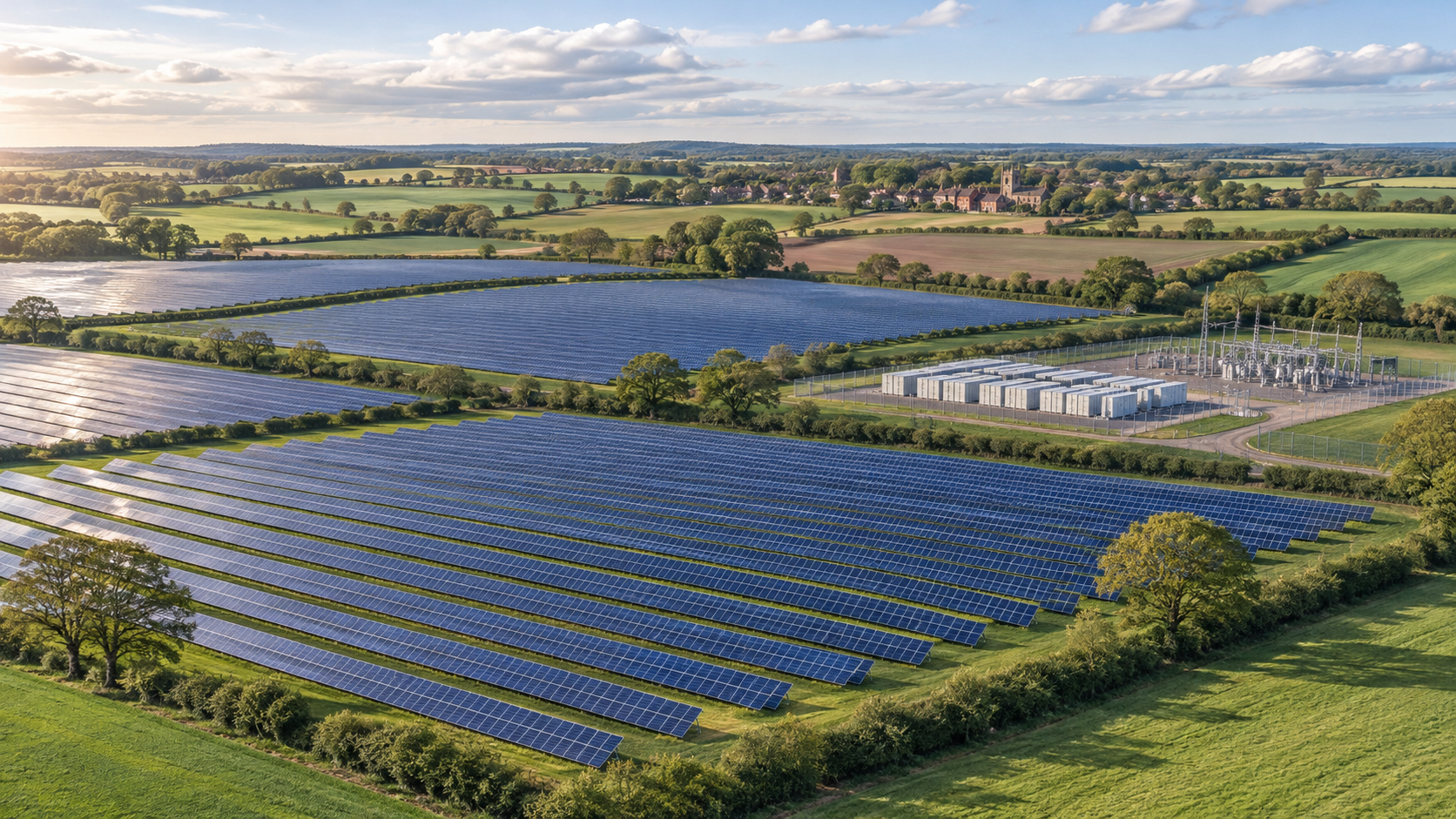
500 Megawatt Solar Park Green Hill: How a British mega-solar park exposes the economic contradictions of the energy transition – Creative image on the topic, with AI: Xpert.Digital
Cheap electricity, but at what price? 3. 1,200 hectares for solar energy – The dispute over Green Hill
Solar park with storage: Why Green Hill is more than a power plant
Energy transition under scrutiny: Who benefits from Green Hill – and who bears the burden?
With the approval of the Green Hill solar park on October 8, 2026, the British government has launched a project with far-reaching implications beyond the affected communities. A photovoltaic plant with a capacity of up to 500 megawatts is planned for approximately 1,200 hectares. A battery storage system and grid connection are also planned. Construction could begin in 2027, with electricity generation targeted for 2029 – however, both are project goals and not guaranteed dates.
Green Hill represents a fundamental shift: solar energy is no longer just a technology for rooftops and smaller installations. Large-scale projects of this magnitude are becoming industrial infrastructure – with consequences for power grids, agriculture, capital markets, and the affected regions. Their evaluation, therefore, cannot be reduced to the question of whether solar power can be generated cheaply. Crucial factors also include when the electricity is available, its market value, the costs associated with storage and grids, and how the benefits and burdens are distributed.
The solar park could provide significant amounts of electricity without ongoing fuel requirements. However, 500 megawatts of installed capacity do not guarantee consistent electricity production or a reliable supply at every hour. Added to this are the land requirements, potential local conflicts, and the question of whether the planned grid connection will be timely and sufficiently powerful. Green Hill thus demonstrates what the energy transition on an industrial scale must be measured by: not solely by installed megawatts, but by the interplay of generation, storage, grid integration, economic viability, and regional acceptance.
Cheap solar power, expensive conflicts: Who benefits from the energy transition – and who bears its burdens?
A major project is becoming a test for British energy policy
With the approval of the Green Hill solar park on October 8, 2026, the British government made a decision whose significance extends far beyond the affected communities. A photovoltaic plant with a capacity of up to 500 megawatts is planned for approximately 2,965 acres (around 1,200 hectares). The designated areas are located primarily in Northamptonshire, south and west of Wellingborough and north of Northampton. Additional areas are included in the Milton Keynes council area, including near the hamlet of Warrington in Buckinghamshire. According to current plans, construction could begin in 2027, with electricity generation targeted for 2029. These dates are project goals, not guaranteed completion dates.
Green Hill exemplifies a fundamental shift in solar energy. A technology long associated in the public perception with private rooftops and small-scale ground-mounted installations has become an integral part of industrial energy infrastructure. A 500-megawatt project is no longer a supplementary energy experiment, but a power plant project with implications for capital markets, electricity grids, agriculture, and regional development.
Its economic evaluation therefore cannot be reduced to the question of whether solar power can be generated cheaply in principle. The crucial factors are whether the project provides electricity at the right time and in the right place, how expensive its integration into the energy system will be, and how the benefits and burdens are distributed.
The rationale is that large solar parks can make a significant contribution to a more affordable and less fossil-dependent energy system. However, their size alone does not prove either economic efficiency or social viability. Green Hill will be judged on whether generation, storage, grid connection, and regional integration function as a cohesive system.
What 500 megawatts can do – and what they can't
The most striking feature of the project is its planned output of up to 500 megawatts. This figure describes the maximum electrical output under the relevant technical conditions. It is not the same as the average output over the course of a year, and certainly not as a continuously available electricity supply.
Photovoltaics do not generate electricity at night. During the day, the sun's position, cloud cover, temperature, and season all affect the yield. Therefore, for economic evaluation, the amount of electricity generated annually is at least as important as the installed capacity. Furthermore, the market value of this electricity at its respective generation times must be considered.
The difference can be illustrated with a simplified model calculation. If a 500-megawatt plant were to achieve 1,000 full-load hours per year, this would result in 500,000 megawatt hours, or 500 gigawatt hours, of electricity. At 1,100 full-load hours, it would be 550 gigawatt hours. These figures are not a yield forecast for Green Hill, but rather demonstrate how power output translates into an annual amount of electricity.
The statement that the solar park can supply approximately 200,000 households should also be understood as a calculated annual comparison. It does not mean that these households could be supplied exclusively from Green Hill at all times of day and year. A continuous supply requires interaction with other producers, storage facilities, grids, and potentially flexible demand.
That's precisely why it would be inaccurate to describe Green Hill as an independent baseload power supplier. The project can deliver significant amounts of electricity and temporarily reduce the need for other power plants. However, this does not automatically guarantee a reliable power supply for every hour of the year.
Land use is an economic factor, not merely a landscape issue
The planned area of approximately 1,200 hectares corresponds to roughly twelve square kilometers. Based on 500 megawatts, this equates to a calculated land requirement of approximately 2.4 hectares per megawatt. This figure serves as a useful initial guideline but should not be confused with the actual area covered or sealed by modules.
A solar park includes not only the rows of modules but also spacing, access roads, technical facilities, safety zones, and, where applicable, compensatory areas. Therefore, the same area definitions must be used for a reliable comparison with other projects. A project with generous ecological buffer zones may appear more land-intensive on paper without actually requiring a correspondingly larger building footprint.
Economically, land use incurs opportunity costs. This refers to the benefit of the best alternative that is forgone in favor of the solar park. This could be agricultural production, but also another use or the preservation of a particular landscape feature.
These costs vary considerably depending on location. A hectare of fertile arable land must be assessed differently than an area with low agricultural yields, an unfavorable shape, or limited cultivation possibilities. Soil quality, water availability, lease structures, and the importance of contiguous land for a farm are also relevant.
A proper assessment must therefore neither consider every open-space facility as unproblematic nor equate every hectare used with an equally large, permanent loss of agricultural productivity. The decisive factors are the specific use, its duration, and the realistic alternative.
National land use statistics and local pollution levels tell different stories
At the national level, the land requirement for solar energy appears manageable. The British solar strategy estimates that, for expansion to the planned scale by 2030, a land requirement of up to approximately 0.4 percent of the total British land area is needed. This figure is a model-based estimate and depends, among other things, on the respective contributions of rooftop and ground-mounted systems to the expansion.
A low national quota, however, does not negate local impacts. If many facilities are concentrated in certain regions, significant changes can occur there. For the affected communities, what matters is not the proportion of the total national territory, but rather the changes happening right on their doorstep, along familiar routes, and in their economic environment.
This stems from a classic distribution problem. The benefits of additional electricity generation are distributed across the electricity grid to many consumers and businesses. In contrast, landscape changes, construction traffic, and potential restrictions on other land uses are concentrated spatially.
Both perspectives can be correct simultaneously. Great Britain may have sufficient land area for solar expansion, while individual sites may still be poorly chosen or disproportionately burdened. Conversely, a clearly visible intervention does not automatically make a project economically unsound.
The crucial question, therefore, is not whether solar energy should be allowed to occupy space in principle. It is which areas should be used, with what consequences, and whether alternative locations would incur lower overall costs while offering comparable energy yields.
Why large solar parks appear economically attractive
The economic logic of large solar parks is primarily based on economies of scale. Planning, procurement, construction organization, financing, and operation can all be bundled together in a large-scale project. Standardized components and recurring construction processes can reduce the cost per installed power unit.
Another advantage of photovoltaics is that no fuel needs to be purchased for electricity generation. Therefore, once the system is installed, the ongoing generation costs are not directly dependent on gas, coal, or oil prices. This doesn't eliminate all risks, but it does change their structure.
A solar park essentially exchanges a large portion of future variable costs for current investment costs. Economically, this means that raising capital, construction costs, and long-term revenue security become particularly important. While the plant doesn't require fossil fuels, it does need financial viability over a long period.
However, size is not an unlimited advantage. As the site expands, internal cabling, coordination, construction traffic, land acquisition agreements, and network connections can become more challenging. The spatial concentration of conflicts also increases.
The relevant target is therefore not the largest possible solar park, but the most cost-effective combination of generation, grid connection, storage, and acceptable site impacts. A smaller project can be economically superior despite higher specific construction costs if it is implemented more quickly or has a significantly better grid connection.
The price of capital determines the availability of supposedly cheap electricity
In capital-intensive technologies, financing directly impacts the required electricity revenues. The higher the interest rate demanded by debt and equity investors, the more revenue a project must generate over its operating lifetime.
A technically identical solar park can therefore achieve very different economic results under different financing conditions. Low perceived risks facilitate favorable financing. Uncertainty about construction costs, grid connection, or future revenues increases the cost.
The available project data for Green Hill does not include reliable, complete investment costs, financing terms, or long-term revenue assumptions. Therefore, any specific return on investment or a supposedly guaranteed electricity generation price would be speculative.
Nevertheless, the direction of impact is clear: delays can negatively affect profitability even if the technology remains unchanged. Development costs continue to accrue, committed capacities may need to be re-coordinated, and expected revenues are postponed.
Planning certainty therefore has real economic value. However, it should not be confused with foregoing careful examination. A quick decision that later leads to significant conflicts or revisions can be more expensive than a more complex but ultimately reliable process.
Why the government decides, yet the municipalities remain important
Green Hill was assessed as a nationally significant infrastructure project. The Planning Inspectorate examined the project and issued a recommendation; final approval was granted at the governmental level. This is an important distinction: the review body is not the same as the political decision-maker.
The national decision-making process should ensure that supra-regional interests are adequately considered. Electricity supply, climate policy, and grid development do not stop at municipal borders. A purely local approach could systematically underestimate the nationwide benefits of large infrastructure projects.
However, this does not mean that the UK is increasingly centralizing responsibility for all solar projects. Rather, the solar strategy describes raising the threshold for the national approval process from 50 to 100 megawatts. This allows more decision-making leeway below the national level for smaller and medium-sized projects. Green Hill, at 500 megawatts, is significantly above this threshold.
Even after national approval, local responsibilities don't disappear. Detailed requirements, safety concepts, construction processes, and further implementation steps remain relevant. The approval is a significant milestone, but it is neither proof that construction has already begun nor a guarantee of an operational grid connection.
Economically, it's about a sensible division of labor: The state must assess national energy interests, while local knowledge remains indispensable for site selection and damage prevention.
Citizen protest is an indication of distribution conflicts
The review of the project ran from October 2025 to April 2026. More than 1,200 individuals and businesses submitted comments. Political opponents included Conservative MPs Sarah Bool and Stuart Andrew, who delivered a petition to Downing Street. A key point of criticism was the solar panels, which could reach a height of 4.5 meters, and the anticipated alteration of the rural landscape.
The number of comments received demonstrates a significant level of public interest. However, it is not a representative vote. Without further information, it is not possible to determine from it whether a local majority is for or against the project.
Likewise, resistance should not be dismissed outright as selfish obstruction. People can fundamentally support the expansion of renewable energies and still have specific objections to the location, size, or distribution of the burdens.
Conversely, local residents' interests do not automatically take precedence over any supra-regional infrastructure. Abandoning a project also has consequences: electricity may then have to be provided elsewhere, using different technologies or at different costs.
A sound assessment must therefore make both sides visible. It must not downplay local damage, but should also consider the costs of not implementing the project. Only this comparison transforms an emotionally charged location debate into an economically comprehensible decision.
New: Patent from the USA – install solar parks up to 30% cheaper and 40% faster and easier – with explanatory videos!

New: Patent from the USA – Install solar parks up to 30% cheaper and 40% faster and easier – with explanatory videos! - Image: Xpert.Digital
The core of this technological advancement is the deliberate departure from conventional clamp mounting, which has been the standard for decades. The new, more time- and cost-effective mounting system addresses this with a fundamentally different, more intelligent concept. Instead of clamping the modules at specific points, they are inserted into a continuous, specially shaped support rail and held securely in place. This design ensures that all forces – whether static loads from snow or dynamic loads from wind – are distributed evenly across the entire length of the module frame.
More information here:
The economic impact of the Green Hill solar park
The price of electricity is not based on the costs of a single solar park
The idea that a large solar park will directly lead to correspondingly lower household bills is too simplistic. There are several economic layers between production costs, wholesale prices, and end-customer prices.
If additional solar energy displaces more expensive generation during hours of high demand, it can lower the wholesale price. This effect is generally desirable. However, it does not mean that every kilowatt-hour generated has the same value.
With increasing simultaneous solar power production, the price can fall, especially during sunny hours. This can be advantageous for consumers, provided the price increase is passed on. For operators, however, it means that rising production volumes do not automatically generate proportionally higher revenues.
This relationship is known as the market value or cannibalization effect. Through its own expansion, the technology increasingly influences the price level during the hours when it produces the most.
Added to this are network charges, distribution costs, taxes, and contractual procurement conditions. Therefore, even a significant decrease in certain wholesale prices does not necessarily translate immediately and fully into lower household bills. The statement that Green Hill can generate cheap electricity must thus be distinguished from the further claim that every household will experience immediate and noticeable relief as a result.
A battery storage system improves the project, but it doesn't replace the seasons
Green Hill encompasses not only photovoltaics, but also battery storage and grid connection infrastructure. The project description specifies a capacity of up to 500 megawatts for the planned storage system. This represents a significant complement to pure solar power generation.
However, power output alone is not sufficient for evaluating a battery storage system. Its usable energy capacity in megawatt-hours is also required. Power output describes how quickly electricity can be absorbed or released. The energy capacity determines how long this is possible.
A hypothetical storage facility with 500 megawatts of power and 1,000 megawatt-hours of usable energy could theoretically be discharged at full power for two hours. With 2,000 megawatt-hours, it would be four hours. These are calculation examples, not information on the approved storage duration for Green Hill.
A storage system can shift solar power generated during peak midday hours to later times. This can improve revenue and, under suitable conditions, reduce grid load. However, conversion losses, investment costs, and wear and tear are incurred.
Above all, short-term storage should not be confused with seasonal backup. A battery storage system designed for shifting energy in short bursts does not automatically bridge longer periods of low solar production in winter. Its strength lies in balancing energy consumption over a limited timeframe, not in the unlimited availability of stored summer energy.
The grid connection determines the value of the location
The generated electricity will be fed into the national grid via the Grendon substation in Northamptonshire. This illustrates that the suitability of a solar park's location depends not only on solar irradiance and land availability, but also on the electrical infrastructure.
A seemingly inexpensive plot of land can become economically unattractive if a long connection line or extensive network upgrades are required. Conversely, a location with higher land costs can be cheaper overall due to better connections.
For Green Hill, the crucial question is therefore whether the planned connection will be available in time and with sufficient capacity. A fully constructed plant without a usable connection ties up capital without generating the expected revenue.
Even after commissioning, bottlenecks can remain relevant. If the grid is temporarily unable to absorb or transmit enough electricity, feed-in may need to be limited. How such risks are distributed depends on the technical and contractual framework.
The economic assessment should therefore not only ask how cheaply Green Hill generates electricity. It must also consider the additional grid costs and the benefits this infrastructure provides beyond the individual project.
Agriculture between stable rents and lost room for maneuver
Long-term solar leases can be attractive for landowners. They potentially generate more predictable income than farming operations whose results depend on weather, yields, operating costs, and agricultural prices. However, whether this applies in any given case depends on the specific contracts.
Owners and farmers are not always the same people. An owner can benefit from leasing land, while a tenant farmer loses productive land. This can change not only individual incomes, but also farm sizes and local lease markets.
Furthermore, there is the question of long-term commitment. An area designated for energy production for decades is only available to other uses to a limited extent during this time. This lost flexibility also has economic value.
Combining solar power with agricultural use can reduce conflicts under suitable conditions. For this to work, the system height, row spacing, soil conditions, and farming practices must be compatible. However, a maximum module height of 4.5 meters alone does not mean that Green Hill can be operated as a fully-fledged agrivoltaic system.
Dismantling and restoration are equally important. A theoretical later return to agriculture is only economically viable if responsibilities, financing, and requirements are clearly defined.
Environmental sustainability is achieved through management, not through the label "solar park"
The ecological assessment of an open space depends heavily on its initial state and subsequent management. Compared to certain intensively used areas, opportunities may arise for more extensive maintenance, additional hedges, or more biodiverse marginal areas.
However, this is not an automatic effect. Construction work, soil compaction, shading, fencing, and changes in water runoff can cause new stresses. Which effects predominate must be assessed on a site-specific basis.
The distinction between land use and sealing remains important. A solar power plant requires a large area, but does not necessarily seal it completely. This does not mean that soil functions remain unchanged, nor that the entire area is permanently destroyed.
Verifiable goals are economically sound. If ecological improvements are part of the justification, they should be linked to suitable baseline data, clear maintenance measures, and long-term monitoring.
This prevents nature conservation from being treated merely as a communicative add-on. For a project of this scale, it is an integral part of the investment's quality: poor management can generate subsequent costs, while well-planned measures can actually reduce conflicts and ecological impacts.
Employment and regional value creation must be considered separately
A project like Green Hill can generate demand for engineering services, construction companies, electrical engineering, transportation, and other services during the planning and construction phases. The proportion of this demand that remains in the region depends on procurement methods and the availability of local skills.
This does not automatically result in a large, lasting employment effect. Construction jobs are temporary. Subsequent operation requires maintenance, technical monitoring, site upkeep, and other services, but is structurally organized differently than labor-intensive industrial production.
Therefore, no specific job creation or value-added figures should be claimed for Green Hill as long as reliable project-related calculations are lacking. It would be particularly problematic to lump together temporary construction work and permanent jobs without disclosing the difference.
The project could still be of interest from a regional economic perspective. If local businesses are trained early on and integrated into suitable service areas, a portion of the investment volume can generate local income.
However, the greater potential benefit lies in the energy system: additional domestic electricity generation and reduced dependence on fossil fuel markets. This benefit is distributed across regions, and precisely for this reason, it doesn't automatically explain why affected communities should accept the project.
Acceptance requires tangible participation, not symbolic gestures
There are differing interests between landowners, immediate neighbors, municipalities, and electricity consumers. Voluntary payments to individual stakeholders do not automatically resolve this distribution conflict.
Meaningful participation must be appropriate to the type of burden. Measures against construction traffic, for example, should actually relieve the affected roads and residents. Landscape interventions cannot be addressed simply by a general reference to national climate targets.
Financial participation can be a building block if it is transparent, long-term, and comprehensible. However, it should not give the impression that objective objections are simply dismissed without their validity being examined.
Reliability is equally important. If commitments are made regarding landscaping, maintenance, or traffic management, responsibilities and oversight must be clear. An economic benefit that is merely announced inspires less trust than a verifiable commitment.
For project developers, this is not merely a matter of public relations. Protracted conflicts can cost time, money, and business acumen. Therefore, effective regional integration is also a tool for risk reduction.
Rooftop systems are a necessary addition, but not a blanket replacement
The argument to first utilize roofs and already sealed surfaces carries economic weight. There, the additional competition for space is often less, and some of the electricity can be used directly at the point of consumption.
However, roof surfaces are not automatically available at short notice or technically suitable. Load-bearing capacity, roof condition, shading, ownership, and connection options can complicate implementation. Furthermore, many individual installations require many individual decisions.
In contrast, large open-space projects concentrate significant resources into a single undertaking. This advantage can result in lower specific costs, but comes at the cost of more concentrated site impacts.
A fair comparison must therefore take more into account than just the module price. Relevant factors include total investment costs, implementation time, grid requirements, self-consumption options, and the respective environmental impacts.
The UK's solar strategy therefore aims to expand various types of installations and sets a target total solar capacity of 45 to 47 gigawatts for 2030. Green Hill would be a significant individual component, but no substitute for widespread expansion on commercial rooftops, residential buildings, and other suitable surfaces.
Energy security means less fuel risk, not complete independence
Domestic solar power generation can reduce the need for fossil fuel-based electricity production during suitable hours. This decreases the direct dependence on fuel deliveries and their price fluctuations.
This effect is economically significant because fuel prices can be influenced not only by normal market movements but also by geopolitical disruptions. A plant without a continuous fuel demand alters the risk profile of the supply.
This does not create complete independence. Solar panels, inverters, batteries, and other components still need to be manufactured, delivered, maintained, and sometimes replaced. Supply chain and technology risks remain.
The electricity system also still needs balancing mechanisms for hours with low solar production. Energy security therefore results from diversity and coordination: different producers, resilient grids, storage, flexible demand, and sufficient available power.
Green Hill can strengthen this structure. However, it would be analytically incorrect to treat its maximum output one-to-one as readily available backup power for other power plants.
The timeline determines the benefits and risks
Between the approval in October 2026, the planned start of construction in 2027, and potential electricity production from 2029 onwards, several crucial implementation steps lie ahead. Detailed planning, contracts, financing, construction organization, and grid connection must all be seamlessly integrated. The project is therefore in a phase where legal permissibility must be translated into actual delivery capability.
A realistic schedule has its own economic value. It allows for the coordination of deliveries and construction work and reduces the risk of individual components being available too early or too late.
Overly optimistic timelines, on the other hand, can create false expectations. This applies to both investors and energy policy, which must not confuse planned capacity with actually available generation.
Several scenarios are possible for the evaluation. In a favorable scenario, commissioning is completed within the planned timeframe, the storage system improves marketing, and the grid connection operates without major limitations.
In a less favorable scenario, delays, higher financing costs, and weaker revenues during sunny hours coincide. Whether the project remains viable under these circumstances is more meaningful than a single optimistic return assumption.
How economic success can actually be measured
A meaningful assessment of Green Hill requires several key figures. These include the actual annual electricity production, its distribution over time, the plant's availability, and any potential feed-in limitations.
On the financial side, total investment costs, operating costs, financing, and revenues are taken into account. For the battery, usable capacity, losses, aging, and actual system contribution must be considered.
For the national economy, other factors come into play: additional grid costs, avoided fuel consumption, impacts on other land uses, and ecological changes. Not every private profit automatically translates into an equally large societal benefit, and not every societal improvement is fully reflected in the project's balance sheet.
The regional distribution should also remain transparent. Who receives lease payments? Which companies benefit? Which municipalities bear the burden? Which commitments are actually being fulfilled?
Only this joint consideration prevents two equally misleading narratives: the solar park as a self-evident advancement without relevant side effects and the solar park as a mere burden on the landscape without supra-regional value.
Green Hill represents an energy transition that needs to grow up
The approval of Green Hill demonstrates that the British government views large-scale solar projects as a strategic component of its energy policy. The planned combination of up to 500 megawatts of photovoltaics, battery storage, and grid connection goes significantly beyond the logic of an isolated ground-mounted plant.
Its economic strength lies in the ability to generate large quantities of electricity without a continuous need for fossil fuels. Its limitations include weather-dependent production, fluctuating market value, capital requirements, and significant spatial intervention.
The reasonable conclusion is therefore neither unqualified approval nor fundamental rejection. Green Hill is well-justified if its added benefits outweigh the total costs, including grid integration, alternative sites, and local impacts.
This requires a policy that doesn't just count installed megawatts. It must consider available electricity volumes, flexibility, financing, environmental compatibility, and fair burden sharing together.
The provocative question is not whether Britain can afford large solar parks. It is whether it can afford to build them according to incomplete standards. Cheap modules alone do not create an affordable energy system. Only the interplay of technology, infrastructure, economic discipline, and societal reliability transforms a megaproject into a long-term benefit.
Your partner for business development in the fields of photovoltaics and construction
From industrial rooftop PV to solar parks and larger solar parking lots
☑️ Our business language is English or German
☑️ NEW: Correspondence in your native language!

Konrad Wolfenstein
I and my team are happy to be available to you as your personal advisor.
You can contact me by filling out the contact form here [email protected]:or simply call me at +49 7348 4088 965. My email address is
I'm looking forward to our joint project.