
Government fails on fuel discounts: 60,000 illegal price increases – How gas stations simply ignore the new rules
Xpert Pre-Release

Available in 27 languages 📢
Prefer Xpert.Digital on GoogleⓘPublished on: May 7, 2026 / Updated on: May 7, 2026 – Author: Konrad Wolfenstein
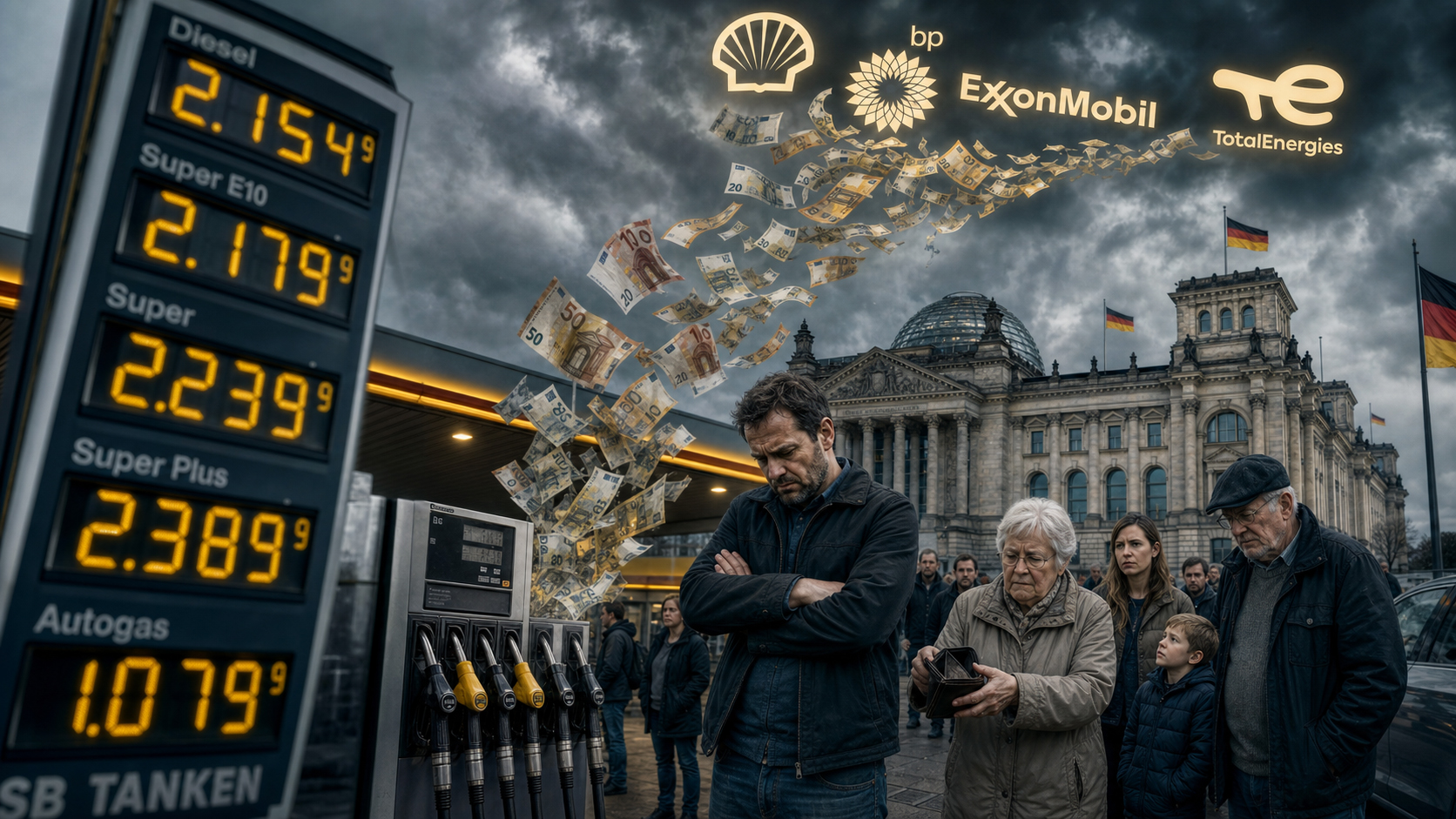
Government fails on fuel discounts: 60,000 illegal price increases – How gas stations simply ignore the new rules – Image: Xpert.Digital
Money for corporations, empty promises for citizens: The bitter truth about tax relief policies
Government fails on fuel discount: New fuel discount fizzles out – How the state allows itself to be led by the nose by oil companies
Euro flop at the gas pump: Why your relief money never reaches you
Okay, you certainly don't have to be a fan of the new energy policy, nor do you have to dislike the current government's apparent resistance to advice. But if this supposedly "expert" government, along with its highly decorated economic specialists, can't even implement a simple "fuel discount" flawlessly, then it reveals a profound systemic problem. This ruthlessly exposes the full extent and the real reason for the widespread distrust and deep-seated insecurity currently gripping the German population. Anyone who distributes billions in tax revenue through the free market and naively hopes that corporations will pass this on to consumers out of pure altruism isn't pursuing policies for the people – they're denying reality. The tax relief policy of 2026 isn't just an oversight; it's a predictable disaster waiting to happen.
When the state deceives itself: The structural logic of the failure to provide relief in Germany
Billions for the citizens – which disappear along the way
The fuel discount isn't a glitch. It's a symptom. What was observed at German gas stations in May 2026, when prices climbed again shortly after the tax cut took effect, has a history stretching back at least four years – and a pattern that extends far beyond fuel prices. To understand why the German public's trust in politics has plummeted to historic lows, one doesn't need to look for spectacular corruption scandals. One simply needs to understand how tax relief policies in Germany structurally function: money is channeled through the market with the hope that it will reach its intended recipients. It doesn't. And nobody is truly surprised.
The fuel discount in 2026: Predicted, realized, unabated
On May 1, 2026, the German Bundestag reduced the energy tax on fuels by 14.04 cents per liter for a period of two months. Including the elimination of value-added tax, this resulted in a theoretical gross relief of up to 17 cents per liter. Calculated for a 50-liter tank, this would have meant a saving of €8.50 – a significant sum for many households, especially given the dramatic increase in energy prices due to the Iran-Iraq War at the beginning of 2026.
What actually happened in practice was a different story. As early as May 3, 2026, just a few days after the fuel discount came into effect, the actual savings, according to an analysis by the ADAC (German Automobile Club) and the Federal Cartel Office, amounted to only 10.9 cents per liter for Super E10 and 11.1 cents per liter for diesel. Six cents per liter remained in the system – not for the consumer. The head of the Cartel Office, Andreas Mundt, put it in his unusually clear, official style: The oil companies were at best trustees of this savings; it wasn't intended for them, it had to reach the customers. A warning. Not a sanction. No intervention. The companies reacted to these words the way free markets react to warnings: They ignored them.
Even before the fuel discount came into effect, the ADAC (German Automobile Club) had issued a warning, and the first fuel discount in 2022 had already shown that, even with a generous interpretation, the pass-through was incomplete. A 2022 study revealed that for gasoline (E10), only about 71 percent of the tax reduction was passed on to end customers, while for diesel, the figure was a more substantial 87 percent. Furthermore, the effect tended toward zero towards the end of the discount period. Anyone who launched a new attempt with the same instrument in 2026, expecting better results, deliberately ignored this data.
The anatomy of market failure: Why tax cuts go to waste
That tax cuts in oligopolistic markets don't necessarily benefit the end consumer is no secret of economics; it's fundamental knowledge. As early as February 2025, the German Federal Cartel Office, in its final report on the sector inquiry into refineries and fuel wholesalers, concluded that the conditions for effective competition in the German petroleum sector are challenging. There is a high degree of import dependency for crude oil, the markets are characterized by vertical integration and mutual dependencies among petroleum companies, and there is a high level of market transparency at all levels of the value chain. Paradoxically, this transparency doesn't promote competition but rather facilitates coordinated pricing behavior among market participants.
In a functioning competitive market, a tax cut would indeed be passed on to consumers through the price-cutting mechanism: if a supplier keeps the tax rebate instead of passing it on, they lose customers to cheaper competitors until equilibrium is restored. In the German fuel market, with its few dominant players, this mechanism functions only to a limited extent. While price transparency through apps and comparison portals exists, it hasn't changed the fundamental market structure. A rebate that isn't passed on remains an additional profit margin – as long as all competitors behave similarly.
According to its own statement, the Federal Cartel Office has not yet used the legal options for direct intervention because anti-competitive behavior could not be proven. High profits alone are not sufficient evidence of anti-competitive conduct. This dilemma is structural: The legislature has created a system that nominally protects consumer interests, but makes effective enforcement contingent on evidence that is virtually impossible to provide in an opaque oligopoly.
The 12 o'clock rule and its next failure: regulation without bite
In parallel with the energy tax reduction, the German government attempted to achieve greater price stability and transparency at German gas stations by implementing the so-called 12 o'clock rule, modeled on the Austrian system. This rule stipulates that fuel prices may only be increased once a day – at 12 noon. The measure seems sensible: if consumers know that the price will not rise after 12 noon, they can better plan their refueling stops. The idea is simple and has been tested in Austria.
The implementation in Germany proved disastrous. A data analysis by the SWR Data Lab from April 2026 documented around 60,000 suspected illegal price increases nationwide in the first three weeks after the rule was introduced. Around 3,800 gas stations – roughly one in four of the approximately 15,000 German gas stations – violated the regulation at least once since April. In Baden-Württemberg alone, around 11,500 suspected illegal price increases were identified, affecting approximately 700 gas stations.
And this despite the threat of fines of up to €100,000. The result shows what happens when regulations exist on paper but are implemented without an effective enforcement infrastructure. Gas station operators apparently realized quickly that the likelihood of actual sanctions was low. While the government task force called for sanctions, the responsible authorities remained unclear. This is no oversight. It is the result of a regulatory philosophy that prefers warnings to action.
The €1,000 relief bonus: History repeats itself
In April 2026, the German government under Chancellor Friedrich Merz announced another relief measure: employers would be able to pay their employees a tax- and contribution-free bonus of up to €1,000 – in response to the increased energy and mobility costs resulting from the Iran-Iraq War. The concept is familiar. It follows the exact same model as the inflation adjustment bonus introduced by the previous coalition government in 2022, which allowed for tax- and contribution-free payments of up to €3,000.
The weakness of this instrument lies in its very design: the payment is voluntary. The state forgoes tax revenue – the government anticipates a shortfall of around €2.8 billion – and hopes that employers will actually distribute the money to their employees. The Confederation of German Employers' Associations (BDA) promptly issued sharp criticism: many companies simply could not afford such a payment – even if they could deduct the costs as business expenses. The German Association of Small and Medium-Sized Businesses called it an outrage to sell such an idea to employees during a crisis and thereby shift new burdens onto companies.
Chancellor Merz himself downplayed the measure as a mere relief offer that could be used in full, in part, or not at all. He could hardly have provided a more honest description of the problem: The government is creating an option whose use depends entirely on the goodwill of employers. The money will only arrive if companies are willing and able to pass it on. Both of these things are unlikely in many cases.
A glance at the previous measure should have sufficed. According to surveys by the Institute for Macroeconomics and Business Cycle Research (IMK), the inflation compensation bonus introduced by the governing coalition reached approximately 26 million employees – primarily those in large, unionized companies that were able to secure the bonus through collective bargaining. Small businesses, those in precarious employment, and many medium-sized enterprises remained structurally disadvantaged. The distributional effect of the voluntary bonus was anything but uniform. Anyone who ignores this experience and implements the same instrument again is not practicing a policy of learning; they are engaging in wishful thinking.
Excess profit tax: Those who profit don't pay
While tax cuts and voluntary bonuses failed to provide the hoped-for relief, the Iran-Iraq War in early 2026 led to crude oil prices temporarily exceeding $120 per barrel, resulting in exceptionally high profits for oil companies. Three German states – Bremen, Hamburg, and Mecklenburg-Western Pomerania – submitted a proposal to the Bundesrat (Federal Council) to introduce a profit tax on oil companies. Federal Finance Minister Lars Klingbeil had such a tax examined and had explicitly stated in his reform agenda of March 25, 2026, that he intended to limit the excess profits of energy companies and use the revenue for tax relief.
Economics Minister Katherina Reiche's response was unequivocal: she firmly rejected the excess profits tax, citing constitutional concerns. This argument is neither new nor entirely untenable. Indeed, introducing an excess profits tax is legally complex, as it retroactively imposes a special levy on companies that was unforeseeable at the time of the economic decision. However, following Russia's war of aggression against Ukraine, the EU had already introduced a temporary energy crisis contribution in 2022, which was essentially an excess profits tax. According to the Federal Ministry of Finance, Germany collected almost two billion euros from this regulation in 2022, and another 465 million euros the following year.
The instrument exists, it has been legally tested, and it works. Nevertheless, the Minister of Economic Affairs rejected it. The economic logic behind this is clear: If companies generate crisis profits through exogenous shocks—that is, through events they neither caused nor brought about through their own efforts—then the state has fundamentally legitimate grounds to partially recoup these extraordinary profits and use them for relief measures. Those who earn billions through war have no normative right to the unrestricted receipt of these funds.
Our EU and German expertise in business development, sales and marketing

Our EU and German expertise in business development, sales and marketing - Image: Xpert.Digital
Industry focus areas: B2B, digitalization (from AI to XR), mechanical engineering, logistics, renewable energies and industry
More information here:
A thematic hub offering insights and expertise:
- Knowledge platform covering global and regional economies, innovation and industry-specific trends
- A collection of analyses, insights, and background information from our key areas of focus
- A place for expertise and information on current developments in business and technology
- A hub for companies seeking information on markets, digitalization, and industry innovations
Lost trust: How failed tax relief measures endanger democracy
The invisible victims: Those who are not included in relief programs
The analysis so far already reveals structural weaknesses in German tax relief policies. Even more serious, however, is whom these policies systematically exclude. Both the fuel discount and the €1,000 bonus are based on the implicit model of a commuter with a private car and a social security-paying employee with an employer who is able and willing to pay bonuses. This model describes a relevant, but by no means representative, segment of German society.
Unemployed people, students, the self-employed, and pensioners generally do not benefit from the tax relief bonus – they simply don't have an employer who could pay them a bonus. The Iran war drove up oil prices; via rising fertilizer and logistics costs, this ultimately ended up on supermarket shelves. The DIW (German Institute for Economic Research) has calculated these transmission mechanisms in several analyses. The Institute for Macroeconomics and Business Cycle Research noted that single parents and couples with low and middle incomes are somewhat more burdened by the oil price increase than single people and families with high incomes, because fuel costs represent a larger share of their purchasing power. However, the government's tax relief measures are not effective for those most affected.
The situation is particularly problematic for employees in small and medium-sized enterprises (SMEs). Steffen Kampeter, CEO of the Confederation of German Employers' Associations (BDA), openly admitted that significantly fewer companies will pay the new bonus than did with the inflation adjustment bonus – and even then, coverage was far from comprehensive. Low-wage earners in small businesses are doubly disadvantaged: they bear the brunt of rising costs and receive the least from the compensation measures.
The principle of hope: When economic policy relies on voluntary action
From a regulatory perspective, Germany's tax relief policy of 2026 reveals a fundamental misunderstanding of how markets function. Markets are not welfare institutions. They respond to incentives and sanctions, not to appeals. When the state urges oil companies to voluntarily limit their profits, it has the same effect as appealing to speeders to slow down – without speed enforcement, without fines, without license suspension.
The principle underlying the Merz government can be precisely described: Taxpayer money is channeled to corporations, and it is hoped that they will be willing to pass these funds on to the population. The tax cut is intended to have an effect on oil companies. The bonus option is intended to have an effect on employers. Both presuppose institutionally enshrined altruistic behavior, which has no structural basis in the history of the market economy. Companies maximize profits within the framework of legal regulations. This is not a moral failing, but rather the functional description of a market participant. Anyone who builds tax relief policies on this foundation is building on sand.
The comparison with Austria is revealing in this context. The 12 o'clock rule originates from the Austrian model – but it functions there under different institutional frameworks, with a different enforcement architecture and a different regulatory tradition. Importing regulations without transferring institutions is a recipe for failure. Germany doesn't lack regulatory ideas; it lacks the resolve to actually implement them.
The trust deficit: When the population has stopped believing
The political and economic consequences of this rhetoric of relief without any actual relief are measurable and serious. According to a survey conducted by the market and social research institute INSA in March 2026, the vast majority of Germans – 56 percent – have completely lost trust in German politics. Compared to 2021, this represents an increase of 14 percentage points. Three out of five German citizens are looking ahead to 2026 with apprehension. The eGovernment Monitor 2025 revealed that only 33 percent of the population still trusts the state's ability to act.
Ipsos data from April 2026 is even more sobering: Only 26 percent of Germans trust the government to act in the best interests of the population, while 41 percent have no confidence in it. Seventy percent of those surveyed do not believe that the current coalition government is up to the challenges of the coming years – a new low, five percentage points lower than the previous month. And the Foundation for Future Studies documented that 89 percent of the population expects a further decline in trust in politics.
These figures are not an expression of political capriciousness. They are the rational response of a population that has observed for years how announced measures fail to deliver their promised results. Anyone who saw how the initial fuel discount in 2022 didn't fully materialize; anyone who witnessed small businesses unable to meet the demands of the inflation adjustment bonus; anyone who now recognizes the same pattern with the 2026 fuel discount and the 12 o'clock rule – has every reason for skepticism, not for trust. This mistrust is not irrational. It is empirically well-founded.
Structural causes: Why Germany is failing to provide relief
The problem runs deeper than short-term policy errors. Germany has one of the strongest regulatory systems in the world, but this system is structurally geared towards prevention and procedures, not rapid intervention. The Federal Cartel Office admits that it can only conduct antitrust reviews after the fact. Market abuse, which occurs in real time, cannot be prevented in real time. The enforcement delay is inherent in the system.
Furthermore, there is a fundamental regulatory stance that views government intervention in price formation processes with skepticism – even when these processes occur in markets that structurally lack functioning competition. The German Federal Cartel Office itself documented in 2025 that the fuel market exhibits significant distortions of competition. The logical conclusion would be a fundamental restructuring of this market, not the hope of relying on voluntary codes of conduct.
The geopolitical context exacerbates the problem. The Iran war has once again painfully highlighted Germany's dependence on fossil fuel imports. A country that had diversified its energy mix more rapidly in recent decades would be less reliant on crisis-related price increases on global markets. Fuel rebates are ultimately a tool for damage control in a system structurally based on fossil fuel imports. Sustainable relief cannot be achieved through temporary tax cuts that subsidize profits instead of reducing dependencies.
What would have worked: A look at alternatives
The debate about the right policy approach is not an academic exercise. It has immediate distributional consequences for millions of households. A direct transfer payment to all households below a defined income threshold would have achieved a more precise relief effect than the fuel discount, which disproportionately benefits frequent drivers and owners of large vehicles. A mandatory bonus—that is, one that employers must pay under threat of sanctions—would have had a higher coverage rate than a voluntary measure. A profit tax would have generated revenue that could have been used for targeted relief measures, instead of creating tax revenue shortfalls that have no compelling corresponding effect on consumers.
All three alternatives have their own drawbacks. Direct transfers require a rapid administrative infrastructure. Mandatory premium payments could overburden companies that are genuinely struggling financially. Excess profit taxes are legally complex and can distort investment incentives. But these drawbacks argue for careful design—not for clinging to instruments whose failures have been empirically proven. The selection of relief instruments should be guided by effectiveness criteria, not by ideological reluctance to intervene in market prices.
Relief policy as a structural task
Germany's tax relief policy of 2026 did not fail due to ill will. It failed due to a structural conceptual flaw: the belief that tax breaks in oligopolistic markets and voluntary employer benefits are reliable means of providing relief. This flaw has been documented since the first fuel discount in 2022. It was confirmed by the experience with the inflation adjustment bonus. And it was repeated in 2026 under changed geopolitical conditions, but with the same underlying logic.
The price of this repetition is not only economic. It is social. Every time promised relief fails to materialize, distrust grows. Every time the antitrust authority issues a warning and nothing happens, the image of a state capitulating to corporations is reinforced. Every time segments of society are systematically excluded from relief measures, social divisions deepen. The figures on political disillusionment are no mystery. They are the understandable reaction to a policy that accepts market failure and also leaves the solution to the market – in a cycle that systematically reproduces the very damage it promises to remedy.
Credible tax relief policies do not require ideological revolutions. They require effective instruments, clear enforcement mechanisms, and the willingness to separate the interests of the population from those of corporations when necessary. This is not a political utopia. It is the toolkit that a government owes its citizens—enough to ensure that its promises are kept—has.





