
Agri-PV: Germany's solar problem is not a lack of space, but the inability to use land multiple times
Xpert Pre-Release

Available in 27 languages 📢
Prefer Xpert.Digital on GoogleⓘPublished on: October 1, 2026 / Updated on: October 1, 2026 – Author: Konrad Wolfenstein
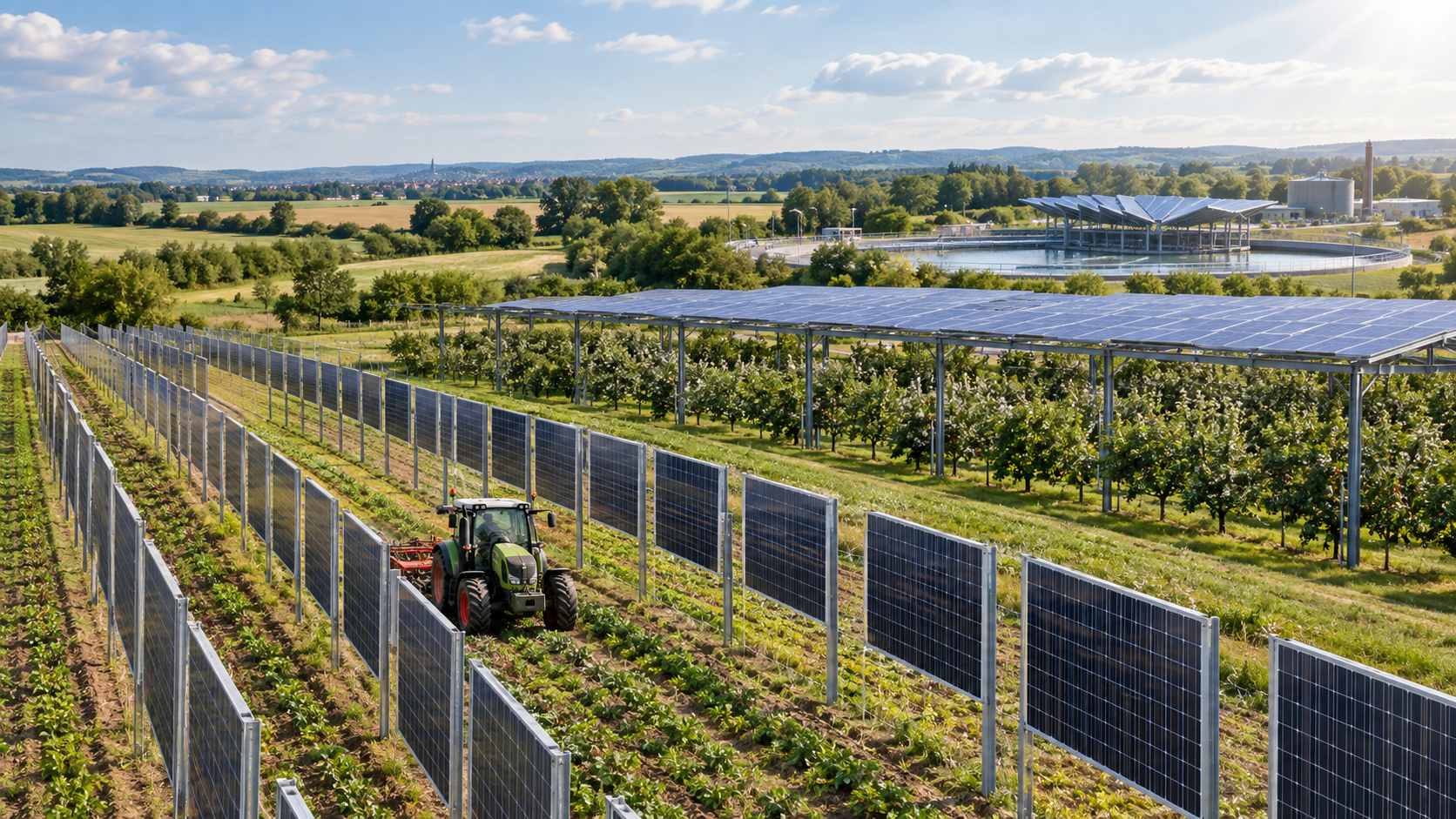
Agri-PV: Germany's solar problem is not a lack of space, but the inability to use land for multiple purposes – creative image on the topic, created with AI: Xpert.Digital
Dual land use: The future of agriculture and energy production
Agri-PV: More than just a solar power system – A new economic concept?
The expansion of photovoltaics in Germany is frequently shaped by the debate surrounding land use and allocation. The clash between different land-use interests – be it agriculture versus energy production or nature conservation versus infrastructure – often leads to a distorted view of the actual possibilities. A promising solution lies in agri-photovoltaics (agri-PV), which combines the primary agricultural use of land with solar power generation. This innovative form of land use not only offers the opportunity to better utilize existing land but also enables simultaneous value creation from agriculture, energy production, and climate adaptation.
With the goal of achieving an installed photovoltaic capacity of 215 gigawatts by 2030, it is crucial to understand the framework and potential for intelligent land-use and energy system planning. Agri-PV is not only part of a technological transformation, but also a response to the growing challenges of land scarcity and increasing energy demand. By using agricultural land for multiple purposes, new income streams can be developed for farmers, and resilience to extreme weather events can be increased. The following sections will comprehensively examine the potential and economic rationale of agri-PV to demonstrate how this technology can contribute to solving the pressing issues of the energy transition.
Agri-PV and innovative solar arrays: The next stage of land economics
In Germany, the debate about expanding photovoltaics is still too often framed as a battle over resources: rooftops versus open spaces, agriculture versus energy production, nature conservation versus infrastructure, and rural areas versus urban centers. Economically, this dichotomy is too simplistic. The crucial question is no longer just how much additional land can be made available for solar installations. The key question is how existing land can be used in such a productive way that agriculture, energy production, climate adaptation, and business use all contribute to added value simultaneously.
Agri-photovoltaics, or Agri-PV for short, exemplifies this shift in perspective. It combines the primary agricultural use of land with the generation of solar power. The spectrum ranges from elevated modules across orchards and specialty crops to vertical rows of modules between field margins. Tracking systems, greenhouse solutions, and structures that can also provide protection against hail, heavy rain, heat, or frost are also included. Simultaneously, other forms of integrated photovoltaics are emerging: solar folding roofs over sewage treatment plants, floating installations on artificial bodies of water, photovoltaics above parking lots, installations on rewetted peatlands, and solar canopies for logistics, transportation, and industrial areas.
These concepts are not merely a technical gimmick on the fringes of the energy transition. They respond to a real economic scarcity. Land is a factor of production, a natural resource, an asset, a planning object, and increasingly a location factor for energy infrastructure. Those who allocate a plot of land to only one function may forgo additional yields, protective effects, and resilience gains. However, the opposite conclusion is also incorrect: not every dual-use solution is automatically economically viable, ecologically sound, or agriculturally sustainable. Success depends on the location, the crop, the type of facility, the grid connection, the financing, and, above all, on the credible continuation of agriculture.
The solar boom is shifting the bottleneck
At the end of 2025, Germany had approximately 117 gigawatts of installed photovoltaic capacity. Around 16.4 gigawatts were added in 2025 alone. The legal target is 215 gigawatts by 2030 and 400 gigawatts by 2040. Therefore, despite the already rapid expansion, a very large additional capacity still needs to be built by 2030. At the same time, electricity demand is growing due to electrification, heat pumps, electric vehicles, data centers, hydrogen production, and the decarbonization of industrial processes.
The bottleneck is therefore shifting. Modules are no longer inherently scarce, and the pure generation costs of photovoltaics have also fallen sharply in the long term. What is becoming scarce, rather, are permittable locations, high-performance grid connections, transformer and substation capacities, local acceptance, suitable project areas, and reliable revenue models. In regions with strong solar expansion, a theoretically excellent location can become economically worthless if the nearest suitable grid connection point is far away, overloaded, or only available after years.
This changes the logic behind site selection. A site with a slightly lower solar yield can be more economically attractive if there is already high operational electricity consumption, a usable grid connection, or a storage system. Wastewater treatment plants, gravel pits, logistics centers, cold storage facilities, irrigation systems, greenhouses, and food processing plants are therefore particularly interesting. They combine available space, energy demand, and often existing technical infrastructure. The value of a solar power system then derives not only from the kilowatt-hour fed into the grid, but also from avoided electricity procurement costs, reduced peak loads, improved self-sufficiency, and less dependence on volatile energy prices.
Agri-PV is thus part of a broader context. It represents a transition from simply searching for land to intelligent land and energy system planning. The most economically viable project is not necessarily the one with the highest installed capacity per hectare. It is the project that best integrates the electricity profile, grid, land use, agricultural production, and risk structure.
Dual use changes the land yield
Conventional ground-mounted photovoltaics typically maximize electricity production per hectare and minimize costs per installed kilowatt. Agri-PV pursues a different optimization goal: to enable high solar yields without displacing the primary agricultural use. This usually results in lower electrical power density, while construction, planning, and management become more complex. However, this is offset by increased agricultural revenue, potential environmental protection benefits, and higher combined land productivity.
For economic evaluation, it is therefore insufficient to simply compare the levelized cost of electricity (LCOE). A more meaningful approach is to consider the total return on investment (ROI) of the land. This includes the contribution margin from agricultural use, the value of electricity production, lease or equity income, energy cost savings, avoided damage, and additional expenses for machinery operation, maintenance, insurance, and documentation. The option value also plays a role: Land that remains usable for agriculture retains more adaptability than land whose economic function is entirely dedicated to electricity generation.
So-called land-use efficiency can increase significantly in well-designed systems. Practical and scientific studies show that combined systems can achieve an area efficiency of approximately 160 percent, and even higher in favorable cases, compared to spatially separated production of agricultural products and solar power. This does not mean that 100 percent of the reference agricultural yield and 100 percent of the maximum possible solar yield are achieved on the same area. The benefit arises from the sum of two reduced, but simultaneously delivered, outputs.
This logic is particularly relevant for regions with high land prices, small-scale agriculture, or significant land pressure. It can also be beneficial where specialty crops already require protective structures. If a fruit farm would have to install hail nets, rain protection, or shading, a photovoltaic system can combine several investment objectives. In such cases, agri-PV competes not only with inexpensive ground-mounted systems but also with the costs of conventional protective systems and the economic risk of weather-related crop failures.
The potential is greater than the market
The purely technical scale of agri-PV is enormous. For Germany, an installable potential of several thousand gigawatts has been identified when considering large portions of the fundamentally suitable agricultural land. Even with strict spatial and environmental restrictions, a theoretical potential of approximately 5,600 gigawatts remains. If only particularly suitable sites are considered, around 500 gigawatts are still conceivable. This figure exceeds the entire German photovoltaic target for 2040.
However, such potential figures should not be confused with realistic market expansion. Technical potential answers the question of where a plant could, in principle, be located. It says little about whether a grid connection is available, whether the landowners agree, whether the local community supports the project, whether financing is viable, or whether agricultural use can be sensibly organized over decades. Supply chains, skilled workers, transformers, permitting capacities, and regional expansion limits also act as constraints.
That's precisely why the figure of 500 gigawatts is interesting. It doesn't suggest that Germany should develop its fields across the board. Rather, it shows that there's no need to force development on unsuitable or conflict-prone sites. Even a small selection of the best areas could make a significant contribution. An economically sound strategy would therefore have to prioritize quality over sheer quantity of land: good grid connections, suitable crops, high conservation value, clear management practices, minimal impact on the landscape and soil, and fair local value creation.
The potential varies considerably from region to region. Bavaria, with its large agricultural area, has particularly high technical potential. Lower Saxony and Bremen also have large areas suitable for this purpose. For Baden-Württemberg, the absolute number of hectares is less important than the combination of specialty crops, high agricultural value creation, innovative farms, and industrial electricity demand. In southern Germany, fruit, wine, and vegetable production, agri-PV can offer greater added value than in locations where robust arable crops are cultivated without irrigation or special weather protection.
Not all agri-PV systems are the same
The term agri-PV encompasses technically and economically diverse systems. Elevated installations position the modules above the cultivated area. Depending on the height and span, tractors, harvesters, or fruit and vegetable farming equipment can be used beneath the structure. Such systems allow for extensive use of the area under the modules but require more steel, more complex foundations, and higher demands on structural engineering, assembly, and occupational safety.
Ground-level or vertical systems arrange modules in rows between cultivated strips. Vertical bifacial modules generate electricity on both sides and, depending on their orientation, can feed in more power in the morning and late afternoon. This profile can be more valuable than additional generation during the already high midday peak. At the same time, wide access lanes for agriculture are maintained. The installed capacity per hectare is typically significantly lower than that of a conventional ground-mounted system, but the design and operation can be comparatively straightforward.
Tracking systems adjust the module angle throughout the day. They can increase power yield, smooth the feed-in profile, and provide more light to crops during critical growth phases. However, this also increases mechanical complexity, maintenance requirements, and the risk of malfunctions. Their economic viability depends on whether the increased yield and flexible shading justify the additional investment and operating costs.
For specialty crops, the protective function can be paramount. Modules placed over apples, berries, grapes, or vegetables can partially divert precipitation, reduce direct radiation, and protect sensitive crops from hail or sunburn. At the same time, they alter humidity, leaf wetness, temperature, and disease pressure. Therefore, a protective benefit against one weather event can trigger new agronomic risks elsewhere. Successful systems require a site- and crop-specific water and ventilation concept rather than simply a roof.
The truth about costs remains inconvenient
In many cases, agrivoltaics is more expensive than conventional ground-mounted photovoltaics. Depending on the system, height, foundation, area size, and location, the specific investment required can be approximately 15 percent to well over 100 percent higher. Elevated installations require particularly large amounts of material and complex support structures. Smaller pilot plants also suffer from a lack of economies of scale, high planning costs, and individually developed components.
The levelized cost of electricity (LCOE) is often estimated at around 5 to 12 cents per kilowatt-hour, depending on the system and assumptions. This range demonstrates that there is no single, uniform price for agrivoltaics. A large-scale vertical system on well-developed farmland has a different cost structure than a tall structure above fruit trees. Financing costs, solar irradiance, grid connection, soil conditions, steel prices, module density, maintenance, and service life all significantly influence the outcome.
The greatest danger lies in a flawed comparison. If an expensive agri-PV system is measured solely against a cost-effective ground-mounted system, it often appears unattractive. However, if factors such as avoided hail nets, reduced irrigation requirements, more stable yields, on-site consumption, potential direct payments, and continued agricultural use are taken into account, the picture can change. Conversely, a project should not be artificially inflated with additional benefits that are difficult to substantiate. An assumed protective value is only economically sound if weather risks, damage history, insurance premiums, and actual impacts are quantified.
Economies of scale play a crucial role. Specific costs often decrease significantly in the smaller, hectare-sized projects because planning, grid analysis, expert reports, and site setup are spread across a larger area. However, very large installations are not automatically optimal. As the area increases, so do the requirements for grid connection, landscape compatibility, and public acceptance. Furthermore, excessive standardization can lead to agriculture being adapted to the solar power plant, when it should be the other way around.
Agricultural yield is not a constant
The effect of shading depends heavily on the crop, soil, water availability, and annual weather conditions. Trials with winter wheat, potatoes, celery, and clover grass show that agri-PV can stabilize yields in hot and dry years or even increase them in some crops. However, in years with high rainfall, the same systems can cause yield losses. For fixed, elevated installations, losses of up to 20 percent have been observed for certain crops and years.
This fluctuation is not a counterargument, but rather the core of the agricultural economic evaluation. The value of agri-photovoltaics may lie less in a consistently higher average yield than in reduced vulnerability to extreme years. For a farm, a more stable contribution margin can be more valuable than a higher but highly fluctuating average. This is especially true for specialty crops with high production costs and a high potential for damage.
Shading reduces direct radiation and can limit evaporation and soil heating. This is advantageous in dry summers, but can negatively impact growth, drying, and plant health during cool, damp periods. Spatial distribution is also important. Different conditions arise under rows of modules than in the spaces between them. This results in different ripening times, soil moisture levels, and working windows. Agricultural processes can therefore become more complex, but at the same time, they also open up new possibilities for targeted irrigation and differentiated management.
Therefore, from an economic perspective, individual trial years should not be generalized. Multi-year scenarios with dry, average, and wet years are necessary. For each crop, yield, quality, price, labor input, and failure risk must be considered. A lower yield can be partially compensated for by better quality or a longer marketing period. Conversely, a nominally stable harvest volume can be economically less profitable if sorting, crop protection, or harvest organization become more expensive.
New: Patent from the USA – install solar parks up to 30% cheaper and 40% faster and easier – with explanatory videos!

New: Patent from the USA – Install solar parks up to 30% cheaper and 40% faster and easier – with explanatory videos! - Image: Xpert.Digital
The core of this technological advancement is the deliberate departure from conventional clamp mounting, which has been the standard for decades. The new, more time- and cost-effective mounting system addresses this with a fundamentally different, more intelligent concept. Instead of clamping the modules at specific points, they are inserted into a continuous, specially shaped support rail and held securely in place. This design ensures that all forces – whether static loads from snow or dynamic loads from wind – are distributed evenly across the entire length of the module frame.
More information here:
Innovative approaches to land use in agriculture
The standard only protects agriculture on paper
DIN SPEC 91434 distinguishes agri-PV from conventional ground-mounted systems and sets requirements for the primary agricultural use. For elevated systems, the loss of agriculturally usable land must not exceed 10 percent, and for ground-level systems, it must not exceed 15 percent. The agricultural yield across the entire project area should reach at least 66 percent of a defined reference yield. Additional requirements include workability, light and water availability, and an agricultural utilization concept.
These criteria are important, but they don't replace good project practice. A yield of 66 percent may be formally sufficient, but economically unattractive for the operation. Similarly, a system can comply with permissible area losses and still worsen working widths, turning maneuvers, or harvesting logistics. What matters is not just how much area is nominally retained, but whether it can be cultivated safely and efficiently with the available machinery.
The agricultural land-use concept must therefore be more than just a permit document. It should map crop rotation, machinery, tramlines, headlands, drainage, irrigation, cable routes, foundation positions, dismantling, soil protection, and responsibilities throughout the entire project duration. Since solar power plants are planned for several decades, the concept must also consider farm transfers, leases, and changes in agricultural markets.
A particular challenge lies in long-term monitoring. At the start of a project, the agricultural use can be convincingly demonstrated. More difficult is the question of what happens after ten or twenty years when crops change, a farm is abandoned, or cultivation is reduced due to low agricultural prices. A credible agri-PV policy therefore requires verifiable yet practical evidence. It must not burden farmers with disproportionate bureaucracy, but it must also prevent merely symbolic agriculture from serving as a pretext for installing solar power plants.
The grid connection is crucial before the field even begins
In many potential analyses, the distance to the grid connection point proves to be one of the strongest limiting factors. This is economically plausible. Long cable routes, crossings, new transformer stations, or the expansion of a substation can account for a significant portion of the project costs. Even more problematic is the uncertainty surrounding the timeline. A project may be technically planned and eligible for approval, but without a binding grid connection plan, it may not receive financing.
This point is particularly important for agri-PV because the system can already bear higher investment costs compared to simple ground-mounted PV. Additional grid connection costs can quickly jeopardize profitability. Project developers should therefore not secure land first and then look for a grid connection. A more sensible approach is an integrated preliminary assessment that considers grid capacity, consumption profile, storage options, and site suitability.
Local self-consumption can reduce dependence on the grid. Farms need electricity for cooling, ventilation, milking, drying, pumping, processing, and increasingly for electric vehicles or heat generation. However, consumption and solar production don't automatically align. Grain drying with seasonally high demand can be well-matched to summer generation, while other loads vary over time. Storage increases self-consumption but incurs additional costs and losses.
Energy partnerships in rural areas are particularly interesting. An agri-PV project can supply neighboring cold storage facilities, dairies, industrial parks, data centers, or municipal facilities via direct supply contracts, provided the legal and grid-related requirements are met. This transforms an isolated generation plant into a regional energy system. The economic benefits then arise from the combination of predictable consumers, long-term pricing, and reduced grid load.
Revenues must be based on multiple pillars
A viable agri-PV business model should not depend on a single revenue stream. Electricity can be generated through long-term supply contracts, market premium schemes, direct marketing, or on-site consumption. Additional revenue streams include agricultural income, lease payments, equity investments, potential savings on protective systems, and the value of avoided crop losses. Depending on the specific structure, certificates of origin, regional electricity products, or the sustainability requirements of industrial customers may also play a role.
For farmers, the distribution of opportunities and risks is crucial. A simple land lease offers predictable income but allows only limited participation in high electricity revenues. A corporate stake enables higher returns but requires capital and entrepreneurial risk tolerance. Hybrid models combining a minimum lease payment with a revenue-based component can better balance competing interests. It is essential that management difficulties, yield risks, and additional labor are compensated separately.
Owners and operators are not always the same entity. High solar value can alter lease markets and exacerbate conflicts between land ownership and active agriculture. If the majority of the added value flows to external investors and landowners, while the operator bears the operational complexity, the model loses acceptance. Fair contracts must therefore clearly regulate access rights, liability, crop failures, repairs, soil compaction, dismantling, and compensation.
For banks and investors, agrivoltaics (Agri-PV) is more demanding than standard ground-mounted PV. In addition to radiation levels, technology, and electricity prices, agricultural use, operator structure, and long-term land availability must be examined. This complexity can increase financing costs. At the same time, it creates new opportunities for insurers, agricultural banks, energy cooperatives, and specialized project developers. Standardized contracts, reliable yield data, and proven system designs can reduce risk premiums as the market ramps up.
Climate adaptation can become a business model
Agriculture is not only affected by climate protection measures, but increasingly by the physical consequences of climate change. Heat, drought, late frosts, hail, and heavy rainfall increase the fluctuations in agricultural yields. Agri-PV can mitigate some of these risks if the system is specifically planned as protective infrastructure. This gives it a value that remains invisible in a simple electricity bill.
For fruit and berry crops, partial roofing can reduce hail damage and sunburn. In dry regions, shade can lower evaporation and retain soil moisture for longer. Rainwater can be collected at the module edges and channeled into storage tanks or targeted irrigation systems. Combined with sensors, water, light, and electricity production can be actively controlled, transforming the system into a platform for precision agriculture.
However, the benefits cannot be assumed across the board. Inadequate drainage can cause erosion, waterlogging, or uneven soil moisture. Reduced air movement can promote fungal diseases. Foundations and access roads can compact soils. Glare effects, landscape impact, and effects on species must be assessed on a site-specific basis. Biodiversity does not automatically benefit either. It can improve if uncultivated strips are designed as flowering areas and habitats, or it can deteriorate if maintenance, fencing, and construction methods impair ecological functions.
Therefore, planning that defines measurable climate adaptation benefits is economically sound. These include reduced irrigation needs, avoided hail damage, more stable quality classes, and reduced insurance premiums. Only when such effects are documented over several years can they be reliably incorporated into financing and operational planning.
The solar folding roof demonstrates the new logic
A particularly striking example of innovative solar panels is being installed at Vienna's main wastewater treatment plant. A movable, folding solar roof with an installed capacity of 262 kilowatts is being erected over a primary settling tank. Covering an actual roof area of 1,750 square meters, 504 modules are expected to generate approximately 260 megawatt-hours of electricity annually. The structure can be extended or retracted in about 30 seconds, allowing access to the tank below for maintenance and cleaning.
The system also reacts automatically to strong winds, hail, and heavy snowfall. Its clearance height is 4.35 meters, its overall height is 6.3 meters, and it weighs approximately 57 tons. The investment of around €1.3 million equates to almost €5,000 per installed kilowatt, significantly exceeding the specific costs of a typical ground-mounted solar power plant. This would be difficult to justify as an isolated, standard power plant. However, as a pilot project on an operationally essential and otherwise largely unusable infrastructure area, the project follows a different logic.
The economic value lies in demonstrating that a wastewater treatment basin can be used for electricity production without restricting its primary function. Approximately 46,000 square meters of basin surface on the site are considered fundamentally suitable. If the pilot project's output could be proportionally scaled up, this would theoretically result in an annual solar power production of roughly 6.8 gigawatt-hours. Such a projection does not constitute an investment commitment, but it does illustrate the potential for scaling.
Wastewater treatment plants are particularly attractive locations because they require a continuous supply of electricity, have a skilled technical workforce, and often possess large, open processing areas. Solar power can be used directly on-site. This reduces marketing risks and increases the value of every self-consumed kilowatt-hour. At the same time, this example demonstrates that integrated photovoltaics can initially be more expensive. Its competitiveness arises from learning curves, mass production, avoided land costs, and the value of the retained primary use.
Water, moors and parking lots are being turned into power plant areas
Floating photovoltaics utilize artificial lakes, gravel pits, open-cast mining lakes, and, in some cases, reservoirs. Germany has more than 6,000 artificial lakes with a surface area of at least one hectare, totaling approximately 90,000 hectares of water surface. Depending on assumptions regarding occupancy and orientation, the technical potential is in the tens of gigawatts. With an occupancy limit of 15 percent of suitable water surfaces, potential output is estimated at around 13.7 to 19.1 gigawatts.
Waters used for industrial purposes are particularly attractive. Gravel pits and other businesses can consume the electricity directly and some already have grid connections. At the same time, anchoring, waves, ice, corrosion, ecology, and accessibility pose special challenges. The economically viable portion of the technical potential is therefore significantly smaller. Here, too, the most interesting projects are not necessarily located on the largest lakes, but rather where water surface area, electricity demand, and infrastructure are ideally suited.
Parking lot PV follows the same logic. Already sealed surfaces are utilized, vehicles receive shade and weather protection, and charging infrastructure can be directly integrated. The technical potential of German parking lots is estimated at around 59 to 60 gigawatts. However, solar canopies are significantly more expensive than simple rooftop or ground-mounted systems because the supporting structure, impact protection, drainage, lighting, and traffic safety measures incur additional costs. For supermarkets, logistics centers, amusement parks, and company parking lots, the combination of on-site energy consumption, charging options, and convenience can nevertheless justify the higher price.
Peatland photovoltaics (PV) combines electricity generation with the rewetting of drained peatlands. The climate potential is significant because drained organic soils release large quantities of greenhouse gases. Photovoltaics can enable economically viable use while raising the water level and protecting the peat. However, the technology is still in its early stages. Foundations, cables, maintenance access roads, and vegetation management must function with high water levels. Near-natural and ecologically valuable peatlands must not be used for solar power; the focus should be on already drained and severely degraded areas.
Acceptance is an economic factor of production
Projects rarely fail solely due to technical issues. Resistance arises when people perceive that the landscape and local infrastructure are being burdened while profits flow to distant investors. Agri-PV generally enjoys an advantage in terms of acceptance because agriculture remains visibly intact. However, this advantage is lost if the dual use is merely a formality or if the installations resemble closed industrial parks.
Early participation is therefore not a mere communicative add-on, but an integral part of project management. Municipalities need clear information about business taxes, municipal involvement, access roads, fire safety, demolition, and landscaping. Agricultural businesses need to understand how their workflows will change. Residents want to know about the resulting sightlines, glare effects, and construction traffic. Transparent planning reduces later delays, lawsuits, and costly redesigns.
Regional ownership models can improve the distribution of added value. Citizen-owned energy projects, municipal participation, local electricity products, or collaborations with public utilities create a direct link between the plant and the region. The crucial factor is not that every project is entirely financed locally. What is crucial is that a verifiable share of the economic benefits remains in the region.
Information and demonstration days in agriculturally dominated regions like the Memmingen area are therefore more than just public relations. Agri-PV can only be explained to a limited extent using plans. Machine widths, shadow patterns, soil cultivation, cable protection, and harvesting processes become understandable when looking at actual installations. The transfer of knowledge between agriculture, project development, municipalities, banks, and grid operators can prevent planning errors and professionalize the market.
New business models are emerging across industries
Agri-PV is shifting value chains. Farms are becoming energy producers or energy partners. Solar companies need to develop agronomic expertise. Machinery manufacturers require solutions for tramlines, sensors, and automated farming. Insurers must assess combined weather, yield, and technology risks. Municipalities and grid operators are becoming more involved in site and infrastructure decisions.
Integrated solutions are particularly promising. A single provider can supply the supporting structure, modules, irrigation, rainwater management, sensors, and operating software as a complete system. Digital models can optimize shading, plant growth, energy yield, and machine deployment simultaneously. Artificial intelligence can utilize weather forecasts, electricity prices, and agronomic data to control movable modules. The market value then lies not only in the hardware but also in the planning, data, and ongoing optimization.
Opportunities also arise for industry and commerce. Food companies can combine long-term electricity supply contracts with regional producers and simultaneously promote more resilient supply chains. Retailers can combine parking lot solar panels, charging infrastructure, and cooling power. Wastewater treatment plants, waterworks, and waste disposal companies can activate previously unused process areas. Logistics companies have large roof, yard, and parking areas, as well as a growing electricity demand for electric fleets.
This also creates an industrial policy field for Germany and Europe. Supporting structures, tracking systems, power electronics, control systems, specialized modules, and planning software offer differentiation opportunities beyond standardized module production. The competitive advantage lies in system integration, reliability, and the ability to develop complex sites economically.
The greatest risks lie between the areas of responsibility
Agri-PV projects intersect with building, energy, agricultural, environmental, and tax law. These interfaces create uncertainty and transaction costs. A system may be economically viable from an energy perspective but fail due to planning regulations, environmental impact assessments, or a lack of grid connection approval. Differing interpretations by authorities complicate standardized project development.
In addition, there are long-term operational risks. Solar technology must cope with dust, pesticides, ammonia, irrigation, and agricultural machinery. At the same time, maintenance must not disrupt the harvest. Damage from collisions, cable breaks, or ground movement must be covered by contracts and insurance. For mobile systems, the number of mechanical components increases, and for tall installations, wind loads and installation requirements also increase.
Another risk is the flawed incentive structure. If high additional payments are granted without effective agricultural criteria, systems are created that primarily optimize funding conditions. Conversely, if the requirements are too complex or economically unpredictable, even good projects will fail to materialize. Therefore, subsidies should address measurable additional costs and societal benefits without perpetuating inefficient systems.
Finally, there is a price risk. With increasing solar power output, hours with very low or negative electricity prices on the exchange occur more frequently. Systems with a profile that deviates from the midday peak, high self-consumption, or storage integration therefore gain in value. Vertical east-west systems, tracking systems, and projects integrated with farm operations can offer structural advantages here. Crucially, it is not only the amount of electricity generated, but its market value over time that matters.
The new yield per unit area is decisive
Agri-PV and innovative solar arrays will not displace traditional ground-mounted photovoltaics. They complement it where land is scarce, agricultural value creation is high, climate risks are significant, or existing infrastructure can be used for dual purposes. Their market will grow not only due to falling module prices, but also through improved system integration, reliable regulations, standardized financing, and demonstrable added value.
Economic priority should be given to locations where several advantages coincide: suitable crops, high conservation needs, good grid connection, local electricity consumption, clear ownership structures, and accepted landscape integration. Projects that rely solely on optimistic yield assumptions, uncertain subsidies, or symbolic agriculture are less convincing.
For the energy transition, the greatest strategic value lies in mitigating land-use conflicts. Germany should not have to choose between food production and electricity generation if some land can provide both. Similarly, sewage treatment plants, parking lots, artificial lakes, and degraded peatlands should not be viewed in a one-dimensional way. The crucial innovation is not the individual module, but the ability to preserve existing land functions and expand them to include economically viable energy production.
This also changes the benchmark for successful solar policy. The goal is no longer the maximum installed capacity on any given area, but rather the highest overall economic output per location. This includes electricity generation, agricultural production, climate adaptation, regional value creation, environmental sustainability, and security of supply. Agri-PV is then not a compromise between two uses, but a productivity model for an economy that must achieve more with scarce land.
Your partner for business development in the fields of photovoltaics and construction
From industrial rooftop PV to solar parks and larger solar parking lots
☑️ Our business language is English or German
☑️ NEW: Correspondence in your native language!

Konrad Wolfenstein
I and my team are happy to be available to you as your personal advisor.
You can contact me by filling out the contact form here [email protected]:or simply call me at +49 7348 4088 965. My email address is
I'm looking forward to our joint project.







