
Germany's battery tsunami: How large-scale storage systems are overtaking the energy transition
Xpert Pre-Release

Available in 27 languages 📢
Prefer Xpert.Digital on GoogleⓘPublished on: February 18, 2026 / Updated on: February 18, 2026 – Author: Konrad Wolfenstein
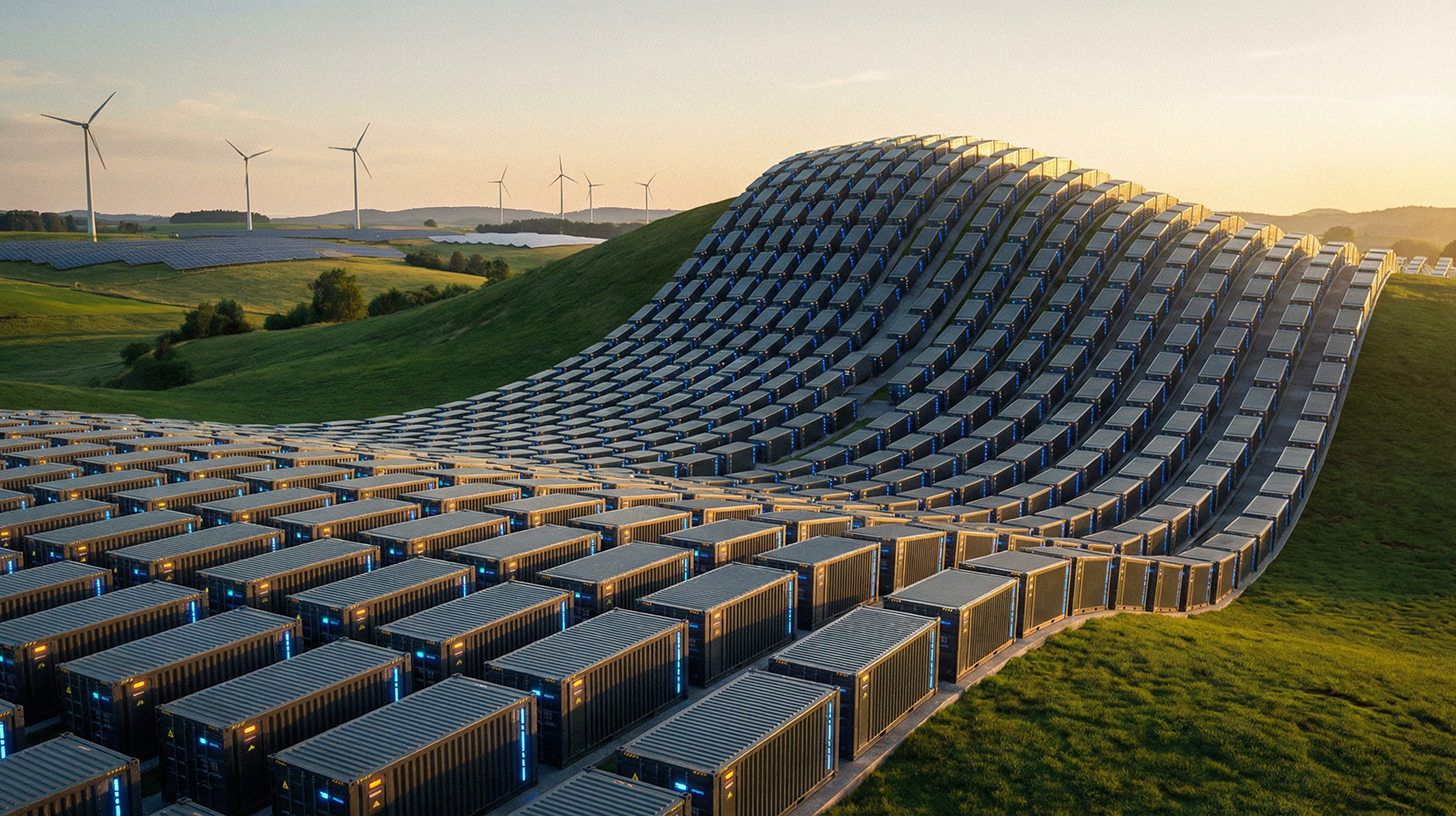
Germany's battery tsunami: How large-scale storage systems are overtaking the energy transition – Image: Xpert.Digital
The 720 gigawatt storage capacity shock, 78 GW already approved: Why the battery wave is overwhelming the German power grid
End of the "dark doldrums"? What the massive expansion of large-scale storage facilities really achieves
Battery price collapse: The underestimated China factor in the German storage boom
For a long time, large-scale battery storage systems were considered an expensive niche solution, a nice "add-on" for sunny days. But in the shadow of protracted debates about power plant strategies and hydrogen networks, a disruptive market dynamic has unfolded, causing disbelief and astonishment in government ministries. The figures are so enormous that they seem abstract: grid connection requests for over 720 gigawatts of storage capacity have been submitted – that's nine times Germany's total annual peak load.
What we are currently witnessing is not a government-mandated ramp-up, but rather a wave of investment driven by a brutal, global market logic. Fueled by an unprecedented price collapse in lithium iron phosphate (LFP) technology and massive overcapacity in China, batteries have suddenly become the cheapest option for grid flexibility. While policymakers were still thinking in five-year timeframes, project developers and investors were already calculating in 15-minute intervals and recognizing the enormous arbitrage profits in the volatile electricity market.
But this unchecked boom is pushing the system to its limits. It raises fundamental questions: How do we manage an infrastructure for which there is hardly any space in the existing grid? How do we prevent speculative “phantom applications” from blocking vital industrial connections? And above all: Can this technological deluge close the gap of the dreaded “dark doldrums,” or are we subject to a collective illusion about the physics of long-term storage? The following text analyzes the anatomy of this battery tsunami, illuminates the tension between regulatory impotence and market-driven innovation, and shows why Germany must radically rethink its energy planning.
Related to this:

When the market calculates faster than politics plans
The year 2025 revealed a technological reality that has yet to be reflected in the German government's strategy papers. Large-scale battery storage systems, long treated as a secondary component of the energy transition, have transformed within just a few quarters into a systemically important infrastructure element. The driving force behind this development is not politics, but rather an economic logic fueled by dramatically falling costs, global mass production, and a growing need for flexibility in the electricity system. What is emerging in Germany is not a gradual shift, but a tectonic shift in the architecture of the energy supply. The figures presented by the German Association of Energy and Water Industries (BDEW) in November 2025 speak for themselves: grid connection applications for large-scale battery storage systems with a total capacity exceeding 720 gigawatts have been submitted to grid operators. This is more than two and a half times Germany's total installed generation capacity of 263 gigawatts. Already committed grid connections amount to at least 78 gigawatts. This figure already exceeds the scenarios of the grid development plan, which projects an installed storage capacity of around 94 gigawatts by 2045. Planning that extends twenty years into the future is thus simply overtaken by the application reality of 2025.
This discrepancy between regulatory planning and market-driven dynamics is at the heart of an energy policy debate that extends far beyond technical details. It raises fundamental questions about the German state's ability to keep pace with technological upheavals and about the architecture of an energy system that is transforming at a speed that no scenario framework could have foreseen.
The political vacuum and its involuntary accelerator
To understand the scope of the energy storage boom, one must consider the political context in which it is taking place. On September 15, 2025, Federal Minister for Economic Affairs Katherina Reiche presented her monitoring report on the energy transition, prepared by the BET and EWI institutes. The 259-page report, entitled "Energy Transition. Efficient. Doing.", analyzed the state of the transformation and culminated in a ten-point plan that emphasized cost efficiency, technological openness, and market mechanisms. However, what was conspicuously absent from this report was a substantial assessment of the role of battery storage. The topic was largely ignored, and even in the Minister's ten-point plan, one searches in vain for a strategic position on large-scale storage. This omission is remarkable because it demonstrates how far political perception had fallen behind technological reality. While Reiche spoke of planning realism and the synchronization of grids and renewable energies, an investment cycle was already unfolding in the market that turned all previous assumptions about the flexibility requirements of the electricity system on their head.
The real surprise of 2025 lies precisely in this gap. The breakthrough of large-scale battery storage occurred not because of, but despite, the political framework. It was not triggered by subsidy programs or strategic industrial policy, but by the sheer arithmetic of falling technology costs and rising revenue potential in the electricity market.
The Cost Slide: Anatomy of a Global Price Collapse
The economic core of the storage boom is the development of costs. Prices for lithium-ion batteries have plummeted in recent years, exceeding even the most optimistic forecasts in their speed. According to BloombergNEF's annual price survey, average global prices for battery packs fell to $108 per kilowatt-hour in 2025, a decrease of eight percent compared to the previous year. In the stationary storage segment, relevant for large-scale batteries, the price decline was even more dramatic: Pack prices dropped to $70 per kilowatt-hour, a decrease of 45 percent compared to 2024. This makes stationary storage the cheapest battery segment overall for the first time.
At the system level, prices for turnkey energy storage systems fell to an average of US$117 per kilowatt-hour globally, a 31 percent decrease year-on-year, according to BNEF. China remains by far the most affordable market, with average system prices of US$73 per kilowatt-hour, while Europe is at US$177 and the US at US$219. The cost advantages of Chinese manufacturers result from a combination of overcapacity in cell production, intense competition, and the consistent shift to lithium iron phosphate (LFP) chemistry. LFP batteries reached average pack prices of US$81 per kilowatt-hour across all applications in 2025, compared to US$128 for the more expensive nickel-manganese-cobalt (NMC) variants.
In China, the center of global battery manufacturing, LFP has established itself as the undisputed standard chemistry. By 2025, LFP cells accounted for 81.2 percent of the Chinese EV battery market, a 52.9 percent increase year-over-year. Market leaders CATL and BYD are driving an innovation cycle with massive investments in research, automation, and capacity expansion, further pushing down the cost curve. BNEF forecasts that the cost of turnkey four-hour energy storage systems could fall to US$41 per kilowatt-hour in China and US$101 in Europe by 2035. These figures mark the transition from a period when storage was a niche technology to one in which it represents the most economically attractive flexibility option in the energy system.
In Germany, the price decline is also evident in the residential storage sector, where costs have fallen from €1,277 per kilowatt-hour in 2013 to an average of €477 per kilowatt-hour in 2025 – a decrease of 63 percent. Between 2023 and 2025 alone, prices dropped by around 41 percent. For large-scale storage systems, where cell costs and system integration costs are more significant than installation costs for end customers, the trend is even more pronounced.
720 gigawatts in the pipeline: Between investment wave and application inflation
The sheer scale of the grid connection applications necessitates a nuanced analysis. The 720 gigawatts of requested storage capacity exceed the transmission grid's annual peak load of approximately 80 gigawatts by a factor of nine. While this figure signals enormous market interest, it must be interpreted with caution. The German Association of Energy and Water Industries (BDEW) itself emphasizes that it represents only a snapshot in time. Transmission system operators point out that many project developers register their storage facilities with multiple grid operators simultaneously, resulting in double counting. It is well known within the energy sector that numerous grid connection requests are essentially trial balloons, lacking a concrete plan, secured land, and a financing strategy.
This is precisely why the Federal Ministry for Economic Affairs and Energy reacted in December 2025 and presented the draft amendment to the Power Plant Grid Connection Ordinance. Large-scale battery storage systems will no longer fall under the scope of the Power Plant Grid Connection Ordinance and thus will not have the same automatic entitlement to a grid connection as power plants. The aim is to prevent the inappropriate allocation of grid connection capacities and to avoid blockages to the detriment of other grid users such as data centers, large heat pumps, and industrial plants.
Tim Meyerjürgens, CEO of TenneT Germany, succinctly summarized the tension: If storage facilities secure all grid capacity today, system-critical gas-fired power plants, industrial facilities, and data centers will be left behind. TenneT alone had received grid connection requests for 181 projects by mid-2025, 131 of which involved battery storage systems. These figures illustrate that the storage boom presents not only a technological but also an infrastructural challenge: The grids are the bottleneck through which all users are simultaneously vying for bandwidth.
Nevertheless, it would be wrong to dismiss the 720 gigawatts as a mere phantom figure. Even if only a fraction of these projects are realized, a storage landscape will emerge that far exceeds all previous plans. The 78 gigawatts already committed alone surpass the scenarios of the grid development plan for 2037 and 2045. According to industry experts, the real market ramp-up is yet to come.
Related to this:

The regulatory dam break: Privileged status and its rapid restriction
A key catalyst for the storage boom was the preferential treatment of large-scale storage systems under building law, which the German Bundestag passed on November 13, 2025. With the introduction of the new Section 35 Paragraph 1 Number 11 of the German Building Code (BauGB), battery storage systems with a capacity of one megawatt-hour or more were classified as privileged projects in rural areas. This means that a development plan is no longer required for their construction, and the approval process is significantly simplified.
The implications of this decision can hardly be overstated. Large-scale battery storage systems depend on proximity to substations and grid connection points, which are typically located in rural areas. Until now, there was no explicit regulation under building planning law, and the permitting process resembled a patchwork of different authorities. The requirement of so-called "site-specificity" was interpreted differently by various agencies, leading to considerable legal uncertainty. The new preferential treatment provides clarity and requires neither grid service nor specific capacity limits.
But this clarity was short-lived. On December 4, 2025, less than three weeks later, the German Bundestag passed the Geothermal Energy Acceleration Act, significantly restricting the original preferential treatment. The broad regulation was replaced by three narrower criteria, including the requirement of spatial coupling to existing energy generation facilities or grid infrastructure. This legislative zigzag course within just a few weeks illustrates the fundamental dilemma: policymakers are attempting to regulate a self-accelerating market process, wavering between enabling and restricting it.
Our EU and German expertise in business development, sales and marketing

Our EU and German expertise in business development, sales and marketing - Image: Xpert.Digital
Industry focus areas: B2B, digitalization (from AI to XR), mechanical engineering, logistics, renewable energies and industry
More information here:
A thematic hub offering insights and expertise:
- Knowledge platform covering global and regional economies, innovation and industry-specific trends
- A collection of analyses, insights, and background information from our key areas of focus
- A place for expertise and information on current developments in business and technology
- A hub for companies seeking information on markets, digitalization, and industry innovations
The storage boom is here, but a strategic danger is often overlooked
Business models in transition: Arbitrage, balancing power and grid relief
The economic attractiveness of large-scale battery storage systems is based on an increasingly diversified revenue model. The classic core business is energy arbitrage: electricity is bought when it is cheap, typically at midday during periods of high solar feed-in at prices between zero and ten euros per megawatt-hour, and sold when it is expensive, for example in the early evening at prices exceeding 160 euros per megawatt-hour. Initial analyses indicate that the switch to 15-minute intervals in the day-ahead market on October 1, 2025, has increased these revenues by around 20 percent, as short-term price fluctuations can now be exploited with greater precision.
In addition, battery storage systems provide balancing power, particularly primary and secondary control reserve. During certain periods in 2025, prices for primary control reserve reached values exceeding €10,000 per week per megawatt, ten times the usual compensation. However, it is foreseeable that margins in the balancing power market will decline as storage capacities expand. This trend is already visible in the UK, and a similar development is predicted for Germany. The future therefore lies in combining several revenue streams, including day-ahead trading, intraday optimization, balancing energy, and increasingly, redispatch services.
A study by the consulting firm Neon Neue Energieökonomik, commissioned by Eco Stor, examined the grid benefits of large-scale batteries and found that grid operators can save three to six euros per kilowatt per year in redispatch costs by operating battery storage systems. This relief currently occurs purely by chance, as batteries react to the uniform wholesale price signal, and grid bottlenecks remain invisible to them. A dynamic redispatch price signal that reflects the regional grid situation could significantly increase this added value. This represents enormous, untapped regulatory potential.
Related to this:

The installed base: Where Germany stands today
Beyond the project pipeline, it's worth taking a look at the actual installed capacity. At the end of July 2025, over two million battery storage systems with a total capacity of around 14 gigawatts and a storage capacity of almost 22.5 gigawatt-hours were installed in Germany. From January to July 2025, over 318,000 new systems were commissioned. The International Economic Forum for Renewable Energies projected around 550,000 new installations for the entire year of 2025, resulting in a total of approximately 2.3 million storage systems with a capacity of 16 gigawatts.
However, the existing infrastructure is dominated by home storage systems, which account for around 80 percent of the capacity. Large-scale storage facilities with a capacity of one megawatt or more accounted for only about 2.35 gigawatts of capacity and just under 2.9 gigawatt-hours of storage capacity by mid-2025. The real leap in the scale of large-scale storage is therefore still to come. For example, EnBW is planning a battery storage facility with a capacity of 0.4 gigawatts and 0.8 gigawatt-hours at the site of the former Philippsburg nuclear power plant – a facility that could theoretically supply 100,000 households for a day. The transmission system operator 50Hertz has already made binding commitments for an additional twelve gigawatts of storage capacity by 2029.
The ecosystem is growing: electric cars, second-life batteries, and bidirectional charging
The dynamics of large-scale energy storage are being amplified by two convergent developments that are transforming the storage ecosystem as a whole. Firstly, the number of electric vehicles is growing, and their batteries can become decentralized flexibility resources via bidirectional charging. According to a study by P3 automotive commissioned by e-mobil BW, around 5.2 million vehicles and as many as 21.7 million vehicles by 2035 will be capable of bidirectional charging, representing 65 percent of the total electric vehicle fleet. LBBW estimates that the integration of electric vehicles into the energy sector could provide an additional capacity of 240 gigawatt-hours, almost as much as all other battery storage systems combined.
On the other hand, a growing market is emerging for second-life batteries, meaning decommissioned vehicle batteries that, after their use in electric cars, still retain 70 to 80 percent of their original capacity and can be reused as stationary storage systems. According to calculations by EnBW, recycled electric car batteries alone could cover up to 35 percent of the total capacity of large-scale storage systems needed in Germany, or up to 67 percent of their power output. With the EU decision to ban the registration of new combustion engine vehicles from 2035 onwards, significant battery capacities are expected to become available for second-life use in the long term.
These developments follow a systemic logic: For the first time, large and small storage systems, stationary and mobile applications are merging into an integrated system. Second-life batteries are significantly more cost-effective than newly produced storage systems, enabling new business models and making energy storage solutions more widely available. The combination of second-life use and subsequent recycling represents a key component of a circular battery economy.
The limits of the battery: Dark periods of low wind and the question of long-term storage
Despite the euphoria surrounding the storage boom, it would be analytically irresponsible to ignore the structural limitations of battery storage. The central challenge is encapsulated in a term that has become a buzzword in the energy policy debate: "dark doldrums." This refers to periods of several days to weeks in which neither wind blows nor the sun shines, and the energy deficit can reach several terawatt-hours.
An analysis by LBBW concludes that periods of low wind and solar power generation lasting longer than 48 hours occur approximately twice a year. In extreme cases, energy deficits of up to 10.6 terawatt-hours can arise, which cannot be bridged by battery storage alone. Even in optimistic scenarios that combine all battery storage in power plants and electric vehicles, as well as pumped-storage hydroelectric plants, the total capacity is just under 600 gigawatt-hours, which would only cover half a day's energy demand.
This illustrates the fundamental physical limitation of battery technology: it is optimally designed for short-term storage in the range of minutes to a few hours, but loses efficiency over longer storage periods. Large batteries achieve efficiencies of around 90 percent, far surpassing hydrogen reconversion with its overall efficiency of only 20 to 25 percent. However, this ratio reverses for storage durations exceeding one and a half days. Approximately 70 percent of the reserve demand in the electricity system falls within storage periods of up to one and a half days, during which batteries are clearly superior. Only from the third day onward does hydrogen gain an advantage.
The optimal technology mix therefore consists of a coexistence of two systems: battery storage for daily flexibility needs, particularly to harness solar power at night, and hydrogen or its derivatives for periods of prolonged low wind and solar output. All reputable studies, whether from Fraunhofer ISE or Agora Energiewende, conclude that a climate-neutral electricity system cannot function at all times without molecule-based long-term storage and dispatchable generators. An analysis by Eco Stor shows that even 60 gigawatts of installed short-term storage can reduce the need for secure backup power by 15 to 20 gigawatts, and by up to 24 gigawatts at 100 gigawatts. This is significant, but it does not eliminate the need for dispatchable reserve capacities for the most critical supply situations.
China's dominance as a strategic risk
One aspect often underestimated in the German debate is the geo-economic dimension of the battery boom. Global battery manufacturing is dominated by Chinese companies. CATL and BYD together control the majority of the world market, and Chinese manufacturers as a whole hold around 69 percent of the global EV battery market. China alone can meet almost the entire global demand for LFP batteries. The total battery capacity in Chinese electric vehicles amounted to 769.7 gigawatt-hours in 2025, an increase of 40.4 percent compared to the previous year.
The low prices are partly due to structural overcapacities in Chinese cell manufacturing, which trigger intense price competition. For German and European project developers, these low import prices are a Segenin the short term, but a strategic risk in the long term. Dependence on a single supply region for a system-critical technology repeats a pattern that has brought Europe painful experience with fossil fuels. Therefore, establishing competitive-scale European battery cell manufacturing remains an industrial policy necessity, even if it cannot achieve the cost advantages of Chinese imports in the short term.
Related to this:

Why regulation and planning need to be fundamentally rethought
The key takeaway from the storage boom is not technological, but institutional. The German energy system has planning instruments, permitting procedures, and regulatory frameworks designed for a world where technologies develop over decades and infrastructure grows in manageable increments. The battery storage market, however, operates at a completely different pace.
If the annual peak load of the transmission grid is nine times lower than the current storage application volume, this demonstrates that the procedures of the existing first-come, first-served system are reaching their limits. The German Association of Energy and Water Industries (BDEW) has called for transparent grid connection procedures that better address the current grid scarcity. Grid capacity has become a scarce resource at high and medium voltage levels, with large-scale batteries, data centers, large heat pumps, and industrial plants all competing for it.
The grid development plan needs a fundamental update to reflect the reality of energy storage. Approval processes require clear criteria to distinguish between speculative applications and serious projects. Introducing registration fees of €50,000, which some grid operators are already implementing, is a first step, but no substitute for a systemic rethink. Furthermore, the introduction of local price signals, such as dynamic redispatch prices, could significantly increase the grid-friendly use of storage and bridge the gap between market logic and system optimization.
Infrastructure revolution from below: What the market has over politics
What the storage boom of 2025 primarily revealed is the power of market-driven transformation. It wasn't a government subsidy program that propelled large-scale batteries to success, but rather the convergence of falling costs, global economies of scale, and an electricity market design that rewards increasing price volatility. In Germany, approximately 2.3 million battery storage systems with a capacity exceeding 25 gigawatt-hours are expected to be installed by the end of 2025. Battery storage capacity has grown by 150 percent since 2023. The cost of stationary storage systems is projected to fall to US$101 per kilowatt-hour in Europe by 2035.
This infrastructure revolution is unfolding at a speed unprecedented in the German planning system. EnBW is building a large-scale battery on the site of a decommissioned nuclear power plant. 50Hertz has made binding commitments to provide connections for twelve gigawatts. Hundreds of projects are in the pipeline. What is being created here is nothing less than a new layer of energy infrastructure that will fundamentally alter the relationship between generation, grid, and consumption.
The resulting task is clear: regulation, planning, and permitting must keep pace with a development that has long since begun. This does not mean that the state should withdraw. On the contrary: a sound regulatory framework that filters speculative applications, rewards grid-friendly operation, promotes long-term storage, and builds European value chains is more urgent than ever. The market has shown that it can accelerate the energy transition. Whether this acceleration is channeled in an orderly manner is the political question of this legislative period.
Your global marketing and business development partner
☑️ Our business language is English or German
☑️ NEW: Correspondence in your native language!

Konrad Wolfenstein
I and my team are happy to be available to you as your personal advisor.
You can contact me by filling out the contact form here or simply call me at +49 7348 4088 965. My email address is: [email protected]
I'm looking forward to our joint project.










