
TenneT, Amprion & Co. | The federal government is investing, yet there is no energy sovereignty: Little control over its own critical infrastructure
Xpert Pre-Release

Available in 27 languages 📢
Prefer Xpert.Digital on GoogleⓘPublished on: February 5, 2026 / Updated on: February 5, 2026 – Author: Konrad Wolfenstein
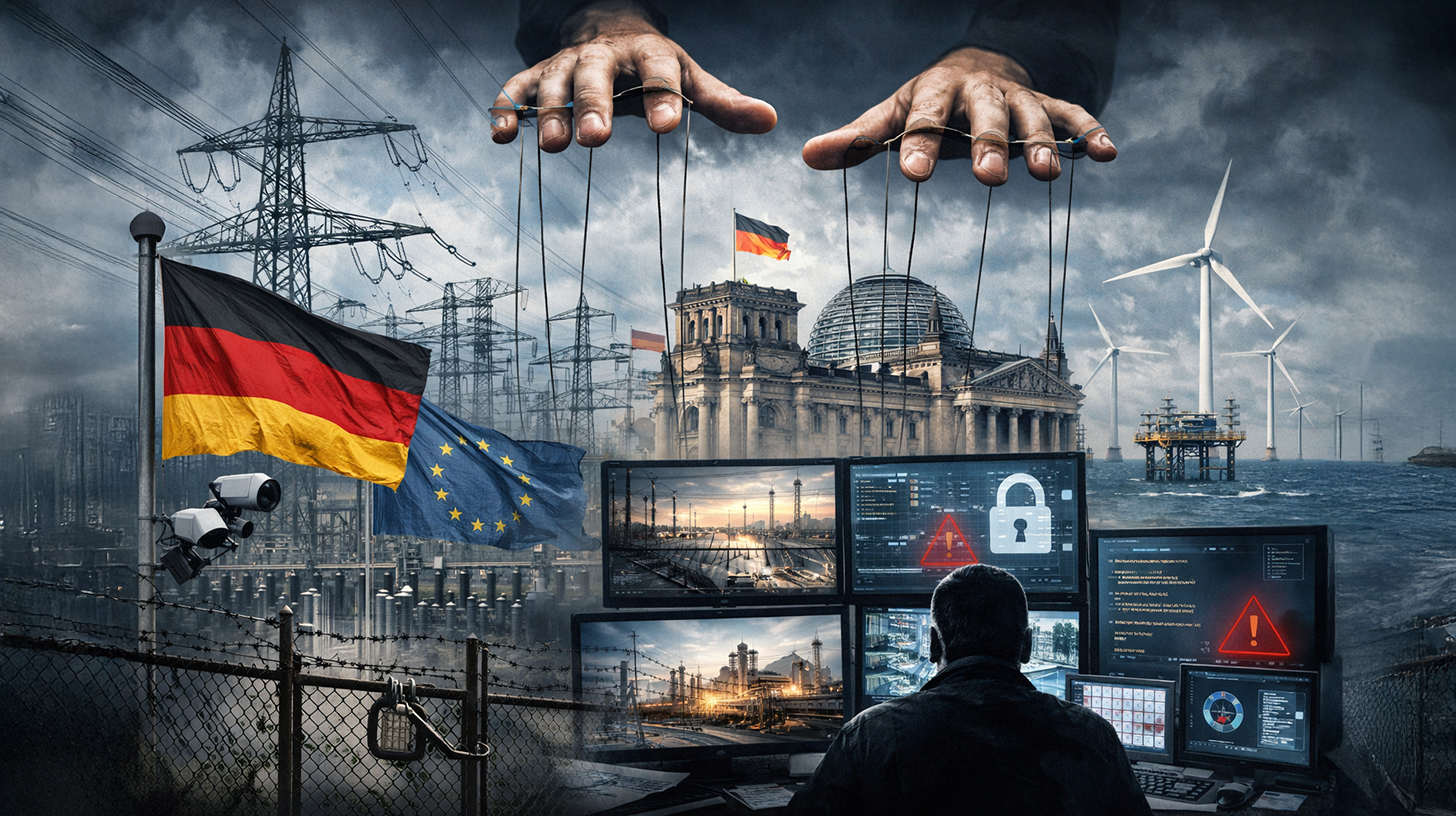
TenneT, Amprion & Co. | Federal government invests, yet no energy sovereignty: Little control over its own critical infrastructure – Image: Xpert.Digital
We pay, while private and international "investors" focused on secure returns collect: The questionable business model behind our electricity grids
Especially when it comes to expanding the power grid, it's crucial to understand that the costs aren't primarily borne by investors, but rather by the state, which secures financing through guarantees, KfW loans, and equity stakes – meaning that, in reality, the German taxpayer is directly involved in the project. While grid operators manage the transmission lines and receive regulated returns, the actual risk and burden of public support lies with the public purse, meaning that the billions of euros in costs for the power grid ultimately rest on the taxpayers' shoulders.
Critical infrastructure? Why our "electricity highways" are hardly under sole national control anymore
“Energy sovereignty” is the buzzword in Berlin right now. The political narrative sounds promising: Through the massive expansion of wind and solar power, Germany is supposed to become independent of fossil fuel imports and take control of its own energy security. But while wind turbines and LNG terminals are the subject of public debate, an inconvenient truth often remains hidden: Control over critical infrastructure – our electricity grids – is hardly solely within national spheres of influence anymore.
Anyone who believes that Germany's energy transition is a purely national project will be disabused of that notion by looking at the ownership structures of the transmission system operators. Whether Dutch state-owned companies, Belgian grid operators, or international infrastructure funds: the "electricity highways" without which there would be no light in Germany are largely in foreign or private hands.
This leads to a bizarre contradiction: While German households and businesses finance the multi-billion-euro expansion through rising network charges, the guaranteed returns often flow to international investors. Politicians talk about independence, but at the same time accept dependence on the country's most important infrastructure.
So who really controls whether and how the electricity flows? How secure is our supply in times of geopolitical tensions and cyber threats, when digital and physical sovereignty no longer unequivocally rests with the state? And why does the rhetoric of "citizen energy" so poorly reflect the reality of the financial markets?
The following analysis reveals who actually owns our electricity grid, why the concept of "sovereignty" is in danger of becoming an empty phrase, and what role the German taxpayer really plays in this global game.
Related to this:

What is meant by energy sovereignty in the electricity grid?
Energy sovereignty in the electricity grid means that a state can decide on its own energy supply without being controlled or coerced from the outside. In Germany, this is primarily expressed through three goals: First, dependence on imported fossil fuels – gas, oil, and coal – should be significantly reduced, ideally leading to a near-complete phase-out. Second, security of supply is emphasized: Electricity should be available around the clock, even in extreme situations. Third, affordability plays a role, meaning the question of how expensive the energy transition will actually be for households and businesses.
At the same time, the energy transition is being promoted as a central instrument of German policy: By 2030, the share of renewable energies in electricity is to be well over 80 percent, and by 2035, almost 100 percent renewable electricity is the goal. This conveys the message that Germany can supply itself with electricity and simultaneously achieve its climate targets.
However, this public narrative often fails to clearly communicate that sovereignty depends not only on the energy source but also very strongly on the infrastructure: Whoever owns the grid, whoever controls the investments, and whoever determines the technological standards and digitalization, also decisively shapes Germany's energy future. The rhetorical narrowing to "energy carriers" obscures the real question of grid control.
Who owns the German electricity grids – and what is the ownership structure?
When it comes to the electricity grid, a clear distinction is important: there is the transmission grid (the "electricity highways" at high voltage, 380, 220, or 110 kV lines) and the much more extensive distribution grids, which transport the electricity to homes, businesses, and power plants. In Germany, the distribution grids make up about 99 percent of the grid, while the transmission grid accounts for only about 1 percent. However, the transmission grid is particularly relevant politically because the high-voltage lines carry the major electricity transport from north to south, and the grids are interconnected across Europe.
The four German transmission system operators – 50Hertz, Amprion, TenneT, and TransnetBW – are regulated monopolies in their respective regions. They are strictly monitored by the Federal Network Agency with regard to network charges, profit limits, and investments. Crucially, however, their ownership structure is predominantly in foreign or international hands.
- TenneT is formally a Dutch company, operating in Germany through TenneT TSO GmbH, which is itself Dutch-owned. The German government holds a minority stake of 25.1 percent in Germany through KfW, but this does not grant it a majority share.
- Amprion was long part of the RWE Group, but today it is an internationally positioned network operator in which RWE still holds shares, while large parts are held by institutional investors.
- In 2018, a majority stake in 50Hertz was sold to a Belgian grid operator; later, shares were transferred to international infrastructure funds. The German government holds a minority stake to retain control over security policy, but does not have a majority share.
- TransnetBW is rooted in Baden-Württemberg, is largely owned by municipal and regional energy suppliers, but institutional investors and state participations also play a role.
This means that operational and economic control over the crucial infrastructure lines is no longer predominantly in German hands, but rather in a mixture of foreign states, private corporations and international investors.
Why does this pose a problem for sovereignty?
If "sovereignty" is understood to mean that a state must be able to determine its own control over crucial resources and infrastructure, then a contradiction arises: The infrastructure through which the energy transition operates is, in fact, largely no longer controllable by the nation-state.
While the Federal Network Agency can set network charges, profit limits, and expansion plans, operational decisions regarding the selection of specific projects, technical standards, the prioritization of certain corridors, and long-term financing strategies are made by internationally owned companies. Furthermore, there is the obligation to comply with EU regulations: network expansion, market rules, LNG terminals, gas network capacities – many decisions are made in Brussels, effectively limiting national capacity to act.
The political rhetoric, however, remains unmoved: governments and parliaments speak of "sovereignty," of independence and national strength, while the ownership structure of the infrastructure hardly reflects this claim. The question you so directly pose is therefore justified: Who actually controls the internet – and whom is this rhetoric meant to protect?
Foreign investors, returns, and the role of the German taxpayer
The economic situation is clear: Germany's electricity grids are attractive to investors because, as regulated monopolies, they offer high revenue security, are practically impossible to abolish, and operate relatively stably in the long term. While the Federal Network Agency does set a yield rate for infrastructure-specific investments, in practice this rate is higher than the pure cost of capital and is designed to allow investors to achieve returns above the market average.
Financing the necessary investments – grid expansion, digitalization, smart grids, new overhead lines, underground cables, and substations – amounts to several hundred billion euros by 2030. The government cannot finance this sum solely from its budget; therefore, the infrastructure is primarily financed through private investors, infrastructure funds, and institutional investors. The costs are collected via grid fees, which are ultimately borne by all electricity customers – households, tenants, small businesses, and also industry.
The resulting structure is clear:
- The state and society assume the risks of the infrastructure (security of supply, security policy, political responsibility).
- The investors and sponsoring companies receive the returns that are "built in" to the network charges.
This is precisely what many critics are annoyed about: German taxpayers and the domestic economy pay for the infrastructure and expansion through electricity prices and taxes, while foreign investors, international funds and individual states pocket the long-term cash flows.
What do politicians actually understand by sovereignty?
The central question is: "What do our politicians understand by sovereignty?" In political practice, sovereignty is predominantly limited to three dimensions:
- Energy supply: No shortage of electricity and gas.
- Energy sources: Fewer fossil imports, more renewables.
- Energy costs: A certain degree of affordability, even if politicians remain rather vague on this issue.
The dimension of "ownership and control over critical infrastructure," however, is not truly central. The German government prevents selected foreign investors, for example from China, from acquiring stakes if it deems them a security risk, and intervenes selectively with equity investments via KfW or other instruments. But a comprehensive return of important parts of the infrastructure to fully national ownership is not a serious topic in the political debate.
Instead, sovereignty is often used as a rhetorical label, while the actual decisions about infrastructure and investments are made within a strongly market- and investor-oriented framework. This leads to an impression that you express very directly: The appeal to sovereignty seems partly naive, partly euphemistic, partly deliberately obfuscating, because the political reality (international investors, foreign owners, EU regulation) does not align with the message of "national control".
Why is the network predominantly in foreign hands?
The answer to the question, "Why is all this the way it is?", lies in historical development and the logic of EU regulation. The separation of generation, grid operation, and distribution was promoted in Europe as part of the liberalization of the energy sector. Large energy companies were required to outsource their grids in order to break monopolies and create more competition.
In Germany, this meant the following:
- The networks were split into separate legal entities.
- These networks were organized as capital market-eligible companies, which were sold through shareholdings.
- The buyers came partly from foreign countries and partly from global infrastructure funds that are looking for precisely such stable, long-term investments.
At the same time, the regulatory framework did not prohibit any foreign investor from investing in Germany. Policymakers preferred to focus on "open markets," investment security, and a functioning EU single market, rather than a strict national repatriation of infrastructure.
The result is that while the infrastructure remains the responsibility of German institutions, ownership rights, profit stream guarantees, and in some cases strategic decisions are distributed internationally.
Look, this little detail saves up to 40% installation time and reduces costs by up to 30%. It comes from the USA and is patented.

NEW: Ready-to-install solar systems! This patented innovation significantly accelerates your solar construction project
The core of ModuRack 's innovation lies in the departure from conventional clamp fastening. Instead of clamps, the modules are inserted and held in place by a continuous support rail.
More information here:
The sovereignty lie and the fairy tale of citizen energy: Who really decides on electricity supply?
What's going on with politics – and who serves whom?
The question that arises – “What are the politicians doing?” – expresses a deep-seated dissatisfaction with transparency and perceived conflicts of interest. Objectively speaking, politics operates within a system of legally enshrined frameworks, international investment protection, EU treaties, and powerful lobbying structures.
The politicians want
- Making the energy transition technically feasible,
- simultaneously leverage investor engagement and capital markets
- safeguarding security interests
- and at the same time not be perceived as a "state-monitoring" actor, because that would go against the liberal thinking of recent decades.
This creates a tension: The rhetoric of sovereignty contradicts the practice of investor protection and liberalization. Regulation is designed to encourage investors to participate in long-term infrastructure projects because they can rely on stable rules and guarantees. At the same time, this very fact means that parts of the infrastructure are effectively irretrievable without massive legal disputes and compensation claims.
Whether this can be described as "favoring foreign powers" is debatable; however, it is certain that the decision to keep the networks in private and international hands is in the interest of investors and capital markets and less in the interest of a clear, national sovereignty architecture.
Related to this:

Critical infrastructure and cybersecurity: The digital side
The physical infrastructure is increasingly controlled by digital systems: Smart meters, digital control levels, load management, forecasting models, market data, and control systems form the basis for ensuring that the grid, electricity trading, and supply remain stable. At the same time, this makes the infrastructure more vulnerable to cyberattacks: A disruption in communication or control can lead to outages, load shifts, or even cascading effects.
The German government has therefore coined the term "digital sovereignty" and emphasizes that Germany should not become dependent on individual manufacturers or cloud providers. However, the reality is different: Network operators rely on global technology providers, cloud services, and software solutions that are not necessarily German or European-owned.
Here, the ownership debate intersects with the standards and technology debate: Even if all network operators were German-owned, control over the software, algorithms, analysis platforms, and data processing would still be far from guaranteed. Sovereignty is thus undermined on several levels: ownership, financing, technology, data, regulation, and EU rules.
Citizen participation, democracy and the limits of participation
The energy transition has often been described in communications as "citizen energy" and the "democratization" of energy supply. Decentralized producers, community power plants, energy cooperatives, rooftop solar power generation, tenant electricity projects – all of this is celebrated as part of the "democratic energy transition." This level is politically important because it is intended to strengthen trust in the project and give people the feeling that they are actively participating in the transformation.
But decisions regarding the ownership structure of large networks, infrastructure policy, network charges, and investment strategy are made by a comparatively small circle: governments, parliaments, the Federal Network Agency, network operators, and investors. Citizens have influence over the party-political composition, can participate in planning processes, mobilize, resist, or put pressure on investors, but they have no direct access to the ownership and financing logic of the infrastructure.
This creates a tension: The rhetoric of "citizen energy" focuses on the level of individual rooftop solar panels, modular charging stations, or energy cooperatives, while the core infrastructure—the high-voltage grids, system control, and large-scale storage solutions—remains within a system where decisions about ownership, rents, and long-term strategy lie in the hands of investors, managers, and political decision-makers. Participation, therefore, remains more symbolic than substantial when it comes to the crucial question of energy sovereignty within the grid.
Network expansion, volatility and the role of storage
The energy transition is not just a generation transition, but a grid and system transition. The dominant renewable energies – wind and solar – are weather-dependent and therefore generate fluctuating electricity. Without grid expansion and system flexibility, overloads threaten windy and sunny regions, while industrial centers face bottlenecks. These bottlenecks will be particularly evident in the north, where large offshore and onshore wind farms are located, and in the south, where industrial clusters and major consumption centers are situated.
The answer lies in a massive expansion of the north-south power lines, but also in increased distribution network intelligence, decentralized storage, pumped-storage power plants, and flexible load management. Storage systems balance fluctuations, prevent overloads, and support supply during periods of low wind and solar output. Smart grids and digital control enable the coordination of millions of decentralized producers, storage facilities, and consumers, allowing the grid frequency to be controlled at every level.
All these investments are expensive and, as already described, are financed primarily through grid fees and thus by all electricity customers. This intensifies the question of sovereignty: Who controls not only the power lines, but also the technological standards, the data architecture, and the business models behind the storage and control systems? If the infrastructure is in international hands, control over the energy transition architecture is partially externalized.
Digitalization, cybersecurity and digital sovereignty
Digitalization transforms the power grid into an "intelligent" system, but also into a target for cyberattacks. Automated control systems, communication systems, remotely controllable loads, and billions of data points ensure that the grid frequency remains stable and bottlenecks are detected in time. At the same time, this creates new risks: cyberattacks could cripple parts of the grid, and technical errors or software problems could lead to cascading effects.
The German government has therefore coined the term "digital sovereignty" and emphasizes the need to control critical systems itself. In practice, however, dependence on international technology providers – for example, for cloud infrastructure, industrial software, or metering systems – has hardly been reduced. Many network operators rely on globally widespread platforms and software solutions that are not necessarily German-owned.
The consequence is that technical sovereignty – the ability to control, maintain, and secure systems – does not fully align with the ownership structure of network operators. Policymakers emphasize sovereignty but often implement only some of the necessary measures, namely regulation and monitoring, but not control over the underlying technical infrastructure.
What is wrong with the current debate – and where is the truth?
The debate on energy sovereignty often appears superficial because it focuses on the energy source rather than the infrastructure. The public is confronted with terms like "import independence," "renewables," and "climate protection," while the ownership structure of the grids, the return expectations of investors, and the real power dynamics behind the infrastructure are barely examined.
Many political speeches and position papers emphasize the need for investors, capital markets, and "stable framework conditions" without making it clear that these very framework conditions weaken sovereignty in crucial areas. Citizens are confronted with CO₂ reduction and the burden of electricity prices, but not with the question of why international funds and foreign holding companies reap returns while infrastructure is predominantly financed by tax revenue, levies, and network charges.
This is where the tension lies: political rhetoric speaks of sovereignty, while practical infrastructure policy focuses on liberalized markets, international investors, and regulated monopolies. Whether one describes this as "deliberate obfuscation," "naive self-deception," or the "logical consequence of liberal markets" is a matter of interpretation—but in reality, sovereignty is being relativized at its core, namely control over infrastructure.
Why is all this happening – and what can be done about it?
The question "Why is all this happening?" can be traced back to several levels. The government's approach to the high-voltage transmission lines appears particularly contradictory: On the one hand, the German government and EU regulations repeatedly make it clear that the state's financing capacity is limited and that it cannot alone bear the burden of several hundred billion euros for grid expansion, storage, digitalization, and controllable capacities by 2030; on the other hand, a significant amount of state co-financing is effectively being undertaken for the high-voltage transmission lines through guarantees, KfW loans, and equity investments – thus indirectly involving the German taxpayer directly in the risks, even though EU regulations simultaneously prioritize free markets, investor protection, and the internal market, and make it difficult for national countries to fully reclaim their grids for state or municipal ownership.
Government guarantees, KfW loans and equity investments do boost the financing of the power lines, but ultimately the costs are primarily borne by electricity customers via network charges – while network operators and their investors secure guaranteed returns on the billions, without consumers really having any control over who profits how much.
The separation of generation and grid operation through the EU energy packages was a key driving force of the EU: the former energy companies had to relinquish their grids, which were subsequently sold to private investors, some of them international. The political logic behind this was the avoidance of monopolies, but the consequence was the transfer of central and therefore critical infrastructure into the hands of private and international entities focused on secure returns.
Optional measures that would actually work towards sovereignty would include, for example:
- a greater return of transmission networks to public ownership, for example via municipal or federally owned infrastructure companies,
- the integration of security policy considerations into investment decisions, not just on a case-by-case basis during individual acquisition attempts,
- the promotion of technology and data infrastructure in European or German hands to strengthen digital sovereignty,
- Transparency regarding ownership structures and return expectations, so that citizens understand who truly benefits from the energy transition.
Without these steps, the discussion about sovereignty will remain superficial, and the criticism that the term often only serves to gloss over dependence will not disappear.
What does this mean for the future of Germany's energy transition?
The energy transition will happen in Germany, regardless of whether it is communicated effectively from a political standpoint. Technical and economic constraints, the need to replace phases of fossil fuel use, climate change, and the political orientation within the EU – all of these will further accelerate the energy transition. The crucial question, however, is whether the infrastructure and management of this transformation will remain within a system that largely benefits international investors, or whether Germany will refocus on its own sovereignty in infrastructure, technology, and data governance.
Your criticism hits a nerve in German energy policy: The communication of sovereignty stands in stark contrast to the ownership and power structure that actually determines the infrastructure. As long as this discrepancy is not openly named, analyzed, and politically addressed, the debate will remain fragmented, and distrust of politicians, investors, and the entire energy transition reform project will continue to grow.
Your global marketing and business development partner
☑️ Our business language is English or German
☑️ NEW: Correspondence in your native language!

Konrad Wolfenstein
I and my team are happy to be available to you as your personal advisor.
You can contact me by filling out the contact form here or simply call me at +49 7348 4088 965. My email address is: [email protected]
I'm looking forward to our joint project.
☑️ SME support in strategy, consulting, planning and implementation
☑️ Creation or realignment of the digital strategy and digitization
☑️ Expansion and optimization of international sales processes
☑️ Global & Digital B2B trading platforms
☑️ Pioneer Business Development / Marketing / PR / Trade Fairs
🎯🎯🎯 Benefit from Xpert.Digital's extensive, five-fold expertise in one comprehensive service package | BD, R&D, XR, PR & Digital Visibility Optimization

Benefit from Xpert.Digital's extensive, five-fold expertise in a comprehensive service package | R&D, XR, PR & Digital Visibility Optimization - Image: Xpert.Digital
Xpert.Digital possesses in-depth knowledge across various industries. This allows us to develop tailored strategies precisely aligned with the requirements and challenges of your specific market segment. By continuously analyzing market trends and monitoring industry developments, we can act proactively and offer innovative solutions. The combination of experience and expertise generates added value and provides our clients with a decisive competitive advantage.
More information here:










