
Strategic partnership at HEMUS 2026: German-Bulgarian defense cooperation as a building block of European resilience
Xpert Pre-Release

Available in 27 languages 📢
Prefer Xpert.Digital on GoogleⓘPublished on: June 10, 2026 / Updated on: June 10, 2026 – Author: Konrad Wolfenstein
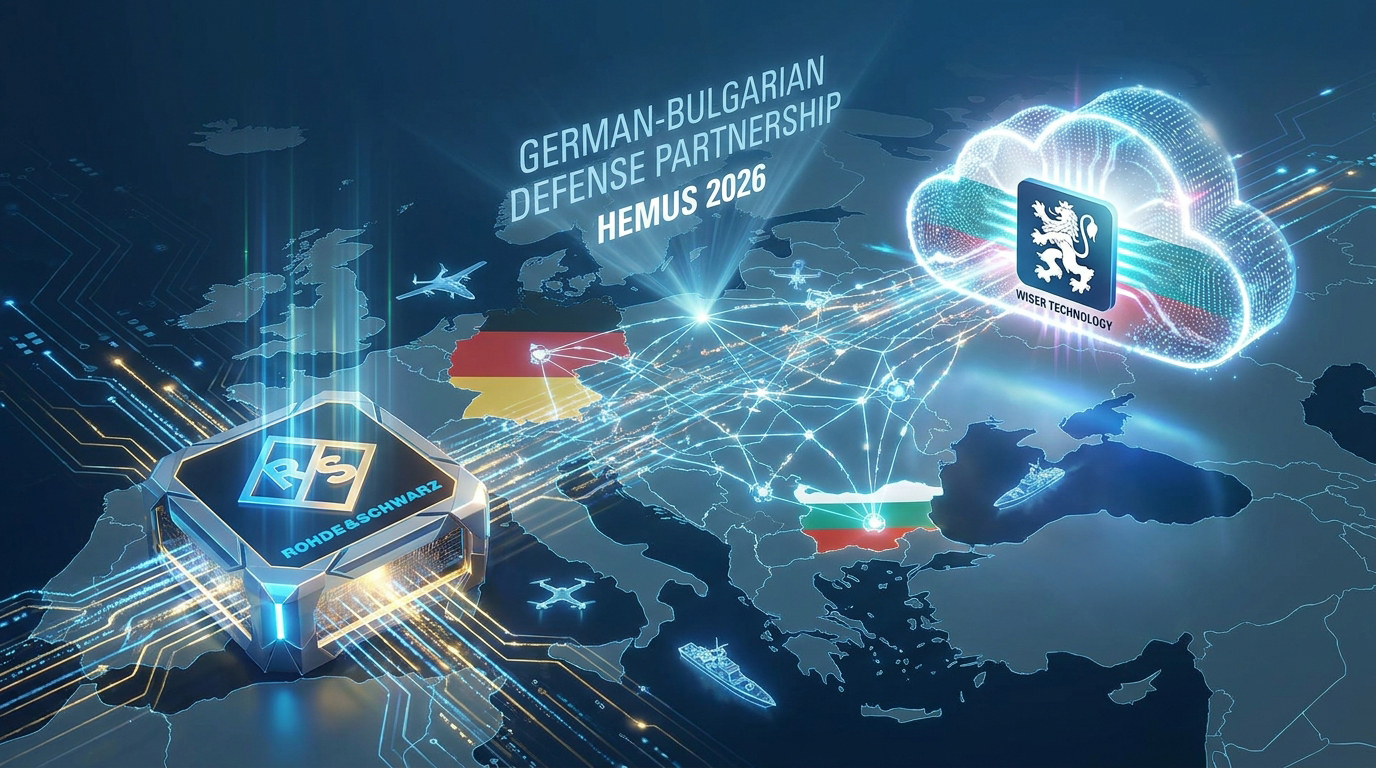
Strategic partnership at HEMUS 2026: German-Bulgarian defense cooperation as a building block of European resilience – Image: Xpert.Digital
Europe's southeastern flank needs more than declarations of intent – it needs technology, infrastructure and real industrial partners
AI, drones & cyber defense: Bulgaria's strategic reassessment – From laggard to asset
Europe's security architecture is undergoing a historic transformation – and the center of gravity of this development is increasingly shifting towards Southeast Europe. The HEMUS 2026 international defense exhibition in Plovdiv made it clear: Bulgaria is no longer merely a geostrategic buffer state, but is developing into a key technological player on NATO's eastern flank. A prime example of this economic and military realignment is the strategic partnership between the Munich-based electronics group Rohde & Schwarz and the Bulgarian software specialist Wiser Technology. The following article examines the geopolitical background of this alliance, analyzes the massive European investments in defense and dual-use infrastructure, and demonstrates why Europe's true defense capability in the future depends on the seamless integration of modern information technology and robust logistics networks.
Related to this:

Plovdiv as a geopolitical stage: What HEMUS 2026 means
The HEMUS International Defense and Security Exhibition in Plovdiv, Bulgaria, is far more than a trade fair. It serves as a political barometer for the state of the European security architecture and a rare forum where government representatives, industrial companies, and military experts from East and West engage in direct exchange. The 17th edition of HEMUS, held from June 3-6, 2026, at the Plovdiv International Fair, surpassed all previous editions: 197 Bulgarian and international exhibitors participated, representing a 37 percent increase in Bulgarian companies and a 17 percent increase in international participation compared to the previous edition. The fair was held under the auspices of the Bulgarian Ministry of Defense, Economy and Innovation and was personally opened by President Iliana Iotova.
Amidst live demonstrations by the Bulgarian Special Forces and Air Force, the Bulgarian technology group Wiser Technology and the Munich-based electronics company Rohde & Schwarz signed a Memorandum of Understanding at the German Pavilion. This document marks the beginning of strategic cooperation in the defense and technology sectors. The signing took place in the presence of high-ranking political representatives: Bulgarian State Secretary of Defense Katerina Gramatikova, German Ambassador to Bulgaria Irene Maria Plank, and Managing Director of the German-Bulgarian Chamber of Commerce (AHK Bulgaria) Sonja Miekley. This institutional framework underscores that this is not a purely commercial agreement, but rather an embedded industrial policy gesture with a distinctly geopolitical dimension.
The German Pavilion at HEMUS 2026, organized by the German-Bulgarian Chamber of Industry and Commerce (AHK Bulgaria) on behalf of the Federal Ministry for Economic Affairs and Climate Action, united 19 exhibitors under the umbrella of the "Made in Germany" brand. In addition to Rohde & Schwarz and Wiser Technology, companies such as Airbus Defence and Space, Diehl Defence, HENSOLDT, Quantum Systems, and Trumpf were represented. The thematic range extended from defense electronics and precision military technology to autonomous drone systems. This concentration of technological expertise in a small space reflects the growing strategic interest of German industry in Bulgaria as a market, a production location, and a political ally.
From handshake to high technology: The profile of the cooperation partners
Rohde & Schwarz: From measurement technology specialist to defense giant
Rohde & Schwarz is a family-owned German technology company founded in 1933 and headquartered in Munich. For decades, the company was primarily known as the world market leader in measurement technology. However, the geopolitical shift has fundamentally changed its core business: In fiscal year 2024/2025, Rohde & Schwarz achieved sales of €3.16 billion for the first time, representing growth of 7.8 percent compared to the previous year. This growth did not stem from traditional measurement technology, but primarily from the security and defense sector, which more than compensated for the weakening demand for civilian measuring instruments. The order backlog exceeded €5 billion, driven mainly by major projects such as the German Armed Forces' D-LBO program, naval communication systems for German and Australian frigates, and the AI backbone development for the European FCAS fighter jet program.
Rohde & Schwarz is currently pursuing an aggressive internationalization strategy through strategic collaborations. Just in May 2026, a few weeks before its appearance at HEMUS, the company signed a Memorandum of Understanding (MoU) at the AFCEA trade fair with Munich-based drone developer Quantum Systems for the joint integration of electronic warfare and counter-UAS capabilities into unmanned platforms. Shortly before that, also in May 2026, the company agreed to a partnership with Ukrainian specialist INFOZAHYST at AOC Europe for the development of high-performance jamming systems, counter-UAV solutions, and mobile electronic warfare platforms. The MoU with Wiser Technology in Sofia is thus part of a systematic network strategy that positions Rohde & Schwarz as a central integration hub within the European defense technology ecosystem.
Wiser Technology: Bulgaria's quiet flagship of defense software
Wiser Technology, listed on the Bulgarian Stock Exchange under the ticker symbol WISR, is largely unknown to many Western European observers. This is about to change. In recent years, the company has established itself as one of the most ambitious European defense software players outside of traditional arms-producing nations. In 2024, Wiser signed a contract with the European Defence Agency (EDA) as part of a consortium led by the Spanish defense company Indra for the E2C (European Command and Control System) project, funded by the European Defence Fund (EDF). Two further EDF projects followed in May 2025: ASTERION, an international consortium for the development of secure underwater communication systems, where Wiser contributes its algorithm and protocol expertise for underwater acoustic communication, and MARTINA, an AI evaluation framework for analyzing satellite data for defense purposes.
In April 2026, it was announced that Wiser was involved in four new EDF projects for the 2025 funding year, with a total volume of over €120 million. These include the ECC2 project (European Cyber Command and Control System) with a sub-budget of €56.25 million, the AI-SHIELD project for the development of data protection-compliant AI dialogue and analysis systems for the defense sector, and the Naval Combat Cloud project E-DOMINION with a total volume of almost €79 million. This makes Wiser the only Bulgarian software company and the Bulgarian company with the largest number of EDF-funded projects overall. Following the signing of the Memorandum of Understanding with Rohde & Schwarz, CEO Dimitar Dimitrov emphasized that the collaboration offers the opportunity to develop mutual innovations that will substantially strengthen Europe's defense capabilities. The company achieved sales growth of approximately 18 percent in the past fiscal year and expects double-digit growth rates for the current year as well.
Bulgaria's strategic reassessment: From laggard to asset
Military budget and modernization pressure
Bulgaria is undergoing a profound defense policy transformation, the speed and radical nature of which are virtually unparalleled in recent Eastern European history. In 2026, the defense budget will amount to US$2.9 billion, representing an average annual growth rate of 21.6 percent between 2022 and 2026. The budget is projected to increase to US$4 billion by 2031. In May 2026, Prime Minister Rumen Radev signaled to NATO Secretary General Mark Rutte that Bulgaria was prepared to increase its defense spending to up to 5 percent of its gross domestic product, making it one of the most committed supporters of NATO's new target path.
The background to this shift is a realistic threat analysis triggered by Russia's war of aggression against Ukraine. Bulgaria's Black Sea coast makes it a direct border state of the potential theater of war. Russia's attempts to close parts of Bulgaria's exclusive economic zone in the Black Sea for military exercises were seen in Sofia as a direct provocation. The country acquired anti-ship missiles for its coast guard and took over several Tripartite-class minesweepers from Belgium and the Netherlands to strengthen its naval presence in the Black Sea. In parallel, the largest modernization of the Bulgarian armed forces since the end of the Cold War is underway: F-16C/D Block 70/72 fighter jets are replacing the aging MiG-29 fleet, Stryker infantry fighting vehicles are modernizing the ground forces, and with the commissioning of the first MMPV-90 frigate, the navy is gaining strategic projection capabilities.
Key geopolitical location in the European security framework
Bulgaria occupies a unique geopolitical position. The country lies at the intersection of three strategic axes: the southeastern European land flank, the Black Sea as a maritime buffer zone between NATO and Russia, and the Balkans as an unstable connecting region between Central Europe and the eastern Mediterranean. As a NATO and EU member, Bulgaria, along with Romania and Turkey, forms the Black Sea Defense Triangle, which has gained considerable importance through NATO planning after the Cold War. For the first time since the end of the East-West conflict, concrete defense plans against an attack from the east are being developed for the region.
In its strategic market assessment for 2026, the German-Bulgarian Chamber of Commerce (AHK Bulgaria) emphasized that Bulgaria is playing an increasingly important role as an industrial location, a committed NATO and EU partner, and a strategic gateway to Southeast Europe. Technologies for digitalization, cybersecurity, and modern equipment systems are in particularly high demand, with international cooperation and investment playing a key role as local companies seek to expand their capacities and integrate more closely into European supply chains. This presents opportunities for German companies in the areas of high-tech components, IT security, and training solutions.
The economic logic of German-Bulgarian cooperation
Complementary strengths as a foundation
The partnership between Wiser Technology and Rohde & Schwarz is not a product of chance encounters at a trade fair, but rather the result of strategically compatible capability profiles. Rohde & Schwarz brings decades of expertise in defense electronics, communication systems, and electromagnetic warfare. Wiser Technology possesses deep software engineering know-how, European EDF project experience, and direct integration into the Bulgarian and Eastern European defense infrastructure. The combination of these competencies addresses a structural bottleneck in the European defense industry: the lack of seamless integration between Western-style hardware systems and adaptive software infrastructure capable of functioning in diverse operational environments.
Dimitar Dimitrov explained that the partnership involves Wiser Technology in the development of complex battlefield surveillance systems capable of hearing, seeing, feeling, and analyzing. Further joint projects include the use of orbital sensors to analyze ground and air activity. For Rohde & Schwarz, the collaboration means access to more affordable Eastern European software engineering expertise and Wiser's network infrastructure within European defense programs. For Wiser Technology, it opens the door to the global sales network and technical depth of one of the world's most renowned defense electronics companies.
Embedded in the larger context: ReArm Europe and the European Defence Fund
Bilateral cooperation is taking place against the backdrop of an unprecedented mobilization of European defense spending. Under the ReArm Europe banner, the EU has mobilized an investment volume of up to €800 billion by 2030. The European Commission created a fiscal space of up to €650 billion through temporary exemptions from the Stability and Growth Pact, supplemented by the SAFE instrument with €150 billion in joint loans. EU defense spending reached a record high of €381 billion in 2025, an increase of 10 percent compared to the previous year. The European Investment Fund tripled its loan program for defense suppliers from €1 billion to €3 billion. The order books of the eight largest European defense companies grew by 15 percent in 2024, reaching a combined free cash flow level of over €8 billion.
The European Defence Fund (EDF) is the central institutional instrument of this transformation. With an annual budget of over €1.1 billion in 2025, it supports projects in AI, robotics, sensor technology, aerospace, communications, and autonomous systems engineering. In 2025, 57 EDF projects totaling €1.07 billion were approved, four of which involve Wiser Technology. This integration into European funding programs means that the cooperation between Wiser and Rohde & Schwarz not only benefits bilaterally but is also embedded in a broad system of European defence innovation. Economists estimate the multiplier effect of defence spending at 1.4 to 1.6, meaning that every euro invested in European defence increases GDP by €1.4 to €1.6.
Hub for Security and Defense - Advice and Information

Hub for Security and Defense - Image: Xpert.Digital
The Security and Defence Hub offers expert advice and up-to-date information to effectively support companies and organizations in strengthening their role in European security and defence policy. Working closely with the SME Connect Defence Working Group, it particularly promotes small and medium-sized enterprises (SMEs) that wish to further develop their innovative capacity and competitiveness in the defence sector. As a central point of contact, the Hub thus creates a crucial bridge between SMEs and European defence strategy.
Related to this:
Intermodal logistics as a safety factor: Industrial opportunities between rail, road and sea
Southeast Europe's Security Architecture: A Critical Assessment
Strategic importance of the region for Europe as a whole
The question of Southeast Europe's significance for overall European security cannot be adequately answered without understanding a simple geographical fact: Whoever controls or destabilizes Southeast Europe holds the key to three strategically vital connections for Europe. First, to the Turkish Straits, the only major bottleneck between the Black Sea and the Mediterranean. Second, to the Balkan corridors, through which troops are moved from Western Europe toward NATO's eastern flank. Third, to the Adriatic coast and the Mediterranean region, through which Europe's maritime supply and projections are routed.
Bulgaria and Romania form the backbone of NATO's Black Sea flank. Romania even surpasses Turkey in defense spending and is investing heavily in its role as the dominant power in Southeast Europe. Bulgaria completes the strategic arc to the south. Together, these two countries secure the eastern exit of the Balkans and the northern flank of the eastern Mediterranean. Without stable, modernized, and NATO-interoperable armed forces in this region, the entire southeastern flank of the alliance would constitute an open flanking attack on the European security architecture.
The course was set at the NATO summit in The Hague in 2025: The alliance partners committed to increasing pure defense spending to 3.5 percent of GDP by 2035. An additional 1.5 percent of GDP is earmarked for militarily necessary infrastructure and cybersecurity. Southeast Europe is not a peripheral region in this context, but rather the first testing ground for the operational implementation of these ambitions.
Related to this:

Dual-use and intermodular transport solutions: The underestimated dimension
Why infrastructure is crucial in war
Anyone who tries to measure the strategic importance of Southeast Europe solely in terms of fighter jets and armored divisions misses the real challenge. The crucial question in a modern collective defense scenario is not: Who has the better weapon? It is: Who can get their forces to the right place faster? This question of military mobility has become the central planning factor in Brussels and NATO headquarters since the Russian attack on Ukraine.
In November 2025, the European Commission presented a comprehensive package on military mobility. The aim is to enable the faster, safer, and more coordinated deployment of troops, equipment, and military goods within Europe – bringing the EU closer to the vision of a "military Schengen." Key components include standardized authorization procedures within a maximum of three days, an emergency framework (EMERS) for accelerated procedures, the modernization of key EU transport corridors to dual-use standards, and the introduction of a solidarity pool. The European Court of Auditors dedicated a special report to military mobility in the EU, and the PESCO project "Military Mobility" simplifies, standardizes, and accelerates cross-border troop movements.
The underlying idea is the concept of dual-use infrastructure: Civilian facilities – from automated warehouses to rail networks – are designed and converted to seamlessly serve military purposes in a crisis. This dual-use effect makes every investment in more robust transport networks simultaneously an investment in defense capabilities. The Connecting Europe Facility (CEF) specifically funds dual-use transport infrastructure projects, while EDF supports the development of interoperable logistics and digital systems.
Southeast Europe as an infrastructure bottleneck
For Southeast Europe, this agenda is of particular urgency, as the region has historically been one of the weakest links in the European infrastructure chain. The Trans-European Transport Network (TEN-T) comprises nine European transport corridors, including the Baltic-Black-Aegean-Sea Corridor and the Western Balkans-Eastern Mediterranean Corridor. Both corridors run through Bulgaria, a region whose rail infrastructure, bridge load-bearing capacity, and logistics capabilities are in dire need of investment. The core infrastructure of the TEN-T network is scheduled for completion by 2030, and the extended core network by 2040. These deadlines coincide precisely with the period in which Europe intends to most significantly strengthen its defense capabilities.
Specifically, this means for Bulgaria: Road and rail connections must be designed with a load-bearing capacity that also allows for battle tanks and heavy military transport vehicles. Logistics hubs and storage facilities must be able to accommodate military equipment at short notice. Black Sea ports must be upgraded to handle civilian and military goods simultaneously. Digital systems must provide real-time transparency regarding capacities, bottlenecks, and routes, both for commercial logistics providers and military commands. These requirements do not describe an abstract future scenario, but rather ongoing planning processes in which Bulgaria is involved with EU funding. Bulgaria and Italy signed an agreement in December 2025 on the construction of new infrastructure for NATO troops in Bulgaria.
Intermodular transport solutions as an industrial opportunity
The term "intermodular transport solution" refers to systems in which goods can be transported in standardized modules that can be transferred from one mode of transport to another without transshipment. In a military context, this means: ammunition containers, vehicle components, or field hospital units that can be transported by rail to Bulgaria in the same standard container, then by truck to the front-line base, and, if necessary, evacuated by air freight. The EU initiative on military mobility explicitly aims to develop Europe-wide heavy-load transport corridors that benefit both European armed forces and industry.
For industry, this translates into significant investment opportunities in modular container standards, handling technology, digital track-and-trace systems, and warehouse automation. Wiser Technology, with its focus on software infrastructure for complex system landscapes, is ideally positioned to contribute in this area as well. The Naval Combat Cloud project E-DOMINION, in which Wiser is involved, addresses precisely this intersection: the digital integration of heterogeneous physical systems under an interoperable data architecture. Transferring such concepts to the logistics sector is technologically logical and strategically valuable.
This goes well with:

The diplomatic dimension: German-American Chamber of Commerce (AHK), embassy, and the network of institutional actors
The role of the German Chamber of Commerce Abroad
At HEMUS 2026, the German-Bulgarian Chamber of Commerce (AHK Bulgaria) acted not only as a trade fair organizer but also as a strategic orchestrator. The organization of the German Pavilion, the support of the MoU signing at the highest diplomatic level, and the facilitation of the fishbowl discussion on the future of the European security architecture and industrial cooperation in Southeast Europe demonstrate that the AHK is growing far beyond its traditional trade promotion role. It is becoming the institutional backbone of a German industry seeking to establish a foothold in a strategically sensitive region, but which depends on political reliability and diplomatic support.
The presence of German Ambassador Irene Maria Plank at the signing of the MoU is not merely a protocol detail in this context. It signals that the Federal Republic of Germany not only approves of this cooperation but actively promotes it. At a time when German foreign economic policy is increasingly taking on security policy dimensions and federal governments are using terms like "security partnerships" and "strategic trade relations" in the same breath, the ambassador's presence at the conclusion of an industrial agreement has both symbolic and realpolitik value. It demonstrates that Germany intends not only to sell goods in Bulgaria but also to invest long-term and establish a foothold there.
Fishbowl dialogue: Institutionalized exchange as infrastructure
The fishbowl discussion, held as part of HEMUS 2026, brought together representatives from politics, business, and the defense industry for an open exchange on the future of the European security architecture, industrial cooperation in Southeast Europe, and cross-border innovation partnerships. This format may at first glance appear to be a mere side event. In fact, it is an indicator of a qualitative leap in the depth of cooperation: It is no longer just about concluding contracts, but about sharing interpretive frameworks and strategic narratives.
Such dialogues are not a mere complement to strong industrial relationships; they are their prerequisite. Companies operating in security-sensitive markets depend on signals of political stability, regulatory predictability, and institutional networks. The fishbowl discussion created precisely this meta-infrastructure, which is essential for long-term partnerships. The open dialogue and high level of participation demonstrate once again how crucial personal exchange is for sustainable cooperation, as the German-Bulgarian Chamber of Commerce (AHK Bulgaria) rightly pointed out.
Risks and open questions: What could jeopardize this cooperation
Technology transfer risks and export control
As promising as the partnership between Rohde & Schwarz and Wiser Technology is, it operates in a highly complex regulatory environment. Defense electronics, battlefield surveillance software, and AI systems for military analysis are subject to the European Dual-Use Regulation, German national export control regulations (BAFA), and NATO security frameworks. The question of which technology components may flow in which direction between a German and a Bulgarian company is legally sensitive. For an operational partnership based on joint development and potentially joint sales in third-party markets, these questions must be carefully answered—not least because Bulgaria, as NATO's easternmost member, lies on the direct border of non-Western spheres of influence.
Institutional capacities and absorption capacity
The Bulgarian defense industry is undergoing a transformation, as the German-Bulgarian Chamber of Commerce (AHK Bulgaria) aptly describes. This transformation creates opportunities, but also structural risks. Skilled labor shortages, bureaucratic capacity bottlenecks in the implementation of EU-funded projects, and the challenge of combining Western technological standards with post-Soviet industrial culture remain real obstacles. Wiser Technology has proven its ability to overcome these hurdles. The company is the only Bulgarian software company with more than ten years of experience in the defense sector and over 15 EU-funded projects. But the partnership with Rohde & Schwarz brings a new level of complexity: it is no longer just about software, but about the integration of hardware and software into operational defense systems.
What's at stake and what remains to be done
The strategic investment logic
The Memorandum of Understanding between Wiser Technology and Rohde & Schwarz is a symptom, not an isolated event. It reflects a profound repositioning of Europe as a security policy actor, the growing role of small and medium-sized economies like Bulgaria in the European defense architecture, and the recognition that technological resilience is a collective, cross-border endeavor. The investment multipliers of European defense spending, ranging from 1.4 to 1.6, suggest that every euro of defense invested in this region generates above-average economic leverage.
For the European defense industry as a whole – illustrated by the STOXX Europe Total Market Aerospace & Defense Index, which is projected to rise by over 65 percent in 2025 – Southeast Europe is the next major growth market. With a Bulgarian defense budget growing to $4 billion by 2031, a modernization program encompassing everything from fighter jets and frigates to cyber infrastructure, and an investment framework secured by EU funds such as EDF, CEF, and SAFE, the foundations are in place for sustained and growing German-Bulgarian industrial cooperation.
Infrastructure as a strategic priority
HEMUS 2026 impressively demonstrated that defense cooperation between Germany and Bulgaria has reached a new level. What is missing, and where the next stage of development must begin, is the integration of this technological cooperation with the infrastructure agenda. Dual-use investments in the Bulgarian transport and logistics network, enabling intermodular transport solutions, upgrading the TEN-T corridors to military capacity, and building storage capacities available in times of crisis – all of this is not just a national task for Bulgaria, but a shared European responsibility with direct security value for all NATO partners. Europe's institutional investors, including German insurance companies, which have increased their infrastructure investments tenfold from €10 billion to €100 billion in ten years, are potential financing partners for precisely these projects.
HEMUS 2026 has shown that cooperation, innovation, and trust are not just empty words. They are the only reliable foundations of a competitive European defense ecosystem, in which companies like Wiser Technology and Rohde & Schwarz should be role models, not exceptions.
🎯🎯🎯 Data-driven B2B industry hub as a quasi-in-house solution

The quasi-in-house solution: How Xpert.Digital closes operational gaps in B2B marketing and sales – Smart Content-Driven Business - Image: Xpert.Digital
Xpert.Digital is a data-driven B2B industry hub led by Konrad Wolfenstein . The company acts as an external, quasi-in-house solution for industrial partners, closing operational gaps in marketing, content, and sales – without requiring additional resources on the client side.
More information here:
Your global marketing and business development partner
☑️ Our business language is English or German
☑️ NEW: Correspondence in your native language!

Konrad Wolfenstein
I and my team are happy to be available to you as your personal advisor.
You can contact me by filling out the contact form here [email protected]:or simply call me at +49 7348 4088 965. My email address is
I'm looking forward to our joint project.
☑️ SME support in strategy, consulting, planning and implementation
☑️ Creation or realignment of the digital strategy and digitization
☑️ Expansion and optimization of international sales processes
☑️ Global & Digital B2B trading platforms
☑️ Pioneer Business Development / Marketing / PR / Trade Fairs
Your container high-bay warehouse and container terminal experts

Container high-bay warehouses and container terminals: The logistical interplay – expert advice and solutions - Creative image: Xpert.Digital
This innovative technology promises to fundamentally change container logistics. Instead of stacking containers horizontally as before, they will be stored vertically in multi-story steel racking structures. This not only allows for a drastic increase in storage capacity within the same area, but also revolutionizes all processes at the container terminal.
More information here:





