
Dual logistics and resilience: The strategic merging of civilian and military supply chains for Europe's security
Xpert Pre-Release

Available in 27 languages 📢
Prefer Xpert.Digital on GoogleⓘPublished on: March 13, 2026 / Updated on: March 13, 2026 – Author: Konrad Wolfenstein
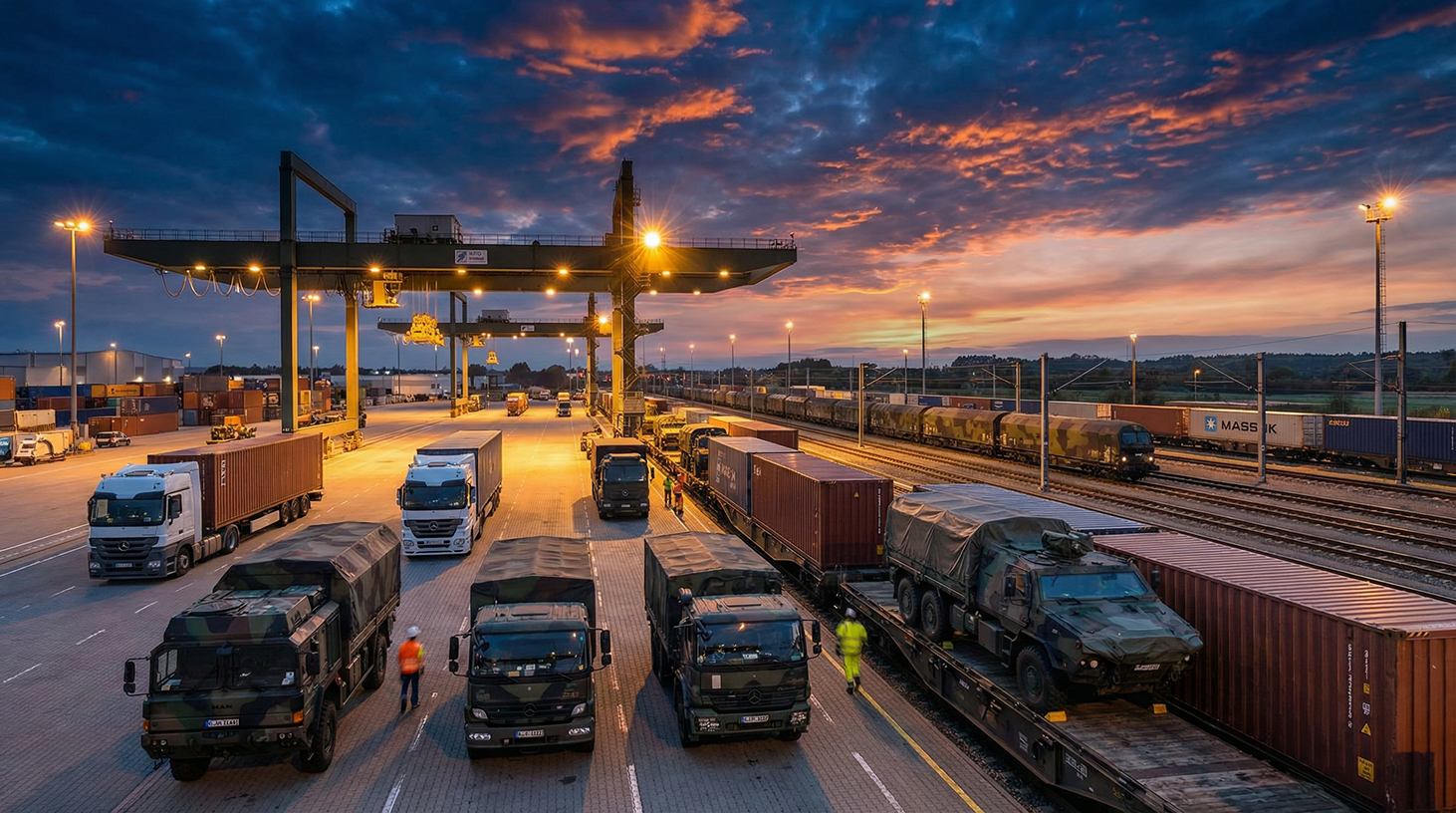
Dual logistics and resilience: The strategic merging of civilian and military supply chains for Europe's security – Creative image: Xpert.Digital
The Russians' fatal mistake: What NATO can learn from the Ukraine war for logistics
Reality shock for Europe: The radical shift in NATO's logistics doctrine
For decades, military logistics in Europe was dismissed as a mere cost center and a secondary administrative task – a dangerous miscalculation that had brutal consequences with the outbreak of the war in Ukraine. Stranded Russian tank columns and critical ammunition shortages have dramatically demonstrated to NATO that logistics is not only the backbone but the very survival factor of modern warfare. The alliance's solution is "dual logistics": the strategic and seamless integration of civilian and military infrastructure. But how realistic is this life-saving concept given dilapidated bridges, tight budgets, and woefully inadequate transport infrastructure, particularly in Germany, a key logistics hub? This comprehensive analysis examines the seven dimensions of the new defense doctrine and demonstrates why the consistent dual use of transport routes and resources is the only way to safeguard Europe's operational capability in a crisis.
Anyone who sees logistics only as a cost center has already lost the next war
The realization that logistics is not merely the rear administration of an army, but rather its operational backbone, only took hold in Europe under the pressure of an actual war. Dual logistics, the systematic integration of civilian and military supply and distribution systems, is proving to be the crucial concept for not only postulating resilience, but actually creating it. It is the answer to a question that Europe had been reluctant to ask for decades: What happens when a continent's peace-dividend-rich infrastructures are suddenly forced to withstand the demands of a high-intensity conflict?
The conclusion that dual logistics represents the secure resilience of supply and distribution systems is not the result of theoretical considerations in Brussels think tanks. It is the distillation of brutal wartime experiences from Ukraine, structural failure analyses of the Russian armed forces, sober assessments of European infrastructure deficits, and a strategic realignment of NATO, the full implications of which have not yet been fully grasped.
From peace dividend to reality shock: Ukraine as a logistical teacher
The Russian war of aggression against Ukraine, with a brutality unprecedented in Europe since 1945, has demonstrated the crucial role of logistics in modern conflicts. It served as a stark reality check for a European defense policy that had for decades treated logistics as a secondary administrative function and systematically underfunded it. The spectacular Russian logistical failures of the first weeks of the war in February and March 2022, when tank columns en route to Kyiv were stranded due to a lack of fuel, ammunition, and food, confirmed an old military adage attributed to US General Omar Bradley: Amateurs talk about strategy, professionals about logistics.
The Russian armed forces traditionally rely on a centralized push logistics system, fundamentally different from the Western pull approach. This system, which delivers supplies to troops according to a predetermined plan rather than responding to specific needs, proved disastrously inflexible in a dynamic combat environment. A key reason for the setbacks lay not in the combat effectiveness of individual units, but in the Russian leadership's failure to adequately integrate logistical considerations into the strategic planning of the campaign. The attempt to capture several regions and urban centers of Ukraine within just ten to fourteen days completely overwhelmed Russia's outdated and rigid logistics system.
Analyses by the Austrian Armed Forces Service reveal the enormous scale of the daily logistical demands: Starting with approximately 110,000 soldiers in 100 to 120 tactical battalion battle groups, the Russian army had to move vast quantities of fuel, ammunition, and provisions daily. The daily fuel requirement of just the three main weapon systems of a single battalion battle group—consisting of 44 infantry fighting vehicles, ten main battle tanks, and 18 self-propelled howitzers—was already in the tens of thousands of liters. Extrapolated to the entire invasion force, this resulted in supply volumes that the Russian transport system simply could not handle.
Due to its limited supply of transport vehicles, the Russian army was logistically ill-equipped to maintain operations over distances exceeding 150 kilometers from its supply bases. To achieve a range of 300 kilometers, Russia would have needed to double the number of its trucks per support brigade to 400, a feat currently considered unrealistic. This structural weakness was dramatically exacerbated by targeted attacks by Ukrainian forces on overstretched and unprotected supply routes, as well as on depots located too close to the front lines.
Numerous reports and photographs of abandoned but intact military vehicles documented the serious shortcomings of Russian logistics in the first months of the war. The Russian supply system was neither organized nor equipped to guarantee the expeditionary logistics necessary for a successful campaign of this scale.
Seven dimensions of a new logistics doctrine: The Mainz conference as a turning point
The lessons of the war in Ukraine extend far beyond the analysis of Russian mistakes. NATO has recognized that the Ukrainian experience provides fundamental insights for its own logistics doctrine – insights that could not have been gained with such clarity in any war game or simulation. In November and December 2025, the first joint NATO-Ukraine conference on logistics lessons learned, the so-called Combined Joint Logistics Lessons Learned Conference (CJL3C), took place in Mainz. This event, organized by the NATO Security Assistance and Training for Ukraine (NSATU) Support Division, was attended by approximately 175 representatives from NATO command structures and allied nations.
The conference provided a forum to gather and share lessons learned from more than a decade of Ukrainian logistics operations during sustained combat operations against Russian aggression. Organizers emphasized that these insights are crucial for NATO allies and partners adapting their doctrines, strategies, and tactics to maintain full combat operations on the European continent.
The conference identified seven key dimensions that define military effectiveness in the 21st century:
- The resilience of supply and distribution systems, i.e., the ability to maintain supply chains under permanent hostile pressure and to quickly find alternative routes in the event of damage or destruction of individual elements.
- The identification and strengthening of logistical weaknesses, that is, the systematic analysis and hardening of the most vulnerable points in one's own logistics chain before an opponent can exploit them.
- The adaptability of doctrines to real combat situations, the realization that no doctrine survives first contact with the enemy in its pure form, and that the ability to adapt doctrines quickly is itself a core competency.
- The role of information as a combat power multiplier, where real-time data on stocks, consumption, transport capacities and threat situations can exponentially increase the efficiency of logistics.
- Investments in personnel training are needed because the best systems are worthless without qualified personnel, and Ukraine has shown that improvisational logisticians are crucial in war.
- Innovation in maintenance and repair is crucial, as the ability to quickly restore damaged equipment to operational condition under field conditions has proven to be a critical factor.
- The development of domestic defense industry capacities that, in an emergency, will ensure the supply of ammunition, spare parts and new weapon systems independent of overseas supply chains.
NATO Brigadier General Witold Bartoszek, Deputy Commander of the NATO Security Assistance and Training Initiative for Ukraine, succinctly summarized the key insight: Logistics, often overlooked in peacetime, has now become a crucial factor in modern warfare. According to Bartoszek, the Ukrainian experience is changing perceptions of how supply systems must function during protracted and high-intensity combat operations.
This conference marked a paradigmatic turning point: Ukraine was no longer perceived merely as a recipient of security support, but as a source of knowledge of vital importance to the entire alliance.
The logic of dual logistics: Why dual use is the only resilient solution
The conclusion that dual logistics represents the secure resilience of supply and distribution systems results from the convergence of several analytical strands which together form a compelling argument.
The first lesson learned from Ukraine is that purely military logistics structures are insufficient in a modern conflict. Ukraine has demonstrated that the ability to seamlessly integrate civilian infrastructure, transport capacities, and logistics expertise into the military supply chain is vital for survival. The decentralized logistics system that Ukraine has established for Western armaments deliberately utilizes civilian transport methods and routes, distributes supplies across various trains, often operating at night, and systematically uses curfews to hinder enemy reconnaissance. This merging of civilian and military logistics is not a makeshift solution, but a fundamental structural principle.
The second aspect is the geographical and infrastructural reality of Europe. Germany plays a key role as NATO's central logistical hub. Under the Operational Plan Germany (OPLAN DEU), in a crisis, up to 800,000 allied soldiers and 200,000 vehicles would have to be deployed through Germany within six months and supplied through Host Nation Support. The Bundeswehr cannot possibly manage this enormous logistical task alone. It relies on close cooperation with the private sector, which must provide available land for storage, trucks, fuel, food, and maintenance capacity when needed. The Bundeswehr already enters into contracts with companies like Deutsche Bahn, which must maintain transport capacity for exercises or in the event of a crisis.
The third aspect is the analysis of the degree of overlap between civilian and military transport needs. Studies by the European Commission and the European External Action Service have shown that there is approximately 94 percent overlap between military mobility requirements and the civilian Trans-European Transport Network (TEN-T). This enormous overlap means that investments in the civilian transport network almost inevitably also benefit military mobility, and vice versa. Dual-use infrastructure is therefore not a luxury, but rather the most efficient form of resource allocation.
The fourth strand is vulnerability analysis. According to its own internal calculations, NATO possesses less than five percent of the air defense capability deemed necessary to protect its logistics hubs in Central and Eastern Europe against a large-scale attack. A senior NATO diplomat admitted that the ability to defend against missiles and air attacks is a crucial component of the plan to defend Eastern Europe, but that this capability is currently lacking. This alarming protection gap makes it all the more important that logistics systems are designed to be decentralized, redundant, and dual: If individual hubs are destroyed, alternative civilian and military capabilities must be able to take effect immediately.
In its position paper of October 2025, the Federation of German Industries (BDI) formulated the core demand that robust infrastructures and reliable logistics chains form the backbone of overall defense. Industry plays a central role in providing logistics services, means of transport, and infrastructure, as well as in protecting these from violent attacks. The private sector is an indispensable partner of state actors. The paper calls for decentralized, secure storage capacities for security-relevant goods and dual-use logistics centers closely integrated with military requirements.
The industrial Achilles' heel: Europe's struggle for resilience
Sustainability, that is, the ability to wage a high-intensity conflict over a prolonged period, depends significantly on logistical resilience. The strength of European armies, which has already been considerably depleted by deliveries to Ukraine, underscores this point. The EU and its member states have mobilized a total of €43.5 billion in cumulative military assistance for Ukraine, including €6.1 billion under the European Peace Facility. In January 2026, the European Commission presented a proposal for a €90 billion interest-free loan, of which approximately €60 billion is earmarked for strengthening Ukrainian defense. Overall, the European Commission estimates Ukraine's financial needs for 2026 and 2027 at €135 billion.
These enormous transfers of resources have drastically reduced European arms stockpiles and simultaneously revealed how inadequately prepared the European defense industry was for a protracted conflict. While the European defense industry has increased its ammunition production capacity by 40 percent, and production capacity for 155mm artillery ammunition is slated to reach two million rounds per year by the end of 2025, the path to this goal has been arduous, and the initial situation was alarmingly weak.
Rheinmetall has opened Europe's largest ammunition factory for 155-millimeter artillery shells in Unterlüß, in the Celle district, after a construction period of just 18 months. The factory is expected to reach a capacity of up to 350,000 rounds annually starting in 2026. Together with its sites in Spain and South Africa, Rheinmetall plans a total production of 1.5 million rounds per year. Rheinmetall is also building a plant in Baisogala, Lithuania, which is slated to further increase production starting in 2027. NATO Secretary General Mark Rutte stated that Europe's annual production capacity for artillery ammunition is now six times higher than it was two years ago.
These figures sound impressive, but a closer look reveals the depth of the problem. A high-intensity conflict on NATO's eastern flank would, according to estimates, generate a level of ammunition consumption that could overwhelm current production capacities within just a few weeks, even after increases. The dual-logistics perspective is crucial here: only by systematically integrating civilian production capacities, civilian transport infrastructure, and civilian warehousing into the military supply chain can sustained operations be raised to a level that acts as a deterrent.
Hub for Security and Defense - Advice and Information

Hub for Security and Defense - Image: Xpert.Digital
The Security and Defence Hub offers expert advice and up-to-date information to effectively support companies and organizations in strengthening their role in European security and defence policy. Working closely with the SME Connect Defence Working Group, it particularly promotes small and medium-sized enterprises (SMEs) that wish to further develop their innovative capacity and competitiveness in the defence sector. As a central point of contact, the Hub thus creates a crucial bridge between SMEs and European defence strategy.
Related to this:
Dual logistics: The underappreciated transformation that is supposed to save Europe's defense
Infrastructural realities: Germany's dilapidated hub
The strategic vision of a functioning dual logistics system clashes with an uncomfortable infrastructural reality in Germany. The German rail network, which should serve as the backbone of any large-scale troop deployment, suffers from a significant backlog of investment. Many bridges, signal boxes, and sections of track are outdated and in need of repair. Extensive modernization and renovation programs have been initiated, but will lead to considerable operational restrictions in the short and medium term.
A particularly alarming example of this structural vulnerability occurred in Rendsburg, northern Germany, in July 2025, when an open hatch cover on an American military train damaged the 15,000-volt overhead power line, paralyzing all rail traffic in Schleswig-Holstein for hours. This seemingly trivial incident illustrates just how fragile the interface between military and civilian use of infrastructure is.
The scale of the problem becomes even clearer when one considers actual transport capacities. According to former US General Ben Hodges, Germany currently only has the capacity to transport one and a half armored brigades, while NATO plans require the simultaneous transport of eight to ten armored brigades. This drastic discrepancy between need and capability is a key argument for the dual-use approach: the gap cannot be closed by building parallel military transport infrastructures, but only by systematically upgrading existing civilian infrastructure for dual use.
Many sections of track, and bridges in particular, do not meet the required military load classes for transporting the heaviest military vehicles, such as battle tanks. There is a lack of a sufficient number of suitable heavy-load railcars. Furthermore, many combined transport terminals lack the necessary loading facilities for the independent loading and unloading of military vehicles. Another symptomatic incident occurred in 2024 at the port of Nordenham, when a cargo ship rammed a railway bridge that was the only rail link to a central transshipment point for ammunition deliveries to Ukraine. Shortly afterward, another ship damaged a temporary replacement bridge, forcing some military transports to be rerouted via Poland. This logistical bottleneck was seen as a warning sign within NATO circles.
The European policy framework: Between ambition and funding gap
At the European level, significant steps have been taken in recent years to create the framework for dual-use logistics. The EU Action Plan on Military Mobility, the revised TEN-T Regulation, which explicitly considers dual-use aspects, and the Connecting Europe Facility (CEF) with a specific budget of approximately €1.7 billion for dual-use transport infrastructure projects form the political framework. These funds have co-financed 95 projects in 21 countries, with Germany securing substantial funding of over €296 million.
For its part, NATO adopted the Logistics Action Plan in May 2024, which comprises 20 measures to complete the transition from national to collective logistics. The plan provides a mechanism for organizing and managing the necessary changes in logistics, taking into account NATO's deterrence and defense requirements. In November 2025, the NATO Logistics Committee met again in Brussels to advance implementation and ensure readiness for collective defense.
In November 2025, the European Commission presented a package to strengthen military mobility in Europe, aiming to harmonize national regulations for the transport of troops and equipment. MEP Markus Ferber welcomed the initiative but called for a more holistic approach and the consistent use of infrastructure for dual-use purposes.
However, a critical funding gap is emerging. The dedicated CEF budget for military mobility has been fully committed through calls for proposals between 2021 and 2023. Consequently, no further specific EU funds for this purpose will be available until the end of the current Multiannual Financial Framework in 2027. This gap between strategic ambition and financial reality is one of the most critical weaknesses of the European approach. NATO's requirement to maintain stockpiles of ammunition, fuel, and spare parts well beyond the 30-day horizon and to establish deployment readiness within ten days of receiving an alert order stands in stark contrast to the available resources.
Resilience through double redundancy: The operational principle of dual logistics
The operational principle of dual logistics is based on a logic that is as simple as it is effective: By interlinking two systems, the civilian and the military, a redundancy is created that neither system can achieve alone. If military supply routes are disrupted by hostile action, civilian resources can step in, and vice versa. This dual redundancy is the core characteristic that distinguishes dual logistics from conventional logistics approaches.
The implementation follows several fundamental principles. The principle of shared use stipulates that infrastructure such as terminals, track sections, and bridges must be planned from the outset to meet the requirements of both commercial freight transport and the specific needs of military transport. The principle of the prioritization mechanism requires clear rules and procedures that define how military transport can be prioritized in crisis situations without denying civilian users reliable access during normal times. The principle of resilience by design requires that infrastructure be designed from the beginning to be resistant to disruptions and attacks, including physical security, system redundancy, and cybersecurity.
In an analysis from October 2025, TÜV formulated the key message that anyone planning infrastructure today cannot afford to think of it in monofunctional terms. The world of threats is interconnected, and the responses must be as well. Dual-use infrastructure is a central building block of Germany's resilience architecture, which must be systematically planned, implemented across sectors, and operated flexibly.
Particularly insightful in this context is the Austrian research project RESISTANT, which aims to make military logistics structures more flexible and resilient. The core idea is to loosen up the existing fixed last-mile supply distribution points and divide them into smaller, mobile supply packages. These so-called supply clusters are in constant data exchange, providing all command levels with a real-time overview of both personnel and equipment. This concept of decentralized, networked supply precisely reflects the Ukrainian experience and is only feasible through the integration of civilian and military logistics capabilities.
Economic rationality: Dual use as an efficiency imperative
Dual-use logistics is not only militarily necessary, but also economically rational. Sharing infrastructure avoids the development and maintenance of parallel, costly, and potentially redundant military transport systems. At a time when European defense budgets are growing, but far from fast enough to close all capability gaps, the dual-use approach is the only realistic option for achieving maximum impact with limited resources.
The economic logic unfolds on several levels. Investments in transport infrastructure, positioned as essential for national and collective defense within the framework of the dual-use concept, can potentially unlock defense budgets for projects that simultaneously deliver significant civilian benefits in terms of efficiency, capacity, and sustainability. Combined rail-road transport offers a reduction in CO2 emissions of up to 80 percent compared to pure truck transport over long distances. Furthermore, rail is approximately five times more energy-efficient than road transport.
Infrastructure improvements primarily driven by military requirements, such as increasing the load-bearing capacity of bridges to military load classes or upgrading lines for longer trains, simultaneously increase the capacity and efficiency of civilian freight transport. The synergy potential is quantifiable: Germany has approximately 150 combined transport terminals that can serve as hubs for both civilian and military transshipment. Projects in Germany with a total volume of around €592 million have already been co-financed under the CEF program, generating both civilian and military benefits.
Dual logistics, as a strategic intersection of civilian and military logistics, also offers potential for knowledge transfer and innovation. Military planning and resilience concepts can be transferred to civilian supply chains, while conversely, civilian technological developments such as digitalization and automation in terminals can be used for military logistics processes.
The cross-border dimension: Europe's logistical patchwork
Dual logistics can only function if it is conceived from a European perspective. The deployment of troops and equipment to NATO's eastern flank requires seamless transit through multiple countries with differing regulations, standards, and infrastructure capabilities. The EU Military Mobility Initiative aims to grant permits for military transport across internal EU borders within a maximum of three working days. In practice, however, this remains far from reality.
The fragmentation of European transport infrastructure is a serious problem. A large portion of Europe's rail infrastructure has been privatized in recent decades, primarily to comply with EU competition and state aid rules. The focus on commercial costs and profitability has resulted in entire infrastructures being built without any consideration for their potential military use in a crisis. Furthermore, China's growing presence in Europe, including its acquisition of critical parts of European infrastructure, particularly ports, raises questions about the alliance's ability to receive and move reinforcements across the continent.
The assessment of the current state of cross-border military mobility indicates a critically low level of maneuverability. Closing the structural gaps and increasing the speed of military mobility will take a long time, given the rapidly evolving threat environment, which limits the armed forces' ability to respond with the necessary speed, intensity, and agility.
Hybrid threats and the protection of dual infrastructure
The integration of civilian and military logistics on shared infrastructure inevitably increases the potential attack surface for physical and cyber threats. In an environment where Russia systematically targets ports, railway hubs, and storage facilities through long-range missiles, drones, and acts of sabotage, the protection of dual infrastructure becomes a top priority.
Civilian systems could become gateways for attacks on military logistics, and vice versa. NATO's Cooperative Cyber Defence Centre has warned of an unprecedented threat to port facilities from state-sponsored actors. While increasing digitalization boosts efficiency, it also increases cyber risks. Comprehensive security concepts must therefore be developed and implemented in a coordinated manner between military and civilian authorities.
The hybrid nature of modern threats makes dual logistics both more vulnerable and more necessary. More vulnerable because interconnectedness opens up more attack vectors. More necessary because only the redundancy of a dual system offers the resilience that a single-function system cannot achieve. If a civilian port is disabled by sabotage, military transshipment capacity must be available. If military transport routes are blocked by hostile action, the civilian logistics network must function as a backup system.
The BDI (Federation of German Industries) has called for clear prioritization mechanisms, coordinated emergency plans, and redundant supply structures to ensure at least a basic level of service for civilian, military, and humanitarian transport. This requires an interoperable, digitally supported logistics network into which civilian logistics infrastructures can be integrated, supplemented by satellite-based services, secure communication networks, and Earth observation systems as a digital foundation for planning, coordinating, and protecting logistical movements.
The overall conclusion: Why dual logistics is without alternative
The conclusion that dual logistics represents the secure resilience of supply and distribution systems is the result of cumulative evidence based on several independent but mutually reinforcing lines of knowledge.
The Ukrainian war experience has shown that a strict separation between civilian and military logistics cannot be maintained in a modern conflict and that the integration of both spheres can be decisive. Analysis of Russian logistical failures has demonstrated that centralized, monofunctional logistics systems fail under the complexity and dynamics of a real combat environment. An inventory of European infrastructure has revealed that existing capacities are insufficient, whether purely military or purely civilian, to meet the demands of a collective defense scenario. Economic analysis has shown that building parallel structures is neither financially viable nor practical, while dual-use infrastructure generates synergies of up to 94 percent infrastructure overlap. Vulnerability analysis has documented that only the redundancy of a dual system can provide the necessary fail-safe operation when less than five percent of the required air defense capacity to protect logistical hubs is available.
The Mainz CJL3C conference has created an analytical framework by identifying seven key dimensions that encompasses the various facets of this challenge. The resilience of supply and distribution systems is not coincidentally placed first: it is the prerequisite for all other dimensions. Without resilient logistics, there is no functioning doctrine, no effective use of information, no effective personnel, and no efficient maintenance.
Dual logistics is therefore not an optional modernization project, but rather the structural prerequisite for Europe's defense capabilities in the 21st century. It requires enormous investments, a fundamental cultural shift in cooperation between civilian and military actors, the overcoming of bureaucratic fragmentation, and the political will not only to name but also to address uncomfortable truths about the state of European infrastructure. The alternative—namely, clinging to monofunctional, inadequately funded, and structurally vulnerable logistics systems—is no longer an option. It would be a strategic risk that Europe cannot afford in light of the changed geopolitical reality.
Consulting - Planning - Implementation

Markus Becker
I would be happy to serve as your personal advisor.
Head of Business Development
Chairman SME Connect Defense Working Group
Consulting - Planning - Implementation
Konrad Wolfenstein
I would be happy to serve as your personal advisor.
contact me at wolfenstein ∂ xpert.digital
Just call me on +49 7348 4088 965 (Munich) .





