
Time to reverse: the fragmentation of the European rail infrastructure - a historically grown obstacle
Xpert pre-release

Language selection 📢
Published on: May 23, 2025 / update from: May 23, 2025 - Author: Konrad Wolfenstein
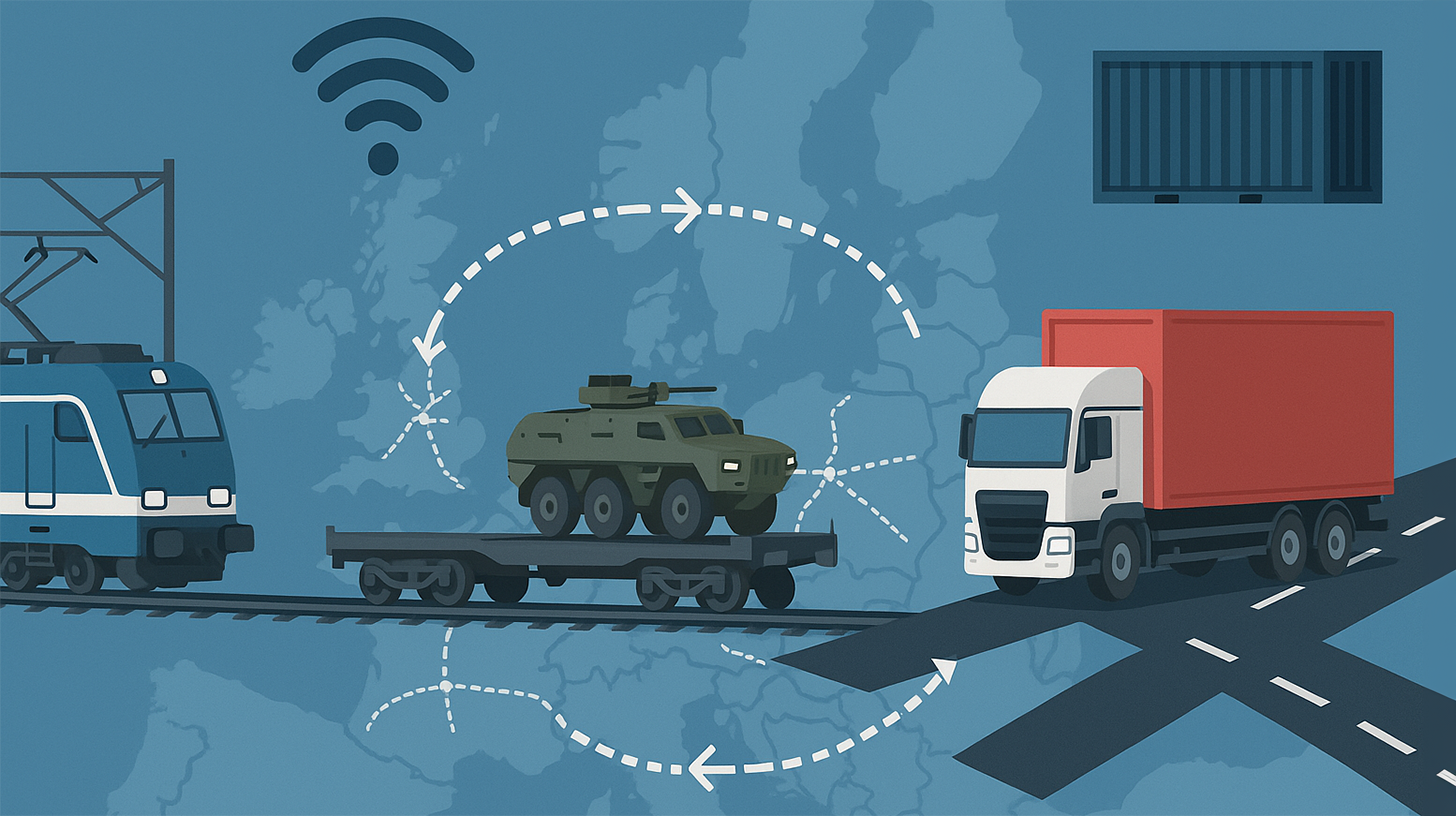
Time to reverse: the fragmentation of the European rail infrastructure - a historically grown obstacle - Image: Xpert.digital
Solutions for networked European logistics UA with dual-use logistics to overcome rail fragmentation in Europe
The fragmentation of the European rail infrastructure - a historically grown obstacle with modern implications
The European railway landscape is characterized by a remarkable technical diversity, which is manifested in particular in the different lane widths. This heterogeneity is not a random product, but the result of complex historical development in the 19th century, in which national interests, divergent technical standards and, last but not least, military strategic considerations lead to a fragmentation of the rail infrastructure. The choice of a specific track width was often a conscious political and economic decision that aimed to protect your own infrastructure from use by competing companies or potential military opponents.
Today, this historically grown fragmentation represents a significant obstacle to the vision of a uniform European traffic area. The different tracks are one of the most serious technical obstacles for seamless and efficient cross -border rail traffic, especially in the goods segment. However, the interoperability of the rail network is of crucial importance for the functionality of the European internal market, the achievement of the EU's ambitious climate goals by increasing the traffic on the rails (as part of the European Green Deal) and the associated economic and ecological advantages.
The recent geopolitical faults, especially the war in Ukraine, have dramatically illustrated the strategic dimension of a powerful and interoperable rail infrastructure. The ability to transport goods and material quickly and reliably over long distances is not only for civilian security, but also for military mobility and collective defense ability of essential importance. In this context, the concept of “dual-use logistics”-the civil and military use of logistics infrastructures-is increasingly relevant.
Interestingly, a paradoxical development is revealed here: While in the 19th century different lane widths were deliberately designed as military barriers in order to make enemy invasions difficult, NATO and the EU's modern defense strategy requires overcoming this barrier. The rapid laying of troops and material over large distances, especially on the west-east axes, is now a central military requirement. The existing differences in lane widths that once served the defense are now an operational obstacle to this modern military mobility. As a result, the harmonization of the lane width or the creation of efficient solutions for overcoming, for example through dual-use infrastructure projects, becomes a military-strategic necessity. This represents a remarkable reversal of the original logic: What once served to defend the differentiation requires defense ability through integration and interoperability.
The fragmentation was created through different national tracks, technical standards and political decisions in the 19th century. Today it leads to significant problems for cross -border rail transport, especially in goods transport. The most important ** modern implications ** are:
- Economic effects: The lack of interoperability between the different tracks and systems increases the transport costs and reduces the efficiency of rail transport.
- Ecological challenges: The EU strives to relocate traffic from the road to rail to reduce CO₂ emissions. However, the fragmentation complicates the implementation of these climate goals.
- Geopolitical and military importance: The war in Ukraine has shown that a powerful and interoperable rail infrastructure is crucial for security and military mobility.
- Technical and infrastructural adjustments: solutions such as lane change systems, multi-rail tracks or dual-use logistics are becoming more important to overcome fragmentation.
The original logic of fragmentation - national demarcation and military defense - turns around today: A harmonized and interoperable rail infrastructure is increasingly becoming a strategic need for business, environment and security.
The fragmentation of the European rail infrastructure is more than just a technical problem. It is also a symptom of deeper challenges in the European integration process, where national sovereign considerations and short -term cost calculations often face long -term, common goals. The changeover of lane widths or the implementation of comprehensive interoperability solutions are associated with immense costs and complex planning procedures, which often makes national governments hesitate. The current debate about dual-use logistics could act as a new lever to overcome national resistance to expensive infrastructure projects. By linking these investments directly with national and supranational security interests, which enjoy a higher political priority in the current geopolitical situation, funds from defense households or special EU funds such as the Fazility "Connecting Europe" (CEF) for military mobility could be mobilized. This harbors the chance of accelerating the modernization of the rail infrastructure, including the overcoming of lane width problems. However, it also means that priorities in infrastructure projects could possibly be guided more by strategic than purely economic or ecological considerations in the future.
Suitable for:

The variety of lane widths in Europe: a detailed inventory
The European railway card is a patchwork of different tracks. This variety has profound effects on the interoperability and efficiency of rail transport. A precise consideration of the prevailing systems is essential to understand the resulting challenges and solutions.
Normal track (1435 mm): The dominant standard
The standard gauge with a distance of 1435 mm (corresponds to 4 feet 8½ inches) between the inner edges of the rail heads is the most widespread lane worldwide. Its origin lies in Great Britain, where George Stephenson used it for the Stockton and Darlington Railway (opened in 1825), which is the first public railway with steam locomotives. As early as 1846, it was legally laid down in Great Britain as a standard track. From there, with the expansion of railway technology, she spread to large parts of Europe, North Africa, the Middle East and North America and China. In Germany and most Western European countries, it is the dominant track width. Around 60 % of all railway lines are normally lane worldwide. In the EU, the entire route network comprised around 202,131 km in 2022, of which the vast majority of the standard gauge.
Breitpur systems: the big deviators
In addition to the standard gauge, there are significant broad -pure networks in Europe that significantly influence cross -border traffic.
Russian broads (nominal 1520 mm, historical/Finland 1524 mm):
This system is the second largest in the world and shapes the railway infrastructure in Russia, most of the successor states of the Soviet Union (GUS countries such as Armenia, Azerbaijan, Belarus, Estonia, Georgia, Kazakhstan, Kyrgyzstan, Latuen, Lithuania, Moldova, Mongolia, Tajikistan, Turkmenistan, Ukraine, Ukraine, Uzbekistan) as well as in Finland. The decision for this track width in the Russian Empire was also based on strategic considerations to make invasions from the West more difficult, as well as different technical developments. The extent was originally 1524 mm (5 feet). In the 1970s, it was adapted to 1520 mm in the Soviet Union to optimize the track and reduce wear. Finland nominally kept the 1524 mm, but the tolerances are designed so that cross-border traffic with the 1520 mm network is technically possible.
Iberian broads (1668 mm):
This track width is characteristic of Spain and Portugal. About 72 % of the Spanish network use this track width. Historically speaking, Spain (originally 1672 mm, corresponding to six Castilian foot) and Portugal (originally 1664 mm, corresponding to five Portuguese foot) chose slightly different dimensions. It was not until 1955 that the compromise value of 1668 mm was agreed. Here, too, strategic reasons, such as fear of invasions after the Napoleonic wars, played a role in the choice of a lane deviating from the rest of Europe. A special feature in Spain is the parallel expansion of a high -speed network in normal gauge (1435 mm), which leads to internal lane width boundaries and the need for access systems or separate operating.
Irish broads (1600 mm):
The Irish broadening of 1600 mm is widespread on the Irish island (Republic of Ireland and Northern Ireland). It is a relatively isolated system without a direct land connection to other European lane width systems, which limits direct interoperability problems with the continent, but is relevant within the island and for ferry traffic.
Schmalspurbahnen (<1435 mm): Diversity for specific purposes
In addition to the large normal and broad-track systems, there is an enormous variety of narrow-gauge widths in Europe, which are typically below 1435 mm. Common examples are the meter track (1000 mm), the Bosnian lane (760 mm), as well as traces of 750 mm and 600 mm. These lanes were often built for cost reasons (lower construction costs) or for better adaptation to difficult terrain (narrow curve radii in mountain regions). They served and served specific industrial applications (mines, field, industrial, industrial, forest railways) or open up interesting regions for tourism (e.g. numerous mountain and museum railways in Switzerland and Austria). They hardly play a role for international passage goods transport, but are important for local and regional care and tourism. The long list of smaller and often industrially used narrow traces shows an often overlooked fragmentation at local and regional level. Although this does not hinder transcontinental freight traffic directly, but complicates local logistics and connection to the main networks, since a direct goods handling without reloading or special transition techniques (such as roller bowls) is often not possible.
Historical, technical, economic and military reasons for the differences in lane (synthesis)
Today's variety of lanes is the result of a complex interaction of various factors:
Technically: Early railway engineers experimented with different tracks in order to find optimal solutions for stability, speed and charging capacity. Narrow traces enabled closer curve radii and were therefore advantageous in mountainous terrain. Leading traces promised higher stability and larger charging capacities.
Economically: narrow -gauge railways were often cheaper under construction and maintenance. Sometimes deviating lane widths were also chosen to protect national industries or to prevent the use of their own infrastructure by foreign competitors.
Military: Especially in countries such as Russia and Spain, the standard deviates from the standard were deliberately chosen to make hostile invasions and replenishment transport more difficult in the event of war.
Historical-political: The railways were created in an era of strong nation states and low international coordination. The choice of track width was primarily regarded as a national matter, without far -reaching considerations to the pan -European interoperability.
It is important to recognize that the “standardization” on normal track is a relative term. Even within the normal -gauge networks in Europe, there are considerable differences in light space profiles, electrification systems and train safety systems that further restrict interoperability. The track width is therefore only - albeit a very fundamental - from many interoperability problems. Even if all routes had the same track width, trains would not automatically be freely used for borders. The focus on the track width is therefore too short; It is a system problem with many interacting technical and administrative variables.
The decisions once made for a certain track width also had long-term “lock-in” effects. As soon as an extensive network and the corresponding rolling material were established for a specific track width, the costs and the effort for recessing entire networks were immense. This explains the remarkable persistence of the historical differences in lane widths despite the obvious disadvantages for international traffic. It is often more economical to accept inefficiencies at the system boundaries than to convert the entire system. The current considerations of Ukraine to convert your network to normal track underline the scope of such decisions, which are often motivated by profound geopolitical new directions.
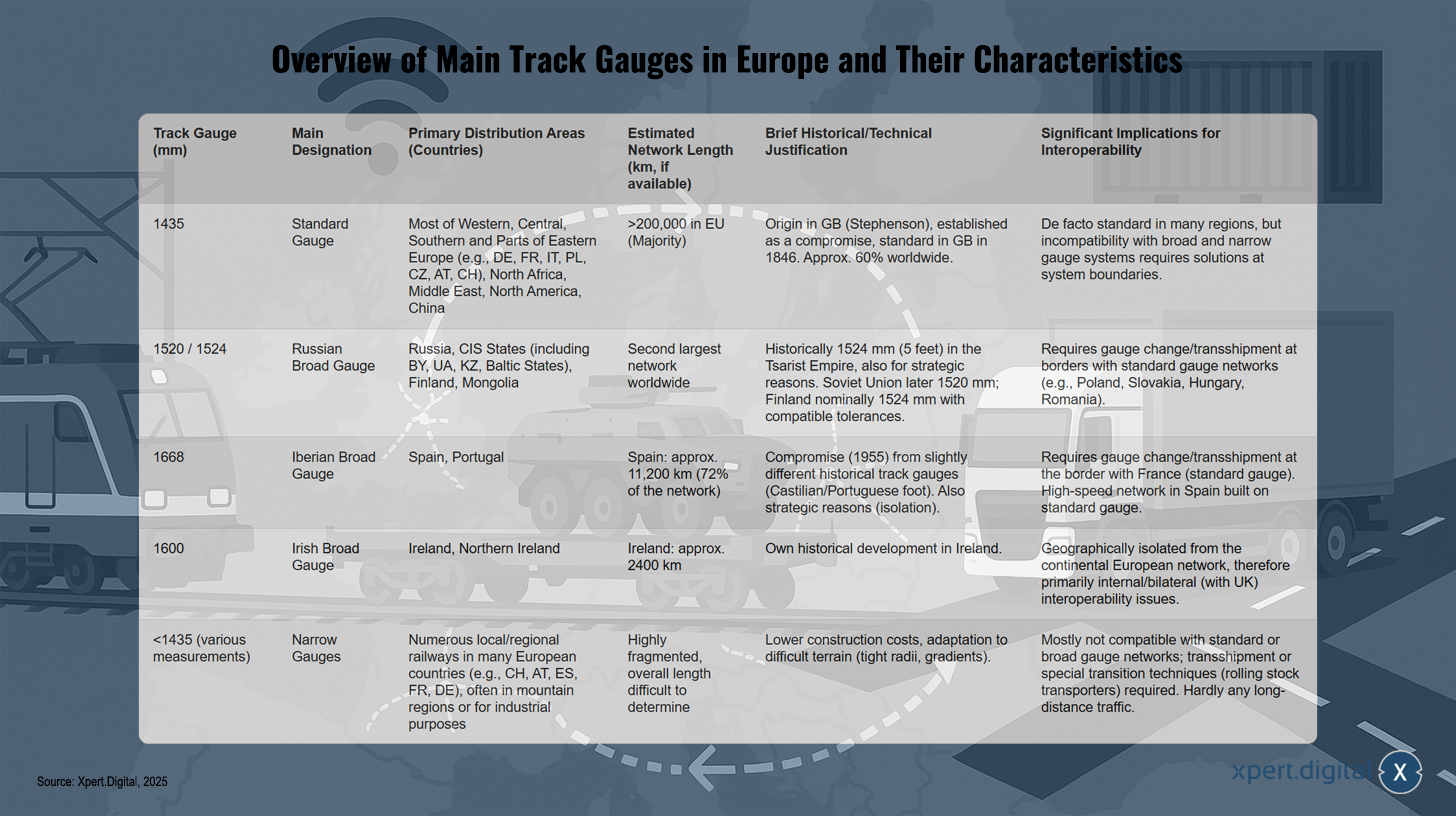
Overview of the main purity in Europe and their characteristics
Overview of the main purity in Europe and their characteristics - Image: Xpert.digital
The overview of the main track in Europe and their characteristics shows that the normal track with 1435 mm is the most widespread worldwide. It is largely found in Western, Central, South and Eastern Europe, North Africa, the Middle East, North America and China with an estimated network length of over 200,000 km alone in the EU. Originally established in Great Britain and has been standard since 1846, it has prevailed as a de facto standard. Nevertheless, there are challenges at the system limits due to incompatibility with wide and narrow-gauge networks.
The Russian broad pure with 1520 mm or historically 1524 mm shapes Russia, the GUS countries, Finland and Mongolia. As the second largest network worldwide, it goes back to the Tsarist Empire and was introduced for strategic reasons. Today, at border crossings to normal -lane networks, it requires a recharging or overload, such as Poland or Romania.
The Iberian broad pure with 1668 mm is mainly widespread in Spain and Portugal, where it comprises about 11,200 km, which corresponds to 72 % of the Spanish railway network. Their formation is based on an adaptation of different foot dimensions. In order to facilitate interoperability, the Spanish high -speed network was built on the normal lane, otherwise it is necessary to cover the border with France.
The Irish broadening of 1600 mm is limited to Ireland and Northern Ireland, at about 2400 km in Ireland. Due to the geographical isolation from the continental European network, internal or bilateral interoperability issues with the United Kingdom are primarily internal or bilateral.
Narrow traces with less than 1435 mm are particularly common in mountainous regions or for industrial purposes, including in countries such as Switzerland, Austria, France, Germany and Spain. They offer advantages such as lower construction costs and greater adaptability to difficult terrain, such as tight curve radii and steep gradients. Since they are usually not compatible with normal or broad-pour networks, umbrellas or special solutions such as roller bowls are required. Long -distance transport hardly plays a role here.
The Baltic States (Estonia, Latvia, Lithuania) are currently using the Russian broads, but are planning a change in important corridors to normal lanes as part of Rail Baltica.
In conclusion, it should be mentioned that the Baltic states are currently using the Russian broads, but is planning to change important corridors to the standard track as part of the Rail Baltica project.
Suitable for:

Challenges due to lane differences in international freight transport
The coexistence of various lane width systems in Europe leads to significant operational, economic and strategic challenges in international freight transport. These manifest themselves in particular on the system boundaries and affect the efficiency and competitiveness of the rail as a mode of transport.
Company complications and inefficiencies at system boundaries
At the interfaces of different tracks there are inevitably interruptions in the transport flow. Reloading goods from wagons of a track width system to the wagon of another, the change of complete bogies or the use of special wardlocks for vehicles with variable track width are the common methods to overcome these system fractures. However, each of these methods is connected to specific disadvantages:
Time loss and costs: All procedures mentioned are time-intensive and costly. The manual reloading of goods, depending on the type of freight and the available infrastructure, can take several hours per wagon. The change of bogies, for example on the Spanish-French border, can take about two hours for a complete freight train of 700 meters. Even if the physical envelope of containers at modern terminals can take place in four to five hours, the associated documentation and processing often take significantly more time, so that the entire process at the border can take up to 24 hours. These delays lead to longer overall transport times and higher operating costs.
The need for special infrastructure: border crossings between different track width systems require considerable investments in special infrastructures. This includes elaborate cover terminals with crane systems and storage areas, track systems for the change of bopics or complex automatic recourse systems. This infrastructure not only binds capital, but also valuable areas in border regions that are often already used.
Increased damage risk: Each individual loading process carries the risk of damage to the transported goods. This is a relevant cost factor, especially for sensitive or high -quality goods, and can reduce the attractiveness of the rail.
Complexity in the disposition: The different track widths often go hand in hand with different wagon types, charging emits and vessels. This makes the disposition and optimal use of the available car space and can lead to inefficiencies in the logistics chain.
Bottlenecks at border crossings, especially in West-East axes
The boundaries between the EU's normal gauge network and the broad -based nets of Eastern Europe (especially Poland/Belarus and Poland/Ukraine) are critical needle tubes in Eurasian freight traffic. The Małaszewicze (Belarus) border crossing, for example, is one of the most important transshipment points on the new silk road and was already chronically overloaded. The capacity limits of the transshipment systems there are often reached, which leads to considerable traffic jams of freight trains and long waiting times. This situation is exacerbated by the fact that in addition to the technical differences in lane widths, different operational regulations, lengthy customs procedures and linguistic barriers slow down the handling processes.
The combination of lane extensions and these other interoperability obstacles (such as different signaling technology or electricity systems) creates a cascade of inefficiencies. These lead to a drastic reduction in the average transport speed and the reliability of international rail freight transport. However, a low speed and lack of planning are decisive competitive disadvantages of the rail compared to the more flexible and often faster road freight transport, especially at medium distances. This in turn hinders the politically desired goal of a significant shift in traffic from the street to the rail, which is of great importance for the achievement of the climate goals in the transport sector.
The bottlenecks at the eastern borders of the EU have received a new, strategic dimension in the course of the Ukraine War. They are no longer just logistical challenges for trade, but have proven to be critical weaknesses for security of supply and military mobility of the EU and NATO. The dependence on a few, heavily used border crossings with lane change systems increases the vulnerability of the entire logistics chains for civil goods and military material. This explains the increased political and financial focus on the modernization of these border crossings and the search for alternative corridors, also in the context of dual-use considerations.
Effects on the competitiveness of rail freight transport
The delays, additional costs and the lower flexibility caused by changing lanes significantly affect the competitiveness of rail freight transport compared to road transport. While the truck enables a door-to-door control without interrupting the transport chain, the rail is disadvantaged in many international relations through the system breaks. The proportion of rails in the total freight traffic in the EU has been stagnating at a relatively low level of around 17-18 % (based on tons of kilometers) for years. This contradicts the goals of the EU to significantly increase the proportion of rail and inland navigation in the sense of sustainable development and the European Green Deal.
Interoperability obstacles beyond the track width
The problem of the gear width differences is reinforced by a number of other technical and administrative interoperability obstacles, which make it more difficult for cross -border rail traffic:
Different train protection and signal systems: Despite the efforts to introduce a uniform European system (ERTMS- European railway guideline management), its implementation is lengthy and costly. Many national systems exist in parallel, which requires the use of multi -system locomotives or elaborate conversions or locomotive changes at the limits.
Varier power systems and electrification degrees: Europe has a variety of different rail flow systems (voltage, frequency). In addition, not all routes are electrified. This also requires the use of expensive multi -system locomotives or time -consuming locomotives.
Different light space profiles and vehicle boundary lines: The permissible maximum dimensions of vehicles and charges vary between the countries and routes. This can restrict the use of certain types of wagons or the transport of oversized loads or make special route guides necessary.
Administrative and regulatory differences: different operating regulations, approval procedures for vehicles and personnel, divergent security standards and national working time regulations for train drivers represent further hurdles for smooth international rail operations.
It turns out that the problems at the lane boundaries are often not solely technical in nature. A lack of coordination between the train companies and the authorities involved, inadequate investments in modern and capacity -strong transshipment systems as well as slow and inefficient administrative processes contribute significantly to tightening the situation. The European Court of Auditors has repeatedly criticized the slow implementation of EU strategies to improve interoperability and the ineffective use of funding. This indicates that, in addition to technical solutions, considerable efforts in the area of organization, management and political cooperation are also necessary in order to permanently eliminate the bottlenecks in European rail freight transport.
Your dual -use logistics expert
Dual -use logistics expert - Image: Xpert.digital
Innovation projects to optimize the European rail network
Solution approaches and technologies to overcome lane width problems
In view of the considerable challenges that represent different tracks for international freight transport, various technical and operational solutions have been developed over time. These aim to enable the transition of goods and vehicles between different lane width systems and to minimize the associated loss of time and costs.
Reloading goods (Transshipment)
Reloading the freight of wagons of a lane width system on the wagon of another is the most traditional and most widespread method to overcome lane width differences.
Containers and exchange containers: The increasing standardization of loading units, especially due to ISO containers and alternating containers, has significantly simplified this process. These units can be handled relatively easily with cranes between different trafficists (trucks, ships, trains) and thus also between trains of different track widths. This is the dominant method in intermodal traffic.
Cover terminals: Powerful terminals are required for the envelope, which are equipped with portal cranes or reader stackers and have sufficient track and storage areas. The efficiency and management of these terminals are crucial for the speed of the entire envelope process.
Disadvantages: Despite the advantages of standardization, reloading is associated with disadvantages. It is time-consuming (3-5 hours per wagon, whereby the entire border stay including documentation can be up to 24 hours), causes additional costs through handling and terminal fees and, with each envelope process, has an increased risk of damage damage. In addition, containers often do not make optimal use of railway wagons, compared to cars specifically designed for certain goods.
Suitable for:

Technical enclosure systems for vehicles
In order to avoid the elaborate reloading of the goods themselves, systems were developed that enable the vehicles to adapt to the respective track width.
Silk frame or wheel set change: With this traditional method, the complete bogies or individual wheel sets of the wagons are physically exchanged on the system boundary. This requires special lifting devices and a pool of exchange racks for the respective target track. The process is also time -consuming; He can take around two hours for a 700 -meter -long freight train.
Automatic recourse systems and vehicles with a variable track width: These modern systems allow an adaptation of the track width of the wheel sets, while the vehicle drives through a special recourse system.
System Talgo (Spain): Originally developed for passenger traffic between Spain (Iberian Breitspur) and France (standard track), there are also applications for freight cars to a axle load of 22.5 tons. The lane change takes place with a slow drive (approx. 15 km/h) by a special system that unlocks, shifts and locked the wheelbeans on the axles. This significantly reduces the time required and the costs.
System Suw 2000 (Poland): This system developed by Ryszard Suwalski also enables automatic adjustment of the track width of the wheel sets during the passage through a transforming system. It is interoperable with the German Rafil Type V system and is used on the Polish borders to Ukraine and Lithuania. For a freight train with 32 wagons, the transforming time with SuW 2000 II can be reduced to about 4 hours, compared to 12 hours for a bogie change.
Other systems (e.g. Rafil Type V, DB AG/Knorr-Bremse): There are other compatible systems that are based on similar principles of automatic track adjustment.
General functionality: Most of these systems are based on relief for the wheels, a unlocking of the wheel disks, the side shift on the axis and a subsequent reference in the new track width.
Advantages: clear time savings compared to reloading or changing the bogie, no reloading of the goods themselves (which reduces the damage risk), and the possibility of continuous use of the same vehicles across system boundaries.
Disadvantages/challenges: Higher acquisition costs for the special wheel sets, bogies and vehicles as well as for the local reversal systems. There is also an additional maintenance effort for the more complex technology. The distribution in freight transport has so far been limited, which could indicate high implementation costs, lack of standardization between different systems or a lack of political and economic will for the nationwide introduction.
Multi-rail tracks (three or four rail tracks)
Multi -rail tracks enable the operation of vehicles of different tracks on the same section of the track through the laying of additional rails.
Four rail track: Two complete tracks are nested into each other, so that four rails run in parallel (e.g. on the Przemyśl - Chyrw route in Ukraine).
Three -rail track: With this variant, a rail is shared by both lane width, while a separate second rail is laid for each track width. This only works technically well if the difference between the lane width is sufficiently large so that the third rail does not collide with the fastening elements of the outer rails. The difference between normal track (1435 mm) and Russian broadening (1520 mm) of only about 85 mm is often too low for this, which requires four -rail tracks or separate parallel tracks. The transition from Iberian broads to normal gauge, on the other hand, is more suitable for three -rail tracks.
Application: multi -rail tracks are mainly found in border stations, in envelope terminals, on short connecting routes between networks or in workshops that wait for vehicles of different tracks.
Disadvantages: The construction of multi -rail tracks is more expensive, in particular the turnout constructions are complex and maintenance -intensive. In addition, speed restrictions can exist on such track sections.
Trot / rolling bowls (for narrow-gauge normal track transitions)
Rolling vans or roller bowls are often used for the transition between narrow -gauge networks and standard land networks (or rare broad -pouring nets). The complete narrow -gauge wagons are loaded onto special standard lane chassis (trolley) or the axes of the narrow -gauge wagons are placed on small, subordinated chassis (roller bowls). This method is of less importance for the transition between the main track width systems in international long-distance transport, but represents an important and widespread solution in the narrow-gauge area in order to enable direct transport of goods without reloading.
The increasing containerization of freight traffic has established the reloading as a pragmatic, if not always optimal, solution for lane width differences. The focus of the investments and optimization efforts is therefore often shifted from direct vehicle interior operability due to clipping systems to increasing the efficiency and capacity of the envelope terminals. However, this also means that the performance of the overall system depends heavily on these terminals, which can become bottlenecks themselves if they are not sufficiently dimensioned or efficiently managed.
Ultimately, there is no universal solution for the track width problem. The choice of the “right” approach is strongly context -dependent and is determined by factors such as the volume of traffic, the type of goods transported, the required transport speed, the available investment means and long -term strategic goals. A combination of different approaches - for example reloading for flexible container traffic, automatic recovery for certain full zero -relateds in mass goods traffic and multi -rail tracks in border train stations and terminals - will therefore continue to remain reality in the European rail network.
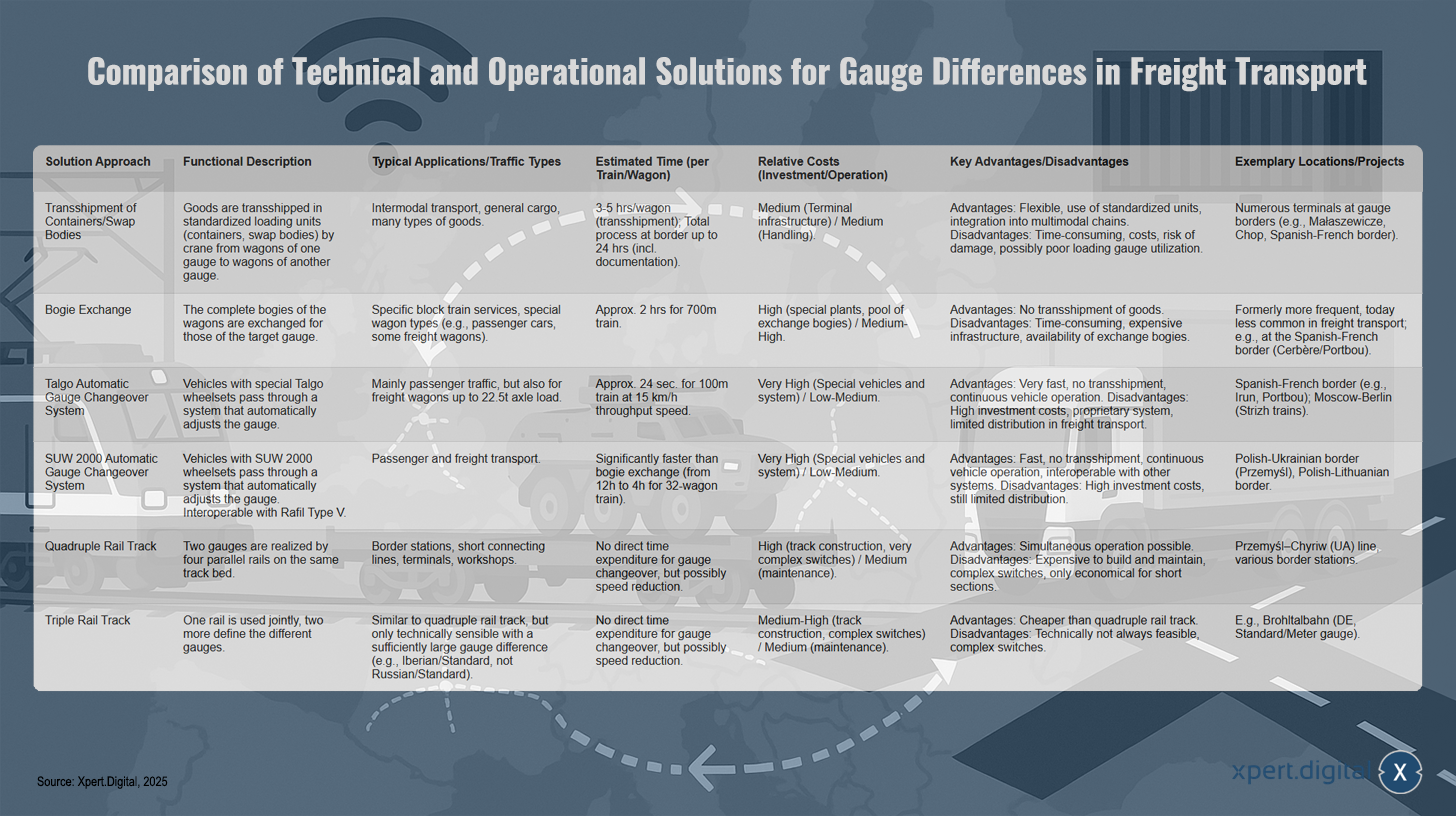
Comparison of technical and operational solutions for differentials in freight transport
Comparison of technical and operational solutions for differentials in freight traffic - Image: Xpert.digital
Solution approach: reloading of containers/change containers
The functionality is to recharge goods in standardized loading units such as containers or alternating containers using a crane between wagons of different lane -wide. This is typically used in intermodal traffic, in general cargo transports and for numerous types of goods. The estimated expenditure of time for the overload is about 3 to 5 hours per wagon, while the entire process at the border, including documentation, can claim up to 24 hours. The costs of investing and operation are to be classified as a means, especially with regard to terminal infrastructure and handling. The main advantages include flexibility, the use of standardized units and integration into multimodal transport chains. Disadvantages are the time -consuming process, the costs incurred, an increased risk of damage and, if necessary, poor loading. Exemplary locations are numerous terminals at track width boundaries such as in Małaszewicze, Chop or on the Spanish-French border.
Solution: change of bog system
The complete functionality is based on the fact that the bogies of the wagons are completely exchanged for those of the target track. This procedure is typically used in certain all -train turns or in special wagon types such as passenger cars and some freight cars. The time effort is about two hours for a 700 meter long train. The costs are relatively high, both in the investment for special systems and a pool of exchange racks as well as in the company, which is to be classified as a medium-high. One of the essential advantages is that the goods are not reloaded. This faces disadvantages such as the high expenditure of time, the expensive infrastructure and the restricted availability of the exchange frame. While this procedure was used more often in freight traffic, it has become less common today. An example of this is the use on the Spanish-French border in Cerbère/Portbou.
Solution: Automatic Track system Talgo
Vehicles with special Talgo wheel sets drive through a system that automatically adjusts the track width. This system is mainly used in passenger transport, but is also suitable for freight cars to a axle load of 22.5 tons. A 100 meter long train needs about 24 seconds to change lanes at a passing speed of 15 km/h. While the investment costs are very high due to the required special vehicles and the system, the operating costs in the low to medium area are moving. The system offers significant advantages, including quick processing without reloading and the continuous use of vehicles. The disadvantages include high investment costs, the proprietary nature of the system and the limited distribution in freight transport. Examples of the use of such systems can be found on the Spanish-French border, such as in Irun and Portbou, as well as on the Moscow Berlin route with the stricter trains.
Solution: Automatic Suw 2000
Vehicles with SUW 2000 wheel sets drive through a system that automatically adjusts the track width and is interoperable with Rafil Type V. Typical areas of application include passenger and freight traffic. The time required per train or wagon is significantly lower than when changing the bogie, which means that the adjustment for a 32-car train only takes about four hours instead of twelve hours. While the investment costs are very high due to the specialized vehicles and systems, the operating costs are low to medium. The advantages include a quick lead time, avoiding reloading processes, the continuous use of vehicles and interoperability with other systems. Disadvantages are the high investment costs and the still limited spread of the system. Exemplary locations include the Polish-Ukrainian border in Przemyśl and the Polish-Lithuanian border.
Solution: four -rail track
Two lanes are made possible by four parallel rails on the same track bed. Typical areas of application are border train stations, short connecting routes, terminals and workshops. Since no direct amount of time is required for the ripple, reductions can occur at speed. The investment and operating costs are relatively high, especially due to the complex track construction and very complex soft, while maintenance is mediocre. The advantages include the possibility of simultaneous operation, whereas the disadvantages include the high construction and maintenance costs, the demanding course and the restriction on short routes. Examples of locations are the Przemyśl - Chyriw route in Ukraine and various border train stations.
Solution: three -rail track
A rail is shared, while two more determine the different track wide. This technique is similar to the four -rail track, but only sensible with a sufficiently large difference in the lane width, for example with Iberian and normal track, but not in Russian and normal trace. There is no direct amount of time for the ripening, but speed reductions can occur. The investment and operating costs are in the medium-high range, whereby the track construction and the complex switches cause higher costs, while maintenance is average. The advantages of this solution are that it is cheaper than a four -rail track, whereas disadvantages are that it is technically not always implementable and the soft complexes are. An example of the application is the Brohltalbahn in Germany, in which normal and meter track are combined.
Suitable for:

Modernization of the logistics infrastructure: strategies and projects in Germany and Europe
The overcoming of the fragmentation of the European rail network caused by lane width and other technical barriers is a central prerequisite for efficient and competitive freight traffic. There are numerous strategies and projects both at EU level and in the individual Member States that aim to modernize the logistics infrastructure.
EU strategies for promoting interoperability and rail freight transport
The European Union has long been pursuing the goal of creating a uniform European railway. Various political initiatives and funding instruments should help to reduce the technical and administrative hurdles in cross -border traffic.
Ten-T politics (Trans-European transport networks): The centerpiece of EU infrastructure policy is the TEN-T program. It aims at building an efficient, EU-wide and multimodal transport network, which includes railways, inland waterways, short-distance lake traffic routes and streets and combines important nodes such as cities, ports and airports. The network is divided into three levels: the core network should be completed by 2030, the extended core network by 2040 and the total network by 2050. The latest revision of the TEN-T regulation in 2024 (based on Ordinance (EU) 2024/1679) has further specified the requirements for the infrastructure and, in particular, has more taken into account the needs of military mobility (dual use). The requirements include, for example, a minimum speed of 160 km/h on passenger traffic routes of the core and expanded core network, the extensive use of ERTMS and the support of freight trains with a length of 740 meters. Nine European traffic corridors, which also integrate the previous rail freight transport corridors, serve the coordinated planning and implementation of investments along the most important traffic axes.
ERTMS (European Rail Traffic Management System): The introduction of a uniform European train protection and signaling system (ERTMS) is a key element to improve interoperability. Ertms should replace the large number of national systems and thus facilitate cross -border train traffic. However, the implementation is slower than originally planned and is associated with high costs. In countries such as Germany, where existing national systems still have a long remaining life, Ertms is initially only introduced as a supplementary system.
Promotion of intermodal traffic: The EU actively promotes the relocation of goods transport from the street to more environmentally friendly modes of transport such as rail and inland waterways. Strategies such as the “Timetable for a Uniform European Traffic Room” (2011) and the “Strategy for Sustainable and Intelligent Mobility” (2020) formulate corresponding goals. However, the European Court of Auditors (EURH) has repeatedly pointed out unrealistic targets and a poor implementation of these strategies.
Standardization of track width to 1435 mm as the goal: In order to further improve interoperability, the European Commission has formulated the goal of establishing the normal track of 1435 mm as the standard for all member states. Countries with different tracks, such as Ireland, Finland, the Baltic States, Portugal and Spain, are asked to develop plans on how their networks can be integrated into the TEN-T corridore with normal track.
Important infrastructure projects with a focus on West-East axes
Along the important West-East traffic axes in Europe are several large infrastructure projects in planning or implementation, which also address aspects of lane compatibility:
Rail Baltica: This project is one of the most ambitious projects to overcome lane width differences. It provides for the construction of a continuous normal -track connection (1435 mm) from Warsaw (Poland) through Lithuania, Latvia and Estonia to Tallinn, with a potential extension to Helsinki through a tunnel. The main goal is the connection of the Baltic states that have so far used the Russian broad -track network to the European normal -track network. This is of great importance for passenger and freight transport as well as for military mobility along the NATO east flank. The construction started in all three Baltic countries, around 15 % of the main route were under construction at the end of 2024. However, financing and the exact schedule remain challenging. Originally planned for 2026, the aim is to complete the cross -border connections by 2030, whereby only a single -track route is often realized in a first phase.
Modernization of border terminals and envelope systems:
Małaszewicze (Poland, border with Belarus): This terminal is a central conversion point for traffic on the new Seidenstrasse and on the border to the Breitspurnetz. Extensive modernization measures are planned to increase the capacity of around 17 to up to 55 train pairs per day and to enable longer trains (up to 1050 m on a wide pour and 750 m on a standard track). The financing is primarily through Poland, since EU funds may only be available to a limited extent due to political relationships with Belarus.
Chop (Ukraine, borders to Slovakia/Hungary): CHOP is another important transshipment station with existing recourse systems for traffic between the Breitspurnetz of Ukraine and the standard land of Slovakia and Hungary. Modernization and expansion projects are underway, partly with the support of EU funds, to expand capacity and increase efficiency.
Other terminals at the EU Eastern Border: Other terminals in Poland, Slovakia, Hungary and Romania on the border to Ukraine are expanded and modernized to facilitate the trade in Ukraine and strengthen the resilience of European supply chains, especially against the background of the war and the need for alternative transport routes.
Fehmarnbelt tunnel (Denmark/Germany): This lowering tunnel under construction will significantly shorten the travel and transport times between Scandinavia and Central Europe. While some analyzes expect positive effects for rail freight transport, others point out that without accompanying investments in the access routes in Sweden and Denmark to remove bottlenecks, there could even be a shift in rail freight traffic onto the street.
Brenner-Basistunnel (Austria/Italy): As the heart of the Scandinavian Middle Mediterranean corridor, the Brenner-Base tunnel will massively increase the capacity for the Alpine-crossing freight traffic on the rail (planned for up to 222 freight trains every day in the base tunnel). Although primarily a north-south axis, it contributes to relieving the overall network and can indirectly also affect West-East traffic.
Modernization projects in Spain and Portugal: On the Iberian Peninsula, parts of the Breitpurnetz (1668 mm) are converted to normal lane (1435 mm) or supplemented by new standard gauge high-speed lines. Important goods traffic corridors such as the Mediterranean corridor and the Atlantic corridor are expanded and modernized to improve the connection to the rest of the European network.
Projects on the Western Balkans: With the financial and technical support of the EU, the countries of the Western Balkans expand their rail infrastructure. The focus is often on electrification and the expansion of important international corridors.
Germany's role as a central transit nation and national modernization initiatives
Due to its geographical location in the heart of Europe, Germany plays a key role as a logistical linchpin. A large part of European transit traffic, especially in West-East axes, crosses Germany. The federal government has launched various programs to strengthen rail freight traffic, such as the “Master Plan Schiens freight transport”, and plans significant investments in the renovation and modernization of the existing network. The focus is on the expansion of the network for 740 -meter -long freight trains, the upgrading of the east corridor and the modernization of important railway nodes. Nevertheless, Germany faces major challenges: a significant investment backlog, capacity bottlenecks on many routes and in important nodes as well as slow implementation of digitization (especially ETCS) impair the performance of the German rail network.
Despite the ambitious EU-wide strategies and significant investments in major projects, the actual implementation of a seamlessly interoperable European rail network remains a task that will extend over decades. The complexity results from the need to harmonize divergent national interests, different technical starting points and enormous financing needs. The repeated criticism of the European Court of Auditors of unrealistic goals and poor implementation of the EU strategies underlines this challenge.
The modernization of key terminals at the lane wide range, such as Małaszewicze or Chop, is not only of crucial importance for civilian trade (e.g. as part of the new Silk Road or the EU Ukraine trade), but has been given an additional strategic urgency from the dual-use perspective. The capacity and efficiency of these terminals are directly associated with the ability to also process military logistics flows on the important west-east axis. Thus, civilian and military interests in the modernization of these nodes converge, which potentially increases the willingness to invest and the political support for such projects.
Germany's central role and the existing infrastructure deficits mean that delays or defects in the modernization of the German network and its connections to the eastern corridors have far -reaching negative effects on the pan -European freight streams and military mobility of NATO and EU. The success of pan-European interoperability and dual-use strategies therefore depends largely on the commitment and progress in Germany.
🎯🎯🎯 Benefit from Xpert.Digital's extensive, fivefold expertise in a comprehensive service package | R&D, XR, PR & SEM

AI & XR 3D Rendering Machine: Fivefold expertise from Xpert.Digital in a comprehensive service package, R&D XR, PR & SEM - Image: Xpert.Digital
Xpert.Digital has in-depth knowledge of various industries. This allows us to develop tailor-made strategies that are tailored precisely to the requirements and challenges of your specific market segment. By continually analyzing market trends and following industry developments, we can act with foresight and offer innovative solutions. Through the combination of experience and knowledge, we generate added value and give our customers a decisive competitive advantage.
More about it here:
Dual-use logistics: How the rail of military-civilian synergies benefits
Dual-use logistics: A catalyst for modernizing the rail infrastructure
The concept of dual-use logistics, i.e. the ability of infrastructures and systems to serve both civilian and military purposes, has become significantly more important in recent years. In the context of the European rail infrastructure in particular, it proves to be a potential catalyst for urgently needed modernization measures, especially on the strategically important West-East axes.
Suitable for:

Definition and relevance of dual-use logistics in a European context
Dual-use-logistics infrastructure refers to traffic routes and systems-such as rail networks, streets, ports, airports and especially envelope terminals-which are designed, built or upgraded in such a way that they meet both the requirements of civil goods and passenger transport as well as the specific needs of military transport. The strategic necessity results from the changed geopolitical situation, especially the war in Ukraine, which has come to the fore the requirements for robust military mobility and a secure civilian supply chain. The aim is to use synergies between civilian and military requirements and to avoid building parallel, potentially redundant infrastructures.
The role of military mobility (EU & NATO initiatives) as a driver for infrastructure investments
Various initiatives at EU and NATO level underline the growing importance of military mobility and drive investments in dual-use infrastructure:
EU Action Plan on Military Mobility: The current action plan (version 2.0, for 2022-2026) forms a comprehensive framework for the development of a well-networked military mobility network. The focus is on shorter response times, a resistant infrastructure and the promotion of investments in dual-use transport infrastructure along the TEN-T network.
Facility "Connecting Europe" (CEF) for military mobility: This specific EU financing mechanism provided around 1.7 billion euros for the co-financing of dual-use projects for the period 2021-2027. These funds are now completely planned for 95 projects in 21 countries, whereby Germany benefited significantly with over 296 million euros.
Pesco project “Military Mobility”: This initiative as part of the constant structured cooperation (PESCO) of the EU serves as a platform for simplification and standardization of cross-border military transport processes with the aim of reducing bureaucratic hurdles.
NATO logistics: NATO emphasizes the need for the quick laying of armed forces and material, which places high demands on civilian infrastructure, including railways. The “Rail Transport Capacity” was identified as a key factor.
TEN-T regulation and dual use: The revised TEN-T regulation (2024) anchors the concept of a military mobility network in EU law and obliges the Commission to identify priority military mobility corridors. This increasingly becomes a dual-use infrastructure.
These initiatives create a strong incentive for the Member States to take military requirements into account in infrastructure planning and prioritize corresponding projects. This represents a paradigm shift: infrastructure planning is no longer only viewed from civilian or ecological aspects, but receives a strong security policy dimension. This can move priorities and realign financing mechanisms, for example by mobilizing funds from defense households for infrastructure projects that at the same time bring considerable civilian advantages.
Synergies and challenges in the implementation of dual-use projects on the rail
The implementation of dual-use projects in rail traffic harbors both significant synergy potential and specific challenges:
Synergies
Accelerated modernization of civil infrastructure can be achieved through military necessities and the associated provision of financial resources.
The increase in capacities, the improvement of resilience and the increase in technical standards (e.g. higher load capacity of bridges, larger light space profiles for tunnels, expansion for 740m trains) benefit both civil and military users.
Improved interoperability, for example through the accelerated introduction of ERTMS or the standardization of terminal processes, benefits all road users.
challenges
Divergent priorities: Civil plans often focus on cost efficiency and regularity, while military requirements emphasize robustness, speed and the ability to cope with lace loads (e.g. large convoys, heavy equipment).
Safety aspects: The protection of critical dual-use infrastructure against physical attacks, sabotage or cyber attacks as well as the guarantee of information security in military transports require special measures.
Complex coordination: Planning, financing and operation of dual-use infrastructure require close coordination between numerous actors (military, civilian authorities, infrastructure operators, transport companies) at national and international level.
Financing: The long-term and sustainable financing of dual-use projects, especially after the expiry of specific support programs such as CEF for military mobility, must be ensured. The distribution of the costs between defense and traffic households must also be clarified.
Differences in lane: The specific problem of lane-wide compatibility at the borders is not automatically solved by dual-use investments. Military equipment, which is often transported to standard wagons, must continue to be reloaded at these limits or transported to enclosable systems. However, dual-use logic can justify investments in more efficient envelope terminals or recourse systems on these strategic limits, since they are critical of military mobility.
Concrete examples of dual-use projects and planning
Along the west-east corridors and in Germany there are already concrete approaches and projects that take into account dual-use aspects:
CEF-funded projects in Germany: As part of the CEF for military mobility, funds for the expansion of overtaking lines, the upgrading of bridges for higher loads and the expansion of terminals for combined traffic were approved. The aim is to improve the accessibility of the network for long and heavy freight trains, which benefits both civil and military transports.
Rail Baltica: This major project is explicitly viewed as a dual-use project with a high military relevance for the NATO east flank. By creating a continuous standard -track connection by the Baltic States, which previously used the Russian broad -pure network, military reliability in this strategically important region is significantly improved.
Modernization of terminals at EU east boundaries: The expansion and modernization of envelope terminals such as Małaszewicze (Poland) and Chop (Ukraine) serve to increase the envelope capacity and efficiency. This is of great importance for civilian trade (e.g. new silk road, EU Ukraine traffic) and military logistics.
Finland's potential lanes to normal lanes: Finland's considerations of switching its broad-based network to European normal gauge are also discussed in the context of NATO membership and the associated necessity of improved military logistics and connection to the western defense alliance.
Identification of priority military mobility corridors: In cooperation with the Member States and NATO, the EU has identified priority corridors for military transports, which often include important west-east axes. Investments in the upgrading of these corridors are prioritized accordingly.
The prioritization of dual-use corridors, especially on the western East axes, also harbors the risk of a concentration of investments on a few strategic routes. If the total financial means for transport infrastructure remains limited, other, also important, but purely civil north-south connections or regional networks could be disadvantaged. There is therefore a risk of a “two-class infrastructure”, in which strategically and military-military corridors are modernized, while other areas of the network may be neglected. A balanced development strategy is therefore essential.
Selected dual-use rail infrastructure projects and initiatives in Europe with relevance for West-East traffic and lane width
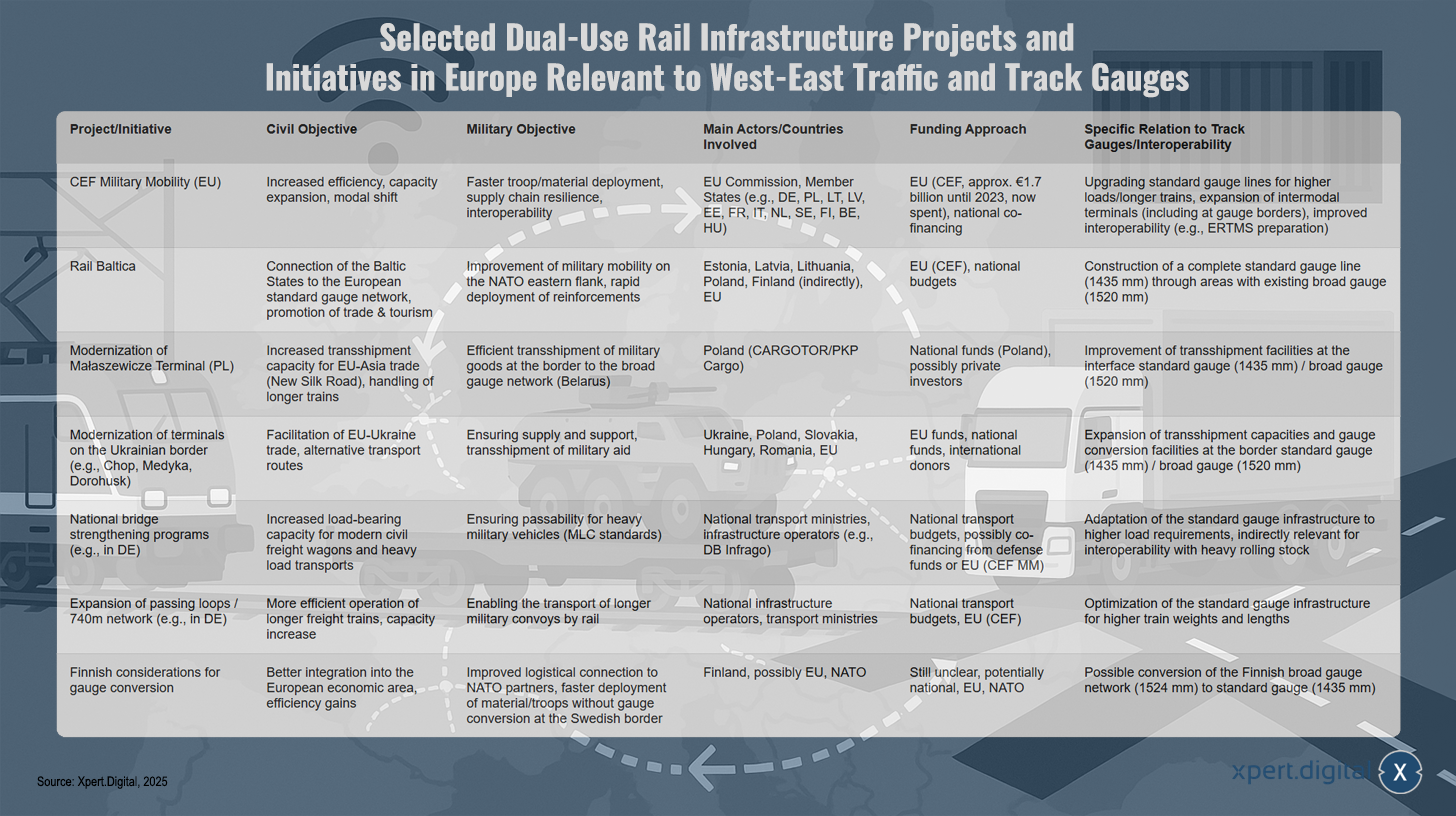
Selected dual-use rail infrastructure projects and initiatives in Europe with relevance for West-East traffic and track width-Image: Xpert.Digital
Project/Initiative: CEF for military mobility (EU)
The EU initiative for military mobility is pursuing both civil and military goals. At the civilian level, the focus is on the increase in efficiency, the increase in capacity and the modal shift. For military purposes, the relocation of troops and material is to be accelerated, the resilience of the supply chains is strengthened and interoperability improved. The main players include the EU Commission and Member States such as Germany, Poland, Lithuania, Latvia, Estonia, France, Italy, the Netherlands, Sweden, Finland, Belgium and Hungary. The EU is carried out by the EU as part of the CEF program (approx. 1.7 billion euros by 2023, now exhausted) and through national co-financing. An essential topic is to adapt and improve normal track lines for higher loads and longer trains, the expansion of combined traffic terminals, also at lane width boundaries, and the preparation for the European railway traffic management system (ERTMS) to increase interoperability.
Project/Initiative: Rail Baltica
Rail Baltica is a comprehensive infrastructure project with the aim of connecting the Baltic states to the European normal -gauge network and thus strengthening trade and tourism. In addition, the project has a military dimension: it is intended to improve mobility on the NATO east flank and enable a quick installation of reinforcements. The main actors include Estonia, Latvia, Lithuania, Poland, the EU and indirectly Finland. Financing takes place via the Connecting Europe Facility (CEF) of the EU and national households. Specifically, a completely new normal -lane track with a track width of 1435 mm is built by areas that were previously shaped by wide track lines with 1520 mm.
Project/Initiative: Modernization Terminal Małaszewicze (PL)
The modernization of the Małaszewicze terminal in Poland pursues a double goal: civilian capacity for trade between the EU and Asia is to be increased as part of the new silk road and the clearance of longer trains is possible. The initiative of the efficient processing of military goods on the border with the Breitspurnetz in Belarus serves militarily. The main actors of the project are Polish companies such as Cargotor and PKP Cargo. The funding is through the national funds of Poland, whereby private investors may also be involved. A central aspect is the improvement of the transshipment systems at the interface between the normal lane with 1435 mm and a wide pour with 1520 mm in order to promote interoperability.
Project/Initiative: Modernization Terminals on the Ukrainian border (e.g. Chop, Medyka, Dorohusk)
The modernization of terminals on the Ukrainian border, such as Chop, Medyka or Dorohusk, pursues the civil goal of facilitating the trade between the EU and Ukraine, and creating alternative transport routes. The focus is on ensuring supplies of supplies and support as well as the envelope of military relief supplies. The main actors include Ukraine, Poland, Slovakia, Hungary, Romania and the EU. Funding is carried out by EU and national funds as well as international donors. A central aspect is the expansion of the cover capacities and recourse systems at the border to ensure interoperability between the normal lanes (1435 mm) and the Breitpur (1520 mm).
Project/Initiative: National Bridging Programs (e.g. in DE)
National bridging programs, such as in Germany, pursue both civil and military objectives. In the civilian area, it is about increasing the load-bearing capacity for modern freight cars and heavy load transport, while the military focus is on ensuring accessibility for heavy military vehicles according to MLC standards. The main actors are the national transport ministries and infrastructure operators such as DB Infrago. Financing is mainly done via national traffic households, with co-finance from defense agents or EU funds, such as the CEF MM. A concrete reference to lane width and interoperability is made by adapting the normal-track infrastructure to higher load requirements, which indirectly concerns interoperability with heavy rolling material.
Project / Initiative: Expansion of overtaking life / 740m network (e.g. in DE)
The project of expansion of overtaking tracks and the 740-meter network, for example in Germany, pursues both civil and military goals. Civil freight trains are to be operated more efficiently and the capacity in the rail network increases. Militually, it is about enabling the transport of longer military convoys by train. The main actors include national infrastructure operators and transport ministries. Financing is carried out by national traffic households and EU funds, in particular from the CEF program (Connecting Europe Facility). An important aspect is the optimization of the normal -track infrastructure to manage higher train weights and lengths and ensure interoperability in the network.
Project/Initiative: Finnish considerations for lane
The Finnish project for spitting aims to improve integration into the European economic area and to achieve efficiency gains. Militually, it is about the optimized logistical connection to NATO partners and faster laying material and troops without having to turn into Sweden on the border. The main actors of this project are Finland as well as potentially the EU and NATO. So far, the financing is unclear, but could be done at national, EU or NATO level. In the context of the lane width and interoperability, a conversion of the Finnish Breitspurnetz with 1524 mm to the standard gauge, which is widespread in Europe, could be considered.
Dual-use logistics: Opportunity for the modernization of the rail
The analysis of the different tracks of the railways in Europe and their effects on international freight transport, especially on West-East axes through Germany, reveals a complex picture of historically grown obstacles, current challenges and promising solutions. The fragmentation of the rail infrastructure through various lane width remains an operational and economic core problem that significantly affects the efficiency and competitiveness of rail freight transport. This problem is additionally tightened by further interoperability deficits in areas such as train protection systems, power supply and administrative procedures.
There is no universal solution to overcome these obstacles. Rather, a combination of different approaches is required
Optimization of the goods handling: Especially for growing container traffic, the increase in efficiency in envelope terminals is of central importance at the lane boundaries.
Use of technical enclosure systems: Advanced automatic recourse systems such as Talgo or SUW 2000 offer considerable time and cost advantages for certain traffic, but their wider application is braked by high investment costs and standardization issues.
Strategic infrastructure projects: Large projects such as Rail Baltica, which create a continuous standard gauge connection into previous broad -track regions, or the targeted modernization of key terminals at the system boundaries are essential.
Germany has a key role as a central European transit nation and economic leadership. The performance of the German rail network and its connection to the international corridors have a direct impact on the pan -European freight currents. Existing deficits in the German network, such as investment congestion and capacity bottlenecks, therefore have a negative impact on the vision of an integrated European railway space.
A significant new impulse for the modernization of the rail infrastructure results from the increased security of military mobility. The concept of dual-use logistics offers the significant opportunity to accelerate urgently needed investments in the rails and to legitimize politically. The synergies between civil efficiency requirements and military robustness and speed needs can increase the resilience and performance of the entire European transport system. The modernization of the European rail infrastructure, in particular the overcoming of the track width problem, is therefore no longer just a question of economic efficiency or environmental protection, but an integral part of European security architecture and strategic autonomy.
However, there are still considerable challenges for the future
Sustainable financing: Long -term secured financing mechanisms for infrastructure projects are required that go beyond current funding periods and geopolitical economies.
Acceleration of planning and approval: bureaucratic hurdles must be dismantled in order to be able to implement projects faster and more efficiently.
Real interoperability: The efforts to standardize must be continued consistently - not only for lane, but also for ERTMS, energy supply systems, digital platforms and cross -border administrative processes.
Balance between civil and military priorities: it must be ensured that the prioritization of certain corridors and projects driven by dual-use requirements does not lead to neglecting other important civilian traffic needs or regional connections.
The successful use of the current dual-use dynamics for comprehensive modernization of the European rail infrastructure depends crucially on whether it is possible to convert the often short-term, crisis-driven focus on military needs into a long-term, sustainable strategy for an integrated European transport system. This system must meet both the diverse civilian requirements for competitive and environmentally friendly freight transport as well as the (potential) military requirements for quick and resilient mobility without one side disproportionately dominating the other.
A consistent expansion of interoperable and powerful rail corridors, supported by a common European vision and supported by innovative technologies and the strategic use of dual-use synergies, is immense opportunities. It can not only strengthen the competitiveness of the rail in the European freight traffic market and make a decisive contribution to achieving the climate goals, but also consolidate the economic and political integration as well as the strategic autonomy of Europe in a changing world.
Advice - planning - implementation

Markus Becker
I would be happy to serve as your personal advisor.
Head of Business Development
Chairman SME Connect Defense Working Group
We are there for you - advice - planning - implementation - project management
☑️ SME support in strategy, consulting, planning and implementation
☑️ Creation or realignment of the digital strategy and digitalization
☑️ Expansion and optimization of international sales processes
☑️ Global & Digital B2B trading platforms
☑️ Pioneer Business Development
Konrad Wolfenstein
I would be happy to serve as your personal advisor.
You can contact me by filling out the contact form below or simply call me on +49 7348 4088 965 (Munich) .
I'm looking forward to our joint project.
Write to me

Xpert.Digital - Konrad Wolfenstein
Xpert.Digital is a hub for industry with a focus on digitalization, mechanical engineering, logistics/intralogistics and photovoltaics.
With our 360° business development solution, we support well-known companies from new business to after sales.
Market intelligence, smarketing, marketing automation, content development, PR, mail campaigns, personalized social media and lead nurturing are part of our digital tools.
You can find out more at: www.xpert.digital - www.xpert.solar - www.xpert.plus
Keep in touch











